
- Home
- »
- Advanced Interior Materials
- »
-
Saudi Arabia, UAE, Qatar Welding Market Size Report, 2030GVR Report cover
![Saudi Arabia, UAE, Qatar Welding Market Size, Share & Trends Report]()
Saudi Arabia, UAE, Qatar Welding Market (2025 - 2030) Size, Share & Trends Analysis Report By Product (Equipment, Consumables), By End Use (Infra & Construction, Oil & Gas, Shipbuilding & Offshore), By Country (Saudi Arabia, UAE, Qatar), And Segment Forecasts
- Report ID: GVR-4-68040-563-3
- Number of Report Pages: 100
- Format: PDF
- Historical Range: 2018 - 2023
- Forecast Period: 2025 - 2030
- Industry: Advanced Materials
- Report Summary
- Table of Contents
- Segmentation
- Methodology
- Download FREE Sample
-
 Download Sample Report
Market Size & Trends
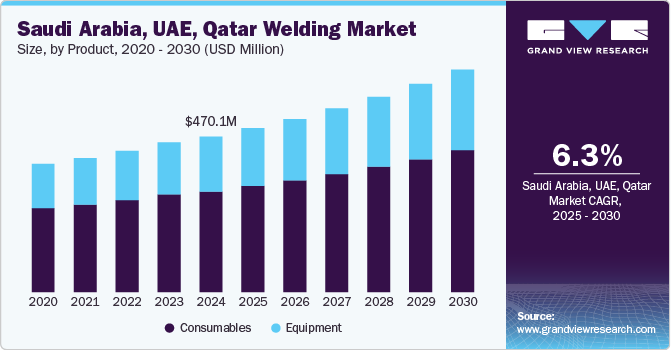
The Saudi Arabia, UAE, Qatar welding market size was estimated at USD 470.1 million in 2024 and is projected to grow at a CAGR of 6.3% from 2025 to 2030. The welding industry in Saudi Arabia, UAE, and Qatar is expanding rapidly due to industrial diversification, infrastructure development, and a growing demand for manufacturing and construction projects. In Saudi Arabia, the government's Vision 2030 initiative has driven a shift toward non-oil sectors, resulting in a surge in demand for welding equipment and consumables, particularly in sectors like automotive, construction, and manufacturing.
Automation and robotics are transforming welding processes. Collaborative robots, or cobots, are now working alongside human operators to improve productivity, precision, and safety. These robots handle tasks such as material handling, weld inspection, and joint preparation, allowing human welders to focus on more complex and specialized tasks. By assisting with repetitive or physically demanding activities, cobots enhance overall operational efficiency and contribute to a more streamlined and safe welding environment.
Market Concentration & Characteristics
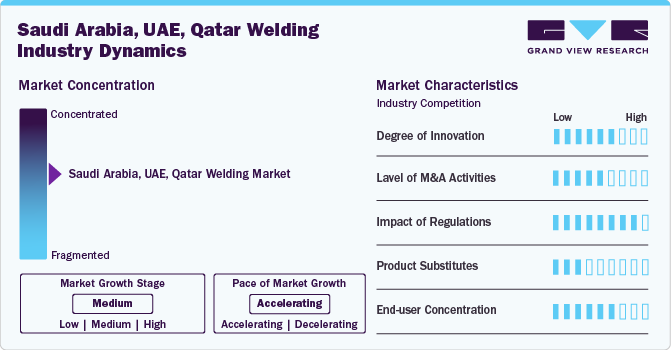
The welding markets in Saudi Arabia, UAE, and Qatar present a moderately fragmented landscape, with both established global players and emerging regional companies contributing to their dynamic nature. Prominent international companies, such as Lincoln Electric, ESAB, and Miller Electric, alongside regional manufacturers, maintain strong market positions by offering extensive product portfolios and ensuring wide geographic reach. Local manufacturers are crucial as they cater to specific regional demands, such as compliance with local regulations and addressing the needs of key industries like construction and oil and gas. This diversity in players intensifies the competition within the market, as companies vie for market share through innovation and localized offerings.
Environmental regulations are also becoming increasingly important in the welding market in these countries, particularly as there is growing pressure to adopt sustainable practices and reduce carbon emissions. Stringent policies aimed at promoting environmental sustainability are driving the adoption of energy-efficient welding technologies. These regulations not only fuel the demand for advanced, eco-friendly solutions but also encourage innovation in welding equipment and processes. As a result, manufacturers are focusing on developing more efficient, less energy-consuming welding systems that meet the region's sustainability goals while delivering high-performance results.
Technological advancements are shaping the welding market in Saudi Arabia, UAE, and Qatar, with key innovations such as automated welding systems, robotic welding, and advanced cutting technologies. These innovations enhance the efficiency, precision, and versatility of welding operations, allowing industries to meet growing demand while reducing costs and minimizing environmental impact. As these countries focus on advancing their industrial capabilities, especially in construction, manufacturing, and oil & gas sectors, the adoption of such technologies is expected to continue to rise, further boosting the welding market's growth.
Moreover, the demand for welding technologies is strong across Saudi Arabia, UAE, and Qatar, fueled by ongoing infrastructure development, industrial diversification efforts, and the expansion of the oil and gas sector. In particular, Saudi Arabia’s Vision 2030 is driving growth in the welding sector by promoting non-oil industries, while the UAE’s focus on construction and manufacturing, and Qatar’s large-scale infrastructure projects, further contribute to the market's expansion. As a result, the welding market in these countries is expected to continue evolving, with a focus on sustainable practices, technological advancements, and meeting the growing needs of key industries.
Drivers, Opportunities & Restraints
The welding markets in Saudi Arabia, UAE, and Qatar are primarily driven by rapid industrialization, ongoing infrastructure projects, and the diversification of the economy away from oil dependence. Saudi Arabia’s Vision 2030, aimed at boosting non-oil sectors, has fueled demand for welding technologies across industries such as construction, automotive, and manufacturing. Additionally, the robust oil and gas sectors in all three countries continue to drive the need for high-quality welding solutions for pipelines, refineries, and petrochemical plants. Technological advancements in welding processes, such as automation and energy-efficient systems, further support market growth by improving productivity and reducing costs.
The growing emphasis on sustainability presents significant opportunities for the welding markets in Saudi Arabia, UAE, and Qatar. As these countries face increasing pressure to reduce carbon emissions and adopt eco-friendly practices, there is a rising demand for energy-efficient, low-emission welding solutions. Moreover, advancements in automation and robotics create new avenues for efficiency and precision, making industries such as construction, automotive, and aerospace key sectors for growth. There is also increasing interest in smart welding technologies that integrate data analytics and real-time monitoring, which could enhance operational performance and safety in the region’s highly demanding industries.
Despite the growth potential, the welding markets in Saudi Arabia, UAE, and Qatar face several challenges. A major restraint is the shortage of skilled labor, as the demand for highly trained welders and technicians often exceeds supply. This gap can hinder the adoption of advanced welding technologies and slow down project timelines. Additionally, the high upfront costs associated with acquiring and maintaining advanced welding equipment can be a barrier for smaller companies and limit market participation. Regulatory challenges, such as compliance with local standards and certifications, also add complexity, particularly for international players entering the market.
Product Insights
Consumable products held the largest market share of 64.8% in 2024. The growth of this segment is driven by several factors, including the increasing complexity of welding applications and the rising need for specialized materials to meet high-performance standards. In particular, the shift toward more automated and advanced welding processes, such as MIG, TIG, and flux-cored welding, has created a greater demand for consumables that can maintain the efficiency, precision, and strength of welds.
The growth of the equipment segment is driven by the increasing demand for advanced welding technologies across various industries, including infra & construction, oil & gas, and shipbuilding. As these countries continue to invest in infrastructure development, especially for large-scale projects like skyscrapers, bridges, and energy facilities, the need for high-performance welding equipment is expanding.
End Use Insights
The oil & gas segment held the largest market share of 50.4% in 2024. The oil & gas industry in Saudi Arabia, Qatar, and the UAE plays a pivotal role in driving the region’s economy and is a key factor influencing the welding market. These countries are major global producers of oil & natural gas, and their vast energy infrastructure requires advanced welding technologies for the construction, maintenance, and repair of critical assets such as pipelines, refineries, offshore platforms, and storage facilities.
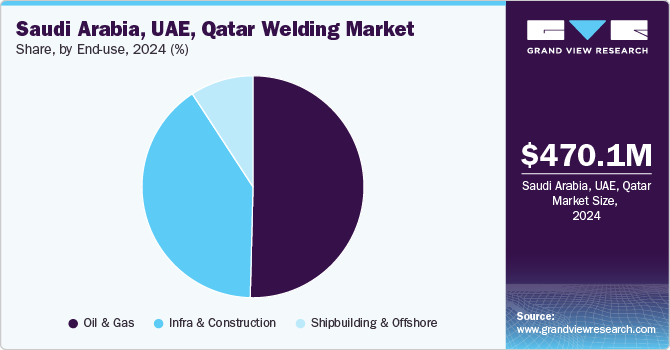
The rapid expansion of infrastructure projects in the Middle East, including the construction of high-rise buildings, bridges, and industrial facilities, is driving the demand for structural welding. As urbanization increases, particularly in cities such as Dubai, Riyadh, and Doha, structural welding is essential for joining steel and other materials used in the creation of strong, durable frameworks for commercial and residential buildings. The focus on creating resilient structures that can withstand harsh climates further increases the demand for high-quality welding materials and technologies.
Country Insights
Saudi Arabia Welding Market Trends
Saudi Arabia led the welding market and accounted for a 50.2% share in 2024. Saudi Arabia's ambitious USD 100 billion investment in its natural gas sector, particularly the development of the Jafurah shale gas field, is expected to significantly drive demand in the welding equipment and consumables market. With extensive infrastructure projects underway, including the construction of gas plants, a 4,000-kilometer pipeline expansion, and gas rig installations, welding technologies such as arc welding, gas welding, and advanced methods like laser and orbital welding will play a critical role.
UAE Welding Market Trends
Moreover, the rapid expansion and diversification of the UAE's oil & gas sector, alongside ADNOC’s ambitious plans to increase production and decarbonize, present significant opportunities for the welding industry. Welding technologies are essential for the construction, maintenance, and expansion of oil rigs, pipelines, gas facilities, and industrial infrastructure, all of which are critical to the UAE’s energy strategy.
Key Saudi Arabia, UAE, Qatar Welding Companies Insights
Key players operating in the Saudi Arabia, UAE, Qatar welding market are undertaking various initiatives to strengthen their presence and increase the reach of their products and services. Strategies such as expansion activities and partnerships are key in propelling the market growth.
Some of the key players operating in the market include The Lincoln Electric Company and ESAB.
-
The Lincoln Electric Company is a global market player in the welding industry, specializing in the design, development, and manufacturing of arc welding products. Founded in 1895 and headquartered in Ohio, U.S., the company offers a wide range of products, including welding machines, robotic welding systems, plasma and oxyfuel cutting equipment, as well as brazing and soldering alloys. The business units of the company are organized into three operational segments. These segments are comprised of Americas Welding, International Welding, and The Harris Products Group. The Americas Welding segment encompasses welding activities in North and South America. The International Welding segment covers welding operations across Europe, Africa, Asia, and Australia.
-
ESAB is a global company specializing in welding and cutting equipment, as well as consumables. The company was founded in 1904 and has its headquarters in Maryland, U.S. A prominent company in the production of welding and cutting equipment, ESAB provides a complete line of fabrication solutions tailored for various applications. The company offers welding & cutting equipment and consumables. It also offers personal protective equipment (PPE), specialty gas, digital solutions, arc accessories, gouging, & exothermic, manual plasma, welding automation, cutting automation, arc equipment, gas control equipment, and filler metals. It caters to a wide range of end-use sectors such as aerospace, process industry, automotive, shipbuilding, pipelines, repair & maintenance, power generation, transport & mobile machinery. The company offers cutting machines, process solutions, software systems, controls, upgrades, and retrofits through the cutting automation segment; brazing, soldering, industrial, and specialty products through its gas equipment segment; and plasma systems, torches, and plasma accessories through its plasma segment.
Key Saudi Arabia, UAE, Qatar Welding Companies:
- The Lincoln Electric Company
- Fronius International GmbH
- ESAB
- Kemppi Oy
- Ador Welding Limited
Recent Developments
- In January 2024, the Lincoln Electric Company launched Mechanized Pipeliner AutoShield. This cutting-edge system is engineered to execute fill and cap welds autonomously, without the need for shielding gas, within a mechanized orbital setup. The AutoShield bolsters efficiency and optimizes performance significantly. It furnishes contractors with a simplified, cost-efficient path toward automation, ensuring uniform welds and arming operators with a novel instrument for innovation.
-
In October 2024, ESAB introduced the OK GoldRox 7018 premium stick electrodes, designed to offer softer arc characteristics and facilitate easier restrikes. These electrodes are engineered for various applications, providing improved performance and usability for welders.
Saudi Arabia, UAE, Qatar Welding Market Report Scope
Report Attribute
Details
Market size value in 2025
USD 495.8 million
Revenue forecast in 2030
USD 673.5 million
Growth rate
CAGR of 6.3% from 2025 to 2030
Historical data
2018 - 2023
Forecast period
2025 - 2030
Quantitative units
Revenue in USD million/billion and CAGR from 2025 to 2030
Report coverage
Revenue forecast, company ranking, competitive landscape, growth factors, and trends
Segments covered
Product, end use, and country
Country scope
Saudi Arabia; UAE; Qatar
Key companies profiled
The Lincoln Electric Company; Fronius International GmbH; ESAB; Kemppi Oy; Ador Welding Limited
Customization scope
Free report customization (equivalent up to 8 analysts working days) with purchase. Addition or alteration to country, regional & segment scope.
Pricing and purchase options
Avail customized purchase options to meet your exact research needs. Explore purchase options
Saudi Arabia, UAE, Qatar Welding Market Report Segmentation
This report forecasts revenue growth at country levels and provides an analysis of the latest industry trends in each of the sub-segments from 2018 to 2030. For this study, Grand View Research has segmented the Saudi Arabia, UAE, Qatar welding market report based on product, end use, and country.
-
Product Type Outlook (Revenue, USD Million, 2018 - 2030)
-
Equipment
-
Arc Welding
-
Shielded Metal/Stick Arc Welding
-
MIG
-
TIG
-
Plasma Arc Welding
-
Orbital Welding
-
Others
-
-
Resistance Welding
-
Laser Beam Welding
-
Gas Welding
-
Others
-
-
Consumables
-
Stick Electrodes
-
Solid Wires
-
Flux-Cored Wires
-
Saw Wires and Fluxes
-
Others
-
-
-
End Use Outlook (Revenue, USD Million, 2018 - 2030)
-
Infra & Construction
-
Structural Welding
-
Pipe Welding
-
-
Oil & Gas
-
Pipeline Construction
-
Onshore and offshore platforms
-
Refineries
-
Others
-
-
Shipbuilding & Offshore
-
-
Country Outlook (Revenue, USD Million, 2018 - 2030)
-
Saudi Arabia
-
UAE
-
Qatar
-
Frequently Asked Questions About This Report
b. The Saudi Arabia, UAE, Qatar welding market size was estimated at USD 470.1 million in 2024 and is expected to be USD 495.8 million in 2025.
b. The Saudi Arabia, UAE, Qatar welding market, in terms of revenue, is expected to grow at a compound annual growth rate of 6.3% from 2025 to 2030 to reach USD 673.5 million by 2030.
b. Consumables product type held a significant share of the market and accounted for a share of 64.8% in 2024. The growth of this segment is driven by several factors, including the increasing complexity of welding applications and the rising need for specialized materials to meet high-performance standards.
b. Some of the key players operating in the Saudi Arabia, UAE, Qatar welding market include The Lincoln Electric Company, Fronius International GmbH, ESAB, Kemppi Oy, Ador Welding Limited
b. The welding markets in Saudi Arabia, UAE, and Qatar are expanding rapidly due to industrial diversification, infrastructure development, and a growing demand for manufacturing and construction projects.

Share this report with your colleague or friend.
Need a Tailored Report?
Customize this report to your needs — add regions, segments, or data points, with 20% free customization.


ISO 9001:2015 & 27001:2022 Certified
We are GDPR and CCPA compliant! Your transaction & personal information is safe and secure. For more details, please read our privacy policy.
Trusted market insights - try a free sample
See how our reports are structured and why industry leaders rely on Grand View Research. Get a free sample or ask us to tailor this report to your needs.













