
- Home
- »
- Communication Services
- »
-
Security Screening Market Size & Share Report, 2026-2033GVR Report cover

Security Screening Market (2026 - 2033)
Size, Share & Trends Analysis By Product (Full Body, Baggage, Liquid, Trace Detectors, Explosive Detectors, Hand-Held Detectors, Walk-Through Metal Detectors), By Technology (X-ray Screening, Metal Detection), By Deployment Type, By Application, By End Us
Market Size, 2025
$11.1BMarket Estimate, 2026
$11.7BMarket Forecast, 2033
$18.3BCAGR, 2026–2033
6.6%Security Screening Market Summary
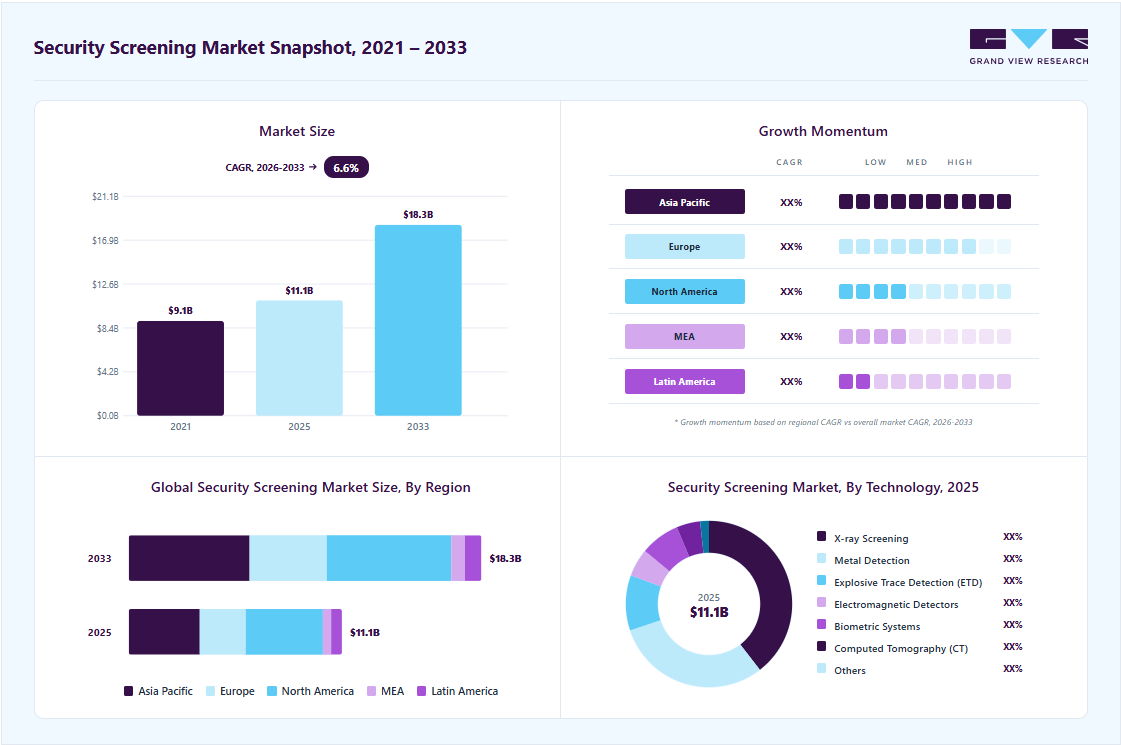
The global security screening market size was valued at USD 11.1 billion in 2025 and is projected to grow from USD 11.7 billion in 2026 to USD 18.3 billion by 2033, at a CAGR of 6.6% from 2026 to 2033. North America held the largest market share of 36.2% of the global security screening market in 2025. This market is rapidly evolving to address emerging threats across airports, seaports, transportation hubs, critical infrastructure, and public spaces.
 Source: Grand View Research, IR Documents, Primary Interviews, Paid DatabasesTo learn more about this report,
 Download Free Sample Report
 Key Market Trends & Insights
- By product: Walk-through metal detectors segment dominated the market, with a revenue share of 32.4% in 2025.
- By technology: X-ray screening segment held the largest revenue share in 2025.
- By deployment type: Fixed screening systems segment accounted for the largest revenue share in 2025.
- By application: Baggage and parcel inspection segment accounted for the largest share in 2025.
Regional Highlights
- Largest regional market: North America (36.2% revenue share, 2025)
- Fastest-growing regional market: Asia Pacific (highest CAGR, 2026-2033)
- By country: The U.S. held the largest market share in 2025.
Market Size & Forecast
- Market size in 2025: USD 11.1 Billion
- Estimated market size in 2026: USD 11.7 Billion
- Projected market size by 2033: USD 18.3 Billion
- CAGR (2026-2033): 6.6%
Three ways to get this report
Buy it, customize it, or ask a question.Ask an Analyst
Analyst response in 1 business day
- AccessReport author, directly
- Reply timeWithin 1 working day
- No sales callDirect answer only
- FormatEmail reply
- CostFree, no cost
Get the Full Report
What the study covers
- FormatsPDF · Excel · Dashboard
- Timeline2026–2033 annual, 2025 base
- Coverage20+ countries, 5 regions
- Companies10+ key players profiled
Customize the Report
20% free customization
- IncludeCountries, segments, points
- TailorTo your product definition
- ExtendDeeper competitor detail
- OrA fully bespoke study
- Turnaround5–10 working days
As operations across sectors digitize through AI-enabled surveillance, real-time monitoring platforms, and integrated access control systems, the risk of unauthorized access, contraband, and security breaches has increased, driving the adoption of advanced security screening solutions. Organizations are now focusing on end-to-end protection of people, baggage, cargo, and assets, leveraging multi-layered screening technologies that combine X-ray, metal detection, trace detection, and biometric systems.Airports, border control points, government buildings, and large commercial establishments are increasingly adopting integrated security frameworks that combine hardware and software solutions. These frameworks include automated detection systems, access control management, and threat analytics to protect both personnel and infrastructure. In addition, compliance with international security standards, such as ISO 18788 and ICAO security regulations, is prompting operators to incorporate security screening systems from facility design to daily operations, ensuring regulatory adherence and risk mitigation.
 To learn more about this report, Download Free Sample Report
 Furthermore, organizations are investing in specialized screening solutions such as trace explosive detection, advanced baggage scanners, and AI-powered threat detection platforms to address complex security challenges. Mobile and portable screening units are also being deployed to enhance flexibility at temporary sites, events, and logistics corridors. The integration of cloud-based monitoring, IoT sensors, and centralized control dashboards is enabling real-time visibility and proactive intervention, reducing the risk of security lapses.
Collaboration among public and private stakeholders is further accelerating the adoption of intelligence-driven security architectures. For example, airports, ports, and urban transit authorities are establishing shared threat intelligence platforms and incident response protocols to enhance situational awareness and operational continuity. Consequently, the global market is transitioning from fragmented, reactive controls to proactive, technology-driven architectures that prioritize efficiency, compliance, and protection of people, assets, and cargo across diverse environments.
By Deployment Type Insights
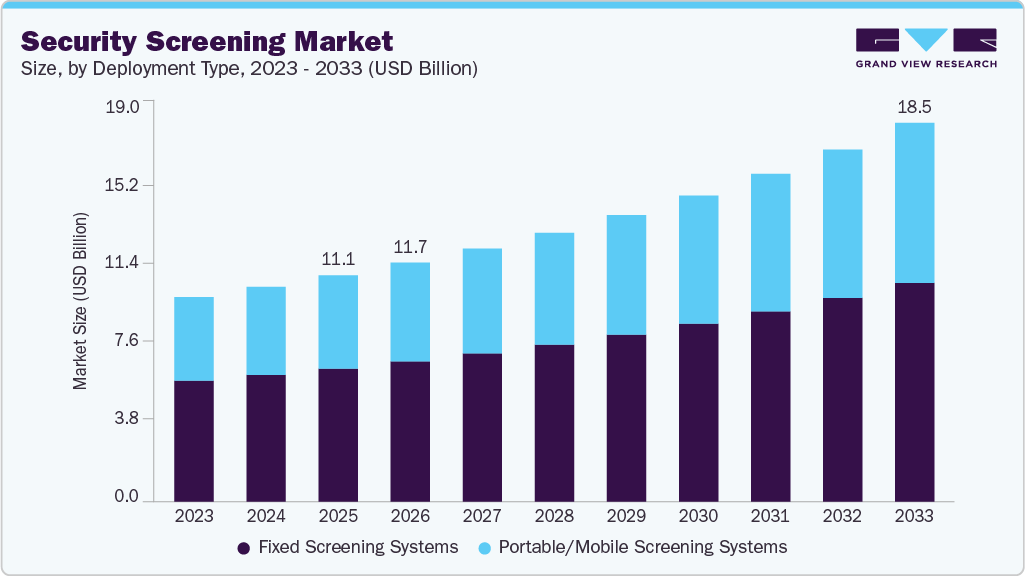
The fixed screening systems segment accounted for the largest revenue share in 2025, driven by widespread deployment in airports, seaports, government buildings, and critical infrastructure. Increasing integration with AI-powered threat detection, real-time monitoring platforms, and multi-layered screening technologies is enhancing detection accuracy and operational efficiency. For instance, in April 2025, Delhi International Airport Limited (DIAL) announced the commencement of trials for advanced full-body scanners at Indira Gandhi International Airport (IGIA), utilizing millimeter-wave technology operating between 70 to 80 GHz. These scanners are designed to detect both metallic and non-metallic threats, including explosives, without emitting harmful radiation, ensuring safety for all travelers, including pregnant women and individuals with medical implants. Consequently, the growing demand for robust, reliable, and intelligence-driven fixed screening solutions is driving the expansion of this segment in the global market.
The portable/mobile screening systems segment is predicted to witness the fastest CAGR in the upcoming years in the market, fueled by increasing demand for flexible, rapid-deployment security solutions at temporary checkpoints, events, and high-risk locations. Additional trends fueling growth include the adoption of AI-powered threat detection for faster and more accurate screening, integration with portable trace and explosive detection devices, cloud-based monitoring for remote operations, and real-time analytics to reduce false alarms and optimize workflows. For instance, in April 2025, U.S. Customs and Border Protection (CBP) launched an innovative International Remote Baggage Screening (IRBS) program, enabling CBP personnel to remotely review X-ray images of checked baggage captured at foreign international airports before passengers depart. This initiative enhances security by allowing earlier detection of potential threats while streamlining the screening process and reducing waiting times for travelers. Consequently, the growing need for agile, scalable, and technology-integrated mobile screening solutions is fueling the rapid expansion of this segment in the market.
Product Insights
The walk-through metal detectors segment accounted for the largest revenue share of 32.4% in 2025 in the market, driven by increasing adoption of AI-enabled threat detection, higher sensitivity systems with low false alarms, and seamless integration with access control and surveillance platforms. Security operators are focusing on solutions that enhance throughput without compromising detection accuracy. For instance, in September 2024, Garrett Metal Detectors introduced a next-generation walkthrough detector featuring AI-enhanced threat detection, configurable sensitivity zones, and networked reporting capabilities, enabling real-time identification of potential security risks across high-traffic facilities. Overall, the demand for fast, accurate, and integrated personnel screening solutions is fueling the expansion of the walk-through metal detectors segment in the global market.
The explosive detectors segment is expected to grow at the fastest CAGR during the forecast period, driven by advancements in AI-powered threat detection, the adoption of portable and rapid-response systems, and the integration of multi-layered security frameworks that combine trace detection with biometrics and real-time monitoring. Increasing automation, predictive analytics for threat assessment, and networked reporting capabilities are further enhancing operational efficiency and reducing false alarms. For instance, in August 2023, Smiths Detection's IONSCAN 600 Explosives Trace Detector was added to the Transportation Security Administration's (TSA) Air Cargo Screening Technology List (ACSTL). This designation allows regulated air cargo facilities to purchase and utilize the IONSCAN 600 as part of their screening operations, strengthening aviation security. Overall, the growing demand for high-sensitivity, intelligent, and integrated explosive detection solutions is propelling the expansion of the explosive detectors segment in the global market.
Technology Insights
The X-ray screening segment accounted for the largest revenue share in 2025, driven by increasing adoption of advanced imaging systems, AI-enabled threat detection, and multi-energy X-ray technology for high-resolution scanning of baggage, parcels, and cargo. Growing demand for automated threat recognition, integration with 3D computed tomography (CT) scanners, and real-time analytics are enhancing both speed and accuracy of screening processes. For instance, Rapiscan Systems launched its next-generation 3DX 6500 Automated Explosive Detection System (EDS) X-ray scanner, featuring enhanced 3D imaging, AI-based detection algorithms, and networked monitoring capabilities, allowing airports and logistics operators to identify threats with higher precision and efficiency. Overall, the X-ray Screening segment continues to expand due to the need for fast, reliable, and integrated scanning solutions that meet stringent regulatory requirements and evolving security challenges.
The metal detection segment is poised for significant growth, driven by advancements in AI-enhanced threat detection, integration with multi-zone detection capabilities, and the increasing adoption of portable and rapid-response systems. These innovations are improving the speed and accuracy of metallic threat identification across airports, government buildings, transportation hubs, and high-security venues. For instance, in April 2025, Garrett Electronics and Rohde & Schwarz announced the development of an integrated security screening solution combining Garrett's Paragon walk-through metal detector with Rohde & Schwarz's R&S QPS201 millimeter-wave security scanner. This combined solution is designed for high-risk environments such as prisons and loss-prevention applications in the precious metals industry, providing a complementary layer of detection for small or internally concealed metallic threats while respecting personal boundaries. The system is fully contactless, user-friendly, and managed via the R&S QPS201 display, ensuring health-safe operations for both personnel and screened individuals. Overall, the growing need for advanced, integrated, and flexible metal detection solutions is fueling the expansion of this segment in the market.
Application Insights
The baggage and parcel inspection segment accounted for the largest share in 2025, driven by increasing air travel, rising cargo volumes, and stringent regulatory requirements at airports, logistics hubs, and transportation centers. Additional trends fueling growth include the adoption of AI-enabled threat recognition, multi-energy X-ray and CT scanning for high-resolution imaging, automated baggage handling integration, and real-time analytics to improve throughput and reduce false alarms. For instance, in September 2025, United Airlines launched the International Remote Baggage Screening (IRBS) program on its daily Sydney-to-San Francisco route. This initiative, in collaboration with U.S. Customs and Border Protection (CBP), allows connecting passengers to bypass baggage claim and re-checking procedures at San Francisco International Airport, streamlining the travel experience and potentially saving up to 45 minutes per connection. The program aims to enhance efficiency and reduce missed connections for international travelers. Consequently, the growing demand for advanced, accurate, and automated baggage and parcel inspection solutions is driving market expansion.
The cargo and vehicle inspection segment is expected to grow at the highest CAGR during the forecast period, driven by increasing global trade, heightened security concerns, and the need for efficient screening solutions at ports, border crossings, and transportation hubs. Key trends contributing to this growth include the adoption of high-energy X-ray and CT-based systems for deep penetration imaging, integration with AI-powered threat detection algorithms, and the deployment of mobile inspection units for flexible and rapid response capabilities. For instance, in May 2024, OSI Systems received an approximately $9 million order from an international customer to provide its Eagle M60 high-energy mobile cargo and vehicle inspection systems, including related service and support. This order marks the initial fulfillment under a multi-year framework agreement, highlighting the growing demand for advanced mobile inspection solutions in enhancing border checkpoint safety and security. Therefore, the increasing emphasis on security and efficiency in cargo and vehicle screening is propelling market growth.
End Use Insights
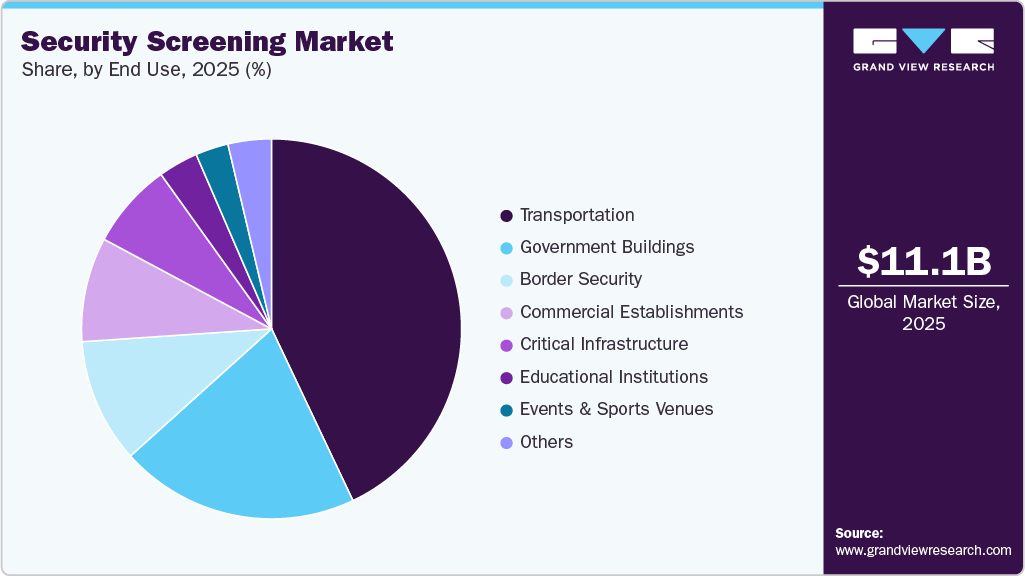
The transportation segment accounted for the largest share in 2025, driven by rising passenger volumes, increasing air and rail travel, and the need for stringent safety and regulatory compliance at airports, metro stations, and transit hubs. Key trends supporting growth include the adoption of AI-powered threat detection, integration of advanced baggage and passenger screening solutions, and the deployment of automated and contactless screening technologies to improve efficiency and throughput. For instance, in September 2025, the Transportation Security Administration (TSA) unveiled a state-of-the-art checkpoint at Southwest Wyoming Regional Airport's new terminal, featuring Automated Screening Lanes (ASLs) and advanced CT scanners. This initiative aims to enhance security efficiency while decreasing the amount of time travelers spend in line, aligning with TSA's broader goal of modernizing airport security infrastructure. Consequently, the increasing emphasis on efficient, accurate, and technology-driven screening solutions is driving market expansion.
 To learn more about this report, Download Free Sample Report
 The critical infrastructure segment is expected to grow at the highest CAGR during the forecast period, fueled by increasing investments in securing energy plants, power grids, water treatment facilities, and urban infrastructure against theft, sabotage, and terrorist threats. Key trends fueling growth include the integration of AI-powered threat detection, real-time monitoring systems, advanced X-ray and metal detection technologies, and predictive analytics for early risk identification. For instance, in March 2025, Honeywell deployed its advanced security screening and threat detection solutions at multiple critical power generation facilities in the U.S., incorporating AI-driven sensors and centralized monitoring platforms to detect potential intrusions and unauthorized access in real time. Overall, the growing need for robust, intelligent, and compliance-aligned security solutions is propelling the expansion of the critical infrastructure segment in the market.
Regional Insights
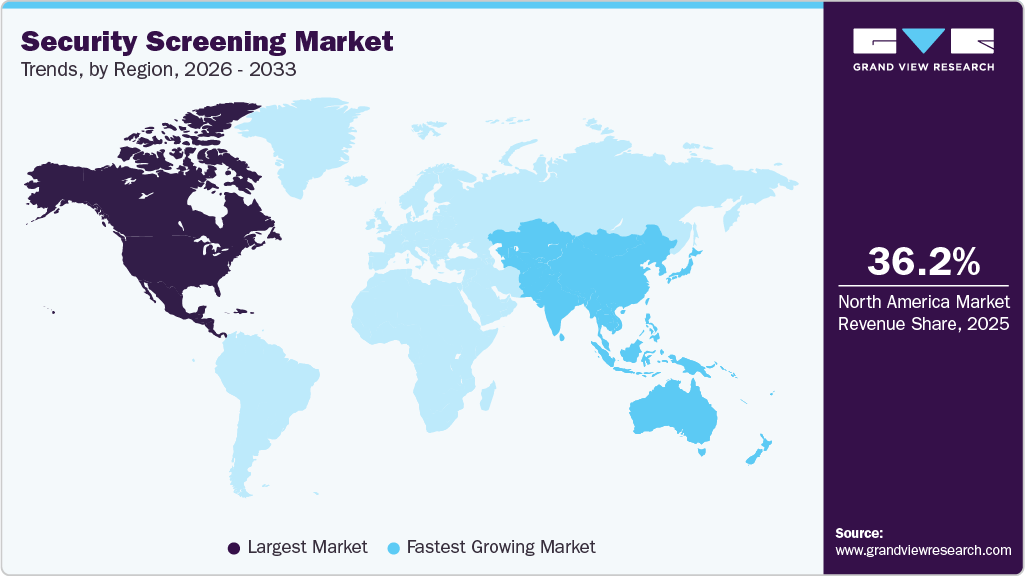
North America security screening market accounted for the largest share in 2025, supported by increasing investments in advanced AI-powered threat detection, integration of multi-layered screening solutions, and adoption of automated and contactless systems across airports, seaports, and critical infrastructure. Rising security concerns, regulatory compliance mandates, and the need for faster, more accurate screening processes are prompting operators to deploy high-resolution X-ray, CT, and millimeter-wave scanning technologies alongside metal and trace detection systems.
 To learn more about this report, Download Free Sample Report
 In addition, the shift toward portable and mobile screening solutions is enabling flexible deployment at temporary checkpoints, events, and high-traffic transportation hubs. The market is also experiencing growing demand for integrated solutions that combine real-time monitoring, predictive analytics, and centralized control to improve operational efficiency, reduce false alarms, and enhance overall threat mitigation capabilities, reflecting a strong focus on intelligence-driven and proactive security measures across the region.
U.S. Security Screening Market Trends
The security screening market in the U.S. is driven by increasing investments in advanced technologies and infrastructure to enhance safety and efficiency. Key trends include the adoption of AI-powered threat detection systems, biometric verification methods, and automated screening processes to streamline operations and reduce wait times. Moreover, there is a growing emphasis on integrating multi-layered security solutions across various sectors, including transportation, critical infrastructure, and public venues, to address evolving security challenges. Government initiatives and legislative support are also contributing to market expansion, with proposed bills aiming to allocate funds for upgrading screening technologies and improving checkpoint efficiency. These developments reflect a concerted effort to modernize security practices and ensure a safer environment for the public.
Europe Security Screening Market Trends
The security screening market in Europe is anticipated to register considerable growth from 2026 to 2033. The market is witnessing strong adoption of AI-enabled and automated threat detection systems across airports, railways, and seaports, alongside growing deployment of high-resolution X-ray, CT, and millimeter-wave scanners for enhanced cargo, baggage, and passenger screening. Integration of biometric verification and identity management with traditional screening solutions is increasing, while portable and mobile screening units are being deployed for temporary checkpoints and high-traffic events. Cloud-based monitoring and centralized analytics platforms are expanding to provide real-time threat detection, and investments are being driven by compliance with EU security regulations, including ECAC and ISO standards. In addition, there is a growing focus on multi-layered security approaches and the integration of cyber-physical security to protect interconnected screening systems across the region.
The UK security screening marketis witnessing robust growth driven by the adoption of AI-powered and automated threat detection systems across airports, seaports, and major transportation hubs. High-resolution X-ray, CT, and millimeter-wave scanners are increasingly deployed for passenger, baggage, and cargo screening, while biometric verification and identity management systems are being integrated for enhanced security and operational efficiency. Portable and mobile screening solutions are gaining traction for temporary checkpoints, large-scale events, and emergency deployments. In addition, cloud-based monitoring, centralized analytics, and real-time threat detection platforms are being expanded to support proactive security management. Regulatory compliance with UK and EU security standards, coupled with government-led initiatives to modernize screening infrastructure, is further driving investment in multi-layered and intelligence-driven security solutions across the region.
The security screening market in Germany is experiencing strong growth, driven by the deployment of AI-powered threat detection and automated screening systems at airports, seaports, and rail networks. High-resolution X-ray, CT, and millimeter-wave scanners are increasingly used for passenger, baggage, and cargo screening, while integration with biometric verification and identity management systems is enhancing accuracy and operational efficiency. There is growing adoption of portable and mobile screening units for temporary checkpoints, events, and emergency situations, complemented by cloud-based monitoring and centralized analytics platforms for real-time threat detection. Investments are further supported by compliance with EU and national security regulations, with a strong focus on multi-layered and intelligence-driven screening approaches that combine metal detection, trace detection, and explosive detection technologies to safeguard critical infrastructure and transportation networks across Germany.
Asia Pacific Security Screening Market Industry Trends
The security screening market in the Asia Pacific is expected to register the fastest CAGR from 2026 to 2033, driven by increasing air travel, expanding seaports, and growing investments in railway and urban transit security infrastructure. Key trends include the adoption of AI-powered and automated threat detection systems, high-resolution X-ray, CT, and millimeter-wave scanners for passenger, baggage, and cargo screening, and the integration of biometric verification and identity management systems. Portable and mobile screening solutions are gaining traction for temporary checkpoints, large-scale events, and border security operations, while cloud-based monitoring and centralized analytics platforms enable real-time threat detection and operational efficiency. Governments across the region are investing in modernizing airport and transportation security systems and implementing multi-layered screening approaches that combine metal, trace, and explosive detection technologies to address evolving security challenges.
Japan security screening market is expanding steadily, driven by the adoption of AI-powered and automated screening technologies across airports, seaports, and rail networks. Key trends include the deployment of high-resolution X-ray, CT, and millimeter-wave scanners for baggage, cargo, and passenger inspection, integration of biometric verification and identity management systems, and the increasing use of portable and mobile screening units for temporary checkpoints and high-traffic events. Cloud-based monitoring, centralized analytics platforms, and real-time threat detection systems are being expanded to enhance operational efficiency and security responsiveness. In addition, government initiatives focused on modernizing transportation security infrastructure, compliance with international safety standards, and implementation of multi-layered screening strategies combining metal, trace, and explosive detection technologies are supporting market growth in Japan.
The security screening market in China is witnessing rapid growth, fueled by increasing air travel, expanding seaport operations, and investments in high-speed rail and urban transit security infrastructure. Key trends include the adoption of AI-powered and automated threat detection systems, deployment of high-resolution X-ray, CT, and millimeter-wave scanners for passenger, baggage, and cargo screening, and integration of biometric verification and identity management technologies. There is growing use of portable and mobile screening solutions for temporary checkpoints, large-scale events, and border security operations, complemented by cloud-based monitoring and centralized analytics platforms for real-time threat detection and operational efficiency. In addition, government initiatives focusing on modernization, compliance with international security standards, and implementation of multi-layered screening approaches combining metal, trace, and explosive detection technologies are driving market growth across China.
India security screening market is experiencing strong growth, driven by rising air travel, expanding seaport operations, and increasing focus on railway and urban transit security. Key trends include the adoption of AI-powered and automated threat detection systems, deployment of high-resolution X-ray, CT, and millimeter-wave scanners for passenger, baggage, and cargo screening, and integration of biometric verification and identity management solutions. Portable and mobile screening units are increasingly used for temporary checkpoints, large-scale events, and border security operations, while cloud-based monitoring and centralized analytics platforms enable real-time threat detection and enhanced operational efficiency. Government initiatives aimed at modernizing airport and transportation security infrastructure, along with compliance with international safety standards and multi-layered screening strategies combining metal, trace, and explosive detection technologies, are further driving market expansion.
Key Security Screening Company Insights
Key players operating in the security screening industry are 3DX-Ray Ltd, Analogic Corporation, Astrophysics Inc., CEIA SpA, and others. Companies are focusing on various strategic initiatives, including new product development, partnerships & collaborations, and agreements to gain a competitive advantage over their rivals. The following are some instances of such initiatives.
-
In October 2025, Analogic Corporation and Analytical AI entered a strategic partnership to co-develop AI-enhanced threat detection capabilities for Analogic’s ConneCT and SeleCT Computed Tomography (CT) systems. This collaboration aims to improve the detection of explosives, prohibited items, and contraband, thereby enhancing airport security and passenger experience.
-
In May 2025, Leidos and Saudi Arabia’s National Security Services Company (SAFE) signed a memorandum of understanding to collaborate on enhancing security screening capabilities at airports and other critical transit points across the Kingdom. This partnership aims to modernize Saudi Arabia’s security infrastructure by integrating Leidos’ advanced technologies, including people and baggage scanners, explosive detection devices, and rapid screening systems for cargo and vehicles, complemented by localized training and support services.
-
In June 2024, OSI Systems secured a USD 10 million contract to supply multiple units of its RTT 110 Real Time Tomography explosive detection system for checked baggage screening at an international airport in Latin America. This deal includes ongoing maintenance and support services.
Key Security Screening Companies:
The following key companies have been profiled for this study on the security screening market.
- 3DX-Ray Ltd
- Analogic Corporation
- Astrophysics Inc.
- CEIA SpA
- Gilardoni SpA
- Honeywell International Inc.
- L-3 Security and Detection Systems Inc.
- Leidos, Inc.
- NEC Corporation
- Nuctech Company Limited
- OSI Systems, Inc.
- Rapiscan Systems
- Smiths Detection Group Ltd.
- Teledyne FLIR LLC
- Thales Group
Security Screening Market Report Scope
Report Attribute
Details
Market size value in 2025
USD 11.1 billion
Estimated Market size in 2026
USD 11.7 billion
Projected Market size by 2033
USD 18.3 billion
Growth rate
CAGR of 6.6% from 2026 to 2033
Actual data
2021 - 2025
Forecast Period
2026 - 2033
Quantitative Units
Revenue in USD million/billion and CAGR from 2026 to 2033
Report Scope
Revenue forecast, company share, competitive landscape, growth factors, and trends
Segments Covered
Product, technology, deployment type, application, end use, region
Regional Scope
North America; Europe; Asia Pacific; Latin America; MEA
Country Scope
U.S.; Canada; Mexico; UK; Germany; France; China; India; Japan; Australia; South Korea; Brazil; UAE; Saudi Arabia; South Africa
Key companies profiled
3DX-Ray Ltd.; Analogic Corporation; Astrophysics Inc.; CEIA SpA; Gilardoni SpA; Honeywell International Inc.; L-3 Security and Detection Systems Inc.; Leidos, Inc.; NEC Corporation; Nuctech Company Limited; OSI Systems, Inc.; Rapiscan Systems; Smiths Detection Group Ltd.; Teledyne FLIR LLC; Thales Group
Customization scope
Free report customization (equivalent to 8 analysts working days) with purchase. Addition or alteration to country, regional & segment scope.
Pricing and purchase options
Avail customized purchase options to meet your exact research needs. Explore purchase options
Global Security Screening Market Report Segmentation
This report forecasts revenue growth at global, regional, and country levels and provides an analysis of the latest industry trends in each of the sub-segments from 2021 to 2033. For this study, Grand View Research has segmented the global security screening market report based on product, technology, deployment type, application, end use, and region:
-
Product Outlook (Revenue, USD Billion, 2021 - 2033)
-
Walk-Through Metal Detectors
-
Hand-Held Detectors
-
Full Body Scanners
-
Baggage Scanners
-
Explosive Detectors
-
Liquid Scanners
-
Trace Detectors
-
-
Technology Outlook (Revenue, USD Billion, 2021 - 2033)
-
X-ray Screening
-
Metal Detection
-
Explosive Trace Detection (ETD)
-
Electromagnetic Detectors
-
Biometric Systems
-
Computed Tomography (CT)
-
Others
-
-
Deployment Type Outlook (Revenue, USD Billion, 2021 - 2033)
-
Fixed Screening Systems
-
Portable/Mobile Screening Systems
-
-
Application Outlook (Revenue, USD Billion, 2021 - 2033)
-
People Screening
-
Baggage and Parcel Inspection
-
Cargo and Vehicle Inspection
-
-
End Use Outlook (Revenue, USD Billion, 2021 - 2033)
-
Transportation
-
Government Buildings
-
Border Security
-
Commercial Establishments
-
Critical Infrastructure
-
Educational Institutions
-
Events and Sports Venues
-
Others
-
-
Regional Outlook (Revenue, USD Billion, 2021 - 2033)
-
North America
-
U.S.
-
Canada
-
Mexico
-
-
Europe
-
UK
-
Germany
-
France
-
-
Asia Pacific
-
China
-
India
-
Japan
-
South Korea
-
Australia
-
-
Latin America
-
Brazil
-
-
Middle East & Africa
-
UAE
-
Saudi Arabia
-
South Africa
-
-
Frequently Asked Questions About This Report
North America dominated with a 36.2% revenue share in 2025.
Asia Pacific is the fastest-growing region over the forecast period.
The X-ray screening segment held the largest revenue share in 2025, while the metal detection segment is poised for significant growth.
Fixed screening systems held the largest share in 2025, while portable/mobile screening systems is the fastest-growing model.
Some key players operating in the market include 3DX-Ray Ltd, Analogic Corporation, Astrophysics Inc., CEIA SpA, Gilardoni SpA, Honeywell International Inc., L-3 Security and Detection Systems Inc., Leidos, Inc., NEC Corporation, Nuctech Company Limited, OSI Systems, Inc., Rapiscan Systems, Smiths Detection Group Ltd., Teledyne FLIR LLC, Thales Group and Others.
Factors such as emerging threats across airports, seaports, transportation hubs, critical infrastructure, and public spaces play a key role in accelerating the security screening market.
The global security screening market is expected to grow at a compound annual growth rate of 6.6% from 2026 to 2033 to reach USD 18.3 billion by 2033.
The walk-through metal detectors segment accounted for the largest revenue share in 2025 in the market, driven by increasing adoption of AI-enabled threat detection, higher sensitivity systems with low false alarms, and seamless integration with access control and surveillance platforms.
The global security screening market size was estimated at USD 11.1 billion in 2025 and is expected to reach USD 11.7 billion in 2026.
About the Author(s)
Communication Services Research Team
Technology · Communication ServicesThis report was authored by the communication services research team at Grand View Research - comprising two research analysts, one senior research analyst, and one industry expert - with specialized expertise in the communication services segment of the technology industry. All findings are based on proprietary technology databases, executive interviews, and regulatory analysis, subject to internal peer review prior to publication.
Last Updated:
Speak to Analyst

Customize this report to your needs - add regions, segments, or data points, with 20% free customization.
Or view our licence options:


ISO 9001:2015 & 27001:2022 Certified
We are GDPR and CCPA compliant! Your transaction & personal information is safe and secure. For more details, please read our privacy policy.


