
- Home
- »
- Advanced Interior Materials
- »
-
Sensor-Based Ore Sorting Market Size Report, 2025-2033GVR Report cover
![Sensor-Based Ore Sorting Market Size, Share & Trends Report]()
Sensor-Based Ore Sorting Market (2025 - 2033) Size, Share & Trends Analysis Report By Technology (X-Ray Transmission, Electromagnetics), By Application (Base Metals, Precious Metals), By Region, And Segment Forecasts
Market Size, 2024
$286.3MMarket Estimate, 2026
$328.8MMarket Forecast, 2033
$603.3MCAGR, 2025–2033
8.9%Sensor-Based Ore Sorting Market Summary
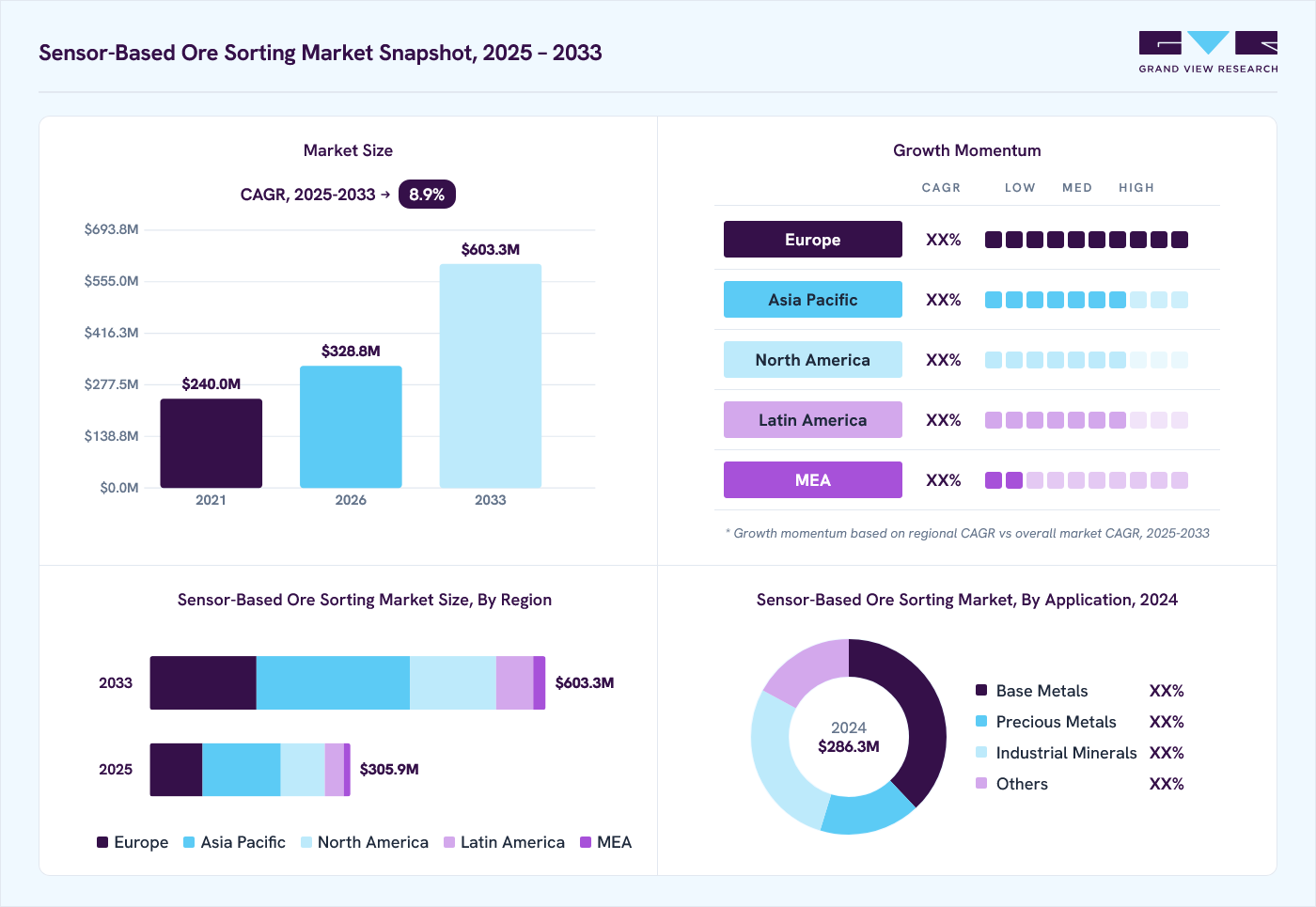
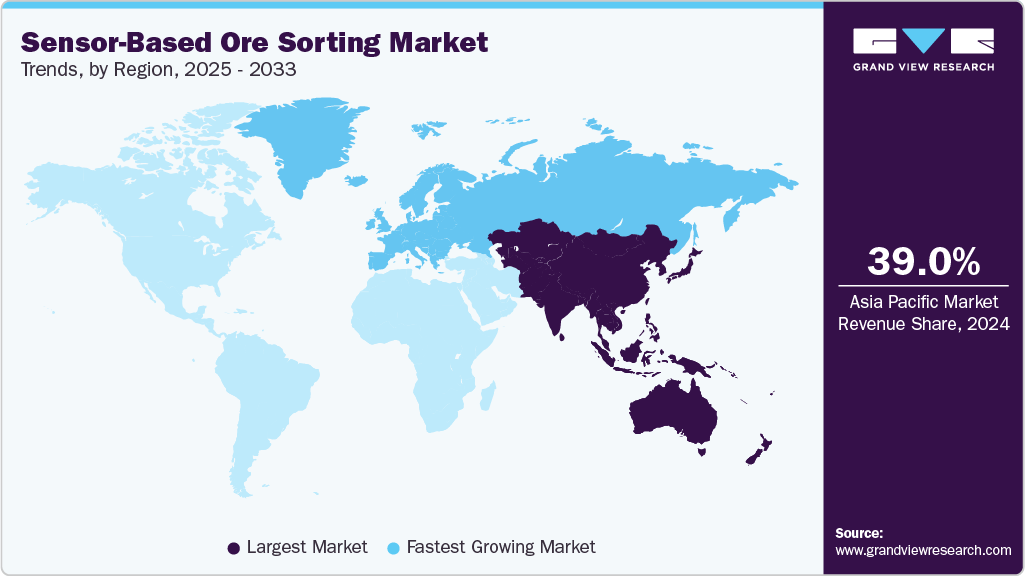
The global Sensor-Based ore sorting market size was valued at USD 286.3 million in 2024 and is projected to grow from USD 328.8 million in 2026 to USD 603.3 million by 2033, at a CAGR of 8.9% from 2025 to 2033. Asia Pacific dominated the market, accounting for a revenue share of 39.0% in 2024. The market is expanding rapidly due to the growing need to improve ore processing efficiency and reduce operational costs in the mining industry.
Key Market Trends & Insights
- Asia Pacific dominated the sensor-based ore sorting market with the largest revenue share of 39.0% in 2024.
- By technology, the near infrared segment is anticipated to register a CAGR of 9.5% from 2025 to 2033.
- By application, the base metals segment accounted for the largest revenue share of 38.0% in 2024.
Market Size & Forecast
- 2024 Market Size: USD 286.3 Million
- 2033 Projected Market Size: USD 603.3 Million
- CAGR (2025-2033): 8.9%
- Asia Pacific: Largest market in 2024
- Europe: Fastest growing market
Base metals are increasingly adopting automated sorting technologies to identify valuable minerals directly at the extraction site. This reduces the volume of waste material processed downstream and enhances the overall recovery rate. The cost savings associated with reduced energy and water consumption during mineral processing are encouraging wider adoption across both large-scale and mid-sized mining operations.Rising concerns over resource depletion and environmental sustainability are crucial in driving the demand for sensor-based ore sorting systems. The technology helps minimize tailings generation and supports efficient utilization of natural resources. Governments and regulatory bodies are implementing stricter environmental norms, which encourage the adoption of eco-friendly technologies that lower the carbon footprint of mining activities. As a result, base metals are increasingly investing in advanced sorting systems that align with sustainability goals.
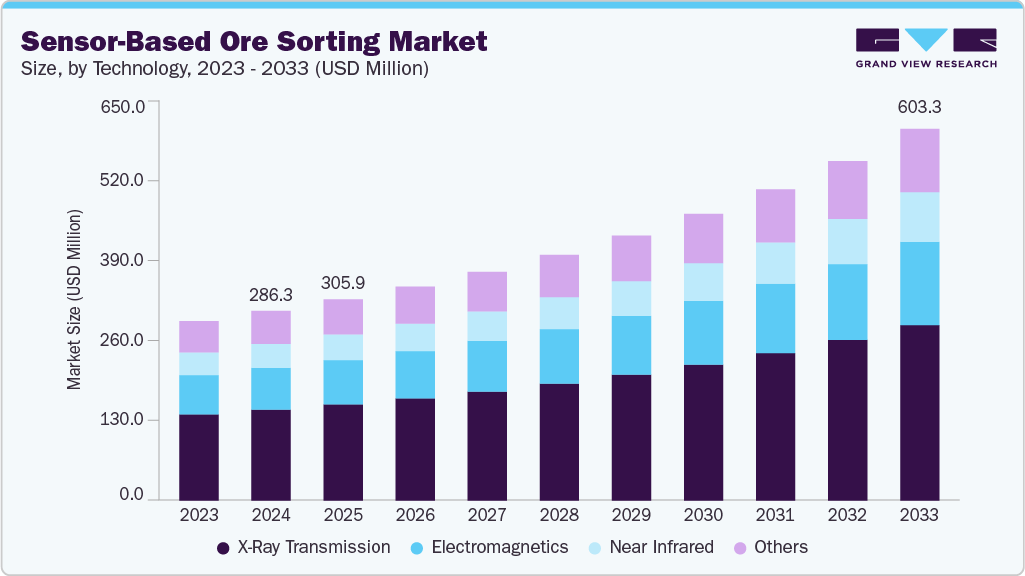
Technological advancements in sensor capabilities are another major factor supporting the growth of the sensor-based ore sorting industry. Modern systems integrate near-infrared (NIR), X-ray transmission (XRT), and laser sensors that can accurately distinguish between ore and waste materials in real time. These advancements have improved precision and sorting speed, making the technology more suitable for a wider range of minerals, including gold, copper, tungsten, and diamonds. Continuous innovation in automation and machine learning algorithms further enhances detection accuracy and throughput efficiency.
Growing mining activity in emerging economies such as Australia, China, South Africa, and Chile also contributes to the market growth. These regions possess large mineral reserves and focus on upgrading existing infrastructure to optimize production. Local mining firms are adopting advanced sorting systems to increase yield quality and reduce operational inefficiencies. Integrating these technologies within regional mining operations has created new opportunities for sensor manufacturers and technology providers.
Additionally, the rising emphasis on reducing overall processing costs and improving ore grade control is accelerating the adoption of sensor-based ore sorting systems. Traditional processing methods often involve high energy consumption and large-scale material handling. In contrast, sensor-based sorting enables pre-concentration at the mine site, lowering transportation and processing costs. This efficiency gain, coupled with the growing trend toward digitalization and automation in the mining industry, is expected to continue strengthening the market outlook over the forecast period.
Drivers, Opportunities & Restraints
The primary drivers of the sensor-based ore sorting market include the increasing focus on operational efficiency, cost reduction, and environmental sustainability in the mining sector. The technology enables pre-concentration of ore by separating waste rock early, which helps reduce energy consumption, water use, and downstream processing costs. Advancements in sensor technology, such as X-ray transmission (XRT), near-infrared (NIR), and laser-based detection, have significantly improved sorting accuracy and speed, making it suitable for a wider range of minerals. These benefits prompt large and mid-sized base metals to integrate sensor-based systems into their production lines.
The market presents strong opportunities driven by the growing adoption of digital and automated solutions in mining operations. The shift toward smart mining practices creates demand for data-driven sorting technologies that enhance decision-making and resource utilization. Emerging economies, such as China, Australia, and Chile, are expanding their mining output, offering potential opportunities for technology providers to collaborate with local players. Furthermore, the growing emphasis on sustainability and compliance with environmental regulations encourages base metals companies to invest in cleaner and more efficient processing methods, creating a favorable environment for the growth of sensor-based ore sorting solutions.
However, the market faces restraints, including high initial capital investment and limited awareness among small-scale miners. The cost of installation, maintenance, and system integration can be significant, which limits adoption in regions with low technological maturity. Additionally, sensor-based sorting requires proper calibration and training for optimal performance, posing operational challenges for some users. In remote mining locations, a lack of technical expertise and inadequate infrastructure can further hinder the widespread implementation of these systems.
Technology Insights
The X-ray transmission (XRT) segment is experiencing significant growth due to its high precision in detecting and separating minerals based on density and atomic composition. XRT technology enables mining operators to efficiently distinguish valuable ores from waste rock, even in complex or low-grade deposits. Its ability to penetrate material and identify subtle differences in atomic density makes it particularly effective for sorting metals such as copper, nickel, and gold. By improving feed grade prior to downstream processing, XRT reduces energy, water, and reagent consumption, resulting in lower operational costs and enhanced recovery rates.
The near infrared segment is anticipated to register the fastest CAGR over the forecast period due to its ability to identify minerals based on their chemical composition and moisture content. NIR sensors can detect specific mineral signatures by analyzing the absorption of infrared light, making them effective for sorting ores with variable mineralogy or moisture levels. This technology is widely applied in base metals, precious metals, and industrial minerals, allowing mining operators to increase feed grades and reduce the volume of waste sent to downstream processing. By enhancing ore concentration before milling, NIR-based sorting reduces energy, water, and reagent consumption, improving operational efficiency and cost-effectiveness.
Application Insights
The base metals segment is experiencing rapid growth in the sensor-based ore sorting market due to the increasing demand to enhance ore quality and improve recovery efficiency for metals such as copper, nickel, zinc, and lead. The rising demand for these metals in the construction, automotive, and renewable energy sectors has compelled mining companies to adopt advanced sorting technologies that maximize yield from existing resources.
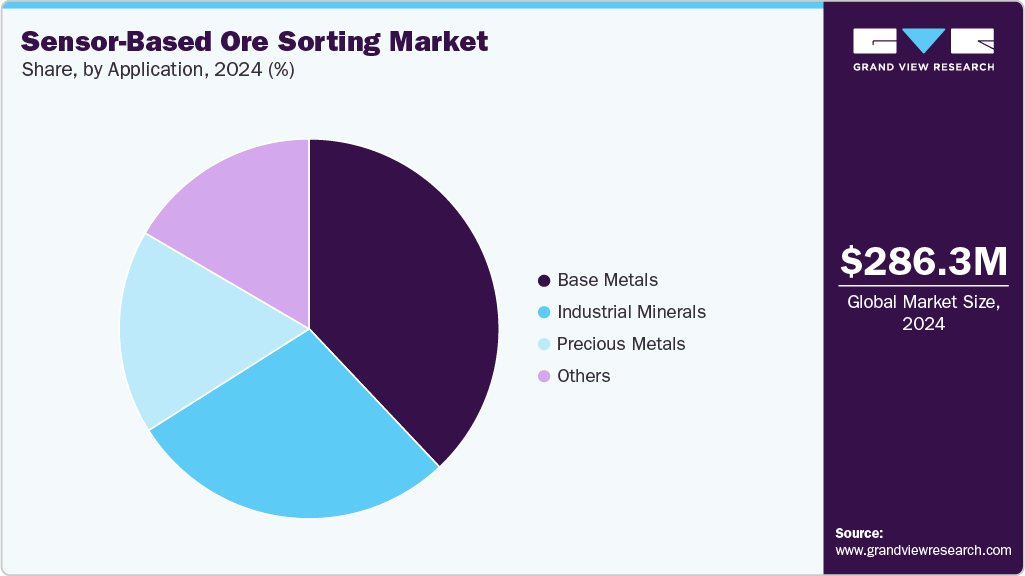
The precious metals segment is anticipated to register the fastest CAGR over the forecast period, due to the rising demand for high recovery efficiency and reduced processing costs in gold, silver, and platinum group metal (PGM) mining. As ore grades decline and extraction costs rise, mining companies turn to sensor-based technologies to enhance ore concentration before milling. This approach enables the early removal of barren or low-grade rock, thereby improving the feed quality of downstream processes. Technologies such as X-ray transmission, near-infrared, and laser-induced sensors enable accurate detection of mineralized zones, even in complex geological formations. The result is a notable reduction in energy consumption and an improvement in overall recovery rates, making operations more cost-effective and sustainable.
Regional Insights
The growth of the Asia Pacific sensor-based ore sorting market is driven by the region’s expanding mining sector and rising demand for efficiency-enhancing technologies. Countries such as China, Australia, and India focus on modernizing their mining operations to improve ore recovery and reduce production costs. The adoption of automated ore sorting systems is gaining traction as base metals seek to increase yield quality and reduce waste generation. The presence of large mineral reserves, combined with growing investments in mining infrastructure, is fuelling demand for advanced sorting solutions across both ferrous and non-ferrous mineral projects.
North America Sensor-Based Ore Sorting Market Trends
The North America sensor-based ore sorting industry is growing steadily due to the increasing emphasis on improving operational efficiency and sustainability within the mining sector. Mining companies in the U.S. and Canada are adopting advanced sorting systems to enhance ore quality, reduce energy usage, and lower processing costs. The strong presence of established mining firms with the financial capability to invest in automation technologies supports regional adoption. Additionally, the rising demand for high-grade minerals, such as gold, copper, and lithium, used in renewable energy and electric vehicle applications, encourages sensor-based sorting to maximize resource recovery.
The growth of the U.S. market for sensor-based ore sorting is primarily driven by the country’s focus on enhancing mineral processing efficiency and sustainability. Base metals increasingly adopt advanced sorting technologies to improve ore recovery rates and reduce operational costs. Environmental sustainability and regulatory compliance are additional factors accelerating market growth in the U.S. The Environmental Protection Agency (EPA) and other regulatory bodies encourage cleaner mining operations that reduce waste and increase energy efficiency. Sensor-based ore sorting aligns with these goals by enabling pre-concentration of ores, reducing the amount of material processed downstream, and minimizing the environmental footprint.
Europe Sensor-Based Ore Sorting Market Trends
Europe's sensor-based ore sorting industry is expanding due to the region’s strong commitment to sustainable mining and efficient resource utilization. European mining companies are adopting advanced sorting systems to reduce waste generation, lower energy consumption, and improve ore recovery rates. Well-established mining operations in countries such as Sweden, Finland, Germany, and Poland, combined with the growing demand for critical minerals used in renewable energy technologies, are driving investments in automation and sensor-based solutions. The technology’s ability to enhance productivity while meeting strict environmental regulations makes it increasingly attractive to regional operators.
Middle East & Africa Sensor-Based Ore Sorting Market Trends
The MEA sensor-based ore sorting industry is witnessing steady growth driven by expanding mining activities and increasing investments in mineral exploration. Countries such as South Africa, Namibia, Saudi Arabia, and the United Arab Emirates focus on improving mining efficiency and maximizing resource recovery. The technology’s ability to enhance ore quality at the extraction stage is gaining attention as regional producers aim to optimize operations and reduce overall processing costs. The growing demand for metals such as copper, gold, and iron ore, coupled with new mining projects supported by government initiatives, contributes to the adoption of sensor-based sorting solutions.
Latin America Sensor-Based Ore Sorting Market Trends
The market in Latin America is growing rapidly due to the region’s abundant mineral reserves and increasing emphasis on improving mining productivity. Countries such as Chile, Peru, and Brazil are leading the adoption of advanced ore sorting systems to enhance recovery efficiency and reduce operational costs. Mining companies invest in modern technologies to manage declining ore grades and optimize processing capacity. The presence of large-scale mining operations for copper, gold, and lithium, combined with rising export demand, is further driving the implementation of sensor-based sorting solutions across the region.
Key Sensor-Based Ore Sorting Company Insights
Some of the key players operating in the market include TOMRA Sorting Solutions and STEINERT GmbH.
-
TOMRA Sorting Solutions is a division of TOMRA Systems ASA, a Norwegian company established in 1972. The company initially focused on reverse vending machines for collecting used beverage containers and later diversified into sensor-based sorting and recycling technologies. Over the years, TOMRA has evolved into a global leader in resource optimization and circular economy solutions, operating in more than 100 countries. Its technologies are applied across various industries, including mining, recycling, and food processing.
-
STEINERT GmbH is a German family-owned company founded in 1889 and headquartered in Cologne, Germany. The company has established itself as a global leader in magnetic and sensor-based sorting technologies for the mining, recycling, and metal recovery industries. With over a century of technological expertise, STEINERT has established a strong international presence through subsidiaries and partnerships across various regions, including the U.S., Australia, and Latin America.
Key Sensor-Based Ore Sorting Companies:
The following are the leading companies in the sensor-based ore sorting market. These companies collectively hold the largest market share and dictate industry trends.
- Binder+Co AG
- Bühler Group
- Eriez Manufacturing Co.
- Gekko Systems
- Metso Outotec
- MineSense Technologies
- REDWAVE (BT-Wolfgang Binder)
- Schenck Process
- STEINERT GmbH
- TOMRA Sorting Solutions
Recent Development
-
In January 2025, TOMRA Mining began the year by showcasing its advanced sensor-based sorting technology at the world’s largest lithium ore plant, part of Pilbara Minerals’ P680 Expansion Project in Australia. This large-scale facility, capable of processing over 1,000 tonnes of ore per hour, has integrated TOMRA’s ore-sorting systems to maximize recovery and reduce energy use. The installation underscores the company’s commitment to sustainability by enabling early waste rejection and improved resource efficiency in one of the world’s most important lithium operations.
Sensor-Based Ore Sorting Market Report Scope
Report Attribute
Details
Market Definition
The sensor-based ore sorting market refers to the value of equipment, systems, and services used for the automatic separation of ores, utilizing sensors to identify valuable minerals and reject waste.
Market size in 2024
USD 286.3 million
Estimated market size in 2026
USD 328.8 million
Projected market size by 2033
USD 603.3 million
Growth rate
CAGR of 8.9% from 2025 to 2033
Base year for estimation
2024
Historical data
2021 - 2023
Forecast period
2025 - 2033
Quantitative units
Revenue in USD million and CAGR from 2025 to 2033
Report coverage
Revenue forecast, competitive landscape, growth factors, and trends
Segments covered
Application, technology, region
Regional scope
North America; Europe; Asia Pacific; Latin America; Middle East & Africa
Country scope
U.S.; Canada; Mexico; Germany; UK; France; China; India; Japan; Brazil; Saudi Arabia, UAE
Key companies profiled
Binder+Co AG; Bühler Group; Eriez Manufacturing Co.; Gekko Systems; Metso Outotec; MineSense Technologies; REDWAVE (BT-Wolfgang Binder); Schenck Process; STEINERT GmbH; TOMRA Sorting Solutions
Customization scope
Free report customization (equivalent up to 8 analysts working days) with purchase. Addition or alteration to country, regional & segment scope.
Pricing and purchase options
Avail customized purchase options to meet your exact research needs. Explore purchase options
Global Sensor-Based Ore Sorting Market Report Segmentation
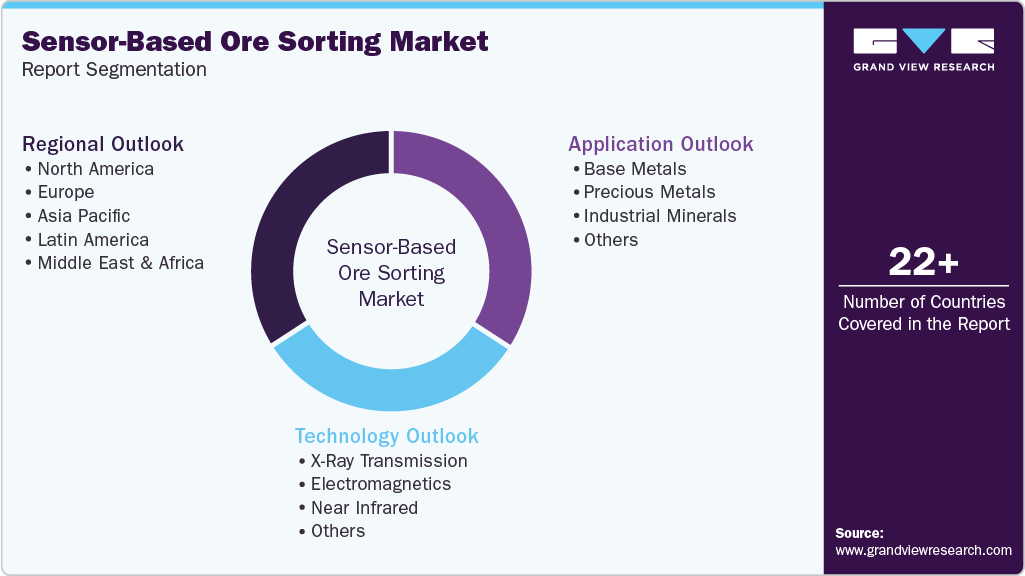
This report forecasts revenue growth at the global, regional, and country levels and provides an analysis of the latest industry trends in each of the sub-segments from 2021 to 2033. For this study, Grand View Research has segmented the global sensor-based ore sorting market report based on technology, application, and region:
-
Technology Outlook (Revenue, USD Million, 2021 - 2033)
-
X-Ray Transmission
-
Electromagnetics
-
Near Infrared
-
Others
-
-
Application Outlook (Revenue, USD Million, 2021 - 2033)
-
Base Metals
-
Precious Metals
-
Industrial Minerals
-
Others
-
-
Regional Outlook (Revenue, USD Million, 2021 - 2033)
-
North America
-
U.S.
-
Canada
-
Mexico
-
-
Europe
-
Germany
-
UK
-
France
-
-
Asia Pacific
-
China
-
India
-
Japan
-
-
Latin America
-
Brazil
-
-
Middle East & Africa
-
Saudi Arabia
-
UAE
-
-
Frequently Asked Questions About This Report
The global Sensor-Based ore sorting market is expected to grow at a CAGR of 8.9% from 2025 to 2033, reaching USD 603.3 million by 2033.
The x-ray transmission segment dominated the market with a revenue share of 47.8% in 2024.
Some of the key players of the global sensor-based ore sorting market are Binder+Co AG, Bühler Group, Eriez Manufacturing Co., Gekko Systems, Metso Outotec, MineSense Technologies, REDWAVE (BT-Wolfgang Binder), Schenck Process, STEINERT GmbH, TOMRA Sorting Solutions, and others.
The key factor driving the growth of the global sensor-based ore sorting market is the increasing need for efficient mineral recovery and waste reduction, which enhances ore grade quality and lowers overall processing costs.
Asia Pacific dominated with a 39.0% revenue share in 2024.
The global Sensor-Based ore sorting market size was valued at USD 286.3 million in 2024 and is estimated at USD 328.8 million for 2026.
About the Author(s)
Advanced Interior Materials Research Team
Advanced Materials · Advanced Interior MaterialsThis report was authored by the advanced interior materials research team at Grand View Research - comprising two research analysts, one senior research analyst, and one industry expert - with specialized expertise in the advanced interior materials segment of the advanced materials industry. All findings are based on proprietary advanced materials databases, executive interviews, and regulatory analysis, subject to internal peer review prior to publication.
Last Updated:
Speak to Analyst

Need a Tailored Report?
Customize this report to your needs — add regions, segments, or data points, with 20% free customization.
Or view our licence options:


ISO 9001:2015 & 27001:2022 Certified
We are GDPR and CCPA compliant! Your transaction & personal information is safe and secure. For more details, please read our privacy policy.












