
- Home
- »
- Plastics, Polymers & Resins
- »
-
Silicone In Personal Care Market Size, Growth Report, 2026-2033GVR Report cover

Silicone In Personal Care Market (2026 - 2033)
Size, Share & Trends Analysis Report By Product (Fluids, Resins, Blends, Cross Polymers), By Application (Skin Care Products, Hair Care Products, Cosmetics, Antiperspirants & Deodorants), By Region, And Segment Forecasts
Market Size, 2025
$3.6BMarket Estimate, 2026
$3.8BMarket Forecast, 2033
$5.6BCAGR, 2026–2033
5.5%Silicone In Personal Care Market Summary
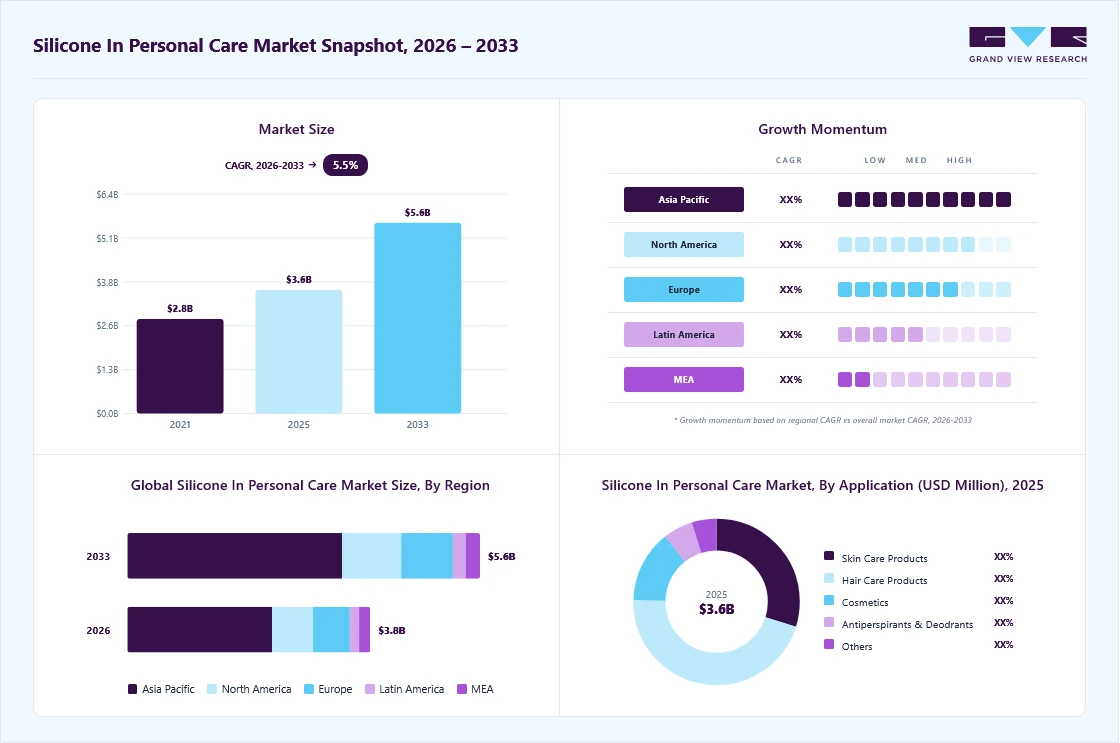
The global silicone in the personal care market size was valued at USD 3.6 billion in 2025 and is projected to grow from USD 3.8 billion in 2026 to USD 5.6 billion by 2033, at a CAGR of 5.5% from 2026 to 2033. Asia Pacific dominated the global market, accounting for the largest revenue share of 59.4% in 2025. The increasing consumerism and disposable income have raised the demand for self-care products, which has grown the demand for silicon in producing products such as shampoos, conditioners, serums, sunscreens, body lotions, lipsticks, eyeliners, concealers, and various other goods.
 Source: Grand View Research, IR Documents, Primary Interviews, Paid DatabasesTo learn more about this report,
 Download Free Sample Report
 Key Market Trends & Insights
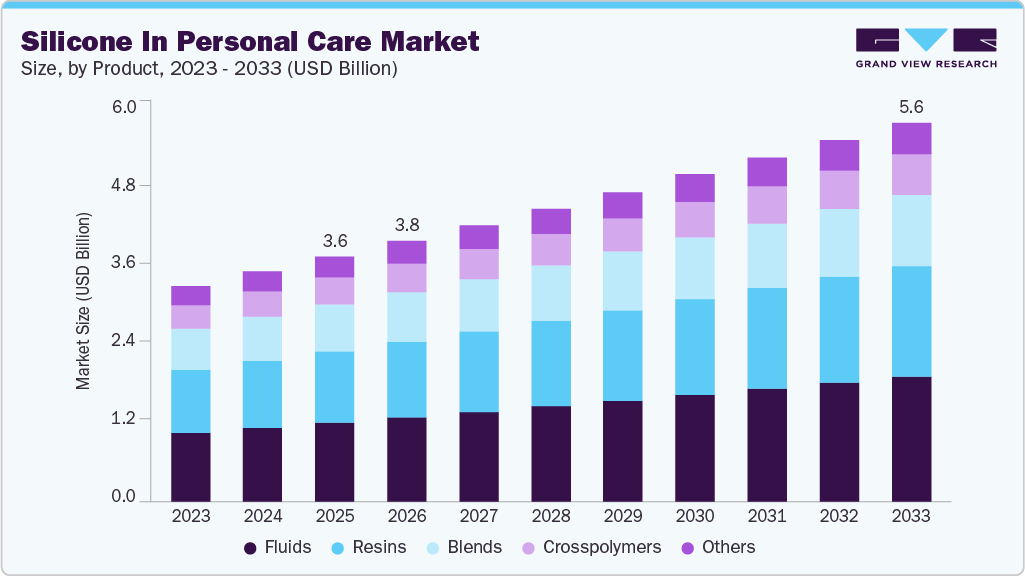
- By product: Fluids segment is expected to grow at a medium CAGR of 5.8% from 2026 to 2033 in terms of revenue.
- By application: Hair care products segment is expected to grow at a CAGR of 5.8% from 2026 to 2033 in terms of revenue.
Regional Highlights
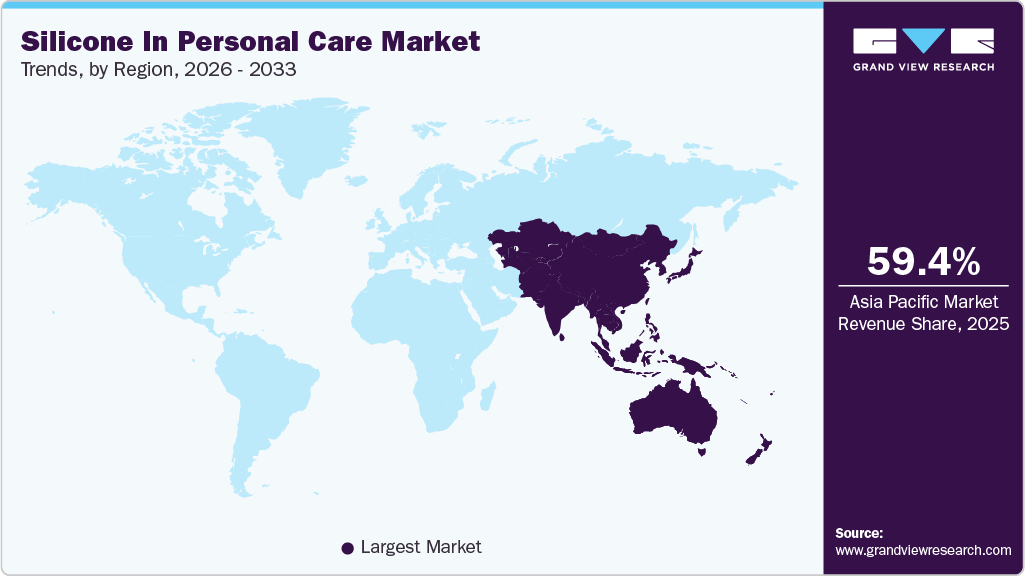
- Largest regional market: Asia Pacific (59.4% revenue share, 2025)
- By country: The India silicone in the personal care industry is a major contributor to the global market.
Market Size & Forecast
- Market size in 2025: USD 3.6 Billion
- Estimated market size in 2026: USD 3.8 Billion
- Projected market size by 2033: USD 5.6 Billion
- CAGR (2026-2033): 5.5%
Three ways to get this report
Buy it, customize it, or ask a question.Ask an Analyst
Analyst response in 1 business day
- AccessReport author, directly
- Reply timeWithin 1 working day
- No sales callDirect answer only
- FormatEmail reply
- CostFree, no cost
Get the Full Report
What the study covers
- FormatsPDF · Excel · Dashboard
- Timeline2026–2033 annual, 2025 base
- Coverage20+ countries, 5 regions
- Companies10+ key players profiled
Customize the Report
20% free customization
- IncludeCountries, segments, points
- TailorTo your product definition
- ExtendDeeper competitor detail
- OrA fully bespoke study
- Turnaround5–10 working days
 To learn more about this report, Download Free Sample Report
 Another notable trend in the silicone in personal care market is the increasing focus on lightweight, multifunctional, and high-performance ingredients that improve texture, spreadability, and product stability. Rising urbanization is increasing demand for convenient personal care products suited to busy lifestyles, driving the use of silicones in skincare, haircare, and cosmetics. Consumers are also seeking premium and sensory-rich formulations, encouraging manufacturers to develop advanced silicone-based products that deliver smooth application, long-lasting effects, and better overall user experience.
Drivers, Opportunities & Restraints
The demand for silicone in personal care products is increasing due to rapid urbanization and rising disposable incomes, which are boosting consumer spending on premium products. In 2025, China’s per capita disposable income reached USD 6,362.36, reflecting a 5.0% nominal growth, indicating stronger purchasing power. Similarly, the U.S., with a disposable income of USD 23,429.8 billion, represents a highly lucrative market. In addition, silicone remains cost-effective for large-scale production, while bio-based alternatives are more expensive. These factors collectively enhance product affordability, improve performance, and drive sustained growth in the personal care market.
The silicone in the personal care market has strong opportunities from bio-based silicone made from renewable biomass, self-healing elastomers with smart encapsulation, and antimicrobial silicone body scrubbers. These innovations support clean beauty goals, lower carbon footprints, and improve product performance and hygiene. As a result, brands can attract more eco-conscious and health-focused consumers while building stronger product differentiation. They also help companies expand into premium and functional care segments. Overall, these opportunities are likely to improve market growth, increase consumer trust, and encourage greater product adoption across personal care applications.
The silicone personal care market faces stricter regulation and environmental scrutiny. Under European Commission Regulation (EU) 2024/1328, the EU restricts D4, D5, and D6 in consumer and personal products, including cosmetics, because the European Chemicals Agency (ECHA) identifies these cyclosiloxanes as persistent and bio-accumulative. These rules force formulators to reformulate products, test alternatives, and manage compliance costs, which can slow launches and raise prices. Environmental concerns also reduce consumer acceptance of silicone-heavy products, limiting demand and encouraging a shift toward safer, more sustainable ingredients.
Market Concentration & Characteristics
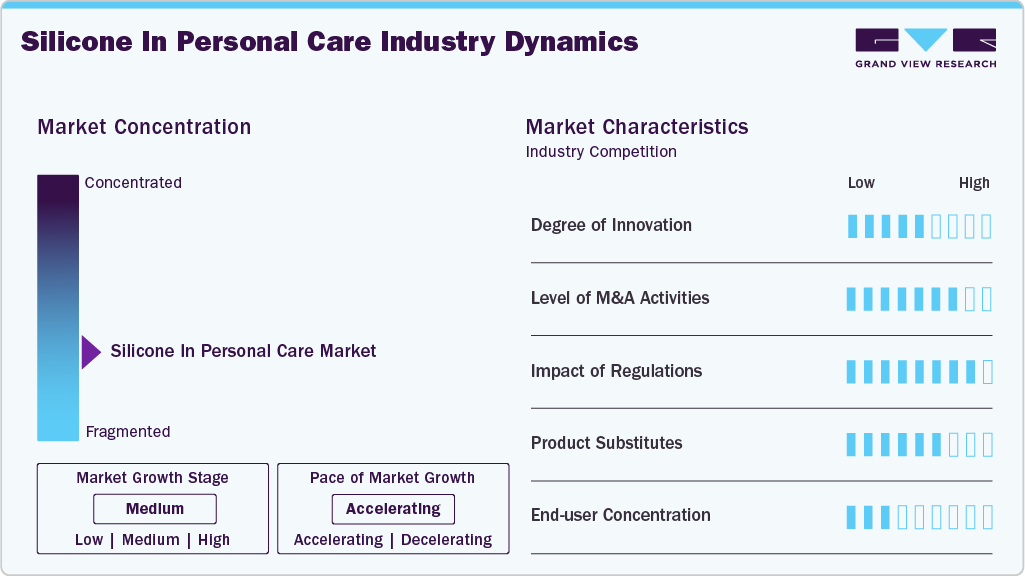
The market growth stage is medium, and growth is accelerating. The market exhibits fragmentation, with key players dominating the industry landscape. Major companies such as Wacker Chemie AG, Elkem ASA, CHT Germany GmbH, Shin-Etsu Chemical, Co., Ltd, Momentive Performance Materials Inc., Dow, Inc., BRB International B.V., DyStar Singapore Pte Ltd, Mitsubishi Shoji Chemical Corporation, Chemsil Silicones, Inc., PHOENIX CHEMICAL, INC., Jiangxi New Jiayi New Materials Co., Ltd., Thor Personal Care, AB Specialty Silicones, Siltech Corporation, and others play a significant role in shaping the market dynamics. These leading players often drive innovation in the market, introducing new products, technologies, and product types to meet the industry's evolving demands.
The degree of innovation in the silicone in the personal care market is moderate to high, driven by the need for better performance, comfort, and sustainability. New silicone-based ingredients are improving spreadability, smooth feel, long-lasting moisture, and product stability in skin care, hair care, and cosmetics. At the same time, manufacturers are developing bio-based, low-volatility, and more environmentally friendly silicone options to meet changing consumer preferences and regulatory expectations. These innovations are increasing product value, supporting premium offerings, and helping companies expand their market presence through differentiated formulations.
 To learn more about this report, Download Free Sample Report
 Product substitutes for silicones in the personal care market mainly include natural oils, plant-based butters, waxes, and bio-based or synthetic polymers that offer similar sensory and functional benefits. Ingredients such as coconut oil, shea butter, and aloe vera are increasingly preferred due to rising consumer demand for natural and sustainable products. These substitutes affect the market by limiting the growth of traditional silicone-based formulations, especially in clean beauty segments. However, silicones continue to maintain demand due to their superior performance, stability, and cost-effectiveness, creating a balanced competitive environment in the market.
Product Insight
Fluids held the largest share among all product types, accounting for 32.3% of total market revenue in 2025, and are projected to expand at a CAGR of 5.8% during the period from 2026 to 2033. This growth is largely supported by increasing demand from the hair care segment. Fluids are widely preferred due to their ability to enhance product texture, improve spreadability, and maintain formulation stability. In addition, they offer a smooth, silky finish without leaving a greasy residue, which aligns with evolving consumer preferences for lightweight and effective personal care products, thereby sustaining their strong market position.
The resins segment is expected to grow at a CAGR of 5.5% during the forecast period. This growth is primarily driven by increasing demand from the cosmetics industry, where resins are valued for their strong film-forming properties, water resistance, and ability to enhance product longevity and texture in makeup applications. Rising use in color cosmetics such as lipsticks, eyeliners, and mascaras is supporting demand. In addition, the need for protective and breathable layers in anti-aging skincare, along with high-performance conditioning agents in hair serums and styling products, is further contributing to growth due to their durability, water repellency, smooth sensory feel, and long-lasting performance.
Application Insights
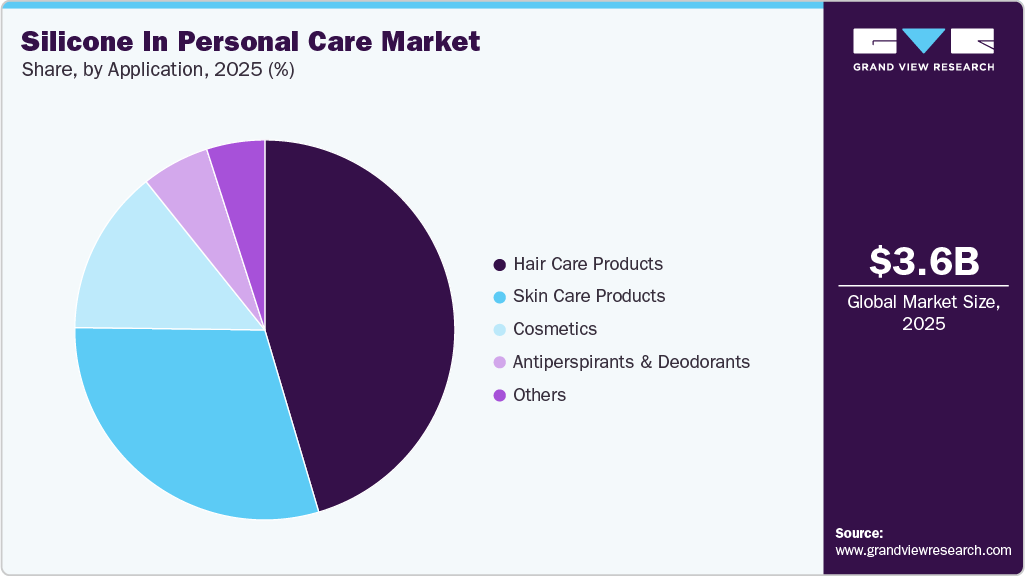
Hair Care Products dominated the market across the application segmentation in terms of revenue, accounting for a 45.4% market share in 2025, and are forecast to grow at a 5.8%CAGR from 2026 to 2033.The demand for shampoos, conditioners, and styling products that enhance hair texture and deliver long-lasting moisture is steadily increasing. This trend is supported by the growing number of premium salons and the entry of new high-end salon brands, which continue to drive the need for advanced hair care solutions. Silicone-based ingredients play a key role in meeting these expectations, as they offer superior conditioning properties, improve hair manageability, and provide enhanced shine. As consumers increasingly seek professional-quality results at home and in salons, the reliance on high-performance formulations, including silicones, is expected to remain strong in the hair care market.
 To learn more about this report, Download Free Sample Report
 The hair care products segment is expected to expand at a medium 5.1% CAGR over the forecast period in the silicone in personal care market. The hair care products application segment is an important area of silicone in the personal care market, as Consumers are increasingly seeking products that improve smoothness, reduce frizz, and protect hair from damage while supporting a healthier appearance. Silicone-based ingredients help enhance shine, manageability, and conditioning performance, making them widely used in shampoos, conditioners, serums, and treatment products across both premium and mass-market formulations.
Regional Insights
The silicone in the personal care market in the Asia Pacific accounted for the revenue share of 59.4% in 2025. The region has witnessed a rise in demand for silicone-based personal care products on account of the rising number of working women professionals across emerging economies such as China and India, along with their growing interests in and increasing spending on beauty and personal care products. Furthermore, the rising demand from the young population across these countries and their easy internet access are anticipated to offer immense opportunities for the market growth over the forecast period.
 To learn more about this report, Download Free Sample Report
 The silicone in the personal care market in China accounted for the largest revenue share in 2025 in the Asia Pacific market. In the past decade, the economic growth of China, an increase in the purchasing power of consumers, and a shift in consumer trends toward high-quality skincare products have propelled the demand for silicone for manufacturing skincare and other personal care products.
North America Silicone In Personal Care Market Trends
The silicone in the personal care market in North America is expected to grow at a substantial CAGR over the forecast period. The growing interest in achieving an appealing appearance among teens and adults in the region has greatly increased the demand for beauty products like lipsticks, eyeliners, nail polish, and foundations, among others. In addition, the rise of social media and the increasing popularity of influencers on platforms such as YouTube and Instagram have benefited cosmetics companies looking to connect with diverse audiences both domestically and globally.
Europe Silicone In Personal Care Trends
In 2025, silicone held a substantial share of the personal care market in Europe. Over the past decades, the European population has increasingly sought products and services that are personal to them and has become more conscious of the environmental and social and ethical ramifications of the consumption and production of personal care products. Hence, manufacturers of personal care products across Europe produce products tailored to diverse individual factors such as gender, age, religious beliefs, ethnicity, geography, climate, lifestyle, health, and well-being. Because silicone-based hair care and skin care products are non-allergenic to the dermis, demand for silicone in personal care products in the European region has increased in recent years.
Key Silicone In Personal Care Company Insights
The silicone in the personal care industry is highly competitive, with several key players dominating the landscape. Major companies include Wacker Chemie AG, Elkem ASA, CHT Germany GmbH, Shin-Etsu Chemical, Co., Ltd, Momentive Performance Materials Inc., Dow, Inc., BRB International B.V., DyStar Singapore Pte Ltd, Mitsubishi Shoji Chemical Corporation, Chemsil Silicones, Inc., PHOENIX CHEMICAL, INC., Jiangxi New Jiayi New Materials Co., Ltd., Thor Personal Care, AB Specialty Silicones, Siltech Corporation The silicone in personal care industry is characterized by a competitive landscape with several key players driving innovation and market growth. Major companies in this sector are investing heavily in research and development to enhance the performance, cost-effectiveness, and sustainability of their products.
Key Silicone In Personal Care Companies:
The following key companies have been profiled for this study on the silicone in personal care market.
- Wacker Chemie AG
- Elkem ASA
- CHT Germany GmbH
- Shin-Etsu Chemical, Co., Ltd.
- Momentive Performance Materials Inc.
- Dow, Inc.
- BRB International B.V.
- DyStar Singapore Pte Ltd
- Mitsubishi Shoji Chemical Corporation
- Chemsil Silicones, Inc.
- PHOENIX CHEMICAL, INC.
- Jiangxi New Jiayi New Materials Co., Ltd.
- Thor Personal Care
- AB Specialty Silicones
- Siltech Corporation
Recent Developments
-
In April 2026, Elkem Silicones, a global leader in advanced silicone materials, introduced PURESIL ORG 0415 and PURESIL ORG 0515. These products are elastomer-based formulations designed to enhance the performance and sensory properties of cosmetic applications. They provide a smooth, silky texture with high lubricity, enabling easy spreadability, a glossy finish, and a more even, natural-looking appearance in makeup and sunscreen products. In addition, they offer moisturizing benefits and improve the overall texture of formulations. Their functionality also supports the uniform dispersion of mineral sunscreens, contributing to better coverage and improved SPF performance. These versatile ingredients are suitable for use across hair care, skin care, sun care, and color cosmetic products.
-
In May 2025, Shin-Etsu Chemical Co., Ltd. developed KF-6070W and KF-6080W, which are modified silicone materials derived from dimethyl silicone oil (INCI: dimethicone). In these products, a portion of the methyl groups in the molecular structure has been replaced with hydrophilic functional groups. This modification enhances their compatibility with water while retaining the key benefits of silicones, such as high fluidity and a smooth, non-sticky feel.
Silicone In Personal Care Market Report Scope
Report Attribute
Details
Market size in 2025
USD 3.6 billion
Market size value in 2026
USD 3.8 billion
Revenue forecast in 2033
USD 5.6 billion
Growth rate
CAGR of 5.5% from 2026 to 2033
Historical data
2021 - 2025
Forecast period
2026 - 2033
Quantitative units
Revenue in USD million/billion, volume in kilotons, and CAGR from 2026 to 2033
Report coverage
Revenue forecast, competitive landscape, growth factors, and trends
Report segmentation
Product, application, region
Regional scope
North America; Europe; Asia Pacific; Central & South America; Middle East & Africa
Country Scope
U.S.; Canada; Mexico; Germany; UK; France; Italy; Spain; Netherlands; China; India; Japan; South Korea; Singapore; Malaysia; Indonesia; Thailand; Vietnam; Australia; Brazil; Argentina; Saudi Arabia; UAE; South Africa
Key companies profiled
Wacker Chemie AG; Elkem ASA; CHT Germany GmbH; Shin-Etsu Chemical, Co., Ltd; Momentive Performance Materials Inc.; Dow, Inc.; BRB International B.V.; DyStar Singapore Pte Ltd; Mitsubishi Shoji Chemical Corporation; Chemsil Silicones, Inc.; PHOENIX CHEMICAL, INC.; Jiangxi New Jiayi New Materials Co., Ltd.; Thor Personal Care; AB Specialty Silicones; Siltech Corporation
Customization scope
Free report customization (equivalent to up to 8 analyst working days) with purchase. Addition or alteration to country, regional & segment scope
Pricing and purchase options
Avail customized purchase options to meet your exact research needs. Explore purchase options
Global Silicone In Personal Care Market Segmentation
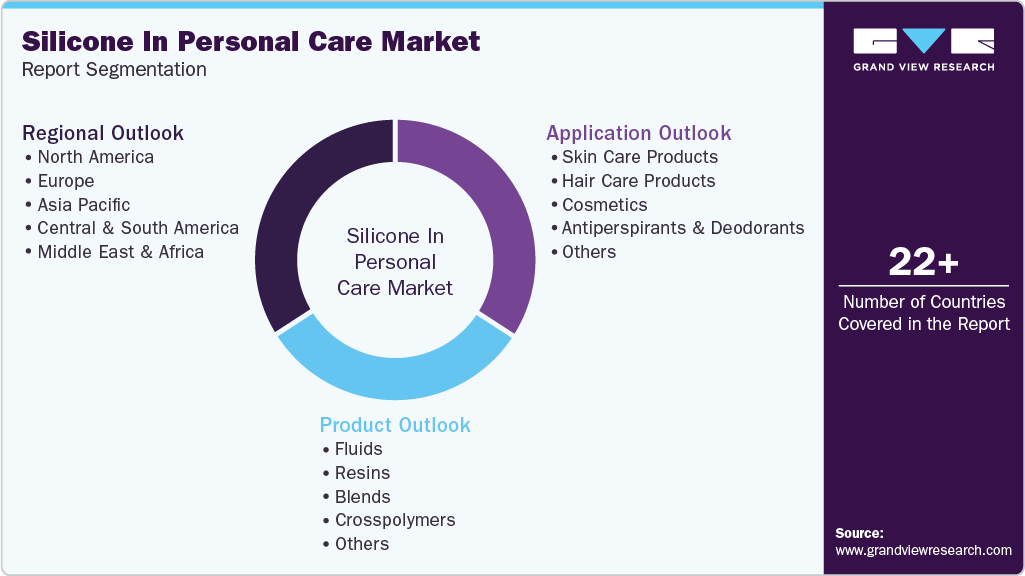
This report forecasts revenue growth at the global, regional, and country levels and provides an analysis of the latest industry trends across sub-segments from 2021 to 2033. For this study, Grand View Research has segmented the global silicone in personal care market report based on product, application, and region:
 To learn more about this report, Download Free Sample Report
 -
Product Outlook (Volume, Kilotons; Revenue, USD Million, 2021 - 2033)
-
Fluids
-
Resins
-
Blends
-
Crosspolymers
-
Others
-
-
Application Outlook (Volume, Kilotons; Revenue, USD Million, 2021 - 2033)
-
Skin Care Products
-
Hair Care Products
-
Cosmetics
-
Antiperspirants & Deodorants
-
Others
-
-
Regional Outlook (Volume, Kilotons; Revenue, USD Million, 2021 - 2033)
-
North America
-
U.S.
-
Canada
-
Mexico
-
-
Europe
-
Germany
-
UK
-
France
-
Italy
-
Spain
-
Netherlands
-
-
Asia Pacific
-
China
-
India
-
Japan
-
South Korea
-
Singapore
-
Malaysia
-
Indonesia
-
Thailand
-
Vietnam
-
Australia
-
-
Central & South America
-
Brazil
-
Argentina
-
-
Middle East and Africa
-
Saudi Arabia
-
UAE
-
South Africa
-
-
Frequently Asked Questions About This Report
The global silicone in personal care market size was valued at USD 3.6 billion in 2025 and is estimated at USD 3.8 billion for 2026.
The global silicone in personal care market is expected to grow at a CAGR of 5.5% from 2026 to 2033, reaching USD 5.6 billion by 2033.
Key factors driving the silicone in personal care market growth include rising awareness in regards to personal hygiene, rising disposable income across various regions, and increasing influence of social media
Asia Pacific dominated with a 59.4% revenue share in 2025.
The hair care products segment led with a 45.4% revenue share in 2025.
The fluid product dominated silicone in personal care market and accounted for the largest revenue share of 32.3% in 2025, silicone fluids show minute changes under distinctive thermal conditions. These are recommended for the manufacturing of personal care products, especially haircare products such as shampoos and conditioners.
Key players include Wacker Chemie AG; Elkem ASA; CHT Germany GmbH; Shin-Etsu Chemical, Co., Ltd; Momentive Performance Materials Inc.; Dow, Inc.; BRB International B.V.; DyStar Singapore Pte Ltd; Mitsubishi Shoji Chemical Corporation; Chemsil Silicones, Inc.; PHOENIX CHEMICAL, INC.; Jiangxi New Jiayi New Materials Co., Ltd.; Thor Personal Care; AB Specialty Silicones; Siltech Corporation.
About the Author(s)
Plastics, Polymers & Resins Research Team
Bulk Chemicals · Plastics, Polymers & ResinsThis report was authored by the plastics, polymers & resins research team at Grand View Research - comprising two research analysts, one senior research analyst, and one industry expert - with specialized expertise in the plastics, polymers & resins segment of the bulk chemicals industry. All findings are based on proprietary bulk chemicals databases, executive interviews, and regulatory analysis, subject to internal peer review prior to publication.
Last Updated:
Speak to Analyst

Customize this report to your needs - add regions, segments, or data points, with 20% free customization.
Or view our licence options:


ISO 9001:2015 & 27001:2022 Certified
We are GDPR and CCPA compliant! Your transaction & personal information is safe and secure. For more details, please read our privacy policy.


