
- Home
- »
- Advanced Interior Materials
- »
-
Silver Paste Market Size, Share & Growth Report, 2026-2033GVR Report cover

Silver Paste Market (2026 - 2033)
Size, Share & Trends Analysis Report By Substrate (Ceramic, Glass, Metal, Polymer), By Application (Solar PV, Printed Electronics, PCB & Electronic Circuits, Automotive Electronics, MLCC & Semiconductors), By Region, And Segment Forecasts
Market Size, 2025
$5.1BMarket Estimate, 2026
$5.5BMarket Forecast, 2033
$9.1BCAGR, 2026–2033
7.3%Silver Paste Market Summary
The global silver paste market size was valued at USD 5.1 billion in 2025 and is projected to grow from USD 5.5 billion in 2026 to USD 9.1 billion by 2033, at a CAGR of 7.3% from 2026 to 2033. The market in Asia Pacific dominated with a revenue share of 74.3% in 2025. The market growth is driven by the superior electrical conductivity, thermal stability, and strong adhesion properties of silver paste, enabling its widespread adoption across photovoltaic cells, electronics, semiconductor packaging, RFID, and sensor applications.
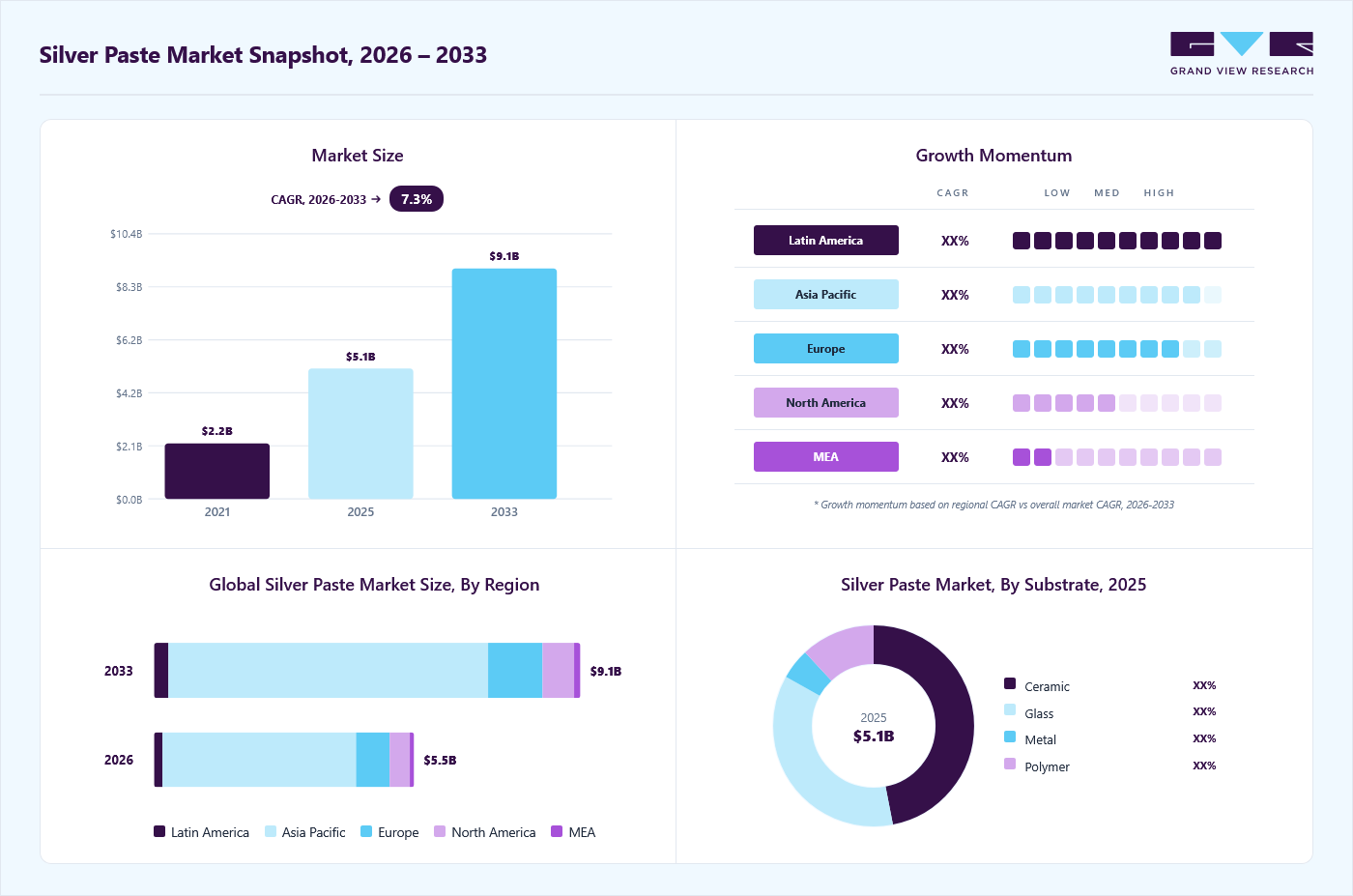 Source: Grand View Research, IR Documents, Primary Interviews, Paid DatabasesTo learn more about this report,
 Download Free Sample Report
 Key Market Trends & Insights
- By substrate: Ceramic segment held the largest market share of 46.9% in 2025.
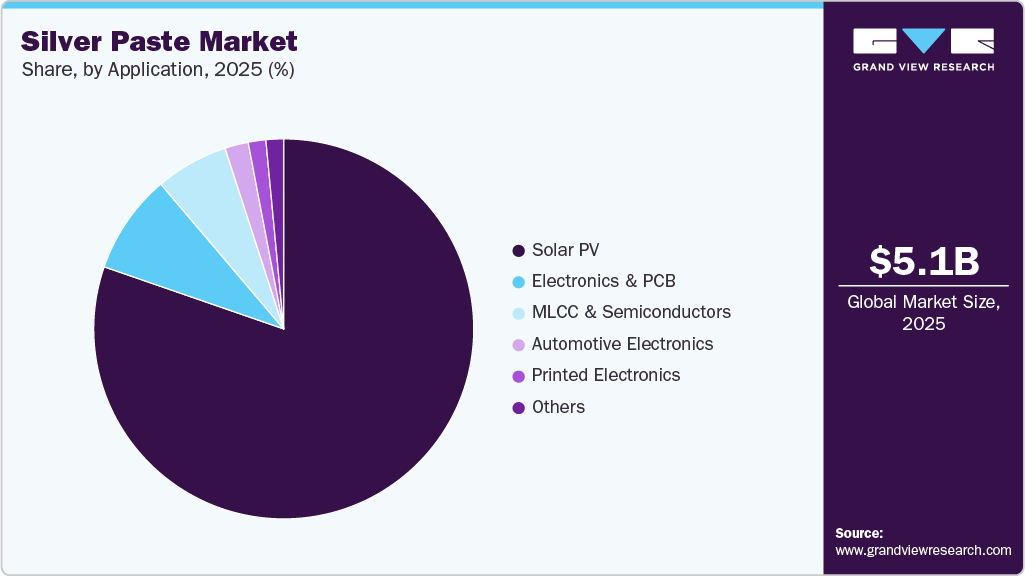
- By application: Solar PV segment held the largest market share in 2025.
Regional Highlights
- Largest regional market: Asia Pacific (74.3% revenue share, 2025)
- Fastest-growing regional market: Latin America (highest CAGR, 2026-2033)
- By country: China held the largest market share in 2025
Market Size & Forecast
- Market size in 2025: USD 5.1 Billion
- Estimated market size in 2026: USD 5.5 Billion
- Projected market size by 2033: USD 9.1 Billion
- CAGR (2026-2033): 7.3%
Three ways to get this report
Buy it, customize it, or ask a question.Ask an Analyst
Analyst response in 1 business day
- AccessReport author, directly
- Reply timeWithin 1 working day
- No sales callDirect answer only
- FormatEmail reply
- CostFree, no cost
Get the Full Report
What the study covers
- FormatsPDF · Excel · Dashboard
- Timeline2026–2033 annual, 2025 base
- Coverage20+ countries, 5 regions
- Companies10+ key players profiled
Customize the Report
20% free customization
- IncludeCountries, segments, points
- TailorTo your product definition
- ExtendDeeper competitor detail
- OrA fully bespoke study
- Turnaround5–10 working days
The market is increasingly shaped by sustainability considerations, particularly due to the high cost and limited availability of silver as a critical raw material. Manufacturers are actively pursuing “de-silvering” strategies, including the development of low-silver and silver-coated copper pastes, to reduce material intensity without compromising performance. Recycling initiatives, especially from end-of-life photovoltaic modules and electronic waste, are also gaining traction to ensure resource efficiency and circularity. In addition, stricter environmental regulations and ESG commitments are pushing companies to adopt cleaner production processes, reduce waste generation, and optimize energy consumption across the value chain.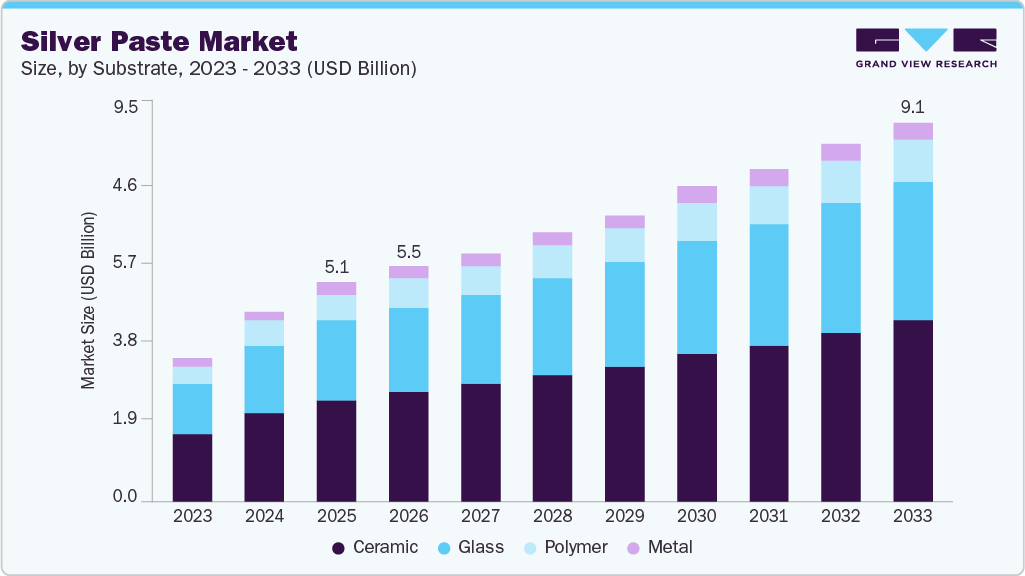 To learn more about this report, Download Free Sample Report
 From a technology standpoint, the market is undergoing rapid innovation driven by advancements in photovoltaic cell architecture and miniaturized electronics. The transition toward high-efficiency solar technologies such as TOPCon and heterojunction (HJT) cells is increasing demand for ultra-fine line, high-conductivity silver pastes with improved adhesion and lower contact resistance. In parallel, developments in screen-printing techniques, nano-silver formulations, and hybrid metallization approaches are enhancing performance while reducing material usage. Beyond solar, the expansion of applications in semiconductors, 5G infrastructure, EV electronics, and printed electronics is further accelerating the need for advanced conductive paste solutions with superior thermal and electrical properties.
Drivers, Opportunities & Restraints
The market is primarily driven by the rapid growth of the photovoltaic (PV) industry, particularly the shift toward high-efficiency solar cell technologies such as TOPCon and HJT, which require more advanced and higher-performance metallization materials. This transition is increasing the functional demand for conductive pastes even as manufacturers attempt to reduce silver loading per cell. For example, in September 2024, industry insights indicated that the adoption of n-type solar cell technologies led to higher silver paste usage due to more complex metallization requirements. In addition, the continued expansion of global solar installations and the rising integration of electronics in automotive and industrial systems are further strengthening demand for reliable conductive materials.
Significant opportunities exist in the development of low-silver and alternative metallization solutions, as manufacturers focus on reducing material costs while maintaining conductivity and efficiency. Innovations such as silver-coated copper pastes, ultra-fine line printing, and hybrid conductive materials are opening new pathways for cost optimization and performance enhancement. In 2025, industry developments demonstrated measurable reductions in silver consumption per watt in advanced solar cells through improved paste formulations and printing technologies, highlighting the potential for scalable innovation. Moreover, increasing demand from EV electronics, 5G infrastructure, and semiconductor packaging is creating additional avenues for growth beyond traditional photovoltaic applications.
One of the key market challenges is the volatility in silver prices, which directly impacts production costs and profitability across end-use industries, particularly solar manufacturing. Rising silver prices have intensified the push toward material substitution and efficiency improvements, with manufacturers actively exploring copper-based alternatives and reduced-silver formulations. In February 2026, market reports indicated a notable increase in silver prices, prompting solar companies to accelerate the adoption of alternative metallization approaches. Furthermore, ongoing efforts to minimize silver usage per cell (thrifting) and the risk of substitution by lower-cost materials are expected to moderate long-term volume growth despite increasing application demand.
Substrate Insights
The ceramic segment accounted for the largest revenue share in 2025, driven by its superior thermal stability, electrical insulation properties, and high durability across advanced electronic applications. Ceramic substrates are extensively utilized in multilayer ceramic capacitors (MLCCs), semiconductors, automotive electronics, and high-frequency communication devices, where reliable heat dissipation and performance efficiency are critical. The increasing adoption of electric vehicles, 5G infrastructure, and compact consumer electronics further supported the strong market position of ceramic-based substrates during the year.
The glass, metal, and polymer substrate segments are also witnessing steady demand due to their expanding use across diverse industrial and electronic applications. Glass substrates are gaining traction in display panels, photovoltaic modules, and precision electronics owing to their transparency and dimensional stability. Metal substrates are widely preferred in power electronics and LED applications because of their excellent thermal conductivity and mechanical strength, while polymer substrates are increasingly used in flexible electronic devices and lightweight electronic devices due to their flexibility, cost-effectiveness, and ease of processing.
Application Insights
The solar PV segment held the largest revenue share in 2025, primarily supported by the rapid expansion of renewable energy installations and growing investments in solar power infrastructure globally. Rising emphasis on clean energy transition, favorable government incentives, and increasing deployment of high-efficiency photovoltaic modules significantly accelerated the consumption of advanced materials and substrates used in solar PV applications. The strong growth of utility-scale solar projects, particularly across Asia Pacific, Europe, and North America, further contributed to the segment’s market dominance.
 To learn more about this report, Download Free Sample Report
 The MLCC & semiconductors segment is projected to witness the fastest CAGR during the forecast period, driven by increasing demand for miniaturized and high-performance electronic components across consumer electronics, automotive systems, telecommunications, and industrial automation. The ongoing expansion of 5G networks, artificial intelligence hardware, electric vehicles, and advanced computing technologies is substantially boosting the production of semiconductors and multilayer ceramic capacitors, thereby accelerating the demand for specialized substrate materials in this segment.
Regional Insights
North America represents a technology-driven market for silver paste, supported by strong demand from semiconductor packaging, automotive electronics, and emerging photovoltaic manufacturing initiatives. The region benefits from advanced R&D capabilities and the presence of key materials science companies, although large-scale solar cell production remains limited compared to Asia. Growing investments in domestic semiconductor fabrication and clean energy infrastructure in the U.S. are expected to drive steady demand for high-performance conductive pastes.
U.S. Silver Paste Market Trends
The silver paste market in the U.S. is the dominant contributor within North America, driven by its robust semiconductor ecosystem, advanced electronics manufacturing, and increasing focus on reshoring solar and chip production. Government-backed initiatives supporting renewable energy and domestic manufacturing are accelerating demand for silver paste in photovoltaic applications, while strong innovation capabilities continue to support developments in low-silver and high-efficiency paste formulations.
Asia Pacific Silver Paste Market Trends
The silver paste market in the Asia Pacific dominated the global market, accounting for the largest share in both production and consumption due to its extensive solar cell manufacturing base and electronics industry. Countries across the region benefit from integrated supply chains, cost advantages, and strong government support for renewable energy and semiconductor industries. The rapid expansion of high-efficiency solar technologies such as TOPCon and HJT further reinforces the region’s leadership in demand for advanced metallization pastes.
 To learn more about this report, Download Free Sample Report
 China silver paste marketis the leading country in the Asia Pacific market, driven by its position as the world’s largest producer of solar cells and modules. The country has a highly integrated photovoltaic supply chain, strong domestic demand, and continuous technological advancements in high-efficiency cell architecture. Government policies supporting renewable energy expansion and manufacturing scale-up further strengthen China’s dominance in both consumption and innovation of silver paste materials.
Europe Silver Paste Market Trends
The silver paste market in Europe is characterized by strong demand from automotive electronics, industrial applications, and high-efficiency solar technologies, particularly in countries like Germany. The region emphasizes sustainability and energy transition, driving the adoption of advanced photovoltaic systems and electronic components. However, limited large-scale solar manufacturing compared to Asia constrains volume growth, with the market leaning more toward high-value, specialty applications.
Latin America Silver Paste Market Trends
The silver paste market in Latin America represents an emerging market, primarily driven by increasing solar energy installations in countries such as Brazil. While the region lacks significant manufacturing capabilities for electronics or photovoltaic components, rising investments in renewable energy infrastructure are supporting gradual demand growth. The market remains largely import-dependent, with future expansion linked to solar adoption trends.
Middle East & Africa Silver Paste Market Trends
The silver paste market in MEA is witnessing growing demand for silver paste due to increasing investments in large-scale solar power projects, particularly in countries like Saudi Arabia and the UAE. The region benefits from high solar irradiance and government-backed clean energy initiatives, although it lacks a strong manufacturing base for photovoltaic components. Demand is therefore largely indirect, driven by solar installations rather than the local production of silver in the past.
Key Silver Paste Company Insights
Some of the key players operating in the market include Heraeus, DuPont, and others.
-
Heraeus, established in 1851, is a Germany-based technology group and a major manufacturer of conductive silver pastes used in photovoltaic cells, printed electronics, automotive electronics, and semiconductor packaging applications. The company specializes in advanced metallization pastes for PERC, TOPCon, and HJT solar technologies, along with thick-film conductive materials for electronic components. Heraeus is recognized for its strong R&D capabilities, high-performance silver formulations, and extensive global manufacturing and customer support network.
-
DuPont, established in 1802, is a U.S.-based materials science company and a prominent supplier of silver conductive pastes for solar photovoltaics, consumer electronics, automotive systems, and industrial electronic applications. The company develops metallization solutions designed for high-efficiency solar cells, fine-line printing, and enhanced electrical conductivity. DuPont is recognized for its advanced electronic materials portfolio, continuous innovation in photovoltaic paste technologies, and long-standing presence across the global electronics value chain.
-
Giga Solar Materials Corporation, established in 2008, is a Taiwan-based manufacturer specializing in photovoltaic silver paste and electronic conductive materials. The company primarily focuses on front-side and back-side silver pastes used in crystalline silicon solar cells, including advanced TOPCon and high-efficiency cell technologies. Giga Solar is recognized for its strong position within the Asia Pacific solar supply chain, customized paste formulations, and close partnerships with leading solar module and cell manufacturers.
Key Silver Paste Companies:
The following key companies have been profiled for this study on the silver paste market.
- artience Co., Ltd.
- Daejoo Electronic Materials
- Dongjin Semichem
- DuPont
- Giga Solar Materials Corporation
- Henkel
- Heraeus
- Namics Corporation
- Noritake Co., Limited
- Samsung SDI
Recent Developments
-
In February 2026, Heraeus pointed out that rising silver prices are pushing the solar industry to accelerate the development of low-silver and high-efficiency metallization solutions, particularly for advanced photovoltaic technologies. This trend highlights the growing importance of cost optimization and material efficiency in solar manufacturing.
-
In September 2025, industry insights involving DuPont indicated that the shift toward advanced solar cell technologies, such as TOPCon, is increasing silver paste consumption, especially during the early stages of technology adoption. This reflects the higher metallization requirements associated with next-generation solar cell architecture.
-
In September 2025, Giga Solar Materials Corporation was part of a broader trend of expanding photovoltaic production, with rising solar cell output contributing to increased demand for silver paste across global markets. This indicates strong alignment between capacity expansion and growing renewable energy demand.
Silver Paste Market Report Scope
Report Attribute
Details
Market definition
The market size represents the revenue generated from the sale of silver paste across various regions.
Market size in 2025
USD 5.1 billion
Estimated market size in 2026
USD 5.5 billion
Projected market size by 2033
USD 9.1 billion
Growth rate
CAGR of 7.3% from 2026 to 2033
Historical data
2021 - 2025
Forecast period
2026 - 2033
Quantitative Units
Revenue in USD million/billion, and CAGR from 2026 to 2033
Report coverage
Revenue forecast, competitive landscape, growth factors, and trends
Segments covered
Substrate, application, region
Regional scope
North America; Europe; Asia Pacific; Latin America; MEA
Country scope
U.S.; Canada; Mexico; Germany; France; UK; Italy; China; India; Japan; South Korea; Taiwan; Brazil; Saudi Arabia; UAE; South Africa
Key companies profiled
artience Co., Ltd.; Daejoo Electronic Materials; Dongjin Semichem; DuPont; Giga Solar Materials Corporation; Henkel; Heraeus; Namics Corporation; Noritake Co., Limited; Samsung SDI
Customization scope
Free report customization (equivalent up to 8 analysts working days) with purchase. Addition or alteration to country, regional & segment scope.
Pricing and purchase options
Avail customized purchase options to meet your exact research needs. Explore purchase options
Global Silver Paste Market Report Segmentation
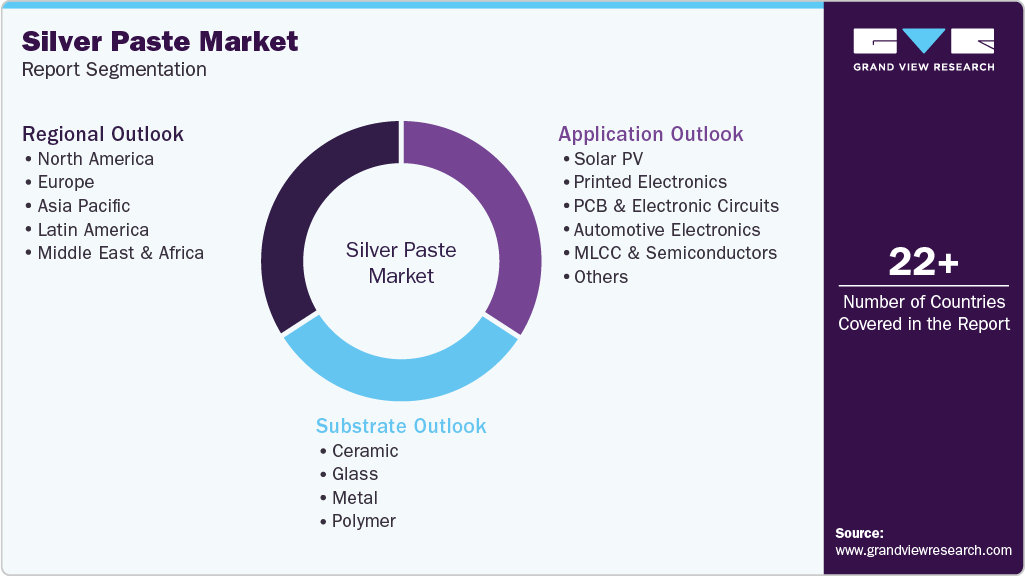
This report forecasts revenue growth at the global, country, and regional levels and provides an analysis of the latest trends in each of the sub-segments from 2021 to 2033. For this study, Grand View Research has segmented the global silver paste market report by substrate, application, and region:
 To learn more about this report, Download Free Sample Report
 -
Substrate Outlook (Revenue, USD Million, 2021 - 2033)
-
Ceramic
-
Glass
-
Metal
-
Polymer
-
-
Application Outlook (Revenue, USD Million, 2021 - 2033)
-
Solar PV
-
Printed Electronics
-
PCB & Electronic Circuits
-
Automotive Electronics
-
MLCC & Semiconductors
-
Others
-
-
Regional Outlook (Revenue, USD Million, 2021 - 2033)
-
North America
-
U.S.
-
Canada
-
Mexico
-
-
Europe
-
Germany
-
France
-
UK
-
Italy
-
-
Asia Pacific
-
China
-
India
-
Japan
-
South Korea
-
Taiwan
-
-
Latin America
-
Brazil
-
-
Middle East & Africa
-
Saudi Arabia
-
UAE
-
South Africa
-
-
Frequently Asked Questions About This Report
Asia Pacific dominated with a 74.3% revenue share in 2025.
Latin America is the fastest-growing region over the forecast period.
The solar PV segment held the largest revenue share in 2025, while MLCC & semiconductors is the fastest-growing application.
The global silver paste market is expected to grow at a CAGR of 7.3% from 2026 to 2033, reaching USD 9.1 billion by 2033.
In 2025, the ceramic segment captured the highest revenue share of 46.9%, primarily supported by its extensive utilization across electronic components, industrial applications, and advanced materials manufacturing.
Key players include artience Co., Ltd.; Daejoo Electronic Materials; Dongjin Semichem; DuPont; Giga Solar Materials Corporation; Henkel; Heraeus; Namics Corporation; Noritake Co., Limited; Samsung SDI.
The global silver paste market size was valued at USD 5.1 billion in 2025 and is estimated at USD 5.5 billion for 2026.
The silver paste market is gaining momentum primarily due to the rapid expansion of the photovoltaic (solar) industry and increasing adoption of high-efficiency cell technologies such as TOPCon and HJT.
About the Author(s)
Advanced Interior Materials Research Team
Advanced Materials · Advanced Interior MaterialsThis report was authored by the advanced interior materials research team at Grand View Research - comprising two research analysts, one senior research analyst, and one industry expert - with specialized expertise in the advanced interior materials segment of the advanced materials industry. All findings are based on proprietary advanced materials databases, executive interviews, and regulatory analysis, subject to internal peer review prior to publication.
Last Updated:
Speak to Analyst

Customize this report to your needs - add regions, segments, or data points, with 20% free customization.
Or view our licence options:


ISO 9001:2015 & 27001:2022 Certified
We are GDPR and CCPA compliant! Your transaction & personal information is safe and secure. For more details, please read our privacy policy.


