
- Home
- »
- Clothing, Footwear & Accessories
- »
-
Skateboard Market Size, Share & Trends Report, 2026-2033GVR Report cover

Skateboard Market (2026 - 2033)
Size, Share & Trends Analysis Report By Product (Street Board, Cruiser Board, Longboard, Electric Board), By End Use (Kids (0-9), Teenagers (12-17), Adults (18 & above)), By Region, And Segment Forecasts
Market Size, 2025
$3.7BMarket Estimate, 2026
$3.8BMarket Forecast, 2033
$4.6BCAGR, 2026–2033
3.0%Skateboard Market Summary
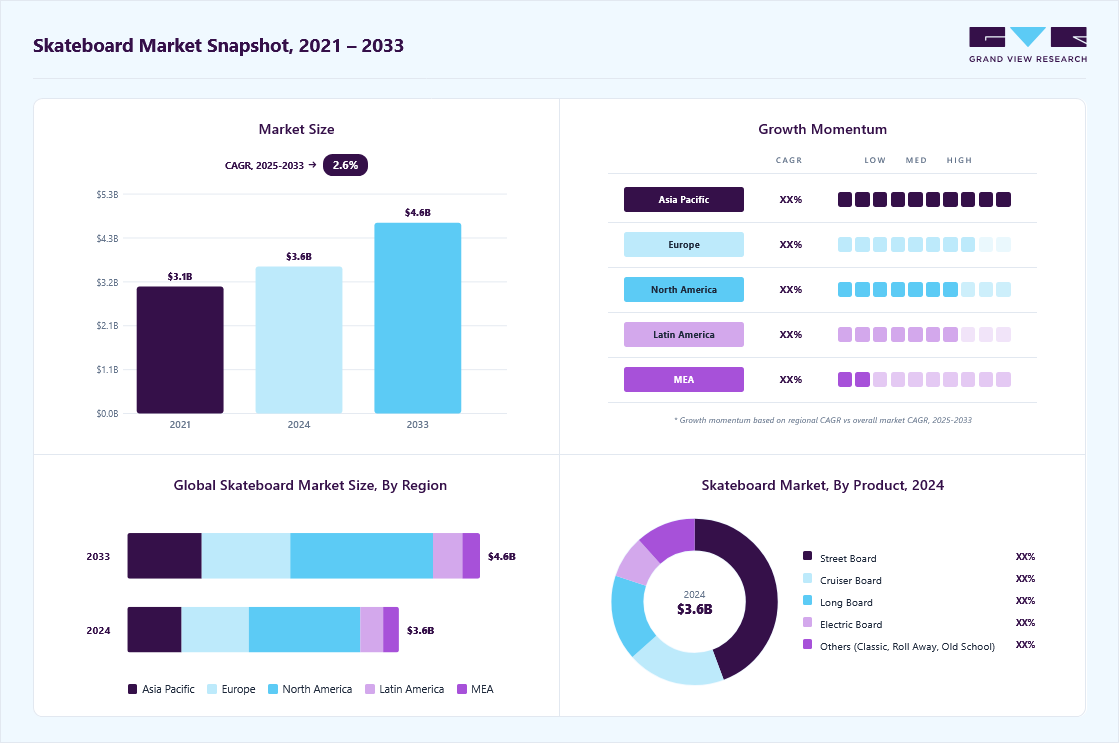
The global skateboard market size was valued at USD 3.7 billion in 2025 and is projected to grow from USD 3.8 billion in 2026 to USD 4.6 billion by 2033, at a CAGR of 3.0% from 2026 to 2033. North America dominated the market, accounting for a revenue share of 41.0% in 2025. Market growth is supported by continued participation in skateboarding among younger consumers, the sport’s integration into mainstream competitive events, and its sustained connection with street culture and digital media.
 Source: Grand View Research, IR Documents, Primary Interviews, Paid DatabasesTo learn more about this report,
 Download Free Sample Report
 Key Market Trends & Insights
- By product: Street board led the market with the largest revenue share of 44.2% in 2025.
- By end use: Teenagers (12-17) led the market with the largest revenue share of 43.4% in 2025.
Regional Highlights
- Largest regional market: North America (41.0% revenue share, 2025)
- Fastest-growing regional market: Asia Pacific (fastest CAGR, 2026-2033)
- By country: The U.S. held the largest market share in 2025
Market Size & Forecast
- Market size in 2025: USD 3.7 Billion
- Estimated market size in 2026: USD 3.8 Billion
- Projected market size by 2033: USD 4.6 Billion
- CAGR (2026-2033): 3.0%
Three ways to get this report
Buy it, customize it, or ask a question.Ask an Analyst
Analyst response in 1 business day
- AccessReport author, directly
- Reply timeWithin 1 working day
- No sales callDirect answer only
- FormatEmail reply
- CostFree, no cost
Get the Full Report
What the study covers
- FormatsPDF · Excel · Dashboard
- Timeline2026–2033 annual, 2025 base
- Coverage20+ countries, 5 regions
- Companies10+ key players profiled
Customize the Report
20% free customization
- IncludeCountries, segments, points
- TailorTo your product definition
- ExtendDeeper competitor detail
- OrA fully bespoke study
- Turnaround5–10 working days
The skateboard industry is evolving alongside broader changes in youth recreation, action sports, and urban lifestyle culture. World Skate reports more than 85 million skateboarding participants globally, while skateboarding’s inclusion in the 2028 Los Angeles Olympic Games is expected to maintain visibility around the sport and related equipment. Product development is also broadening the range of skateboarding equipment available to consumers. Manufacturers continue to refine deck shapes, materials, wheel configurations, and component performance, while sustainability is emerging as an area of experimentation. In February 2024, Mondi partnered with Olympic skateboarder Julia Brückler to demonstrate the strength and recyclability of containerboard through a fully functional half-pipe, illustrating how skateboarding is also being used to showcase alternative material applications.
 To learn more about this report, Download Free Sample Report
 Online retail has improved access to complete boards, decks, trucks, wheels, bearings, protective equipment, and replacement components, while collaborations with fashion, music, and entertainment brands are connecting skateboarding with wider consumer culture. In July 2024, Welcome Skateboards launched a limited-edition collaboration with Britney Spears featuring custom skate decks and apparel, demonstrating how licensed designs can introduce skateboarding products to audiences beyond dedicated skaters.
Urban infrastructure is another important part of the skateboard ecosystem, as skate parks, public recreation spaces, and purpose-built facilities provide venues for participation and organized events. Government-supported recreation programs can also contribute to access; for example, California State Parks included skate parks among the recreational amenities eligible for funding under its 2025 outdoor recreation grant programs. In addition, electric skateboards and other technology-enabled board formats are extending the category toward personal mobility. However, these products represent a distinct segment from traditional skateboards and should be evaluated separately when assessing the core skateboard market.
Market Dynamics
The skateboard market is shaped by evolving participation patterns, changing consumer preferences, product innovation, and the expanding role of skateboarding within sports and urban culture. Greater youth participation, Olympic visibility, digital engagement, e-commerce accessibility, and developments in board design are influencing how consumers discover, purchase, and use skateboarding products. At the same time, factors such as product costs, safety considerations, infrastructure availability, and regulatory requirements can affect adoption across markets. The following section examines the key drivers, restraints, and opportunities influencing the market.
Growing participation in skateboarding is supporting demand for complete boards, replacement decks, wheels, trucks, bearings, and protective equipment. The sport has also moved beyond its traditional street-culture base into organized competitions and mainstream sporting events. Its inclusion in the Olympic Games has increased international visibility, while youth-focused programs and community events are creating additional entry points for new participants. In 2025, Stapleford, UK, secured funding for a skatepark designed around both street and park skateboarding disciplines, following extensive consultation with local young people. Such projects can improve access to dedicated facilities and support participation at the community level.
Digital platforms are further changing how skateboarding is discovered and consumed. Short-form video, athlete content, online skate communities, and brand-led media allow tricks, competitions, and product demonstrations to reach audiences beyond established skateboarding communities. This visibility can influence equipment preferences and encourage first-time participation, particularly among younger consumers. The commercial effect extends across both specialist skateboard brands and mainstream sporting goods retailers, as consumers increasingly encounter skateboarding through sports content, entertainment, and lifestyle media rather than only through dedicated skate shops.
Safety considerations can limit participation, particularly among younger or inexperienced riders. Falls, collisions, and loss of control remain inherent risks, creating demand for helmets and protective equipment while potentially discouraging some consumers from taking up the activity. The U.S. Consumer Product Safety Commission specifically recommends helmets and other protective equipment for skateboarders and highlights risks associated with traffic, excessive speed, and unsuitable riding surfaces. Limited access to appropriate skateboarding areas can further restrict participation in locations without dedicated facilities.
Investment in dedicated skateboarding facilities provides an opportunity to expand participation and create recurring demand for equipment. Municipalities are increasingly incorporating skate parks into broader recreational and youth-development programs, creating spaces for both recreational users and organized activities. These investments can strengthen local skateboarding ecosystems by improving accessibility and providing purpose-built environments for different skill levels. Manufacturers can address distinct consumer requirements through street, park, cruiser, longboard, and specialized performance configurations, while developments in materials, component design, and electric propulsion are broadening the wider skateboard category. Electric skateboards, in particular, connect skateboarding with personal mobility, although they should be assessed separately from conventional boards when measuring the core market. This product differentiation allows manufacturers and retailers to serve recreational users, experienced skaters, commuters, and lifestyle-oriented consumers through increasingly specialized product portfolios.
Analyst Perspective
The skateboard market is evolving as skateboarding gains wider acceptance as a recreational, competitive, and lifestyle activity across age groups. Demand is supported by growing participation in outdoor and action sports, urban recreation, and the visibility of organized competitions and the Olympic platform. Manufacturers are focusing on deck materials, wheel compounds, truck designs, and board configurations to improve performance across riding styles. Electric skateboards are creating a new category by combining recreation and short-distance personal mobility. Product durability, safety, design, and price remain important purchasing factors. Future market development will depend on participation trends, product innovation, urban recreational infrastructure, and expanding adoption among younger and emerging consumer groups.
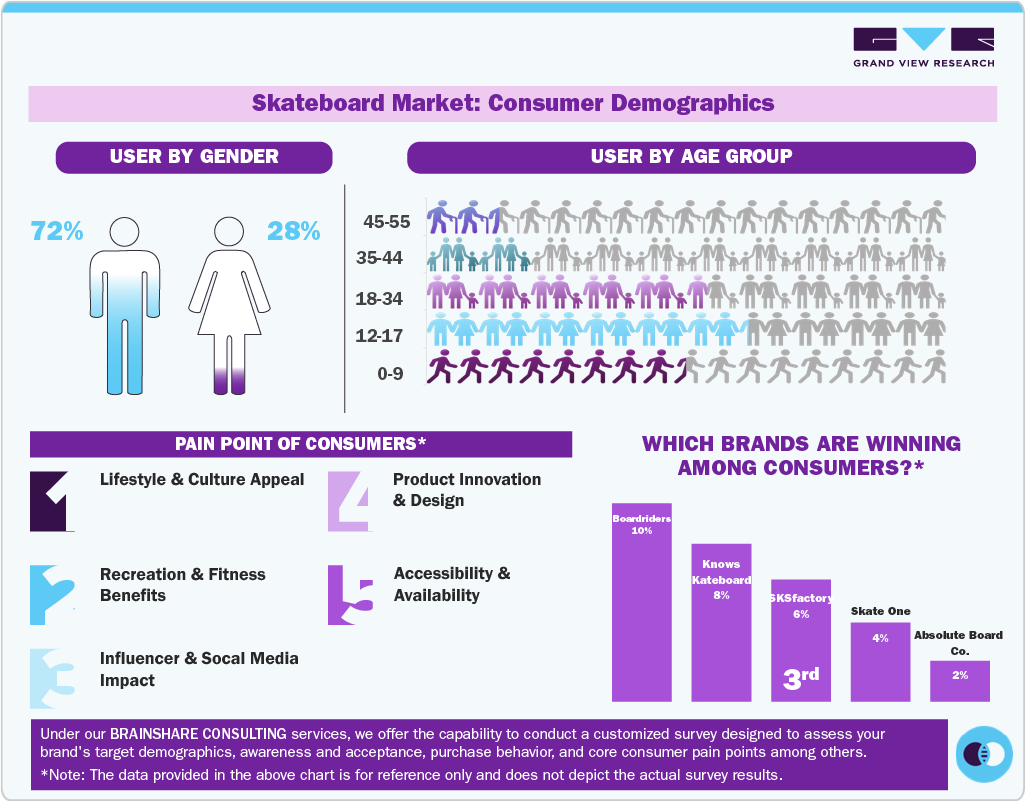
Consumer Insights for Skateboard
 To learn more about this report, Download Free Sample Report
 Product Insights
The street board segment accounted for the largest revenue share at 44.2% in 2025, driven by the growing popularity of urban sports and lifestyle-oriented recreational activities, particularly among younger consumers. Greater exposure through digital media, video-sharing platforms, and international sporting events is increasing awareness and participation. The influence of streetwear culture, athlete and influencer collaborations, and evolving board designs is further supporting consumer interest. At the product level, improvements in deck materials, including lighter and more durable constructions, are enhancing riding performance and usability. Wider availability through e-commerce platforms is also making skateboards more accessible to consumers across regional markets.
 To learn more about this report, Download Free Sample Report
 The electric board segment is anticipated to grow at the fastest CAGR of 3.5% over the forecast period. Increasing interest in convenient personal mobility, particularly for short-distance urban travel, is creating additional demand beyond traditional recreational use. Improvements in battery technology, motor performance, and lightweight materials are enhancing range, handling, and overall usability. Smart features, including Bluetooth connectivity and mobile application controls, are further expanding product functionality. In July 2024, Future Motion Inc. (Onewheel) introduced the “GT-S Series Rally Edition,” featuring a 6-inch central hub motor, larger tire, and Recurve Rails geometry designed for off-road use. The model can also be controlled through the Onewheel mobile application.
End Use Insights
The teenagers (12-17) segment dominated the skateboard industry, accounting for a revenue share of 43.4% in 2025. Skateboarding continues to attract teenagers as both a recreational activity and a lifestyle expression, with social media and influencer content playing an important role in shaping interest. Exposure to tricks, street culture, and skateboarding communities through digital platforms is encouraging greater participation. School clubs, local competitions, and events such as the X Games further provide opportunities for engagement. Product aesthetics also influence purchasing preferences, with colorful graphics, innovative designs, and customizable boards adding to their appeal. Wider availability through online stores and retail outlets, combined with relatively affordable pricing, is further expanding access among teenage consumers.
 To learn more about this report, Download Free Sample Report
 The kids (0-9) segment is projected to grow at the fastest CAGR of 3.2% over the forecast period. Growing parental interest in outdoor activities and skill development is encouraging participation among younger children. Beginner-friendly boards with safety-oriented features can make the activity more approachable, while marketing through cartoons, toys, and educational content helps introduce skateboarding to this age group. Community programs, sports camps, and child-friendly skate parks also provide structured environments for learning and social interaction. Rising household disposable income is supporting spending on recreational activities and related equipment, creating additional opportunities for the segment.
Regional Insights
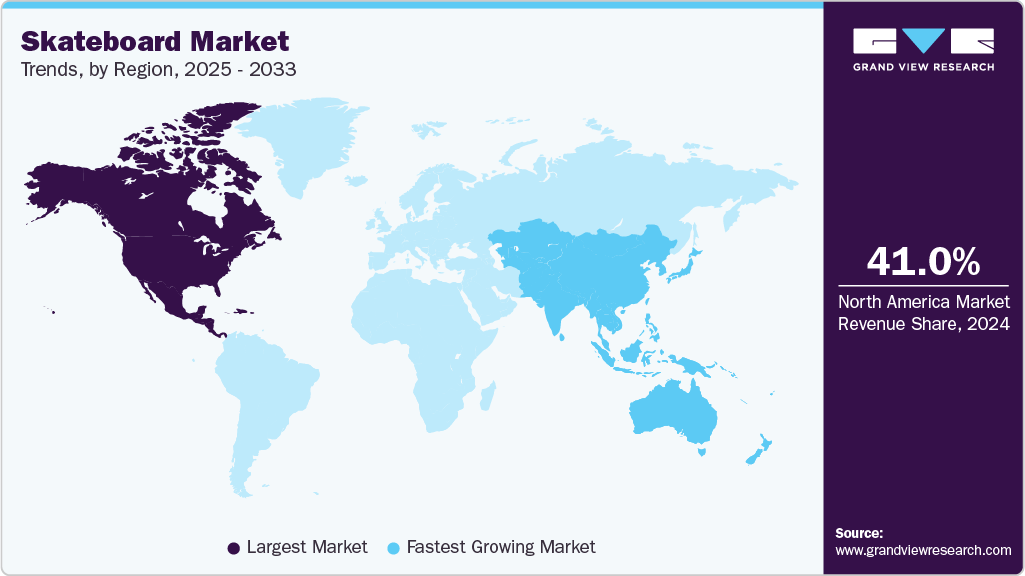
North America dominated the skateboard market with a revenue share of 41.0% in 2025. A strong youth culture and the widespread popularity of extreme sports drive the North America market. High media exposure through skateboarding events, movies, and social media campaigns fuels consumer interest. Established retail chains and specialized skate shops improve product accessibility. Investment in urban infrastructure, including skate parks and recreational zones, encourages participation. Collaborations between skateboard brands and entertainment or fashion sectors further strengthen brand visibility and adoption.
 To learn more about this report, Download Free Sample Report
 The U.S. skateboard market held the largest share of the North America market in 2025-a trend that benefits from government and private initiatives promoting youth sports and outdoor activities. Skateboarding's inclusion in the Olympics has boosted mainstream appeal. Advances in board materials and safety equipment attract beginners and enthusiasts. Community events, competitions, and skateboarding clubs foster growth, while interest in sustainable, eco-friendly boards is shaping consumer preferences.
Europe Skateboard Market Trends
The Europe skateboard industry accounted for 24.8% of global revenue in 2025. The regional market is supported by increasing urbanization and the development of city-based recreational spaces, while growing cultural acceptance of skateboarding as both a sport and lifestyle encourages participation across age groups. E-commerce platforms and cross-border retail networks are also improving product availability. Festivals, exhibitions, and street sports competitions provide additional exposure and attract new participants. In June 2024, Santa Cruz Skateboards and Jägermeister collaborated to launch a limited three-piece capsule collection of skateboards and apparel centered on a reissue of the “Kendall Deck,” highlighting the continued intersection of skateboarding, fashion, and lifestyle branding.
Asia Pacific Skateboard Market Trends
The Asia Pacific skateboard industry is projected to grow at the fastest CAGR of 3.6% from 2026 to 2033. The Asia Pacific skateboard industry is driven by rapid urban development and growing youth populations across the region. Rising disposable incomes and the adoption of Western lifestyle trends increase demand for recreational sports products. Social media and digital campaigns targeting teenagers are fueling awareness and aspiration. Expansion of skate parks and urban sports infrastructure supports active participation. Collaborations with local influencers and celebrity endorsements enhance brand penetration and popularity.
Key Skateboard Company Insights
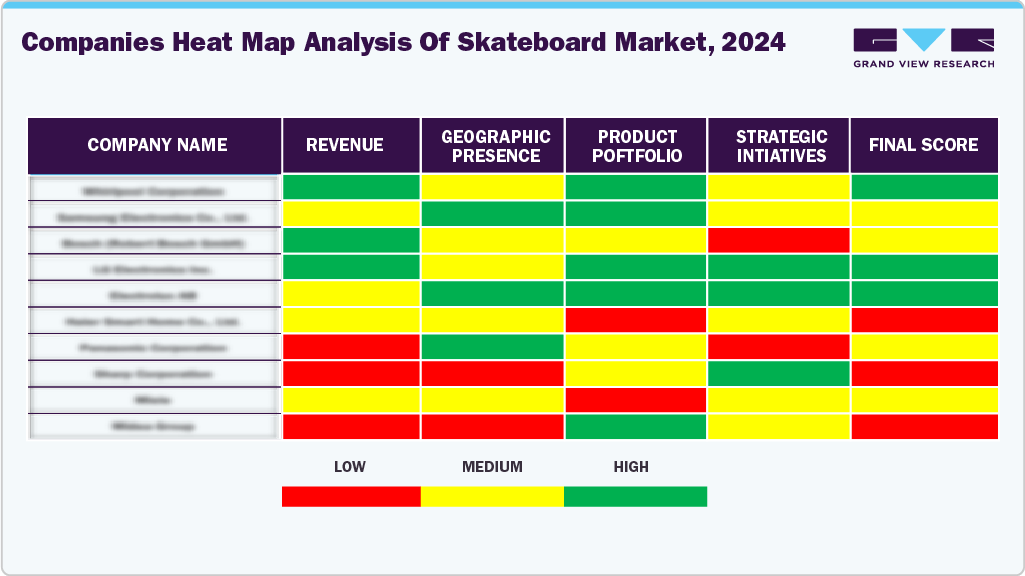
The skateboard market is exploring new growth opportunities by expanding product designs, customization options, and marketing approaches in line with changing consumer preferences. A greater focus on niche rider groups, lifestyle trends, and emerging product categories is helping companies broaden their customer base, strengthen brand engagement, and expand their presence in international markets.
 To learn more about this report, Download Free Sample Report
  To learn more about this report, Download Free Sample Report
 Key Skateboard Companies
The following key companies have been profiled for this study on the skateboard market.
-
Sk8factory
Recent Developments
-
In September 2026, Santa Cruz Skateboards announced a limited-edition collaboration with Pokémon Trading Card Game, featuring blind-bag skateboard decks and apparel. The collection includes 30 different deck designs based on Pokémon TCG card artwork, with additional limited-edition variants, reflecting the continued use of entertainment and pop culture collaborations.
-
In April 2026, Welcome Skateboards launched a collaboration with Slipknot featuring custom skateboard decks with prism light effects and candy-shell finishes. The collection combined original Slipknot-inspired artwork with customized deck designs.
Skateboard Market Report Scope Table
Report Attribute
Details
Market size in 2025
USD 3.7 billion
Estimated market size in 2026
USD 3.8 billion
Projected market size by 2033
USD 4.6 billion
Growth rate
CAGR of 3.0% from 2026 to 2033
Actual data
2021 - 2025
Forecast period
2026 - 2033
Quantitative units
Revenue in USD million/billion and CAGR from 2026 to 2033
Report coverage
Revenue forecast, company ranking, competitive landscape, growth factors, and trends
Segments covered
Product, end use, and region
Country scope
U.S.; Canada; Mexico; Germany; UK; France; Italy; Spain; China; Japan; India; South Korea; Australia & New Zealand; Brazil; South Africa
Key companies profiled
Absolute Board Co.; Alien Workshop; Boardriders; Control MFG; Krown Skateboards; Razor USA LLC; Sk8factory; Skate One; Zero Skateboards
Customization scope
Free report customization (equivalent up to 8 analysts' working days) with purchase. Addition or alteration to country, regional & segment scope.
Pricing and purchase options
Avail customized purchase options to meet your exact research needs. Explore purchase options
Global Skateboard Market Report Segmentation
This report forecasts revenue growth and provides an analysis of the latest trends in each of the sub-segments from 2021 to 2033. For this study, Grand View Research has segmented the skateboard market report based on product, end use, and region:
 To learn more about this report, Download Free Sample Report
 -
Product Outlook (Revenue, USD Million/Billion, 2021 - 2033)
-
Street Board
-
Cruiser Board
-
Longboard
-
Electric Board
-
Others (Classic, Roll Away, Old School)
-
-
End Use Outlook (Revenue, USD Million/Billion, 2021 - 2033)
-
Kids (0-9)
-
Teenagers (12-17)
-
Adults (18 & above)
-
-
Regional Outlook (Revenue, USD Million/Billion, 2021 - 2033)
-
North America
-
U.S.
-
Canada
-
Mexico
-
-
Europe
-
UK
-
Germany
-
France
-
Italy
-
Spain
-
-
Asia Pacific
-
China
-
India
-
Japan
-
Australia & New Zealand
-
-
Latin America
-
Brazil
-
-
Middle East & Africa
-
UAE
-
South Africa
-
-
Research Methodology
The skateboard market figures in this report are based on a proven research process that combines executive interviews with secondary research from proprietary databases, company filings, and recognized regulatory and institutional sources. Market size is built through value-chain sizing - reconciling supply-side and demand-side estimates - and triangulated with bottom-up and top-down approaches. Every estimate passes multiple levels of expert validation before publication, with each skateboard segment quantified using the revenue-capture definitions in the table below.
Segment Definition
Segment - Product
Revenue capture definition
Street Board
In the largest skateboard product segment, revenue is primarily generated through sales of versatile skateboards designed for street skating, tricks, skate parks, and competitive skateboarding.
Cruiser Board
Revenue is generated from the sale of compact, maneuverable skateboards designed for casual riding, short-distance travel, and urban commuting.
Longboard
Revenue is primarily generated from sales of extended-deck skateboards for cruising, downhill riding, carving, and long-distance recreational transportation.
Electric Board
Revenue is generated from the sale of battery-powered skateboards equipped with electric motors, advanced control systems, and smart mobility features for recreational and commuting purposes.
Others
This segment captures revenue from specialty and traditional skateboard types, including classic skateboards, roll-away boards, old-school designs, collector models, and niche recreational boards.
Estimation Model
Population Layer
Access Layer
Behavioural Layer
Monetisation Layer
Who forms the base consumer pool?
Who has access to skateboard products?
Who actively purchases skateboards?
How much revenue is generated?
Total potential skateboard participants, including recreational riders, sports enthusiasts, commuters, youth consumers, and lifestyle users across urban and suburban markets, adjusted for age demographics, disposable income, and access to outdoor recreational activities.
Consumers with access to organized sporting goods retailers, skate shops, e-commerce platforms, specialty action-sports stores, and direct-to-consumer skateboard brands across developed and emerging markets.
Active skateboard buyers are based on participation frequency, equipment replacement cycles, skill progression, and usage across street boards, cruiser boards, longboards, electric boards, and specialty skateboard categories.
Revenue is derived by multiplying the number of active skateboard purchasers by the average annual spending per consumer, including skateboard purchases, upgrades, accessories, replacement components, protective gear, and premium performance products across all skateboard segments.
Delivered Customizations
This report has been delivered with the following In-depth customizations
Client Request
Customization Delivered
Value Adds
Cross-Segment Market Structuring (Product × End User Mapping)
Developed an integrated assessment of skateboard demand across product categories (street boards, cruiser boards, longboards, electric boards, others), mapped against end-user segments (kids, teenagers, adults), capturing differences in usage intensity, participation patterns, and monetization potential.
Enables visibility into how value is distributed across product and age cohorts, highlighting high-volume participation in teenagers and higher ASP-driven demand in adults.
End-User Behavior & Participation Analysis
Evaluated behavioral differences across user groups, with kids driven by entry-level recreational adoption, teenagers forming the core active skating base, and adults contributing to premium and utility-led purchases such as longboards and electric skateboards.
Provides insights into cohort-specific demand drivers, including trend-led engagement among teenagers, learning-driven adoption among kids, and mobility-oriented consumption among adults.
Channel & Purchase Driver Assessment
Assessed how skateboard purchasing is shifting across channels (specialty stores, mass retail, and e-commerce/DTC platforms), alongside key purchase drivers such as brand influence, social media exposure, and community-led adoption.
Highlights the increasing role of digital-first discovery and DTC ecosystems in driving conversion, while identifying channel-specific opportunities to improve engagement, brand loyalty, and repeat purchases.
Frequently Asked Questions About This Report
The street board market accounted for a revenue share of 44.2% in 2025, driven by rising youth participation in action sports and the growing influence of social media culture, the street board (skateboard) market is seeing strong momentum.
Key factors driving growth in the skateboard market include increasing youth engagement in action and adventure sports and the rising popularity of skateboarding as a mainstream recreational activity. Expanding urban skate parks, supportive government initiatives promoting outdoor sports, and stronger representation in global events such as the Olympics are further boosting demand.
The global skateboard market size was estimated at USD 3.7 billion in 2025 and is expected to reach USD 3.8 billion in 2026.
The global skateboard market is expected to grow at a compound annual growth rate (CAGR) of 3.0% from 2026 to 2033 to reach USD 4.6 billion by 2033.
North America dominated with a 41.0% revenue share in 2025.
Some key players operating in the skateboard market include Absolute Board Co., Alien Workshop, Boardriders, Control MFG, Krown Skateboards, Razor USA LLC, Sk8factory, Skate One, and Zero Skateboards.
Asia Pacific is the fastest-growing region over the forecast period.
Teenagers (12-17) held the largest share of 43.4% in 2025 and Kids (0-9) are the fastest growing end user.
U.S. dominated the North America skateboard market in 2025.
About the Author(s)
Clothing, Footwear & Accessories Research Team
Consumer Goods · Clothing, Footwear & AccessoriesThis report was authored by the clothing, footwear & accessories research team at Grand View Research - comprising two research analysts, one senior research analyst, and one industry expert - with specialized expertise in the clothing, footwear & accessories segment of the consumer goods industry. All findings are based on proprietary consumer goods databases, executive interviews, and regulatory analysis, subject to internal peer review prior to publication.
Last Updated:
Speak to Analyst

Customize this report to your needs - add regions, segments, or data points, with 20% free customization.
Or view our licence options:


ISO 9001:2015 & 27001:2022 Certified
We are GDPR and CCPA compliant! Your transaction & personal information is safe and secure. For more details, please read our privacy policy.


