
- Home
- »
- Next Generation Technologies
- »
-
Smart Cleaning And Hygiene Market Size Report, 2026-2033GVR Report cover
![Smart Cleaning And Hygiene Market (2026 - 2033)Report]()
Smart Cleaning And Hygiene Market (2026 - 2033)
Size, Share & Trends Analysis Report By Product, By Distribution Channel (Direct, Indirect), By End-use (Residential, Commercial, Healthcare, Industrial, Institutional & Public Facilities), By Region, And Segment Forecasts
Market Size, 2025
$5.3BMarket Estimate, 2026
$5.9BMarket Forecast, 2033
$13.7BCAGR, 2026–2033
12.7%Smart Cleaning and Hygiene Market Summary
The global smart cleaning and hygiene market size was valued at USD 5.3 billion in 2025 and is projected to grow from USD 5.9 billion in 2026 to USD 13.7 billion by 2033, at a CAGR of 12.7% from 2026 to 2033. North America dominated the market, accounting for the largest revenue share of 42.4% in 2025. The market growth is primarily driven by the increasing deployment of AI-enabled cleaning management platforms, rising demand for autonomous robotic scrubbers and vacuums, rapid adoption of IoT-connected smart dispensing systems, and heightened regulatory emphasis on automated hygiene standards across healthcare and commercial environments.

Key Market Trends & Insights
- By product: Smart floor & surface cleaning equipment segment held the largest revenue share of over 46% in 2025.
- By distribution channel: Indirect segment accounted for the largest revenue share in 2025.
- By end use: Residential segment dominated the market in 2025.
Regional Highlights
- Largest regional market: North America (42.4% revenue share in 2025)
- Fastest growing regional market: Asia Pacific (highest CAGR, 2026-2033)
- By Country: The U.S. held the largest market share in 2025.
Market Size & Forecast
- Market size in 2025: USD 5.3 Billion
- Estimated market size in 2026: USD 5.9 Billion
- Projected market size by 2033: USD 13.7 Billion
- CAGR (2026-2033): 12.7%
The smart cleaning and hygiene industry growth is driven by the increasing need for demand-based sanitation models, labor cost optimization, and real-time monitoring of facility cleanliness. The adoption of modern autonomous cleaning robots, touchless sensor-based dispensers, and cloud-connected hygiene management platforms is accelerating as hospitals, airports, hotels, corporate offices, and residential spaces seek efficient, hygienic, and scalable sanitation operations.In addition, rapid advancements in artificial intelligence, computer vision, autonomous navigation, sensor technologies, cloud connectivity, and machine learning are driving innovation across the smart cleaning and hygiene industry. Manufacturers are integrating LiDAR, cameras, ultrasonic sensors, real-time mapping, dirt detection, occupancy sensing, automated chemical dispensing, UV-C disinfection, predictive maintenance, and fleet-management software to improve cleaning accuracy and operational efficiency.

Furthermore, ongoing enhancements in autonomous mobility, battery technology, edge computing, robotic navigation, and multi-sensor fusion are enabling smart cleaning equipment to operate across increasingly complex environments. Advanced robots can independently navigate large commercial facilities, avoid obstacles, identify high-traffic areas, adjust cleaning intensity, automatically return to charging stations, and share operational data via centralized platforms. Integration with building-management systems, occupancy analytics, access-control systems, and cloud-based facility-management platforms is further increasing the value of connected cleaning solutions and supporting the development of integrated smart-building hygiene ecosystems.
Moreover, increasing adoption of automated cleaning solutions across healthcare, hospitality, retail, transportation, education, food processing, and industrial facilities is creating significant demand for specialized smart hygiene technologies. Healthcare providers are increasingly adopting automated disinfection and cleaning systems to improve infection prevention, while hotels, airports, shopping centers, and offices are deploying robotic cleaning systems to maintain large facilities with limited labor availability. These factors are expected to further drive smart cleaning and hygiene industry growth in the coming years.
Market Dynamics
The smart cleaning and hygiene market is experiencing significant growth, driven by increasing demand for automated cleaning solutions, rising labor costs and workforce shortages, growing hygiene awareness, and rapid adoption of artificial intelligence, robotics, IoT, and connected facility-management technologies. The increasing use of robotic floor cleaners, smart vacuum and mopping systems, automated window-cleaning equipment, intelligent disinfection systems, smart restroom solutions, and connected cleaning-management platforms is creating strong demand across residential, commercial, healthcare, industrial, and institutional environments.
The growing emphasis on operational efficiency, hygiene consistency, and workforce productivity is increasing the adoption of autonomous cleaning technologies across commercial, healthcare, industrial, institutional, and residential environments. Increasing labor costs and difficulties in recruiting and retaining cleaning personnel are particularly encouraging hotels, hospitals, airports, shopping centers, warehouses, manufacturing facilities, and large office buildings to invest in robotic cleaning equipment and connected cleaning-management platforms.
The expansion of smart-building infrastructure and digital facility-management systems is further strengthening demand for connected cleaning solutions. Facility operators are increasingly integrating cleaning equipment with IoT platforms, occupancy sensors, building-management systems, and centralized dashboards to optimize cleaning frequency based on real-time usage patterns. Growing awareness of infection prevention, workplace safety, indoor environmental quality, and hygiene compliance is also encouraging healthcare and institutional users to adopt automated disinfection, smart restroom monitoring, touchless dispensing, and hygiene-management technologies.
Smart cleaning and hygiene equipment typically incorporates advanced robotics, sensors, cameras, LiDAR, AI software, connectivity modules, automated docking systems, and specialized batteries, resulting in higher upfront acquisition costs compared with conventional cleaning equipment. These costs can limit adoption among small businesses, residential consumers in price-sensitive markets, and smaller institutional facilities with constrained capital budgets. In addition, organizations may incur additional expenses related to software subscriptions, equipment integration, staff training, maintenance, replacement parts, and connectivity infrastructure, increasing the total cost of ownership.
The increasing integration of artificial intelligence, autonomous robotics, computer vision, IoT connectivity, advanced batteries, cloud computing, and sustainable cleaning technologies is creating new opportunities for smart cleaning and hygiene manufacturers. Companies are increasingly developing intelligent systems capable of autonomous navigation, real-time environment recognition, adaptive cleaning, automated chemical dispensing, predictive maintenance, and performance analytics. These capabilities can enable cleaning providers and facility managers to optimize labor deployment, reduce water and chemical consumption, improve equipment utilization, and deliver measurable hygiene outcomes.
Market Concentration & Characteristics
The smart cleaning and hygiene market is fragmented, characterized by the presence of established cleaning-equipment manufacturers, consumer robotics companies, professional hygiene providers, autonomous robotics specialists, smart-home technology companies, and facility-management technology providers competing across residential, commercial, healthcare, industrial, and institutional applications. The market is characterized by a high degree of technological innovation, supported by continuous advancements in AI-enabled navigation, computer vision, IoT connectivity, autonomous mobility, sensor fusion, smart dispensing, disinfection technologies, predictive maintenance, and cloud-based cleaning-management platforms.
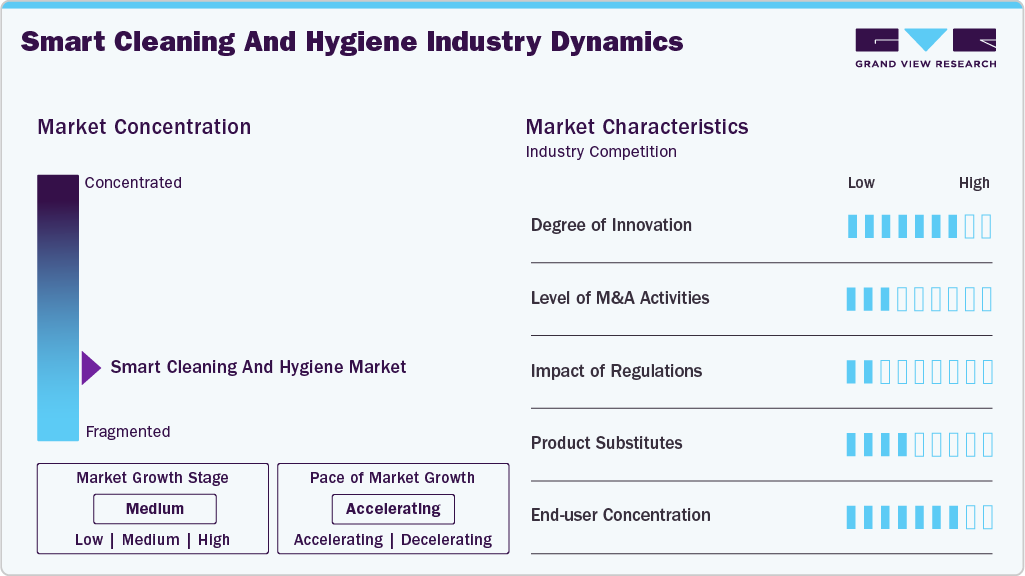
Strategic partnerships with facility-management companies, healthcare providers, hospitality groups, retailers, airports, industrial organizations, distributors, and technology providers are enabling companies expand applications and geographic reach. Competition is increasing across autonomous cleaning robots, conventional equipment, outsourced cleaning services, and smart hygiene technologies, with commercial and institutional robotics emerging as a key competitive area. The market is expected to see increasing adoption of AI-enabled autonomous cleaning, connected hygiene systems, smart disinfection, robotic floor scrubbers, intelligent dispensing, and data-driven facility management.
Analyst Perspective
The smart cleaning and hygiene market is shaped by the convergence of cleaning automation, robotics, IoT connectivity, touchless hygiene, AI-enabled monitoring, labor optimization, and growing demand for efficient, sustainable, and data-driven facility management solutions. Increasing adoption across residential, commercial, healthcare, industrial, and institutional environments is further supported by rising hygiene standards, workforce constraints, and the need to improve cleaning consistency, operational efficiency, and resource utilization.
Product Insights
The smart floor & surface cleaning equipment segment accounted for the largest revenue share of over 46.0% in 2025, supported by rising demand for automated and efficient cleaning solutions, increasing adoption of robotic vacuum cleaners, scrubbers, and autonomous floor-cleaning equipment, and growing awareness of hygiene and sanitation across residential, commercial, healthcare, hospitality, and institutional facilities. The integration of smart technologies such as sensors, IoT connectivity, AI-based navigation, automated scheduling, and real-time monitoring has further enhanced the efficiency, convenience, and reliability of these solutions, encouraging their adoption among end users seeking to reduce labor requirements and improve cleaning performance.
The smart cleaning & hygiene management solutions segment is expected to witness the fastest CAGR of over 14% from 2026 to 2033, fueled by growing adoption of IoT- and AI-enabled hygiene management systems, increasing demand for real-time monitoring and data-driven cleaning optimization, and rising emphasis on maintaining high hygiene standards across commercial, healthcare, hospitality, educational, and institutional facilities. These solutions enable automated monitoring of cleaning activities, occupancy-based scheduling, supply-level tracking, predictive maintenance, and performance analytics, helping organizations improve operational efficiency while reducing cleaning costs and resource consumption.
Distribution Channel Insights
The indirect segment accounted for the largest market share in 2025, driven by the widespread presence of distributors, wholesalers, retailers, and specialized cleaning-equipment dealers, which provide manufacturers with broader geographic reach, established customer networks, product availability, and after-sales support. The indirect channel is particularly important for smart cleaning equipment as customers often rely on local distributors and specialized dealers for product demonstrations, installation, maintenance, and technical assistance, supporting higher adoption across commercial, institutional, and residential end users.
The direct segment is expected to witness highest CAGR from 2026 to 2033, fueled by the increasing adoption of e-commerce and manufacturer-owned online sales platforms, growing preference for direct purchasing, and manufacturers' efforts to strengthen customer relationships and provide customized solutions, installation, software updates, and after-sales services. The direct channel also enables manufacturers to collect customer and usage data, offer subscription-based services, and provide tailored smart cleaning and hygiene solutions, making it increasingly attractive as digital purchasing and connected-product ecosystems expand.
End Use Insights
The residential segment accounted for the largest market share in 2025, fueled by increasing consumer awareness of hygiene and cleanliness, rising adoption of smart home technologies, growing demand for convenient and time-saving cleaning solutions, and the increasing popularity of robotic vacuum cleaners and automated floor-cleaning devices. Rising disposable incomes and consumers' preference for connected home appliances that can be remotely monitored and controlled through smartphones and smart-home platforms are further supporting the adoption of smart cleaning solutions in residential settings.

The commercial segment is expected to grow from 2026 to 2033, driven by increasing hygiene and sanitation requirements across offices, healthcare facilities, hospitality venues, retail stores, educational institutions, and other commercial spaces, along with rising labor costs and the need to improve cleaning efficiency and consistency. Growing adoption of autonomous cleaning equipment, IoT-enabled monitoring, AI-based cleaning optimization, and data-driven facility management is encouraging businesses to deploy smart cleaning solutions to reduce operational costs, optimize workforce utilization, and maintain higher standards of cleanliness across large and frequently occupied facilities.
Regional Insights
North America smart cleaning and hygiene industry held the largest share of 42.4% in 2025, supported by high adoption of robotic cleaning equipment, connected hygiene systems, automated floor-care solutions, and advanced disinfection technologies across residential, commercial, healthcare, hospitality, industrial, and institutional facilities. Demand is driven by labor shortages, rising hygiene standards, growing smart-building adoption, and increasing investments in autonomous cleaning and facility-management technologies.

U.S. Smart Cleaning and Hygiene Market Trends
The smart cleaning and hygiene industry in U.S. dominated, with a share of 79.2% in 2025, driven by widespread adoption of robotic vacuum and floor-cleaning systems, autonomous commercial cleaning equipment, smart dispensers, and connected hygiene-management solutions across healthcare, hospitality, retail, offices, and industrial facilities.
Europe Smart Cleaning and Hygiene Market Trends
Europe smart cleaning and hygiene industry is expected to grow at a CAGR of 12.1% from 2026 to 2033. The market growth is supported by stringent hygiene and workplace safety standards, rising labor costs, sustainability initiatives, smart-building development, and increasing adoption of autonomous cleaning technologies across commercial and institutional facilities. The region has strong demand for robotic floor scrubbers, smart vacuuming systems, automated disinfection equipment, connected hygiene dispensers, and digital cleaning-management platforms, particularly across healthcare, hospitality, manufacturing, retail, and public infrastructure.
The smart cleaning and hygiene industry in UK is expected to grow significantly in the coming years, driven by the increasing adoption of robotic cleaning solutions across offices, hospitals, hotels, airports, and retail facilities, alongside demand for labor-efficient and sustainable hygiene technologies. The country's growing smart-building ecosystem and emphasis on workplace health, infection prevention, and environmental sustainability are further supporting market development.
Germany smart cleaning and hygiene industry is expanding rapidly, owing to its strong industrial and commercial cleaning-equipment sector, advanced manufacturing base, emphasis on automation, and growing adoption of autonomous cleaning robots and resource-efficient cleaning systems. The country's highly developed manufacturing, logistics, healthcare, hospitality, and commercial sectors are generating demand for automated floor scrubbers, industrial cleaning robots, smart vacuum systems, intelligent disinfection technologies, and connected cleaning-management platforms.
Asia Pacific Smart Cleaning and Hygiene Market Trends
The Asia-Pacific smart cleaning and hygiene industry is expected to grow at the fastest CAGR of 15.4% from 2026 to 2033, driven by rapid urbanization, expanding middle-class populations, increasing smart-home penetration, labor shortages, rising commercial infrastructure development, and growing awareness of hygiene and automation. The region is becoming a major hub for smart-cleaning robotics, supported by leading manufacturers and technology companies developing AI-enabled robotic vacuum cleaners, mopping systems, window-cleaning robots, autonomous commercial cleaning machines, and connected hygiene solutions.
Japan smart cleaning and hygiene industry is gaining traction, supported by the country’s advanced robotics ecosystem, aging population, labor shortages, high adoption of automation, and strong consumer acceptance of smart-home technologies. Increasing demand for labor-saving solutions across residential, healthcare, hospitality, commercial, and institutional facilities is encouraging the adoption of robotic vacuum cleaners, automated floor-cleaning systems, smart disinfection equipment, and connected hygiene-management technologies.
The smart cleaning and hygiene industry in China is expanding rapidly, with the country's large urban population, strong domestic robotics manufacturing ecosystem, expanding smart-home industry, rising consumer purchasing power, and increasing adoption of artificial intelligence and connected technologies supporting market development. China has emerged as a major hub for smart-cleaning robotics, with domestic companies developing robotic vacuum and mopping systems, window-cleaning robots, intelligent floor-cleaning equipment, and other autonomous cleaning technologies for both residential and commercial applications.
Key Smart Cleaning And Hygiene Company Insights
Some of the key players operating in the market are Alfred Kärcher SE & Co. KG and Ecolab, Inc. among others.
-
Alfred Kärcher SE & Co. KG is a German cleaning technology company that provides a comprehensive portfolio of professional and residential cleaning equipment, including high-pressure cleaners, vacuum cleaners, industrial vacuums, floor scrubbers, sweepers, steam cleaners, window and surface cleaning equipment, cleaning robots, detergents, and integrated cleaning systems. The company serves a broad range of applications across commercial, industrial, institutional, municipal, and residential environments, with a strong focus on efficient, resource-conserving and innovative cleaning technologies.
-
Ecolab Inc. is a global water, hygiene, and infection-prevention company that provides cleaning, sanitization, disinfection, hygiene-management, water-treatment, and food-safety solutions and services. Its offerings include cleaning chemicals, sanitizers and disinfectants, cleaning equipment, monitoring and data-driven solutions, training, and specialized hygiene programs for healthcare, hospitality, foodservice, food processing, industrial, institutional, and life-sciences customers. The company integrates science-based solutions, data-driven insights, AI technologies, and professional services to improve hygiene, operational efficiency, safety, and sustainability.
ECOVACS Robotics Co., Ltd. and Roborock Technology Co., Ltd. are some of the emerging and established market participants in the smart cleaning and hygiene market.
-
ECOVACS Robotics Co., Ltd. is a smart robotics company that provides intelligent cleaning and service-robot solutions, with a strong focus on automated residential cleaning. Its portfolio includes DEEBOT robotic vacuum and floor-cleaning systems, WINBOT window-cleaning robots, and other smart robotic products. ECOVACS integrates AI-powered navigation, intelligent sensing, mapping, automation, and connected-device technologies to improve cleaning performance and reduce manual intervention, while expanding smart-cleaning applications across homes and outdoor environments.
-
Roborock Technology Co., Ltd. is a smart-cleaning technology company that provides intelligent robotic vacuuming and floor-mopping solutions designed to automate household cleaning. Its solutions combine robotic navigation, mapping, sensing, automated cleaning, docking and connected-home technologies to deliver hands-free floor-care capabilities. The company focuses on integrating advanced robotics and smart-home technologies to improve cleaning efficiency, convenience, and automation, positioning it as a key high-growth participant in the smart residential cleaning segment.
Key Smart Cleaning And Hygiene Companies
The following key companies have been profiled for this study on the smart cleaning and hygiene market.
-
ECOVACS Robotics Co., Ltd.
-
Roborock Technology Co., Ltd.
-
iRobot Corporation
-
Alfred Kärcher SE & Co. KG
-
Tennant Company
-
Nilfisk Group
-
Samsung Electronics Co., Ltd.
-
LG Electronics Inc.
-
Ecolab Inc.
-
Diversey Holdings, Ltd.
Competitive Benchmarking
Category
Operating Strategies
Competitive Edge
Weakness
Established Players (Alfred Kärcher SE & Co. KG, Ecolab, Tennant)
- Expand autonomous cleaning equipment, smart hygiene systems, IoT-enabled monitoring, and integrated facility-management solutions.
- Invest in AI, robotics, digital platforms, sustainability, and long-term enterprise contracts.
- Strong global brands established distribution/service networks, and diversified customer bases.
- Extensive product portfolios and expertise across commercial, healthcare, industrial, hospitality, and institutional applications.
- Higher equipment and implementation costs can limit adoption among smaller customers.
- Complex integration with existing facility-management systems and relatively long enterprise sales cycles.
Emerging Players (ECOVACS Robotics, Roborock)
- Focus on AI-powered robotic vacuuming, mopping, smart navigation, mapping, and connected-home technologies.
- Rapidly expand product portfolios, geographic presence, and specialized autonomous cleaning applications.
- Strong robotics and AI capabilities with rapid product innovation and advanced smart-home integration.
- Growing consumer recognition and ability to deliver highly automated, user-friendly cleaning solutions.
- Greater exposure to the residential segment and intense competition from other smart-cleaning brands.
- Comparatively limited commercial infrastructure and after-sales networks in some international markets.
Recent Developments
-
In July 2026, iRobot Corporation introduced a 5-in-1 disinfecting hard-floor cleaner alongside a new generation of Roomba robots, expanding its portfolio beyond traditional robotic vacuuming into broader automated floor-care and hygiene applications.
-
In April 2026, Tennant Company partnered with Brain Corp to accelerate robotic-cleaning innovation and advance its transformation into a robotics and technology leader, strengthening its autonomous commercial floor-cleaning capabilities.
-
In January 2026, ECOVACS Robotics Co., Ltd. showcased its latest AI-powered robotic cleaning innovations at CES 2026, including advanced DEEBOT systems designed to improve autonomous floor cleaning, obstacle recognition, and hands-free operation.
Smart Cleaning And Hygiene Market Report Scope
Report Attribute
Details
Market size in 2025
USD 5.3 billion
Estimated market size in 2026
USD 5.9 billion
Projected market size by 2033
USD 13.7 billion
Growth rate
CAGR of 12.7% from 2026 to 2033
Base year for estimation
2025
Historical data
2021 - 2024
Forecast period
2026 - 2033
Quantitative units
Revenue in USD Billion and CAGR from 2026 to 2033
Report Product
Revenue forecast, company ranking, competitive landscape, growth factors, and trends
Segments covered
Product, distribution channel, end use, region
Region scope
North America; Europe; Asia Pacific; Latin America; Middle East & Africa
Country scope
U.S.; Canada; Mexico; UK; Germany; France; China; Japan; India; South Korea; Australia; Brazil; Saudi Arabia; UAE; South Africa
Key companies profiled
ECOVACS Robotics Co., Ltd.; Roborock Technology Co., Ltd.; iRobot Corporation; Alfred Kärcher SE & Co. KG; Tennant Company; Nilfisk Group; Samsung Electronics Co., Ltd.; LG Electronics Inc.; Ecolab Inc.; Diversey Holdings, Ltd.
Customization scope
Free report customization (equivalent to up to 8 analyst’s working days) with purchase. Addition or alteration to country, regional & segment scope.
Pricing and purchase options
Avail customized purchase options to meet you exact research needs. Explore purchase options
Global Smart Cleaning And Hygiene Market Report Segmentation
This report forecasts revenue growth at global, regional, and country levels and provides an analysis of the latest technological trends in each of the sub-segments from 2021 to 2033. For this study, Grand View Research has segmented the global smart cleaning and hygiene market report based on product, distribution channel, end use, and region:

-
Product Outlook (Revenue, USD Billion, 2021 - 2033)
-
Smart Floor & Surface Cleaning Equipment
-
Smart Window & Glass Cleaning Equipment
-
Smart Outdoor & Specialized Cleaning Equipment
-
Smart Personal & Restroom Hygiene Equipment
-
Smart Disinfection & Sanitization Equipment
-
Smart Cleaning & Hygiene Management Solutions
-
-
Distribution Channel Outlook (Revenue, USD Billion, 2021 - 2033)
-
Direct
-
Indirect
-
-
End Use Outlook (Revenue, USD Billion, 2021 - 2033)
-
Residential
-
Commercial
-
Healthcare
-
Industrial
-
Institutional & Public Facilities
-
-
Regional Outlook (Revenue, USD Billion, 2021 - 2033)
-
North America
-
-
U.S.
-
Canada
-
Mexico
-
-
Europe
-
UK
-
Germany
-
France
-
-
Asia Pacific
-
China
-
Japan
-
India
-
South Korea
-
Australia
-
-
Latin America
-
Brazil
-
-
Middle East and Africa (MEA)
-
Saudi Arabia
-
UAE
-
South Africa
-
-
Research Methodology
The smart cleaning and hygiene market figures in this report are based on a proven research process that combines executive interviews with secondary research from proprietary databases, company filings, and recognized regulatory and institutional sources. Market size is built through value-chain sizing-reconciling supply-side and demand-side estimates-and triangulated with bottom-up and top-down approaches. Every estimate passes multiple levels of expert validation before publication, with each smart cleaning and hygiene segment quantified using the revenue-capture definitions in the table below.
Segment Definition
Segment - Product
Revenue capture definition
Smart Floor & Surface Cleaning Equipment
Revenue is generated through the sale and leasing of smart robotic vacuums, scrubbers, sweepers, mopping systems, and automated floor and surface cleaning equipment.
Smart Window & Glass Cleaning Equipment
Revenue is generated through the sale and leasing of automated window-cleaning robots, glass-cleaning systems, façade-cleaning equipment, and associated smart cleaning devices.
Smart Outdoor & Specialized Cleaning Equipment
Revenue is generated through the sale and leasing of smart equipment used for outdoor, industrial, façade, pool, vehicle, and other specialized cleaning applications.
Smart Personal & Restroom Hygiene Equipment
Revenue is generated through the sale and installation of smart dispensers, automated handwashing systems, touchless hand dryers, and other personal and restroom hygiene devices.
Smart Disinfection & Sanitization Equipment
Revenue is generated through the sale and leasing of automated disinfection robots, UV-C systems, electrostatic sprayers, fogging systems, and other smart sanitization equipment.
Smart Cleaning & Hygiene Management Solutions
Revenue is generated through software subscriptions, licensing, implementation, monitoring, analytics, and integrated cleaning and hygiene management solutions.
Segment - Distribution Channel
Revenue capture definition
Direct
Revenue is generated through direct sales, contracts, subscriptions, and leasing arrangements between manufacturers or solution providers and end users.
Indirect
Revenue is generated through distributors, dealers, retailers, system integrators, e-commerce platforms, resellers, and other third-party channels.
Segment - End Use
Revenue capture definition
Residential
Revenue is generated through sales and subscriptions of smart cleaning and hygiene products used by households for domestic applications.
Commercial
Revenue is generated through sales, leasing, service contracts, and subscriptions for smart cleaning and hygiene solutions used in offices, hotels, retail stores, restaurants, and other commercial facilities.
Healthcare
Revenue is generated through sales, leasing, service contracts, and subscriptions for smart cleaning, disinfection, sanitization, and hygiene solutions used in healthcare facilities.
Industrial
Revenue is generated through sales, leasing, service contracts, and subscriptions for smart cleaning and hygiene equipment and solutions used in manufacturing, warehouses, and other industrial environments.
Institutional & Public Facilities
Revenue is generated through sales, leasing, service contracts, and subscriptions for smart cleaning and hygiene solutions used in schools, government buildings, transportation facilities, and public spaces.
Estimation Model
Layer Name
Key Question
Description
End-User Adoption Layer
Who are the potential adopters?
Identifies residential households, commercial facilities, healthcare providers, industrial facilities, hospitality operators, educational institutions, government buildings, transportation facilities, and public infrastructure operators seeking smart cleaning and hygiene solutions.
Product Enablement Layer
Who can provide smart cleaning and hygiene solutions?
Deployment depends on smart cleaning equipment manufacturers, robotic cleaning technology providers, hygiene equipment suppliers, IoT and sensor technology providers, software and analytics providers, system integrators, distributors, and facility management companies.
Application Deployment Layer
Where are smart cleaning and hygiene solutions currently being used?
Smart cleaning and hygiene solutions are used across floor and surface cleaning, window and glass cleaning, outdoor and specialized cleaning, restroom hygiene, disinfection and sanitization, facility monitoring, cleaning automation, and hygiene management applications.
Revenue Generation Layer
How is revenue generated?
Revenue is generated through equipment sales and leasing, software subscriptions, solution licensing, installation and integration services, maintenance contracts, consumables, managed cleaning services, technology upgrades, and recurring hygiene management contracts.
Delivered Customizations
This report has been delivered with the following In-depth customizations
Client Request
Customization Delivered
Value Adds
Market Sizing, Segmentation & Growth Opportunity Assessment
Assessed the global Smart cleaning and hygiene market size, historical trends, forecast growth outlook, and detailed segmentation by Product (Smart Floor & Surface Cleaning Equipment, Smart Window & Glass Cleaning Equipment, Smart Outdoor & Specialized Cleaning Equipment, Smart Personal & Restroom Hygiene Equipment, Smart Disinfection & Sanitization Equipment, and Smart Cleaning & Hygiene Management Solutions), Distribution Channel (Direct and Indirect), and End Use (Residential, Commercial, Healthcare, Industrial, and Institutional & Public Facilities). Evaluated adoption patterns, purchasing behavior, automation requirements, hygiene standards, and investment trends driving market expansion.
Enables cleaning equipment manufacturers, facility-management companies, technology providers, investors, and hygiene solution providers to identify high-growth segments, prioritize product development, optimize distribution strategies, target attractive end-use industries, and capture emerging revenue opportunities across smart cleaning, automation, disinfection, and hygiene-management technologies.
Technology Landscape & Smart Cleaning Innovation Analysis
Evaluated the adoption of next-generation technologies across smart cleaning and hygiene systems, including AI-enabled cleaning optimization, autonomous robotic cleaning, IoT-enabled equipment, sensor-based dirt and occupancy detection, computer vision, automated dispensing, UV-C disinfection, electrostatic spraying, cloud-based fleet management, predictive maintenance, real-time monitoring, connected hygiene systems, and data-driven facility management platforms.
Helps cleaning-equipment manufacturers, technology providers, facility operators, and hygiene service companies identify emerging innovation opportunities, improve cleaning productivity, reduce labor and operating costs, enhance hygiene outcomes, enable predictive maintenance, and develop next-generation connected cleaning solutions.
Regional Demand & Adoption Analysis
Assessed regional demand across North America, Europe, Asia Pacific, Latin America, and the Middle East & Africa by evaluating commercial and residential cleaning requirements, healthcare hygiene standards, labor availability and costs, smart-building adoption, urbanization, hospitality and retail expansion, industrial facility development, public-infrastructure investments, regulatory requirements, and increasing demand for automated and contactless cleaning solutions.
Provides actionable insights into regional growth opportunities, adoption hotspots, customer requirements, competitive positioning, and investment priorities, enabling stakeholders to develop market-entry strategies, strengthen regional partnerships, optimize sales channels, and capitalize on rising demand for automated, connected, efficient, and data-driven cleaning and hygiene solutions.
About the Author(s)
Next Generation Technologies Research Team
Technology · Next Generation TechnologiesThis report was authored by the next generation technologies research team at Grand View Research - comprising two research analysts, one senior research analyst, and one industry expert - with specialized expertise in the next generation technologies segment of the technology industry. All findings are based on proprietary technology databases, executive interviews, and regulatory analysis, subject to internal peer review prior to publication.
Last Updated:
Speak to Analyst


Customize this report to your needs — add regions, segments, or data points, with 20% free customization.
Or view our licence options:


ISO 9001:2015 & 27001:2022 Certified
We are GDPR and CCPA compliant! Your transaction & personal information is safe and secure. For more details, please read our privacy policy.


