
- Home
- »
- Electronic & Electrical
- »
-
Smart Doorbell Market Size And Share Report, 2026-2033GVR Report cover

Smart Doorbell Market (2026 - 2033)
Size, Share & Trends Analysis Report By Product (Wired Doorbell, Wireless Doorbell), By End User (Residential, Commercial), By Distribution Channel (Offline, Online), By Region, And Segment Forecasts
Market Size, 2025
$7.5BMarket Estimate, 2026
$9.9BMarket Forecast, 2033
$94.4BCAGR, 2026–2033
38.1%Smart Doorbell Market Summary
The global smart doorbell market size was valued at USD 7.5 billion in 2025 and is projected to grow from USD 9.9 billion in 2026 to USD 94.4 billion in 2033, at a CAGR of 38.1% from 2026 to 2033. The North America smart doorbell industry accounted for the largest share of 33.7% in 2025. Rising awareness of home safety is expected to boost demand for smart doorbells worldwide. Growing concerns about the security, safety, and well-being of individuals and families are expected to drive broader adoption of doorbell cameras.
Key Market Trends & Insights
- By product: Wired segment held the highest revenue share of 54.8% in 2025.
- By end use: Residential segment dominated the smart doorbell market, accounting for 83.4% in 2025.
- By Distribution Channel: Online distribution channel held the largest share of 78.9% in 2025.
Regional Highlights
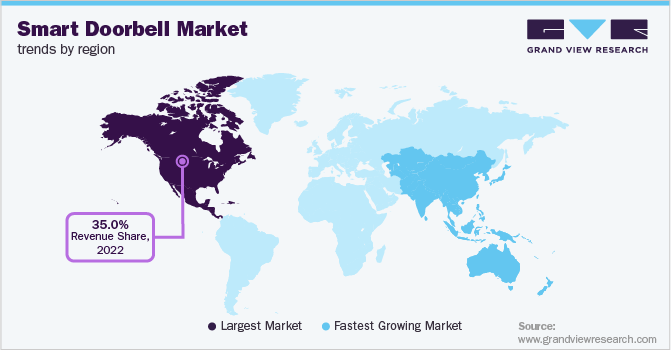
- Largest regional market: North America (33.7% revenue share, 2025)
- Fastest-growing regional market: Asia Pacific (highest CAGR, 2026-2033)
Market Size & Forecast
- Market size in 2025: USD 7.5 Billion
- Estimated market size in 2026: USD 9.9 Billion
- Projected market size by 2033: USD 94.4 Billion
- CAGR (2026-2033): 38.1%
Three ways to get this report
Buy it, customize it, or ask a question.Ask an Analyst
Analyst response in 1 business day
- AccessReport author, directly
- Reply timeWithin 1 working day
- No sales callDirect answer only
- FormatEmail reply
- CostFree, no cost
Get the Full Report
What the study covers
- FormatsPDF · Excel · Dashboard
- Timeline2026–2033 annual, 2025 base
- Coverage20+ countries, 5 regions
- Companies10+ key players profiled
Customize the Report
20% free customization
- IncludeCountries, segments, points
- TailorTo your product definition
- ExtendDeeper competitor detail
- OrA fully bespoke study
- Turnaround5–10 working days
The growth of the smart doorbell industry is further supported by growing public awareness of integrating artificial intelligence into everyday life for comfort and luxury. Significant expansion in the commercial space is likely to drive high demand for security device installations, thereby boosting market growth.The rising prevalence of counterfeit devices, including doorbell cameras, is likely to hamper the market growth. Counterfeit/fake doorbell cameras are products sold and marketed at a lower price. Increasing incidents of cybercrime and data breaches are hindering market growth. The growing popularity of smart security devices, such as doorbell cameras, owing to their benefits, such as real-time protection and greater convenience, makes consumers susceptible to various cybersecurity threats.
 Source: Grand View Research, IR Documents, Primary Interviews, Paid DatabasesTo learn more about this report,
 Download Free Sample Report
 A smart doorbell is a doorbell with a camera that connects to the owner’s phone via Wi-Fi. This connection lets the owner see and communicate with the visitor. It has opened up a new purpose for the doorbell. Most smart doorbells send a notification to the owner’s phone as soon as it rings. This, along with various other smart features, makes it a useful device to add to homes and commercial spaces, along with the integrated apps and technologies we use on a day-to-day basis. Tech hardware companies are manufacturing products that leverage AI to update and enhance their offerings and cater to evolving consumer requirements.
Market Dynamics
The rising concerns about burglaries, package thefts, and other intrusions into private property have led to a surge in demand for smart doorbells. A smart doorbell comes loaded with an impressive list of features, including high-definition video recording, motion detection, night vision, and even cloud storage. People are increasingly concerned about their safety, which is a key factor driving the adoption of smart doorbells. Rising urbanization and residential and commercial construction activities are presenting new growth opportunities. In certain locations, insurance companies are now considering these devices to mitigate risk.
The higher cost of smart doorbells compared to conventional doorbells might limit adoption due to affordability concerns. Besides initial expenditure, additional features offered by service providers, which incur a fee as part of the monthly subscription package, also add to recurring costs. Features such as cloud storage, analysis, and additional video recording options add up to the monthly costs to keep the smart doorbell devices active and upgraded. This may impose a cost burden on consumers and hinder market growth.
The growing integration of smart doorbells with other devices in smart home environments is creating significant opportunities for market players. Consumers are increasingly interested in products that can help them manage security cameras, smart locks, lighting systems, and voice assistants from a single interface. Manufacturers of smart doorbells can enhance their products' appeal by improving interoperability with smart home ecosystems. Cloud services, AI, and AI agents' voice commands add extra value to the products. Companies offering products that help users build a more integrated environment may benefit significantly from these market trends.
Analyst Perspective
The market is evolving into central hubs offering broader space security ecosystems. The long-term value will be primarily shaped by ownership of behavioral data, data insights, and subscription-driven monitoring services. Over the next decade, competitive advantage is likely to concentrate among platforms that can fuse video, audio, and contextual household data into persistent user profiles, enabling higher-value AI-driven security intelligence and cross-device integration. A shift in revenue generation is anticipated, mainly favoring subscription-based service models. Entry barriers are expected to rise through proprietary AI models and ecosystem bundling with broader smart home platforms, pushing the market toward consolidation around a small set of vertically integrated leaders, while hardware-only players may struggle to sustain the competition.
Product Insights
The wired segment dominated the market, accounting for a share of 54.8% in 2025. Wired or hard-wired doorbell cameras are available in a wide range of styles, from vintage to traditional to contemporary. Wired doorbell cameras are less expensive than battery-powered models, and many consumers find them user-friendly. These cameras eliminate the need for frequent recharging and are known to deliver faster smartphone alerts and snappier live views than battery-powered models. These factors make wired doorbell cameras more popular among consumers looking for simple yet smart security solutions.
The wireless segment is expected to grow with the fastest CAGR of 40.0% during the forecast period. At a macro level, the increasing demand for wireless sensor networks, improved reliability, and technological advancements are the notable factors driving demand for wireless doorbell cameras worldwide. As there is no wiring involved, wireless installation is a convenient option for the homeowners. Thus, the wireless segment is expected to witness significant demand in the coming years.
End User Insights
The residential segment dominated the market in 2025, accounting for 83.4%. The increasing demand for home automation and the rising adoption of smart appliances are driving the adoption of technologically advanced security products, such as doorbell cameras. The ability to control these devices via smartphones has also boosted their adoption, driven by the growing digitalization and the increasing penetration of internet-controlled devices in security & home automation. Doorbell cameras can be easily connected to smartphones or tablets to facilitate visitor entry, even when homeowners are absent.
The commercial segment is expected to grow at a CAGR of 36.2% over the forecast period. Owing to stringent safety practices in commercial settings, demand for doorbell cameras has increased among consumers. Moreover, rapid infrastructural development in the commercial sector is driving demand for high-end security in hotel rooms, lobbies, corporate offices, and other commercial spaces. In April 2026, Livly formed a partnership with Comelit, combining video intercoms, access control, and property operation services in a single package for multifamily residential and commercial buildings. This partnership enables property managers to manage visitors, property entrances, and security processes from a single connected device.
Distribution Channel Insights
The online segment held the largest share of 78.9% in 2025 and is expected to grow rapidly over the forecast period. The proliferation of online retailers worldwide is a key factor driving segmental growth. Various developments have occurred in recent years in how doorbell cameras reach consumers. In this respect, the offline segment’s share is being acquired by direct/online sales. While such trends are most apparent in the developed markets of North America and Europe, similar trends are also being observed in Asian countries such as India and China. These factors will continue to favor the segment growth during the forecast period.
The offline segment is estimated to grow at a CAGR of 34.1% over the forecast period, from 2026 to 2033. Specialist retailers in the industry continue to face intense competition from online and e-commerce retailers. The high costs associated with maintaining physical stores continue to limit their ability to compete with e-commerce retailers. A majority of consumers continue to prefer offline distribution channels, as the sales representatives in these channels/platforms/retail stores help them gain adequate product knowledge.
Regional Insights
Asia Pacific is anticipated to record the fastest CAGR of 40.5% over the forecast period. The growing crime rate in countries such as Pakistan, Iran, Afghanistan, India, the Philippines, South Korea, Qatar, and China is expected to increase the utility of doorbell cameras. The high crime rate in these countries has made people immensely vulnerable and has compelled them to opt for domestic security measures. The region has been witnessing a significant shift toward AI-enabled models, subscription-based monitoring services, and platform-led ecosystems, as consumers increasingly prefer integrated security solutions over basic ones.
North America Smart Doorbell Market Trends
The smart doorbell market in North America held the largest market share of 33.7% in 2025. The growing trend of smart homes, which include home automation solutions, and rising concerns about home safety are driving demand for doorbell cameras in the region. The region’s dominance is anchored to the high penetration of smart home ecosystems, where doorbell cameras are increasingly embedded as standard entry-level devices within broader home automation systems rather than standalone security tools. Surging demand for real-time monitoring and remote access control is making video doorbells a default layer of protection for residential and commercial spaces in the region.
 To learn more about this report, Download Free Sample Report
 Key Smart Doorbell Company Insights
Most key players in the market are launching new products to achieve maximum customer penetration. Players are focusing on developing and launching products that offer the latest software support and features that make it easier to track visitors and their movement.
Key Smart Doorbell Companies
The following key companies have been profiled for this study on the smart doorbell market.
-
Ring Inc.
-
Vivint, Inc.
-
Smart wares Group
-
Intelligent Technology Co. Ltd.
-
Sky Bell Technologies Inc.
-
Aeotec Technology (Shenzhen) Co., Ltd.
-
Arlo Technologies Inc.
-
August Home Inc.
-
Eques Inc.
-
iseeBell Inc.
Recent Developments
-
In May 2026, Consistent Infosystems launched its 3MP Wi-Fi Smart Video Doorbell, featuring real-time video monitoring, two-way audio communication, and motion detection, strengthening its smart home security product portfolio and supporting the growing adoption of connected residential security solutions.
-
In January 2026, Ring unveiled a new generation of smart security solutions at CES 2026, introducing AI-powered features such as AI Unusual Event Alerts and Active Warnings that enhance the intelligence and relevance of notifications generated by connected security devices, including video doorbells.
Smart Doorbell Market Report Scope
Report Attribute
Details
Market size in 2025
USD 7.5 billion
Estimated market size in 2026
USD 9.9 billion
Projected market size by 2033
USD 94.4 billion
Growth rate
CAGR of 38.1% from 2026 to 2033
Historical data
2021 - 2025
Forecast period
2026 - 2033
Quantitative units
Revenue in USD billion, and CAGR from 2026 to 2033
Report coverage
Revenue forecast, company ranking, competitive landscape, growth factors, and trends
Segments covered
Product, end user, distribution channel, region
Regional scope
North America; Europe; Asia Pacific; CSA; MEA
Country scope
U.S.; UK; Germany; France; China; India; Japan; Brazil; UAE
Key companies profiled
Ring Inc.; Vivint, Inc.; Smart wares Group; Intelligent Technology Co., Ltd.; Sky Bell Technologies Inc.; Aeotec Technology (Shenzhen) Co., Ltd.; Arlo Technologies Inc.; August Home Inc.; Eques Inc.; iseeBell Inc.
Customization scope
Free report customization (equivalent up to 8 analysts working days) with purchase. Addition or alteration to country, regional & segment scope.
Pricing and purchase options
Avail of customized purchase options to meet your exact research needs. Explore purchase options
Global Smart Doorbell Market Report Segmentation
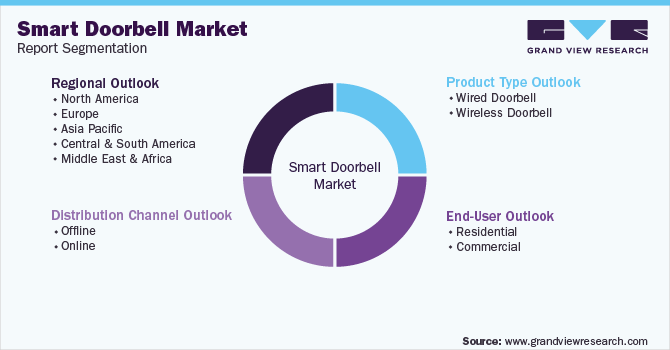
This report forecasts revenue growth at global, regional & country levels and provides an analysis of the latest trends and opportunities in each of the sub-segment from 2021 to 2033. For this study, Grand View Research has segmented the global smart doorbell market report based on the product, end user, distribution channel, and region:
 To learn more about this report, Download Free Sample Report
 -
Product Type Outlook (Revenue, USD Million, 2021 - 2033)
-
Wired Doorbell
-
Wireless Doorbell
-
-
End-User Outlook (Revenue, USD Million, 2021 - 2033)
-
Residential
-
Commercial
-
-
Distribution Channel Outlook (Revenue, USD Million, 2021 - 2033)
-
Offline
-
Online
-
-
Regional Outlook (Revenue, USD Million; 2021 - 2033)
-
North America
-
U.S.
-
-
Europe
-
U.K.
-
Germany
-
France
-
-
Asia Pacific
-
China
-
India
-
Japan
-
-
Central & South America
-
Brazil
-
-
Middle East & Africa
-
UAE
-
-
Frequently Asked Questions About This Report
The global smart doorbell market size was valued at USD 7.5 billion in 2025 and is expected to reach USD 9.9 billion in 2026.
The global smart doorbell market is expected to grow at a compound annual growth rate of 38.1% from 2026 to 2033 to reach USD 94.4 billion in 2033.
North America accounted for the highest market share of around 33.7% in 2025.
Some of the key companies include Ring Inc.; Vivint, Inc.; Smart wares Group; Intelligent Technology Co., Ltd.; Sky Bell Technologies Inc.; Aeotec Technology (Shenzhen) Co., Ltd.; Arlo Technologies Inc.; August Home Inc.; Eques Inc.; iseeBell Inc.
Residential segment dominated the smart doorbell market, accounting for 83.4% in 2025.
About the Author(s)
Electronic & Electrical Research Team
Consumer Goods · Electronic & ElectricalThis report was authored by the electronic & electrical research team at Grand View Research - comprising two research analysts, one senior research analyst, and one industry expert - with specialized expertise in the electronic & electrical segment of the consumer goods industry. All findings are based on proprietary consumer goods databases, executive interviews, and regulatory analysis, subject to internal peer review prior to publication.
Last Updated:
Speak to Analyst

Customize this report to your needs - add regions, segments, or data points, with 20% free customization.
Or view our licence options:


ISO 9001:2015 & 27001:2022 Certified
We are GDPR and CCPA compliant! Your transaction & personal information is safe and secure. For more details, please read our privacy policy.


