
- Home
- »
- Advanced Interior Materials
- »
-
Smart Facade Systems Market Size & Share Report, 2033GVR Report cover

Smart Facade Systems Market (2026 - 2033)
Size, Share & Trends Analysis Report By Facade Type (Curtain Walls, Double-Skin Facades), By Component (Shading Systems, Sensors & Control Systems), By End-use (Commercial, Residential), By Installation Type, By Region, And Segment Forecasts
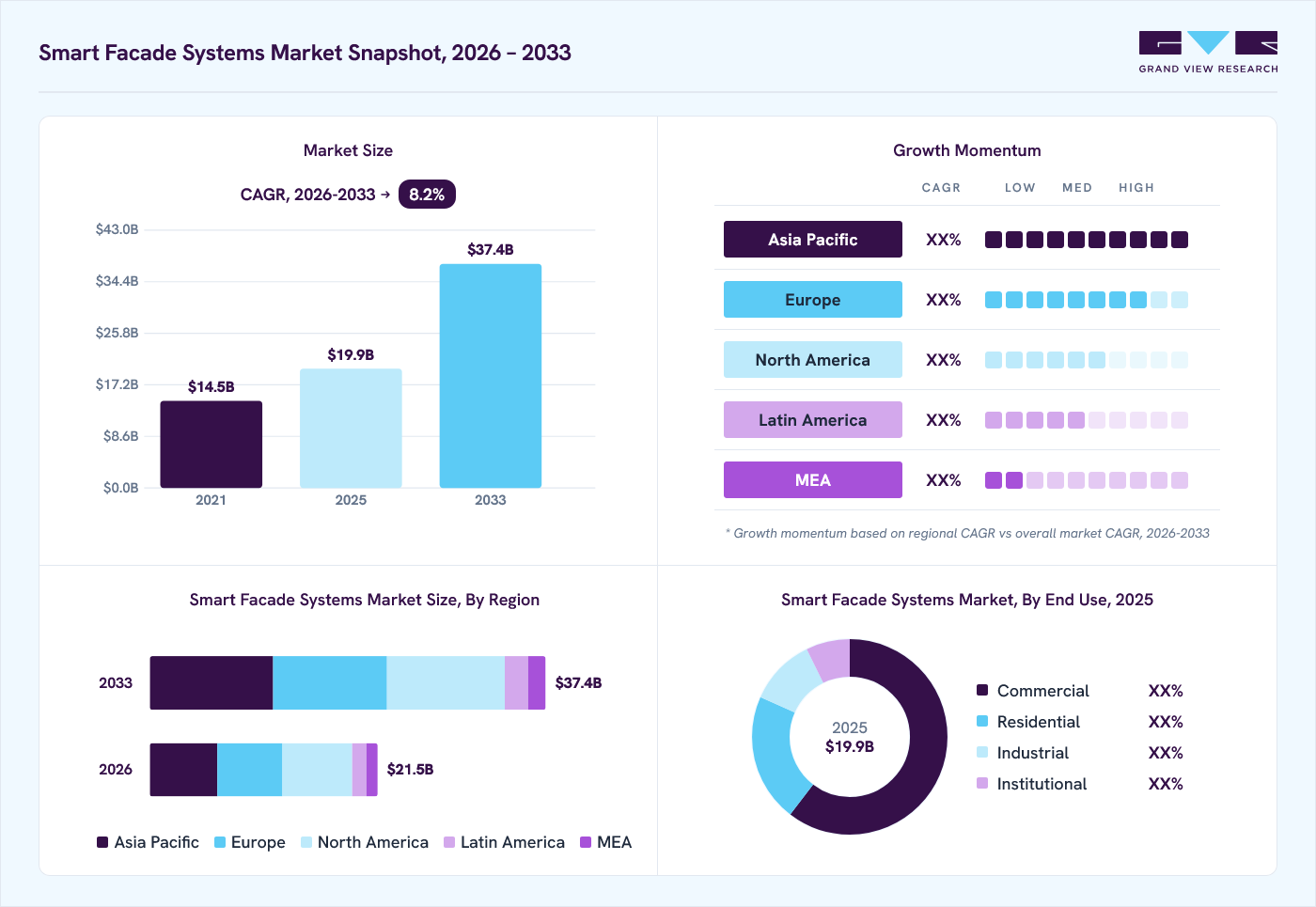
Market Size, 2025
$19.9BMarket Estimate, 2026
$21.5BMarket Forecast, 2033
$37.4BCAGR, 2026–2033
8.2%Smart Facade Systems Market Summary
The global smart facade systems market size was valued at USD 19.9 billion in 2025 and is projected to grow from USD 21.5 billion in 2026 to USD 37.4 billion by 2033, at a CAGR of 8.2% from 2026 to 2033. North America dominated the market, accounting for the largest revenue share of 30.7% in 2025. The demand for smart facade systems is increasing rapidly as the construction industry focuses on developing energy-efficient, intelligent, and sustainable buildings.
 Source: Grand View Research, IR Documents, Primary Interviews, Paid DatabasesTo learn more about this report,
 Download Free Sample Report
Key Market Trends & Insights
- By facade type: The curtain walls segment held the highest revenue share of 43.9% in 2025.
- By component: The smart glazing segment dominated the market with a revenue share of 40.8% in 2025.
- By end-use: The commercial segment held the highest revenue market share of 60.4% in 2025.
- By installation type: The new construction segment dominated the market with a revenue share of 73.5% in 2025.
Regional Highlights
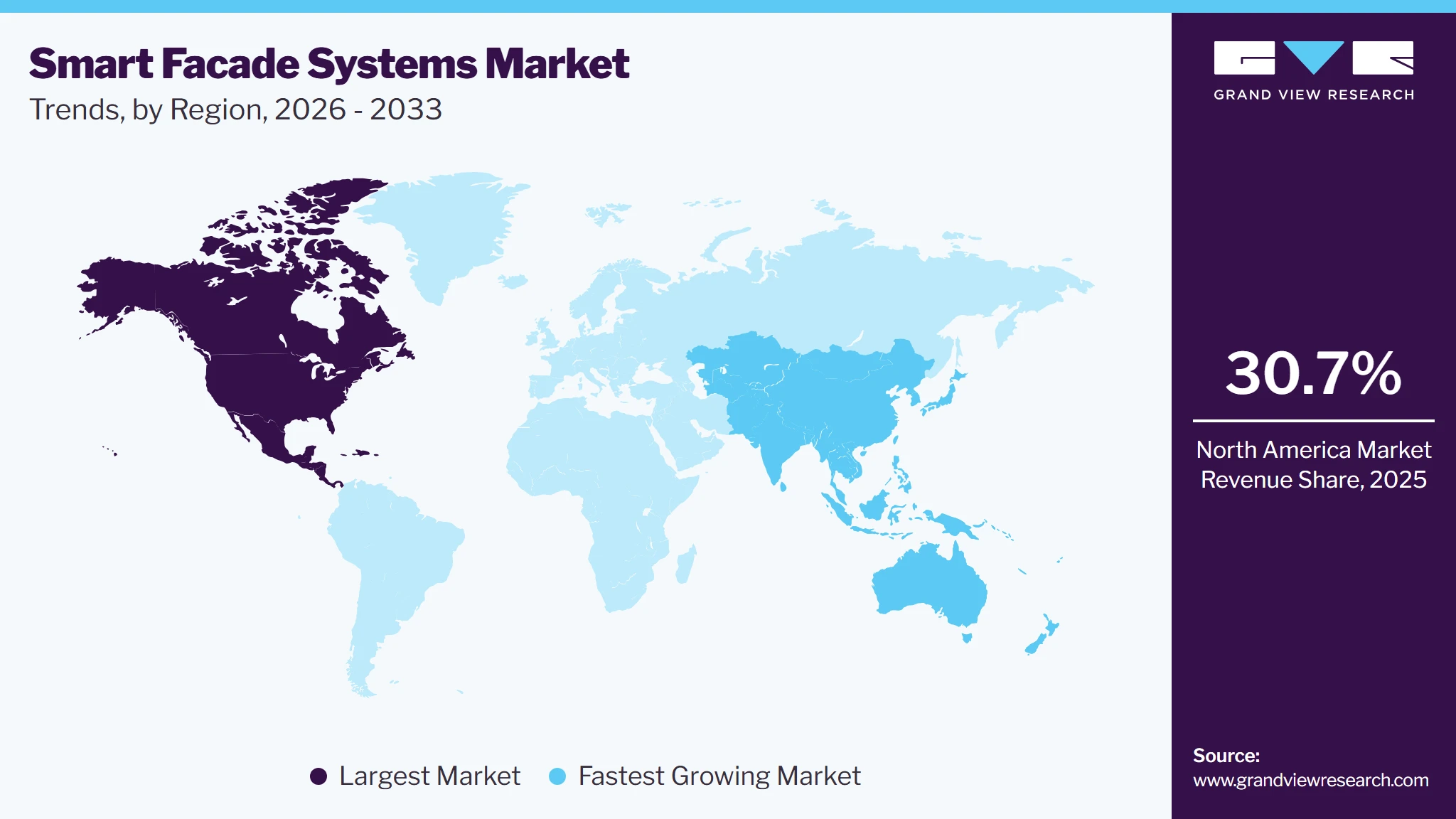
- Largest market: North America (30.7% revenue share, 2025)
- Fastest growing market: Asia Pacific (highest CAGR, 2026-2033)
- By country: The U.S. held the largest revenue share in 2025.
Market Size & Forecast
- Market size in 2025: USD 19.9 Billion
- Estimated market size in 2026: USD 21.5 Billion
- Projected market size by 2033: USD 37.4 Billion
- CAGR (2026-2033): 8.2%
Prism AI by Grand View Research Free to tryAsk a question about the smart facade systems market✓Every figure cited from GVR research Prefer the report? Download free sample →
Smart facades help regulate indoor temperature, optimize natural lighting, improve ventilation, and reduce overall energy consumption, making them highly suitable for commercial, residential, and institutional infrastructure. Rapid urbanization, rising green building construction, and the adoption of intelligent building management systems are further supporting market growth.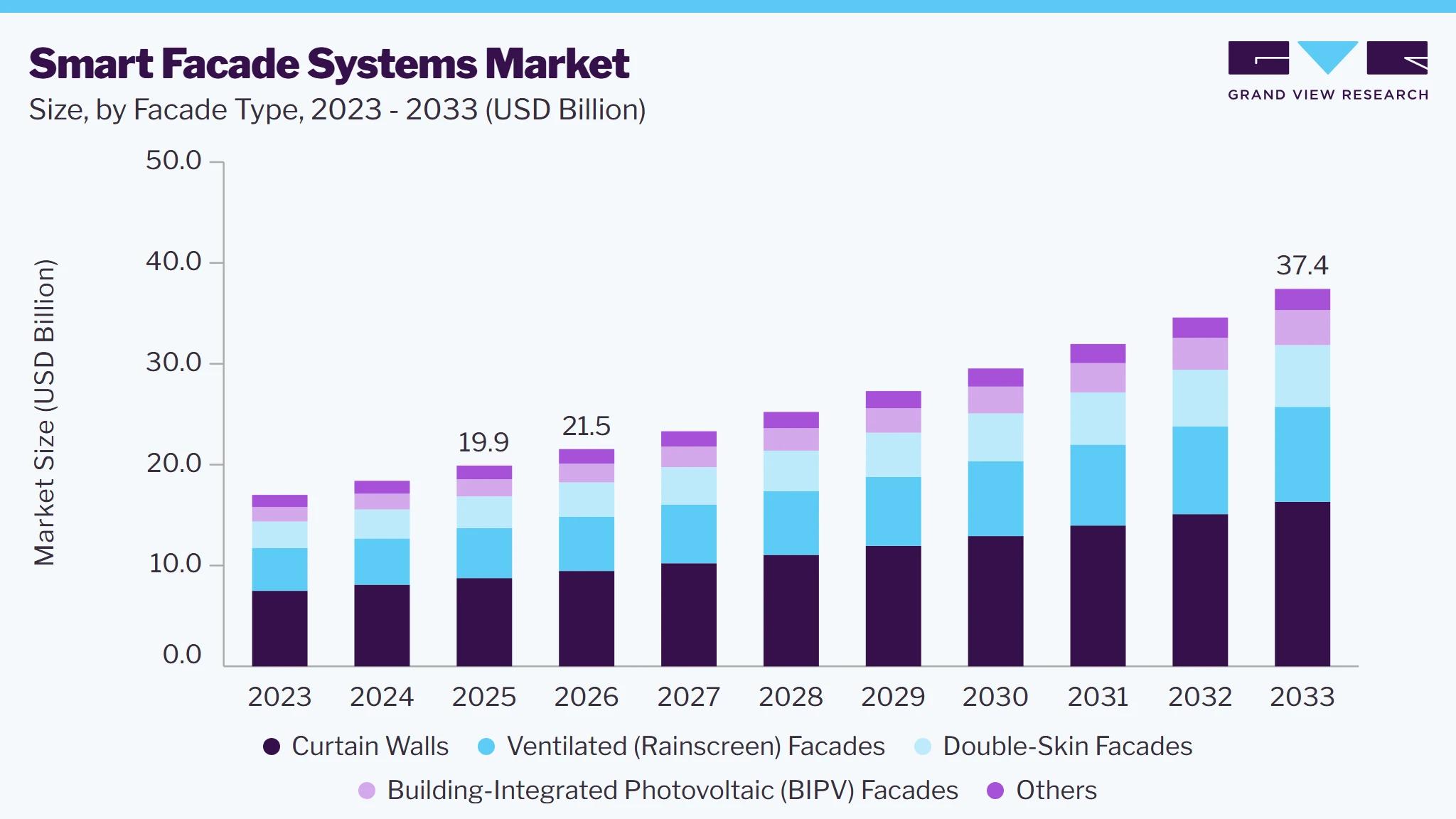 To learn more about this report, Download Free Sample Report
The growing implementation of stringent building energy efficiency regulations and net-zero carbon initiatives is a major factor driving the industry. Governments and regulatory bodies are encouraging the adoption of advanced building envelopes that minimize heat loss and reduce greenhouse gas emissions. Architects and developers are increasingly integrating automated shading systems, electrochromic glass, ventilated facades, and sensor-enabled facade technologies to comply with sustainability standards while improving building performance.
Technological advancements are transforming the smart facade industry through the integration of Internet of Things (IoT), artificial intelligence, automation, and advanced glazing materials. Modern facade systems can automatically adjust shading, transparency, and ventilation based on weather conditions and occupancy, enhancing energy efficiency and occupant comfort. Manufacturers are also developing lightweight materials, photovoltaic facades, dynamic insulation systems, and digital monitoring platforms that improve long-term operational performance.
Market Dynamics
Smart facade systems represent one of the fastest-evolving segments within advanced building technologies, driven by increasing demand for energy-efficient infrastructure, intelligent automation, and sustainable construction. The market is benefiting from rapid digitalization of buildings, integration of smart sensors, and advancements in adaptive building envelopes that enhance occupant comfort while reducing operational costs. Rising investments in green commercial buildings, smart cities, and net-zero construction projects continue to strengthen long-term market growth.
Increasing energy costs and stricter building efficiency standards are encouraging developers to adopt smart facade systems that reduce heating, cooling, and lighting requirements. Intelligent facades improve thermal insulation, daylight utilization, and indoor environmental quality, helping building owners achieve lower operating costs while meeting sustainability objectives.
Growing adoption of green building certifications and smart building technologies is further accelerating market demand. Commercial offices, airports, hospitals, educational institutions, and premium residential projects increasingly utilize dynamic glazing, automated shading, and ventilated facade systems to enhance energy performance and occupant comfort.
Smart facade systems require significant upfront investment due to advanced materials, automation technologies, specialized engineering, and system integration. Higher installation costs and longer return-on-investment periods may limit adoption among small-scale construction projects and cost-sensitive markets.
Rapid development of smart cities and increasing commitments toward carbon-neutral buildings create significant opportunities for smart facade manufacturers. Continuous innovation in photovoltaic facades, AI-enabled building management, adaptive glazing technologies, and digital monitoring solutions is expected to unlock new growth opportunities across both developed and emerging economies.
Market Concentration & Characteristics
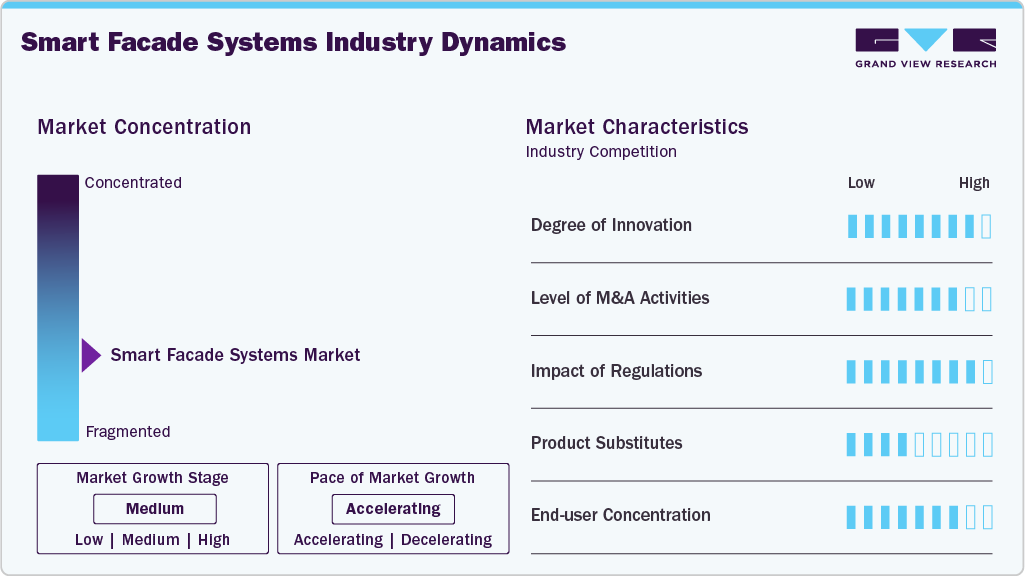
The industry is moderately fragmented, with competition among global building material manufacturers, glass producers, facade engineering companies, and automation technology providers. Leading companies focus on technological innovation, strategic collaborations, customized facade solutions, and sustainable product development to strengthen their market positions. Partnerships with architects, construction firms, and smart building solution providers are becoming increasingly common. Regional manufacturers compete by offering cost-effective and project-specific solutions, while multinational companies invest heavily in research, digital integration, and high-performance materials.
 To learn more about this report, Download Free Sample Report
Traditional curtain walls, conventional insulated facades, fixed glazing systems, and standard building envelopes remain substitutes for smart facade systems, particularly in projects with limited budgets. Although these alternatives provide structural protection and aesthetic value, they lack intelligent automation, adaptive performance, and energy optimization capabilities. As building efficiency regulations become more stringent and sustainability objectives gain importance, conventional facade solutions are gradually losing competitiveness in premium commercial and institutional construction projects.
Analyst Perspective
The industry is growing as the construction industry increasingly prioritizes energy efficiency, intelligent building management, and sustainable infrastructure. The integration of IoT, AI, advanced glazing technologies, and automated shading systems is transforming facades from passive building components into active systems that optimize energy consumption and occupant comfort. While high installation costs and integration complexity may pose short-term challenges, continuous technological advancements, supportive regulatory frameworks, and growing investments in smart cities and green buildings are expected to accelerate adoption across commercial, residential, and institutional sectors, creating significant opportunities for manufacturers and solution providers.
Facade Type Insights
The curtain walls segment held the highest revenue share of 43.9% in 2025, supported by its widespread adoption across commercial buildings, high-rise developments, airports, hotels, and institutional infrastructure. Smart curtain wall systems can integrate advanced glazing, automated shading, sensors, and energy-efficient framing to improve thermal performance and daylight management. Increasing construction of modern high-performance buildings and growing emphasis on sustainable building envelopes are further supporting the segment’s demand.
The building-integrated photovoltaic (BIPV) facades segment is expected to grow at a CAGR of 9.3% over the forecast period, as building owners increasingly seek to combine facade functionality with on-site renewable energy generation. BIPV systems allow photovoltaic technologies to be incorporated directly into building envelopes while maintaining architectural functionality and aesthetics. Growing adoption of net-zero buildings, renewable energy technologies, and carbon reduction strategies is expected to create significant opportunities for BIPV facade solutions.
Component Insights
The smart glazing segment held the highest revenue share of 40.8% in 2025, due to its ability to dynamically regulate daylight, solar heat gain, glare, and indoor temperatures. Electrochromic and other intelligent glazing technologies help buildings reduce cooling and lighting requirements while improving occupant comfort. Increasing demand for energy-efficient commercial buildings, stringent building performance requirements, and greater adoption of intelligent building technologies are driving the use of smart glazing systems.
The sensors & control systems segment is expected to grow at a CAGR of 9.1% over the forecast period, with the increasing integration of smart facades into connected building management systems. Sensors enable real-time monitoring of factors such as sunlight, temperature, occupancy, and weather conditions, allowing facade components to respond automatically. Rising adoption of IoT, artificial intelligence, predictive controls, and automated energy management is expected to increase demand for advanced sensing and control technologies.
Installation Type Insights
The new construction segment held the highest revenue market share of 73.5% in 2025, due to the increasing incorporation of smart facade technologies during the planning and design stages of new buildings. Integrating intelligent glazing, automated shading, sensors, and energy-efficient facade systems during construction enables better system coordination and building performance optimization. Rising development of smart cities, green buildings, and high-performance commercial infrastructure continues to support demand.
The retrofit & renovation segment is expected to grow at a CAGR of 8.8% over the forecast period, as building owners increasingly upgrade aging facades to improve energy efficiency, occupant comfort, and operational performance. Existing commercial and institutional buildings provide significant opportunities for replacing conventional glazing, adding automated shading, and integrating smart sensors and control systems. Growing energy-efficiency requirements and increasing investment in building modernization are expected to accelerate the adoption of smart facade solutions in renovation projects.
End-use Insights
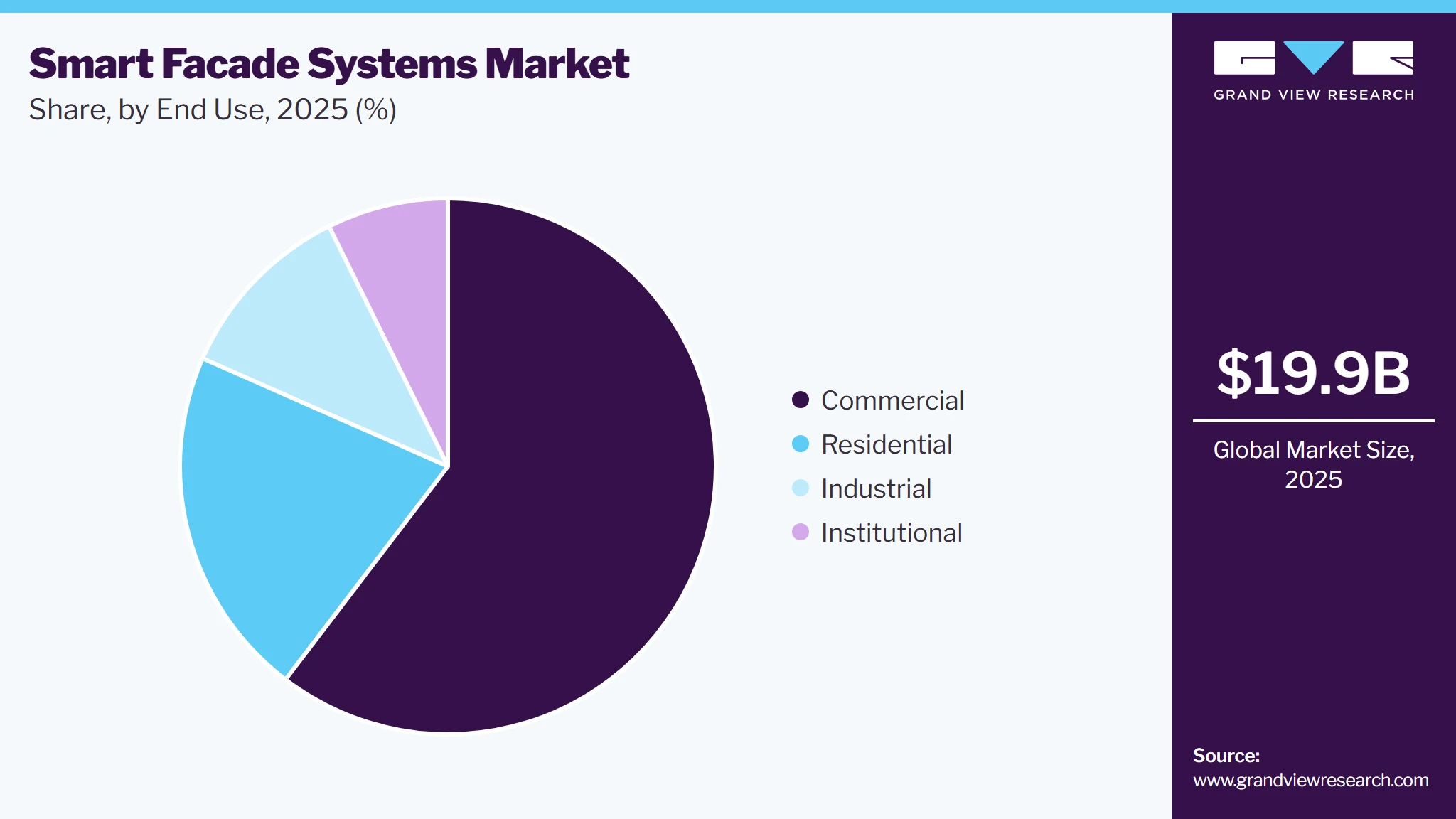
The commercial segment held the highest revenue market share of 60.4% in 2025, driven by the extensive deployment of smart facade systems in office buildings, retail complexes, hotels, airports, and mixed-use developments. Commercial property owners increasingly prioritize energy efficiency, occupant comfort, and operational cost reduction to improve building performance. Growing investments in green buildings, smart offices, and sustainable commercial infrastructure are further strengthening demand.
 To learn more about this report, Download Free Sample Report
The industrial segment is expected to grow at a CAGR of 8.8% over the forecast period, as manufacturing facilities, warehouses, logistics centers, and industrial plants increasingly adopt high-performance building envelope solutions. Smart facades can help industrial facilities manage solar heat gain, ventilation, daylight, and energy consumption while supporting improved indoor working conditions. Increasing modernization of industrial infrastructure and growing focus on energy-efficient operations are expected to support segment expansion.
Regional Insights
The North America smart facade systems market accounted for the largest revenue share of 30.7% in 2025, driven by stringent building energy regulations, widespread adoption of smart buildings, and high demand for sustainable commercial infrastructure. Developers increasingly invest in intelligent facade technologies to reduce operational costs and achieve environmental certifications. Technological innovation, digital building management systems, and strong research capabilities further support regional market expansion. Increasing renovation of aging commercial buildings also contributes to growing adoption.
 To learn more about this report, Download Free Sample Report
U.S. Smart Facade Systems Market Trends
The smart facade systems market in the U.S. leads North America owing to widespread implementation of green building standards, advanced construction technologies, and significant investments in commercial real estate. Smart offices, healthcare facilities, educational institutions, and corporate campuses increasingly utilize adaptive facade systems to improve energy efficiency and occupant comfort. Growing emphasis on carbon reduction and intelligent infrastructure continues to create favorable market conditions.
Asia Pacific Smart Facade Systems Market Trends
The smart facade systems market in Asia Pacific is a mature market, driven by rapid urbanization, expanding commercial infrastructure, increasing smart city initiatives, and growing investments in sustainable buildings. Countries across the region are adopting advanced building technologies to improve energy efficiency and reduce environmental impact. Rising construction of high-rise buildings, airports, business parks, and mixed-use developments further supports market growth. Government policies promoting green buildings and energy-efficient infrastructure continue to accelerate adoption across both developed and emerging economies.
The China smart facade systems market represents the largest market within Asia Pacific due to its extensive construction industry, rapid smart city development, and strong government support for green infrastructure. Large-scale commercial projects increasingly incorporate intelligent facade technologies to improve energy performance and building sustainability. Domestic manufacturers continue investing in advanced glazing materials, automated shading systems, and digital building technologies. Continuous urban redevelopment and modernization initiatives are expected to sustain long-term market growth.
Europe Smart Facade Systems Market Trends
The smart facade systems market in Europe remains a major market due to ambitious climate policies, energy efficiency regulations, and strong adoption of sustainable construction practices. Building renovation initiatives and stringent environmental standards encourage developers to install advanced facade technologies across commercial and residential projects. Increasing demand for net-zero buildings and renewable energy integration further strengthens regional growth prospects.
The Germany smart facade systems market is one of Europe's leading markets due to its strong engineering expertise, advanced construction sector, and emphasis on sustainable building design. High adoption of intelligent glazing, ventilated facades, and automated building technologies supports market expansion. Government policies promoting energy-efficient buildings and carbon-neutral construction continue to encourage investments in smart facade solutions. Research and innovation remain central to industry development.
Central and South America Smart Facade Systems Market Trends
The smart facade systems market in Central and South America is gradually expanding with increasing investments in commercial construction, urban infrastructure, and energy-efficient buildings. Rising awareness regarding sustainable architecture and lower building operating costs encourages the adoption of smart facade technologies. Government initiatives supporting green construction and the modernization of urban infrastructure create additional growth opportunities. Although adoption remains at an early stage, long-term prospects are positive.
Middle East & Africa Smart Facade Systems Market Trends
The smart facade systems market in the Middle East & Africa is experiencing steady growth due to rising investments in iconic commercial buildings, hospitality projects, and smart city developments. Harsh climatic conditions increase the importance of intelligent facade systems that improve thermal performance and reduce cooling requirements. Governments continue investing in sustainable infrastructure and energy-efficient construction to diversify economic development. Growing adoption of high-performance building technologies is expected to support future market expansion.
Key Smart Facade Systems Company Insights
Some of the key players operating in the market include Saint-Gobain and Schüco International KG.
-
Saint-Gobain is a global leader in construction materials and high-performance building solutions, offering advanced architectural glass, smart glazing, and sustainable facade technologies for energy-efficient buildings.
-
Schüco International KG is a leading provider of aluminum, steel, and PVC-U window, door, and facade systems, specializing in innovative, energy-efficient, and digitally integrated building envelope solutions.
Reynaers Aluminium and GEZE are some of the emerging market participants in the smart facade systems market.
-
Reynaers Aluminium is a Belgium-based manufacturer of premium aluminum window, door, and facade systems, recognized for customized architectural solutions that combine sustainability, aesthetics, and high performance.
-
GEZE is a global provider of building automation and door, window, and safety technologies, offering intelligent solutions that enhance smart facade functionality, ventilation, access control, and energy efficiency.
Key Smart Facade Systems Companies
The following key companies have been profiled for this study on the smart facade systems market
-
Saint-Gobain
-
Schüco International KG
-
Kingspan
-
Permasteelisa Group
-
AGC Inc.
-
Kawneer
-
GEZE
-
Reynaers Aluminium
-
Enclos Corp
-
YKK AP Inc.
Competitive Benchmarking
Category
Operating Strategies
Competitive Edge
Weakness
Established Players (Saint-Gobain, Schüco International KG, Kingspan, Permasteelisa Group, AGC Inc., Kawneer)
- Invest in smart glazing, BIPV facades, automated shading, and AI-enabled facade technologies to improve building performance.
- Expand through partnerships with developers, architects, and contractors while strengthening global manufacturing and project capabilities.
- Focus on sustainable, low-carbon facade solutions aligned with green building standards.
- Strong global presence with diversified smart facade portfolios and engineering expertise.
- Established relationships with major developers and construction firms worldwide.
- High R&D investment supports continuous product innovation and technology leadership.
- High investment required for advanced facade technologies and manufacturing.
- Long project approval and construction cycles delay revenue realization.
- Dependent on commercial construction and infrastructure spending.
Emerging Players (GEZE, Reynaers Aluminium, Enclos Corp, YKK AP Inc.)
- Develop innovative facade automation, intelligent window systems, and customized facade solutions.
- Expand through collaborations with architects, EPC firms, and smart building solution providers.
- Focus on retrofit projects and IoT-enabled building integration.
- Strong specialization in niche facade technologies and customized engineering solutions.
- Flexible operations enable faster product development and customer response.
- Well-positioned to benefit from growing smart building adoption.
- Limited global presence compared to established multinational competitors.
- Lower financial resources for large-scale expansion and R&D investments.
- Reliance on partnerships and regional projects may limit market reach.
Recent Developments
-
In January 2025, Kawneer launched the 1600UT SS Curtain Wall System, offering improved thermal performance, faster installation, and compliance with the latest seismic standards.
-
In September 2024, Kingspan expanded insulated panel distribution capacity in the United States to support growing demand from industrial and logistics infrastructure projects.
Smart Façade System Market Report Scope
Report Attribute
Details
Market size in 2025
USD 19.9 billion
Estimated market size in 2026
USD 21.5 billion
Projected market size by 2033
USD 37.4 billion
Growth rate
CAGR of 8.2% from 2026 to 2033
Base year for estimation
2025
Actual estimates/historical data
2021 - 2024
Forecast period
2026 - 2033
Quantitative units
Revenue in USD billion and CAGR from 2026 to 2033
Report coverage
Revenue forecast, company ranking, competitive landscape, growth factors, and trends
Segments covered
Facade type, component, end-use, installation type, region
Regional scope
North America; Europe; Asia Pacific; Central and South America; Middle East and Africa
Country scope
U.S.; Canada; Mexico; Germany; UK; France; Italy; Spain; China; Japan; India; South Korea; Brazil; Saudi Arabia
Key companies profiled
Saint-Gobain; Schüco International KG; Kingspan; Permasteelisa Group; AGC Inc.; Kawneer; GEZE; Reynaers Aluminium; Enclos Corp; YKK AP Inc.
Customization scope
Free report customization (equivalent up to 8 analysts working days) with purchase. Addition or alteration to country, regional & segment scope.
Pricing and purchase options
Avail customized purchase options to meet your exact research needs. Explore purchase options
Global Smart Façade System Market Report Segmentation
This report forecasts revenue growth at global, regional & country levels and provides an analysis on the industry trends in each of the sub-segments from 2021 to 2033. For this study, Grand View Research has segmented the global smart facade systems market report on the basis of facade type, component, end-use, installation type, and region:
-
Facade Type Outlook (Revenue, USD Billion, 2021 - 2033)
-
Curtain Walls
-
Double-Skin Facades
-
Ventilated (Rainscreen) Facades
-
Building-Integrated Photovoltaic (BIPV) Facades
-
Others
-
-
Component Outlook (Revenue, USD Billion, 2021 - 2033)
-
Smart Glazing
-
Shading Systems
-
Sensors & Control Systems
-
Structural Framing Systems
-
Others
-
-
End-use Outlook (Revenue, USD Billion, 2021 - 2033)
-
Commercial
-
Residential
-
Industrial
-
Institutional
-
-
Installation Type Outlook (Revenue, USD Billion, 2021 - 2033)
-
New Construction
-
Retrofit & Renovation
-
-
Regional Outlook (Revenue, USD Billion, 2021 - 2033)
-
North America
-
U.S.
-
Canada
-
Mexico
-
-
Europe
-
UK
-
Germany
-
France
-
Italy
-
Spain
-
-
Asia Pacific
-
China
-
Japan
-
India
-
South Korea
-
-
Central and South America
-
Brazil
-
-
Middle East and Africa
-
Saudi Arabia
-
-
Segment Definition
Segment - Facade Type
Revenue Capture Definition
Curtain Walls
Revenue generated from the sale, engineering, fabrication, and installation of smart curtain wall systems incorporating intelligent glazing, integrated sensors, automated shading, and energy-efficient technologies that enhance building performance and occupant comfort.
Double-Skin Facades
Revenue generated from smart double-skin facade systems featuring dual building envelopes designed to improve thermal insulation, natural ventilation, daylight utilization, and energy efficiency through intelligent control systems.
Ventilated (Rainscreen) Facades
Revenue generated from the supply and installation of smart ventilated facade systems that improve moisture management, thermal performance, air circulation, and energy efficiency using advanced materials and integrated monitoring technologies.
Building-Integrated Photovoltaic (BIPV) Facades
Revenue generated from facade systems integrating photovoltaic panels into the building envelope to generate renewable electricity while providing weather protection, insulation, and aesthetic functionality.
Others
Revenue generated from other advanced smart facade technologies, including kinetic facades, responsive facades, adaptive facade systems, media facades, and customized intelligent building envelope solutions.
Segment - Component
Revenue Capture Definition
Smart Glazing
Revenue generated from electrochromic, thermochromic, photochromic, and other intelligent glazing solutions that automatically regulate light transmission, solar heat gain, glare, and indoor temperature.
Shading Systems
Revenue generated from automated blinds, louvers, external shading devices, and dynamic solar control systems designed to optimize daylight, reduce cooling loads, and enhance occupant comfort.
Sensors & Control Systems
Revenue generated from smart sensors, controllers, IoT devices, AI-based automation platforms, weather monitoring systems, occupancy sensors, and building management integration technologies used to control facade performance.
Structural Framing Systems
Revenue generated from aluminum, steel, composite, and other structural framing systems engineered to support intelligent facade components while ensuring durability, structural integrity, and energy performance.
Others
Revenue generated from supporting smart facade components, including insulation materials, actuators, ventilation modules, sealing systems, mounting accessories, communication hardware, and other integrated technologies.
Segment - End Use
Revenue Capture Definition
Commercial
Revenue generated from smart facade systems installed in office buildings, retail complexes, hotels, airports, business parks, mixed-use developments, and other commercial infrastructure projects.
Residential
Revenue generated from smart facade installations in apartments, condominiums, villas, gated communities, and other residential buildings designed to improve energy efficiency and indoor comfort.
Industrial
Revenue generated from intelligent facade solutions deployed in manufacturing facilities, warehouses, logistics centers, industrial plants, and other industrial infrastructure requiring energy-efficient building envelopes.
Institutional
Revenue generated from smart facade systems installed in hospitals, educational institutions, government buildings, research centers, cultural facilities, and other public infrastructure projects.
Segment - Installation Type
Revenue Capture Definition
New Construction
Revenue generated from the specification, supply, engineering, and installation of smart facade systems in newly constructed commercial, residential, industrial, and institutional buildings.
Retrofit & Renovation
Revenue generated from upgrading, replacing, or modernizing existing building facades with intelligent glazing, automated shading, energy-efficient components, and smart control systems to improve building performance and sustainability.
Estimation Model
Layer Name
Key Question
Description
Parent Market Analysis
What is the overall size and growth outlook of the global building envelope, facade, and smart building technologies market?
The estimation begins by evaluating the broader building envelope, facade systems, and smart building technologies market. Macroeconomic indicators, global construction activity, commercial and residential building development, green building initiatives, energy efficiency regulations, and investments in intelligent building infrastructure are analyzed to establish the total addressable market for smart facade systems.
Facade Technology Penetration Analysis
What proportion of the facade market is represented by smart facade systems across different technologies and building types?
This layer estimates the penetration of electrochromic glass, automated shading systems, double-skin facades, ventilated facades, photovoltaic (BIPV) facades, and kinetic facades by assessing their adoption across commercial, residential, industrial, institutional, and mixed-use buildings. Technology adoption trends, energy performance requirements, and smart building integration are analyzed to determine market penetration.
Regional & End-use Demand Assessment
Which regions and building applications contribute the highest demand for smart facade systems?
Market demand is evaluated across major regions based on construction investments, urbanization, smart city projects, green building certifications, and energy efficiency regulations. Demand is further segmented across commercial offices, residential buildings, healthcare facilities, educational institutions, hospitality, airports, retail complexes, and industrial facilities to determine overall revenue contribution.
Company Revenue Validation & Market Forecasting
How is the final market size validated and forecast?
The final market estimates are validated using company revenues, project portfolios, facade installation volumes, technology offerings, strategic partnerships, construction contracts, sustainability initiatives, and secondary research. Bottom-up and top-down approaches are triangulated to generate reliable market size estimates and long-term forecasts for the Smart Facade Systems Market.
Delivered Customizations
We have successfully delivered the following deep-dive customizations:
Client Request
Customization Delivered
Value Adds
Technology Benchmarking
Comprehensive comparison of electrochromic glass, automated shading systems, double-skin facades, ventilated facades, photovoltaic (BIPV) facades, kinetic facades, and AI-enabled facade technologies based on energy efficiency, thermal performance, lifecycle cost, maintenance requirements, technology maturity, and application suitability.
Enables stakeholders to identify the most efficient and commercially viable technologies, benchmark competitors, prioritize R&D investments, optimize product portfolios, and support technology adoption strategies across different building segments.
Regional Regulatory Assessment
Detailed evaluation of regional building energy codes, green building certification requirements, fire safety standards, glazing regulations, carbon reduction policies, net-zero building mandates, and smart city initiatives across all major regions.
Assists manufacturers in ensuring regulatory compliance, developing region-specific market entry strategies, minimizing certification risks, accelerating product approvals, and identifying high-growth markets driven by sustainability regulations.
Smart Building Integration Analysis
In-depth assessment of smart facade integration with Building Management Systems (BMS), IoT platforms, AI-based automation, HVAC systems, lighting controls, occupancy sensors, digital twins, cloud-based monitoring platforms, and predictive maintenance solutions.
Helps companies develop future-ready intelligent facade solutions, improve interoperability with smart building ecosystems, enhance operational efficiency, strengthen digital capabilities, and capitalize on the growing adoption of connected and autonomous buildings.
Frequently Asked Questions About This Report
The smart facade systems market size was estimated at USD 19.9 billion in 2025 and is expected to reach USD 21.5 billion in 2026.
The smart facade systems market is expected to grow at a CAGR of 8.2% from 2026 to 2033 to reach USD 37.4 billion by 2033.
The new construction segment accounted for the highest revenue share of 73.5% in 2025, driven by rising construction activity, increasing adoption of energy-efficient building solutions, and growing integration of smart facade systems into modern commercial, residential, and institutional projects.
North America held the highest revenue market share of 30.7% in 2025, driven by stringent energy-efficiency regulations, strong adoption of smart building technologies, and increasing investments in sustainable commercial infrastructure.
Key factors driving the smart facade systems market include rising demand for energy-efficient buildings, stringent sustainability regulations, smart city development, growing adoption of intelligent building technologies, and increasing investment in green and net-zero construction.
Some key players in the smart facade systems market include Saint-Gobain, Schüco International KG, Kingspan, Permasteelisa Group, AGC Inc., Kawneer, GEZE, Reynaers Aluminium, YKK AP Inc., and Enclos Corp.
Asia Pacific is the fastest-growing region over the forecast period.
The curtain walls segment held the highest revenue share of 43.9% in 2025, while the building-integrated photovoltaic (BIPV) facades segment is fastest growing facade type.
The smart glazing segment held the highest revenue share of 40.8% in 2025, while the sensors & control systems segment is fastest growing component.
About the Author(s)
Advanced Interior Materials Research Team
Advanced Materials · Advanced Interior MaterialsThis report was authored by the advanced interior materials research team at Grand View Research - comprising two research analysts, one senior research analyst, and one industry expert - with specialized expertise in the advanced interior materials segment of the advanced materials industry. All findings are based on proprietary advanced materials databases, executive interviews, and regulatory analysis, subject to internal peer review prior to publication.
Last Updated:
Speak to Analyst

Customize this report to your needs - add regions, segments, or data points, with 20% free customization.
Or view our licence options:


ISO 9001:2015 & 27001:2022 Certified
We are GDPR and CCPA compliant! Your transaction & personal information is safe and secure. For more details, please read our privacy policy.


