
- Home
- »
- Next Generation Technologies
- »
-
Smart Naval Munitions Market Size, Share Report 2026-2033GVR Report cover

Smart Naval Munitions Market (2026 - 2033)
Size, Share & Trends Analysis Report By Type (Missiles, Munitions), By Launch Platform (Surface Ships, Submarine), By Guidance Technology (Satellite-Guided, Radar-Guided), By Application, By Region, And Segment Forecasts
Market Size, 2025
$2.2BMarket Estimate, 2026
$2.3BMarket Forecast, 2033
$3.4BCAGR, 2026–2033
5.5%Smart Naval Munitions Market Summary
The global smart naval munitions market size was valued at USD 2.2 billion in 2025 and is projected to grow from USD 2.3 billion in 2026 to USD 3.4 billion by 2033, at a CAGR of 5.5% from 2026 to 2033. North America dominated the market, accounting for a revenue share of 35.6% in 2025. The market growth is primarily driven by the large-scale naval modernization initiatives across major economies aiming to upgrade aging fleets with advanced destroyers, submarines, and aircraft carriers.
 Source: Grand View Research, IR Documents, Primary Interviews, Paid DatabasesTo learn more about this report,
 Download Free Sample Report
 Key Market Trends & Insights
- By type: Missiles segment accounted for the largest revenue share of 47.5% in 2025.
- By launch platform: Surface ships segment dominated the market with a share of 48.0% in 2025.
- By guidance technology: Laser-guided segment led the market with a share of 39.9% in 2025.
- By application: The laser-guided segment led the market with a share of 37.8% in 2025.
Regional Highlights
- Largest regional market: North America (35.6% revenue share in 2025)
- Fastest growing regional market: Asia Pacific (highest CAGR, 2026-2033)
- By Country: The U.S. held the largest market share in 2025.
Market Size & Forecast
- Market size in 2025: USD 2.2 Billion
- Estimated market size in 2026: USD 2.3 Billion
- Projected market size by 2033: USD 3.4 Billion
- CAGR (2026-2033): 5.5%
Three ways to get this report
Buy it, customize it, or ask a question.Ask an Analyst
A direct answer, usually in 1 working day
- AccessReport author, directly
- Reply timeWithin 1 working day
- No sales callDirect answer only
- FormatEmail reply
- CostFree, no cost
Get the Full Report
What the study covers
- FormatsPDF · Excel · Dashboard
- Timeline2026–2033 annual, 2025 base
- Coverage20+ countries, 5 regions
- Companies10+ key players profiled
Customize the Report
20% free customization
- IncludeCountries, segments, points
- TailorTo your product definition
- ExtendDeeper competitor detail
- OrA fully bespoke study
- Turnaround5–10 working days
These platforms increasingly require integration with smart naval munitions to enhance offensive strike capabilities and layered defense systems. Governments are prioritizing maritime power to secure strategic sea lanes and enhance deterrence in contested regions. There is a growing shift toward precision-guided naval munitions that offer higher accuracy, reduced collateral damage, and extended engagement ranges. Navies are investing in advanced missile systems capable of engaging surface ships, submarines, and land targets from long distances. This trend is driven by the need for rapid-response capabilities and improved mission effectiveness in modern naval warfare, thereby spurring growth in the smart naval munitions industry. To learn more about this report, Download Free Sample Report
 Additionally, the emergence of hypersonic missiles, unmanned surface vehicles (USVs), and aerial drones is reshaping naval defense requirements. As a result, demand is rising for advanced interception and multi-layered defense systems integrated with smart naval munitions. Navies are focusing on real-time threat detection, rapid response, and enhanced targeting accuracy to counter evolving asymmetric threats.
Furthermore, the growing integration of artificial intelligence, advanced sensors, and network-enabled combat systems into naval weapon platforms. AI-driven targeting, predictive analytics, and real-time battlefield data sharing are improving decision-making and strike precision. This shift toward connected naval ecosystems is enhancing interoperability between ships, submarines, aircraft, and satellite systems, which is expected to further drive the market growth in the coming years.
Moreover, the rising geopolitical instability and maritime disputes are driving higher defense spending across multiple regions. Governments are allocating larger budgets toward naval defense upgrades, missile systems, and strategic deterrence capabilities. This sustained investment cycle is accelerating smart procurement of naval munitions and encouraging continuous innovation in next-generation naval warfare technologies.
Market Dynamics
The smart naval munitions industry growth is accelerated by increasing naval modernization initiatives, rising maritime security concerns, and growing demand for precision-guided weapons. Furthermore, growing advancements in AI-enabled guidance systems, sensor technologies, and network-centric warfare are enhancing the effectiveness of smart naval munitions, while increasing defense spending and the adoption of autonomous naval platforms continue to support market expansion.
The smart naval munitions market is primarily driven by increasing global naval modernization programs and the growing need for advanced maritime defense capabilities. Countries are significantly upgrading their naval fleets with next-generation destroyers, submarines, and aircraft carriers, equipped with precision-guided missile systems to enhance their offensive and defensive capabilities.
Furthermore, increasing geopolitical tensions and maritime security concerns across strategic waterways are prompting higher defense budgets and faster procurement cycles. This is leading to sustained investments in advanced naval strike systems. Overall, this sustained focus on strengthening naval superiority and combat readiness is expected to drive ongoing global demand for advanced smart naval munitions.
The high costs associated with the research, development, and production of advanced missile systems are constraining the market. These systems require sophisticated technologies, extensive testing, and long development timelines, making them capital-intensive for manufacturers and governments alike.
Furthermore, the procurement processes in the defense sector are highly complex and time-consuming, often involving multiple layers of approval, regulatory compliance, and international coordination. This slows down adoption and delays large-scale deployment of new naval munitions systems. Moreover, dependence on government defense budgets and shifting geopolitical priorities can create uncertainty in demand. Budget constraints or policy changes may directly affect long-term contracts and procurement decisions, thereby impacting market stability. Overall, these factors collectively limit the pace of adoption and create significant barriers to entry and scalability in the smart naval munitions market.
The increasing integration of artificial intelligence and autonomous technologies presents a major growth opportunity in the smart naval munitions market. AI-enabled targeting, predictive threat analysis, and autonomous guidance systems are significantly improving missile accuracy, response time, and operational efficiency. Additionally, the growing adoption of network-centric, integrated naval warfare systems is expanding opportunities for advanced smart munitions. Real-time data sharing between ships, aircraft, and satellite systems enhances situational awareness and enables more effective coordinated strikes and defense operations.
Furthermore, the rising investment in hypersonic weapons, long-range precision strike capabilities, and next-generation missile defense systems is expected to drive innovation. This shift toward highly intelligent, automated, and interoperable defense systems is creating strong long-term growth potential for the market.
Market Concentration & Characteristics
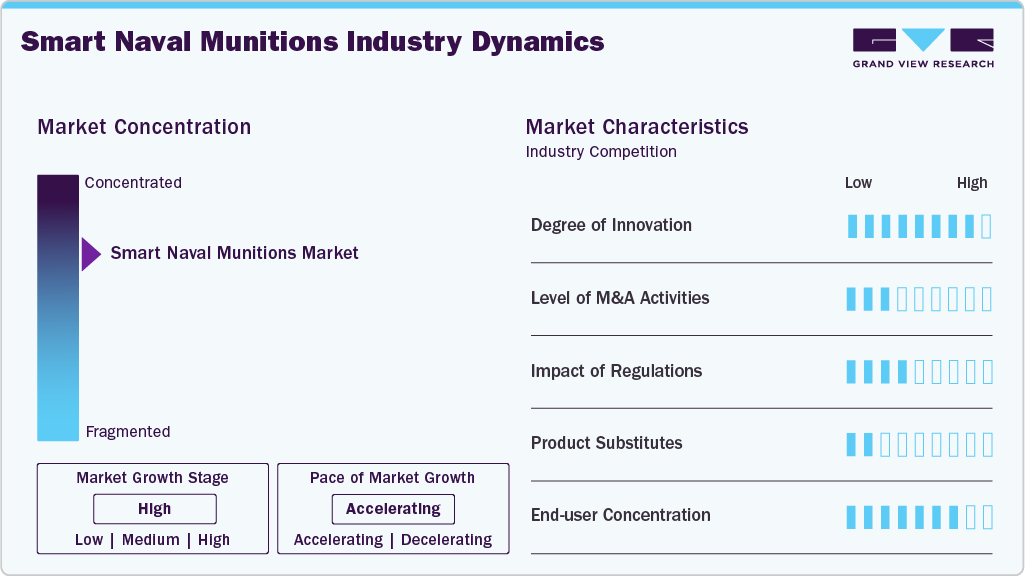
The global smart naval munitions market is highly concentrated, with a limited number of large defense contractors dominating development, production, and procurement of advanced naval missile systems and precision-guided munitions. These established players operate alongside a smaller group of specialized defense technology firms that focus on niche capabilities such as propulsion systems, guidance technologies, and naval combat integration. Market competition is primarily driven by technological superiority, long-range strike capabilities, system reliability, and integration with advanced naval combat platforms.
 To learn more about this report, Download Free Sample Report
 The market has very limited substitutes, as smart naval munitions are critical for modern maritime defense, deterrence, and offensive strike operations. However, the industry is heavily influenced by stringent government regulations, defense procurement policies, export control frameworks, and international arms trade agreements. Compliance with national security standards, testing protocols, and interoperability requirements is essential for market participation. Additionally, increasing investments in naval modernization, missile defense systems, and next-generation warfare technologies are creating sustained growth opportunities for manufacturers in both developed and emerging defense markets.
Analyst Perspective
The smart naval munitions market is poised for sustained expansion, driven by rising defense expenditures, accelerated naval fleet modernization, and the increasing adoption of precision-guided weapon systems to enhance maritime strike capabilities. The integration of autonomous technologies, AI-enabled targeting, and advanced guidance systems is expected to create new growth opportunities, while the growing emphasis on multi-domain warfare, maritime security, and operational readiness will further accelerate demand for next-generation smart naval munitions.
Type Insights
The missiles segment accounted for the largest market share of 47.5% in 2025. This growth can be attributed to the rising demand for long-range precision-strike capabilities and advanced naval missile defense systems. Increasing investments in hypersonic, cruise, and anti-ship missiles, as well as interceptor systems, are accelerating the development of next-generation smart naval munitions. Navies are focusing on multi-layered missile defense architectures to effectively counter evolving aerial and maritime threats. Furthermore, continuous advancements in propulsion technologies, guidance systems, AI-enabled targeting, and the integration of electronic warfare are enhancing missile performance and supporting segment growth.
The precision-guided firearms are expected to register the fastest CAGR of 7.1% from 2026 to 2033, owing to the increasing demand for highly accurate close-range naval defense systems and advanced tactical engagement capabilities. Naval forces are adopting smart targeting technologies and guided weapon systems to improve firing accuracy, reduce collateral damage, and enhance mission efficiency during maritime combat operations. Growing focus on automated weapon stations, integrated fire control systems, and AI-assisted targeting is supporting adoption of precision-guided firearms across naval platforms.
Launch Platform Insights
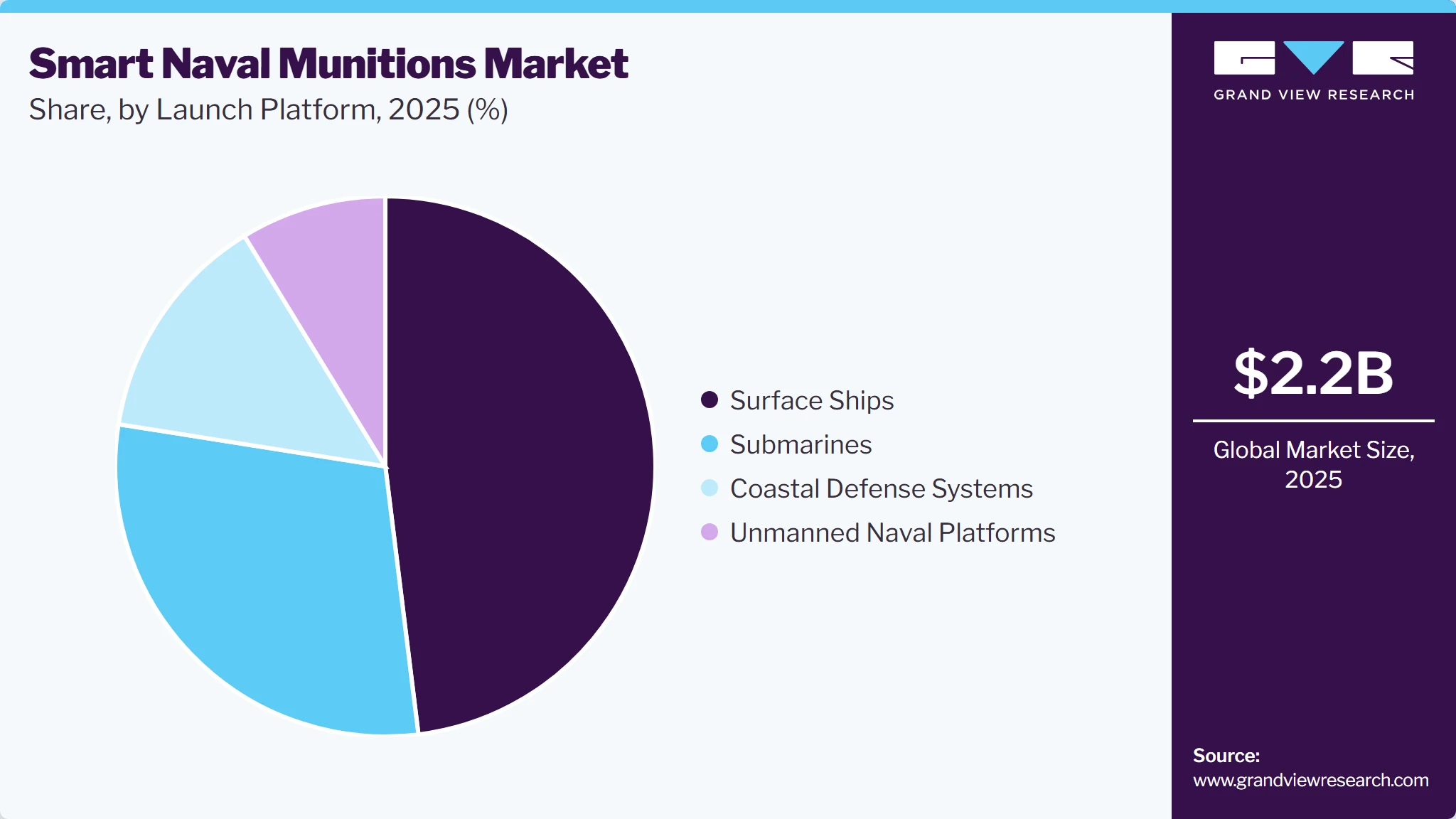
The surface ships accounted for the largest market share in 2025, driven by the ongoing modernization of destroyers, frigates, corvettes, and aircraft carriers, which are equipped with advanced smart naval munitions systems. Navies are increasingly integrating precision-guided missiles, missile defense systems, and automated combat management technologies into surface combat vessels to strengthen maritime defense and offensive capabilities. Rising geopolitical tensions, expanding naval patrol operations, and the increased deployment of multi-role warships are accelerating the procurement of advanced naval munitions for surface fleets.
 To learn more about this report, Download Free Sample Report
 The unmanned naval platforms segment is expected to register the fastest CAGR from 2026 to 2033, driven by the growing adoption of autonomous and remotely operated vessels for intelligence, surveillance, and reconnaissance (ISR), mine countermeasures, anti-submarine warfare, and maritime security missions. Furthermore, growing investments in AI, autonomous navigation, and network-centric naval operations are further accelerating segment growth.
Guidance Technology Insights
The satellite-guided segment accounted for the largest market share in 2025, owing to the growing demand for highly accurate long-range strike systems capable of operating in complex maritime combat environments. Integration of satellite navigation technologies such as GPS and advanced positioning systems is improving targeting precision, mission flexibility, and real-time navigation capabilities for naval munitions. Increasing emphasis on network-centric warfare and real-time battlefield awareness is accelerating the adoption of satellite-guided naval weapons.
The laser-guided segment is expected to post the highest CAGR from 2026 to 2033, driven by increasing demand for highly accurate and low-collateral naval strike capabilities. Laser-guided smart munitions enable precise targeting of moving maritime threats, improving operational effectiveness in both defensive and offensive missions. Growing focus on reducing ammunition wastage and improving engagement efficiency is encouraging the adoption of laser-guided systems across modern naval platforms. Additionally, advancements in laser designation technologies, electro-optical sensors, and integrated targeting systems are enhancing precision strike performance and supporting market growth.
Application Insights
The anti-ship warfare segment accounted for the largest market share in 2025, fueled by the increasing maritime security threats, rising naval conflicts, and growing investments in sea-denial and long-range strike capabilities. The expansion of naval fleets, growing deployment of carrier strike groups, and rising geopolitical tensions in strategic waterways are accelerating the procurement of smart anti-ship munitions. Additionally, advancements in hypersonic missile technologies, AI-enabled targeting systems, and integrated naval combat platforms are further supporting segment growth.
The land attack missions segment is expected to register the highest CAGR from 2026 to 2033, driven by the increasing demand for long-range precision strike capabilities, rising naval investments in advanced cruise missiles, and the growing emphasis on enhancing deep-strike and coastal target engagement capabilities. Furthermore, the integration of advanced guidance systems, AI-enabled target recognition, and network-centric combat technologies is improving mission accuracy and operational effectiveness, thereby accelerating the adoption of smart naval munitions for land-attack operations.
Regional Insights
North America dominated the smart naval munitions market, with a share of 35.6% in 2025, driven by robust defense modernization programs and sustained investment in next-generation naval warfare capabilities. Rising focus on missile defense systems, hypersonic threat countermeasures, and integrated combat platforms is accelerating procurement of advanced naval munitions. Additionally, high defense spending and rapid adoption of network-centric warfare technologies are supporting sustained market growth.
 To learn more about this report, Download Free Sample Report
 U.S. Smart Naval Munitions Market Trends
The U.S. smart naval munitions industry dominated the market with an 83% share in 2025, supported by large-scale naval fleet modernization programs and rising demand for precision-guided naval strike systems. The growing emphasis on multi-layer missile defense, deterrence capabilities, and the integration of advanced combat systems across destroyers and carriers is boosting adoption. Continuous R&D investment and strong defense procurement budgets further support innovation in smart naval munitions.
Europe Smart Naval Munitions Market Trends
The Europe smart naval munitions industry is expected to grow at a CAGR of over 4% from 2026 to 2033, propelled by rising geopolitical tensions and increased focus on strengthening naval defense capabilities across NATO member states. Growing investment in maritime security, coastal defense, and joint defense programs is accelerating demand for advanced naval munitions. Additionally, collaborative defense initiatives are promoting the development of next-generation missile systems.
The Germany smart naval munitions industry is expected to grow significantly in the coming years, fueled by rising defense spending and a growing focus on strengthening naval defense within European security frameworks. Investments in maritime security, advanced missile systems, and joint EU defense programs are supporting the adoption of smart naval munitions. Additionally, the modernization of naval platforms is boosting the procurement of advanced guided weapons.
The UK smart naval munitions industry is witnessing rapid expansion, driven by the modernization of naval fleets and increasing emphasis on maintaining advanced maritime strike and deterrence capabilities. The expansion of submarine and destroyer programs, along with the integration of precision missile systems, is supporting market growth. Strong focus on allied defense cooperation and advanced naval technologies further strengthens demand.
Asia Pacific Smart Naval Munitions Market Trends
The Asia Pacific smart naval munitions industry is expected to grow at the fastest CAGR of over 7% from 2026 to 2033, driven by increasing territorial disputes, naval expansion programs, and rising defense budgets across key economies. Growing focus on maritime security, coastal protection, and blue-water navy development is accelerating demand for advanced naval munitions. Rapid modernization of naval fleets and adoption of missile defense systems further support market expansion.
The China smart naval munitions industry is being accelerated by rapid naval modernization and large-scale expansion of maritime military capabilities. Strong investments in indigenous missile development, anti-ship systems, and integrated naval combat platforms are fueling demand. Additionally, focus on regional dominance and advanced naval deterrence strategies is accelerating the procurement of smart naval munitions.
The Japan smart naval munitions industry is expanding steadily, supported by increasing focus on maritime defense and strengthening naval deterrence capabilities amid regional security challenges. Investments in missile defense systems, advanced destroyers, and integrated naval platforms are supporting market growth. Strong alignment with allied defense frameworks and modernization of self-defense forces further enhances demand.
Key Smart Naval Munitions Company Insights
Some of the key players operating in the market include Lockheed Martin Corporation and Raytheon Technologies, among others.
-
Lockheed Martin is a defense company that provides advanced smart naval munitions, including precision-guided missiles, anti-ship missile systems, naval strike weapons, and integrated maritime combat solutions. The company plays a key role in modern naval warfare systems through its highly advanced missile guidance technologies, long-range strike capabilities, and network-enabled defense platforms used by naval forces globally.
-
Raytheon Technologies is a major defense and aerospace company that provides smart naval munitions such as guided missiles, naval defense systems, torpedoes, and advanced sensor-based weapon technologies. The company is known for its expertise in missile guidance, radar systems, and precision strike capabilities that enhance naval fleet protection and offensive maritime operations.
Rafael Advanced Defense Systems and Kongsberg Gruppen are some of the emerging market participants in the smart naval munitions market.
-
Rafael Advanced Defense Systems is an emerging defense technology company that provides smart naval munitions including anti-ship missiles, precision-guided naval strike systems, and advanced maritime defense solutions. The company is recognized for its innovation in missile accuracy, electronic warfare integration, and compact naval weapon systems designed for modern multi-domain combat environments.
-
Kongsberg Gruppen is a growing defense and technology company that provides smart naval munitions such as precision-guided missiles, naval strike systems, and autonomous maritime defense solutions. The company focuses on advanced missile technology, remote weapon systems, and integrated naval combat platforms, supporting next-generation naval warfare and coastal defense applications.
Key Smart Naval Munitions Companies:
The following key companies have been profiled for this study on the smart naval munitions market
-
Raytheon Technologies
-
Lockheed Martin
-
Northrop Grumman
-
BAE Systems
-
Thales Group
-
MBDA
-
Leonardo S.p.A.
-
Bharat Dynamics Limited
-
Kongsberg Gruppen
-
Rafael Advanced Defense Systems
Competitive Benchmarking
Operating Strategies
Competitive Edge
Weaknesses
Established Players (Lockheed Martin Corporation, Northrop Grumman Corporation, BAE Systems)
- Focus on long-term defense contracts, government partnerships, and multi-decade naval modernization programs.
- Heavy investment in R&D for next-generation missile systems, integrated combat platforms, and network-centric warfare capabilities.
- Strong technological maturity in precision-guided munitions, propulsion systems, and advanced guidance technologies.
- Established global defense supply chains and deep relationships with naval forces and defense ministries.
- High development costs and long procurement cycles reduce flexibility and speed to market.
- Dependence on government defense budgets and geopolitical priorities
Emerging & Specialized Players (Rafael Advanced Defense Systems, Kongsberg Gruppen, Bharat Dynamics Limited)
- Focus on niche capabilities such as cost-efficient missile systems, modular platforms, and specialized naval applications.
- Expand through strategic collaborations, technology partnerships, and regional defense contracts.
- Faster innovation cycles and the ability to adapt to evolving naval warfare requirements.
- Competitive pricing and targeted solutions for specific operational needs.
- Limited large-scale manufacturing capacity and global defense integration capability.
- Lower access to long-term defense contracts and restricted international market reach.
Recent Developments
-
In April 2026, Lockheed Martin Corporation was awarded a landmark contract by the U.S. Navy to integrate the PAC-3 MSE air defense missile into the Aegis Combat System for the first time. This development enables the missile to be deployed on Arleigh Burke-class destroyers via the Mk 41 Vertical Launch System, significantly enhancing the Navy’s shipborne missile defense capability against advanced threats such as hypersonic and ballistic missiles.
-
In February 2026, Raytheon Technologies signed a long-term agreement with the U.S. Department of Defense to significantly expand production of naval and strategic missiles, including Tomahawk cruise missiles and SM-series interceptors.
-
In January 2026, Northrop Grumman was awarded a U.S. Navy contract worth approximately USD 94.3 million for the development and qualification of a new 21-inch solid rocket motor (SSRM). The program supports next-generation missile systems to enhance extended-range strike and hypersonic defense capabilities, improving the Navy’s ability to engage fast-moving air, surface, and missile threats across multiple operational domains.
Smart Naval Munitions Market Report Scope
Report Attribute
Details
Market size in 2025
USD 2.2 billion
Estimated market size in 2026
USD 2.3 billion
Projected market size by 2033
USD 3.4 billion
Growth rate
CAGR of 5.5% from 2026 to 2033
Base year of estimation
2025
Actual data
2021 - 2024
Forecast period
2026 - 2033
Quantitative units
Revenue in USD million/billion and CAGR from 2026 to 2033
Report coverage
Revenue forecast, company ranking, competitive landscape, growth factors, and trends
Segments covered
Type, launch platform, guidance technology, application, region
Regional scope
North America; Europe; Asia Pacific; Latin America; Middle East and Africa
Country scope
U.S.; Canada; Mexico; Germany; UK; France; China; Japan; India; South Korea; Australia; Brazil; UAE; Saudi Arabia; South Africa
Key companies profiled
Raytheon Technologies; Lockheed Martin; Northrop Grumman; BAE Systems; Thales Group; MBDA; Leonardo S.p.A.; Bharat Dynamics Limited; Kongsberg Gruppen; Rafael Advanced Defense Systems
Customization scope
Free report customization (equivalent up to 8 analysts working days) with purchase. Addition or alteration to country, regional & segment scope.
Global Smart Naval Munitions Market Report Segmentation
This report forecasts revenue growth at global, regional, and country levels and provides an analysis of the latest industry trends in each of the sub-segments from 2021 to 2033. For this study, Grand View Research has segmented the global smart naval munitions market report based on type, launch platform, guidance technology, end-use, and region:
-
Type Outlook (Revenue, USD Million, 2021 - 2033)
-
Missiles
-
Munitions
-
Guided Projectiles
-
Guided Rockets
-
Precision-Guided Firearms
-
-
Launch Platform Outlook (Revenue, USD Million, 2021 - 2033)
-
Surface Ships
-
Submarines
-
Coastal Defense Systems
-
Unmanned Naval Platforms (USVs / UUVs)
-
-
Guidance Technology Outlook (Revenue, USD Million, 2021 - 2033)
-
Satellite-Guided
-
Radar-Guided
-
Infrared-Guided
-
Laser-Guided
-
-
Application Outlook (Revenue, USD Million, 2021 - 2033)
-
Anti-Ship Warfare
-
Anti-Submarine Warfare
-
Naval Air Defense
-
Land Attack Missions
-
Others
-
-
Regional Outlook (Revenue, USD Million, 2021 - 2033)
-
North America
-
U.S.
-
Canada
-
Mexico
-
-
Europe
-
Germany
-
UK
-
France
-
-
Asia Pacific
-
China
-
Japan
-
India
-
South Korea
-
Australia
-
-
Latin America
-
Brazil
-
-
Middle East and Africa (MEA)
-
UAE
-
Saudi Arabia
-
South Africa
-
-
Research Methodology
The smart naval munitions market figures in this report are based on a proven research process that combines executive interviews with secondary research from proprietary databases, company filings, and recognized regulatory and institutional sources. Market size is built through value-chain sizing-reconciling supply-side and demand-side estimates-and triangulated with bottom-up and top-down approaches. Every estimate passes multiple levels of expert validation before publication, with each smart naval munitions segment quantified using the revenue-capture definitions in the table below.
Segment Definition
Segment - Type
Revenue capture definition
Missiles
Revenue is generated through the development, production, procurement, and maintenance of advanced naval missile systems, including anti-ship, land-attack, and multi-purpose guided missile solutions.
Munitions
Revenue is generated through the manufacturing, supply, and lifecycle support of smart naval munitions, including precision-guided ammunition and specialized naval weapon payloads.
Guided Projectiles
Revenue is generated through the production and integration of precision-guided naval projectiles, including advanced targeting, guidance, and fire-control technologies for naval gun systems.
Guided Rockets
Revenue is generated through the supply of guided rocket systems, including precision-strike rocket technologies, launch systems, and associated guidance and support solutions.
Precision-Guided Firearms
Revenue is generated through the development and procurement of advanced precision-guided firearm systems and associated targeting, stabilization, and accuracy-enhancement technologies.
Segment - Launch Platform
Revenue capture definition
Surface Ships
Revenue is generated through the integration, procurement, and maintenance of smart naval munitions deployed on destroyers, frigates, corvettes, and other surface combat vessels.
Submarines
Revenue is generated through submarine-launched smart weapon systems, including guided torpedoes, missiles, and underwater strike capabilities, along with integration and support services.
Coastal Defense Systems
Revenue is generated through the supply and deployment of shore-based smart naval weapon systems, including coastal missile batteries, surveillance integration, and defense infrastructure.
Unmanned Naval Platforms
Revenue is generated through the development and integration of smart munitions for unmanned surface and underwater vehicles, including autonomous strike, surveillance, and defense applications.
Segment - Guidance Technology
Revenue capture definition
Satellite-Guided
Revenue is generated through satellite-based navigation and precision guidance technologies integrated into smart naval munitions to improve targeting accuracy and operational range.
Radar-Guided
Revenue is generated through radar seeker systems, targeting technologies, and guided munition solutions that enable accurate engagement of maritime and aerial threats.
Infrared-Guided
Revenue is generated through infrared seeker technologies and heat-signature-based targeting systems used in advanced naval missile and munition applications.
Laser-Guided
Revenue is generated through laser designation and precision-guidance systems that enhance strike accuracy for naval weapon platforms and tactical missions.
Segment - Application
Revenue capture definition
Anti-Ship Warfare
Revenue is generated through the development, procurement, and deployment of smart naval munitions designed to detect, track, and engage enemy surface vessels.
Anti-Submarine Warfare
Revenue is generated through advanced naval weapon systems, including smart torpedoes and underwater munitions, designed for submarine detection and engagement missions.
Naval Air Defense
Revenue is generated through the supply of guided naval defense systems, including surface-to-air missiles and precision interception technologies for protecting fleets against aerial threats.
Land Attack Missions
Revenue is generated through long-range precision strike systems, including cruise missiles and guided munitions designed to engage strategic land-based targets from naval platforms.
Others
Revenue is generated through specialized smart naval munition applications, including electronic warfare support, maritime security operations, training systems, and emerging naval combat requirements.
Estimation Model
Layer Name
Key Question
Description
Advanced Naval Weapons Technology & Enablement Layer
What technologies and systems enable smart naval munitions capabilities?
Represents the foundational technologies, weapon systems, and supporting infrastructure that enable the development and deployment of smart naval munitions. Includes precision guidance systems, advanced propulsion technologies, seeker technologies, AI-enabled targeting, sensor fusion, satellite navigation, electronic warfare resilience, autonomous navigation systems, secure communication networks, combat management systems, and advanced materials that enhance accuracy, range, survivability, and mission effectiveness.
Naval Mission Application & End-User Layer
Where are smart naval munitions deployed and which defense segments generate demand?
Represents the naval applications and defense organizations driving demand for smart munitions. Key end users include naval forces, maritime security agencies, and defense organizations. Applications include anti-ship warfare, land-attack missions, anti-submarine warfare, air defense, precision-strike operations, coastal defense, and fleet protection. These systems support enhanced maritime dominance, deterrence capabilities, and operational effectiveness across surface vessels, submarines, and unmanned naval platforms.
Smart Munition Integration & Lifecycle Management Layer
How are smart naval munitions developed, integrated, and maintained across naval operations?
Covers the integration, deployment, and lifecycle management of advanced naval weapon systems. Includes weapon system integration, platform compatibility testing, mission software updates, targeting system integration, simulation and training solutions, maintenance services, logistics support, modernization programs, and aftermarket services that ensure reliability, interoperability, and long-term operational readiness of naval munitions.
Defense Procurement & Market Monetization Layer
How is revenue generated in the smart naval munitions market?
Revenue is generated through the development, production, procurement, and sustainment of smart naval weapon systems. Key revenue streams include missile and munition sales, guidance and sensor system contracts, naval platform integration programs, technology upgrades, maintenance and support agreements, simulation and training services, and long-term defense contracts with naval forces and government defense agencies seeking advanced maritime warfare capabilities.
Customization Table
This report has been delivered with the following In-depth customizations
CLIENT REQUEST
CUSTOMIZATION DELIVERED
VALUE ADDS
Market Sizing, Segmentation & Growth Opportunity Assessment
Assessed the global Smart Naval Munitions market size, historical trends, forecast growth outlook, and detailed segmentation by type (missiles, munitions, guided projectiles, guided rockets, precision-guided firearms), launch platform (surface ships, submarines, coastal defense systems, unmanned naval platforms), guidance technology (satellite-guided, radar-guided, infrared-guided, laser-guided), and application (anti-ship warfare, anti-submarine warfare, naval air defense, land attack missions, and others).
Enables defense stakeholders, naval forces, and industry participants to identify high-growth segments, prioritize investments in advanced naval weapon technologies, and develop strategic initiatives aligned with maritime modernization, precision warfare, autonomous platforms, and next-generation defense capabilities. Provides insights into revenue opportunities across weapon types, deployment platforms, guidance systems, and mission applications.
Technology Landscape & Advanced Weapon System Adoption Analysis
Evaluated the adoption of emerging technologies across smart naval munitions, including AI-enabled targeting, autonomous navigation, advanced seeker systems, precision guidance technologies, electronic warfare resilience, network-centric warfare capabilities, and integration with naval combat management systems. Analyzed advancements in propulsion, sensor fusion, communication systems, and unmanned naval platforms to understand evolving technology trends and operational capabilities.
Helps defense manufacturers, naval organizations, and technology providers identify emerging innovation opportunities, enhance weapon system performance, improve strike accuracy and survivability, and develop advanced solutions to support modern maritime warfare requirements and multi-domain defense operations.
Regional Defense Demand & Naval Modernization Analysis
Assessed regional demand trends across North America, Europe, Asia Pacific, Latin America, and the Middle East & Africa by evaluating defense budget allocations, naval fleet modernization programs, maritime security concerns, geopolitical developments, indigenous defense manufacturing initiatives, and procurement activities for advanced naval weapon systems.
Provides insights into regional growth opportunities, procurement priorities, and competitive dynamics, enabling stakeholders to identify key markets, align product development strategies, and capitalize on rising demand for precision-guided naval weapons, autonomous maritime systems, and enhanced maritime defense capabilities.
Frequently Asked Questions About This Report
North America dominated the global market, accounting for 35.6% in 2025.
The increasing naval modernization programs, rising defense budgets, growing demand for precision-guided weapons, advancements in guidance and targeting technologies, and the need to enhance maritime security and combat effectiveness are the key factors driving the smart naval munitions market.
Key players include Raytheon Technologies, Lockheed Martin, Northrop Grumman, BAE Systems, Thales Group, MBDA, Leonardo S.p.A., Bharat Dynamics Limited, Kongsberg Gruppen, and Rafael Advanced Defense Systems are the key players in the smart naval munitions market.
The surface ships segment accounted for the largest market share in 2025, while unmanned naval platforms is the fastest growing segment.
The satellite-guided segment led the market with a share in 2025, while laser-guided is the fastest growing segment.
Asia Pacific is the fastest-growing region over the forecast period.
The global smart naval munitions market size was estimated at USD 2.2 billion in 2025 and is projected to reach USD 2.3 billion in 2026.
The global smart naval munitions market is expected to reach USD 3.4 billion by 2033, at a CAGR of 5.5% from 2026 to 2033.
The missiles segment led with the largest revenue share of 47.5% in 2025, while precision-guided firearms segment is the fastest growing type.
About the Author(s)
Next Generation Technologies Research Team
Technology · Next Generation TechnologiesThis report was authored by the next generation technologies research team at Grand View Research - comprising two research analysts, one senior research analyst, and one industry expert - with specialized expertise in the next generation technologies segment of the technology industry. All findings are based on proprietary technology databases, executive interviews, and regulatory analysis, subject to internal peer review prior to publication.
Last Updated:
Speak to Analyst

Customize this report to your needs - add regions, segments, or data points, with 20% free customization.
Or view our licence options:


ISO 9001:2015 & 27001:2022 Certified
We are GDPR and CCPA compliant! Your transaction & personal information is safe and secure. For more details, please read our privacy policy.


