
- Home
- »
- Advanced Interior Materials
- »
-
Smart Personal Protective Equipment Market Report, 2033GVR Report cover

Smart Personal Protective Equipment Market (2026 - 2033 ) Size, Share & Trends Analysis Report By Product (Hand Protection, Protective Clothing, Head Protection, Respiratory Protection, Eye Protection, Fall Protection), By End Use, By Region, And Segment Forecasts
Market Size, 2025
$3.3BMarket Estimate, 2026
$3.8BMarket Forecast, 2033
$9.8BCAGR, 2026–2033
14.6%Smart Personal Protective Equipment Market Summary
The global smart personal protective equipment market size was valued at USD 3.3 billion in 2025 and is projected to reach USD 9.8 billion by 2033, growing at a CAGR of 14.6% from 2026 to 2033. The global smart PPE market is driven by the increasing emphasis on worker safety across high-risk industries such as construction, oil & gas, and manufacturing.
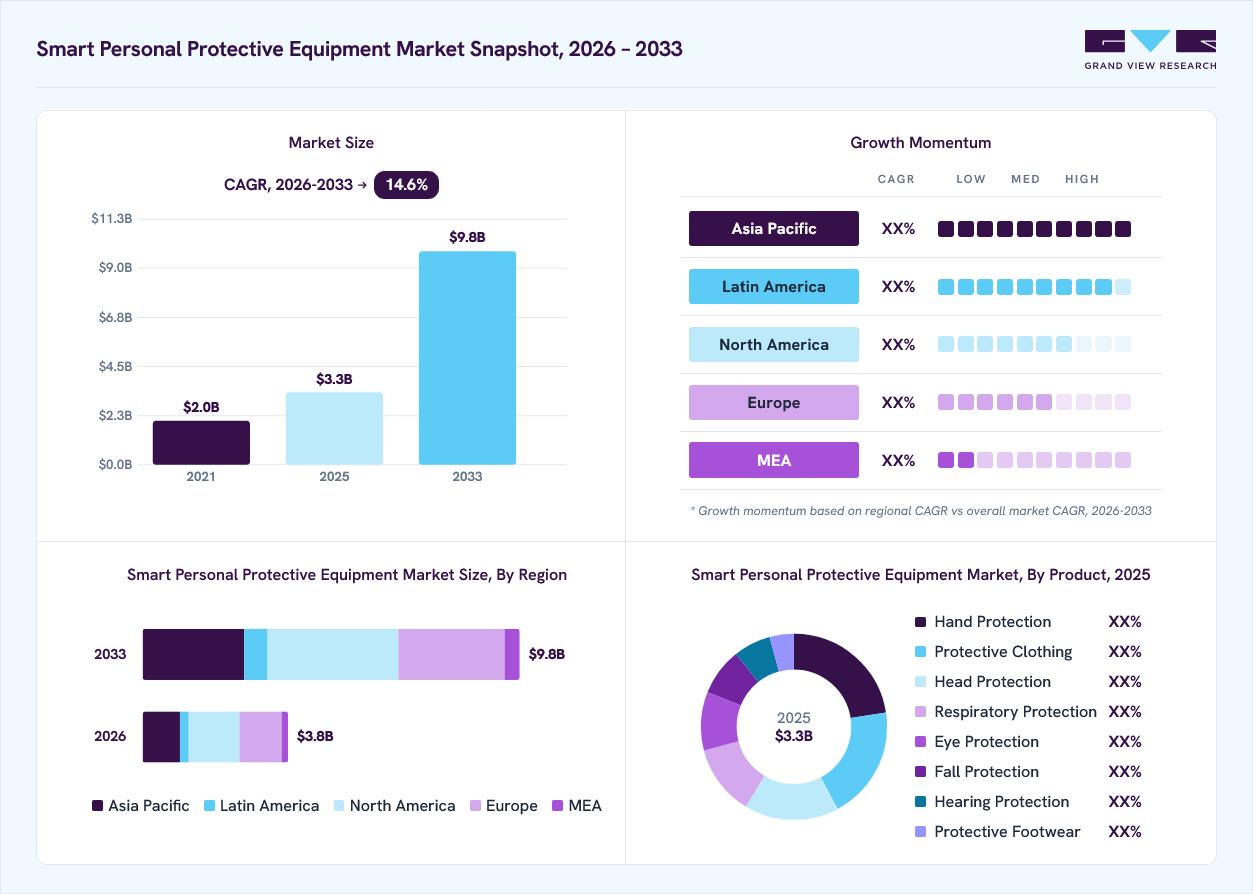 Source: Grand View Research, IR Documents, Primary Interviews, Paid DatabasesTo learn more about this report,
 Download Free Sample Report
Key Market Trends & Insights
- North America dominated the smart personal protective equipment market with the largest revenue share of 35.0% in 2025.
- The smart personal protective equipment market in Mexico is expected to grow at a substantial CAGR of 15.1% from 2026 to 2033.
- By product, the head protection segment is expected to grow at a considerable CAGR of 15.6% from 2026 to 2033 in terms of revenue.
- By end use, the healthcare segment is expected to grow at a considerable CAGR of 15.3% from 2026 to 2033 in terms of revenue.
Market Size & Forecast
- 2025 Market Size: USD 3.3 Billion
- 2033 Projected Market Size: USD 9.8 Billion
- CAGR (2026-2033): 14.6%
- North America: Largest market in 2025
- Asia Pacific: Fastest growing market
Three ways to get this report
Buy it, customize it, or ask a question.Ask an Analyst
Analyst response in 1 business day
- AccessReport author, directly
- Reply timeWithin 1 working day
- No sales callDirect answer only
- FormatEmail reply
- CostFree, no cost
Get the Full Report
What the study covers
- FormatsPDF · Excel · Dashboard
- Timeline2026–2033 annual, 2025 base
- Coverage20+ countries, 5 regions
- Companies10+ key players profiled
Customize the Report
20% free customization
- IncludeCountries, segments, points
- TailorTo your product definition
- ExtendDeeper competitor detail
- OrA fully bespoke study
- Turnaround5–10 working days
Rising awareness of occupational hazards and stringent regulatory standards compels companies to adopt advanced protective solutions. Integration of IoT, AI, and wearable sensors allows real-time monitoring of health metrics and environmental conditions. This technological advancement enhances operational efficiency while minimizing workplace accidents. Another key driver is the growing adoption of connected worker solutions that enable predictive safety management. Smart PPE provides data analytics to identify potential risks before incidents occur, reducing downtime and associated costs.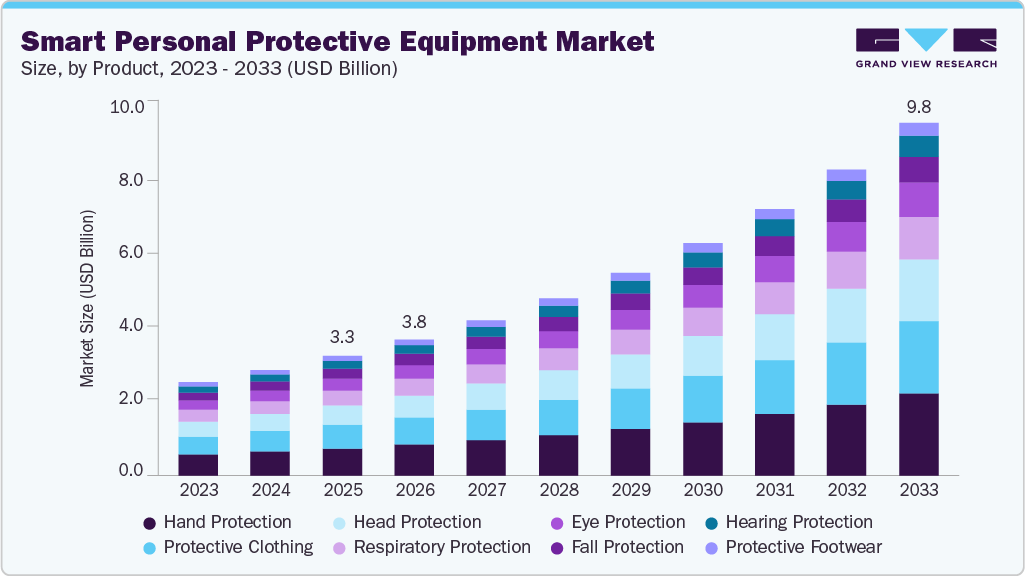 To learn more about this report, Download Free Sample Report
Rising demand for lightweight, comfortable, and multifunctional protective gear further supports market growth. Additionally, companies are investing in eco-friendly and sustainable PPE solutions, aligning with corporate social responsibility goals.
Market Dynamics
The growth of the manufacturing sector, driven by industrial expansion and infrastructure development, is closely tied to the adoption and scaling of smart personal protective equipment. As the global manufacturing sector grows, there is a parallel escalation in workplace complexity and risk, creating robust demand not just for conventional protective equipment but specifically for technology-enabled smart PPE. In manufacturing, smart PPE is a significant asset for protection against a wide range of occupational hazards, going beyond traditional physical barriers by adding real-time hazard detection, connectivity, and data analytics.
Additionally, smart PPE includes specialized features such as wearables with heat sensors for protection in high-temperature environments, integrated insulation and monitoring for electrical safety, and sensor-driven ear protection that can detect and report hazardous noise levels to prevent hearing loss. High-visibility smart clothing enhances worker visibility by transmitting location information to supervisors, and advanced devices are designed to limit exposure to biological threats in pharmaceutical or food production through environmental monitoring.
The rapid expansion of automation and robotics is fundamentally reshaping global industry and acts as a considerable restraint on the future growth of the smart personal protective equipment (PPE) market. This surge in automation has direct implications for the smart PPE market. Robots are increasingly replacing human workers in high-risk roles such as welding, material handling, assembly, and inspection—tasks that previously required specialized protective gear, such as helmets, gloves, and respiratory protection. As machines assume these hazardous functions, human exposure to risks diminishes, leading to reduced demand for protective equipment.
Market Concentration & Characteristics
The smart PPE industry is fragmented, led by a few dominant players and large regional and local players, with advanced technology and wide distribution. Established reputations strengthen their market hold, while smaller firms and startups introduce specialized solutions. This combination creates a competitive environment. Overall, the market remains moderately concentrated.
The smart PPE sector is highly focused on innovation, with ongoing development of wearable devices and integrated sensor systems. Technologies like IoT connectivity, real-time monitoring, and AI analytics are central to enhancing worker safety and efficiency. Products are designed for improved comfort and usability. Continuous R&D ensures the industry stays at the forefront of technological advancement.
 To learn more about this report, Download Free Sample Report
Mergers and acquisitions are common as companies aim to broaden their offerings and enter new markets. Larger firms often acquire smaller innovators to gain access to specialized technologies. Strategic alliances also help accelerate product development and market penetration. This activity contributes to both industry consolidation and technological progress.
Regulations play a major role in shaping the smart PPE market, with safety standards and certifications guiding product design. Companies must comply with occupational safety laws and regional certification requirements. Compliance ensures protection for workers and product reliability. Regulations thus drive innovation while maintaining high safety standards.
Product Insights
Hand protection remains the largest segment in the smart PPE market and accounted for a 22.5% share in 2025, due to its critical role in preventing workplace injuries. Smart gloves with sensors provide real-time monitoring of hand movements, pressure, and environmental hazards. Industries such as manufacturing, construction, and oil & gas heavily rely on advanced hand protection. Continuous innovations in materials and connectivity sustain its dominant position in the market.
Head protection is the fastest-growing segment as smart helmets gain popularity in high-risk industries. These helmets integrate sensors, IoT, and AI to detect impacts, falls, and hazardous conditions in real time. The rising focus on connected worker solutions and predictive safety management drives demand. Enhanced safety features combined with ergonomic designs make smart headgear a rapidly expanding market segment.
End Use Insights
The manufacturing sector dominated the smart PPE market and accounted for a 24.0% share in 2025, due to the high risk of workplace injuries and strict safety regulations. Smart PPE, such as gloves, helmets, and vests, helps monitor worker safety in real time. Integration of IoT and sensor technologies improves operational efficiency and reduces accidents. Continuous adoption of advanced safety solutions reinforces manufacturing’s leading position in the market.
 To learn more about this report, Download Free Sample Report
Healthcare is the fastest-growing end-use segment as hospitals and clinics increasingly adopt smart PPE for infection control and worker safety. Wearable devices and connected protective gear enable real-time monitoring of staff health and exposure risks. Rising awareness of workplace hazards and regulatory compliance drives adoption. The demand for innovative, lightweight, and comfortable PPE fuels rapid growth in this sector.
Regional Insights
North America dominated the smart PPE market and accounted for a 35.0% share in 2025, due to stringent occupational safety regulations and high awareness of workplace hazards. Advanced industrial sectors and widespread adoption of IoT-enabled safety solutions drive growth. The presence of key market players and strong R&D capabilities further strengthen the region’s leadership. Continuous innovation and investment in connected worker technologies maintain its dominant position.
 To learn more about this report, Download Free Sample Report
U.S. Smart Personal Protective Equipment Market Trends
The U.S. dominates the North America smart PPE market owing to strict occupational safety regulations and widespread adoption of connected safety solutions. Advanced industrial sectors such as oil & gas, construction, and healthcare drive strong demand. High investment in IoT-enabled and AI-integrated PPE enhances workplace safety. Continuous innovation and the presence of leading technology providers reinforce their leadership position.
Mexico is the fastest-growing smart PPE market in North America, supported by rapid industrialization and expanding manufacturing activities. Rising government focus on workplace safety and compliance boosts adoption. Growth in sectors such as automotive, construction, and mining further fuels demand for advanced protective equipment. Increasing awareness of worker safety and the adoption of cost-effective smart solutions accelerate market expansion.
Europe Smart Personal Protective Equipment Market Trends
Europe shows steady growth in the smart PPE market, driven by stringent safety regulations and technological advancements. Adoption of smart protective equipment is rising across industries such as manufacturing, construction, and healthcare. Investments in connected worker solutions enhance workplace safety and efficiency. Regulatory support and innovation continue to encourage market growth.
Germany dominates the European smart PPE market, driven by its strong industrial base and strict workplace safety standards. High adoption of advanced protective equipment in manufacturing, automotive, and chemical sectors strengthens demand. Investment in IoT-enabled safety solutions enhances operational efficiency and worker protection. Continuous innovation and regulatory compliance keep Germany at the forefront of the market.
The smart PPE market in the UK is witnessing steady growth due to increasing focus on workplace safety and digital transformation. Adoption of connected protective gear is expanding in sectors like construction, healthcare, and energy. Government initiatives and safety regulations encourage companies to invest in advanced solutions. Rising awareness of worker well-being supports the market’s upward trajectory.
Asia Pacific Smart Personal Protective Equipment Market Trends
The smart PPE market in Asia Pacific is the fastest-growing region with a CAGR of 15.4%, fueled by rapid industrialization and urbanization. Increasing construction, manufacturing, and mining activities boost demand for advanced protective gear. Rising safety awareness and government initiatives promoting worker protection support adoption. Growth in smart technologies and cost-effective solutions accelerates market expansion in the region.
China dominates the Asia Pacific smart PPE market, supported by its vast industrial sector and rapid adoption of advanced technologies. Strong demand comes from construction, mining, and manufacturing, where worker safety is a priority. Government policies promoting industrial safety further encourage market growth. Local production capabilities and cost-effective solutions strengthen China’s leadership in the region.
India is showing strong growth in the smart PPE market, driven by rapid industrialization and expanding infrastructure projects. Rising safety awareness among industries such as construction, oil & gas, and healthcare is boosting adoption. Government initiatives and stricter enforcement of safety regulations support demand. Increasing investment in connected worker solutions enhances India’s market growth potential.
Latin America Smart Personal Protective Equipment Market Trends
The smart PPE market in Latin America is experiencing gradual growth due to increasing industrial activities and emphasis on worker safety. Smart PPE adoption is expanding across sectors like oil & gas, mining, and construction. Companies are investing in technology-driven safety solutions to reduce workplace accidents. Awareness campaigns and regulatory initiatives support steady market development.
Brazil is witnessing steady growth in the smart PPE market, driven by expanding industrial and construction activities. Rising enforcement of workplace safety regulations is encouraging companies to adopt advanced protective gear. Growing demand in sectors such as mining, oil & gas, and manufacturing supports market expansion. Increased awareness of worker safety and digital transformation further contributes to growth in the country.
Middle East & Africa Smart Personal Protective Equipment Market Trends
The smart PPE market in the Middle East and Africa is witnessing growth due to rising industrialization and safety compliance initiatives. Adoption of connected safety devices is increasing in high-risk sectors such as construction and energy. Technological advancements and workforce safety programs drive market penetration. Continuous focus on workplace safety and regulation enforcement supports steady growth.
Saudi Arabia is experiencing strong growth in the smart PPE market, supported by rapid industrial expansion and large-scale infrastructure projects. Government initiatives such as Vision 2030 emphasize workplace safety and modernization. High-risk sectors like oil & gas, construction, and mining are driving demand for advanced protective solutions. Rising adoption of connected worker technologies further strengthens market growth in the country.
Key Smart Personal Protective Equipment Company Insights
Key players operating in the smart personal protective equipment market are undertaking various initiatives to strengthen their presence and increase the reach of their products and services. Strategies such as expansion activities and partnerships are key in propelling the market growth. Some of the key players operating in the market include 3M, Ansell Ltd., and Delta Plus Group.
-
3M is a diversified technology company with a strong presence in the smart PPE space, focusing on advanced respiratory protection, connected safety solutions, and digital monitoring tools. Its safety division integrates IoT and sensor-based technologies into protective equipment, enabling real-time worker health and hazard tracking. Beyond PPE, 3M operates across healthcare, industrial, consumer, and electronics segments. The company invests heavily in R&D to enhance safety, sustainability, and efficiency in its solutions. Its portfolio spans smart respirators, authentication apps, and connected worker platforms, making it a leader in innovation-driven safety technology.
-
Ansell specializes in protective solutions with a focus on hand and body protection across healthcare, industrial, and life sciences sectors. In the smart PPE domain, it develops intelligent gloves and packaging innovations that improve safety, traceability, and sustainability. The company’s healthcare vertical delivers surgical and examination gloves, while its industrial vertical emphasizes chemical-resistant and cut-resistant protective gear. Ansell also targets critical environments like pharmaceuticals and cleanrooms with specialized solutions. Its innovation-driven approach integrates sustainability and digital monitoring, positioning it as a key player in smart safety gear advancements.
Key Smart Personal Protective Equipment Companies:
The following are the leading companies in the smart personal protective equipment market. These companies collectively hold the largest Market share and dictate industry trends.
- 3M
- Ansell Ltd.
- Delta Plus Group
- Proxgy
- Vuzix
- MSA
- Bullard
- Uvex Group
- Drägerwerk AG & Co. KGaA
- LUCYD
- Corvex Connected Workers
- DuPont
- PIP
- Aatmunn
Competitive Benchmarking
Operating Strategies
Competitive Edge
Weaknesses
Mature Players: 3M; Ansell Ltd.; Delta Plus Group; MSA; Bullard; Uvex Group; Drägerwerk AG & Co. KGaA; DuPont; PIP
- Strong investments in connected worker technologies, industrial safety automation, and IoT-enabled PPE solutions.
- Expansion of smart helmets, connected respiratory protection, wearable sensors, and real-time worker monitoring systems.
- Integration of AI, AR/VR, and cloud-based safety management platforms into PPE solutions.
- Strong global brand recognition and diversified industrial safety product portfolios.
- Advanced R&D capabilities in occupational safety, wearable technology, and sensor integration.
- Established relationships with oil & gas, construction, manufacturing, mining, and healthcare industries.
- Premium pricing compared to regional PPE manufacturers.
- High dependence on industrial capital expenditure and workplace safety budgets.
- Complex integration and implementation requirements for connected PPE ecosystems.
Emerging Players: Proxgy; Vuzix; LUCYD; Corvex Connected Workers; Aatmunn
- Focus on AI-enabled smart wearables, connected eyewear, and real-time workforce monitoring solutions.
- Increasing emphasis on AR-assisted industrial operations and remote collaboration technologies.
- Expansion into niche smart PPE applications for industrial safety, logistics, healthcare, and field operations.
- Strong innovation capabilities in smart glasses, wearable communication, and connected workforce solutions.
- Competitive flexibility and faster product innovation cycles.
- Growing adoption in Industry 4.0 and digital workplace environments.
- Comparatively lower global market penetration and brand visibility.
- Limited financial scale for large manufacturing and global expansion initiatives.
- Higher dependence on technology adoption rates and enterprise digital transformation investments.
Recent Developments
-
In November 2024, Guardio and Quin plan to release the Armet PRO, the first smart industrial helmet, in 2025. It combines Quin’s sensors with Mips brain protection to detect falls and impacts in real time. The helmet automatically notifies emergency contacts with incident details and location. It also tracks workers’ return to safe zones, improving overall workplace safety.
-
In April 2024, 3M launched the 3M Verify app to help authenticate healthcare PPE and prevent counterfeits. Users can scan respirator barcodes to confirm authenticity, ensuring safety compliance. Products supported include N95 respirators and 3M Aura models. The app is available on Apple’s App Store, with a Google Play release forthcoming.
Global Smart Personal Protective Equipment (PPE) Market Report Scope
Report Attribute
Details
Market size value in 2026
USD 3.8 billion
Revenue forecast in 2033
USD 9.8 billion
Growth rate
CAGR of 14.6% from 2026 to 2033
Historical data
2021 - 2024
Forecast period
2026 - 2033
Quantitative units
Revenue in USD million/billion and CAGR from 2026 to 2033
Report coverage
Revenue forecast, company ranking, competitive landscape, growth factors, and trends
Segments covered
Product, end use, region
Regional scope
North America; Europe; Asia Pacific; Latin America; Middle East & Africa
Country scope
U.S.; Canada; Mexico; Germany; France; Italy; Spain; UK; China; Japan; India; South Korea; Australia; Argentina; Brazil; Saudi Arabia; South Africa; UAE
Key companies profiled
3M; Ansell Ltd.; Delta Plus Group; Proxgy; Vuzix
MSA; Bullard; Uvex Group; Drägerwerk AG & Co. KGaA; LUCYD; Corvex Connected Workers; DuPont; PIP; Aatmunn.
Customization scope
Free report customization (equivalent up to 8 analysts working days) with purchase. Addition or alteration to country, regional & segment scope.
Pricing and purchase options
Avail customized purchase options to meet your exact research needs. Explore purchase options
Global Smart Personal Protective Equipment (PPE) Market Report Segmentation
This report forecasts revenue growth at global, regional, and country levels and provides an analysis of the latest industry trends in each of the sub-segments from 2021 to 2033. For this study, Grand View Research has segmented the global smart personal protective equipment market report based on product, end use, and region.
 To learn more about this report, Download Free Sample Report
-
Product Outlook (Revenue, USD Million, 2021 - 2033)
-
Hand Protection
-
Protective Clothing
-
Head Protection
-
Respiratory Protection
-
Eye Protection
-
Fall Protection
-
Hearing Protection
-
Protective Footwear
-
-
End Use Outlook (Revenue, USD Million, 2021 - 2033)
-
Construction
-
Manufacturing
-
Oil & Gas
-
Chemicals
-
Utilities
-
Firefighting
-
Healthcare
-
Transportation
-
Mining
-
Others
-
-
Region Outlook (Revenue, USD Million, 2021 - 2033)
-
North America
-
U.S.
-
Canada
-
Mexico
-
-
Europe
-
France
-
Germany
-
Italy
-
Spain
-
UK
-
-
Asia Pacific
-
China
-
India
-
Japan
-
South Korea
-
Australia
-
-
Latin America
-
Brazil
-
Argentina
-
-
Middle East & Africa
-
Saudi Arabia
-
UAE
-
South Africa
-
-
Delivered Customizations
This report has been delivered with the following In-depth customizations
Client Request
Customization Delivered
Value Adds
Regional Segmentation
Detailed market estimates and forecasts for the Smart PPE Market across North America, Europe, Asia Pacific, Latin America, and Middle East & Africa. Country-level demand analysis covering construction, oil & gas, mining, manufacturing, healthcare, logistics, and utilities sectors.
Identify high-growth regional markets and workplace safety investment hotspots. Support regional expansion planning, distributor network optimization, and demand forecasting.
Competitive Benchmarking
Detailed benchmarking of leading smart PPE manufacturers based on product portfolio, wearable technology integration, IoT capabilities, AI-enabled monitoring features, regional presence, partnerships, and innovation strategies.
Enable competitive intelligence and technology benchmarking. Support product positioning, partnership evaluation, and innovation strategy development.
Opportunity Assessment
Identification of emerging growth opportunities driven by Industry 4.0 adoption, connected workforce management, industrial automation, rising workplace safety regulations, and increasing use of AI- and AR-enabled wearable technologies.
Prioritize high-growth applications and investment opportunities. Support the development of the innovation roadmap and long-term strategic planning.
Frequently Asked Questions About This Report
North America dominates the smart PPE market and accounted for 35.0% share, due to stringent occupational safety regulations and high awareness of workplace hazards. Advanced industrial sectors and widespread adoption of IoT-enabled safety solutions drive growth.
Some of the key players operating in the smart personal protective equipment market include 3M, Ansell Ltd., Delta Plus Group, Proxgy, Vuzix, MSA, Bullard, Uvex Group, Drägerwerk AG & Co. KGaA, LUCYD, Corvex Connected Workers, DuPont, PIP, Aatmunn.
The smart PPE market is driven by rising workplace safety concerns and strict regulatory standards across industries. Integration of IoT, AI, and sensor-based technologies enables real-time monitoring and predictive safety management. Growing demand for connected, comfortable, and multifunctional protective gear further accelerates adoption.
The smart PPE market was estimated at USD 3.3 billion in 2025 and is expected to reach USD 3.8 billion in 2026.
The smart personal protective equipment market, in terms of revenue, is expected to grow at a compound annual growth rate of 14.6% from 2026 to 2033 to reach USD 9.8 billion by 2033.
About the Author(s)
Advanced Interior Materials Research Team
Advanced Materials · Advanced Interior MaterialsThis report was authored by the advanced interior materials research team at Grand View Research - comprising two research analysts, one senior research analyst, and one industry expert - with specialized expertise in the advanced interior materials segment of the advanced materials industry. All findings are based on proprietary advanced materials databases, executive interviews, and regulatory analysis, subject to internal peer review prior to publication.
Last Updated:
Speak to Analyst

Customize this report to your needs - add regions, segments, or data points, with 20% free customization.
Or view our licence options:


ISO 9001:2015 & 27001:2022 Certified
We are GDPR and CCPA compliant! Your transaction & personal information is safe and secure. For more details, please read our privacy policy.


