
- Home
- »
- Next Generation Technologies
- »
-
Smart Ticketing Market Size, Share & Growth Report, 2026-2033GVR Report cover

Smart Ticketing Market (2026 - 2033)
Size, Share & Trends Analysis Report By Component (Hardware, Software, Service), By Product (E-Kiosk, E-Ticket, E-Toll, Request Tracker, Smart Parking System), By System, By End Use, By Region, And Segment Forecasts
Market Size, 2025
$15.3BMarket Estimate, 2026
$17.6BMarket Forecast, 2033
$49.7BCAGR, 2026–2033
16.0%Smart Ticketing Market Summary
The global smart ticketing market size was valued at USD 15.3 billion in 2025 and is projected to grow from USD 17.6 billion in 2026 to USD 49.7 billion by 2033, at a CAGR of 16.0% from 2026 to 2033. Europe dominated the global market, accounting for the largest revenue share of 34.2% in 2025. The primary factor driving the adoption of smart ticketing solutions is the growing adoption of emerging technologies.
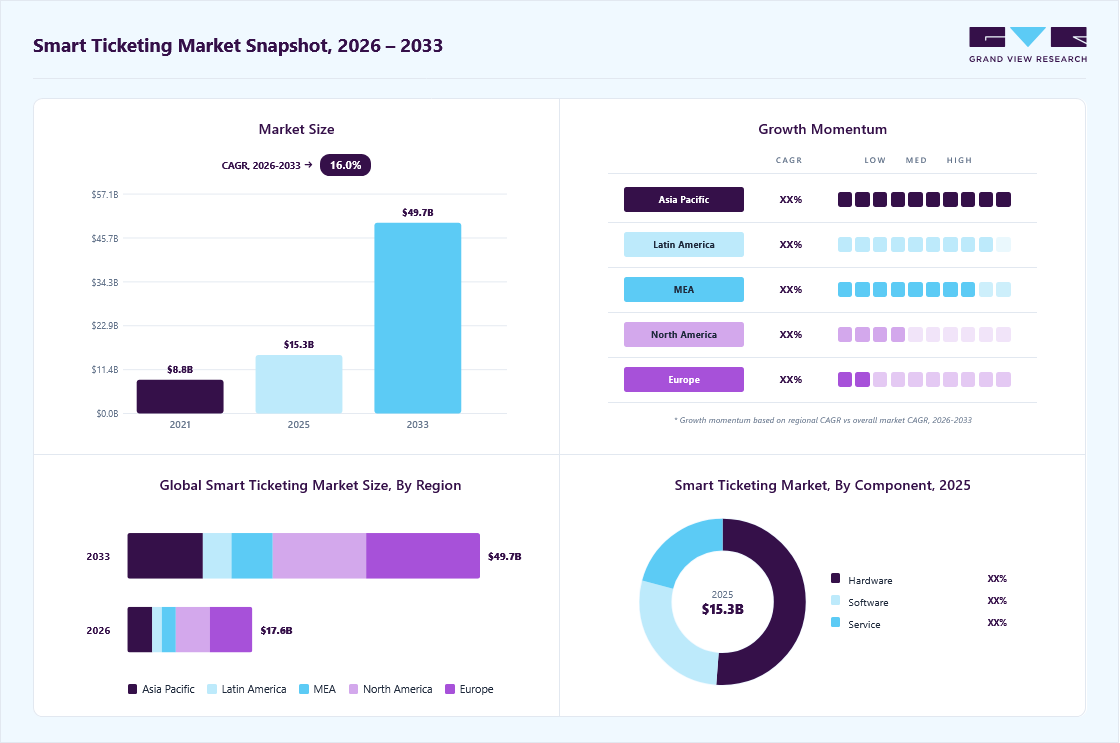 Source: Grand View Research, IR Documents, Primary Interviews, Paid DatabasesTo learn more about this report,
 Download Free Sample Report
 Key Market Trends & Insights
- By component: hardware segment dominated the smart ticketing market, accounting for the largest share of 51.1% in 2025.
- By product: e-ticket segment accounted for the largest share in 2025.
- By system: smart card segment accounted for the largest share in 2025.
- By end use: transportation segment accounted for the largest share in 2025.
Regional Highlights
- Largest regional market: Europe (34.2% revenue share, 2025)
- By country: France smart ticketing market is a major contributor to the global market.
Market Size & Forecast
- Market size in 2025: USD 15.3 Billion
- Estimated market size in 2026: USD 17.6 Billion
- Projected market size by 2033: USD 49.7 Billion
- CAGR (2026-2033): 16.0%
GVR research-powered AIAsk Prism AI about the smart ticketing marketGet cited answers from GVR research on market growth, segments, regulations and forecasts.Start with✓ Source-linked answers ✓ Market-specific context ✓ Traceable figuresExplore Prism AI ↗Introduction of innovative ticket purchasing and payment methods, such as contactless payment systems, virtual tickets (E-tickets), and smart cards, enables smooth, efficient transit. Additionally, the availability of multi-modal disbursement channels through online ticketing systems, smartphones, E-kiosks, and smart ticketing machines is supplementing effective crowd management and making smart ticketing systems preferable over traditional paper-based ticketing systems.
Moreover, shifting customer preferences toward digital channels for accessing transport services is driving the growth of the smart ticketing solutions market. Various benefits in the form of reduced waiting time compared to waiting in queues during peak hours, subsidized fares, real-time route updates, and a personalized mobility experience make a strong appeal among customers for online ticketing systems. Moreover, the advantages of smart ticketing solutions for transport operators include reduced maintenance costs, access to an integrated ticketing infrastructure, and cost-effective use of resources such as employees, energy, and paper. Thus, the use of smart ticketing systems is expected to rise over the forecast period, contributing to the growth of the overall smart ticketing industry.
 To learn more about this report, Download Free Sample Report
 The increasing adoption of mobile and QR-based e-ticketing solutions is further accelerating market growth, particularly in emerging economies. With widespread smartphone use and the rise of digital payment ecosystems, commuters are increasingly opting for app-based ticketing that eliminates the need for physical tickets. QR codes offer a cost-effective and scalable solution, especially for bus networks and smaller transit systems with limited infrastructure budgets. These systems also enable faster deployment and easier upgrades compared to traditional hardware-based solutions. As a result, mobile ticketing is becoming a key driver of digital transformation in public transport.
Data security concerns are one of the restraints plaguing the smart ticketing market. Smart ticketing systems are open-loop and typically require users to provide personal information such as their name, contact details, and payment information. They also inherit the risks of such data being accessed or misused if the system's security measures need to be improved. Market players and vendors are upgrading to leverage technologies such as blockchain to overcome these restraints.
Component Insights
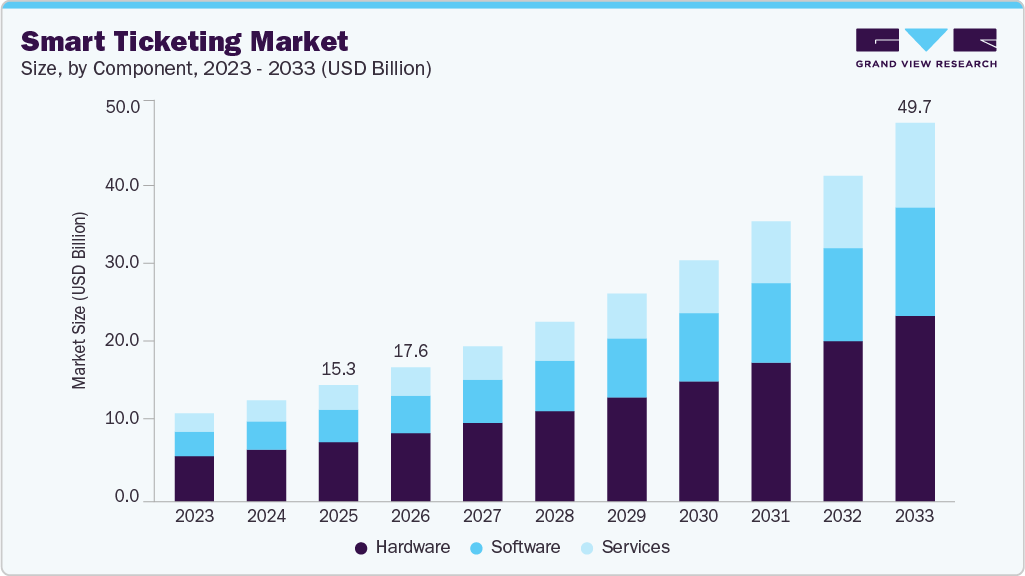
The hardware segment dominated the smart ticketing market, accounting for the largest share of 51.1% in 2025. The deployment of custom and readily available innovative hardware solutions enables transport operators to issue and read tickets via a single interface. The adoption of smart ticketing systems as a measure to transition to a more digitally advanced ticketing infrastructure has been a driving factor for the growth of the hardware segment. Moreover, the need for upgrades to legacy transportation ticketing systems is expected to drive the growth of the hardware segment.
The service segment is expected to grow at a significant CAGR during the forecast period. A comprehensive, straightforward ticketing system is essential to promoting the use of public transportation. Smart ticketing companies increasingly emphasize supporting the integration and deployment services for the convenient use of smart ticketing systems. An example of a prominent service offered by smart ticketing companies is Mobility as a Service (MaaS), which enables end-to-end booking and payment.
Product Insights
The e-ticket segment held the largest share of the smart ticketing industry in 2025. The segment is witnessing strong growth, driven by the rapid shift toward mobile-first and contactless fare collection systems across public transport networks. One of the key trends is the widespread adoption of QR-based and mobile app-generated tickets, enabling commuters to purchase, store, and validate tickets digitally without relying on physical cards or paper tickets. Transport operators are increasingly integrating e-ticketing with account-based ticketing (ABT) systems, where tickets are linked to user accounts rather than stored on devices, improving flexibility and backend fare management. Another important driver is the expansion of open-loop payment ecosystems, which allow passengers to use bank cards, mobile wallets, and UPI-based systems for ticket generation, significantly reducing entry barriers.
The smart parking system segment is expected to grow at the fastest CAGR during the forecast period. A key trend fueling this growth is the adoption of IoT-enabled parking solutions, which provide real-time parking availability, reducing search time and traffic congestion. Additionally, the integration of smart parking with mobile apps and digital payment platforms is enhancing user convenience through features such as slot reservation, contactless payments, and navigation assistance. Governments and municipalities are also investing heavily in smart city initiatives, where intelligent parking systems play a critical role in traffic management and urban planning.
System Insights
The smart card segment dominated the market in 2025. The smart card segment within the smart ticketing market continues to be driven by a combination of legacy system persistence and gradual digital transition. One of the key trends supporting its relevance is the large installed base of contactless smart cards in public transport systems, particularly across Europe and parts of Asia, where transport authorities prefer incremental upgrades over full system overhauls due to cost efficiency and operational continuity. Additionally, smart cards remain widely adopted among daily commuters who value their reliability, offline usability, and ease of top-ups through retail networks. Another important driver is the integration of smart cards with account-based ticketing ecosystems, enabling hybrid models in which the card serves as an identifier linked to backend user accounts rather than storing fare data locally.
The near-field communication is projected to grow at a significant CAGR over the forecast period. Near-field communication systems have proved vital in providing a frictionless ticketing experience. Additionally, near-field communication transactions can be validated in 120 milliseconds. Innovative payment methods such as tap-and-go through Quick Response (QR) codes, debit, and credit cards have increased customer convenience in conducting many transactions, which are expected to bode well for the market.
End Use Insights
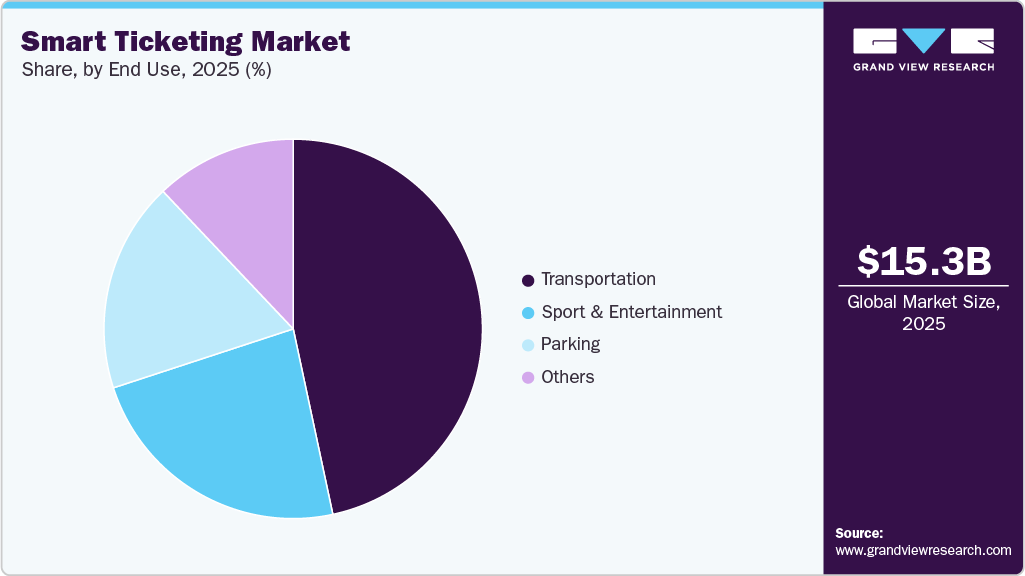
The transportation segment dominated the smart ticketing industry in 2025. Smart ticketing systems are safe, agile, and help with automated fare collection and resource management. The benefits of a streamlined travel and ticketing system are driving its increasing adoption by various transportation departments. Public transport operators, including metro rail, buses, trams, and suburban rail networks, are progressively adopting smart ticketing solutions to improve fare collection efficiency, reduce operational leakages, and enhance passenger convenience. The shift toward integrated mobility platforms is another key driver, enabling seamless travel across multiple modes of transport through a single ticketing system or account-based solution. Additionally, growing urbanization and rising commuter volumes in major cities are compelling transport authorities to deploy scalable, contactless ticketing systems that can handle high throughput while reducing congestion at access points.
 To learn more about this report, Download Free Sample Report
 The sport & entertainment segment is projected to grow at the fastest CAGR over the forecast period. The segment growth can be attributed to sporting stadiums and entertainment venues incorporating contactless ticketing systems. The latest technology, blockchain, is also being leveraged to make smart ticketing more efficient and secure. For instance, France explored a blockchain-based, Non-fungible Token ticketing system for the 2024 Olympic Games, signaling growing institutional interest in next-generation smart ticketing.
Regional Insights
The North America smart ticketing market held a significant share in 2025. The shift towards contactless payment technologies is significantly fueling the growth of smart ticketing systems in North America. Consumers increasingly prefer seamless, quick, and secure payment methods, which smart ticketing offers. Contactless solutions eliminate the need for cash transactions, reducing waiting times and improving the overall user experience.
U.S. Smart Ticketing Market Trends
The U.S. smart ticketing industry held a dominant position in 2025. The growing investment in public transportation and infrastructure in the country drives the market growth. Governments and private entities in the U.S. are heavily investing in modernizing public transportation systems. Smart ticketing solutions are being integrated into buses, trains, and other transit modes to streamline operations and enhance efficiency. These systems enable transit authorities to better track ridership data and optimize routes and schedules.
Europe Smart Ticketing Market Trends
Europe was identified as a lucrative region in 2025. The Europe smart ticketing system market is witnessing strong and sustained growth, driven by large-scale public transport modernization, regulatory push for cashless mobility, and increasing adoption of integrated digital fare ecosystems. Europe remains the largest regional market globally, supported by advanced transit infrastructure and high penetration of contactless payment technologies across metro, rail, and bus networks. A key trend is the rapid shift from traditional smart cards toward open-loop EMV payments, mobile ticketing, and QR-based solutions, enabling passengers to use bank cards and smartphones directly for fare access.
 To learn more about this report, Download Free Sample Report
 The UK smart ticketing market is expected to grow rapidly in the coming years, driven by the proliferation of smartphones and advancements in NFC and QR code technologies. In the UK, commuters can now purchase, store, and use tickets via mobile apps, eliminating the need for physical tickets.
Asia Pacific Smart Ticketing Industry Trends
The Asia Pacific smart ticketing market is anticipated to grow at a CAGR of 17.2% during the forecast period. The Asia Pacific (APAC) region is witnessing strong growth in smart ticketing adoption, driven by rapid urbanization, expanding metro and bus networks, and large-scale government-led smart city initiatives. A key trend is the accelerated shift toward contactless, mobile-first ticketing, with transport operators increasingly deploying QR code-, NFC-, and account-based ticketing systems to improve commuter convenience and reduce cash dependency. Countries such as China and Japan are leading large-scale deployments, supported by digital payment ecosystems (including mobile wallets and UPI-based systems in India) and integration with broader mobility platforms. At the same time, contactless smart cards remain widely used, particularly in mature transit networks, where they continue to serve as a reliable backbone while hybrid systems evolve toward more digital alternatives.
The Japan smart ticketing market is expected to grow rapidly in the coming years, owing to the growing tourism industry. Japan's position as a global tourist destination has fueled the demand for efficient and user-friendly transportation solutions. Smart ticketing systems simplify travel for international visitors by eliminating language barriers and providing multi-modal access through a single card or app.
The smart ticketing market in China held a substantial share in 2025, driven by rapid urbanization and rising public transportation demand. China’s rapid urbanization has significantly increased the demand for efficient public transportation systems. Major cities like Beijing, Shanghai, and Guangzhou experience heavy commuter traffic daily, requiring seamless, scalable ticketing solutions. Smart ticketing systems, integrated with subway lines, buses, and high-speed rail networks, reduce congestion, minimize queues, and improve the overall efficiency of transit systems.
Key Smart Ticketing Company Insights
Some of the key companies in the smart ticketing market include Confidex Ltd., Cubic Corporation, Giesecke & Devrient GmbH, and CPI Card Group Inc. Organizations are focusing on increasing their customer base to gain a competitive edge in the industry. Therefore, key players are taking several strategic initiatives, such as mergers and acquisitions, and partnerships with other major companies.
-
Confidex Ltd. is a company specializing in advanced RFID (Radio Frequency Identification) and NFC (Near Field Communication) technologies. It offers high-performing contactless smart tickets, industrial RFID tags, and specialty labels, catering to a diverse range of industries, including transportation, logistics, and manufacturing. It serves a wide network of customers across Europe, the Americas, the Middle East, and Asia, leveraging its expertise to deliver tailored solutions that improve supply chain management and asset tracking.
-
Cubic Corporation provides innovative solutions that enhance public transportation systems worldwide. The company specializes in integrated fare collection technologies, including contactless payment options that allow users to pay for transit services using credit cards and mobile devices. The smart ticketing offered by the organization has been successfully implemented in various locations, such as the Gold Coast Light Rail in Queensland, Australia, and the Umo Mobility Platform in Bloomington, Indiana. These systems streamline the payment process and offer features such as fare capping and account management, making public transport more accessible and user-friendly.
Key Smart Ticketing Companies:
The following key companies have been profiled for this study on the smart ticketing market.
- Confidex Ltd.
- CPI Card Group Inc.
- Cubic Corporation
- Thales
- Giesecke & Devrient GmbH
- HID Global Corporation (ASSA ABLOY)
- Infineon Technologies AG
- NXP Semiconductors
- IDEMIA
- Xerox Corporation
Recent Developments
-
In January 2026, HUB Parking Technology launched a multi-purpose smart parking kiosk designed to extend traditional payment machines into flexible self-service mobility touchpoints. The kiosk supports a wide range of functions, including parking and non-parking payments, subscription renewals, voucher validation, and digital content display, making it suitable for airports, hotels, retail centers, and transport hubs. It features a 21.5-inch touchscreen, PCI-compliant payments, and integration with HUB’s Jupiter platform, enabling seamless connectivity with existing payment systems. The solution is built on a software-driven, integration-ready architecture, enabling third-party service integration for navigation, ticketing, and transport.
-
In September 2025, IPS Group launched the MSX Multi-Space Parking Kiosk, a next-generation smart parking solution designed to modernize urban parking systems with a focus on contactless and digital payments. The kiosk supports multiple payment modes, including tap-to-pay, mobile apps, TEXT-TO-PAY, and third-party integrations, enhancing user convenience and flexibility. It features a customizable touchscreen interface with multilingual support, improving accessibility for diverse user groups and enabling operator branding. Built on a modular, scalable design, MSX enables rapid deployment and is compatible with cloud-based parking management systems for real-time operations.
Smart Ticketing Market Report Scope
Report Attribute
Details
Market size in 2025
USD 15.3 billion
Estimated Market size in 2026
USD 17.6 billion
Projected Market size by 2033
USD 49.7 billion
Growth rate
CAGR of 16.0% from 2026 to 2033
Base year for estimation
2025
Historical data
2021 - 2024
Forecast period
2026 - 2033
Quantitative units
Revenue in USD million/billion and CAGR from 2026 to 2033
Report coverage
Revenue forecast, company market share, competitive landscape, growth factors, and trends
Segments covered
Component, product, system, end use, and region
Regional scope
North America, Europe, Asia Pacific, Latin America, MEA
Country scope
U.S., Canada, Mexico, Germany, UK, France, China, Japan, India, South Korea, Australia, Brazil, KSA, UAE, and South Africa
Key companies profiled
Confidex Ltd.; CPI Card Group Inc.; Cubic Corporation; Thales; Giesecke & Devrient GmbH; HID Global Corporation (ASSA ABLOY); Infineon Technologies AG; NXP Semiconductors; IDEMIA; Xerox Corporation
Customization scope
Free report customization (equivalent up to 8 analysts working days) with purchase. Addition or alteration to country, regional & segment scope.
Pricing and purchase options
Avail customized purchase options to meet your exact research needs. Explore purchase options
Global Smart Ticketing Market Report Segmentation
This report forecasts revenue growth at the global, regional, and country levels and provides an analysis of the latest industry trends in each of the sub-segments from 2021 to 2033. For this study, Grand View Research has segmented the global smart ticketing market report based on component, product, system, end use, and region:
-
Component Outlook (Revenue, USD Million, 2021 - 2033)
-
Hardware
-
Software
-
Service
-
-
Product Outlook (Revenue, USD Million, 2021 - 2033)
-
E-Kiosk
-
E-Ticket
-
E-Toll
-
Request Tracker
-
Smart Parking System
-
Ticket Machine
-
Ticket Validators
-
Others
-
-
System Outlook (Revenue, USD Million, 2021 - 2033)
-
Open Payment System
-
Smart Card
-
Near-field Communication
-
-
End Use Outlook (Revenue, USD Million, 2021 - 2033)
-
Parking
-
Sport & Entertainment
-
Transportation
-
Others
-
-
Regional Outlook (Revenue, USD Million, 2021 - 2033)
-
North America
-
U.S.
-
Canada
-
Mexico
-
-
Europe
-
Germany
-
UK
-
France
-
-
Asia Pacific
-
China
-
Japan
-
India
-
South Korea
-
Australia
-
-
Latin America
-
Brazil
-
-
Middle East and Africa (MEA)
-
KSA
-
UAE
-
South Africa
-
-
Frequently Asked Questions About This Report
Some key players operating in the smart ticketing market include Confidex Ltd.; CPI Card Group Inc.; Cubic Corporation; Thales; Giesecke & Devrient GmbH; HID Global Corporation (ASSA ABLOY); Infineon Technologies AG; NXP Semiconductors; IDEMIA; and Xerox Corporation.
Key factors that are driving the smart ticketing market growth include increased adoption of advanced technologies in smart ticketing systems and increasing demand for smart ticketing from the tourism and sports & entertainment industries.
The hardware segment led with a 51.1% revenue share in 2025, while service is growing significantly.
The e-ticket segment accounted for the largest share in 2025, while smart parking system is the fastest-growing segment.
The smart card segment dominated the market in 2025, while near-field communication is growing significantly.
The global smart ticketing market size was estimated at USD 15.3 billion in 2025 and is expected to reach USD 17.6 billion in 2026.
The global smart ticketing market is expected to grow at a compound annual growth rate of 16.0% from 2026 to 2033 to reach USD 49.7 billion by 2033.
Europe dominated the smart ticketing market with a share of 34.2% in 2025. This is attributable to the presence of prominent market players such as Giesecke & Devrient GmbH, Thales, and Infineon Technologies AG in the region.
The transportation segment held the highest market share in 2025.
About the Author(s)
Next Generation Technologies Research Team
Technology · Next Generation TechnologiesThis report was authored by the next generation technologies research team at Grand View Research - comprising two research analysts, one senior research analyst, and one industry expert - with specialized expertise in the next generation technologies segment of the technology industry. All findings are based on proprietary technology databases, executive interviews, and regulatory analysis, subject to internal peer review prior to publication.
Last Updated:
Speak to Analyst

Customize this report to your needs - add regions, segments, or data points, with 20% free customization.
Or view our licence options:


ISO 9001:2015 & 27001:2022 Certified
We are GDPR and CCPA compliant! Your transaction & personal information is safe and secure. For more details, please read our privacy policy.


