
- Home
- »
- Plastics, Polymers & Resins
- »
-
Smell Proof Bags Market Size & Share Report, 2026-2033GVR Report cover
![Smell Proof Bags Market (2026 - 2033)Report]()
Smell Proof Bags Market (2026 - 2033)
Size, Share & Trends Analysis Report By Material (Plastic-Based Barrier Films, Activated Carbon-Lined Materials), By Product Form (Pouches, Backpacks/Carry Bags), By Application, By Region, And Segment Forecasts
Market Size, 2025
$359.0MMarket Estimate, 2026
$383.7MMarket Forecast, 2033
$648.3MCAGR, 2026–2033
7.8%Smell Proof Bags Market Summary
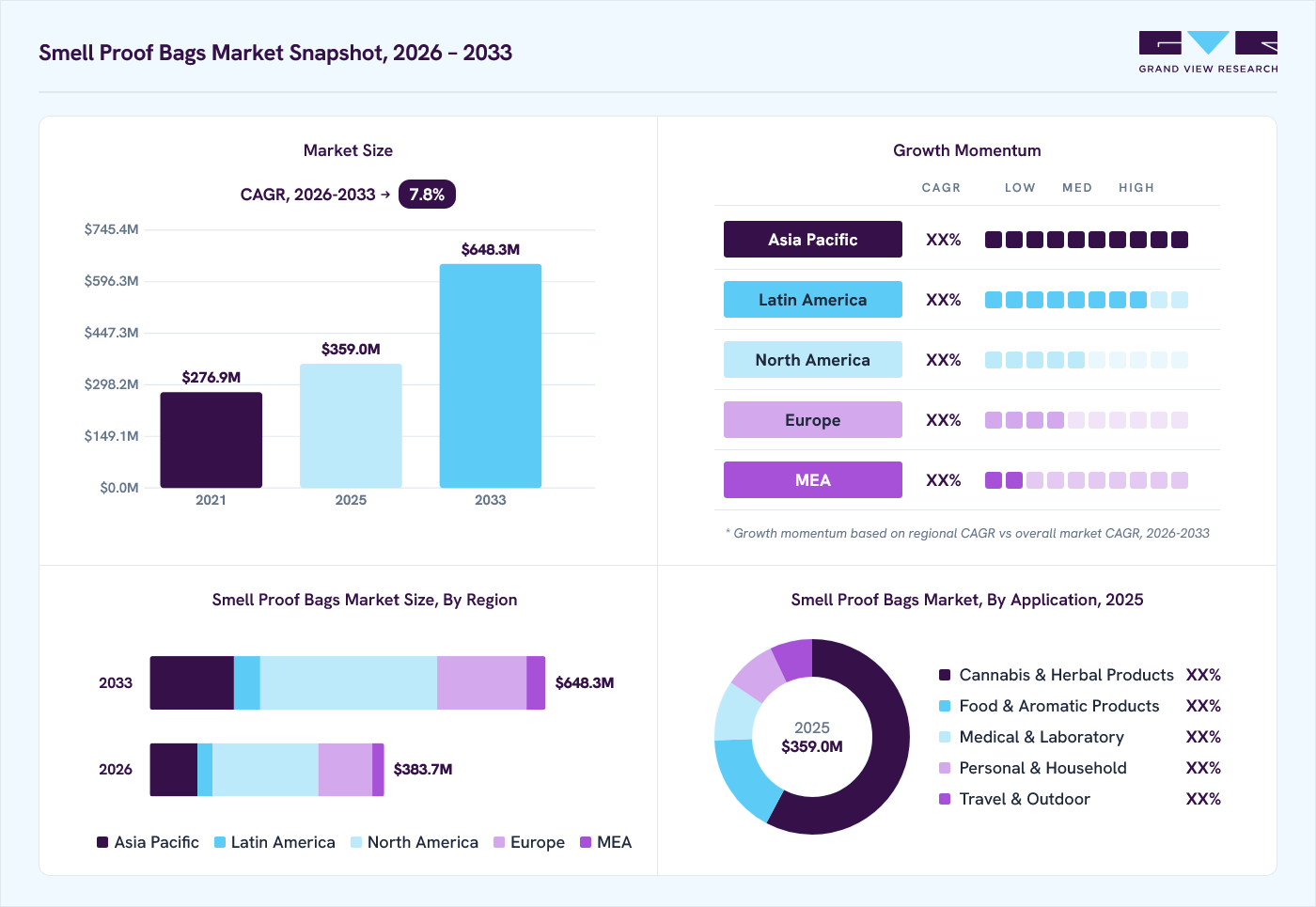
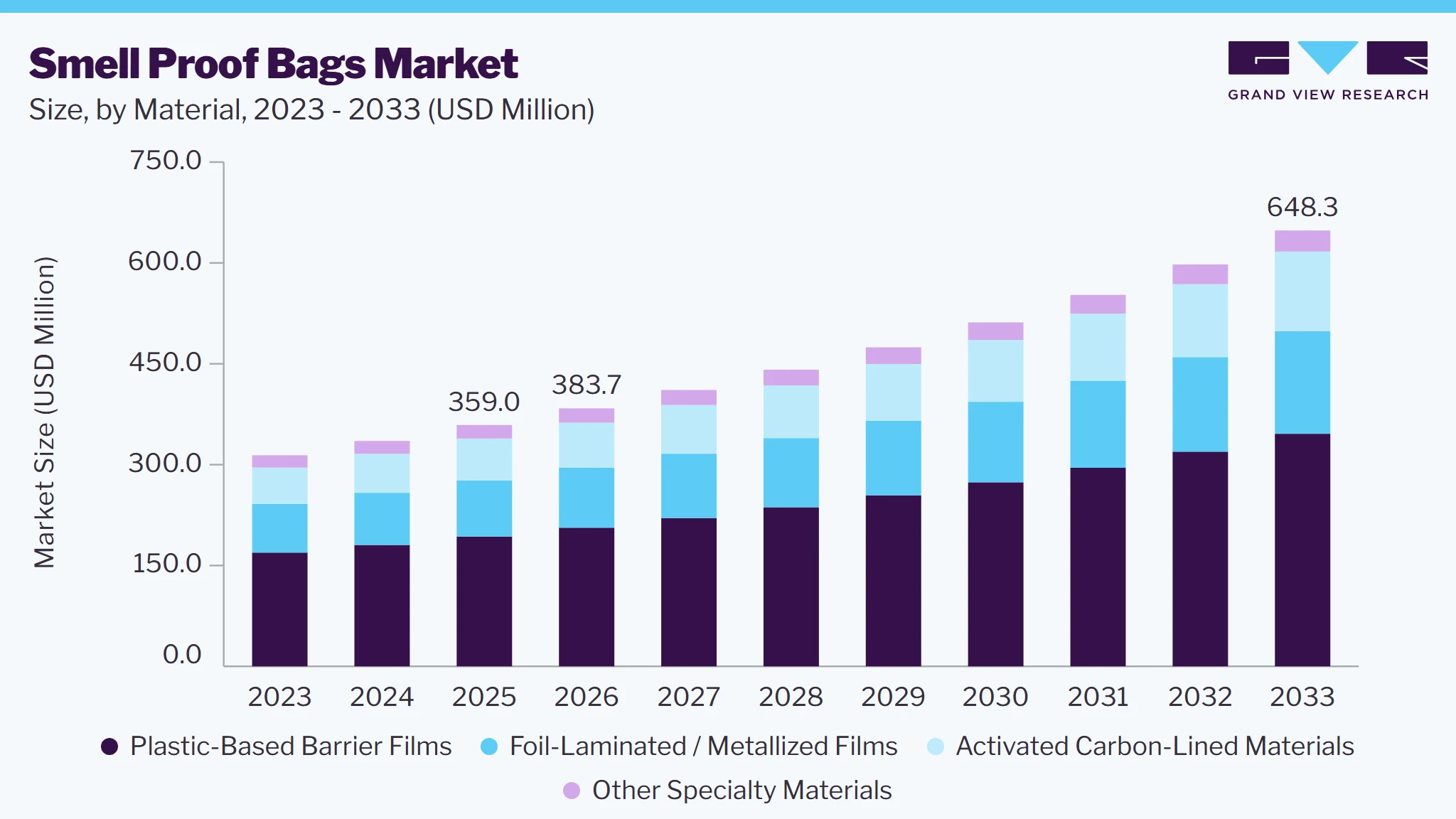
The global smell proof bags market size was valued at USD 359.0 million in 2025 and is projected to grow from USD 383.7 million in 2026 to USD 648.3 million by 2033, at a CAGR of 7.8% from 2026 to 2033. North America dominated the market, accounting for the revenue share of 45.0% in 2025. The market is primarily driven by the expansion of the legal cannabis industry, rising demand for discreet, odor-resistant packaging, increasing use of high-barrier materials, and growing requirements for secure, airtight, moisture-resistant packaging.
Key Market Trends & Insights
- Based on material: Plastic-based barrier films segment held the largest revenue share of 53.8% in 2025.
- Based on application: Cannabis & herbal products segment dominated the market with a 57.7% revenue share in 2025.
- Based on product form: Pouches accounted for the largest revenue share of 48.4% in 2025.
Regional Highlights
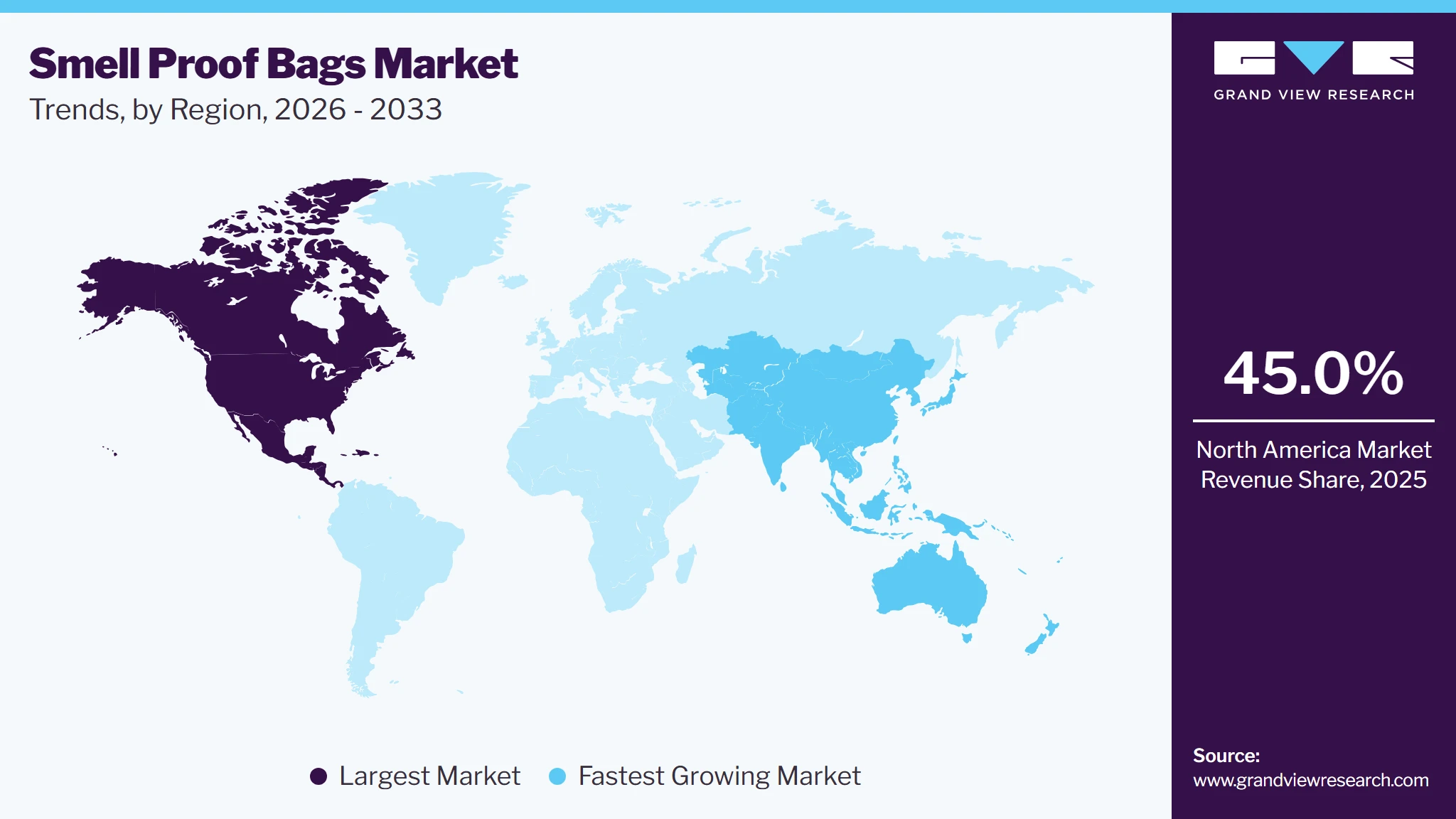
- Largest regional market: North America (45.0% revenue share, 2025)
- Fastest-growing regional market: Asia-Pacific (highest CAGR, 2026-2033)
- By country:
Market Size & Forecast
- Market Size in 2025: USD 359.0 Million
- Estimated market size in 2026: USD 383.7 Million
- Projected market size by 2033: USD 648.3 Million
- CAGR (2026-2033): 7.8%
The smell proof bag industry is driven by the rapid expansion of the legal cannabis and herbal products industry, where effective odor containment, product discretion, and secure packaging are increasingly important. As cannabis manufacturers, retailers, and distributors expand their product portfolios, there is growing demand for high-barrier bags that can prevent odor leakage while protecting contents from moisture, oxygen, and external contaminants. Plastic-based barrier films are widely adopted because of their flexibility, lightweight construction, heat-sealing capability, and cost efficiency, making them suitable for pouches, gusseted bags, and other smell proof formats. The increasing adoption of smell proof packaging across cannabis, herbal, food, and specialty products is further supporting market growth.An increasing focus on product protection, consumer safety, and packaging performance is expected to boost market growth in the coming years. Applications such as cannabis & herbal products, food & aromatic products, medical & laboratory products, and personal & household products increasingly require packaging that minimizes odor transmission and maintains product integrity during storage and transportation. Multilayer plastic films, foil-laminated structures, and metallized films provide enhanced barrier properties against moisture, oxygen, light, and odor migration, while activated carbon-lined materials offer additional odor-adsorption capabilities for products requiring stronger odor control. Growing demand for discreet packaging, particularly for cannabis and other odor-sensitive products, is encouraging manufacturers to develop advanced barrier structures and functional packaging formats.
Sustainability initiatives and the transition toward more resource-efficient packaging systems are also influencing the smell proof bag market. A defining trend in the industry is the development of thinner, lightweight, and recyclable barrier film structures that maintain high odor and moisture resistance while reducing material consumption. Manufacturers are increasingly exploring recyclable mono-material structures, recycled-content films, and improved film-conversion technologies to balance barrier performance with environmental requirements.
The growing commercialization of cannabis products and the increasing need for compliant, discreet, and odor-resistant packaging are encouraging packaging manufacturers to invest in advanced multilayer films, metallized structures, and activated-carbon technologies. Such developments are expected to enhance odor-control efficiency, product protection, and packaging functionality, supporting the continued expansion of the global smell proof bag market.
Market Dynamics
The smell proof bag market is witnessing steady growth, driven by the expansion of the legal cannabis industry, increasing demand for odor-containment packaging, and rising adoption of high-barrier packaging solutions for odor-sensitive products. Manufacturers are focusing on multilayer barrier films, foil-laminated structures, and activated carbon-lined materials to improve odor control, moisture resistance, and product protection. Additionally, advancements in flexible packaging technologies are driving market expansion, while sustainability concerns and packaging regulations are spurring the development of recyclable, resource-efficient solutions.
The rapid expansion of the legal cannabis and herbal products industry is a key driver of the smell proof bag industry. Increasing cannabis legalization, commercialization, and consumer adoption are creating greater demand for packaging that can effectively contain strong odors while providing product protection and discreet handling. Smell proof bags are increasingly used for cannabis flowers, herbs, and related products because they offer odor resistance, moisture protection, lightweight construction, and secure sealing.
In addition, growing demand for odor-control packaging across food & aromatic products, medical & laboratory products, and personal & household applications is supporting market growth.
A significant restraint is the environmental concern associated with multilayer plastic films, metallized structures, and other difficult-to-recycle barrier materials. While these materials provide effective protection against odor, moisture, and oxygen, their complex construction can limit recyclability and increase waste-management challenges. Growing restrictions on plastic waste and increasing consumer preference for sustainable packaging are therefore creating pressure on manufacturers to develop recyclable barrier structures without compromising odor-control performance.
A major opportunity for smell proof bag companies lies in the increasing adoption of advanced odor-control materials, particularly activated carbon-lined materials and high-performance barrier films. Activated carbon-lined materials present an immense opportunity, supported by demand for enhanced odor adsorption and containment. Manufacturers can capitalize on this trend by developing lightweight, recyclable, and high-barrier bags that combine effective odor control with moisture and oxygen protection across cannabis, food, medical, household, and other specialized applications.
Market Concentration & Characteristics
The smell proof bag industry is characterized by its focus on odor containment, barrier performance, product protection, and discreet packaging, particularly across cannabis & herbal products, food & aromatic products, and medical & laboratory applications. The industry relies heavily on multilayer flexible packaging structures, with manufacturers prioritizing high-barrier performance, airtight sealing, moisture resistance, and durability. For instance, plastic-based barrier films offer flexibility, lightweight construction, heat-sealing capability, and cost-effectiveness. Leading packaging manufacturers are increasingly optimizing film structures and converting technologies to deliver reliable odor control while maintaining cost competitiveness.
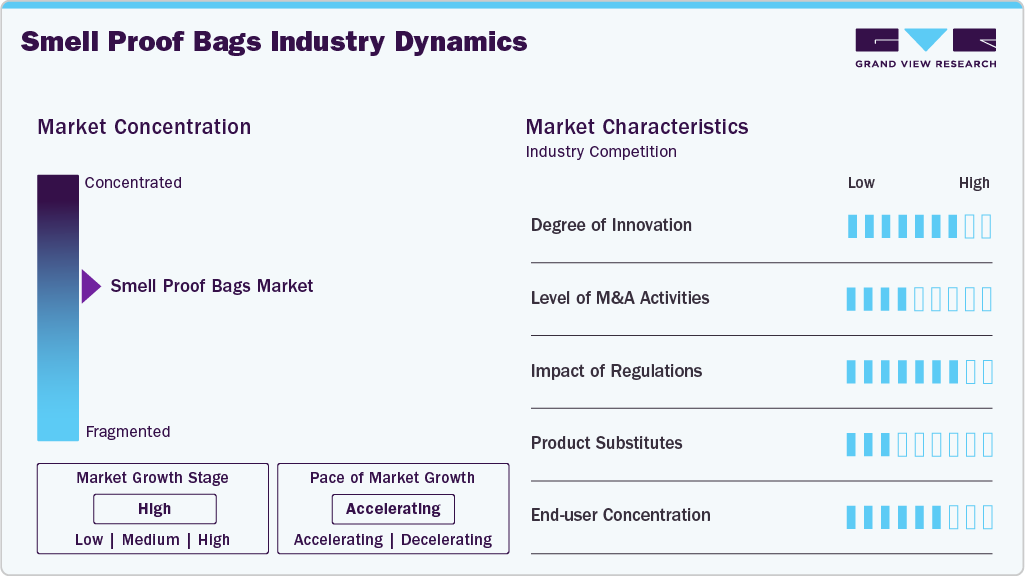
A defining feature of the industry is the increasing use of specialized odor-control materials, including foil-laminated or metallized films and activated carbon-lined materials. For instance, the latter has gained importance due to its strong odor-adsorption capabilities. At the same time, sustainability concerns surrounding multilayer plastic packaging are encouraging manufacturers to develop recyclable barrier films, lightweight structures, and reduced-material packaging solutions. The growing legalization of cannabis, increasing demand for discreet packaging, and evolving sustainability expectations are influencing product development and investment decisions across the smell proof bag industry.
Analyst Perspective
The global smell proof bag market has evolved from a niche odor-containment solution into a specialized flexible packaging segment, initially driven by cannabis and herbal products and now expanding into food, medical, household, and outdoor applications. Currently, demand is supported by growing requirements for discreet storage, odor control, moisture protection, resealability, and child-resistant packaging. Looking ahead, the market is expected to grow steadily through 2033, supported by cannabis market expansion, increasing adoption of high-barrier materials, product innovation, and rising demand for sustainable and recyclable odor-proof packaging solutions.
Material Insights
The plastic-based barrier films segment led the smell proof bag market with the largest revenue share of 53.8% in 2025. These films are widely used in smell proof bags due to their flexibility, lightweight construction, heat-sealing capability, and effective resistance to moisture and odor migration. They are particularly suitable for pouches and gusseted bags used for cannabis & herbal products, food & aromatic products, and other odor-sensitive applications. Their cost-effectiveness, scalable production, and ability to be engineered into multilayer structures with enhanced barrier properties continue to support their dominance in the market.
The activated carbon-lined materials segment is expected to grow at the fastest CAGR of 8.4% from 2026 to 2033. These materials are increasingly adopted for applications requiring enhanced odor adsorption and containment, particularly in cannabis and other strong odor-sensitive products. Activated carbon provides additional odor-control functionality when integrated into bag structures, supporting discreet storage and transportation. Rising demand for high-performance odor barriers and specialized packaging solutions is expected to accelerate the adoption of activated carbon-lined materials during the forecast period.
Product Form Insights
The pouches segment dominated with the largest revenue share of 48.4% in 2025. Pouches are widely used due to their lightweight construction, flexible design, resealable options, and ability to incorporate high-barrier materials for effective odor containment. Their compact format makes them particularly suitable for cannabis & herbal products, food & aromatic products, and other odor-sensitive applications requiring discreet storage and transportation. The increasing demand for convenient, portable, and secure packaging is expected to support the continued growth of pouches during the forecast period.
The backpacks/carry bags segment is expected to grow at the fastest CAGR of 8.4% from 2026 to 2033. These formats are gaining adoption for larger-volume and portable storage applications where odor control, durability, and convenient handling are important. Their suitability for travel, outdoor use, and discreet transportation of odor-sensitive products is supporting demand. Increasing consumer preference for reusable and functional packaging formats is expected to further accelerate the adoption of backpacks/carry bags over the forecast period.
Application Insights
The cannabis & herbal products segment led the market with the largest revenue share of 57.7% in 2025. Smell proof bags are extensively used for cannabis flowers, herbs, and related products due to their ability to contain strong odors while protecting contents from moisture, oxygen, and external contaminants. The expansion of legal cannabis markets, increasing consumer adoption, and growing demand for discreet and secure packaging are supporting the segment’s dominance.
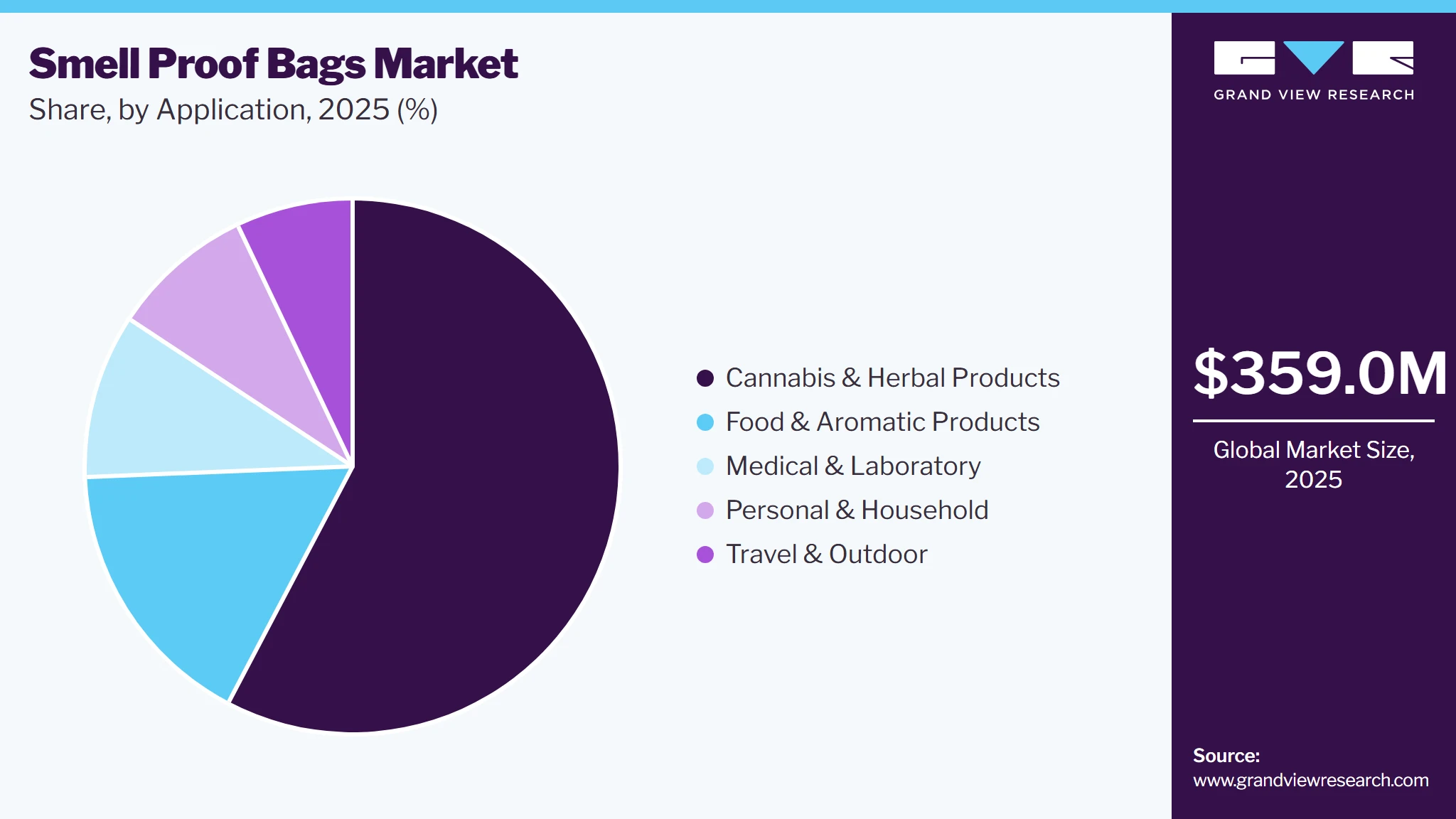
The travel & outdoor segment is expected to grow at a CAGR of 7.9% from 2026 to 2033, making it the fastest-growing application after cannabis & herbal products. Increasing demand for discreet, portable, and odor-resistant packaging during travel, camping, hiking, and other outdoor activities is supporting adoption. The need for durable and secure bags that can protect odor-sensitive contents during transportation and outdoor use is expected to create continued demand for smell proof packaging in this segment.
Regional Insights
The North America smell proof bags market dominated the global industry with a revenue share of 45.0% in 2025, supported by strong demand for odor-resistant packaging across cannabis & herbal products, food, and specialty applications. The region’s established cannabis market, widespread use of flexible packaging, and growing preference for discreet and secure product handling are strengthening demand. The market is expected to reach USD 289.5 million by 2033, growing at a CAGR of 7.7% during the forecast period.
U.S. Smell Proof Bags Market Trends
The smell proof bag market in the U.S. expects promising opportunities, primarily due to the expanding regulated cannabis industry and increasing demand for compliant, discreet, and odor-containment packaging. Growing adoption of high-barrier pouches, gusseted bags, and specialized odor-control materials is supporting market development. Increasing product diversification within cannabis and herbal categories is also creating demand for different sizes and functional packaging formats.
Asia Pacific Smell Proof Bags Market Trends
The smell proof bag market in the Asia Pacific is projected to be the fastest-growing regional market, registering a CAGR of 8.4% from 2026 to 2033. Market growth is supported by expanding food processing, pharmaceutical, herbal product, and flexible packaging industries across the region. Increasing urbanization, rising consumer spending, development of modern retail channels, and growing adoption of advanced barrier films are creating new opportunities for smell proof bag manufacturers. The regional market is expected to increase from USD 72.8 million in 2025 to USD 137.9 million by 2033.
The China smell proof bag market is a key contributor to the Asia Pacific industry, owing to its extensive flexible packaging manufacturing base and large food, pharmaceutical, herbal, and consumer goods industries. Increasing production of odor-sensitive products and the availability of advanced film-converting capabilities are supporting demand. Manufacturers are increasingly developing multilayer barrier structures and specialized packaging formats to address diverse product requirements.
The smell proof bags market in India is expected to witness strong growth as expanding pharmaceutical, food processing, herbal products, and consumer goods industries increase demand for specialized packaging. Rising urbanization, modern retail penetration, and growing awareness of product protection are encouraging the adoption of high-barrier and odor-resistant bags. Increasing domestic flexible packaging production is also supporting the availability of cost-effective smell proof packaging solutions.
Europe Smell Proof Bags Market Trends
The smell proof bags market in Europe is projected to expand steadily, reaching USD 146.3 million by 2033, at a CAGR of 7.5%. Demand is supported by increasing adoption of odor-control packaging for cannabis & herbal products, food & aromatic products, and medical applications. Growing emphasis on sustainable flexible packaging and the development of recyclable barrier structures are also influencing product innovation across European markets.
The Germany smell proof bags market represents an important European sector, supported by its large consumer base, established packaging industry, and growing demand for specialized flexible packaging solutions. Increasing interest in regulated cannabis products and discreet packaging formats is expected to create additional opportunities for smell proof bags. Manufacturers are also focusing on high-barrier and recyclable packaging structures to align with sustainability requirements.
The smell proof bags market in the UK is expected to witness gradual expansion, underpinned by demand for odor-resistant packaging in food, herbal, household, and specialty product applications. Increasing consumer preference for convenient resealable packaging and growing attention toward product containment are encouraging the use of flexible smell proof formats. Product innovation focused on lightweight and recyclable materials is expected to further support market development.
Latin America Smell Proof Bags Market Trends
The smell proof bag market in Latin America is expected to grow at a CAGR of 8.1%, increasing from USD 23.3 million in 2025 to USD 43.0 million by 2033. Growth is supported by the expansion of the food and beverage processing, herbal products, consumer goods, and flexible packaging industries. The increasing adoption of convenient packaging formats and improvements in retail infrastructure are creating opportunities for odor-resistant packaging solutions across the region.
The Brazil smell proof bag market is supported by the country’s large food processing sector, expanding consumer goods industry, and growing flexible packaging production. Reiteratively, demand for odor-resistant bags is increasing across food, aromatic, herbal, and household applications. Investments in modern packaging technologies and increasing preference for lightweight flexible formats are expected to support future growth.
The smell proof bag market in Argentina is expected to expand steadily as demand for flexible packaging increases across food, herbal, household, and specialty applications. Manufacturers are focusing on cost-effective barrier solutions that provide odor containment and product protection. Recovery in industrial activity and improving adoption of modern packaging formats are expected to support market development.
Middle East & Africa Smell Proof Bags Market Trends
The smell proof bag market in the Middle East & Africa is projected to grow steadily at a CAGR of 7.1%, reaching USD 31.5 million by 2033. Increasing food processing activity, pharmaceutical production, consumer goods consumption, and the development of modern retail infrastructure are supporting demand for specialized flexible packaging. Growing adoption of high-barrier packaging for odor-sensitive products is expected to create further opportunities across the region.
Key Smell Proof Bags Company Insights
Some key companies in the smell proof bag market include Smelly Proof Inc., ePac Holdings, LLC, and IMPAK Corporation, among others. The market is characterized by the development of high-barrier flexible packaging, odor-containment technologies, child-resistant packaging, resealable formats, and customized packaging solutions. Key participants are focusing on improving odor-blocking performance, moisture and oxygen resistance, product security, and packaging functionality while increasingly addressing sustainability and material-efficiency requirements.
-
Smelly Proof Inc. specializes in reusable odor-proof packaging solutions designed to contain strong odors and protect enclosed products. Its portfolio includes odor-proof bags and storage formats, with emphasis on airtight sealing, reusable construction, and convenient handling for odor-sensitive products.
-
ePac Holdings, LLC provides digitally printed flexible packaging solutions, including smell and odor-proof packaging. Its offerings include stand-up pouches and lay-flat bags manufactured with high-barrier structures, enabling brands to combine odor containment with customized graphics, resealability, and product protection.
Key Smell Proof Bags Companies
The following key companies have been profiled for this study on the smell proof bag market.
-
Smelly Proof Inc.
-
ePac Holdings, LLC
-
IMPACK CORPORATION
-
Dymapak
-
CarePac
-
Shenzhen M-star Packaging Group Limited
-
SCG PACKAGING
-
iPackU
-
INNORHINO
-
Teal Packaging
Competitive Benchmarking
Category
Operating Strategies
Competitive Edge
Weakness
Established Players (ePac Holdings, LLC; IMPAK Corporation; Dymapak; SCG PACKAGING)
- Focus on expanding odor-proof and high-barrier flexible packaging portfolios through advanced film structures, specialized odor-containment technologies, customized printing, and secure packaging formats. These companies emphasize product innovation, manufacturing capabilities, regulatory requirements, and customer-specific solutions across cannabis, food, medical, and other odor-sensitive applications.
- Established packaging expertise, strong manufacturing capabilities, advanced barrier technologies, broad product portfolios, customization capabilities, and established customer relationships provide a strong competitive position.
- Higher production and technology costs, dependence on multilayer packaging materials, and increasing pressure to develop recyclable odor-barrier structures can increase operational and compliance costs.
Emerging Players (Smelly Proof Inc.; CarePac; Shenzhen M-Star Packaging Group Limited; iPackU; INNORHINO; Teal Packaging)
- Concentrate on specialized smell-proof Mylar bags, pouches, resealable formats, child-resistant packaging, and customized high-barrier solutions. These companies compete through flexible product configurations, customization, competitive pricing, and targeted solutions for cannabis, herbal, food, and specialty applications.
- High specialization in odor-resistant packaging, responsive customization, competitive pricing, diverse bag formats, and the ability to address niche customer requirements support their growth in the market.
- Smaller manufacturing scale, comparatively limited global distribution networks, lower brand recognition, and more limited investment in advanced material R&D compared with established packaging manufacturers may restrict broader market expansion.
Recent Developments:
-
In 2026, ePac Holdings, LLC continued to expand its smell and odor-proof flexible packaging portfolio, offering high-barrier films designed to prevent odor escape while providing moisture and oxygen barrier protection. Its portfolio includes customized stand-up pouches and lay-flat bags, supporting growing demand for branded, high-performance packaging for food, herbal, and other odor-sensitive products.
-
In February 2026, ePac announced a major expansion of its North American manufacturing network, including a new Phoenix site and increased capacity and new technology in Atlanta, Philadelphia, and Vancouver. The company also entered a USD 50 million commercial agreement with HP for the installation of more than 10 HP Indigo 200K digital presses. These investments strengthen ePac's ability to produce customized flexible packaging at scale, including its portfolio of smell-proof Mylar bags, resealable pouches, and high-barrier flexible formats.
-
In November 2025, Dymapak published updated guidance on FDA-compliant nicotine packaging, highlighting its certified child-resistant packaging solutions and regulatory-focused product development. The company continues to expand packaging formats that combine child resistance, durability, product protection, and branding flexibility, which are relevant to odor-sensitive cannabis, nicotine, and specialty-product packaging applications.
Smell Proof Bags Market Report Scope
Report Attribute
Details
Market size in 2025
USD 359.0 million
Estimated market size in 2026
USD 383.7 million
Projected market size by 2033
USD 648.3 million
Growth rate
CAGR of 7.8%from 2026 to 2033
Base year for estimation
2025
Historical data
2021 - 2024
Forecast period
2026 - 2033
Quantitative units
Revenue in USD million and CAGR from 2026 to 2033
Report coverage
Revenue forecast, company ranking, competitive landscape, growth factors, and trends
Segments covered
Material, product form, application, region
Regional Scope
North America; Europe; Asia Pacific; Latin America; Middle East & Africa
Country scope
U.S.; Canada; Mexico; Germany; France; UK; Italy; Spain; China; India; Japan; South Korea; Australia; Brazil; Argentina; Saudi Arabia; UAE; South Africa
Key companies profiled
Smelly Proof Inc.; ePac Holdings, LLC; IMPACK Corporation; Dymapak; CarePac; Shenzhen M-Star Packaging Group Limited; SCG Packaging; iPackU; INNORHINO; Teal Packaging.
Customization scope
Free report customization (equivalent up to 8 analysts working days) with purchase. Addition or alteration to country, regional & segment scope.
Pricing and purchase options
Avail of customized purchase options to meet your exact research needs. Explore purchase options
Global Smell Proof Bags Market Report Segmentation
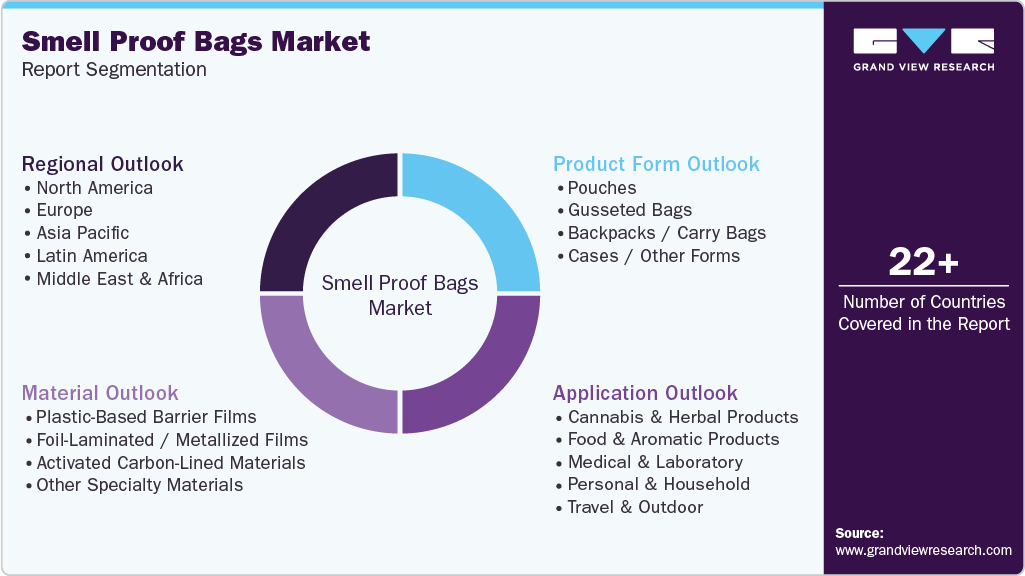
This report forecasts revenue growth at the global, regional, and country levels and provides an analysis on the latest industry trends and opportunities in each of the sub-segments from 2021 to 2033. For this study, Grand View Research has segmented the global smell proof bags market report on the basis of material, product form, application, and region:
-
Material Outlook (Revenue, USD Million, 2021 - 2033)
-
Plastic-Based Barrier Films
-
Foil-Laminated / Metallized Films
-
Activated Carbon-Lined Materials
-
Other Specialty Materials
-
-
Product Form Outlook (Revenue, USD Million, 2021 - 2033)
-
Pouches
-
Gusseted Bags
-
Backpacks / Carry Bags
-
Cases / Other Forms
-
-
Application Outlook (Revenue, USD Million, 2021 - 2033)
-
Cannabis & Herbal Products
-
Food & Aromatic Products
-
Medical & Laboratory
-
Personal & Household
-
Travel & Outdoor
-
-
Regional Outlook (Revenue, USD Million, 2021 - 2033)
-
North America
-
U.S.
-
Canada
-
Mexico
-
-
Europe
-
Germany
-
France
-
UK
-
Italy
-
Spain
-
-
Asia Pacific
-
China
-
India
-
Japan
-
South Korea
-
Australia
-
-
Latin America
-
Brazil
-
Argentina
-
-
Middle East & Africa
-
Saudi Arabia
-
UAE
-
South Africa
-
-
Research Methodology
The smell proof bags marketfigures in this report are based on a proven research process that combines executive interviews with secondary research from proprietary databases, company filings, and recognized regulatory and institutional sources. Market size is built through value-chain sizing-reconciling supply-side and demand-side estimates-and triangulated with bottom-up and top-down approaches. Every estimate passes multiple levels of expert validation before publication, with eachsmell proof bags segment quantified using the revenue-capture definitions in the table below.
Segment Definition
Segment - Material
Revenue capture definition
Plastic-Based Barrier Films
Revenue generated from the sale of smell-proof bags manufactured using plastic-based barrier films, including multilayer PE, PP, PET, and other polymer film structures designed to provide odor containment, moisture resistance, and protection against external contaminants. Includes films used in pouches, gusseted bags, carry bags, and other flexible smell-proof packaging formats.
Foil-Laminated / Metallized Films
Revenue generated from the sale of smell-proof packaging incorporating aluminum foil-laminated or metallized film structures that provide enhanced odor, moisture, light, oxygen, and vapor barrier properties. Includes laminated and metallized films used in high-barrier pouches, bags, and packaging for cannabis, herbal products, food, and other odor-sensitive applications.
Activated Carbon-Lined Materials
Revenue generated from the sale of smell-proof bags and packaging materials incorporating activated carbon layers or carbon-based odor-adsorbing materials designed to capture and neutralize volatile odor compounds. Includes carbon-lined bags and specialty odor-control packaging used for cannabis, herbal products, medical materials, and other applications requiring enhanced odor containment.
Other Specialty Materials
Revenue generated from the sale of smell-proof packaging manufactured using other specialty barrier and odor-control materials, including specialty coatings, odor-absorbing layers, bio-based barrier materials, and customized multilayer structures. Includes innovative materials developed to improve odor retention, sealing performance, durability, and environmental performance in specialized packaging applications.
Segment - Product Form
Revenue capture definition
Pouches
Revenue generated from the sale of smell-proof pouches designed to provide odor containment through high-barrier films, secure closures, and airtight or resealable structures. Includes stand-up, flat, zipper, and child-resistant pouches used for cannabis, herbal products, food, and other odor-sensitive applications.
Gusseted Bags
Revenue generated from the sale of smell-proof gusseted bags featuring expandable side or bottom gussets that provide higher volume and improved product capacity. Includes high-barrier and resealable bags used for bulk cannabis, herbal products, food, and specialty materials requiring odor containment.
Backpacks / Carry Bags
Revenue generated from the sale of reusable smell-proof backpacks, carry bags, and transport bags designed to contain odors during storage and transportation. Includes multi-layer barrier bags and portable odor-control formats used for personal, travel, outdoor, and specialty applications.
Cases / Other Forms
Revenue generated from the sale of other smell-proof packaging formats, including rigid cases, containers, boxes, specialty storage bags, and customized odor-resistant packaging solutions. Includes products designed for enhanced odor containment, protection, portability, and secure storage across specialized applications.
Segment - Application
Revenue capture definition
Cannabis & Herbal Products
Revenue generated from smell-proof bags used for cannabis, hemp, herbs, botanicals, and related products requiring odor containment during storage, transportation, and retail distribution. Includes high-barrier, resealable, and child-resistant packaging formats designed to minimize odor leakage and protect product quality.
Food & Aromatic Products
Revenue generated from smell-proof packaging used for food, spices, coffee, tea, herbs, and other aromatic products where odor containment and freshness preservation are important. Includes barrier pouches and bags designed to limit aroma transfer, moisture exposure, and external contamination.
Medical & Laboratory
Revenue generated from smell-proof bags used for medical materials, laboratory samples, pharmaceutical-related products, and other odor-sensitive substances requiring secure containment. Includes specialized barrier and sealed packaging formats designed to support safe handling, storage, and transportation.
Personal & Household
Revenue generated from smell-proof bags used for personal-care products, household items, waste materials, and other products requiring discreet odor containment. Includes reusable bags, storage pouches, and specialty odor-control packaging designed for convenient everyday use.
Travel & Outdoor
Revenue generated from smell-proof bags used during travel, camping, hiking, outdoor recreation, and other mobile applications where odor containment and discreet storage are required. Includes portable pouches, carry bags, backpacks, and protective cases designed for repeated handling and transportation.
Estimation Model
Layer Name
Key Question
Description
End-use Application Layer
What drives demand?
Estimate demand from key applications including cannabis & herbal products, food & aromatic products, medical & laboratory, personal & household, and travel & outdoor uses that require effective odor containment and secure storage.
Material Adoption Layer
Which materials are preferred?
Assess the adoption of plastic-based barrier films, foil-laminated/metallized films, activated carbon-lined materials, and other specialty materials based on odor-barrier performance, moisture resistance, durability, and product protection requirements.
Product Form Layer
Which packaging formats generate demand?
Evaluate consumption of pouches, gusseted bags, backpacks/carry bags, and cases/other forms according to capacity, portability, resealability, security, and odor-containment requirements across end-use applications.
Revenue Layer
How is revenue generated?
Revenue is generated through the sale of smell-proof bags and specialized odor-containment packaging incorporating high-barrier films, laminated structures, activated carbon layers, and other specialty materials across consumer, commercial, medical, and specialty applications.
Delivered Customizations
This report has been delivered with the following In-depth customizations
Client Request
Customization Delivered
Value Adds
Pricing Analysis
Detailed assessment of smell proof bag pricing across Plastic-Based Barrier Films, Foil-Laminated / Metallized Films, Activated Carbon-Lined Materials, and Other Specialty Materials, considering raw material costs, barrier performance, manufacturing complexity, product form, customization, and regional price variations.
Helps clients understand price differentials, optimize product pricing, manage input-cost risks, and identify competitive pricing opportunities across key regional and application markets.
Opportunity Assessment
Comprehensive evaluation of growth opportunities across Cannabis & Herbal Products, Food & Aromatic Products, Medical & Laboratory, Personal & Household, and Travel & Outdoor applications, along with emerging opportunities for high-barrier, reusable, child-resistant, and sustainable smell-proof packaging formats.
Enables clients to identify high-growth applications, prioritize attractive product segments, develop targeted product strategies, and capitalize on emerging demand for advanced odor-containment solutions.
Trade Assessment
Assessment of international trade patterns for smell proof bags and related high-barrier flexible packaging, including major exporting and importing regions, trade flows, material sourcing, manufacturing hubs, tariffs, logistics considerations, and regional supply-demand dynamics.
Supports sourcing and procurement decisions, identification of potential supplier markets, evaluation of supply-chain risks, and development of effective regional expansion and import-export strategies.
About the Author(s)
Plastics, Polymers & Resins Research Team
Bulk Chemicals · Plastics, Polymers & ResinsThis report was authored by the plastics, polymers & resins research team at Grand View Research - comprising two research analysts, one senior research analyst, and one industry expert - with specialized expertise in the plastics, polymers & resins segment of the bulk chemicals industry. All findings are based on proprietary bulk chemicals databases, executive interviews, and regulatory analysis, subject to internal peer review prior to publication.
Last Updated:
Speak to Analyst


Customize this report to your needs — add regions, segments, or data points, with 20% free customization.
Or view our licence options:


ISO 9001:2015 & 27001:2022 Certified
We are GDPR and CCPA compliant! Your transaction & personal information is safe and secure. For more details, please read our privacy policy.


