
- Home
- »
- Clothing, Footwear & Accessories
- »
-
Backpack Market Size And Share Report, 2026-2033GVR Report cover

Backpack Market (2026 - 2033)
Size, Share & Trends Analysis Report By Product (Lifestyle, Technical, Outdoor), By Distribution Channel (Supermarkets & Hypermarkets, Specialty Stores), By Material (Nylon, Polyester, Leather), By Region, And Segment Forecasts
Market Size, 2025
$24.0BMarket Estimate, 2026
$25.5BMarket Forecast, 2033
$42.7BCAGR, 2026–2033
7.6%Backpack Market Summary
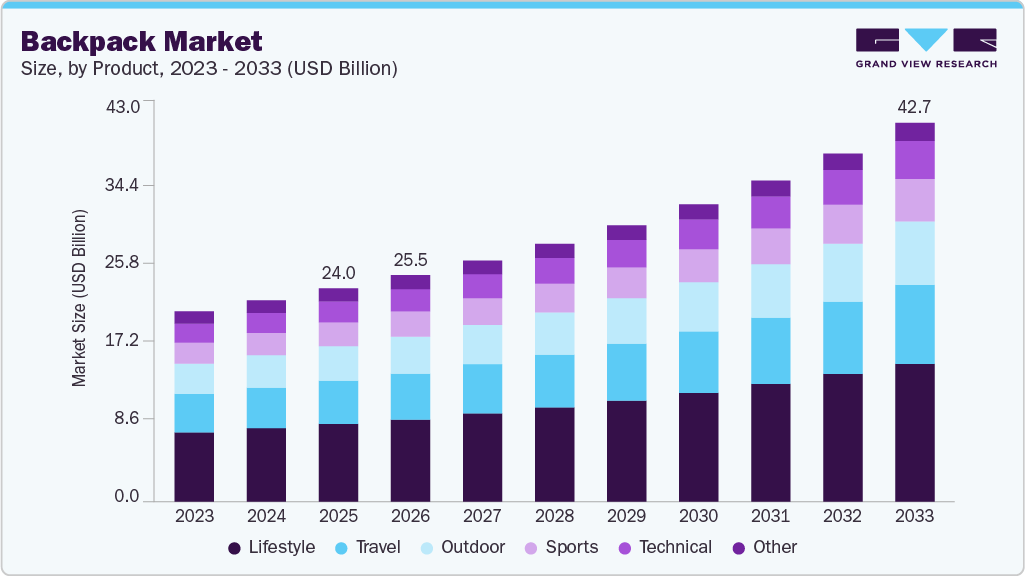
The global backpack market size was valued at USD 24.0 billion in 2025 and is projected to grow from USD 25.5 billion in 2026 to USD 42.7 billion by 2033, at a CAGR of 7.6% from 2026 to 2033. The market in Asia Pacific dominated with a revenue share of 35.0% in 2025. Global backpack demand is driven by rising urban mobility, expanding student populations, and strong growth in travel and outdoor activities.
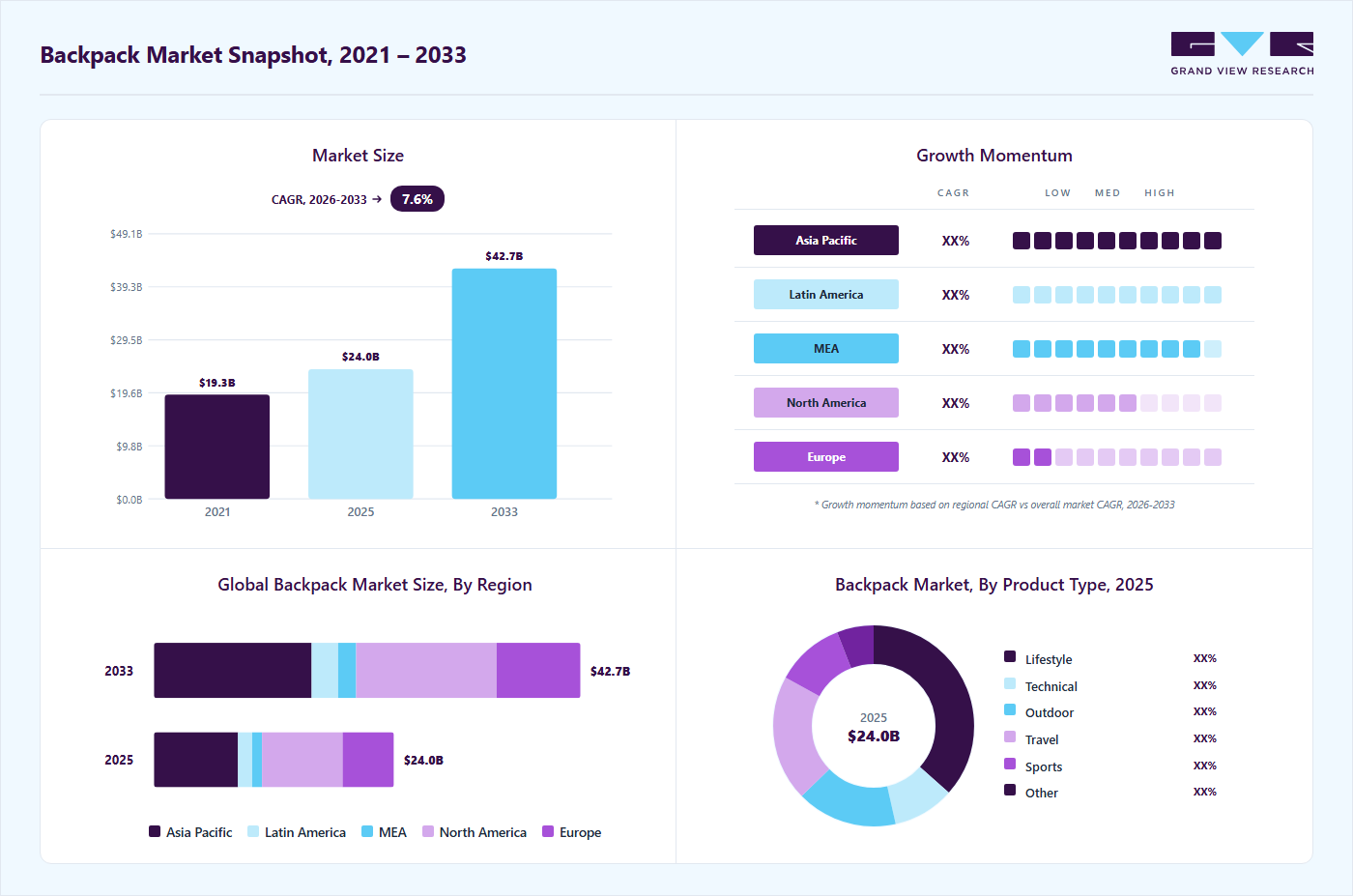 Source: Grand View Research, IR Documents, Primary Interviews, Paid DatabasesTo learn more about this report,
 Download Free Sample Report
 Key Market Trends & Insights
- By product: Lifestyle backpacks segment held the largest market share of 36.5% in 2025.
- By material: Polyester segment held the largest market share of 38.2% in 2025.
- By distribution channel: Specialty stores segment held the largest market share of 26.5% in 2025.
Regional Highlights
- Largest regional market: Asia Pacific (35.0% revenue share, 2025)
- By country: India held the largest market share in 2025
Market Size & Forecast
- Market size in 2025: USD 24.0 Billion
- Estimated market size in 2026: USD 25.5 Billion
- Projected market size by 2033: USD 42.7 Billion
- CAGR (2026-2033): 7.6%
Three ways to get this report
Buy it, customize it, or ask a question.Ask an Analyst
Analyst response in 1 business day
- AccessReport author, directly
- Reply timeWithin 1 working day
- No sales callDirect answer only
- FormatEmail reply
- CostFree, no cost
Get the Full Report
What the study covers
- FormatsPDF · Excel · Dashboard
- Timeline2026–2033 annual, 2025 base
- Coverage20+ countries, 5 regions
- Companies10+ key players profiled
Customize the Report
20% free customization
- IncludeCountries, segments, points
- TailorTo your product definition
- ExtendDeeper competitor detail
- OrA fully bespoke study
- Turnaround5–10 working days
Consumers increasingly prefer multifunctional, lightweight, and durable designs that combine utility with fashion. E-commerce expansion and brand-driven purchasing are accelerating product accessibility and personalization. Sustainability trends are boosting demand for eco-friendly materials, while innovations such as anti-theft features and ergonomic designs enhance product value. In addition, growing health awareness and hybrid work lifestyles are reinforcing backpacks as essential, everyday carry solutions across diverse consumer segments.
The global backpack industry is set to grow at a CAGR of 7.6% from 2026 to 2033, showing steady demand across everyday and specialized uses. The market continues to be anchored by the lifestyle segment, which represents the largest share of overall demand. This dominance is underpinned by the essential nature of backpacks in daily routines, particularly among students and urban commuters. Rising urbanization, coupled with increasing school and university enrolments, has reinforced sustained consumption across school bags, college bags, and daily-use backpacks. Within this segment, the laptop backpack industry has emerged as a key growth driver, supported by rising laptop penetration among students and working professionals, as well as increasing demand for durable, ergonomic, and aesthetically appealing designs.
 To learn more about this report, Download Free Sample Report
 In parallel, the outdoor and travel segment is witnessing accelerated growth, driven by the resurgence of global mobility and a structural shift toward experience-led consumption. The backpack travel bag market is expanding as consumers increasingly prioritize lightweight, compact, and airline-compliant solutions that support seamless travel. At the same time, the active backpack industry is benefiting from rising participation in fitness and recreational activities, including trekking, hiking, and short-duration leisure travel. Within this space, the hydration backpack industry is gaining notable traction, particularly among outdoor enthusiasts and endurance athletes, driven by demand for performance-oriented, ergonomic, and hydration-integrated solutions.
The technical segment is also gaining strategic importance, reflecting the growing integration of digital devices into everyday life. Consumers are increasingly seeking backpacks that offer enhanced organization, device protection, and security features. This has contributed to the growth of specialized categories such as anti-theft and business backpacks, alongside the continued expansion of the laptop backpack industry, which remains central to both professional and academic use cases. Additionally, niche segments such as the bulletproof backpack industry are witnessing emerging demand, particularly in select geographies, driven by heightened safety awareness and the need for protective solutions in educational environments.
From a consumer behavior standpoint, there is a clear shift toward products that deliver superior utility, convenience, and multifunctionality. The proliferation of portable electronic devices has intensified demand for backpacks with dedicated compartments, smart storage configurations, and enhanced carrying comfort. Concurrently, sustainability considerations are becoming increasingly influential in purchase decisions. The eco-friendly backpack industry is gaining momentum as manufacturers incorporate recycled materials, biodegradable fabrics, and environmentally responsible production processes. This shift is driving innovation across product design, with a focus on lightweight, durable, and sustainable solutions.
Demand fundamentals remain robust across both education and professional settings. A large and growing global student population, combined with rising workforce participation, continues to position backpacks as a necessity rather than a discretionary purchase. The evolution of hybrid working models has further amplified demand for versatile solutions that can seamlessly transition between personal, academic, and professional environments. This trend is reinforcing the importance of multifunctional designs within both the laptop backpack industry and the broader active backpack industry.
The recovery in global travel, alongside increasing engagement in outdoor and leisure activities, is further accelerating demand for versatile backpack solutions. Consumers are gravitating toward designs that combine portability, durability, and efficient space utilization. The backpack travel bag market is particularly benefiting from this shift, with growing adoption of modular designs, suitcase-style openings, and hybrid formats that enhance packing efficiency and usability. These innovations reflect a broader transition toward multi-purpose products capable of addressing diverse use cases within a single offering.
From a regional perspective, emerging markets, particularly in Asia-Pacific, are playing a pivotal role in driving incremental growth. Rapid urbanization, expanding middle-class populations, and rising disposable incomes are enabling greater access to branded and higher-quality backpacks. Simultaneously, the continued expansion of digital commerce platforms is improving product accessibility and consumer reach. Increasing adoption of online retail channels is facilitating growth across segments, including the eco-friendly backpack industry and the backpack travel bag market, by offering wider product assortments and competitive pricing.
The market is undergoing a structural shift toward higher-value, feature-rich, and purpose-driven products. Categories such as the hydration backpack, laptop backpack, eco-friendly backpack, bulletproof backpack, backpack travel bag, and active backpack are expected to play a critical role in shaping future growth trajectories, as manufacturers continue to innovate in response to evolving consumer expectations.
Market Dynamics
The expansion of urban micromobility infrastructure, particularly shared electric scooters and dockless bike systems, is a major factor driving growth in the global backpack market. As commuters increasingly rely on first- and last-mile mobility solutions, backpacks are becoming essential for carrying laptops, chargers, and personal essentials while transitioning between walking, cycling, and e-scooter rides in dense urban environments. For instance, in cities such as Paris, where e-scooter and bike-share systems are widely used for short-distance mobility, commuters frequently carry compact, ergonomic backpacks designed for mobility efficiency and hands-free travel. In addition, riders often combine scooter trips with metro or walking segments in a single journey, reinforcing demand for weather-resistant, lightweight backpacks that support multi-modal urban movement.
A major restraint in the global backpack market is the persistent presence of counterfeit and imitation products on large e-commerce platforms, which directly undermines brand equity, distorts pricing structures, and reduces consumer trust in online purchases. Counterfeit sellers often replicate high-demand backpack designs from established brands and distribute them through third-party marketplace networks, making enforcement difficult at scale. This leads to revenue leakage for legitimate manufacturers and increases return rates due to quality mismatch. For instance, in 2023, Amazon's Counterfeit Crimes Unit reported that Amazon continues to identify and remove large volumes of counterfeit goods sold through third-party sellers, reflecting the scale of imitation activity across product categories, including fashion and accessories such as backpacks.
Consumer Insights
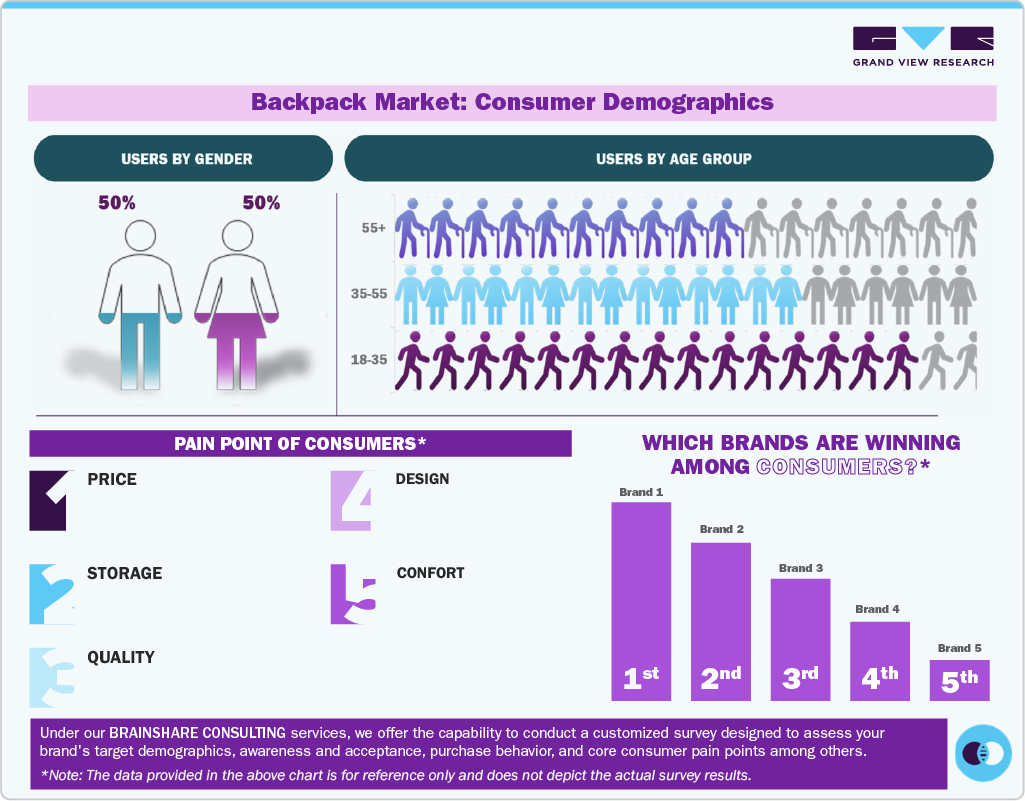
Backpack demand is strongly driven by younger consumers, with students and young adults (15-30 years) forming the largest segment, supporting high-volume sales in lifestyle backpacks within market estimates. This group prefers affordable, lightweight, and multifunctional designs for daily use. Meanwhile, professionals aged 25-45 are driving premium demand, with increasing preference for tech-enabled and secure backpacks, reflecting urban work trends and digital device usage. Consumers above 45 contribute steadily to travel and outdoor segments, aligned with rising leisure travel trends.
 To learn more about this report, Download Free Sample Report
 Product Insights
Lifestyle backpacks accounted for the largest share of 36.5% of the global market in 2025, mainly due to their everyday use among students, commuters, and working professionals. Their popularity comes from being practical, affordable, and suitable for daily needs. With increasing urbanization and rising student populations, demand for lightweight, durable, and multifunctional backpacks remains strong. At the same time, growing interest in fashion and branded products is making lifestyle backpacks more appealing, especially among younger consumers
The travel and outdoor backpack segment is projected to witness robust growth, with demand expected to expand at a CAGR of 8.1% during the 2026 to 2033. This growth trajectory is largely underpinned by the continued recovery of global travel, alongside a notable surge in participation in outdoor and adventure activities such as hiking, trekking, and camping. As mobility patterns evolve, consumers are increasingly seeking backpacks that offer a balance of capacity, comfort, and durability to support both short trips and extended travel.
In addition, there is a clear shift toward multi-functional and hybrid designs, with users favoring products that can seamlessly transition between travel, work, and leisure use cases. Features such as ergonomic support, lightweight materials, weather resistance, and smart compartmentalization are becoming key purchase drivers. The growing popularity of “one-bag travel” and minimalist packing trends is further accelerating demand for versatile backpacks. Moreover, rising disposable incomes and increased exposure to global travel trends, particularly in emerging markets, are reinforcing this upward momentum, positioning the segment as one of the fastest-growing categories within the broader backpack industry.
Material Insights
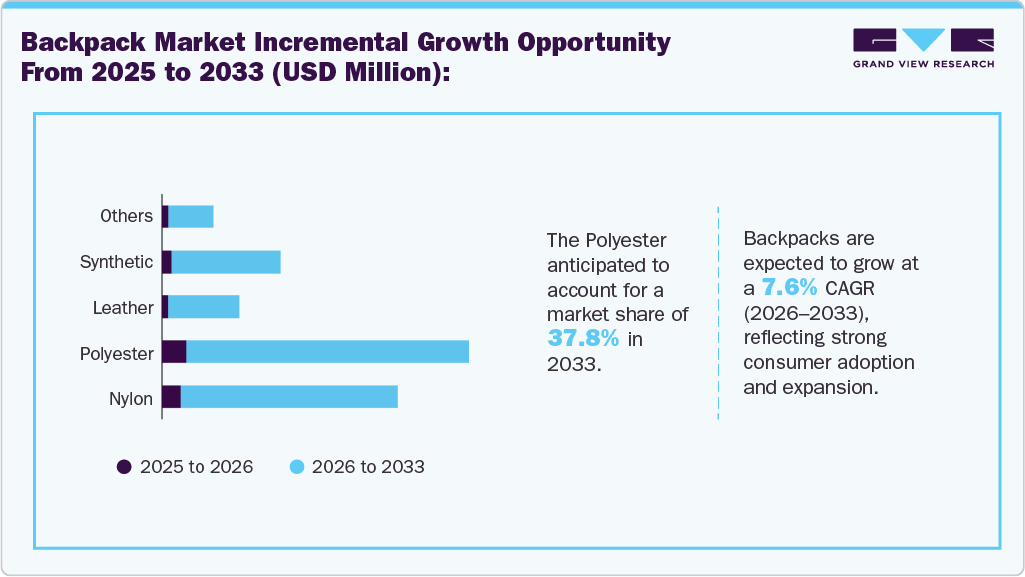
The global backpack industry reflects a strong preference for polyester, which held approximately 38.2% share in 2025, making it the most widely used material. This dominance is driven by its affordability, lightweight nature, durability, and ease of mass production, making it ideal for high-volume segments such as lifestyle and school backpacks. In addition, polyester offers high design flexibility in terms of colors, textures, and finishes, which aligns well with fast-changing fashion trends. The growing adoption of recycled polyester is further strengthening its position, as consumers and manufacturers increasingly focus on sustainability and environmentally responsible materials. This shift is also contributing to the rising demand for eco-friendly backpacks across developed and emerging markets.
 To learn more about this report, Download Free Sample Report
 The synthetic backpack segment is anticipated to register a strong CAGR of approximately 7.9% over 2026 to 2033, reflecting its growing importance within the overall market. This growth is primarily driven by the widespread adoption of synthetic materials such as polyester and nylon, which offer a compelling combination of affordability, durability, and design flexibility. As a result, these materials are particularly favored in price-sensitive markets, where consumers prioritize value for money without significantly compromising on functionality or aesthetics.
Synthetic backpacks continue to dominate the entry-level and mid-range segments, enabling manufacturers to cater to large, volume-driven demand across emerging economies. Their lightweight nature, resistance to wear and tear, and ease of maintenance further enhance their appeal for daily-use applications, including school, commuting, and casual travel. At the same time, advancements in material technology are allowing brands to improve product quality while maintaining competitive pricing. Importantly, the segment is also evolving in response to rising environmental concerns. Increasing consumer awareness around sustainability is prompting manufacturers to incorporate recycled polyester (rPET) and other eco-friendly blends into their product portfolios. This shift is helping bridge the gap between affordability and sustainability, positioning synthetic backpacks as not only a cost-effective choice but also a more environmentally responsible option in the long term.
Distribution Channel Insights
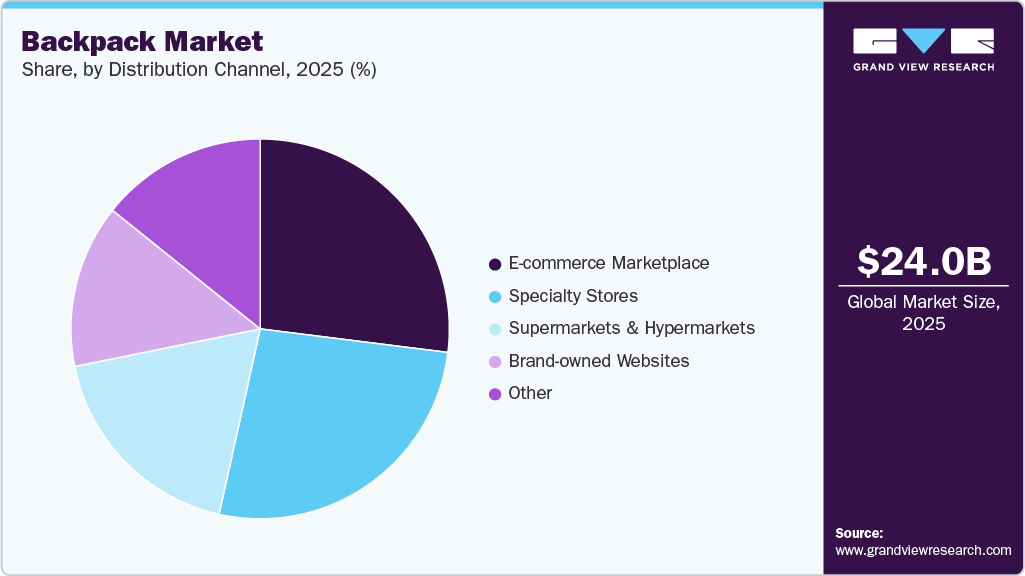
Specialty stores accounted for approximately 26.5% of total backpack sales in 2025, underscoring their continued relevance in a competitive retail landscape. This channel’s strength is largely driven by its ability to deliver a curated and immersive shopping experience, where consumers can physically evaluate product attributes such as comfort, durability, material quality, and storage functionality. The presence of knowledgeable sales staff and personalized assistance further enhances purchasing confidence, particularly for premium, travel, and outdoor backpacks. Additionally, specialty retailers often feature exclusive collections, new product launches, and brand-focused assortments, appealing to quality-conscious and brand-loyal consumers. The ongoing expansion of organized retail and experiential shopping formats, especially in emerging markets, is expected to sustain steady growth and footfall in this segment.
 To learn more about this report, Download Free Sample Report
 Backpack sales through e-commerce marketplaces are projected to grow at a CAGR of 8.2% from 2026 to 2033, making it the fastest-growing distribution channel. This growth is primarily fueled by rising internet penetration, increasing smartphone usage, and the convenience of anytime, anywhere shopping. Online platforms offer extensive product variety, competitive pricing, and easy comparison of features and consumer reviews, which significantly influence purchase decisions. Furthermore, frequent promotional campaigns, discounts, and large-scale sales events are accelerating online adoption. Advancements in logistics, including faster delivery and seamless return policies, are also strengthening consumer trust. In addition, the growing impact of social media, influencer marketing, and digital-first brand strategies is driving higher engagement and conversion rates, particularly among younger and tech-savvy consumers.
Regional Insights
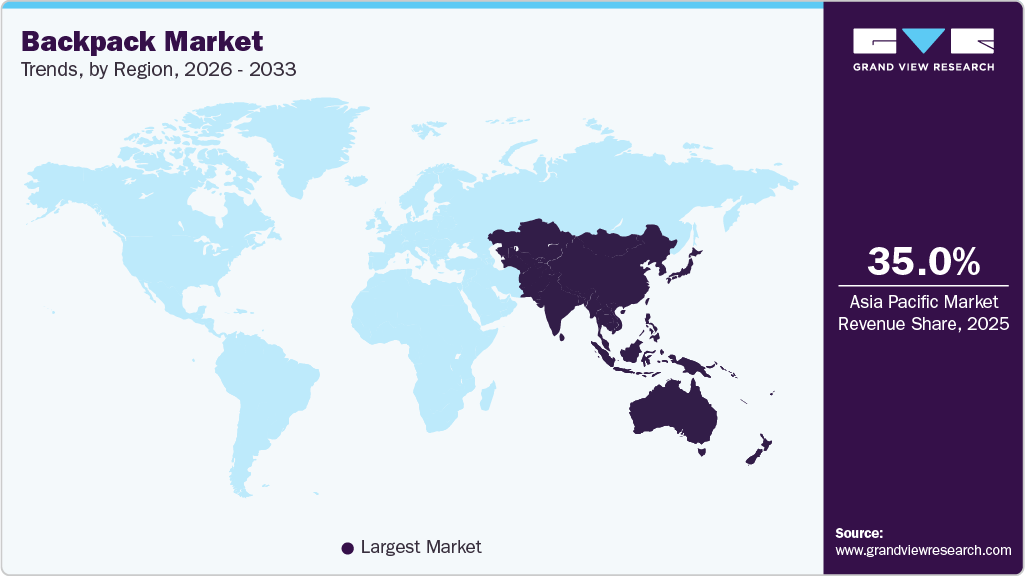
The Asia Pacific backpack industry held the largest global revenue share of 35.0% in 2025, driven by its large population base and high consumption across education and daily-use segments. Countries such as India and China contribute significantly due to rising student populations and increasing workforce mobility, making backpacks an essential everyday product. The region sees strong demand from the lifestyle segment, which aligns with your highest share category, supported by increasing school enrolments and urban commuting needs.Rising demand for durable and stylish laptop backpacks, driven by increasing laptop penetration among students and professionals, is strengthening the overall growth of this segment.
 To learn more about this report, Download Free Sample Report
 In addition, rapid urbanization and rising disposable incomes are improving access to branded products through e-commerce and organized retail, boosting overall market penetration. Growing interest in travel and outdoor activities is also driving demand for premium and multifunctional backpacks.A hydration backpack is used for long-duration outdoor activities requiring water storage and hands-free hydration systems. As consumer preferences shift toward durable, stylish, and feature-rich products, manufacturers are focusing on innovation and affordability, further strengthening the Asia Pacific’s dominant position in the global market.
India Backpack Market Trends
The backpack industry in India is anticipated to witness a CAGR of 8.8% from 2026 to 2033. India is expected to witness a higher growth rate in the market compared to China, driven by strong underlying demand fundamentals. The country has a large and growing student population, which significantly contributes to consistent volume demand, especially in the lifestyle segment. Increasing urbanization, rising disposable incomes, and improving access to education are further supporting market expansion. The shift from unorganized to organized and branded products is accelerating growth, as consumers increasingly prefer better quality, durability, and design. The rapid expansion of e-commerce platforms is also improving product accessibility across tier-2 and tier-3 cities, creating new demand pockets. According to World Bank, India continues to experience steady urban and income growth, supporting higher consumption levels.
North America Backpack Market Trends
The North America backpack industry held a significant global revenue share of approximately 33.6% in 2025, driven by high consumer spending, strong brand presence, and widespread adoption across lifestyle, travel, and professional segments. The region benefits from a well-established retail ecosystem and high penetration of branded products, making backpacks a staple across multiple use cases. Demand is primarily driven by students, working professionals, and frequent travelers, with a strong preference for premium, durable, and feature-rich backpacks. The increasing use of laptops and portable devices has significantly boosted demand for technical backpacks with compartments, anti-theft features.
Consumers in the region show a higher inclination toward branded and innovative products, supporting value-driven market growth. The growing popularity of travel and outdoor activities is further contributing to demand for multifunctional and high-capacity backpacks. Moreover, sustainability trends are gaining traction, with increasing demand for eco-friendly backpack and responsibly sourced materials. North America’s dominance is supported by high purchasing power, strong product penetration, and continuous innovation, positioning it as the leading market despite relatively moderate growth compared to emerging regions.
The backpack industry in the U.S. is expected to grow at a CAGR of 7.2% from 2026 to 2033. The market is driven by high consumer spending and strong demand across lifestyle, travel, and professional segments. Backpacks are widely used among students, working professionals, and frequent travellers, supporting consistent demand. The increasing use of laptops and portable devices is driving preference for technical backpacks with features such as organized compartments, ergonomic designs, and anti-theft functionality.Technical backpacks, including laptop backpack, business backpacks, and anti-theft backpacks, are growing due to rising demand for functional and secure carrying solutions among professionals and commuters. In addition, the strong presence of established brands and a well-developed retail ecosystem further support market growth. Despite being a mature and highly penetrated market, growth is sustained through premiumization and product innovation, including eco-friendly backpack and multifunctional designs. The popularity of travel and outdoor activities also contributes to demand for high-quality backpacks.
The backpack industry in Canada is anticipated to witness a CAGR of 7.8% from 2026 to 2033. Growth in the country is driven by strong consumer purchasing power and a high preference for premium and branded products. Backpacks are widely used across daily commuting, education, and travel, supporting steady demand across multiple segments. A key factor supporting this growth is Canada’s strong outdoor and travel culture, which drives demand for durable, high-performance, and multifunctional backpacks.
Consumers increasingly prefer products with weather resistance and advanced storage features. In addition, rising adoption of remote and hybrid work models is boosting demand for laptop-compatible and professional backpacks. The expansion of e-commerce and organized retail channels is further enhancing product accessibility and variety. Moreover, increasing awareness around sustainability is influencing purchasing behaviour, with growing demand for eco-friendly backpack and responsibly sourced materials.
Europe Backpack Market Trends
The Europe backpack industry accounted for a global revenue share of approximately 21.4% in 2025. The region represents a mature and well-established market, supported by high product penetration across lifestyle, travel, and professional segments. Demand is primarily driven by students, urban commuters, and travellers, with a strong preference for durable, high-quality, and branded backpacks.
Consumers in countries such as Germany, France, and United Kingdom show a growing inclination toward premium and sustainably produced products, reflecting increasing environmental awareness. The relatively moderate growth rate is attributed to market maturity, slower population growth, and longer product replacement cycles.
The backpack industry in Germany is expected to grow at a CAGR of 7.2% from 2026 to 2033. This growth is supported by strong consumer purchasing power and a well-established market for premium and branded products. Germany holds the largest share within Europe due to its large economy and high adoption of backpacks across lifestyle, travel, and professional segments. Consumers show a strong preference for durable, high-quality, and sustainable products, which is driving demand for premium backpacks.
In addition, the country’s advanced retail and e-commerce infrastructure supports easy product availability and innovation. Growth is further driven by increasing demand for eco-friendly backpack, ergonomic designs, and multifunctional backpacks, especially among urban professionals and students.
The backpack industry in the UK is expected to grow at a CAGR of 7.1% from 2026 to 2033. This growth is supported by strong demand across education, professional, and travel segments. The UK has a well-established consumer base, with high usage of backpacks among students and urban commuters. The country’s dense urban population and reliance on public transportation drive consistent demand for practical, lightweight, and multifunctional backpacks.
In addition, the growing adoption of hybrid work models is increasing demand for laptop-friendly and professional backpacks. UK also benefits from a highly developed e-commerce market, which improves product accessibility and supports the growth of branded and premium products. Consumers are increasingly influenced by fashion trends, leading to higher demand for stylish and design-focused backpacks.
Middle East & Africa Backpack Market Trends
The Middle East & Africa backpack industry accounted for a global revenue share of approximately 4.08% in 2025 and is expected to grow at a CAGR of 8.1% from 2026 to 2033. The relatively low share is primarily due to lower product penetration, price-sensitive consumers, and the presence of unorganized markets across several countries.
However, demand is expanding across multiple product categories. Lifestyle backpacks dominate due to strong usage among students and daily commuters, supported by a growing young population and rising school enrolments. At the same time, travel backpacks are gaining traction, particularly in countries such as United Arab Emirates and Saudi Arabia, driven by increasing tourism and business travel.
The backpack industry in South Africa is expected to grow at a CAGR of 8.0% from 2026 to 2033. This growth is supported by increasing urbanization, a growing young population, and rising demand across education and daily-use segments. Lifestyle backpacks continue to dominate due to strong usage among students and commuters.The lifestyle segment comprising school bags, college bags, daily use backpacks, and laptop backpack accounts for a significant share of the backpack industry. Rising demand for durable and stylish laptop bags, driven by increasing laptop penetration among students and professionals, is strengthening the overall growth of this segment. At the same time, demand for sports and outdoor backpacks is increasing, driven by growing participation in fitness activities, adventure tourism, and recreational travel.
The gradual adoption of digital devices is supporting demand for technical backpacks with organized compartments and durability features. The relatively high CAGR is driven by low market penetration and a rising shift toward branded products, as consumers increasingly prefer better quality and long-lasting designs. Expansion of retail networks and e-commerce platforms is further improving accessibility, enabling market growth.
Central & South America Backpack Market Trends
The Central & South America backpack industry accounted for a global revenue share of approximately 5.9% in 2025 and is expected to witness steady growth over the forecast period. The region represents a developing market, supported by a growing middle-class population and increasing urbanization. Countries such as Brazil and Mexico are key contributors, driven by rising school enrolment and workforce participation, which support consistent demand for lifestyle backpacks.
The market is largely volume-driven, with strong preference for affordable and functional products, although demand for branded backpacks is gradually increasing. In addition, improving retail infrastructure and the expansion of e-commerce platforms are enhancing product accessibility, encouraging consumers to shift toward higher-quality and durable products. Travel and outdoor segments are also gaining traction, supported by increasing tourism and recreational activities.
The backpack industry in Brazil is expected to grow at a CAGR of 8.6% from 2026 to 2033, making it one of the fastest-growing markets within Central & South America. This growth is driven by a large and young population, increasing urbanization, and rising participation in education, which supports strong demand for lifestyle backpacks. The market is primarily volume-driven, with high consumption of affordable and functional backpacks among students and daily commuters. At the same time, improving economic conditions and a growing middle class are encouraging a gradual shift toward branded and higher-quality products.
The expansion of e-commerce platforms and organized retail is enhancing product accessibility across urban and semi-urban areas, creating new demand opportunities. Increasing interest in travel and outdoor activities is also supporting demand for multifunctional and durable backpacks.
Key Backpack Company Insights
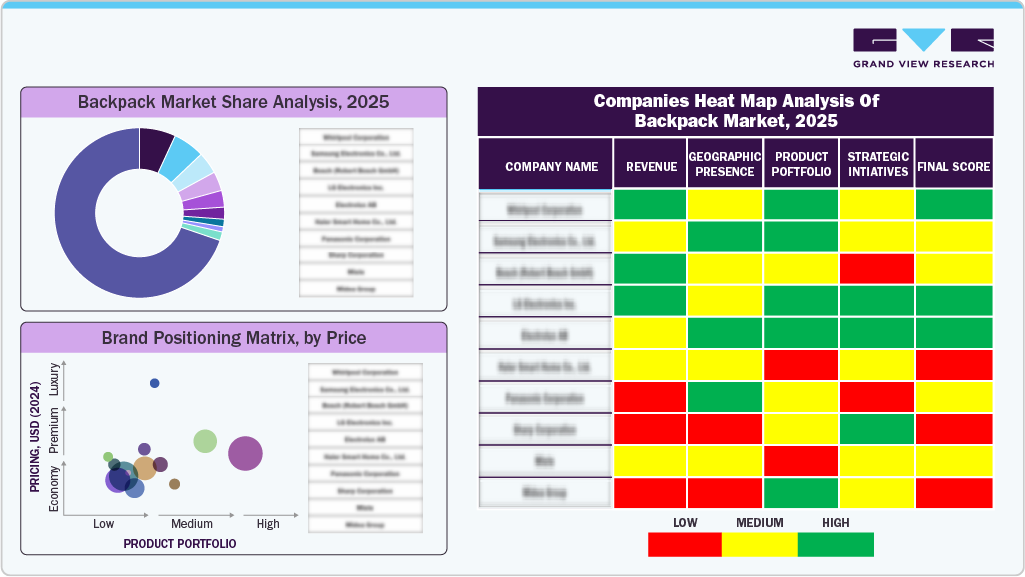
The competitive landscape of the backpack industry is highly dynamic and moderately fragmented, with global brands competing across multiple segments such as lifestyle, travel, outdoor, and technical backpacks. Leading players, including VF Corporation, Samsonite International, and Amer Sports, maintain strong market positions through diversified product portfolios, established brand recognition, and extensive global distribution networks.
These companies continuously invest in product innovation, focusing on durability, ergonomic design, and sustainable materials to meet evolving consumer preferences. In addition, major sportswear brands such as Nike, Adidas, and Puma play a significant role in driving demand, particularly in lifestyle and sports segments.
Industry trends shaping competition include increasing demand for sustainable and eco-friendly materials, integration of technology-driven features such as anti-theft and smart compartments, and growing consumer preference for multifunctional and stylish designs. Competitive strategies adopted by market players include product differentiation, expansion through e-commerce and direct-to-consumer channels, and strategic partnerships to strengthen market presence.
 To learn more about this report, Download Free Sample Report
 Key Backpack Companies:
The following key companies have been profiled for this study on the backpack market.
- VF Corporation
- Amer Sports Inc.
- Samsonite International S.A
- Adidas AG
- Nike Inc.
- Helen of Troy Limited
- Safari Industries Limited
- Colombia Sportswear Company
- Fenix Outdoor International AG
- Puma SE
Recent Developments
-
In April 2026, The North Face introduced its Universal 20 Daypack as part of the Universal Collection, marking a significant step toward inclusive product design in the backpack segment. The backpack incorporated adaptive features such as magnetic closures, ergonomic access points, and enhanced usability for individuals with mobility constraints. This launch highlighted the brand’s focus on accessibility and user-centric innovation, aligning with broader industry trends toward inclusive outdoor gear.
-
In April 2026, STATE Bags collaborated with LoveShackFancy to launch a co-branded backpack collection, targeting the lifestyle and family-oriented consumer segment. The collection featured aesthetically driven designs, including signature floral patterns, and extended beyond backpacks into complementary accessories such as diaper bags and organizers. This partnership illustrated the rising influence of fashion collaborations in driving product differentiation within the backpack industry.
-
In March 2026, Wandrd expanded its product portfolio with the launch of the Prvke Zip and Pocket backpacks, offering a minimalist alternative to its traditional roll-top designs. The new range featured zip-access compartments, modular internal organization, and weather-resistant materials, catering to content creators and travelers seeking versatile, hybrid-use solutions. The launch underscored increasing demand for backpacks that combine professional functionality with everyday usability.
-
In March 2026, Peak Design launched a new Travel Backpack 2-in-1 system, introducing a modular solution tailored for modern travelers. The product featured a 34L main backpack paired with a detachable 16L daypack, enabling seamless transition between long-haul travel and daily use. The launch emphasized durability and sustainability, incorporating weatherproof materials and recycled fabrics, while also integrating anti-theft features and smart storage solutions. This development reflected the growing consumer preference for multifunctional and eco-conscious travel gear.
-
In February 2026, Stanley 1913 entered the backpack category with the launch of its Vitalize Backpack, as part of its broader expansion into wellness and lifestyle products. The backpack was positioned for active consumers, particularly those engaged in fitness and gym activities, and was designed to complement the brand’s existing hydration and outdoor product lines. This move reflected the increasing participation of non-traditional players in the backpack industry.
-
In July 2025, JanSport partnered with L2 Brands to launch collegiate-branded backpacks through university bookstores, strengthening its presence in the student segment. This reflects growing demand for customized, identity-driven products and highlights how brands are leveraging strategic partnerships and targeted distribution channels to expand market reach.
-
In June 2025, Peak Design expanded its outdoor lineup with the launch of an 18L backpack and 4L sling, focusing on lightweight, multifunctional designs. This reflects growing consumer preference for versatile, modular backpacks that cater to travel, outdoor, and daily-use applications, highlighting the shift toward compact and hybrid product solutions.
-
In January 2025, Osprey Packs launched its expanded lifestyle backpack collection, emphasizing sustainability and advanced functionality. The collection incorporates innovative recycled materials, including proprietary fabrics made from production waste, along with water-resistant and ergonomic designs. It also introduces versatile products such as commuter-focused and sling backpacks, reflecting growing demand for eco-friendly, multifunctional, and urban lifestyle-oriented solutions.
Backpack Market Report Scope
Report Attribute
Details
Market size in 2025
USD 24.0 billion
Estimated market size in 2026
USD 25.5 billion
Projected market size by 2033
USD 42.7 billion
Growth rate
CAGR of 7.6% from 2026 to 2033
Actuals
2021 - 2025
Forecast period
2026 - 2033
Quantitative units
Revenue in USD billion and CAGR from 2026 to 2033
Report coverage
Revenue forecast, company ranking, competitive landscape, growth factors, and trends
Segments covered
Product, material, distribution channel, region
Regional scope
North America; Europe; Asia Pacific; Central & South America; Middle East & Africa
Country scope
U.S.; Canada; Mexico; UK; Germany; France; Italy; Spain; China; India; Japan; Australia & New Zealand; South Korea; Brazil; South Africa
Key companies profiled
VF Corporation; Amer Sports Inc; Samsonite International; Adidas AG; Nike Inc; Helen of Troy Limited; Safari Industries Limited; Colombia Sportswear Company; Fenix Outdoor International AG; Puma SE
Customization scope
Free report customization (equivalent up to 8 analysts working days) with purchase. Addition or alteration to country, regional & segment scope.
Pricing and purchase options
Avail customized purchase options to meet your exact research needs. Explore purchase options
Global Backpack Market Report Segmentation
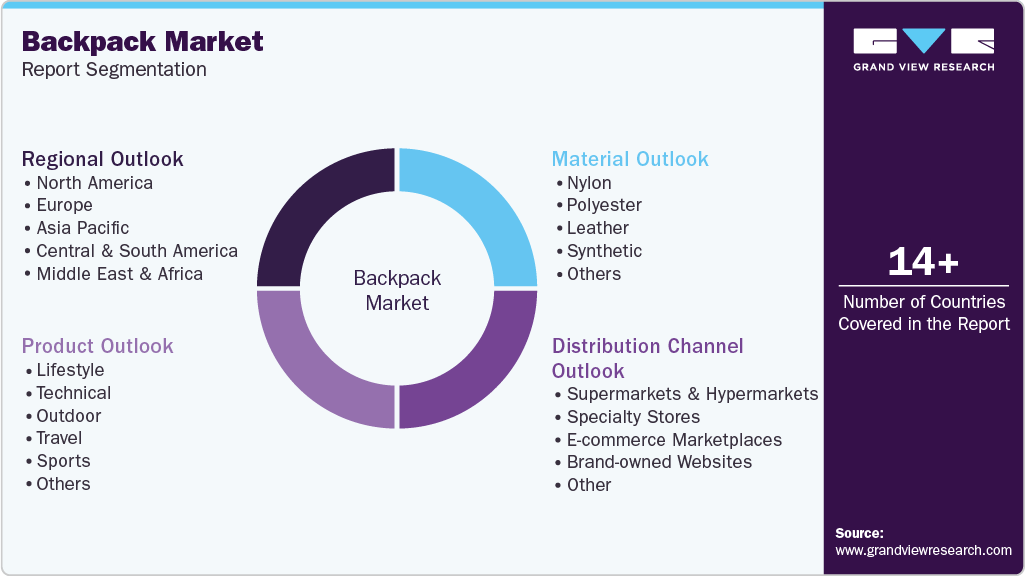
This report forecasts revenue growth at global, regional & country levels and provides an analysis of the latest trends and opportunities in each of the sub-segments from 2021 to 2033. For this study, Grand View Research has segmented the global backpack market report based on product, material, distribution channel, and region:
 To learn more about this report, Download Free Sample Report
 -
Product Outlook (Revenue, USD Million, 2021 - 2033)
-
Lifestyle
-
Technical
-
Outdoor
-
Travel
-
Sports
-
Others
-
-
Material Outlook (Revenue, USD Million, 2021 - 2033)
-
Nylon
-
Polyester
-
Leather
-
Synthetic
-
Others
-
-
Distribution Channel Outlook (Revenue, USD Million, 2021 - 2033)
-
Supermarkets & Hypermarkets
-
Specialty Stores
-
E-commerce Marketplaces
-
Brand - owned Websites
-
Other
-
-
Regional Outlook (Revenue, USD Million, 2021 - 2033)
-
North America
-
U.S.
-
Canada
-
Mexico
-
-
Europe
-
UK
-
Germany
-
France
-
Italy
-
Spain
-
-
Asia Pacific
-
China
-
India
-
Japan
-
Australia & New Zealand
-
South Korea
-
-
Central & South America
-
Brazil
-
-
Middle East & Africa (MEA)
-
South Africa
-
-
Delivered Customizations
This report has been delivered with the following In-depth customizations
Client Request
Customization Delivered
Value Adds
Urban Mobility & Consumer Usage Analysis
Developed a tailored assessment of backpack usage patterns across key consumer categories, including students, working professionals, travelers, and outdoor enthusiasts. The study evaluated urban mobility trends, laptop penetration, hybrid work culture, school and university enrolments, and evolving lifestyle preferences influencing demand for multifunctional and ergonomic backpacks.
Enables stakeholders to understand changing consumer usage behavior, identify high-demand application segments, and align product development strategies with evolving mobility, education, and workplace trends.
Sustainable Materials & Product Innovation Analysis
Developed an in-depth assessment of material innovation and sustainability trends in the backpack market, including rising adoption of recycled polyester, eco-friendly fabrics, anti-theft functionality, smart compartments, and multifunctional product designs.
Helps stakeholders evaluate innovation-driven growth opportunities, strengthen sustainability positioning, identify evolving consumer preferences for premium products, and enhance competitive differentiation through advanced product features.
Retail Channel & E-commerce Opportunity Assessment
Conducted a focused evaluation of backpack distribution channels, including specialty stores, supermarkets, and e-commerce marketplaces. The analysis assessed online shopping behavior, digital commerce penetration, promotional strategies, social media influence, and consumer preference for personalized and branded backpack products.
Supports strategic retail expansion planning by identifying the fastest-growing sales channels, evaluating digital commerce opportunities, and helping brands optimize omnichannel distribution and customer engagement strategies.
Frequently Asked Questions About This Report
The lifestyle backpacks segment led with a 36.5% revenue share in 2025, while the travel and outdoor backpack segment is the fastest-growing.
The polyester segment led with a 38.2% revenue share in 2025, while the synthetic backpack segment is the fastest-growing.
The specialty stores segment led with a 26.5% revenue share in 2025, while the e-commerce segment is the fastest-growing.
The global backpack market size was estimated at USD 24.0 billion in 2025 and is expected to reach USD 25.5 billion in 2026.
The global backpack market is expected to grow at a compound annual growth rate of 7.6% from 2026 to 2033 to reach USD 42.7 billion by 2033.
The Asia Pacific backpack market held the largest revenue share of 35.0% in the global backpack industry in 2025, driven by its large population base and high consumption across education and daily-use segments.
Some key players operating in the backpack market include VF Corporation, Amer Sports Inc, Samsonite International, Adidas AG, Nike Inc, Helen of Troy Limited, Safari Industries Limited, Colombia Sportswear Company, Fenix Outdoor International AG, and Puma SE.
Key factors that are driving the market growth include the rising urban mobility, expanding student populations, and strong growth in travel and outdoor activities.
About the Author(s)
Clothing, Footwear & Accessories Research Team
Consumer Goods · Clothing, Footwear & AccessoriesThis report was authored by the clothing, footwear & accessories research team at Grand View Research - comprising two research analysts, one senior research analyst, and one industry expert - with specialized expertise in the clothing, footwear & accessories segment of the consumer goods industry. All findings are based on proprietary consumer goods databases, executive interviews, and regulatory analysis, subject to internal peer review prior to publication.
Last Updated:
Speak to Analyst

Customize this report to your needs - add regions, segments, or data points, with 20% free customization.
Or view our licence options:


ISO 9001:2015 & 27001:2022 Certified
We are GDPR and CCPA compliant! Your transaction & personal information is safe and secure. For more details, please read our privacy policy.


