
- Home
- »
- IT Services & Applications
- »
-
Software Composition Analysis Market Size Report, 2033GVR Report cover

Software Composition Analysis Market (2026 - 2023)
Size, Share & Trends Analysis Report By Component (Solution, Services), By Deployment (Cloud, On-premise), By Enterprise Size (SMEs, Large Enterprises), By End-use, By Region, And Segment Forecasts
Market Size, 2025
$337.0MMarket Estimate, 2026
$389.2MMarket Forecast, 2033
$1,438.7MCAGR, 2026–2033
20.5%Software Composition Analysis Market Summary
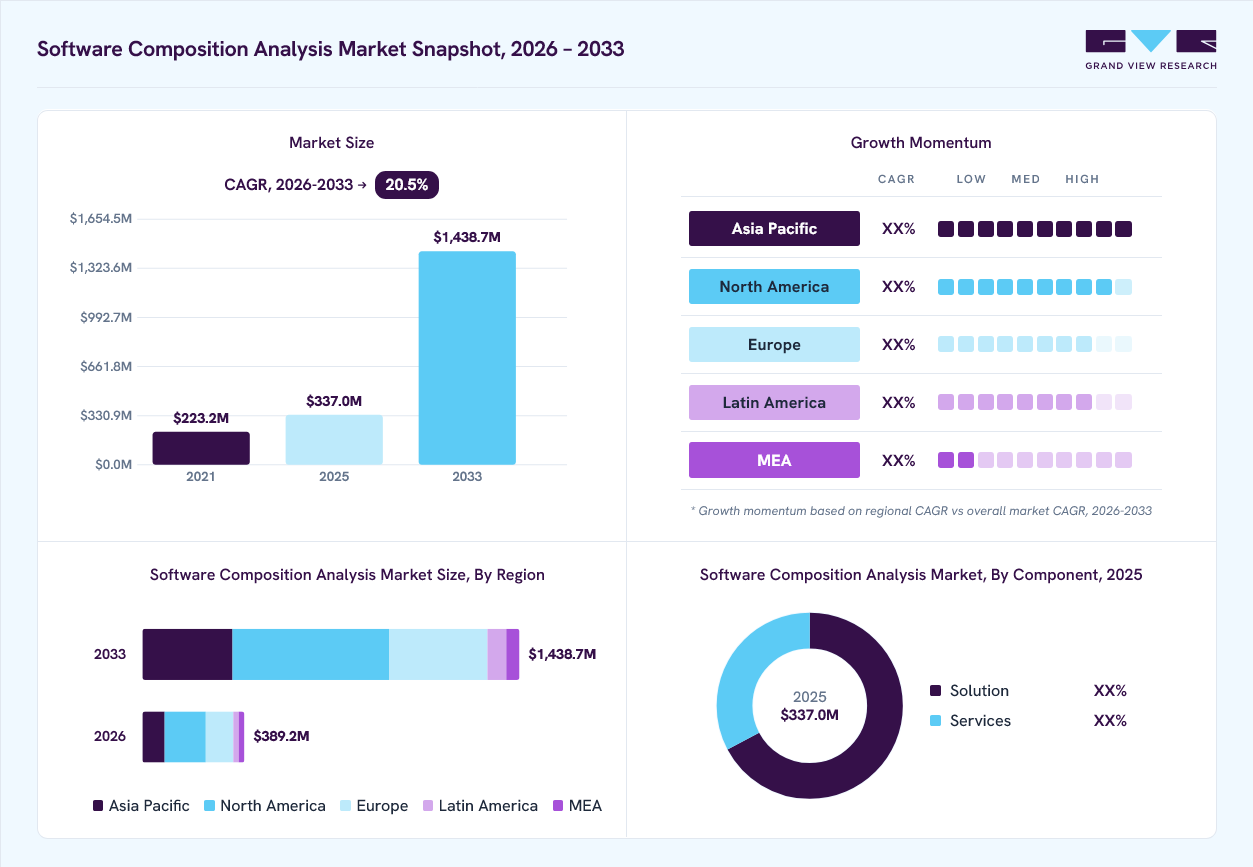
The global software composition analysis market size was valued at USD 337.0 million in 2025 and is projected to grow from USD 389.2 million in 2026 to USD 1,438.7 million by 2033, at a CAGR of 20.5% from 2026 to 2033. The North America market dominated, with a revenue share of 40.2% in 2025. The market is experiencing rapid growth, driven by the widespread adoption of open-source software in modern application development and the increasing need to identify security vulnerabilities while ensuring license compliance.
 Source: Grand View Research, IR Documents, Primary Interviews, Paid DatabasesTo learn more about this report,
 Download Free Sample Report
Key Market Trends & Insights
- By Component: The solution segment dominated the market, with a revenue share of 67.2% in 2025
- By Deployment: The cloud segment dominated the market, with a revenue share of 54.6% in 2025
- By Enterprise Size: The large enterprises segment dominated the market in 2025
- By End Use: The BFSI segment held the largest market share in 2025
Regional Highlights
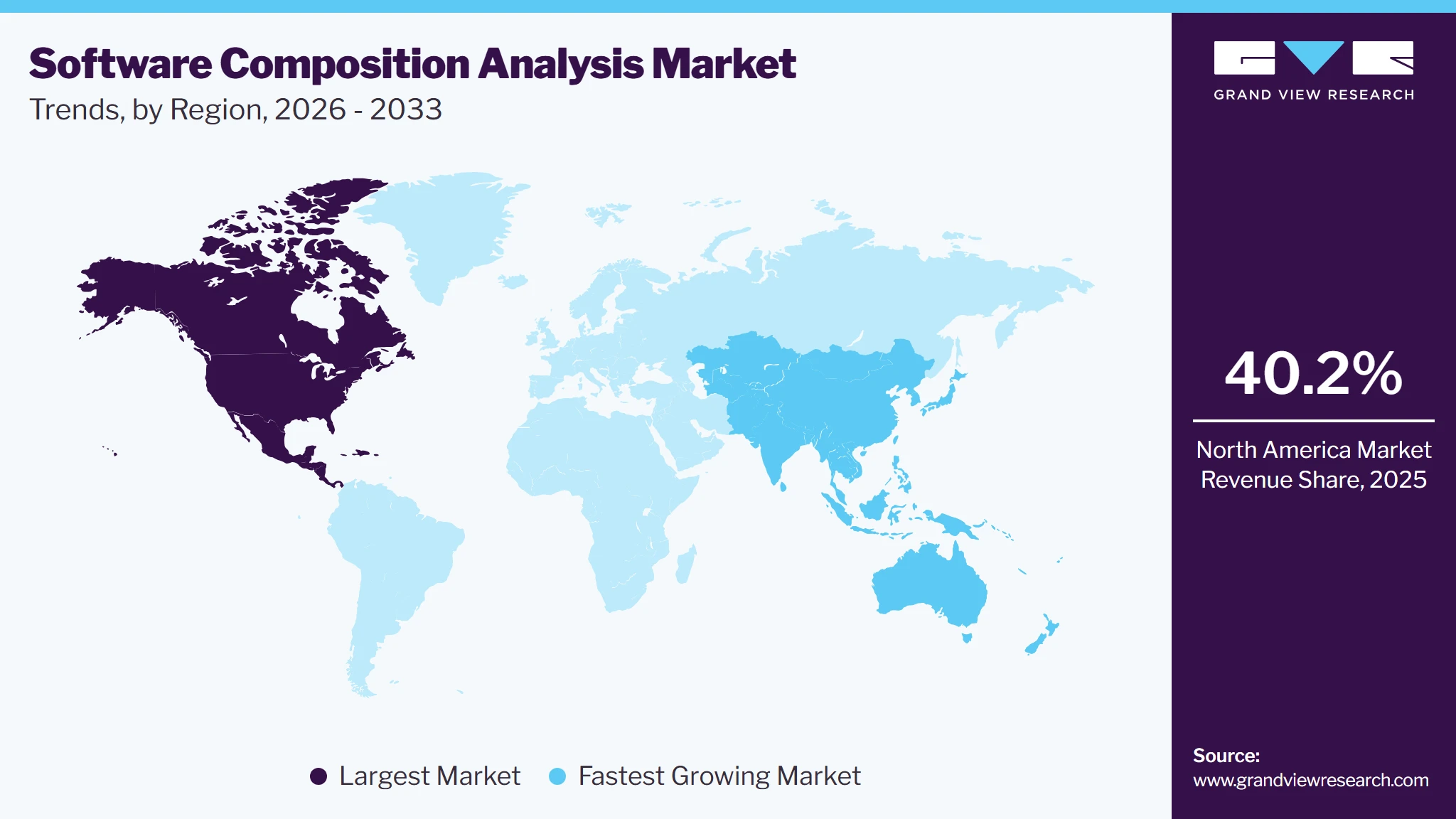
- Largest regional market: North America (40.2% revenue share, 2025)
- Fastest-growing regional market: Asia Pacific (highest CAGR, 2026-2033)
- By country: The U.S. held the largest market share in 2025
Market Size & Forecast
- Market size in 2025: USD 337.0 million
- Estimated market size in 2026: USD 389.2 million
- Projected market size by 2033: USD 1,438.7 million
- CAGR (2026-2033): 20.5%
Three ways to get this report
Buy it, customize it, or ask a question.Ask an Analyst
Analyst response in 1 business day
- AccessReport author, directly
- Reply timeWithin 1 working day
- No sales callDirect answer only
- FormatEmail reply
- CostFree, no cost
Get the Full Report
What the study covers
- FormatsPDF · Excel · Dashboard
- Timeline2026–2033 annual, 2025 base
- Coverage20+ countries, 5 regions
- Companies10+ key players profiled
Customize the Report
20% free customization
- IncludeCountries, segments, points
- TailorTo your product definition
- ExtendDeeper competitor detail
- OrA fully bespoke study
- Turnaround5–10 working days
The rising frequency of cyberattacks targeting software supply chains, coupled with stringent regulatory frameworks such as GDPR and HIPAA, is accelerating the demand for robust SCA solutions. Additionally, the growing adoption of DevSecOps practices, which embed security throughout the software development lifecycle, is further fueling market expansion by enabling organizations to detect and remediate risks early in the development process. Among end-use industries, the healthcare sector is emerging as one of the fastest-growing adopters of SCA solutions, driven by strict regulatory compliance requirements, the need to protect sensitive patient data, and the increasing sophistication of cyber threats targeting healthcare systems.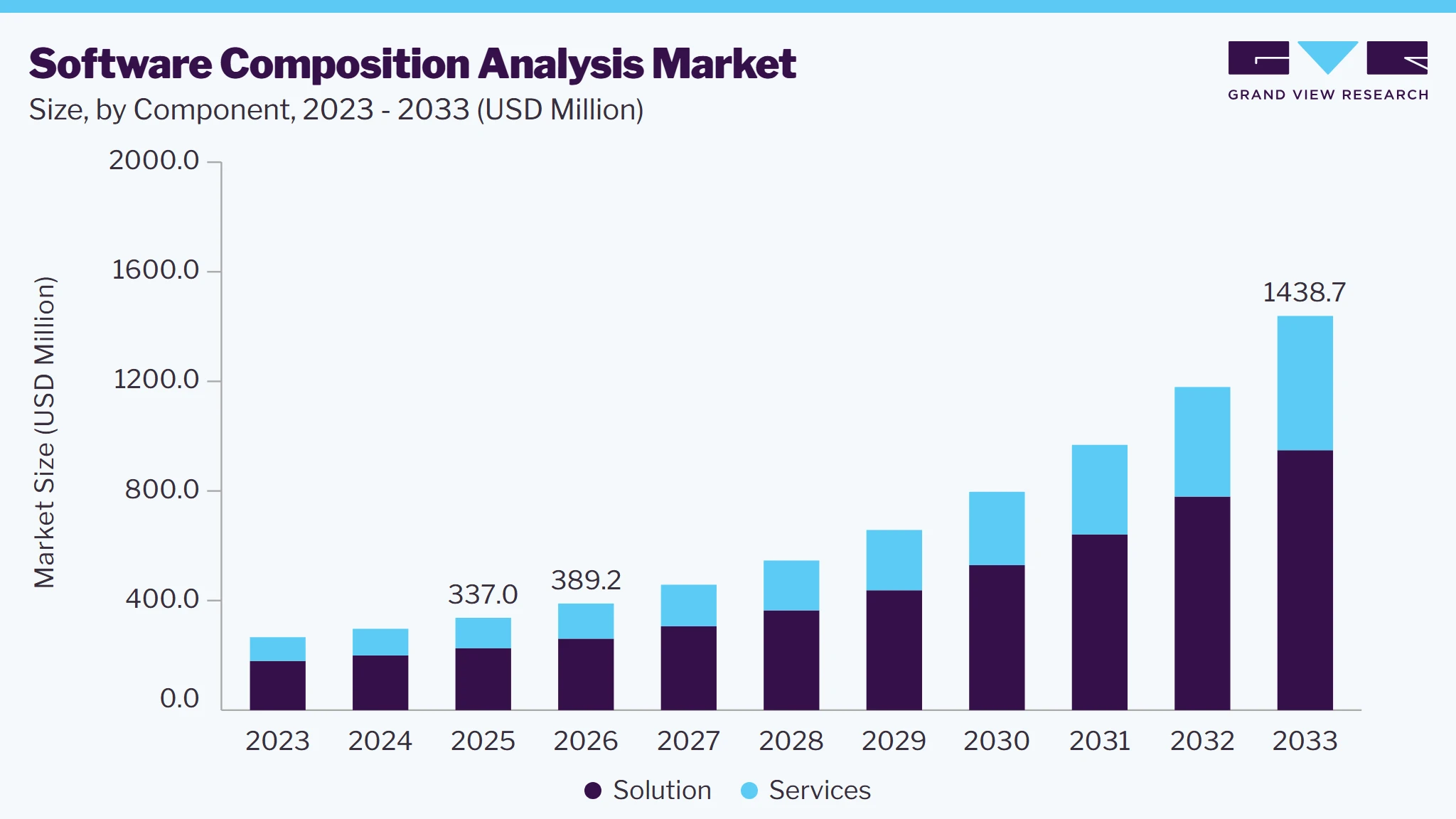 To learn more about this report, Download Free Sample Report
Software Composition Analysis (SCA) tools help organizations identify, track, and manage open-source components within their software, ensuring that these components are free from known vulnerabilities and comply with licensing requirements.
Key drivers of this market include the rise in cyber threats targeting software supply chains, stringent regulatory requirements such as GDPR and HIPAA, and the shift towards DevSecOps practices that integrate security early in the development process. The healthcare sector is experiencing particularly high growth in the SCA market due to its stringent regulatory environment and increased cyber threats. Major players in the market, such as Synopsys, Snyk, Sonatype, Veracode, and WhiteSource, offer comprehensive solutions that cater to various industries, including BFSI, IT and telecommunications, and retail.
The increasing use of open-source software is a significant driver for the software composition analysis market. Organizations across various industries are leveraging open-source components to accelerate development processes, reduce costs, and benefit from the collective innovation of global developer communities. Open-source software offers the flexibility and scalability needed for modern applications, allowing companies to build robust solutions without starting from scratch. However, as the adoption of open-source components grows, so does the complexity of managing these components. Each piece of open-source software can have multiple dependencies and may introduce vulnerabilities that could be exploited by malicious actors. Furthermore, compliance with open-source licenses is critical to avoid legal repercussions. This heightened reliance on open-source software necessitates effective management solutions to ensure that all components are secure, up-to-date, and comply with relevant licenses. SCA tools address these needs by providing automated solutions for identifying, tracking, and managing open-source components, thereby mitigating risks and ensuring that organizations can safely leverage the benefits of open-source innovation.
Market Dynamics
The software composition analysis market is being driven by the rapid growth of open-source software adoption, cloud-native application development, and the increasing complexity of modern software supply chains. Organizations are integrating hundreds of open-source libraries into applications, making it essential to continuously identify vulnerabilities, manage software licenses, and maintain Software Bills of Materials (SBOMs). Regulatory initiatives and cybersecurity frameworks are further accelerating adoption, as enterprises seek to comply with evolving software supply chain security requirements and improve transparency across the software development lifecycle. The widespread adoption of DevSecOps and continuous integration/continuous delivery (CI/CD) pipelines is also increasing demand for automated SCA solutions that can detect and remediate risks early in the development process without disrupting release cycles.
A key market trend is the evolution of SCA platforms from vulnerability detection tools to comprehensive software supply chain security solutions. Vendors are increasingly incorporating artificial intelligence (AI) and machine learning to prioritize exploitable vulnerabilities, reduce alert fatigue, and provide contextual risk analysis. Integration with application security testing (AST), cloud-native application protection platforms (CNAPP), container security, and code repositories is enabling organizations to establish unified application security programs. Demand is particularly strong across highly regulated industries such as healthcare, BFSI, government, and critical infrastructure, where organizations must safeguard sensitive data while complying with stringent cybersecurity regulations. As software supply chain attacks continue to increase and digital transformation accelerates globally, enterprises are expected to prioritize SCA investments as a core component of their cybersecurity and secure software development strategies.
The rapid expansion of open-source software adoption across enterprise application development is one of the primary drivers of the Software Composition Analysis (SCA) market. Modern software ecosystems increasingly rely on open-source libraries and third-party components to accelerate innovation, reduce development costs, and improve scalability. However, this growing dependency has significantly increased the complexity of managing vulnerabilities, license compliance, and software supply chain risks, thereby driving strong demand for SCA solutions. Organizations are increasingly deploying SCA tools to gain visibility into code composition and ensure continuous monitoring of security risks throughout the software lifecycle.
In addition, the widespread adoption of DevSecOps practices is further strengthening market growth by embedding security directly into development and deployment pipelines. Enterprises are shifting from traditional reactive security approaches to proactive, automated vulnerability detection integrated within CI/CD workflows. This enables development teams to identify and remediate security issues early in the development cycle without slowing down release velocity. As organizations continue modernizing application development and scaling cloud-native environments, SCA solutions are becoming a critical enabler of secure and compliant software delivery.
Despite strong demand, the software composition analysis market faces challenges related to the operational complexity of deploying and managing SCA solutions within diverse development environments. One of the key issues is the high volume of vulnerability alerts and false positives generated by SCA tools, which can overwhelm security teams and lead to alert fatigue. This reduces efficiency in prioritizing critical risks and may slow down remediation efforts, particularly in large enterprises managing complex codebases with extensive dependencies.
Another major restraint is the difficulty of integrating SCA tools into existing DevOps pipelines, legacy systems, and multi-cloud environments. Many organizations face compatibility challenges across programming languages, repositories, and deployment frameworks, which can delay adoption. Additionally, the cost of advanced SCA platforms, along with the need for skilled cybersecurity professionals to manage and interpret results, can be a barrier for small and medium-sized enterprises. These factors collectively limit seamless and widespread adoption across all industry segments.
The increasing global emphasis on software supply chain security presents a significant growth opportunity for the SCA market. High-profile cyberattacks targeting open-source vulnerabilities have heightened awareness among enterprises regarding the need for full visibility into software components. As a result, organizations are increasingly adopting Software Bills of Materials (SBOMs) to ensure transparency, traceability, and compliance across software ecosystems. SCA solutions play a critical role in enabling automated SBOM generation and continuous monitoring of open-source dependencies, making them essential in modern application security strategies.
Another key opportunity lies in the integration of artificial intelligence (AI) and machine learning (ML) into SCA platforms. These technologies enable advanced capabilities such as intelligent vulnerability prioritization, risk-based scoring, and contextual analysis of exploitability, significantly improving remediation efficiency. Furthermore, the growing adoption of cloud-native architectures, containerized applications, and microservices is expanding the scope of SCA deployment across industries such as BFSI, healthcare, government, and IT services. Emerging markets in Asia Pacific, Latin America, and MEA also offer substantial untapped potential as organizations accelerate digital transformation and strengthen cybersecurity frameworks.
Analyst Perspective
From an analyst perspective, the Software Composition Analysis (SCA) market is rapidly transitioning from a niche application security segment into a foundational layer of modern software supply chain security. The surge in open-source dependency usage across cloud-native and DevSecOps-driven environments has fundamentally increased the attack surface, making visibility into third-party components a critical enterprise priority. As organizations scale microservices architectures and adopt CI/CD pipelines, SCA solutions are becoming essential for continuously monitoring vulnerabilities, managing license compliance, and generating SBOMs. This shift is further reinforced by increasing regulatory scrutiny and high-profile supply chain attacks, which are pushing enterprises to prioritize proactive and automated security controls over traditional reactive approaches.
Looking ahead, the market is expected to witness strong convergence between SCA and broader application security platforms, including static and dynamic application security testing, container security, and cloud-native application protection platforms. Analysts also observe a clear trend toward AI-driven vulnerability prioritization and contextual risk scoring, which is helping organizations reduce alert fatigue and improve remediation efficiency. While mature vendors are consolidating their leadership through integrated security ecosystems, emerging players are driving innovation with developer-centric, lightweight, and API-first solutions. Overall, the SCA market is positioned for sustained high growth, supported by expanding digital transformation initiatives, evolving regulatory frameworks, and the growing emphasis on secure software development lifecycle practices globally.
Component Insights
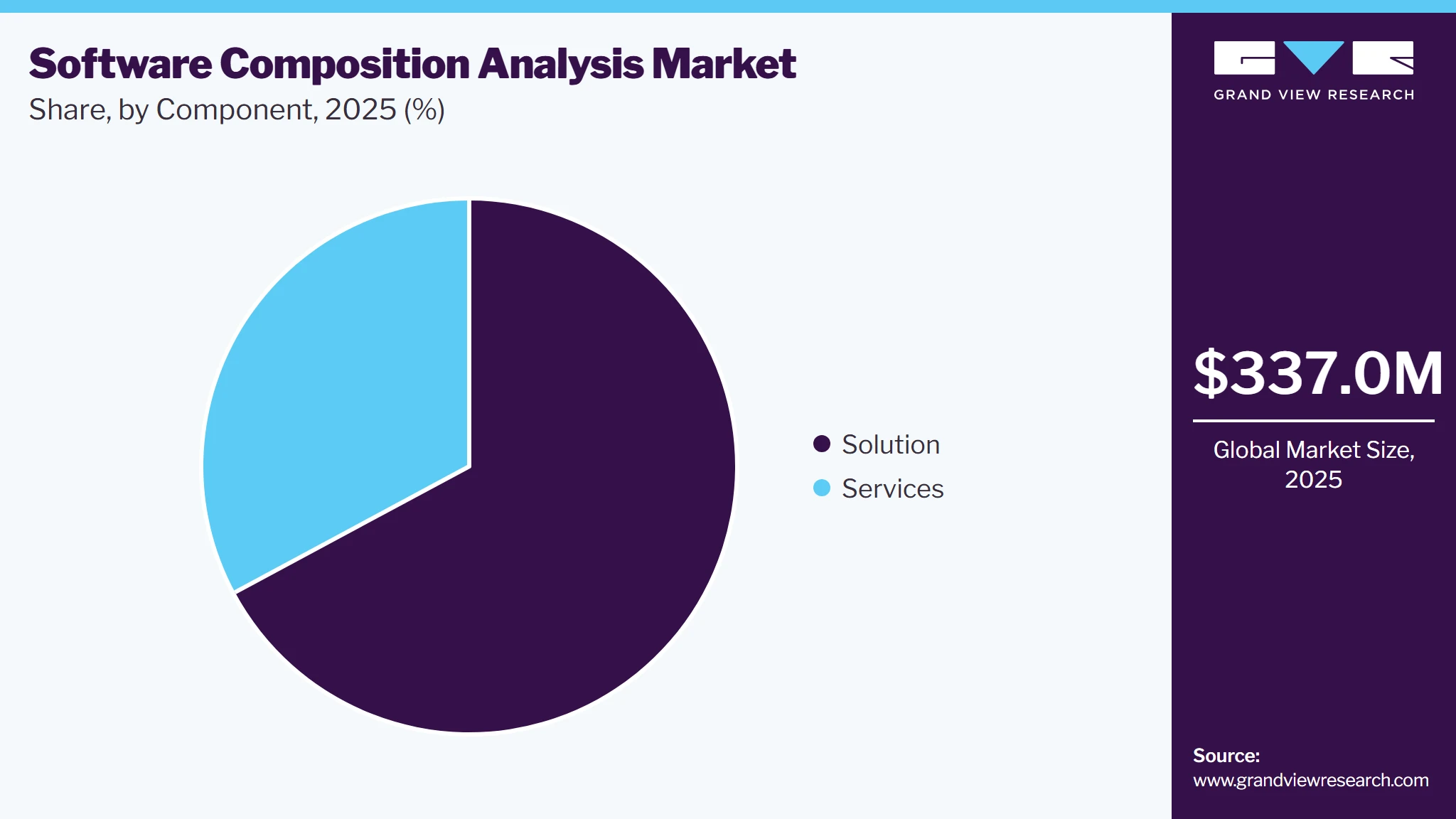
Based on component, the solution segment led the market with the largest revenue share of 67.2% in 2025. SCA solutions have significantly advanced in their capabilities, making them indispensable for organizations. These solutions now offer real-time monitoring, which allows continuous surveillance of open-source components for any emerging vulnerabilities. AI-driven vulnerability detection enhances the accuracy and speed of identifying potential security risks, reducing the burden on development teams and minimizing false positives. Furthermore, seamless integration with development environments and CI/CD pipelines ensures that security checks are embedded throughout the software development lifecycle, from code writing to deployment. This integration facilitates the early detection and remediation of vulnerabilities, aligning with the shift-left security approach.
The services segment is expected to grow at a CAGR of 20.41% during the forecast period. Many organizations, particularly small and medium-sized enterprises (SMEs), lack the in-house expertise and resources to manage SCA processes effectively. Managed services offer a cost-effective solution by outsourcing these tasks to experts. Furthermore, managed services provide ongoing monitoring and management of open-source components, ensuring continuous protection against vulnerabilities and compliance issues without overburdening internal teams.
Deployment Insights
Based on the deployment, the cloud segment led the market with the largest revenue share of 54.6% in 2025. Cloud-based SCA solutions offer scalable resources that can easily adapt to the varying needs of organizations, accommodating everything from small projects to large enterprise applications. Cloud deployment allows organizations to quickly implement and scale SCA tools as their software development needs evolve, providing flexibility in managing open-source components across different projects and teams. Similarly, cloud-based SCA tools integrate seamlessly with DevOps practices and continuous integration/continuous deployment (CI/CD) pipelines, facilitating automated and continuous monitoring of open-source components throughout the development lifecycle.
The on-premise segment is expected to grow at a significant CAGR during the forecast period. Organizations that prioritize control over their IT assets, including software tools like SCA solutions, typically do so to align with their organizational culture and governance principles. These organizations often have strict policies regarding data security, compliance, and risk management, which require comprehensive oversight and direct management of technology assets. By opting for on-premise deployment of SCA solutions, these organizations retain full control over their data, infrastructure, and security protocols. This approach allows them to implement customized security measures, integrate seamlessly with existing IT environments, and adhere strictly to regulatory requirements without relying on external service providers.
Enterprise Size Insights
Based on the enterprise size, the large enterprises segment led the market with the largest revenue share of 58.3% in 2025. Large enterprises operate on a scale that involves managing extensive and diverse software environments, which often include a multitude of open-source components. These components are critical for driving innovation, reducing development costs, and accelerating time-to-market for new products and services. However, the complexity of these software ecosystems introduces significant challenges in terms of security and compliance management. By continuously scanning and analyzing these components, SCA tools identify vulnerabilities, assess license compliance, and monitor for any potential security risks. This proactive approach ensures that large enterprises can effectively manage and mitigate risks associated with their software assets, safeguarding against potential security breaches, intellectual property issues, and regulatory non-compliance. Moreover, SCA tools enable enterprises to maintain operational resilience and agility, supporting their ongoing digital transformation initiatives while maintaining robust software security practices across their complex software environments.
The SMEs segment is expected to grow at a significant CAGR of 21.22% over the forecast period. SMEs typically face constraints in terms of budget, manpower, and expertise, making it challenging to maintain robust cybersecurity measures manually. SCA tools play a pivotal role in addressing these challenges by automating the identification of vulnerabilities within open-source components used in their software applications. By leveraging automated scanning and analysis capabilities, SCA tools enable SMEs to detect potential security weaknesses promptly and efficiently, minimizing the need for extensive manual oversight. This automation not only enhances the speed and accuracy of vulnerability management but also optimizes resource allocation, allowing SMEs to focus their limited resources on other critical business priorities.
End-use Insights
Based on the end use, the BFSI segment led the market with the largest revenue share of 27.0% in 2025. Financial institutions are attractive targets for cyberattacks due to the immense value of financial data and the potential financial gains for malicious actors. These institutions handle sensitive information such as customer financial records, transaction details, and personal identification data, making them prime targets for cybercriminals seeking to steal money, commit fraud, or disrupt financial markets. In this high-stakes environment, SCA tools play a crucial role in enhancing cybersecurity posture. By continuously scanning and analyzing open-source components used in their software applications, SCA tools identify vulnerabilities that could be exploited by attackers. These vulnerabilities might exist in libraries, frameworks, or dependencies integrated into financial systems. Prompt identification and mitigation of these vulnerabilities are essential to reducing the attack surface and strengthening defenses against potential exploits.
 To learn more about this report, Download Free Sample Report
The retail & e-commerce segment is expected to grow at a significant CAGR over the forecast period. Retailers and e-commerce companies are leveraging digital technologies to drive sales, optimize inventory management, and elevate the overall customer experience. As part of this transformation, there is a significant reliance on integrating open-source components into their software solutions. These components provide cost-effective and innovative functionalities but also introduce security and compliance challenges. This integration of open-source software necessitates robust SCA tools to effectively manage and mitigate risks associated with vulnerabilities and license compliance issues. SCA tools play a crucial role in continuously monitoring and analyzing open-source components used in digital platforms, ensuring they meet stringent security standards and regulatory requirements. Thus, SCA becomes integral to supporting the ongoing digital transformation initiatives that drive growth and competitiveness in these dynamic sectors.
Regional Insights
North America dominated the global software composition analysis market, with the largest revenue share of 40.2% in 2025. North America, including the United States and Canada, maintains rigorous regulatory frameworks across industries like healthcare (HIPAA), finance (PCI-DSS), and government (FISMA). These regulations mandate strict data protection and software compliance standards. SCA solutions are pivotal for enterprises in these sectors, ensuring adherence to regulatory requirements by identifying and mitigating vulnerabilities within open-source software components. By managing licensing issues and enhancing software security practices, SCA tools help organizations maintain compliance, mitigate risks of data breaches, and uphold trust among stakeholders, crucially supporting their efforts to safeguard sensitive information and meet regulatory mandates effectively.
 To learn more about this report, Download Free Sample Report
U.S. Software Composition Analysis Market Trends
The software composition analysis market in the U.S. held the largest share of the North American market in 2025. U.S. boasts a robust IT infrastructure, facilitating widespread cloud computing adoption. This environment supports the deployment of cloud-based SCA solutions, which offer significant benefits such as scalability, flexibility, and cost-efficiency. Cloud-based SCA tools can seamlessly adapt to the varying demands of enterprises, from startups to large corporations, ensuring effective management of open-source software security and compliance. The ability to scale resources on demand, coupled with reduced upfront costs and maintenance, makes cloud-based SCA solutions an attractive option for U.S. businesses aiming to enhance their cybersecurity posture and regulatory compliance efficiently.
Asia Pacific Software Composition Analysis Market Trends
The market in Asia Pacific is projected to grow significantly at a CAGR of 22.22% from 2024 to 2030. Asia Pacific is undergoing rapid digital transformation across various sectors, resulting in widespread adoption of open-source software to drive innovation and efficiency. This surge in open-source usage necessitates robust management of security and compliance to prevent vulnerabilities and legal issues. SCA tools are critical in this context, as they provide comprehensive oversight of open-source components, identifying potential risks and ensuring adherence to regulatory standards. The growing reliance on digital technologies and open-source software in the region fuels the demand for SCA solutions, making them indispensable for maintaining secure and compliant software development practices.
Europe Software Composition Analysis Market Trends
The market in Europe is expected to grow significantly at a CAGR of 20.10% from 2024 to 2030. Europe's robust open-source community fosters collaborative development and encourages the widespread adoption of open-source software across various industries. This collaborative environment accelerates innovation and reduces costs, but also brings challenges in managing security and compliance. SCA tools are essential in this context, as they provide the necessary oversight to identify and mitigate vulnerabilities, ensure license compliance, and maintain the integrity of open-source components. The reliance on open-source software in Europe drives the demand for SCA solutions, making them crucial for organizations aiming to leverage open-source benefits while safeguarding against associated risks.
Key Software Composition Analysis Company Insights
The key companies in the market are focusing on various strategic initiatives, including new product development, partnerships & collaborations, and agreements to gain a competitive advantage over their rivals.
Key Software Composition Analysis Companies:
The following key companies have been profiled for this study on the software composition analysis market.
-
Arnica, Inc.
-
Checkmarx
-
Contrast Security, Inc.
-
Flexera Inc.
-
FOSSA
-
JFrog
-
Mend.io
-
NexB, Inc
-
Qwiet
-
Snyk Limited
-
Sonatype Inc.
-
Synopsys, Inc.
-
Veracode Inc.
-
WhiteHat Security,Inc.
Competitive Benchmarking
Category
Operating Strategies
Competitive Edge
Weakness
Mature Players (Synopsys, Inc.; Veracode Inc.; Snyk Limited; Mend.io; Sonatype Inc.; Checkmarx; Flexera Inc.)
- Focus on end-to-end SCA platforms integrated with DevSecOps, AppSec, and cloud security ecosystems. Invest heavily in AI-driven vulnerability detection, SBOM automation, and enterprise compliance capabilities.
- Strong enterprise adoption, comprehensive vulnerability intelligence, and deep integration across CI/CD, cloud, and DevOps tools.
- High pricing and complex deployment models can limit SME adoption; potential vendor lock-in due to ecosystem dependency.
Emerging Players (Arnica, JFrog, FOSSA, NexB, Qwiet, WhiteHat Security)
- Deliver lightweight, developer-first SCA tools with API-first design, fast deployment, and CI/CD integration. Emphasize cloud-native and shift-left security approaches.
- Easy-to-use platforms, faster onboarding, flexible pricing, and strong appeal for agile teams and startups.
- Limited enterprise-scale capabilities, smaller global presence, and fewer advanced compliance and governance features.
Recent Developments
-
In April 2024, Synopsys launched Black Duck Supply Chain Edition, a comprehensive SCA solution designed to enhance software supply chain security. This new offering integrates multiple open-source detection technologies, automated Software Bill of Materials (SBOM) analysis, and malware detection. It helps development and security teams identify and mitigate risks in open-source, third-party, and AI-generated code, addressing vulnerabilities, license conflicts, and malicious code. The tool ensures extensive coverage of software dependencies, providing actionable insights and compliance management across the entire application lifecycle.
-
In March 2024, GitGuardian introduced a new SCA module designed for DevSecOps environments. This module helps security and developer teams by offering a unified solution for vulnerability remediation. It allows for the quick identification of unsafe dependencies, prioritization of incidents by severity, and provides remediation guidance. The SCA module also monitors legal risks in the software supply chain, ensuring compliance with license and security policies. This tool supports shift-left practices and integrates with GitGuardian’s CLI tool ggshield, enhancing security throughout the development process.
Software Composition Analysis Market Scope
Report Attribute
Details
Market size in 2025
USD 337.0 million
Estimated market size in 2026
USD 389.2 million
Projected market size by 2033
USD 1,438.7 million
Growth rate
CAGR of 20.5% from 2026 to 2033
Base year for estimation
2025
Historical data
2021 - 2024
Forecasts period
2026 - 2033
Quantitative units
Revenue in USD million/billion and CAGR from 2026 to 2033
Report coverage
Revenue forecasts, company market share analysis, competitive landscape, growth factors, and trends
Segments covered
Component, Deployment, Enterprise Size, End Use, and Region
Regional scope
North America; Europe; Asia Pacific; Latin America; MEA
Country scope
U.S.; Canada; Mexico; Germany; UK; France; Italy; Spain; China; Japan; India; South Korea; Australia; Brazil; Saudi Arabia; South Africa; UAE
Key companies profiled
Arnica, Inc.; Checkmarx; Contrast Security, Inc.; Flexera Inc.; FOSSA; JFrog; Mend.io; NexB, Inc; Qwiet; Snyk Limited; Sonatype Inc.; Synopsys, Inc.; Veracode Inc.; WhiteHat Security,Inc.
Customization scope
Free report customization (equivalent to up to 8 analysts' working days) with purchase. Addition or alteration to country, regional & segment scope.
Pricing and purchase options
Avail customized purchase options to meet your exact research needs. Explore purchase options
Global Software Composition Analysis Market Report Segmentation
This report forecasts revenue growth at the global, regional, and country levels and provides an analysis of the latest industry trends from 2021 to 2033 in each of the sub-segments. For this study, Grand View Research has segmented the global software composition analysis market report based on component, deployment, enterprise size, end-use, and region:
-
Software Composition Analysis Component Outlook (Revenue, USD Million, 2021 - 2033)
-
Solution
-
Services
-
Professional Services
-
Managed Services
-
-
-
Software Composition Analysis Deployment Outlook (Revenue; USD Million, 2021 - 2033)
-
Cloud
-
On-Premise
-
-
Software Composition Analysis Enterprise Size Outlook (Revenue, USD Million, 2021 - 2033)
-
Small & Medium Enterprises (SMEs)
-
Large Enterprises
-
-
Software Composition Analysis End Use Outlook (Revenue, USD Million, 2021 - 2033)
-
BFSI
-
IT & Telecom
-
Manufacturing
-
Government & Defense
-
Retail & E-Commerce
-
Automotive
-
Healthcare
-
Others
-
-
Software Composition Analysis Regional Outlook (Revenue, USD Million, 2021 - 2033)
-
North America
-
U.S.
-
Canada
-
Mexico
-
-
Europe
-
UK
-
Germany
-
France
-
-
Asia Pacific
-
China
-
India
-
Japan
-
Australia
-
South Korea
-
-
Latin America
-
Brazil
-
-
Middle East & Africa (MEA)
-
UAE
-
Saudi Arabia
-
South Africa
-
-
Research Methodology
The software composition analysis market figures in this report are based on a proven research process that combines executive interviews with secondary research from proprietary databases, company filings, and recognized regulatory and institutional sources. Market size is built through value-chain sizing - reconciling supply-side and demand-side estimates - and triangulated with bottom-up and top-down approaches. Every estimate passes multiple levels of expert validation before publication, with each software composition analysis segment quantified using the revenue-capture definitions in the table below.
Segment Definition
Segment - Component
Revenue Capture Definition
Solution
Revenue generated from SCA software platforms that identify open-source vulnerabilities, manage license compliance, generate SBOMs, and provide continuous monitoring, risk prioritization, and remediation capabilities across application codebases and software supply chains.
Services
Revenue from professional and managed services including implementation, integration, consulting, training, support, vulnerability assessment services, compliance advisory, and customization of SCA tools within enterprise DevSecOps environments.
Segment - Deployment
Revenue Capture Definition
Cloud
Revenue generated from SaaS-based SCA platforms deployed on public or hybrid cloud infrastructure, including subscription fees, API-based usage charges, continuous scanning services, and cloud-hosted vulnerability intelligence solutions.
On-Premise
Revenue from SCA solutions deployed within enterprise data centers, including licensed software, maintenance contracts, updates, and security modules installed on internal infrastructure for enhanced control and compliance.
Segment - Enterprise Size
Revenue Capture Definition
Large Enterprises
Revenue from advanced, enterprise-grade SCA platforms offering deep vulnerability intelligence, large-scale code analysis, policy enforcement, DevSecOps integration, and compliance management across complex software ecosystems.
SMEs
Revenue generated from subscription-based and lightweight SCA tools adopted by small and medium enterprises for open-source vulnerability detection, license management, and basic SBOM generation with cost-effective pricing models.
Segment - Vertical
Revenue Capture Definition
BFSI
Revenue generated from SCA solutions used to secure banking applications, fintech platforms, payment systems, fraud detection software, and regulatory-compliant financial services applications.
IT and Telecom
Revenue from SCA tools used in software development, cloud-native applications, communication platforms, and telecom infrastructure software to ensure secure and compliant codebases.
Manufacturing
Revenue generated from securing industrial software, IoT-enabled systems, automation platforms, and predictive maintenance applications using SCA tools.
Government & Defense
Revenue from SCA solutions is used to secure critical government applications, defense software systems, citizen service platforms, and ensure compliance with strict cybersecurity mandates.
Retail & E-Commerce
Revenue generated from securing digital commerce platforms, mobile apps, payment gateways, customer engagement systems, and omnichannel retail applications.
Automotive
Revenue from SCA tools used in connected vehicles, infotainment systems, autonomous driving software, and embedded automotive applications.
Healthcare
Revenue generated from securing healthcare applications such as EHR systems, telemedicine platforms, patient management systems, and compliance-driven medical software.
Others
Revenue from additional industries including energy & utilities, education, media & entertainment, travel & hospitality, and logistics, where software applications require open-source risk management and compliance assurance.
Estimation Model
Layer
Question
Analysis
Application Security Exposure Layer (TAM)
Who can potentially use SCA solutions?
All organizations developing or using software with open-source components across industries form the total addressable market due to increasing software supply chain risks.
Security & DevSecOps Readiness Layer (SAM)
Who can technically adopt SCA solutions?
Enterprises with cloud adoption, DevOps/DevSecOps practices, and CI/CD pipelines capable of integrating SCA tools represent the serviceable market.
Active SCA Adoption Layer (SOM)
Who actively deploys SCA solutions today?
Organizations actively using SCA for vulnerability detection, SBOM generation, and license compliance within secure development workflows.
Revenue Realization Layer
How is revenue generated?
Revenue comes from SaaS subscriptions, usage-based pricing, enterprise licensing, and premium security, compliance, and integration services.
Delivered Customizations
This report has been delivered with the following In-depth customizations
CLIENT REQUEST
CUSTOMIZATION DELIVERED
VALUE ADDS
Software supply chain risk assessment & open-source dependency analysis
Conducted a detailed assessment of software supply chain ecosystems, including open-source dependency mapping, vulnerability exposure analysis, license compliance evaluation, SBOM generation practices, and risk prioritization frameworks across enterprise applications and cloud-native environments.
Enables organizations to improve visibility into third-party code risks, strengthen software supply chain security, ensure license compliance, and proactively mitigate vulnerabilities across development pipelines.
DevSecOps integration & application security workflow evaluation
Evaluated SCA integration within DevSecOps pipelines, including CI/CD security embedding, automated vulnerability scanning, shift-left security practices, container and microservices security alignment, and integration with application security testing (AST) tools.
Helps organizations accelerate secure software delivery, reduce remediation time, improve developer productivity, and embed security seamlessly into modern development workflows.
Competitive benchmarking & Software Composition Analysis vendor positioning
Benchmarked leading SCA vendors including Synopsys, Veracode, Snyk, Sonatype, Mend.io, Checkmarx, Flexera, JFrog, FOSSA, Qwiet, Arnica, NexB, and WhiteSource based on vulnerability intelligence depth, SBOM capabilities, AI/ML-driven risk scoring, integration strength, compliance support, and developer experience.
Supports vendor selection, security platform modernization, investment planning, and strategic decision-making by identifying competitive strengths, innovation gaps, pricing positioning, and enterprise readiness across the SCA ecosystem.
Frequently Asked Questions About This Report
Asia Pacific is the fastest-growing region over the forecast period.
The solution segment led with a 67.2% revenue share in 2025, while services segment is the fastest-growing segment.
The cloud segment led with a 54.6% revenue share in 2025 and is also the fastest-growing segment.
The large enterprises segment led with a 58.3% revenue share in 2025, while SMEs segment is the fastest-growing segment.
The global software composition analysis market was valued at USD 337.0 million in 2025 and is expected to reach USD 389.2 million in 2026.
The global software composition analysis market is expected to grow at a compound annual growth rate of 20.5% from 2026 to 2033 to reach USD 1,438.7 million by 2033.
North America dominated with 40.2% revenue share in 2025.
Key players operating in the software composition analysis market include Synopsys, Inc., Sonatype Inc, WhiteHat Security, Inc., Veracode Inc., Flexera Inc., Contrast Security, Inc., NexB, Inc., FOSSA, JFrog, Checkmarx, Arnica, Inc., Mend.io, Qwiet and Snyk Limited
Key drivers of this market include the rise in cyber threats targeting software supply chains, stringent regulatory requirements such as GDPR and HIPAA, and the shift towards DevSecOps practices that integrate security early in the development process.
About the Author(s)
IT Services & Applications Research Team
Technology · IT Services & ApplicationsThis report was authored by the it services & applications research team at Grand View Research - comprising two research analysts, one senior research analyst, and one industry expert - with specialized expertise in the it services & applications segment of the technology industry. All findings are based on proprietary technology databases, executive interviews, and regulatory analysis, subject to internal peer review prior to publication.
Last Updated:
Speak to Analyst

Customize this report to your needs - add regions, segments, or data points, with 20% free customization.
Or view our licence options:


ISO 9001:2015 & 27001:2022 Certified
We are GDPR and CCPA compliant! Your transaction & personal information is safe and secure. For more details, please read our privacy policy.


