
- Home
- »
- Next Generation Technologies
- »
-
Solar Lighting System Market Size Report, 2026-2033GVR Report cover

Solar Lighting System Market (2026 - 2033)
Size, Share, & Trends Analysis Report By Offerings (Hardware, Software, Services), By System Type (Standalone, Hybrid, Grid-connected), By Technology, By Installation Type, By Application, By Region, And Segment Forecasts
Market Size, 2025
$12.3BMarket Estimate, 2026
$13.7BMarket Forecast, 2033
$31.5BCAGR, 2026–2033
12.6%Solar Lighting System Market Summary
The global solar lighting system market size was valued at USD 12.3 billion in 2025 and is projected to grow from USD 13.7 billion in 2026 to USD 31.5 billion by 2033, at a CAGR of 12.6% from 2026 to 2033. Asia Pacific dominated the market with the largest revenue share of 40% in the global market in 2025. The market is witnessing strong expansion as governments, municipalities, and private organizations increasingly adopt renewable energy-based lighting solutions to reduce electricity consumption and carbon emissions.
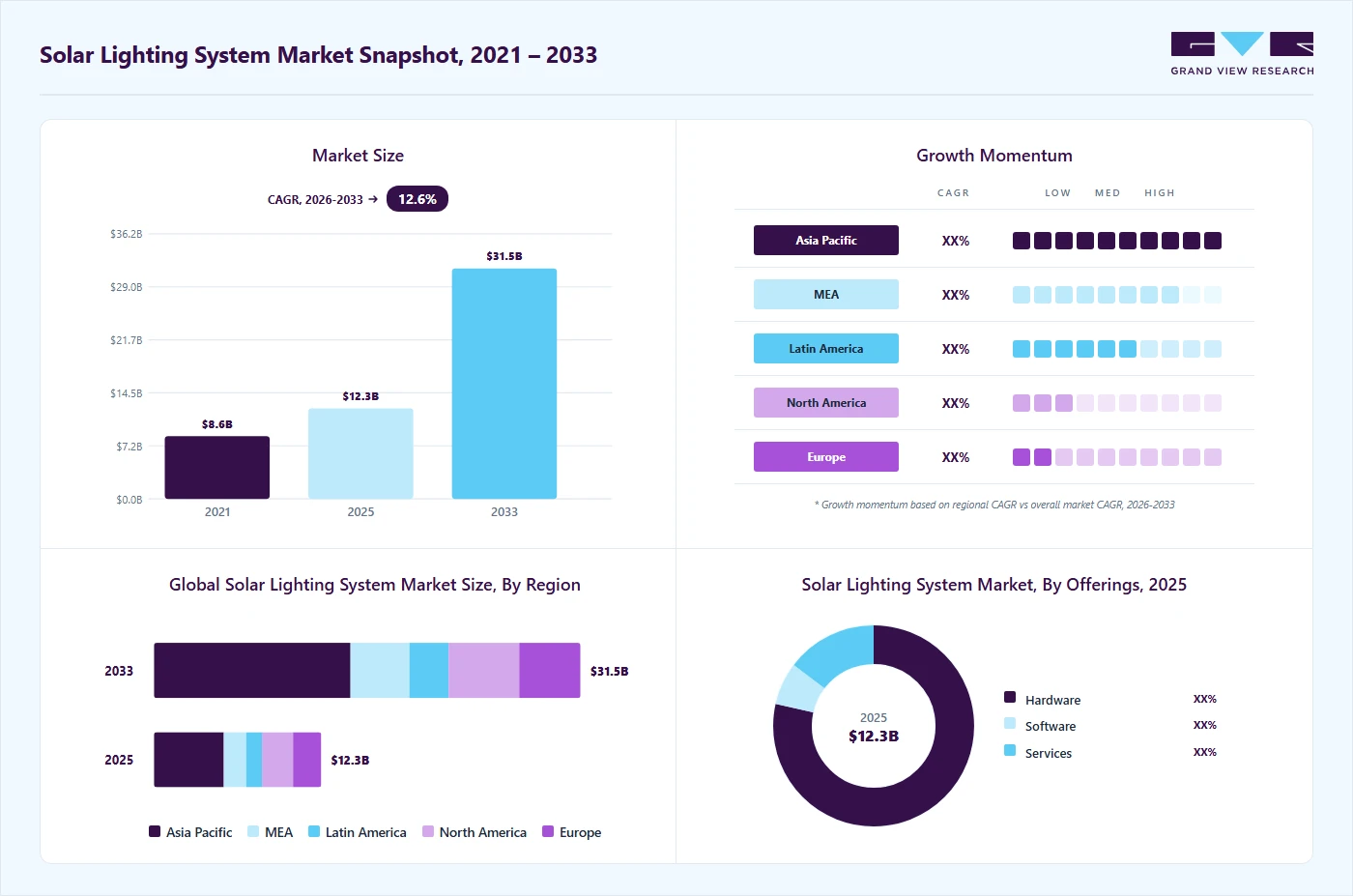 Source: Grand View Research, IR Documents, Primary Interviews, Paid DatabasesTo learn more about this report,
 Download Free Sample Report
 Key Market Trends & Insights
- By offerings: The hardware segment held the largest market share of 78.4% in 2025.
- By system type: The standalone solar lighting systems segment held the largest market share in 2025.
- By technology: The LED-based solar lighting segment held the largest market share in 2025.
- By installation type: The new installations segment held the largest market share in 2025.
- By application: The public infrastructure segment held the largest market share in 2025.
Regional Highlights
- Largest regional market: Asia Pacific (40% revenue share, 2025)
- By country: The U.S. held the largest market share in 2025.
Market Size & Forecast
- Market size in 2025: USD 12.3 Billion
- Estimated market size in 2026: USD 13.7 Billion
- Projected market size by 2033: USD 31.5 Billion
- CAGR (2026-2033): 12.6%
Three ways to get this report
Buy it, customize it, or ask a question.Ask an Analyst
A direct answer, usually in 1 working day
- AccessReport author, directly
- Reply timeWithin 1 working day
- No sales callDirect answer only
- FormatEmail reply
- CostFree, no cost
Get the Full Report
What the study covers
- FormatsPDF · Excel · Dashboard
- Timeline2026–2033 annual, 2025 base
- Coverage20+ countries, 5 regions
- Companies10+ key players profiled
Customize the Report
20% free customization
- IncludeCountries, segments, points
- TailorTo your product definition
- ExtendDeeper competitor detail
- OrA fully bespoke study
- Turnaround5–10 working days
Solar lighting systems provide an energy-efficient alternative to conventional grid-powered lighting by utilizing photovoltaic technology and battery storage, enabling reliable illumination in both grid-connected and off-grid environments. Rapid urbanization, infrastructure modernization, and the growing focus on sustainable development are collectively accelerating global adoption.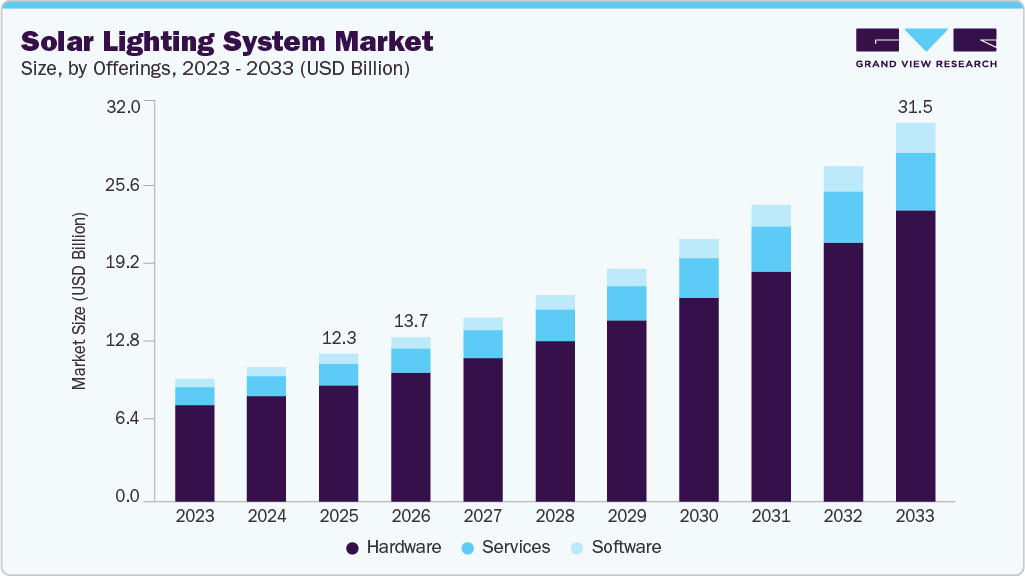 To learn more about this report, Download Free Sample Report
 The rising global focus on clean energy transition and decarbonization initiatives is one of the major drivers. Governments across developed and emerging economies are implementing policies promoting renewable energy deployment, smart cities, and energy-efficient public infrastructure. Solar street lighting projects, rural electrification programs, and sustainable urban planning initiatives are significantly increasing demand. In addition, declining costs for solar panels, LEDs, and battery technologies have improved system affordability, making solar lighting economically viable compared to traditional lighting systems over the long term.
One of the key growth factors is the increasing demand for off-grid and reliable lighting solutions, particularly in remote and underserved regions. Solar lighting systems eliminate dependence on unstable power grids and reduce operational costs associated with fuel-based or grid electricity. This makes them highly suitable for rural communities, highways, industrial sites, and disaster-prone areas where a consistent electricity supply remains a challenge. The integration of advanced battery storage and automatic energy management systems further enhances operational efficiency and reliability.
Technological advancements are also playing a crucial role in market expansion. The adoption of LED-based lighting, smart controllers, motion sensors, and IoT-enabled monitoring systems is transforming solar lighting into an intelligent infrastructure solution. Smart solar lighting systems enable remote monitoring, adaptive brightness control, predictive maintenance, and energy optimization, which are particularly attractive for smart city deployments and large-scale municipal projects. These innovations are improving system performance while reducing maintenance requirements, thereby strengthening return on investment for end users.
Furthermore, increasing investments in public infrastructure, commercial real estate development, and industrial sustainability initiatives are expected to sustain long-term market growth. Public infrastructure applications, including streets, parks, transportation hubs, and public facilities, represent a major share of installations due to large-scale government procurement. Meanwhile, residential and commercial adoption is rising as consumers seek energy independence and lower electricity expenses. With supportive regulatory frameworks, continuous technological improvements, and expanding awareness of renewable energy benefits, the solar lighting system market is poised for strong growth throughout the forecast period.
Market Dynamics
The growth of smart cities and urban infrastructure projects is a major driver of global demand for solar lighting systems. Governments and municipalities are increasingly investing in smart roads, intelligent public infrastructure, and energy-efficient urban development to reduce electricity consumption, lower carbon emissions, and improve public safety. Solar-powered street lighting systems are becoming an essential component of smart city ecosystems because they can operate independently from the grid while integrating advanced technologies such as IoT-enabled monitoring, adaptive brightness controls, motion sensors, and centralized management platforms. In addition, rapid urbanization and increasing investments in highways, industrial parks, airports, public parks, and municipal infrastructure are further supporting the adoption of smart solar lighting solutions across developed and emerging economies.
For instance, in September 2025, Signify announced its involvement in Washington D.C.’s Smart Street Lighting Project, under which nearly 52,000 streetlights were upgraded with connected energy-efficient LED lighting systems featuring remote monitoring and dimming capabilities. The initiative was designed to improve sustainability, operational efficiency, and public safety while reducing streetlighting energy consumption by approximately 82%. This development highlights how smart city modernization projects are significantly driving the deployment of intelligent, sustainable solar and connected lighting infrastructure worldwide.
Limited energy storage capacity is a significant restraint affecting the performance and reliability of solar lighting systems. These systems depend on batteries to store solar energy collected during the day for use at night or during periods of low sunlight. However, battery storage capacity is often limited, particularly in low-cost or entry-level solar lighting products. During extended cloudy weather, rainy seasons, or winter conditions with reduced sunlight, the stored energy may become insufficient to support continuous lighting. As a result, lighting duration, brightness levels, and overall system efficiency can decline, creating reliability concerns for end users in residential, commercial, and municipal applications.
The challenge becomes more critical in large-scale street lighting, industrial infrastructure, and remote off-grid projects where uninterrupted illumination is essential for safety and operational efficiency. To overcome storage limitations, manufacturers often need to integrate higher-capacity lithium-ion or advanced battery systems, which significantly increase product costs and maintenance requirements. In developing regions, where affordability remains a major purchasing factor, the higher cost associated with advanced energy storage technologies can slow market adoption. In addition, battery degradation over time further reduces storage efficiency, resulting in shorter backup durations and higher replacement costs for end users and municipalities.
The integration of IoT and smart monitoring technologies is creating substantial growth opportunities in the solar lighting system market by enhancing operational efficiency, automation, and energy optimization capabilities. Modern solar lighting systems are increasingly equipped with IoT-enabled sensors, wireless communication modules, motion detectors, and centralized control platforms, enabling real-time monitoring and intelligent management of lighting infrastructure. These smart systems can automatically adjust brightness levels based on traffic movement, weather conditions, or time schedules, helping reduce energy consumption and improve battery utilization. In addition, municipalities and commercial operators can remotely monitor system performance, detect faults, and manage maintenance activities more efficiently, significantly lowering operational and maintenance costs.
The adoption of smart solar lighting solutions is particularly increasing across smart cities, highways, industrial parks, airports, and public infrastructure projects where efficient energy management and public safety are critical priorities. Advanced technologies such as AI-based predictive maintenance, cloud-based analytics, and remote diagnostics are further improving system reliability and long-term performance. Smart monitoring systems also help operators identify battery degradation, panel performance issues, or lighting failures in real time, minimizing downtime and improving service efficiency. As governments and urban planners continue to invest in connected infrastructure and digital transformation initiatives, demand for intelligent solar lighting systems with IoT capabilities is expected to grow significantly in the coming years.
Market Concentration & Characteristics
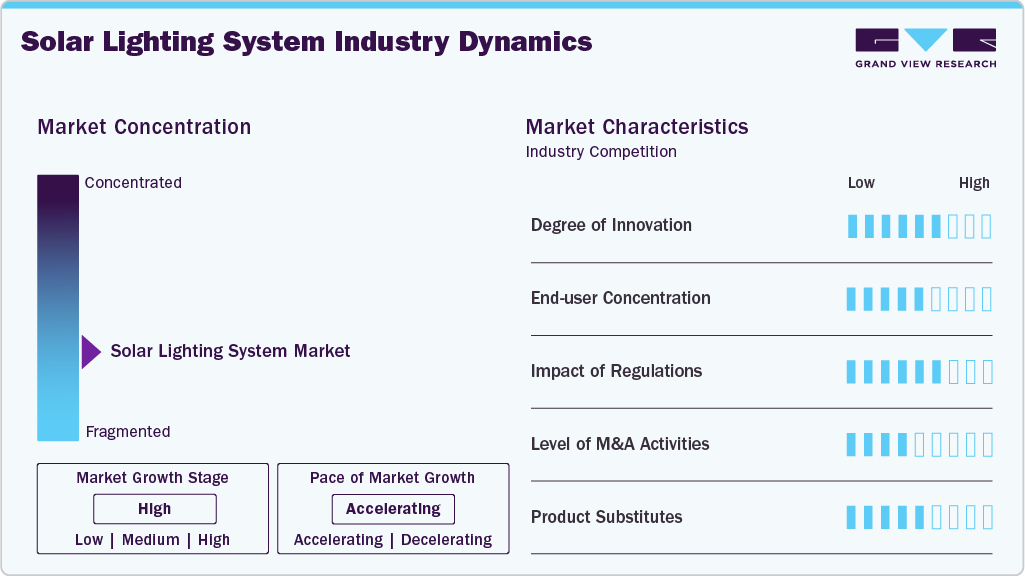
The solar lighting system market exhibits a fragmented competitive landscape, with numerous regional and local manufacturers alongside global renewable energy companies. The market encompasses diverse customer requirements, differences in government subsidy programs, and localized distribution networks, enabling smaller players to compete effectively in specific geographies. In emerging economies, local assemblers and installers account for a substantial share of deployments, particularly in off-grid and rural electrification projects. In addition, rapid technological accessibility and declining photovoltaic component costs have lowered barriers to entry, increasing the number of market participants and intensifying price-based competition across product categories such as solar street lights, garden lights, home lighting systems, and portable lighting solutions.
 To learn more about this report, Download Free Sample Report
 The market exhibits a moderate degree of innovation driven by advancements in photovoltaic efficiency, lithium-ion battery storage, smart lighting controls, IoT-enabled monitoring systems, and energy-efficient LED technologies. Manufacturers are increasingly integrating motion sensors, remote diagnostics, adaptive brightness control, and AI-based energy management capabilities to improve system performance and operational efficiency. Growing investments in smart city infrastructure and sustainable energy initiatives worldwide are also supporting innovation. Furthermore, ongoing improvements in battery lifespan, charging efficiency, and hybrid solar-grid integration are enabling solar lighting systems to become more reliable and cost-effective for both urban and remote applications.
Offerings Insights
The hardware segment led the market with the largest revenue share in 2025, driven by the high cost contribution and essential role of physical components such as solar panels, batteries, LED luminaires, charge controllers, and mounting structures within solar lighting systems. Hardware accounts for the majority of total system investment as these components directly determine energy generation, storage capacity, and lighting performance. Increasing deployment of solar street lighting projects, rural electrification initiatives, and public infrastructure development has significantly increased demand for durable and high-efficiency hardware solutions. In addition, declining photovoltaic module prices, advancements in lithium-based battery technologies, and growing adoption of integrated all-in-one solar lighting units are accelerating installation volumes globally. Government sustainability programs, expanding smart city projects, and rising demand for off-grid lighting in remote areas continue to act as key drivers supporting the strong growth of the segment.
The software segment is anticipated to grow at the fastest CAGR during the forecast period, driven by the increasing adoption of smart and connected solar lighting systems. Software solutions enable remote monitoring, automatic brightness control, energy usage tracking, and fault detection, helping operators enhance efficiency and reduce maintenance costs. The growing development of smart cities and intelligent public infrastructure is encouraging municipalities and commercial users to deploy centralized lighting management platforms. In addition, the integration of IoT technologies and cloud-based control systems allows real-time performance monitoring and predictive maintenance, which enhances system reliability. Growing demand for energy optimization, operational transparency, and lower lifecycle costs is expected to remain a key driver supporting the rapid growth of the software segment.
System Type Insights
The standalone solar lighting systems segment led the market with the largest revenue share in 2025, mainly due to its wide adoption in off-grid and remote locations where access to conventional electricity infrastructure is limited or unreliable. These systems operate independently using solar panels and battery storage, making them highly suitable for rural electrification projects, highways, villages, parks, and developing regions. Growing government initiatives focused on expanding energy access, along with increasing investments in sustainable public lighting, have significantly supported demand for standalone solutions. Rising awareness of renewable energy benefits and the need for reliable outdoor lighting continue to drive the growth of this segment.
The hybrid solar lighting systems segment is anticipated to register the fastest CAGR during the forecast period, driven by the growing need for reliable and uninterrupted lighting solutions in urban and commercial environments. Hybrid systems combine solar power with grid electricity, ensuring continuous operation even during low sunlight conditions or high energy demand. This reliability makes them highly suitable for smart city projects, commercial complexes, industrial facilities, and urban streets where consistent lighting is essential. Increasing investments in modern infrastructure, along with rising adoption of energy-efficient solutions that reduce electricity costs while maintaining performance, are key factors supporting segment growth. In addition, advancements in smart controllers and automatic power switching technologies are encouraging wider deployment of hybrid solar lighting systems across developed and developing regions.
Technology Insights
The LED-based solar lighting segment led the market with the largest revenue share in 2025, primarily due to its high energy efficiency, long operational lifespan, and low maintenance requirements compared to traditional lighting technologies. LEDs consume significantly less power while providing brighter and more consistent illumination, making them ideal for solar-powered applications where energy optimization is critical. The declining cost of LED components and continuous improvements in lighting performance have further accelerated adoption across residential, commercial, and public infrastructure projects. The growing demand for reliable, cost-effective, and environmentally friendly lighting solutions continues to support the strong growth of this segment.
The CFL-based solar lighting segment is anticipated to register a significant CAGR during the forecast period. CFL lighting systems require lower upfront investment compared to advanced lighting technologies, making them suitable for small-scale residential and rural installations. In some developing regions, existing solar lighting infrastructure still relies on CFL lamps, supporting replacement and maintenance demand. In addition, government electrification programs and budget-focused projects in remote areas continue to encourage the use of economical lighting solutions. Although adoption is gradually shifting toward LED technology, steady demand from price-conscious users and legacy system upgrades is expected to support the growth of the CFL-based solar lighting segment.
Installation Type Insights
The new installations segment led the market with the largest revenue share in 2025. The market growth is driven by the increasing deployment of solar lighting systems across newly developed infrastructure and electrification projects worldwide. Rapid urbanization, expansion of smart city initiatives, and growing investments in sustainable public infrastructure, such as roads, parks, and transportation facilities, have significantly increased demand for new solar lighting installations. Governments and municipalities are increasingly choosing solar-powered lighting for new projects to reduce long-term energy costs and meet environmental targets. In addition, rising construction activities in residential and commercial sectors, along with improved affordability of solar components, are encouraging the integration of solar lighting systems during initial project development rather than retrofitting later. These factors continue to support the strong growth of the new installations segment.
The retrofit installations segment is anticipated to grow at a significant CAGR during the forecast period, driven by the increasing replacement of conventional lighting systems with energy-efficient solar lighting solutions. Many municipalities, commercial facilities, and industrial sites are upgrading existing lighting infrastructure to reduce electricity consumption and operational costs without requiring complete new installations. Retrofit solutions allow users to integrate solar panels, LED luminaires, and smart controllers into existing poles and structures, making upgrades more cost-effective and faster to deploy. Growing government regulations promoting energy efficiency and carbon emission reduction are also encouraging organizations to modernize legacy lighting systems.
Application Insights
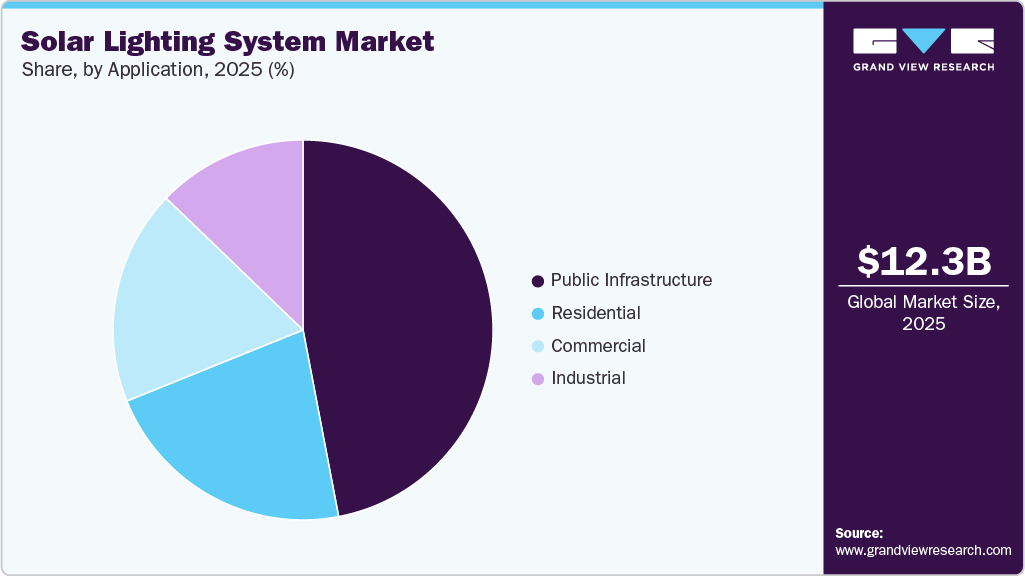
The public infrastructure segment accounted for the largest share of market revenue in 2025. The market growth is driven by the large-scale deployment of solar lighting systems across streets, highways, parks, transportation hubs, and public facilities. Governments and municipal authorities are increasingly adopting solar lighting to reduce electricity costs, improve energy efficiency, and support sustainability goals. Rising investments in smart city projects and urban infrastructure development have significantly increased demand for solar-powered street lighting and public area illumination. In addition, solar lighting systems reduce dependence on grid electricity and lower maintenance expenses, making them a practical solution for public sector projects. Supportive government policies, rural electrification programs, and a growing focus on environmentally friendly infrastructure continue to act as key drivers for the growth of the public infrastructure segment.
 To learn more about this report, Download Free Sample Report
 The commercial segment is expected to grow at a significant CAGR during the forecast period. The growth of this segment is primarily driven by increasing adoption of solar lighting systems across offices, shopping complexes, parking areas, hotels, and business campuses. Commercial establishments are increasingly investing in solar-powered lighting to reduce electricity expenses and improve energy efficiency while meeting sustainability goals. Rising awareness of environmental responsibility and the need to lower operational costs are encouraging businesses to shift toward renewable energy solutions. In addition, advancements in smart solar lighting technologies, including automated controls and energy monitoring systems, are enabling commercial users optimize lighting performance and maintenance. The growing construction of commercial spaces and expansion of green building initiatives continue to support the strong growth of the commercial application segment.
Regional Insights
Asia Pacific solar lighting system market accounted for the largest market share of the global industry in 2025. The region’s growth is driven by its large agricultural base and urgent need for efficient water management due to population growth and water scarcity. Countries such as India and China are investing heavily in irrigation modernization and smart irrigation technology adoption, supporting large-scale installation of sprinkler and precision irrigation systems. Government policies promoting irrigation infrastructure, subsidies for water-saving technologies, and increasing mechanization in farming are encouraging farmers to shift from traditional methods to advanced sprinkler solutions. Large irrigated farmland areas and a rising focus on food security further strengthen demand for modern irrigation systems in the Asia Pacific.
 To learn more about this report, Download Free Sample Report
 The solar lighting system industry in China is projected to grow at a notable CAGR from 2026 to 2033. The region’s dominance is mainly driven by rapid urbanization, expanding infrastructure development, and strong government initiatives supporting renewable energy adoption. Countries across the Asia Pacific are actively deploying solar street lighting to improve energy access in rural and semi-urban areas while reducing dependence on conventional electricity. In 2025, large-scale public infrastructure projects, smart city programs, and rural electrification initiatives in countries such as India, China, and Southeast Asian nations significantly increased installation volumes. Falling solar component costs and growing demand for energy-efficient lighting solutions in residential and public infrastructure applications have further strengthened regional market growth.
North America Solar Lighting System Market Trends
The solar lighting system industry in North America is expected to register a significant CAGR from 2026 to 2033. Growth in the region is mainly driven by increasing investments in renewable energy infrastructure, strong government support for energy efficiency, and rising adoption of sustainable public lighting solutions. Municipalities across North America are actively replacing conventional streetlights with solar-powered and LED-based systems to reduce electricity costs and carbon emissions. In 2025, several cities and local authorities expanded smart city and green infrastructure programs, encouraging the deployment of intelligent solar lighting equipped with remote monitoring and automated controls. In addition, growing demand for resilient energy systems capable of operating during power outages and extreme weather events is further supporting market expansion across the region.
U.S. Solar Lighting System Market Trends
The solar lighting system industry in the U.S. is anticipated to witness a significant CAGR from 2026 to 2033. Market growth is supported by federal and state-level clean energy initiatives, tax incentives, and increasing investments in sustainable infrastructure modernization. In 2025, the U.S. continued to see strong adoption of solar lighting across highways, public parks, commercial campuses, and industrial facilities as organizations focused on reducing operational energy costs and achieving sustainability targets. Rising construction of smart commercial buildings and expansion of EV charging and transportation infrastructure are also creating new opportunities for solar lighting deployment.
Europe Solar Lighting System Market Trends
The solar lighting system market in Europe is anticipated to grow at a significant CAGR from 2026 to 2033. Market growth in Europe is mainly driven by strict environmental regulations, strong climate policies, and increasing investments in energy-efficient public infrastructure. European countries are actively replacing conventional street lighting with solar-powered and LED-based systems to meet carbon reduction targets and lower municipal energy costs. In 2025, several cities across the region expanded smart city and sustainable urban mobility programs, encouraging the adoption of intelligent solar lighting solutions in streets, parks, and transportation corridors. Rising energy prices and growing focus on energy independence have also accelerated demand for renewable lighting systems across commercial and public infrastructure sectors.
The UK solar lighting system industry is anticipated to grow at a significant CAGR from 2026 to 2033. Growth is supported by the country’s strong commitment to net-zero emission goals and increasing modernization of public lighting infrastructure. Expansion of smart city initiatives and green building projects is further encouraging the adoption of solar lighting across commercial spaces and urban developments. In addition, rising investments in resilient infrastructure and growing awareness of long-term energy savings are key drivers supporting the adoption of solar lighting systems across the UK.
Key Solar Lighting System Company Insights
Some of the key companies operating in the solar lighting system market, include Clear Blue Technologies Inc., ENGOPLANET ENERGY SOLUTIONS LLC, Fonroche Lighting America, Inc., among others are some of the leading participants in the solar lighting system market.
-
Clear Blue Technologies International Inc. is a Canada-based company that provides smart off-grid energy solutions powered by solar technology for lighting, telecommunications, and IoT infrastructure. The company develops integrated solar power systems integrated with cloud-based monitoring software that enables remote management, performance optimization, and predictive maintenance. Its key offerings include smart solar street lighting solutions under its Illumient platform, along with nano-grid and micro-grid energy systems. Clear Blue primarily serves municipalities, telecom operators, and smart city projects, with deployments across multiple countries. Through its intelligent energy management approach and Energy-as-a-Service model, the company holds a strong presence in the solar lighting system market, particularly in smart and off-grid lighting applications.
-
Fonroche Lighting is a France-based company founded in 2011 that specializes in the design, development, manufacturing, and installation of autonomous solar-powered street lighting systems. The company focuses on off-grid solar lighting solutions used for urban roads, public infrastructure, and commercial environments, offering fully independent solar street lamps that operate without connection to the electrical grid. Headquartered in Agen, France, Fonroche Lighting manufactures its systems locally and has deployed solar lighting projects in more than 50 countries through a global network of subsidiaries and partners.
Key Solar Lighting System Companies:
The following key companies have been profiled for this study on the solar lighting system market
- Clear Blue Technologies Inc.
- ENGOPLANET ENERGY SOLUTIONS LLC
- Fonroche Lighting America, Inc.
- Greenshine New Energy owned by Oceania International LLC
- Jakson Solar
- Leadsun
- Lumiax
- Orion Solar
- SEPCO
- Signify Holding
- SOKOYO Solar Lighting Co., Ltd.
- Sol by Sunna Design
- Solar One
- SOLTECH LLC
- SunMaster
Competitive Benchmarking
Operating Strategies
Competitive Edge
Weakness
Mature Players: Signify Holding; SEPCO; Fonroche Lighting America Inc.; Jakson Solar; SOKOYO Solar Lighting Co., Ltd.
- Focus on large-scale municipal and government lighting projects (smart cities, highways, airports)
- Strong emphasis on integrated solar + LED + IoT-based smart lighting solutions
- Heavy investment in R&D for hybrid solar-grid and smart connected lighting systems
- Strong brand reputation and global presence
- Advanced product portfolios with high efficiency and durable systems
- Established after-sales service and maintenance ecosystems
- Compliance with international quality and safety standards
- Less flexibility in pricing for highly competitive emerging markets
- Slower customization due to standardized global product lines
Emerging Players: Clear Blue Technologies Inc.; ENGOPLANET Energy Solutions LLC; Greenshine New Energy (Oceania International LLC); Lumiax, SunMaster
- Focus on cost-effective solar lighting solutions for residential and small municipal applications
- Rapid deployment in off-grid and rural electrification projects
- Modular and easy-to-install product designs targeting price-sensitive markets
- Highly competitive pricing structure suitable for developing economies
- Ability to serve niche or underserved market segments ignored by large players
- Strong presence in off-grid, rural, and semi-urban regions
- Limited global brand recognition compared to established leaders
- Lower economies of scale are impacting profitability and pricing power
- Dependence on third-party suppliers for key components
Recent Developments
-
In February 2026, RS Group plc announced a three-year collaboration with SolarAid to deliver clean and affordable solar lighting solutions to 150,000 people across rural African communities lacking electricity access. The partnership aims to raise around 1 million pounds through corporate donations, employee fundraising, product contributions, and technical support to expand solar light deployment and reduce reliance on kerosene lamps and candles. The initiative also supports SolarAid’s mission of building sustainable local solar businesses while improving education, health, and energy access in underserved regions, highlighting growing industry focus on social impact-driven solar lighting expansion in emerging markets.
-
In January 2026, Streetleaf entered into a national vendor agreement with Lennar Homes to supply solar-powered streetlights across residential communities throughout the U.S. The partnership enables Lennar to integrate solar streetlighting into new housing developments nationwide, supporting sustainable community infrastructure while reducing reliance on traditional grid-connected lighting systems.
-
In January 2026, Dragonfly Energy launched its Battle Born solar panel product line, introducing four new solar panel models designed for real-world installations, including rigid and portable panels engineered to deliver consistent power output under shaded and variable light conditions, expanding the company’s clean energy portfolio into solar generation solutions.
Solar Lighting System Market Report Scope
Report Attribute
Details
Market size in 2025
USD 12.3 billion
Estimated Market size in 2026
USD 13.7 billion
Projected Market size by 2033
USD 31.5 billion
Growth rate
CAGR of 12.6% from 2026 to 2033
Actual data
2021 - 2025
Forecast period
2026 - 2033
Quantitative units
Revenue in USD million/billion, and CAGR from 2026 to 2033
Report coverage
Revenue forecast, company share, competitive landscape, growth factors, and trends
Segments covered
Offerings, system type, technology, installation type, application, region
Regional scope
North America; Europe; Asia Pacific; Latin America; MEA
Country scope
U.S.; Canada; Mexico; UK; Germany; France; China; India; Japan; Australia; South Korea; Brazil; UAE; Saudi Arabia; South Africa
Key companies profiled
Clear Blue Technologies Inc.; ENGOPLANET ENERGY SOLUTIONS LLC; Fonroche Lighting America, Inc.; Greenshine New Energy owned by Oceania International LLC; Jakson Solar; Leadsun; Lumiax; Orion Solar; SEPCO; Signify Holding; SOKOYO Solar Lighting Co., Ltd.; Sol by Sunna Design; Solar One;
SOLTECH LLC; SunMaster
Customization scope
Free report customization (equivalent to 8 analysts working days) with purchase. Addition or alteration to country, regional & segment scope.
Pricing and purchase options
Avail customized purchase options to meet your exact research needs. Explore purchase options
Global Solar Lighting System Market Report Segmentation
This report forecasts revenue growth at global, regional, and country levels and provides an analysis of the latest industry trends in each of the sub-segments from 2021 to 2033. For this study, Grand View Research has segmented the solar lighting system market report based on offerings, system type, technology, installation type, application, and region.
-
Offerings Outlook (Revenue, USD Billion, 2021 - 2033)
-
Hardware
-
Solar Panels
-
LED Lamps / Luminaires
-
Batteries
-
Charge Controllers
-
Poles & Mounting Structures
-
Smart Controllers / IoT Modules
-
Others
-
-
Software
-
Services
-
-
System Type Outlook (Revenue, USD Billion, 2021 - 2033)
-
Standalone Solar Lighting Systems
-
Hybrid Solar Lighting Systems (Solar + Grid)
-
Grid-Connected Solar Lighting Systems
-
-
Technology Outlook (Revenue, USD Billion, 2021 - 2033)
-
LED-Based Solar Lighting
-
CFL-Based Solar Lighting
-
-
Installation Type Outlook (Revenue, USD Billion, 2021 - 2033)
-
New Installations
-
Retrofit Installations
-
-
Application Outlook (Revenue, USD Billion, 2021 - 2033)
-
Residential
-
Commercial
-
Industrial
-
Public Infrastructure
-
-
Regional Outlook (Revenue, USD Billion, 2021 - 2033)
-
North America
-
U.S.
-
Canada
-
Mexico
-
-
Europe
-
Germany
-
UK
-
France
-
-
Asia Pacific
-
China
-
India
-
Japan
-
South Korea
-
Australia
-
-
Latin America
-
Brazil
-
-
Middle East & Africa
-
UAE
-
Saudi Arabia
-
South Africa
-
-
Delivered Customizations
This report has been delivered with the following In-depth customizations
Client Request
Customization Delivered
Value Adds
Solar lighting market opportunity assessment for an off-grid energy solutions provider
Assessment of solar lighting demand patterns across rural, peri-urban, and urban off-grid regions
Analysis of technology adoption trends across product types, solar lanterns, solar home systems, and solar street lighting
Benchmarking of key vendors by product range, energy capacity, distribution reach, and pricing models
Identified high-growth off-grid and underserved market segments by geography
Supported product portfolio positioning and geographic expansion strategy
Consumer behavior and product preference analysis for a solar lighting brand entering emerging markets
Analysis of product attribute preferences by end-user segment, brightness, durability, charging speed, portability, and aesthetics, based on existing consumer research and product review data
Informed product design priorities and feature trade-off decisions for the target consumer segment
Supported brand positioning and messaging strategy tailored to emerging market buyer psychology
Strategic partnership and M&A target landscape study for a solar lighting conglomerate pursuing inorganic growth
Assessment of target company profiles by geographic presence, product focus, technology capabilities, funding history, and strategic fit with the client's growth objectives
Review of recent M&A activity, joint venture formations, and investment deals within the solar lighting and broader distributed renewable energy sector
Provided a list of partnerships and acquisitions prioritized by strategic relevance
Supported inorganic growth strategy by mapping capability gaps that the client could address through acquisition or alliance.
Frequently Asked Questions About This Report
The global solar lighting system market size was valued at USD 12.3 billion in 2025 and is expected to reach USD 13.7 billion in 2026.
The global solar lighting system market is expected to grow at a CAGR of 12.6% from 2026 to 2033, reaching USD 31.5 billion by 2033.
Asia Pacific dominated the market with the largest revenue share of 40% in 2025.
Some key players operating in the market include Clear Blue Technologies Inc., ENGOPLANET ENERGY SOLUTIONS LLC, Fonroche Lighting America, Inc., Greenshine New Energy owned by Oceania International LLC, Jakson Solar, Leadsun, Lumiax, Orion Solar, SEPCO, Signify Holding, SOKOYO Solar Lighting Co., Ltd., Sol by Sunna Design, Solar One, SOLTECH LLC, SunMaster
Factors such as the rising global focus on clean energy transition and decarbonization initiatives and increasing investments in public infrastructure, commercial real estate development, and industrial sustainability initiatives are the key factors driving the market growth.
The hardware segment held the market with the largest revenue share of 78.4% in 2025, while software is the fastest-growing segment.
The standalone solar lighting systems segment held the market with the largest revenue share in 2025, while hybrid solar lighting systems is the fastest-growing segment.
The LED-based solar lighting segment held the market with the largest revenue share in 2025.
The new installations segment held the market with the largest revenue share in 2025.
The public infrastructure segment held the market with the largest revenue share in 2025.
About the Author(s)
Next Generation Technologies Research Team
Technology · Next Generation TechnologiesThis report was authored by the next generation technologies research team at Grand View Research - comprising two research analysts, one senior research analyst, and one industry expert - with specialized expertise in the next generation technologies segment of the technology industry. All findings are based on proprietary technology databases, executive interviews, and regulatory analysis, subject to internal peer review prior to publication.
Last Updated:
Speak to Analyst

Customize this report to your needs - add regions, segments, or data points, with 20% free customization.
Or view our licence options:


ISO 9001:2015 & 27001:2022 Certified
We are GDPR and CCPA compliant! Your transaction & personal information is safe and secure. For more details, please read our privacy policy.


