
- Home
- »
- Paints, Coatings & Printing Inks
- »
-
Solvent Dyes Market Size, Share & Growth Report, 2033GVR Report cover
![Solvent Dyes Market (2026 - 2033)Report]()
Solvent Dyes Market (2026 - 2033)
Size, Share & Trends Analysis Report By Chemical Composition (Azo-Based, Anthraquinone-Based, Phthalocyanine-Based, Triphenylmethane-Based), By Application, By Region, And Segment Forecasts
Market Size, 2025
$1.1BMarket Estimate, 2026
$1.2BMarket Forecast, 2033
$1.6BCAGR, 2026–2033
4.9%Solvent Dyes Market Summary
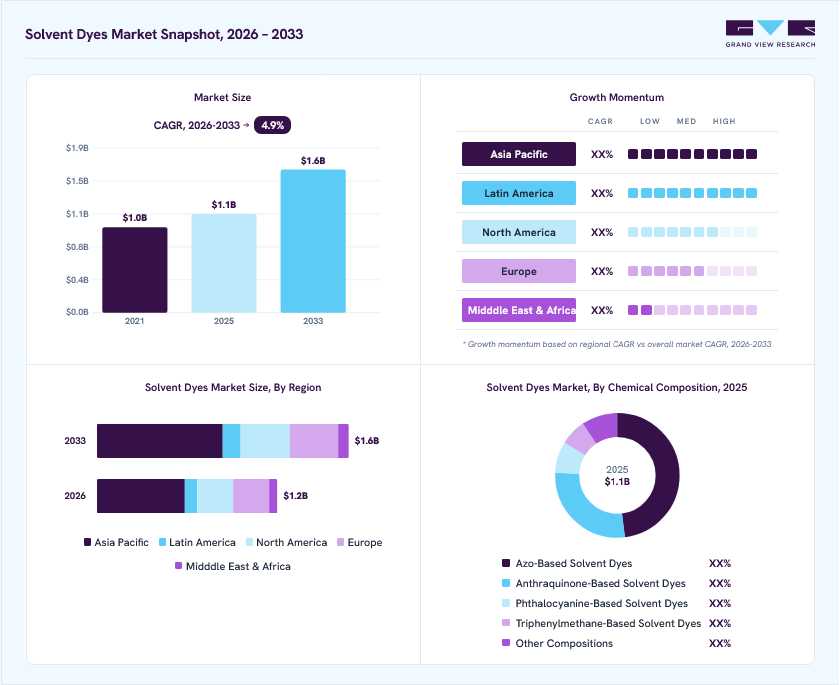
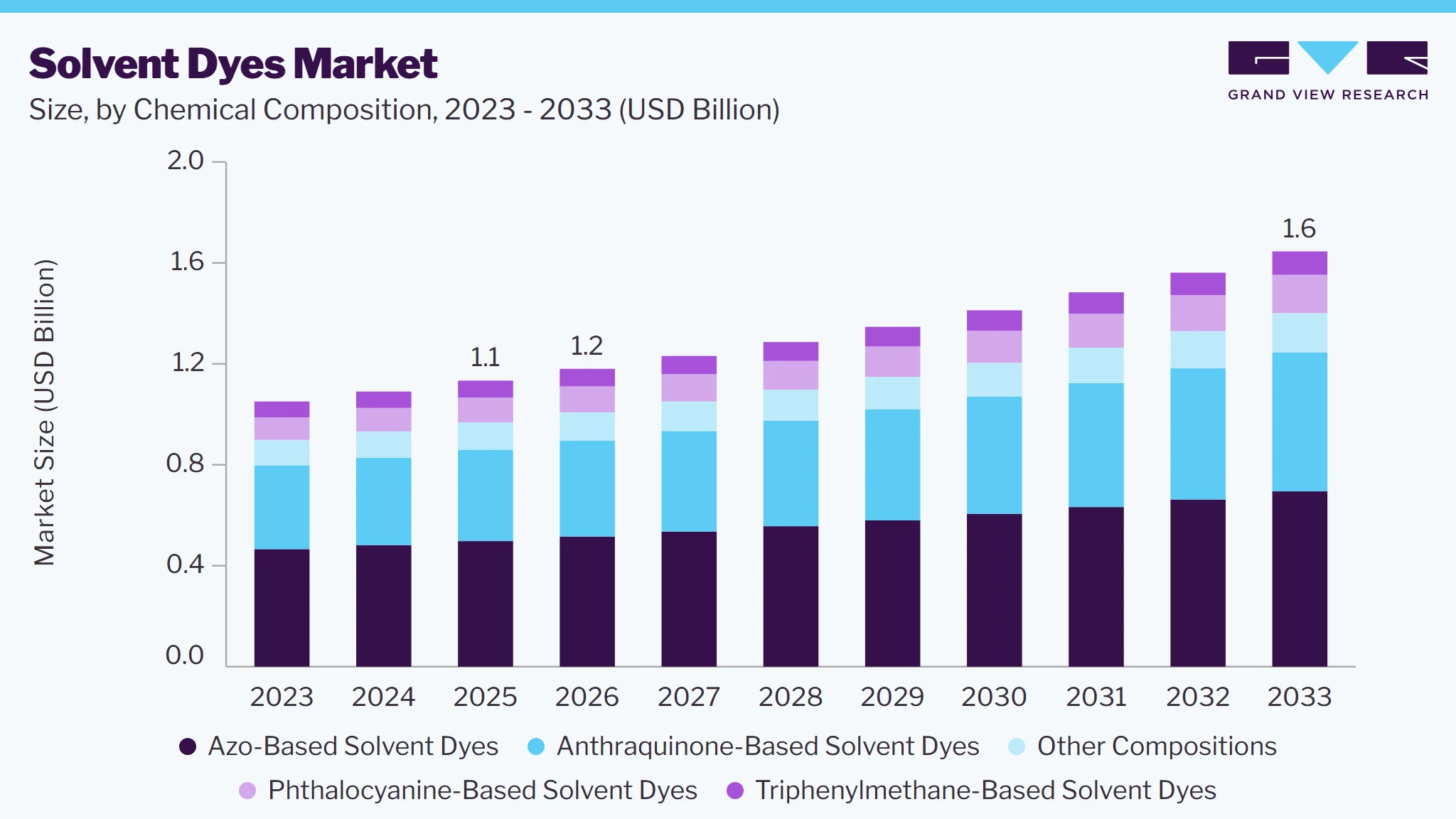
The global solvent dyes market size was valued at USD 1.1 billion in 2025 and is projected to grow from USD 1.2 billion in 2026 to USD 1.6 billion by 2033, at a CAGR of 4.9% from 2026 to 2033. The market in Asia Pacific dominated with a revenue share of 48.5% in 2025. The market is expanding as demand rises for high performance colorants that combine solubility, transparency, thermal stability, and consistent coloration across industrial applications.
Key Market Trends & Insights
- By chemical composition: Azo-based solvent dyes segment held the largest market share of 43.9% in 2025.
- By application: Plastics & polymers segment held the largest market share of 31.6% in 2025.
Regional Highlights
- Largest regional market: Asia Pacific (48.5% revenue share, 2025)
- By country: China held the largest market share in 2025
Market Size & Forecast
- Market size in 2025: USD 1.1 Billion
- Estimated market size in 2026: USD 1.2 Billion
- Projected market size by 2033: USD 1.6 Billion
- CAGR (2026-2033): 4.9%
Growth is being led by plastics and polymers, where solvent dyes are valued for bright shades, transparency, and compatibility with materials such as polystyrene, acrylics, polycarbonate, and engineering resins. Their molecular solubility allows uniform coloration without the particle dispersion issues associated with pigments, which is important in transparent and precision molded products. Printing inks also remain a significant source of demand as packaging, labels, coding, and specialty printing require strong color strength and fast drying formulations. These uses sustain steady consumption while increasing the need for grades with improved heat resistance and migration performance.Paints, coatings, fuels, lubricants, and greases provide another broad demand base. In coatings, solvent dyes are selected when transparency and clean coloration are required, while fuel and lubricant applications rely on them for identification, differentiation, and regulatory marking. Demand patterns are gradually shifting toward products that offer stronger lightfastness, chemical resistance, and compatibility with complex formulations. This favors higher value anthraquinone and specialty chemistries, even though azo based dyes continue to account for the largest volume because of their broad color range and competitive cost.
The market is therefore expected to grow through a combination of rising end use consumption and gradual improvement in product mix. Within the organic solvent dyes market, manufacturers are focusing on purity, batch consistency, thermal performance, and formulation compatibility to meet stricter customer specifications. Environmental and regulatory requirements are also encouraging reformulation away from less suitable chemistries, creating opportunities for cleaner and more durable alternatives. As customers place greater value on performance rather than color alone, average selling prices are likely to increase modestly, allowing revenue growth to remain somewhat stronger than volume growth through 2033.
Market Dynamics
The solvent dyes market is growing as plastics, printing inks, coatings, fuels, and lubricants require colorants that dissolve effectively in nonaqueous formulations while providing strong color intensity and uniform appearance. Rising production of transparent and engineering plastics is increasing consumption because solvent dyes provide clarity without introducing dispersed solid particles. Demand for durable coloration in packaging, automotive components, specialty coatings, and industrial identification also contributes to consumption. Manufacturers are responding with grades offering improved thermal stability, lightfastness, chemical resistance, and compatibility with demanding polymer and solvent systems.
Expanding use of colored plastics and polymers is increasing demand for solvent dyes because these colorants provide transparent, intense, and uniform coloration in compatible polymer systems. Applications involving polystyrene, acrylic materials, engineering resins, and other thermoplastics require colorants capable of maintaining appearance during processing and throughout the useful life of the finished product. Solvent dyes can deliver strong tinting strength without the particle dispersion associated with conventional pigments, making them suitable for transparent and visually demanding plastic products.
Demand is becoming more performance oriented as polymer processors require better heat resistance, migration resistance, consistency, and light stability. Automotive components, packaging materials, consumer products, electronics, and specialty molded products create requirements for grades capable of tolerating demanding processing conditions. This encourages greater consumption of anthraquinone and other high performance solvent dyes alongside established azo products. Continued expansion of polymer applications therefore creates sustained demand across both commodity and premium solvent dye categories.
Environmental and chemical safety regulations can restrict the commercial use of certain solvent dyes containing substances associated with toxicity, hazardous aromatic amines, heavy metals, or other undesirable chemical characteristics. Producers selling into regulated applications must comply with requirements governing chemical registration, restricted substances, worker exposure, waste management, and product safety. Compliance can require reformulation, additional testing, documentation, wastewater treatment, and substitution of established chemistries, increasing manufacturing costs and limiting the commercial viability of some products. Restrictions are particularly relevant when dyes or their impurities fail increasingly stringent customer or regulatory specifications. Buyers in plastics, coatings, packaging, and consumer applications are also strengthening their own restricted substance requirements. These conditions can reduce demand for noncompliant formulations and constrain the ability of manufacturers using older chemistries to participate in higher specification applications.
Manufacturers can capture higher value opportunities by developing specialty solvent dyes designed for demanding polymers, coatings, printing inks, and engineered materials. Customers increasingly require colorants that maintain transparency and color strength while offering improved heat stability, lightfastness, migration resistance, chemical resistance, and compatibility with advanced formulations. These requirements create room for differentiated products that compete through performance rather than primarily through price. Producers can focus on high purity anthraquinone, phthalocyanine, and other specialty chemistries tailored to engineering plastics, automotive materials, electronics, premium packaging, and specialty coatings. Developing application specific grades also enables manufacturers to work more closely with compounders and formulators during product qualification. Suppliers capable of delivering consistent quality, regulatory documentation, customized shades, and reliable technical support can strengthen customer relationships while achieving better margins than those available in standardized commodity solvent dye categories.
Market Concentration & Characteristics
The solvent dyes market is moderately fragmented, with established international manufacturers competing alongside numerous regional and specialized producers. This structure reflects the broad range of dye chemistries, shades, performance specifications, and end use requirements that prevent a limited number of suppliers from controlling the entire market. Competition remains particularly strong in standardized products, where manufacturing efficiency, consistent quality, pricing, distribution networks, and reliable supply influence purchasing decisions.
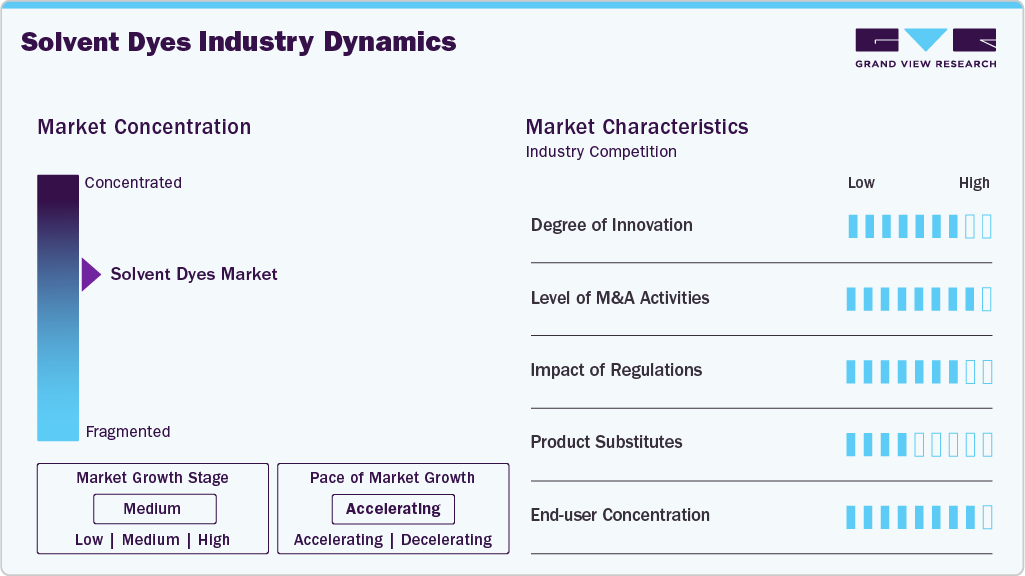
Market characteristics are shaped by application specific performance requirements and increasing emphasis on product quality and regulatory compliance. Customers in plastics, printing inks, coatings, fuels, and lubricants require different levels of thermal stability, solubility, lightfastness, migration resistance, and chemical compatibility. These requirements create opportunities for manufacturers offering customized and specialty formulations. Long qualification processes and customer preference for consistent batches can strengthen supplier relationships, while environmental regulations encourage investment in cleaner manufacturing processes and compliant dye chemistries.
Analyst Perspective
The solvent dyes market is expected to maintain steady growth as demand expands across plastics, printing inks, coatings, fuels, and specialty industrial applications. Analysts expect product performance to become increasingly important, encouraging adoption of dyes with stronger thermal stability, lightfastness, and migration resistance. Asia Pacific manufacturing capacity will influence global supply dynamics, while regulatory requirements will encourage cleaner formulations. Specialty grades should generate attractive opportunities for manufacturers seeking higher margins through differentiated products.
Chemical Composition Insights
The azo-based solvent dyes segment dominated the market in 2025, accounting for 43.9% of total revenue. Its leading position is attributed to broad commercial availability, strong coloring efficiency, diverse shade ranges, and relatively competitive production costs. Azo-based products are widely consumed across plastics, printing inks, fuels, lubricants, and coatings, providing the segment with a diversified demand base. Their suitability for high-volume applications strengthens consumption, particularly where cost efficiency and strong color intensity are purchasing priorities. Established manufacturing processes and extensive supplier availability also reinforce the segment’s position in the global solvent dyes market.
The phthalocyanine-based solvent dyes segment is projected to record the fastest growth, with a CAGR of 5.7% from 2026 to 2033. Growth is associated with increasing demand for high-performance colorants offering strong color strength, chemical stability, lightfastness, and durability in demanding applications. Phthalocyanine chemistries are particularly valuable for producing intense blue and green shades used across specialty plastics, coatings, inks, and related formulations. Increasing performance requirements in engineered materials create opportunities for these dyes, while their durability can justify premium pricing. Greater emphasis on longer-lasting coloration is expected to strengthen adoption through 2033.
Application Insights
The plastics & polymers segment led the solvent dyes market in 2025, accounting for 31.6% of total revenue. Its leading position reflects extensive use of solvent dyes for transparent, bright, and uniform coloration across thermoplastics, engineering resins, acrylics, polystyrene, and other polymer materials. Strong compatibility with polymer matrices and high tinting strength make these dyes suitable for packaging, automotive components, consumer products, electronics, and specialty molded products. Demand also benefits from requirements for heat stability, migration resistance, and consistent coloration during processing, sustaining significant solvent dye consumption across polymer applications.
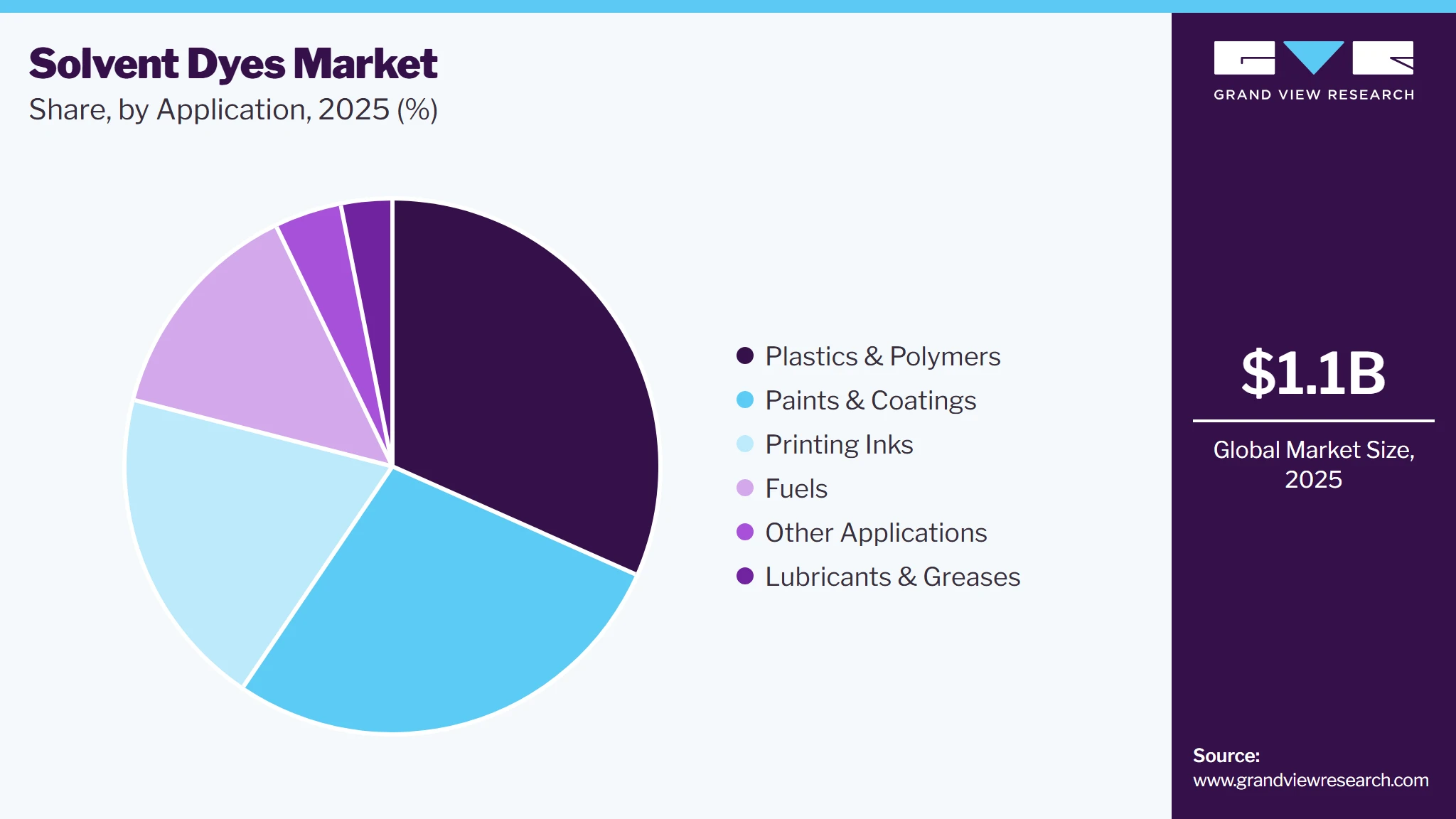
The printing inks segment is expected to grow at the fastest rate, with a CAGR of 5.4% from 2026 to 2033. Growth reflects increasing consumption of solvent dyes in packaging, labels, coding, marking, and specialty printing applications requiring strong color intensity and effective solubility. Solvent dyes enable uniform ink formulations while providing transparency and desirable printing performance across suitable substrates. Expanding requirements for visually distinctive packaging and high-quality printed materials are encouraging demand for dyes with improved purity, color consistency, and stability. Specialty and high-performance ink formulations should further strengthen solvent dye consumption through 2033.
Regional Insights
Asia Pacific dominated the solvent dyes market in 2025, accounting for 48.5% of global revenue, and is projected to remain the fastest-growing region with a CAGR of 5.3% from 2026 to 2033. The region benefits from a strong dyes and chemicals manufacturing base and substantial demand from plastics, printing inks, coatings, packaging, automotive materials, fuels, and lubricants. Expanding polymer processing and specialty manufacturing, combined with increasing requirements for heat stability, color consistency, lightfastness, and migration resistance, are expected to strengthen demand for higher performance solvent dye formulations through 2033.
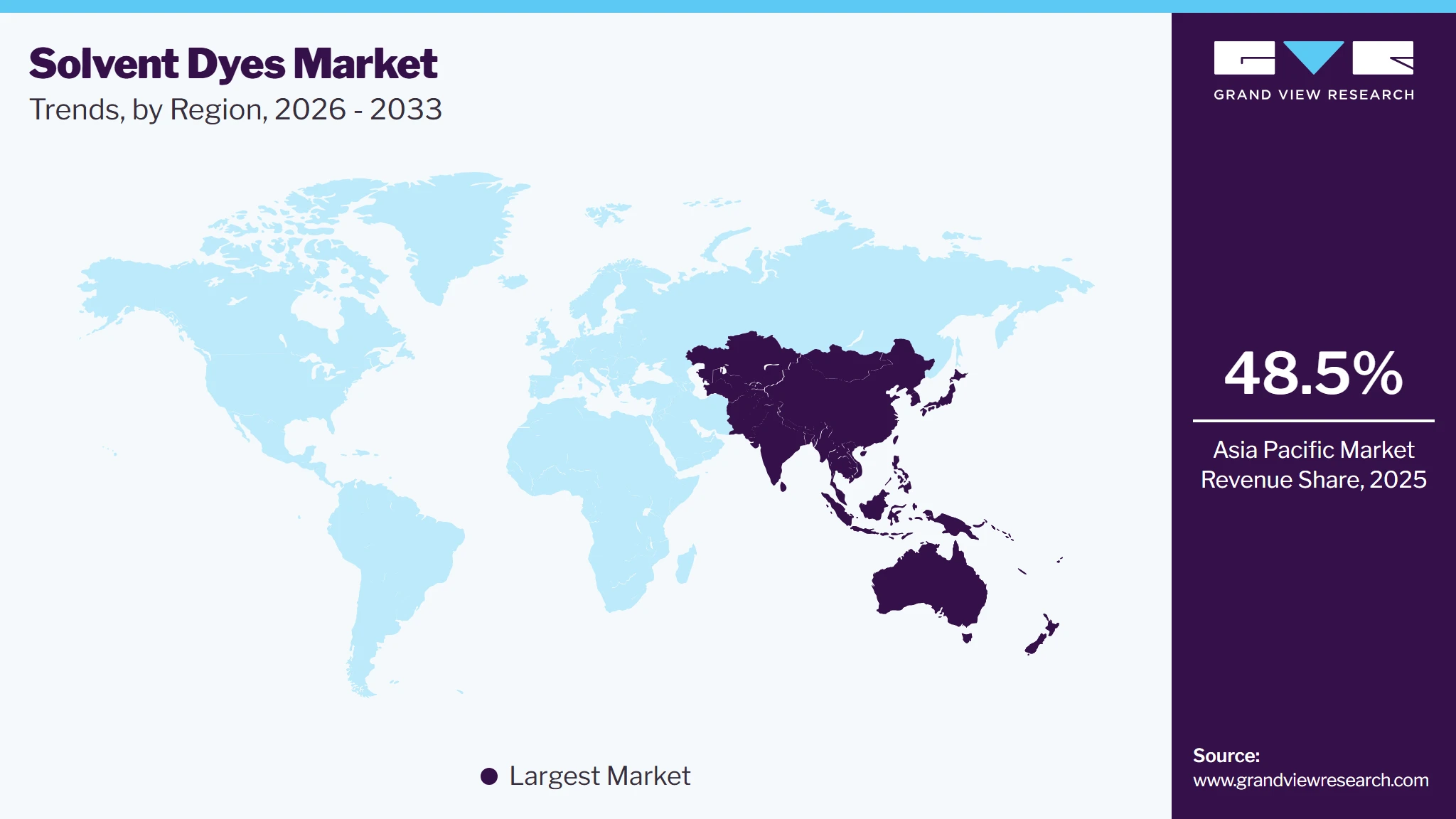
The solvent dyes market in China represents the largest solvent dyes market within Asia Pacific, supported by its extensive domestic dye manufacturing industry and large plastics, coatings, printing inks, and chemical processing sectors. The country’s position as a major producer of polymers, packaging materials, automotive components, electronics, and consumer products generates substantial demand for industrial colorants. China also maintains an established export-oriented dyes industry, providing economies of scale and broad product availability. Increasing requirements for higher purity, thermal stability, and regulatory compliance are encouraging producers to improve solvent dye formulations and manufacturing processes.
North America Solvent Dyes Market Trends
North America solvent dyes industry represented a significant share, characterized by demand for higher performance and specialty formulations across plastics, printing inks, coatings, fuels, and lubricants. The region has substantial automotive, packaging, polymer processing, and specialty chemicals industries that require consistent coloration and reliable technical performance. Fuel identification and lubricant coloration also provide an established demand base. Strict chemical safety requirements and customer specifications encourage suppliers to focus on compliant formulations, product consistency, migration resistance, and durability, supporting greater value contribution from specialty solvent dyes rather than primarily commodity grades.
The solvent dyes market in the U.S. dominates solvent dye consumption within North America due to its large plastics processing, packaging, automotive, coatings, printing, petroleum, and lubricant industries. Demand is particularly relevant in applications requiring consistent shade quality, strong solubility, heat resistance, and reliable performance under demanding operating conditions. The country's sizable fuel and lubricant markets also create requirements for identification and coloration products. Increasing regulatory scrutiny and stringent customer specifications encourage manufacturers and formulators to use dyes offering better purity, controlled impurities, regulatory documentation, and dependable batch consistency.
Europe Solvent Dyes Market Trends
Europe represents an established solvent dyes market where demand is increasingly influenced by product performance, chemical safety, and environmental compliance. The region’s automotive, packaging, coatings, printing, and engineered plastics industries require dyes with strong thermal stability, lightfastness, migration resistance, and formulation compatibility. European chemical regulations and restricted substance requirements influence product selection and encourage substitution of chemistries with undesirable environmental or toxicological profiles. As a result, market development is increasingly oriented toward compliant, high purity, and specialty solvent dyes capable of meeting demanding technical and regulatory specifications.
Germany solvent dyes market is a prominent solvent dyes market in Europe, supported by its advanced automotive, chemicals, plastics, coatings, printing, and industrial manufacturing sectors. Its large engineering and automotive supply chains generate demand for colored polymers, technical plastic components, coatings, lubricants, and specialty formulations requiring consistent performance. German manufacturers place considerable emphasis on product quality, process reliability, chemical compliance, and durability. Demand therefore favors solvent dyes with strong heat stability, lightfastness, migration resistance, and batch consistency, creating a particularly relevant market for technically differentiated and higher specification colorants.
Latin America Solvent Dyes Market Trends
Latin America is expected to expand at a CAGR of 5.2% from 2026 to 2033, making it the fastest-growing regional solvent dyes market after Asia Pacific. Growth is associated with expanding plastics conversion, flexible and rigid packaging, printing inks, coatings, automotive production, and petroleum-related applications. Brazil provides an important demand base through its sizable plastics, packaging, automotive, paints, and chemical industries, while manufacturing development across other countries broadens regional consumption. Increasing local requirements for consistent industrial coloration and higher performance formulations are expected to support both solvent dye volumes and market revenue through 2033.
Middle East & Africa Solvent Dyes Market Trends
The Middle East & Africa solvent dyes market is influenced strongly by petroleum processing, plastics, packaging, construction coatings, lubricants, and downstream petrochemical activities. Gulf countries benefit from extensive refining and petrochemical capacity, creating demand for dyes used in fuels, oils, plastics, and related industrial applications. Expansion of polymer conversion and packaging manufacturing provides further consumption potential. In Africa, South Africa represents an important industrial demand center through its plastics, coatings, printing, automotive, and chemical sectors. Growing downstream processing of petrochemical products is expected to gradually broaden solvent dye applications across the region.
Key Solvent Dyes Company Insights
The solvent dyes market includes established manufacturers with specialized expertise in high performance colorants for plastics, coatings, inks, and other industrial applications. Among the leading companies, LANXESS AG and Milliken & Company maintain strong positions through established colorant portfolios, application expertise, product quality, and continued development of solvent soluble dye technologies for demanding industrial uses worldwide across multiple end markets.
-
LANXESS is a specialty chemicals manufacturer with an established presence in high performance colorants and solvent dyes. Its Macrolex portfolio includes solvent soluble dyes developed primarily for engineering plastics and related applications. The company focuses on color strength, brilliance, heat stability, lightfastness, weather resistance, and purity, enabling its products to meet demanding requirements across thermoplastics, packaging, masterbatches, fibers, and technical plastic applications.
-
Milliken & Company is a diversified manufacturer with significant expertise in specialty chemicals, colorants, and performance materials. Within solvent based coloration, its Keyfast Spirit portfolio consists of organic metal complex dye powders designed to produce transparent and relatively lightfast colors. These dyes serve applications including wood and foil coatings and various binder systems, reflecting the company’s focus on performance oriented colorant solutions and formulation compatibility.
Key Solvent Dye Companies
The following key companies have been profiled for this study on the solvent dye market.
-
LANXESS AG
-
Milliken & Company
-
Orient Chemical Industries
-
Mansi Chemicals
-
K. Patel Chemopharma
-
Nation Ford Chemical
-
Royce Global / Royce Colors
-
Kunshan Organic Chemical Factory Co., Ltd.
-
Taiwan Dyestuffs & Pigments Corp.
-
Sunbelt Colors
Competitive Benchmarking
Operating Strategies
Competitive Edge
Weaknesses
Mature Players: LANXESS AG; Milliken & Company; Orient Chemical Industries Co., Ltd.
- Maintain established solvent dye portfolios targeting engineering plastics, coatings, inks, and specialty formulations.
- Develop performance-oriented grades emphasizing heat stability, lightfastness, solubility, purity, and formulation compatibility.
- Strengthen customer relationships through application expertise, technical support, consistent quality, and regulatory compliance.
- Established product families such as Macrolex and VALIFAST strengthen recognition across industrial coloration applications.
- Strong technical expertise enables development of dyes for demanding polymer, coating, ink, and solvent-based systems.
- Product consistency, application knowledge, quality control, and regulatory capabilities support participation in higher-specification applications.
- Higher manufacturing, environmental compliance, and regulatory costs can reduce competitiveness against lower-cost producers.
- Greater emphasis on performance-oriented products can limit competitiveness in highly price-sensitive commodity applications.
- Changing chemical regulations can require additional testing, reformulation, registration, and portfolio adjustments.
Emerging Players: Mansi Chemicals; K. Patel Chemopharma; Nation Ford Chemical; Royce Global / Royce Colors; Kunshan Organic Chemical Factory Co., Ltd.; Taiwan Dyestuffs & Pigments Corp.; Sunbelt Colors
- Target plastics, petroleum products, inks, waxes, coatings, and specialized industrial coloration applications.
- Compete through flexible manufacturing, customized shades, broad grade availability, and application-specific formulations.
- Expand international business by developing standard and customized grades for different industrial end uses.
- Focused solvent dye expertise enables responsiveness to specific shade, solubility, concentration, and application requirements.
- Flexible production supports customized formulations and smaller specialty requirements that large manufacturers may address less efficiently.
- Competitive manufacturing economics and specialized portfolios strengthen positioning across price-sensitive and niche solvent dye applications.
- Geographic presence and product diversification can be narrower compared with large multinational chemical manufacturers.
- Smaller research, regulatory, and technical-service resources can restrict penetration into highly regulated applications.
- Greater dependence on specific applications, customers, products, or manufacturing locations increases exposure to demand and raw-material fluctuations.
Recent Developments
-
In April 2026, Aolong Chemical launched a comprehensive range of high-performance solvent dyes comprising more than 30 specifications across six color groups. The portfolio targets engineering plastics, including nylon, polystyrene, ABS, polycarbonate, PET, and PMMA, with emphasis on heat and light resistance.
Solvent Dyes Market Report Scope
Report Attribute
Details
Market size in 2025
USD 1.1 billion
Estimate market size in 2026
USD 1.2 billion
Projected market size by 2033
USD 1.6 billion
Growth rate
CAGR of 4.9% from 2026 to 2033
Base year for estimation
2025
Historical data
2021 - 2024
Forecast period
2026 - 2033
Quantitative units
Revenue in USD billion, volume in kilotons, and CAGR from 2026 to 2033
Report coverage
Revenue forecast, company ranking, competitive landscape, growth factors, and trends
Segments covered
Chemical composition, application, and region
Regional scope
North America; Europe; Asia Pacific; Latin America; Middle East & Africa
Country scope
U.S.; Canada; Mexico; Brazil; Argentina; Germany; UK; Italy; Spain; France; China; Japan; South Korea; Saudi Arabia; South Africa
Key companies profiled
LANXESS AG; Milliken & Company; Orient Chemical Industries; Mansi Chemicals; K. Patel Chemopharma; Nation Ford Chemical; Royce Global / Royce Colors; Kunshan Organic Chemical Factory Co., Ltd.; Taiwan Dyestuffs & Pigments Corp.; Sunbelt Colors
Customization scope
Free report customization (equivalent to up to 8 analysts’ working days) with purchase. Addition or alteration to country, regional & segment scope.
Pricing and purchase options
Avail customized purchase options to meet your exact research needs. Explore purchase options
Global Solvent Dyes Market Report Segmentation
This report forecasts revenue growth at global, regional, and country levels and provides an analysis of the latest industry trends in each of the sub-segments from 2021 to 2033. For this study, Grand View Research has segmented the global solvent dyes market report based on chemical composition, application, and region.
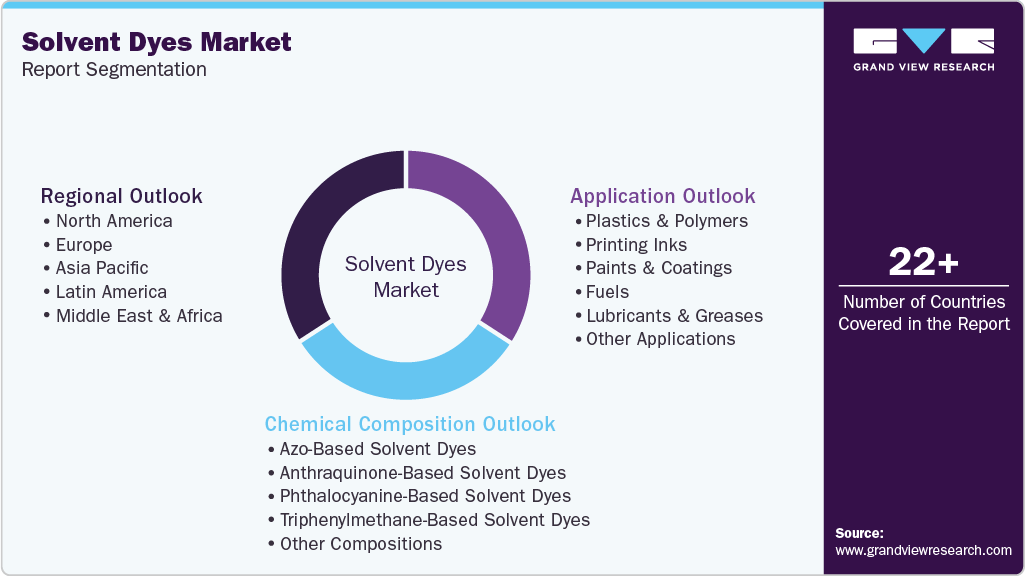
-
Chemical Composition Outlook (Volume, Kilotons; Revenue, USD Billion, 2021 - 2033)
-
Azo-Based Solvent Dyes
-
Anthraquinone-Based Solvent Dyes
-
Phthalocyanine-Based Solvent Dyes
-
Triphenylmethane-Based Solvent Dyes
-
Other Compositions
-
-
Application Outlook (Volume, Kilotons; Revenue, USD Billion, 2021 - 2033)
-
Plastics & Polymers
-
Printing Inks
-
Paints & Coatings
-
Fuels
-
Lubricants & Greases
-
Other Applications
-
-
Regional Outlook (Volume, Kilotons; Revenue, USD Billion, 2021 - 2033)
-
North America
-
U.S.
-
Canada
-
Mexico
-
-
Europe
-
Germany
-
UK
-
Italy
-
Spain
-
France
-
-
Asia Pacific
-
China
-
India
-
Japan
-
South Korea
-
-
Latin America
-
Brazil
-
Argentina
-
-
Middle East & Africa
-
Saudi Arabia
-
South Africa
-
-
Research Methodology
The solvent dyes market figures in this report are based on a proven research process that combines executive interviews with secondary research from proprietary databases, company filings, and recognized regulatory and institutional sources. Market size is built through value-chain sizing-reconciling supply-side and demand-side estimates-and triangulated with bottom-up and top-down approaches. Every estimate passes multiple levels of expert validation before publication, with each solvent dyes segment quantified using the revenue-capture definitions in the table below.
Segment Definition
Chemical Composition
Revenue Capture Definition
Azo-Based Solvent Dyes
Revenue is captured through the sale of azo-based solvent dyes used to provide strong, uniform coloration across plastics, printing inks, fuels, lubricants, coatings, and other solvent-compatible applications. Manufacturers generate income from recurring industrial purchases of multiple shades and grades, with value determined by color strength, solubility, purity, application compatibility, and required performance characteristics.
Anthraquinone-Based Solvent Dyes
Revenue is generated through sales of anthraquinone-based solvent dyes used where strong thermal stability, lightfastness, chemical resistance, and color durability are required. Manufacturers capture value from higher-performance grades supplied for engineering plastics, specialty inks, coatings, fibers, and related applications, where demanding processing conditions and long-term color retention support greater product differentiation.
Phthalocyanine-Based Solvent Dyes
Revenue is captured through sales of phthalocyanine-based solvent dyes, particularly products providing intense blue and green coloration with strong stability characteristics. Income is generated from their use in plastics, coatings, printing inks, and specialty formulations requiring high color strength, durability, and resistance to demanding processing or environmental conditions.
Triphenylmethane-Based Solvent Dyes
Revenue is generated through the sale of triphenylmethane-based solvent dyes used where bright shades, strong color intensity, and effective solubility are important. Manufacturers capture income from industrial consumption across inks, coatings, plastics, petroleum products, and specialty coloration applications, with product selection influenced by shade requirements, formulation compatibility, purity, and performance specifications.
Other Compositions
Revenue is captured through sales of solvent dyes based on other chemistries, including methine, azomethine, quinoline, xanthene, perylene, and related structures. Manufacturers generate value by addressing specialized shade and performance requirements that are not adequately served by mainstream dye chemistries, particularly in technically demanding or customized industrial formulations.
Application
Revenue Capture Definition
Plastics & Polymers
Revenue is generated through sales of solvent dyes used for transparent and uniform coloration of thermoplastics, engineering resins, masterbatches, fibers, and other polymer materials. Manufacturers capture value from recurring purchases by polymer processors requiring strong color intensity, thermal stability, migration resistance, clarity, and compatibility with specific resin systems.
Printing Inks
Revenue is captured through sales of solvent dyes incorporated into printing ink formulations for packaging, labels, coding, marking, and specialty printing. Manufacturers generate income from grades offering effective solvent solubility, strong color development, formulation stability, transparency, and consistent printing performance across required substrates and ink systems.
Paints & Coatings
Revenue is generated through sales of solvent dyes incorporated into decorative, protective, wood, industrial, and specialty coating formulations. Manufacturers capture value by providing colorants with required transparency, solubility, lightfastness, chemical resistance, and compatibility with solvent-based coating systems, including higher-performance grades for technically demanding applications.
Fuels
Revenue is captured through sales of solvent dyes used for identification, differentiation, and coloration of gasoline, diesel, aviation fuels, and other petroleum products. Manufacturers generate recurring income from bulk consumption by refiners and fuel-related industries requiring consistent coloration, strong oil solubility, controlled dosage, and compliance with applicable fuel identification requirements.
Lubricants & Greases
Revenue is generated through sales of oil-soluble dyes incorporated into lubricants, greases, hydraulic fluids, and related products for identification, branding, and product differentiation. Manufacturers capture value from recurring formulation requirements where strong solubility, shade consistency, stability, and compatibility with hydrocarbon-based products are essential.
Other Applications
Revenue is captured through solvent dye sales for applications including waxes, candles, wood stains, adhesives, specialty chemicals, household products, and other solvent or oil-based formulations. Manufacturers generate income by providing standard and customized grades suited to specific processing conditions, shade requirements, substrates, and end-product performance specifications.
Estimation Model
Layer Name
Key Question
Content
Addressable Application Base Layer
What forms the demand base?
Identify the addressable downstream industries consuming solvent dyes, including plastics and polymers, printing inks, paints and coatings, fuels, lubricants and greases, and other solvent-compatible applications. Relevant industry output and material consumption are assessed across major countries and regions to establish the underlying application base requiring oil-soluble or solvent-soluble coloration.
Solvent Dye Adoption Layer
Where are solvent dyes consumed?
Estimate the penetration of solvent dyes within each addressable application based on coloration requirements and compatibility with the underlying formulation or material. Adoption is assessed across engineering plastics, transparent polymers, solvent-based inks, specialty coatings, fuel identification, lubricant coloration, waxes, wood stains, and related applications where dissolved colorants are technically preferred over alternative coloration methods.
Consumption Intensity Layer
How much solvent dye is consumed?
Estimate average solvent dye usage per unit of applicable material or formulation. Consumption intensity is adjusted for color strength, required shade, dye concentration, polymer or solvent system, processing conditions, performance specifications, and end-use requirements. The analysis differentiates high-volume commodity applications from lower-volume specialty uses requiring higher-performance azo, anthraquinone, phthalocyanine, and other solvent dye chemistries.
Revenue Realization Layer
How is market revenue generated?
Convert estimated solvent dye consumption into market revenue using realized selling prices for relevant dye chemistries, grades, applications, and geographic markets. Pricing assumptions account for differences between standard and specialty grades, purity, color strength, heat stability, lightfastness, migration resistance, and formulation requirements. Revenue is aggregated across chemical composition, application, country, and regional segments to derive the total solvent dyes market value.
Delivered Customizations
We have successfully delivered the following deep-dive customizations:
Client Request
Customization Delivered
Value Adds
Regional Segmentation
Extended geographic assessment covering additional solvent dyes markets outside the standard country scope, including Turkey, Indonesia, and Vietnam. The analysis evaluates country-specific demand across plastics, printing inks, coatings, fuels, lubricants, and specialty applications, alongside regulatory conditions and end-use industry developments influencing solvent dye consumption.
Provides greater visibility into markets not captured within the standard geographic coverage and helps identify countries with attractive demand potential. The assessment supports geographic prioritization by highlighting differences in application mix, downstream industry development, regulatory environment, and adoption of specialty solvent dye grades.
Competitive Benchmarking
Customized comparison of leading solvent dye manufacturers based on product portfolio breadth, dye chemistry coverage, application focus, geographic presence, technical capabilities, product differentiation, sustainability initiatives, regulatory positioning, and recent strategic developments. Benchmarking can include companies such as LANXESS, Milliken, Orient Chemical Industries, Sunbelt Colors, and other relevant manufacturers.
Enables clients to understand competitive positioning and identify differences in product specialization, application expertise, geographic reach, and technological capabilities. The analysis helps evaluate potential competitive gaps, benchmark product offerings, identify differentiation opportunities, and assess how manufacturers are positioned across commodity and high-performance solvent dye applications.
Opportunity Assessment
Detailed evaluation of growth opportunities across engineering plastics, specialty printing inks, high-performance coatings, polymer coloration, and advanced industrial formulations. The assessment examines opportunities for heat-stable, lightfast, migration-resistant, high-purity, and application-specific solvent dyes, including areas where customers increasingly require improved technical and environmental performance.
Helps identify attractive applications and product categories where manufacturers can pursue higher-value growth. The analysis supports product development and market-entry decisions by highlighting unmet performance requirements, potential specialty-grade opportunities, evolving customer specifications, and applications where differentiated solvent dyes can command stronger positioning than standardized products.
About the Author(s)
Paints, Coatings & Printing Inks Research Team
Bulk Chemicals · Paints, Coatings & Printing InksThis report was authored by the paints, coatings & printing inks research team at Grand View Research - comprising two research analysts, one senior research analyst, and one industry expert - with specialized expertise in the paints, coatings & printing inks segment of the bulk chemicals industry. All findings are based on proprietary bulk chemicals databases, executive interviews, and regulatory analysis, subject to internal peer review prior to publication.
Last Updated:
Speak to Analyst


Customize this report to your needs — add regions, segments, or data points, with 20% free customization.
Or view our licence options:


ISO 9001:2015 & 27001:2022 Certified
We are GDPR and CCPA compliant! Your transaction & personal information is safe and secure. For more details, please read our privacy policy.


