
- Home
- »
- Alcohol & Tobacco
- »
-
Sparkling Wine Market Size, Share & Trends Report, 2033GVR Report cover

Sparkling Wine Market (2026 - 2033)
Size, Share & Trends Analysis Report By Product Type (Champagne, Prosecco, Sparkling Rosé), By Distribution Channel (On-trade, Off-trade), By Region (North America, Europe, Asia Pacific, CSA, MEA), And Segment Forecasts
Market Size, 2025
$72.1BMarket Estimate, 2026
$77.6BMarket Forecast, 2033
$144.9BCAGR, 2026–2033
9.3%Sparkling Wine Market Summary
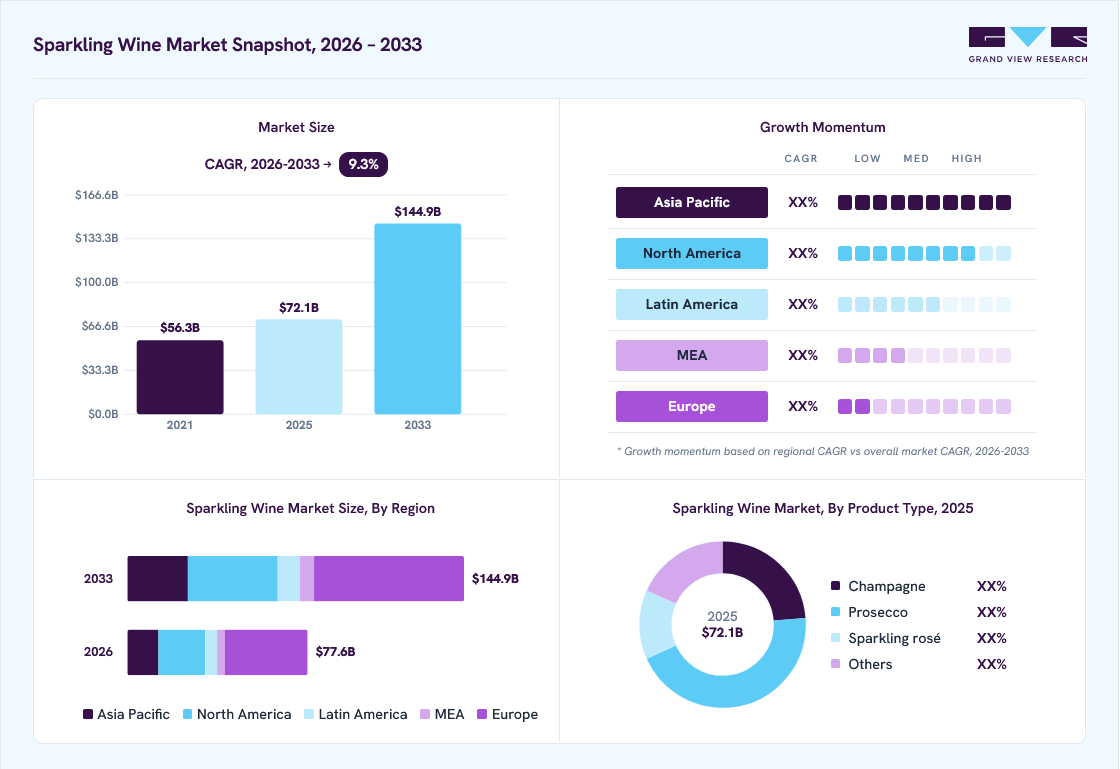
The global sparkling wine market size was valued at USD 72.1 billion in 2025 and is projected to grow from USD 77.6 billion in 2026 to USD 144.9 billion by 2033, at a CAGR of 9.3% from 2026 to 2033. The market in Europe dominated with a revenue share of 46.1% in 2025. Strong consumer preference for sparkling wines, particularly Champagne, Prosecco, and Cava, coupled with the region’s established wine culture and longstanding production heritage, supports market growth.
 Source: Grand View Research, IR Documents, Primary Interviews, Paid DatabasesTo learn more about this report,
 Download Free Sample Report
Key Market Trends & Insights
- By product type: Prosecco segment held the largest market share of 44.4% in 2025.
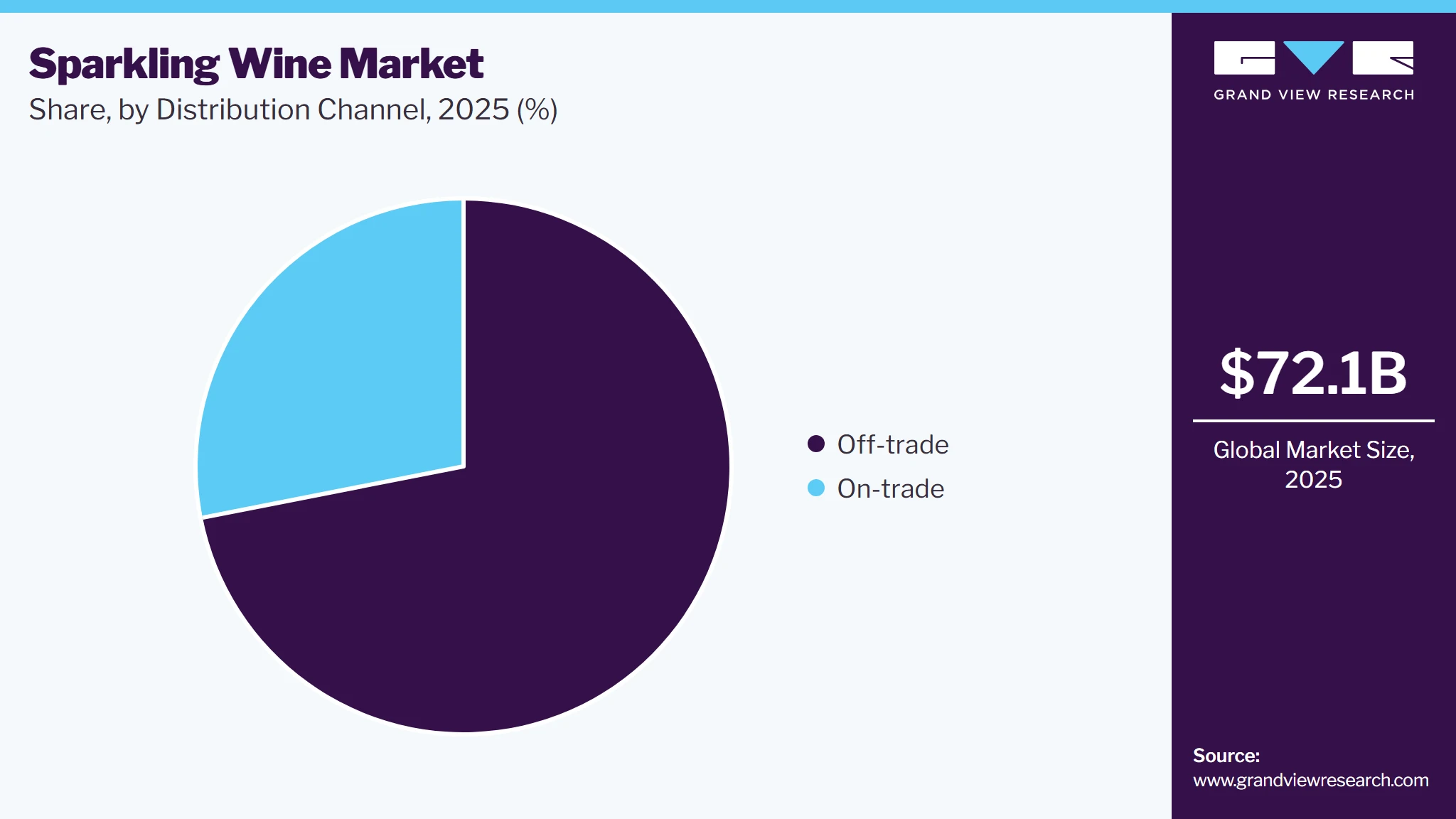
- By distribution channel: Off-trade segment held the largest market share of 71.9% in 2025.
Regional Highlights
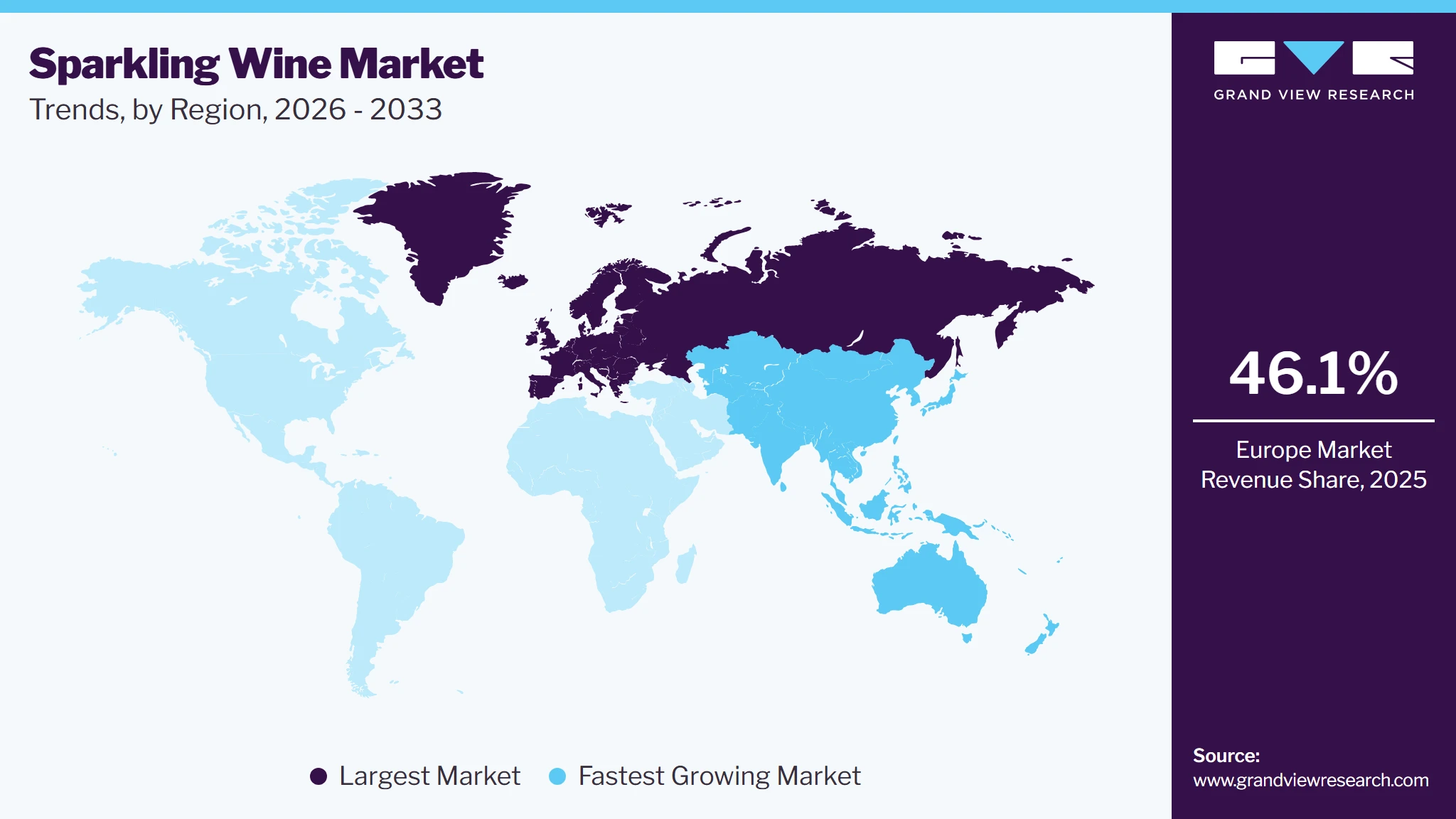
- Largest regional market: Europe (46.1% revenue share, 2025)
- Fastest-growing regional market: Asia Pacific (highest CAGR, 2026-2033)
- By country: Italy held the largest market share in 2025
Market Size & Forecast
- Market size in 2025: USD 72.1 Billion
- Estimated market size in 2026: USD 77.6 Billion
- Projected market size by 2033: USD 144.9 Billion
- CAGR (2026-2033): 9.3%
Prism AI by Grand View Research Free to tryAsk a question about the sparkling wine marketTry asking✓Every figure cited from GVR research Prefer the report? Download free sample →
Additionally, increasing demand for premium sparkling wines and their growing popularity during celebrations, social gatherings, and dining occasions further strengthens regional demand. Changing lifestyles and the growing influence of wine culture are encouraging consumers to explore sparkling wine beyond traditional festive occasions. Increased tourism, hospitality activity, and premium dining experiences are also creating new consumption opportunities. Expanding urbanization and greater exposure to international beverage trends are further supporting market development. According to YouGov PLC data published in March 2024, among 1,000 respondents, approximately 21% of consumers said they loved sparkling wine, while 42% said they liked it.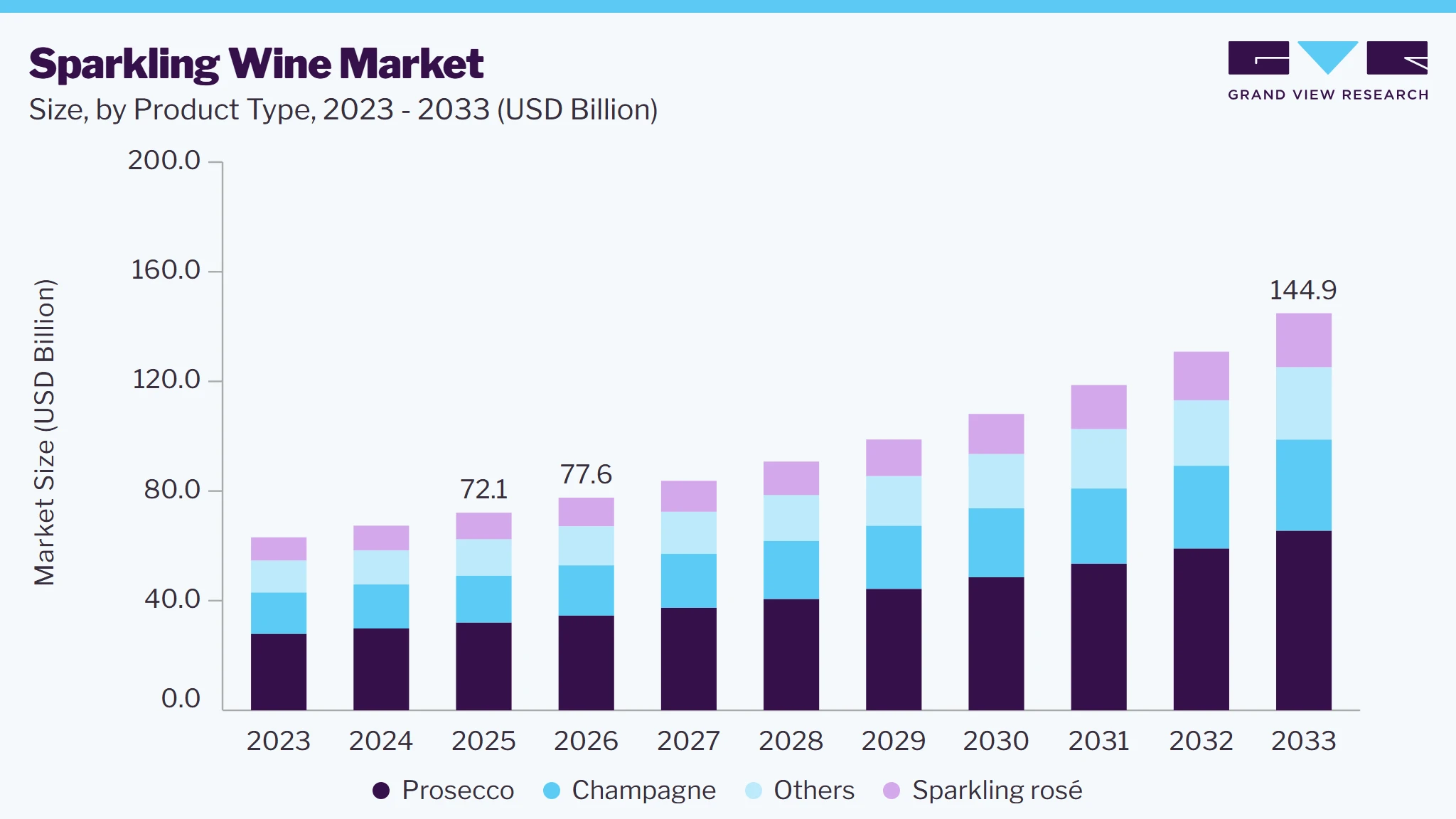 To learn more about this report, Download Free Sample Report
Furthermore, the expansion of modern retail and e-commerce is improving product accessibility across a wider range of consumer segments. Attractive packaging, smaller bottle formats, and convenient ready-to-serve options are supporting trial and purchase occasions. According to data published in August 2026, the growing popularity of miniature wine bottles, typically 200-250ml, is supporting convenient single-serve consumption, particularly for sparkling wine, where smaller formats help consumers enjoy a glass without losing the wine’s bubbles. Stronger marketing through digital platforms and social media is also increasing consumer awareness and brand engagement.
Market Dynamics
Consumers are increasingly seeking distinctive beverages that offer greater perceived quality and sophistication. This trend is encouraging producers to introduce higher-end sparkling wine ranges with differentiated positioning. Consumers are also showing greater interest in origin, production methods, and product craftsmanship when making purchasing decisions. Such preferences can support higher-value product segments and strengthen brand differentiation. In December 2025, Maison Vendôme launched a diamond-infused sparkling wine, positioning the product as an ultra-luxury offering with distinctive packaging and product innovation. The launch highlights the growing premiumization and differentiation trend in the sparkling wine market. The trend is particularly relevant for producers seeking to move beyond mass-market offerings.
Sparkling wine can carry higher production, packaging, and distribution costs than many alternative alcoholic beverages. These costs can translate into elevated retail prices, particularly for premium and imported products. Higher prices may discourage occasional consumers from purchasing the category frequently. Price sensitivity can also make consumers more likely to switch to lower-cost beverage alternatives. This can limit category penetration in markets where consumers remain highly value-conscious.
The development of alcohol-free and low-alcohol sparkling wines creates an opportunity to reach consumers who prefer reduced-alcohol beverages. These products can broaden consumption occasions beyond traditional alcoholic-drinking settings. According to the YouGov PLC data published in September 2025, about 50% Americans prefer non-alcoholic wine/ champagne. Producers can use improved formulations and production techniques to enhance taste and overall product appeal. New variants may also help brands attract consumers who are interested in moderation without leaving the sparkling wine category. In November 2025, BOLLE launched Grand Reserve, a non-alcoholic sparkling wine aged on lees, expanding premium and innovative options within the sparkling wine category. The launch reflects growing product innovation aimed at meeting demand for sophisticated alcohol-free alternatives.
Analyst Perspective
The global sparkling wine market is expected to benefit from evolving consumer preferences and broader interest in premium beverage experiences. Product differentiation and innovation are likely to remain important as producers seek to attract new consumer groups. Expanding retail accessibility and digital purchasing channels can support wider market penetration. Regional wine cultures, tourism, and hospitality activity will continue to influence consumption patterns across markets. Competition among established producers and emerging brands is expected to encourage greater variety and differentiation within the category.
Consumer Insights
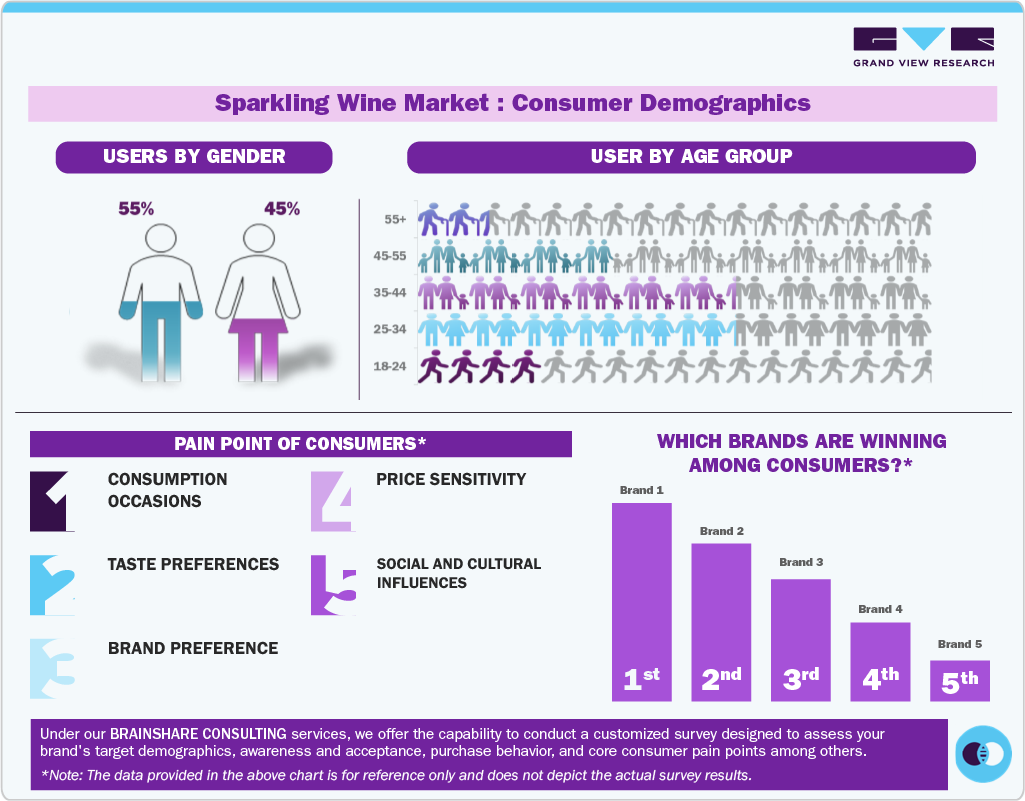
Consumers in the sparkling wine market are increasingly seeking premium products that offer an affordable luxury experience for celebrations, gifting, and social occasions. Sparkling wine consumption is gradually expanding beyond traditional events to casual dining, brunches, and everyday gatherings. Younger consumers are showing growing interest in rosé, fruit-forward flavors, and sweeter, easy-drinking varieties. Rising awareness of mindful drinking is also creating opportunities for low-alcohol and alcohol-free alternatives. Additionally, attractive packaging, social media influence, and aspirational lifestyles are shaping consumer preferences and purchase decisions, particularly among younger urban consumers.
 To learn more about this report, Download Free Sample Report
Product Type Insights
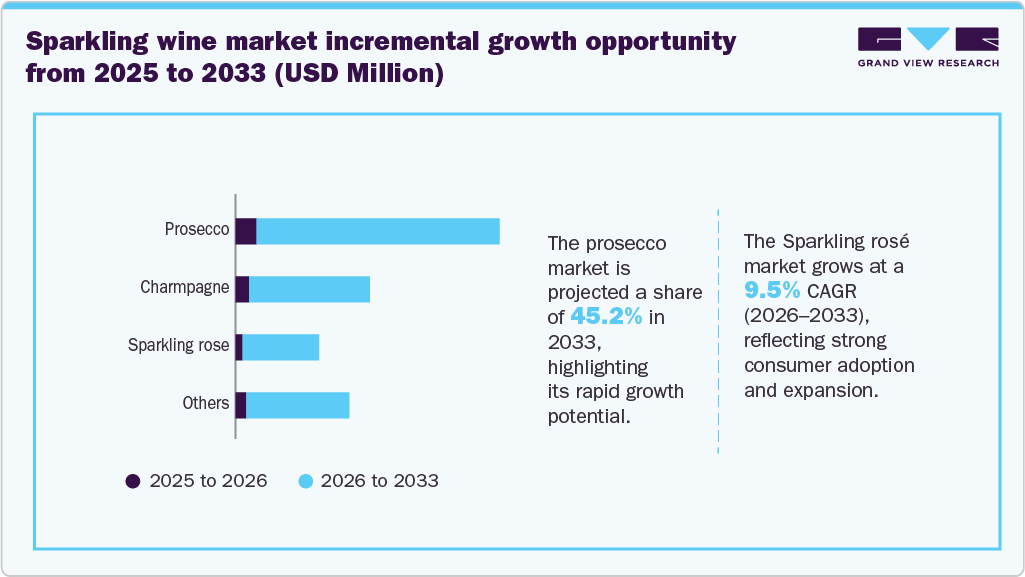
The prosecco in the sparkling wine market accounted for the largest share of 44.4% of the revenue in 2025. Prosecco benefits from its approachable taste profile, making it accessible to consumers who may be new to sparkling wine. Its lighter and fruit-forward character supports consumption across casual as well as formal occasions. Strong brand recognition has also helped establish Prosecco as a familiar choice in international markets. Its versatility with food and cocktails further broadens its potential consumption occasions. The segment also benefits from a wide range of price points, allowing producers to target different consumer groups.
 To learn more about this report, Download Free Sample Report
Sparkling rosé segment is projected to grow significantly at a CAGR of 9.5% from 2026 to 2033. Sparkling rosé is supported by consumer interest in visually distinctive and contemporary wine products. Its attractive color and fruit-oriented flavor profile can appeal particularly to consumers seeking novel drinking experiences. The category also aligns well with social occasions where presentation and product aesthetics influence purchasing decisions. Its positioning across both premium and lifestyle-oriented offerings provides brands with opportunities for differentiation. Seasonal launches and limited-edition variants can further stimulate consumer interest in the segment.
Distribution Channel Insights
The sales of sparkling wine through off-trade channels account for the largest share of 71.9% of the global revenue in 2025. The off-trade segment benefits from consumers purchasing sparkling wine for home consumption and private gatherings. Supermarkets and specialty wine stores provide broader shelf visibility and allow consumers to compare products across brands and price points. E-commerce platforms are also improving access to a wider selection, particularly where physical retail has a limited assortment. Promotional campaigns, seasonal displays, and multi-pack offerings can encourage purchase decisions. Greater convenience in product discovery and purchasing is supporting the channel's expansion.
 To learn more about this report, Download Free Sample Report
The sales of sparkling wine through the on-trade channel are projected to grow at the fastest CAGR of 9.6% from 2026 to 2033. The on-trade segment is supported by the expansion of restaurants, hotels, bars, and premium dining establishments. Sparkling wine benefits from being frequently selected for celebratory occasions and social gatherings within hospitality venues. Sommelier recommendations and curated wine lists can also influence consumer trial and brand selection. Food-pairing experiences provide additional opportunities to introduce consumers to different sparkling wine styles. The growth of premium hospitality and experiential dining further supports sales through this channel.
Regional Insights
The North America sparkling wine market accounted for a market share of 25.9% in 2025. The North American sparkling wine market is supported by strong consumer familiarity with sparkling beverages and diverse purchasing occasions. Product innovation is helping brands appeal to younger and more experimental consumers. Growth in premium dining and hospitality is creating additional opportunities for category penetration. Seasonal celebrations and social events also contribute to recurring demand. Established retail infrastructure enables broad product availability across major markets.
U.S. Sparkling Wine Market Trends
The U.S. led the North American sparkling wine market in 2025, holding the largest market share with 84.4% of the region’s total revenue. The sparkling wine market in the U.S. benefits from a broad consumer base with growing interest in diverse wine styles and premium beverage experiences. Expanding wine tourism and tasting experiences are encouraging consumers to explore different sparkling wine varieties. Strong restaurant and hospitality networks provide multiple occasions for consumption. Digital marketing is helping brands engage younger audiences and communicate product attributes more effectively. Specialty wine retailers also provide greater visibility for differentiated offerings.
Europe Sparkling Wine Market Trends
The European sparkling wine market accounted for the largest market share of 46.1% in 2025. Europe benefits from its long-established wine culture and strong consumer familiarity with sparkling wine. Tourism across major wine-producing destinations creates opportunities for product discovery and brand exposure. Well-developed hospitality networks support consumption through restaurants, hotels, and events. Cross-border trade also enables consumers to access products from different producing countries. The presence of established wine producers and specialized distribution networks further strengthens the regional market.
 To learn more about this report, Download Free Sample Report
Italy led the European sparkling wine market in 2025, holding the largest market share with 28.3% of the region’s total revenue. Italy is supported by its strong domestic wine culture and established production base for sparkling wines. Prosecco has expanded the category's presence across both domestic and international markets. Wine tourism and visits to production regions provide consumers with opportunities to engage directly with producers and products. Strong food culture also creates natural pairing occasions for sparkling wines. Export activity further enhances the visibility of Italian sparkling wine brands globally. According to data published in March 2025, Italy’s wine exports reached USD 8.8 billion (Euro 8.13 billion) in 2024, with sparkling wine exports growing 8.9% to USD 2.6 billion (Euro 2.38 billion). Prosecco DOC was a key contributor, accounting for more than 75% of Italy’s exported sparkling wine value and reinforcing Italy’s strong position in global sparkling wine trade.
Asia Pacific Sparkling Wine Market Trends
The Asia Pacific sparkling wine market is expected to grow at the fastest CAGR of 10.0% in 2025. The sparkling wine market in the Asia Pacific is benefiting from increasing exposure to international wine varieties and evolving beverage preferences. Expanding urban hospitality sectors are creating additional consumption occasions across restaurants, hotels, and lounges. Younger consumers are showing greater interest in premium and visually distinctive beverage products. Improved retail infrastructure is making imported and locally produced sparkling wines more accessible. Wine education and tasting events are also helping build category awareness.
China led the Asia Pacific sparkling wine market in 2025, holding the largest market share with 35.9% of the region’s total revenue. China's market is supported by the expansion of its urban middle-class consumer base and growing interest in international wine products. Premium restaurants and hotels provide important channels for introducing sparkling wine to consumers. Online retail platforms offer extensive product selection and convenient purchasing options. Increasing exposure to Western dining and beverage culture is broadening consumption occasions. Local distributors and international brands are also expanding their presence across major cities.
Central & South America Sparkling Wine Market Trends
The Central & South America sparkling wine market is projected to grow at a CAGR of 9.4% from 2026 to 2033. The sparkling wine market in Central & South America is supported by a strong social culture around gatherings, celebrations, and shared drinking occasions. Local wine-producing countries provide a foundation for consumer familiarity with wine-based beverages. Growing modern retail networks are improving access to sparkling wine beyond specialist outlets. Tourism and hospitality development are creating additional opportunities for consumption. Producers can also benefit from introducing products tailored to local taste preferences and price sensitivities.
Middle East & Africa Sparkling Wine Market Trends
The Middle East & Africa sparkling wine industry is expected to grow at a CAGR of 9.1% from 2026 to 2033. The Middle East & Africa market is shaped by significant differences in alcohol regulations, consumer preferences, and market structures across countries. In permitted markets, premium hotels, restaurants, and tourism destinations provide important consumption channels. International tourism can increase exposure to sparkling wine brands and product varieties. The development of premium hospitality infrastructure is creating new opportunities in selected markets. Non-alcoholic sparkling alternatives may also broaden category participation in markets with stronger restrictions on alcoholic beverages.
Key Companies Insights & Market Share Insights
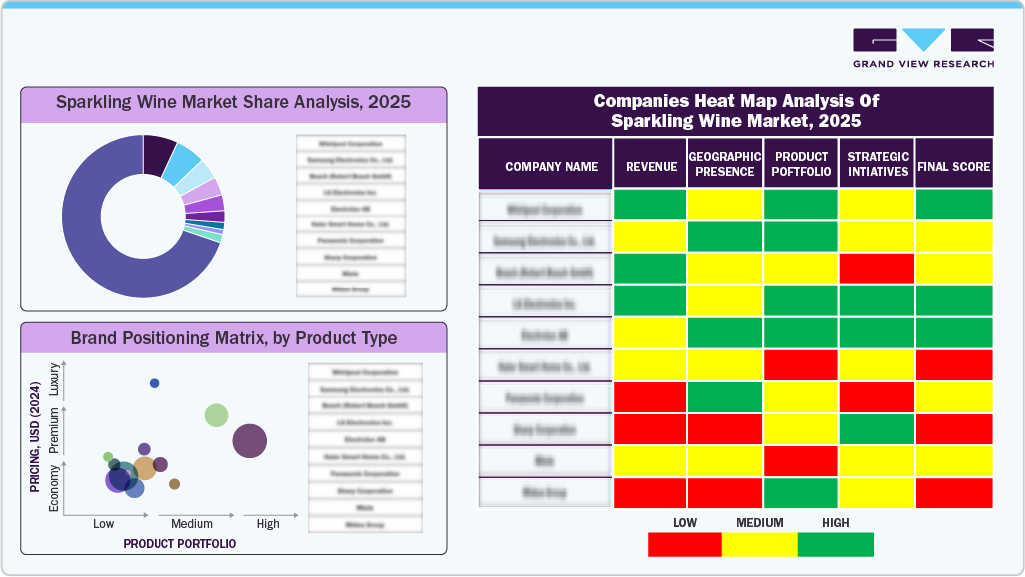
The sparkling wine industry is characterized by the presence of established global wine producers and regional specialists competing across diverse product categories. Companies focus on strengthening brand recognition, expanding distribution networks, and introducing differentiated products to capture consumer demand.
Market participants are also investing in packaging, product innovation, and premium positioning to enhance competitiveness. Partnerships with retailers, hospitality providers, and distributors remain important for increasing market reach. Competitive dynamics vary significantly across regions due to differences in consumer preferences, regulations, and purchasing patterns.
 To learn more about this report, Download Free Sample Report
Key Sparkling Wine Companies
The following key companies have been profiled for this study on the sparkling wine market.
-
LVMH (Moët Hennessy Louis Vuitton)
-
Pernod Ricard
-
Freixenet Global
-
Rotkäppchen-Mumm Sektkellereien GmbH
-
Tenute Lunelli.
-
Campari Group Ingredients
-
Codorníu Raventós.
-
Treasury Wine Estates Ltd.
-
Laurent-Perrier Group
-
Vinarchy Australia Limited
Competitive Benchmarking
Category
Operating Strategies
Competitive Edge
Weakness
Established Players (LVMH (Moët Hennessy Louis Vuitton))
- Strengthen brand equity, expand premium portfolios, and scale retail & HoReCa presence.
- Strong distribution, brand recognition, and established winemaking expertise.
- Higher costs and slower adaptation to changing consumer preferences.
Emerging Players (Vinarchy Australia Limited)
- Focus on niche styles, innovative formats, DTC, and experiential marketing.
- Agility, differentiation, and a stronger appeal to younger consumers.
- Limited scale, brand awareness, and distribution reach.
Recent Developments
-
In December 2025, Maison Vendôme launched a diamond-infused sparkling wine, positioning the product as an ultra-luxury offering with distinctive packaging and product innovation. The launch highlights the growing premiumization and differentiation trend in the sparkling wine market.
-
In September 2025, French Bloom became Formula 1’s first official non-alcoholic sparkling wine partner, with its Le Blanc and Le Rosé cuvées available across F1 hospitality venues. The partnership highlights the growing presence of premium alcohol-free sparkling wine in high-profile lifestyle and hospitality occasions.
Sparkling Wine Market Report Scope
Report Attribute
Details
Market size in 2025
USD 72.1 billion
Estimated market size in 2026
USD 77.6 billion
Projected market size by 2033
USD 144.9 billion
Growth Rate (Revenue)
CAGR of 9.3% from 2026 to 2033
Actuals
2021 - 2025
Forecast period
2026 - 2033
Quantitative (Revenue) units
Revenue in USD Million, and CAGR from 2026 to 2033
Report coverage
Revenue forecast, company ranking, competitive landscape, growth factors, and trends
Segments covered
Product type, distribution channel, region
Regional Scope
North America, Europe, Asia-Pacific, Central & South America, Middle East & Africa
Country scope
U.S., Canada, Mexico, U.K., Germany, France, Italy, Spain, China, Japan, India, Australia & New Zealand, South Korea, Brazil, South Africa
Key companies profiled
LVMH (Moët Hennessy Louis Vuitton), Pernod Ricard, Freixenet Global, Rotkäppchen-Mumm Sektkellereien GmbH, Tenute Lunelli, Campari Group, Codorníu Raventós, Treasury Wine Estates Ltd., Laurent-Perrier Group, Vinarchy Australia Limited
Customization scope
Free report customization (equivalent up to 8 analysts’ working days) with purchase. Addition or alteration to country, regional & segment scope.
Pricing and purchase options
Avail customized purchase options to meet your exact research needs. Explore purchase options
Global Sparkling Wine Market Report Segmentation
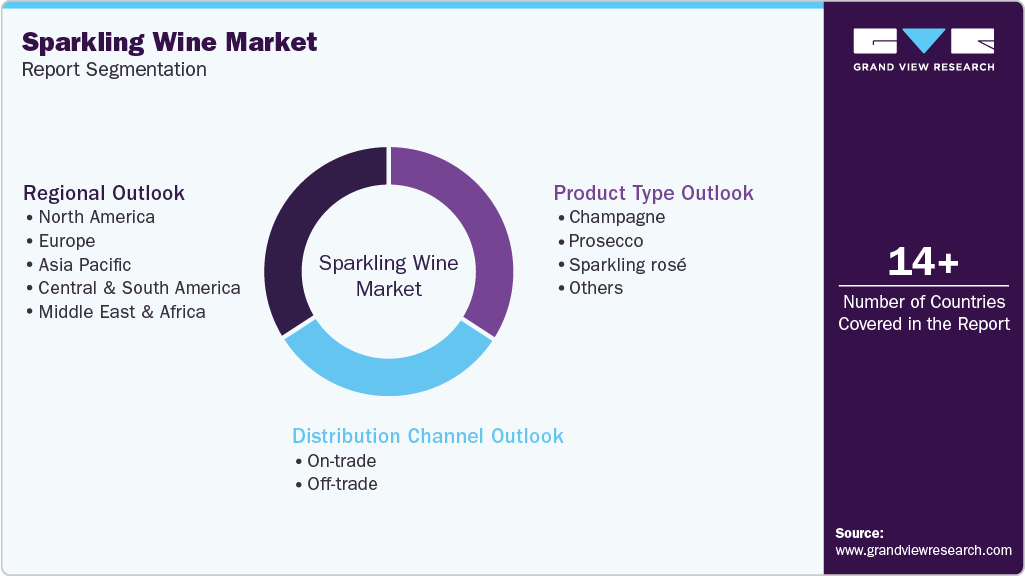
This report forecasts revenue growth at the regional and country levels and provides an analysis of the latest industry trends and opportunities in each of the sub-segments from 2021 to 2033. For the purpose of this study, Grand View Research has segmented the sparkling wine market report on the basis of product type, distribution channel, and region.
 To learn more about this report, Download Free Sample Report
-
Product Type Outlook (Revenue, USD Million, 2021 - 2033)
-
Champagne
-
Prosecco
-
Sparkling rosé
-
Others
-
-
Distribution Channel Outlook (Revenue, USD Million, 2021 - 2033)
-
On-trade
-
Off-trade
-
-
Regional Outlook (Revenue, USD Million, 2021 - 2033)
-
North America
-
U.S.
-
Canada
-
Mexico
-
-
Europe
-
U.K.
-
Germany
-
France
-
Italy
-
Spain
-
-
Asia Pacific
-
China
-
Japan
-
India
-
Australia & New Zealand
-
South Korea
-
-
Central & South America
-
Brazil
-
-
Middle East & Africa
-
South Africa
-
-
Research Methodology
The sparkling wine market figures in this report are based on a proven research process that combines executive interviews with secondary research from proprietary databases, company filings, and recognized regulatory and institutional sources. Market size is built through value-chain sizing-reconciling supply-side and demand-side estimates-and triangulated with bottom-up and top-down approaches. Every estimate passes multiple levels of expert validation before publication, with each sparkling wine segment quantified using the revenue-capture definitions in the table below.
Segment Definition
Product Type
Revenue capture definition
Champagne
Champagne generates revenue primarily through bottled products sold across supermarkets, specialty wine retailers, restaurants, hotels, and e-commerce platforms. Revenue is captured through standard bottles, larger formats, and premium cuvées targeting higher-value consumers. Producers can enhance value through vintage releases, limited editions, and distinctive brand positioning. Strong gifting and celebratory demand also supports sales during seasonal and special-event periods.
Prosecco
Prosecco generates revenue through widespread sales across retail stores, hospitality venues, online platforms, and specialty wine outlets. Revenue is captured through standard bottles as well as premium and branded variants targeting different consumer segments. Producers can increase value through differentiated labels, regional positioning, and collaborations with hospitality operators. Cocktail applications and casual consumption occasions can further expand purchase frequency.
Sparkling rosé
Sparkling rosé generates revenue through bottled offerings positioned across retail, hospitality, and online sales channels. Revenue can be captured through standard products, premium labels, limited releases, and visually distinctive packaging. Producers can strengthen monetization by emphasizing varietal characteristics, origin, and stylistic differentiation. Seasonal launches and event-oriented marketing can create additional purchasing opportunities.
Others
The Others segment includes sparkling wine styles outside the major Champagne, Prosecco, and sparkling rosé categories, generating revenue through diverse regional and varietal offerings. Sales are captured through retail outlets, restaurants, specialty wine merchants, and digital commerce platforms. Producers can differentiate these products through local grape varieties, production methods, and regional identity. Niche positioning and emerging consumer interest in lesser-known wine styles can support premium pricing and category expansion.
Estimation Model
Layer Name
Key Question
Description
Consumption Profile Layer
Who consumes sparkling wine?
Social drinkers, celebration-led consumers, wine enthusiasts, premium lifestyle buyers, and younger experiential consumers.
Market Reach Layer
Where can consumers access them?
Retail stores, supermarkets, specialty wine shops, restaurants, hotels, bars, e-commerce, and direct-to-consumer channels.
Purchase & Retention Layer
What drives repeat purchases?
Taste, brand reputation, occasion relevance, price-value perception, packaging, recommendations, and premiumization.
Value Generation Layer
How is revenue generated?
Premium pricing, branded sparkling wines, luxury variants, innovative formats, food-service sales, gifting, and recurring consumption occasions.
Delivered Customizations
This report has been delivered with the following In-depth customizations
Client Request
Customization Delivered
Value Adds
Global Sparkling Wine Brand & Product Landscape Assessment
Mapped sparkling wine categories, including Champagne, Prosecco, Cava, Crémant, and emerging sparkling styles, assessing formats, price tiers, consumer occasions, and brand differentiation.
Highlights whitespace opportunities, emerging product concepts, premiumization avenues, and potential areas for brand differentiation.
Global Sparkling Wine Channel & Commercial Assessment
Assessed key routes to market across retail, e-commerce, hospitality, specialty wine, and direct-to-consumer models, including channel dynamics and consumer purchase behavior.
Enables channel prioritization, commercial strategy development, pricing architecture, and identification of scalable growth opportunities.
Global Sparkling Wine Regulatory & Market Environment Assessment
Reviewed market-specific alcohol regulations, labeling and packaging requirements, geographical indications, import considerations, sustainability expectations, and evolving consumer trends.
Supports market-entry planning, reduces regulatory execution risks, and helps align product and launch strategies with local market requirements.
Frequently Asked Questions About This Report
The global sparkling wine market size was valued at USD 72.1 billion in 2025 and is estimated at USD 77.6 billion for 2026.
The global sparkling wine market is expected to grow at a CAGR of 9.3% from 2026 to 2033, reaching USD 144.9 billion by 2033.
Europe dominated with a 46.1% revenue share in 2025.
Key factors include rising demand for premium beverages, growing popularity of celebrations and social occasions, expanding wine tourism, and increasing availability through online and retail channels.
Key players include LVMH (Moët Hennessy Louis Vuitton); Pernod Ricard; Freixenet Global; Rotkäppchen-Mumm Sektkellereien GmbH; Tenute Lunelli; Campari Group; Codorníu Raventós; Treasury Wine Estates Ltd.; Laurent-Perrier Group; and Vinarchy Australia Limited.
Asia Pacific is the fastest-growing region over the forecast period.
Based on the distribution channel, the on-trade segment is the fastest-growing over the forecast period.
The prosecco segment led with a 44.4% revenue share in 2025.
The off-trade segment led with a 71.9% revenue share in 2025.
About the Author(s)
Alcohol & Tobacco Research Team
Consumer Goods · Alcohol & TobaccoThis report was authored by the alcohol & tobacco research team at Grand View Research - comprising two research analysts, one senior research analyst, and one industry expert - with specialized expertise in the alcohol & tobacco segment of the consumer goods industry. All findings are based on proprietary consumer goods databases, executive interviews, and regulatory analysis, subject to internal peer review prior to publication.
Last Updated:
Speak to Analyst

Customize this report to your needs - add regions, segments, or data points, with 20% free customization.
Or view our licence options:


ISO 9001:2015 & 27001:2022 Certified
We are GDPR and CCPA compliant! Your transaction & personal information is safe and secure. For more details, please read our privacy policy.


