
- Home
- »
- Consumer F&B
- »
-
Spices Market Size, Share & Trends, Industry Report, 2033GVR Report cover

Spices Market (2026 - 2033) Size, Share & Trends Analysis Report By Product (Pepper, Ginger, Cumin, Cinnamon), By Form (Powder, Whole, Chopped/Crushed), By Application (Commercial, Household), By Distribution Channel, By Region, And Segment Forecasts
Market Size, 2025
$8.6BMarket Estimate, 2026
$9.1BMarket Forecast, 2033
$13.1BCAGR, 2026–2033
5.3%Spices Market Summary
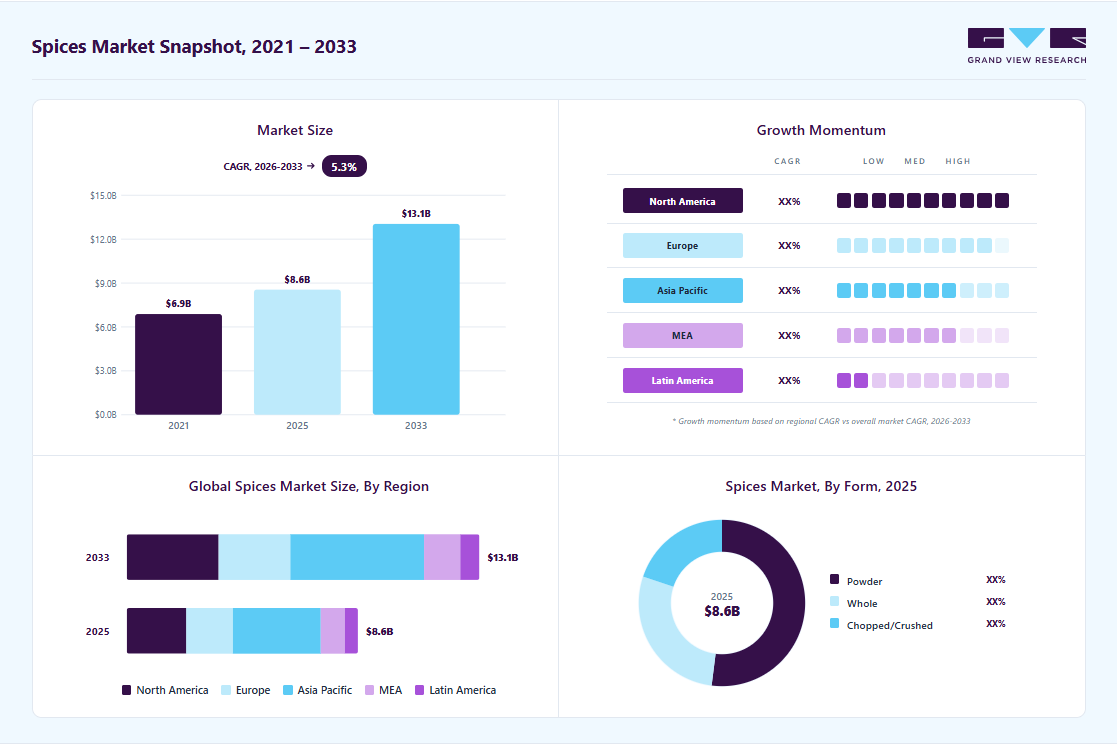
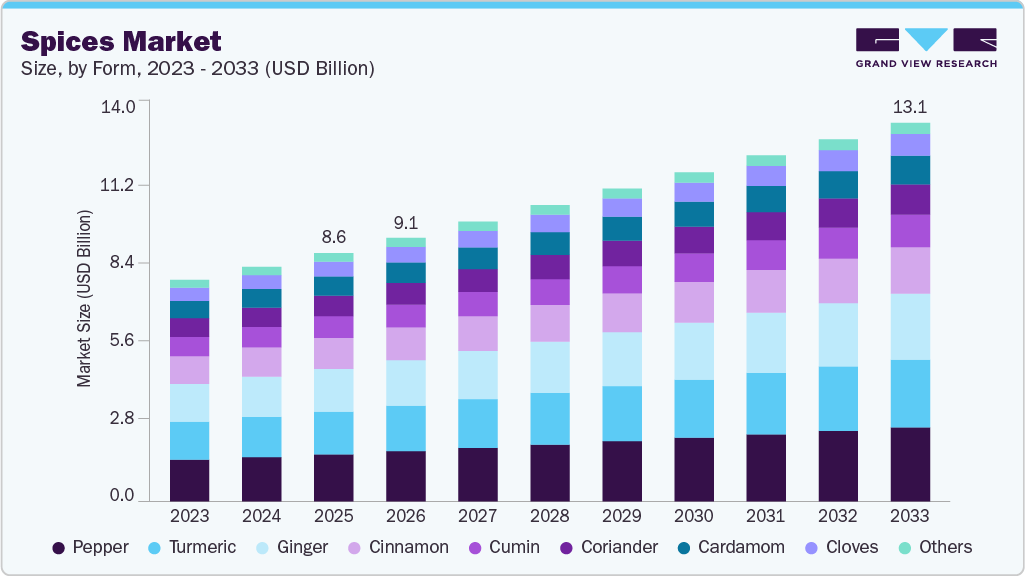
The global spices market size was valued at USD 8.6 billion in 2025 and is projected to grow from USD 9.1 billion in 2026 to USD 13.1 billion by 2033, at a CAGR of 5.3% from 2026 to 2033. The market in Asia Pacific dominated with a revenue share of 38.0% in 2025. The market for spices is rising globally because they sit at the intersection of population growth, globalized cuisine, and consumer health awareness.
 Source: Grand View Research, IR Documents, Primary Interviews, Paid DatabasesTo learn more about this report,
 Download Free Sample Report
 Key Market Trends & Insights
- By product: The pepper segment led the market with the largest revenue share of 18.9% in 2025.
- By form: The powdered spices segment led the market with the largest revenue share of 52.0% in 2025.
- By application: The household segment is expected to grow at the fastest CAGR of 5.9% during the forecast period.
- By distribution channel: The hypermarkets & supermarkets segment led the market with the largest revenue share of 44.4% in 2025.
Regional Highlights
- Largest regional market: Asia Pacific (38.0% revenue share, 2025)
- By country: The China held the largest market share in 2025.
Market Size & Forecast
- Market size in 2025: USD 8.6 Billion
- Estimated market size in 2026: USD 9.1 Billion
- Projected market size by 2033: USD 13.1 Billion
- CAGR (2026-2033): 5.3%
Three ways to get this report
Buy it, customize it, or ask a question.Ask an Analyst
Analyst response in 1 business day
- AccessReport author, directly
- Reply timeWithin 1 working day
- No sales callDirect answer only
- FormatEmail reply
- CostFree, no cost
Get the Full Report
What the study covers
- FormatsPDF · Excel · Dashboard
- Timeline2026–2033 annual, 2025 base
- Coverage20+ countries, 5 regions
- Companies10+ key players profiled
Customize the Report
20% free customization
- IncludeCountries, segments, points
- TailorTo your product definition
- ExtendDeeper competitor detail
- OrA fully bespoke study
- Turnaround5–10 working days
As the world population expands and urban households rely more on home cooking, the volume consumption of packaged, processed, and single-ingredient spices naturally increases. Unlike sauces or imported flavor bases, spices remain a relatively affordable way to transform everyday meals, which protects category demand even in inflationary periods and encourages higher purchase frequency.Consumers across North America, Europe, the Middle East, and Asia-Pacific are cooking and dining across more ethnic cuisines than ever before. Indian curries rely on turmeric, cumin, and coriander, Middle Eastern dishes use sumac and za’atar, Thai meals depend on chili and lemongrass seasonings, and Mexican cuisine drives demand for paprika, oregano, and smoky chili.
 To learn more about this report, Download Free Sample Report
 This broadening of home recipes and restaurant menus creates sustained structural dependency on spices, pushing global import growth from producing hubs such as India, Vietnam, Sri Lanka, China, and Indonesia. According to the data published in October 2025, Indonesia plans to invest about USD 21 billion to transform North Maluku into a global spice hub, focusing on crops such as nutmeg, cloves, and coconut through industrial processing. The strategy emphasizes downstreaming and value-added production to boost exports, create jobs, and restore Indonesia’s historic dominance in the global spice trade.
Beyond flavor, spices have also gained a strong functional identity. Turmeric, ginger, cinnamon, black pepper, and clove are increasingly trusted for anti-inflammatory, immunity, metabolic, and digestive benefits. They are now curated not only as pantry staples but also as wellness ingredients in spiced teas, immunity tonics, golden milk mixes, and clean-label seasoning kits. The clean-ingredient movement amplifies this trend, as consumers shift away from artificial flavors toward natural seasonings backed by recognizable plants, roots, and seeds.
E-commerce marketplaces, brand D2C websites, and quick-commerce grocery apps enable consumers to order spices in small and mid-pack formats, increasing trial rate, repeat purchases, and availability of premium single-origin or organic variants. Foodservice growth- especially cloud kitchens and delivery-only restaurants- increases spice consumption per prepared meal, while local processing clusters improve supply stability, shelf life, packaging innovation, and private label manufacturing.
Market Dynamics
The growing popularity of ethnic and international cuisines worldwide is driven by globalization, travel, migration, and social media exposure. People today are more willing to explore diverse food cultures such as Asian, Middle Eastern, Mexican, and Mediterranean cuisines, seeking unique flavors, ingredients, and dining experiences. Food delivery platforms, cooking shows, and online content have further increased awareness and accessibility of global dishes, making international cuisine a regular part of consumers’ eating habits. For instance, according to a survey conducted among 1,104 U.S. adults in 2026, about 36% of consumers reported adding condiments to their food "often," reflecting a growing interest in customizing and experimenting with flavors.
This trend has significantly influenced the food and beverage industry, encouraging restaurants and food manufacturers to introduce fusion dishes, authentic regional recipes, and culturally inspired products. Consumers, especially younger generations, value variety, authenticity, and culinary experimentation, which has expanded market demand for ethnic ingredients, specialty sauces, and ready-to-eat international meals. As a result, businesses are continuously innovating to cater to evolving global taste preferences.
Supply chain disruptions in the spices market occur when the movement of spices from farmers to manufacturers and retailers is interrupted. These disruptions can happen due to transportation delays, port congestion, fuel price increases, labor shortages, political instability, or natural disasters. Since spices are often sourced from different regions and countries, any interruption in logistics can delay deliveries and increase operational costs. According to the data published in December 2025, climate change can lead to fluctuations in:
• Cardamom harvests in Kerala are liable to vary as unpredictable monsoon patterns continue to affect cultivation conditions.
• Rising summer temperatures could reduce black pepper production levels.
• Prolonged rainy conditions increase the risk of fungal infections in cloves and nutmeg crops.
• In Sri Lanka, cinnamon yield projections appear highly dependent on changes in rainfall patterns.
Such disruptions affect product availability, pricing, and business profitability. Manufacturers may face shortages of raw spices, leading to delayed production and higher market prices. Inconsistent supply can also reduce customer satisfaction and impact export commitments, making it difficult for spice companies to maintain smooth business operations.
Consumer Demographic Insights
Consumer interest in spices is being shaped by cultural, behavioral, and product-led trends that go far beyond basic seasoning needs. One central driver is the human desire for sensory-rich, culturally immersive experiences. Food has become one of the most accessible expressions of identity, exploration, and entertainment, and spices help unlock authentic flavor profiles at home. The global popularity of ethnic and regional cuisine, particularly Indian, Middle Eastern, Mexican, Thai, and North African dishes, creates a habitual fascination with layered spice combinations such as turmeric-cumin bases, paprika blends, and aromatic cinnamon-cardamom notes. People are increasingly confident in preparing globally inspired meals themselves, a trend accelerated by social media cooking content, recipe creators, and influencer-led food culture, where spices become the key to credibility and taste replication without relying on processed sauces or artificial additives.
 To learn more about this report, Download Free Sample Report
 A growing segment of consumers perceives spices as functional botanicals rather than only taste enhancers. Ingredients such as turmeric, ginger, and cinnamon are being added to lattes, immunity tonics, digestive teas, and clean seasoning sachets, reinforcing the idea that spices deliver both enjoyment and well-being. For instance, in March 2024, Costa Coffee added a Cinnamon Bun Latte and its iced version to the menu as permanent drinks after they proved popular with customers, who praised the new flavor on social media.
This overlaps seamlessly with the clean-label movement, where people reject artificial colors, preservatives, and synthetic flavor compounds, replacing them with recognizable pantry ingredients. Spices also benefit from economic consumer psychology: even during inflationary cycles, spices remain small-ticket purchases, allowing people to enhance meals cheaply while still trading up into premium, organic, or single-origin variants, an expression of everyday indulgence and value.
Another major preference trend involves experimentation with formats. Consumers increasingly buy:
-
Spice mixes for specific recipes (e.g., shawarma, biryani, ramen seasoning, taco seasoning).
-
Seasoning sachets & instant premixes used in convenience cooking.
-
Single-origin or artisanal spices curated for superior aroma, freshness, color, and storytelling appeal.
Foodservice culture is reinforcing demand for the industry global spices market. The rise of cloud kitchens and delivery-only restaurants has increased the number of spice-rich prepared meals ordered per capita, which pushes bulk procurement from suppliers serving restaurants like BOMBAY SPICE. In addition, consumers seek boldness, heat, aroma intensity, natural color appeal, pairing versatility (for bakery, beverages, and savory dishes), and reliability (consistent taste across batches). These priorities make spices essential not only for cooking but also for food product innovation in adjacent sectors, such as baked seasoning blends or spiced beverage kits. This expands the spice ecosystem to include B2B private-label manufacturers, ingredient suppliers, health food startups, and FMCG seasoning players.
Product Insights
The pepper segment led the market with the largest revenue share of 18.9% in 2025. Black pepper is now widely recognized not only as a seasoning but also as a metabolism and digestion booster, especially when paired with turmeric or herbal wellness drinks, making it popular in both savory and health-oriented recipes. The trend toward clean-label cooking is pushing households and restaurants to replace artificial seasonings with natural spice profiles, where pepper plays a critical role in aroma, heat, and seasoning versatility across cuisines such as Indian, Middle Eastern, and pan-Asian street-food flavor kits.
 To learn more about this report, Download Free Sample Report
 The turmeric segment is projected to grow at the fastest CAGR of 5.8% from 2026 to 2033. The market for turmeric spice is increasing as consumers increasingly view it as both a flavor enhancer and a functional wellness ingredient, driven by rising interest in natural anti-inflammatory and immunity-supporting foods. Turmeric has been mainstreamed through trending formats such as spiced milk beverages, health tonics, and globally popular home-cooked cuisines, while the clean-label movement has strengthened preference for recognizable, plant-based seasonings over artificial additives. Its vibrant natural color appeal also boosts adoption in foodservice and packaged seasonings, and because it remains an affordable pantry staple, consumers continue buying and experimenting with it even in inflationary periods.
Form Insights
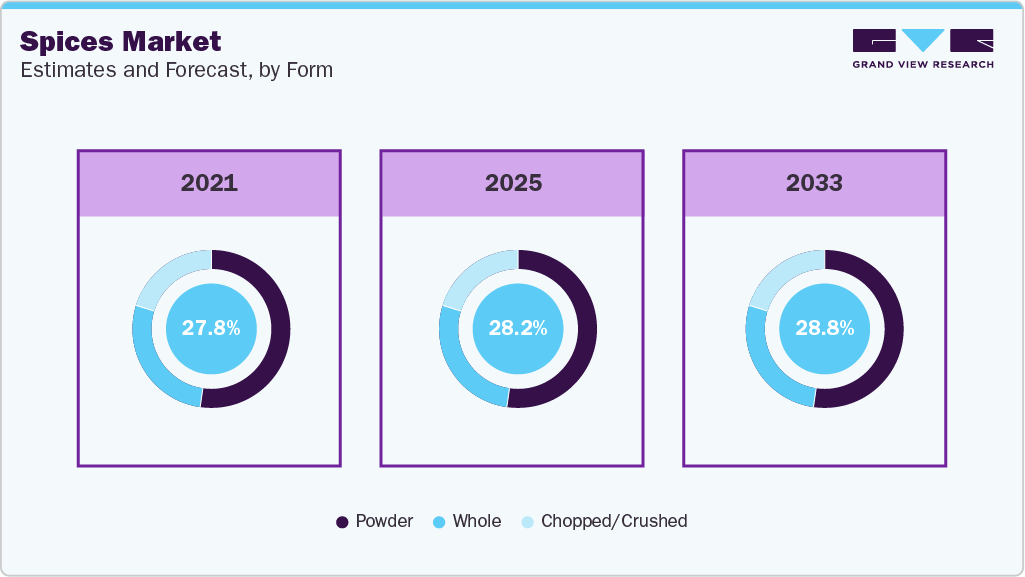
The powdered segment led the market with the largest revenue share of 52.0% in 2025. Powdered spices dissolve instantly, blend uniformly, and remove the variability seen in whole or crack-based seasonings, ensuring repeatable taste across batches an increasingly important preference for home cooks and delivery kitchens. These powders fit seamlessly into busy lifestyles, smaller kitchens, and quick-prep recipes, while also doubling as natural flavor and color enhancers for adjacent categories like beverages, snacks, soups, and bakery seasonings.
 To learn more about this report, Download Free Sample Report
 The whole spices segment is projected to grow at the fastest CAGR of 5.6% from 2026 to 2033. The market for whole spices is increasing because consumers are prioritizing freshness, aroma, and authenticity in everyday cooking. Unlike pre-ground formats, whole spices retain essential oils for longer, delivering stronger flavor release when toasted, tempered, or freshly crushed just before use. Modern home cooks, especially younger, digitally influenced food explorers, are inspired by social recipes that emphasize techniques like dry-roasting cumin or blooming whole cinnamon and clove, reinforcing the belief that real flavor starts from whole ingredients.
Application Insights
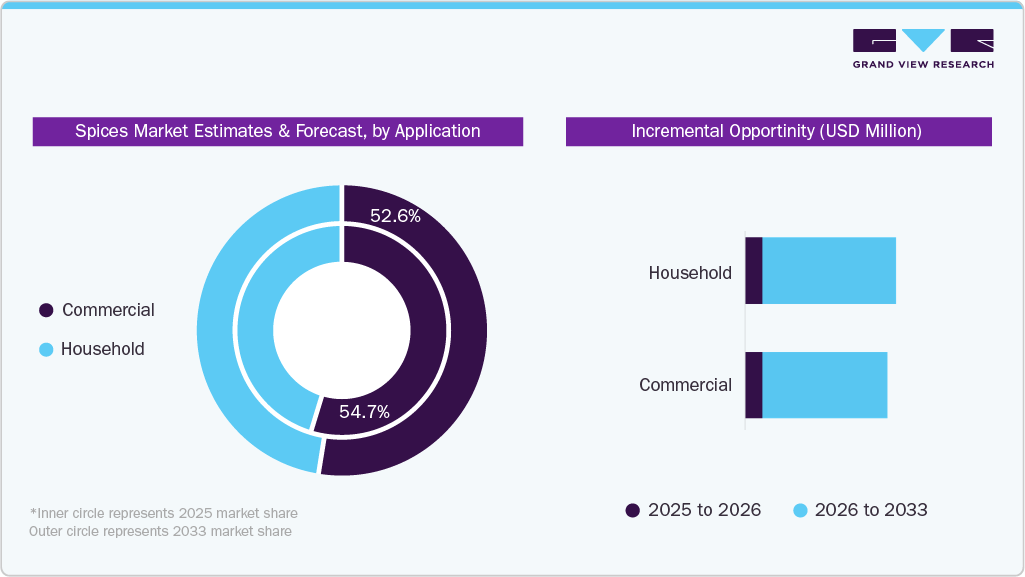
The commercial segment led the market with the largest revenue share of 54.7% in 2025. The commercial spice industry is increasing among consumers because flavor is becoming a strategic lever for both product differentiation and repeat consumption. Restaurants, packaged food brands, and commercial kitchens are intensifying their use of spices to deliver consistent, bold, and culturally authentic taste profiles that build brand identity and customer loyalty. As global foodservice competition grows, operators rely on spices rather than expensive processed flavorings to enhance aroma, color, and taste at a lower cost per prepared meal, improving margins while maintaining sensory impact.
 To learn more about this report, Download Free Sample Report
 The household segment is projected to grow at the fastest CAGR of 5.9% from 2026 to 2033. The household spice industry is increasing because home cooking has shifted from a routine necessity to a form of self-expression, cultural exploration, and everyday wellness. As global cuisines enter mainstream household recipes, families are replacing artificial sauces and flavor additives with natural seasonings that deliver bold taste at a low cost per meal. Rising digital recipe consumption, food content influence, and the trend toward clean-label pantry staples have normalized frequent repurchase of single ingredients like turmeric, chili, and cinnamon, while ready-made mixes for dishes such as biryani or taco seasoning increase trial rates and repeat usage.
Distribution Channel Insights
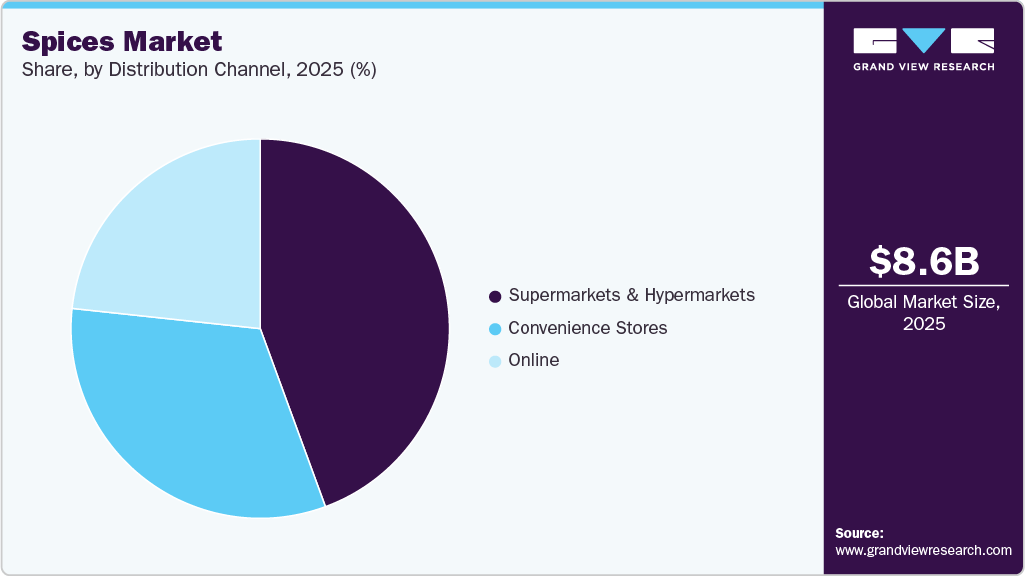
The supermarkets & hypermarkets segment led the market with the largest revenue share of 44.4% in 2025. The market for spices is increasing in supermarkets & hypermarkets because large-format retail has become the primary destination for discovery, trust, and repeat purchase of everyday flavor ingredients. Supermarkets such as Carrefour and Tesco have expanded ethnic aisles, seasoning kits, and small-pack spice racks, making global cuisines easier to cook at home. Consumers increasingly favor bold, natural, and authentic flavors instead of synthetic seasonings, and they treat spices as affordable meal enhancers even during food inflation. Supermarkets reinforce purchase loops through visibility, variety, and frequent basket additions, positioning spices as a habitual, high-rotation category in weekly grocery shopping.
 To learn more about this report, Download Free Sample Report
 The online/e-commerce segment is anticipated to grow at the fastest CAGR of 5.8% from 2026 to 2033. The spice industry is increasing among online consumers because digital shopping has made flavor discovery personal, instant, and repeatable. Spices also benefit from small pack economics; people can trial new flavors without high spend, and once a blend works, repurchase becomes habitual through saved carts, subscriptions, and one-click ordering.
Regional Insights
The spices industry in North America is anticipated to grow at the fastest CAGR during the forecast period. The spice industry among consumers in North America is growing because spices have shifted from pantry staples to lifestyle flavor tools that fuel cooking creativity, authenticity, and natural wellness. Growing interest in globally inspired cuisine, cooking content creators, and home experimentation has strengthened dependency on bold seasoning mixes, single-origin aromatics, and heat-forward flavors, while the clean-label movement favors recognizable spices over artificial flavoring an area where brands such as McCormick & Company and retailers like Whole Foods Market continue to fuel trial and repeat purchases through curated, recipe-led spice kits and premium, natural seasonings that enhance everyday meals affordably.
U.S. Spices Market Trends
The spices market in the U.S. held a significant share in North America in 2025. The U.S. market is growing as consumer’s cook more globally inspired meals at home, seeking authentic, bold flavors without relying on highly processed sauces, while spices remain an affordable way to elevate everyday dishes. The boom of short-form recipe content and influencer-led cooking trends has driven experimentation with seasoning blends used in cuisines such as Tex-Mex, Indian, and Cajun, boosting repeat purchases in small and mid-pack formats.
Asia Pacific Spices Market Trends
Asia Pacific dominated the global spices market with the largest revenue share of 38.0% in 2025. The Asia Pacific market is increasing among consumers because daily diets in the region are deeply flavor-driven, and spices are central to both tradition and modern food innovation. Rapid urbanization and dual-income households are shifting cooking habits toward packaged seasonings and recipe-focused spice mixes, while social platforms accelerate the discovery of trending cuisines such as Sichuan hotpot, Korean stews, Indian curries, and Thai spice bases, all of which rely on complex, aromatic seasoning. In addition, consumers increasingly view spices like turmeric, cinnamon, and ginger as natural wellness boosters for immunity and digestion, making them attractive clean-label alternatives to artificial flavorings.
 To learn more about this report, Download Free Sample Report
 The spices market in India accounted for the largest market revenue share in the Asia Pacific in 2025, due to urbanization and growing disposable incomes, which are expanding spice consumption beyond traditional cooking, while ready-to-use mixes and premium organic blends appeal to convenience and health-conscious consumers. Indian spices such as turmeric and cardamom are gaining global recognition, reinforcing both domestic and export demand. Cultural festivals and traditional recipes continue to anchor strong daily consumption. Consumers increasingly value aromatic, authentic spices that preserve the essence of regional cuisines.
Europe Spices Market Trends
The spices market in Europe is increasing among consumers due to a blend of evolving lifestyles, globalized food culture, and demand for natural flavor enhancement. European consumers are cooking more diverse, spice-intensive cuisines at home, driven by multicultural populations, travel-inspired eating habits, and viral online recipes, leading to higher consumption of seasoning mixes and single spices. Growing interest in plant-based diets, healthier home cooking, and premium, organic culinary ingredients further reinforces the demand loop, making spices one of the easiest ways for consumers to elevate everyday meals while keeping purchases affordable, frequent, and experience-driven.
The Germany spices market held a significant share in Europe in 2025. German consumers increasingly embrace international cuisines, from Thai curries to Mexican dishes, boosting demand for a diverse array of spices. Health-conscious trends favor turmeric, ginger, and cinnamon for immunity and anti-inflammatory benefits. The rise of home cooking and meal kits encourages experimentation with specialty herbs and spice blends. Clean-label and organic certifications are highly valued, making quality and freshness key purchase drivers.
Central & South America Spices Market Trends
The spices market in Central & South America is expected to grow at a significant CAGR of 4.8% during the forecast period. Local cuisines rely heavily on chili, paprika, oregano, and other native spices, which sustain strong regional demand. Interest in fusion cooking and international recipes is driving the use of imported and exotic spices. Wellness trends encourage the integration of spices like ginger and cinnamon into teas and functional beverages. Small-scale farms and cooperatives play a key role in ensuring authenticity and high-quality spice supply across the region.
Middle East & Africa Spices Market Trends
The spices market in the Middle East & Africa is expected to grow at a substantial CAGR of 5.2% during the forecast period. Traditional dishes in these regions depend on spice blends such as za’atar, sumac, cumin, and coriander, keeping daily usage high. Urbanization and the expansion of international restaurant chains are increasing demand for both local and imported spices. Health awareness is increasing the use of turmeric, cinnamon, and ginger in teas, tonics, and functional foods. Seasonal festivals, religious events, and hospitality needs also create significant spikes in spice purchases, especially for premium blends.
Key Spices Company Insights
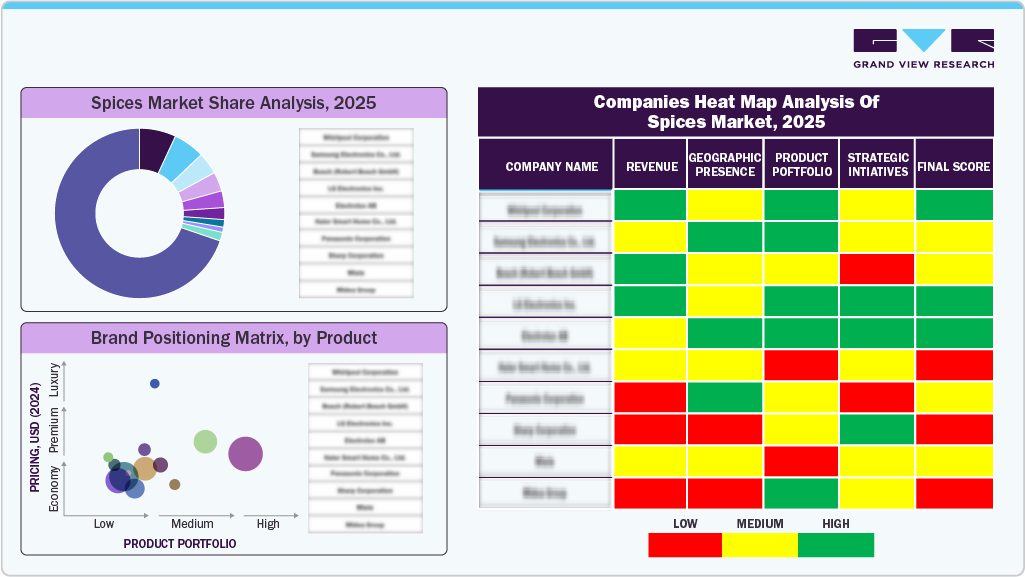
Established and emerging players in the spices industry operate in a highly competitive environment, driven by increasing consumer demand for authentic flavors, clean-label ingredients, organic and sustainably sourced spices, and value-added spice blends. Companies are focusing on expanding their product portfolios, strengthening sourcing networks, enhancing quality assurance and traceability systems, and investing in processing technologies to improve product consistency and shelf life. Strategic initiatives such as capacity expansions, product innovations, certifications, partnerships with growers, and geographic expansion are increasingly being adopted to strengthen market positioning and cater to evolving consumer and industrial requirements across the food & beverage, foodservice, and nutraceutical sectors.
 To learn more about this report, Download Free Sample Report
 Key Spices Companies:
The following key companies have been profiled for this study on the spices market.
- Ajinomoto Co., Inc.
- Associated British Foods plc
- ARIAKE JAPAN CO., LTD.
- Baria Pepper
- Kerry Group
- The Bart Ingredients Co. Ltd.
- DS Group
- Everest Spices
- Dohler Group
- McCormick & Company, Inc.
Recent Developments
-
In October 2025, Indonesia plans to invest about USD 21 billion to transform North Maluku into a global spice hub, focusing on crops such as nutmeg, cloves, and coconut through industrial processing. The strategy emphasizes downstreaming and value-added production to boost exports, create jobs, and restore Indonesia’s historic dominance in the global spice trade.
-
In May 2025, the Spices Board of India launched the "Sustainability in Spice Sector through Progressive, Innovative and Collaborative Interventions for Export Development" (SPICED) scheme to boost exports and improve cardamom productivity. The board plans to disburse ₹130 crores under this scheme in the 2025-2026 fiscal year.
Spices Market Report Scope
Report Attribute
Details
Market size in 2025
USD 8.6 billion
Estimated market size in 2026
USD 9.1 billion
Projected market size by 2033
USD 13.1 billion
Growth rate
CAGR of 5.3% from 2026 to 2033
Base year for estimation
2025
Historical data
2021 - 2025
Forecast period
2026 - 2033
Quantitative units
Revenue in USD million/billion and CAGR from 2026 to 2033
Report coverage
Revenue forecast, company ranking, competitive landscape, growth factors, and trends
Segments covered
Product, form, application, distribution channel, region
Regional scope
North America; Europe; Asia Pacific; Central & South America; Middle East & Africa
Country scope
U.S.; Canada; Mexico; Germany; UK; France; Italy; Spain; China; India; Japan; South Korea; South Africa; Brazil
Key companies profiled
Ajinomoto Co., Inc.; Associated British Foods plc; ARIAKE JAPAN CO., LTD.; Baria Pepper; Kerry Group; The Bart Ingredients Co. Ltd.; DS Group; Everest Spices; Dohler Group; McCormick & Company, Inc.
Customization scope
Free report customization (equivalent up to 8 analysts working days) with purchase. Addition or alteration to country, regional & segment scope.
Pricing and purchase options
Avail customized purchase options to meet your exact research needs. Explore purchase options
Global Spices Market Report Segmentation
This report forecasts revenue growth at the global, regional, and country levels and provides an analysis of the latest industry trends and opportunities in each of the sub-segments from 2021 to 2033. For this study, Grand View Research has segmented the global spices market report based on the product, form, application, distribution channel, and region:
-
Product Outlook (Revenue, USD Million, 2021 - 2033)
-
Pepper
-
Ginger
-
Cinnamon
-
Cumin
-
Turmeric
-
Cardamom
-
Coriander
-
Cloves
-
Others
-
-
Form Outlook (Revenue, USD Million, 2021 - 2033)
-
Powder
-
Whole
-
Chopped/Crushed
-
-
Application Outlook (Revenue, USD Million, 2021 - 2033)
-
Household
-
Commercial
-
-
Distribution Channel Outlook (Revenue, USD Million, 2021 - 2033)
-
Hypermarkets & Supermarkets
-
Convenience Stores
-
Online
-
-
Regional Outlook (Revenue, USD Million, 2021 - 2033)
-
North America
-
U.S.
-
Canada
-
Mexico
-
-
Europe
-
Germany
-
UK
-
France
-
Italy
-
Spain
-
-
Asia Pacific
-
China
-
India
-
Japan
-
South Korea
-
-
Central & South America
-
Brazil
-
-
Middle East & Africa
-
South Africa
-
-
Competitive Benchmarking
Client Request
Customization Delivered
Value Adds
Cross-Segmentation Analysis for Spice Categories Across Channels
Detailed cross-segmentation analysis of spice categories including whole spices, ground spices, spice blends, herbs, seasonings, organic spices, and ready-to-cook mixes across retail, foodservice, e-commerce, convenience, and horeca channels. Analysis of category performance by pricing tier, cuisine preference, consumer demographics, and usage occasions. Benchmarking of channel-wise product penetration and spice mix consumption by country.
Identify fastest-growing spice categories across individual distribution channels. Evaluate channel-wise growth rates and revenue contribution by spice type. Support targeted category expansion and channel prioritization strategies. Highlight whitespace opportunities for premium, organic, and ethnic spice blends.
Spice Production & Competitive Manufacturing Analysis
Comprehensive assessment of competitor-wise estimated spice production volumes, processing footprint, grinding/blending capacities, sourcing hubs, and regional production facilities. Portfolio benchmarking across premium, mainstream, and value spice segments. Analysis of pricing positioning, backward integration, and private-label manufacturing exposure.
Identify benefits of vertical integration including supply stability, quality consistency, and sourcing control. Evaluate horizontal integration opportunities through portfolio diversification and geographic expansion. Benchmark competitor manufacturing efficiencies and export scale advantages. Support strategic sourcing, production localization, and capacity expansion decisions.
Spice Price & Packaging Format Analysis
Analysis of global spice price fluctuations across pepper, turmeric, cumin, chili, cardamom, cinnamon, blended seasonings, and herbs categories. Assessment of raw material cost transfer to end consumers across retail and foodservice channels. Country-level benchmarking of packaging formats including jars, pouches, sachets, grinders, PET bottles, and bulk packs. Analysis of consumer preference shifts toward convenience, sustainability, and premium packaging.
Support country-specific pricing strategy development based on affordability and competitive intensity. Identify optimal GTM strategies by packaging format and channel. Benchmark packaging formats with highest adoption and profitability by geography. Evaluate pricing elasticity and premiumization potential across spice formats. Support innovation decisions in sustainable and convenience-led spice packaging solutions.
Frequently Asked Questions About This Report
Asia Pacific dominated with a 38.0% revenue share in 2025.
The powdered spices segment led the market with the largest revenue share of 52.0% in 2025.
The commercial segment led the market with the largest revenue share of 54.7% in 2025.
The global spices market size was estimated at USD 8.6 billion in 2025 and is expected to reach USD 9.1 billion in 2026.
The global spices market is expected to grow at a compound annual growth rate of 5.3% from 2026 to 2033 to reach USD 13.1 billion by 2033.
The pepper accounted for a market share of 18.9% of the global revenues in 2025. Black pepper is now widely recognized not only as a seasoning but also as a metabolism and digestion–boosting ingredient, especially when paired with turmeric or herbal wellness drinks, making it popular in both savory and health-positioned recipes.
Some key players operating in the spices market include Ajinomoto Co, Inc., Associated British Foods plc, ARIAKE JAPAN CO, LTD., Baria Pepper, Kerry Group, The Bart Ingredients Co. Ltd., DS Group, Everest Spices, Dohler Group, and McCormick & Company, Inc.
Key factors that are driving the spices market growth include increasing demand for authentic food cuisine and new product launches.
About the Author(s)
Consumer F&B Research Team
Consumer Goods · Consumer F&BThis report was authored by the consumer f&b research team at Grand View Research - comprising two research analysts, one senior research analyst, and one industry expert - with specialized expertise in the consumer f&b segment of the consumer goods industry. All findings are based on proprietary consumer goods databases, executive interviews, and regulatory analysis, subject to internal peer review prior to publication.
Last Updated:
Speak to Analyst

Customize this report to your needs - add regions, segments, or data points, with 20% free customization.
Or view our licence options:


ISO 9001:2015 & 27001:2022 Certified
We are GDPR and CCPA compliant! Your transaction & personal information is safe and secure. For more details, please read our privacy policy.


