
- Home
- »
- Conventional Energy
- »
-
Spinning Machinery Market Size & Share Report, 2026-2035GVR Report cover

Spinning Machinery Market (2026 - 2035)
Size, Share & Trends Analysis Report By Type (Ring Spinning, Rotor Spinning), By Material (Natural, Synthetic), By End Use (Clothing, Textile), By Region, And Segment Forecasts
Market Size, 2025
$5.7BMarket Estimate, 2026
$6.0BMarket Forecast, 2035
$9.2BCAGR, 2026–2035
4.9%Spinning Machinery Market Summary
The global spinning machinery market size was valued at USD 5.7 billion in 2025 and is projected to grow from USD 6.0 billion in 2026 to USD 9.2 billion in 2035, at a CAGR of 4.9% from 2026 to 2035. Asia Pacific dominated the market, accounting for the largest revenue share of 55.0% in 2025. Market growth is driven by rising textile production, increasing demand for high-quality yarn, and the growing adoption of automated and energy-efficient spinning machinery across the textile industry.
Key Market Trends & Insights
- By type: The ring spinning segment held the largest market share of approximately 65.0% in 2025.
- By material: The natural segment held the largest market share of approximately 65.0% in 2025.
- By end use: The clothing segment held the largest market share of approximately 70.0% in 2025.
Regional Highlights
- Largest regional market: Asia Pacific (55.0% revenue share, 2025)
Market Size & Forecast
- Market size in 2025: USD 5.7 Billion
- Estimated market size in 2026: USD 6.0 Billion
- Projected market size by 2035: USD 9.2 Billion
- CAGR (2026-2035): 4.9%
Prism AI by Grand View Research Free to tryAsk a question about the spinning machinery marketTry asking✓Every figure cited from GVR research Prefer the report? Download free sample →
The spinning machinery industry is supported by the long-term expansion of the global textile and apparel industry, rising yarn-quality requirements, and the ongoing modernization of textile manufacturing facilities. Textile manufacturers are increasingly investing in automated, high-speed, and energy-efficient spinning machinery to enhance productivity, optimize operating costs, improve process consistency, and meet increasingly stringent yarn-quality requirements. The replacement of aging equipment and investments in modern spinning capacity are also supporting demand, particularly in major textile manufacturing and export markets. In parallel, the adoption of digital technologies, including real-time production monitoring, predictive maintenance, automated process control, and data-driven quality management, enabling manufacturers to improve operational efficiency and reduce unplanned downtime.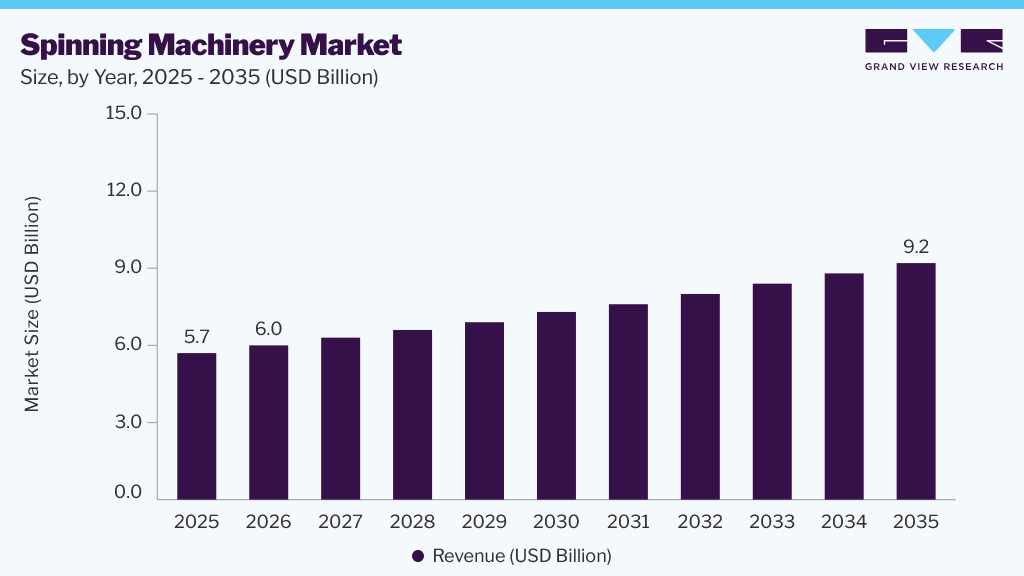 Source: Grand View Research, IR Documents, Primary Interviews, Paid DatabasesTo learn more about this report,
 Download Free Sample Report
Market growth is also supported by the expansion of textile manufacturing capacity in emerging economies, government policies and incentives aimed at strengthening domestic textile production, and investments in manufacturing infrastructure. However, demand remains dynamic to the cyclical nature of the textile industry. High upfront capital requirements for advanced spinning machinery can constrain investment among small and medium-sized textile manufacturers.
Despite challenges, the market presents opportunities from the growing emphasis on sustainable and resource-efficient textile production. Manufacturers are increasingly evaluating machinery capable of processing recycled and other alternative fibers while maintaining productivity and yarn quality. The integration of Industry 4.0 technologies, automation, intelligent process control, and connected manufacturing systems is expected to further support machinery upgrades and replacement demand. In addition, continued growth in apparel consumption, expansion of textile manufacturing in emerging economies, and increasing demand for higher-productivity and energy-efficient spinning solutions are expected to create long-term opportunities for spinning machinery manufacturers.
Analyst Perspective
The spinning machinery industry is expected to witness sustained growth over the forecast period, supported by increasing investments in textile manufacturing modernization and the rising adoption of automation across spinning mills. Growing demand for high-quality yarn, coupled with the need to improve productivity, reduce labor dependency, and enhance energy efficiency, is encouraging manufacturers to replace conventional equipment with advanced spinning machinery. Industry participants are increasingly focusing on smart manufacturing solutions, digital monitoring systems, and energy-efficient technologies to strengthen their competitive position. In addition, expanding textile production in emerging economies, rising demand for technical and sustainable textiles, and ongoing capacity expansions are expected to create significant opportunities for market growth.
Type Insights
The ring spinning segment dominated the market and accounted for the largest revenue share of approximately 65.0% in 2025. The segment's dominance is attributed to its ability to produce high-quality yarn with superior strength and uniformity, making it the preferred technology for cotton and blended fiber applications. Continuous advancements in automation, energy efficiency, and process optimization are further strengthening demand for ring spinning systems. For instance, in September 2025, Rieter introduced its latest solutions for fully automated spinning mills, including the OMEGAlap E 40 combing preparation machine, at ITMA ASIA + CITME 2025, highlighting innovations that improve productivity and energy efficiency in ring spinning operations.
The rotor spinning segment is expected to register the fastest CAGR during the forecast period. The segment is gaining traction due to its high production speed, lower operating costs, and suitability for manufacturing coarse and medium-count yarns used in denim, home textiles, and industrial fabrics. Increasing investments in cost-efficient spinning technologies and the expansion of textile manufacturing capacity in emerging economies are expected to support the segment's growth. In addition, rotor spinning requires fewer processing stages and lower labor input than conventional spinning methods, enabling manufacturers to improve operational efficiency and reduce production costs. Continuous technological advancements in rotor spinning machines, including enhanced automation, digital monitoring, and improved yarn quality, are further expected to accelerate the adoption of this technology across modern textile mills.
Material Insights
The natural segment dominated the market and accounted for the largest revenue share of approximately 65.0% in 2025. The natural-fiber segment's dominance is supported by the extensive use of cotton, wool, and other natural fibers in apparel, home textiles, and selected industrial textile applications. Continued demand for breathable, comfortable, and high-performance textile products, combined with the established global production and processing infrastructure for natural fibers, supports demand for spinning machinery used in natural-fiber processing. Investments in modern spinning mills and the replacement of aging equipment, particularly in major textile-producing and cotton-spinning countries, are encouraging manufacturers to adopt high-performance machinery to improve productivity, yarn quality, and operational efficiency. In addition, advancements in ring, compact, and other spinning technologies are enabling manufacturers to process natural fibers more efficiently while improving energy and resource efficiency.
The synthetic segment is expected to register the fastest CAGR during the forecast period. Rising demand for polyester, nylon, acrylic, and other man-made fibers across apparel, technical textiles, automotive textiles, and industrial applications is supporting investments in advanced spinning and fiber-processing machinery. Manufacturers are increasingly adopting high-speed and automated systems capable of efficiently processing synthetic and blended staple fibers while meeting demand for lightweight, durable, and performance-oriented textile products. The growing use of recycled synthetic fibers and increasing emphasis on circular textile production are also creating additional opportunities for machinery manufacturers. For instance, in April 2025, Syre signed a USD 1 billion memorandum of understanding with Binh Dinh Province, Vietnam, to establish a large-scale textile-to-textile recycling plant. The facility is expected to produce up to 250,000 metric tons of high-quality circular polyester annually, supporting the availability of recycled synthetic fibers for the textile industry and reinforcing long-term demand for advanced spinning technologies. Such investments are expected to increase the availability of recycled polyester feedstock and support the broader adoption of technologies capable of processing recycled and alternative fibers. Continued innovation in synthetic-fiber processing and increasing investments in circular textile manufacturing are therefore expected to support demand for advanced spinning machinery over the forecast period.
End Use Insights
Clothing dominated the market and accounted for the largest revenue share of approximately 70.0% in 2025. The segment's growth is driven by the rising global demand for apparel, fashion wear, and premium garments, which require high-quality yarn and efficient spinning processes. Increasing investments in integrated textile manufacturing facilities and the expansion of apparel production across emerging economies are encouraging textile manufacturers to adopt advanced, automated spinning machinery. Furthermore, the growing focus on improving production efficiency, reducing manufacturing costs, and meeting sustainability standards is accelerating the replacement of conventional spinning equipment. For instance, in February 2025, the Suez Canal Economic Zone (SCZone) and Eroğlu Knitting signed a USD 120 million agreement to establish a fully integrated garment manufacturing facility in Egypt, covering the entire production process from spinning to final garment production with an annual capacity of 30 million garments. The investment is expected to strengthen regional textile manufacturing and support long-term demand for spinning machinery.
Textile is expected to register the fastest CAGR during the forecast period. Rising investments in textile manufacturing capacity, growing demand for home textiles, technical textiles, industrial fabrics, and sustainable textile products are driving the adoption of advanced spinning machinery. Manufacturers are increasingly investing in automated and energy-efficient spinning systems to improve yarn quality, enhance operational efficiency, and reduce production costs. In addition, expanding textile exports, continuous modernization of spinning mills, and increasing adoption of smart manufacturing technologies are expected to support long-term segment growth. Growing demand for recycled and specialty fibers is also encouraging investments in next-generation spinning technologies, further boosting the demand for advanced spinning machinery.
Regional Insights
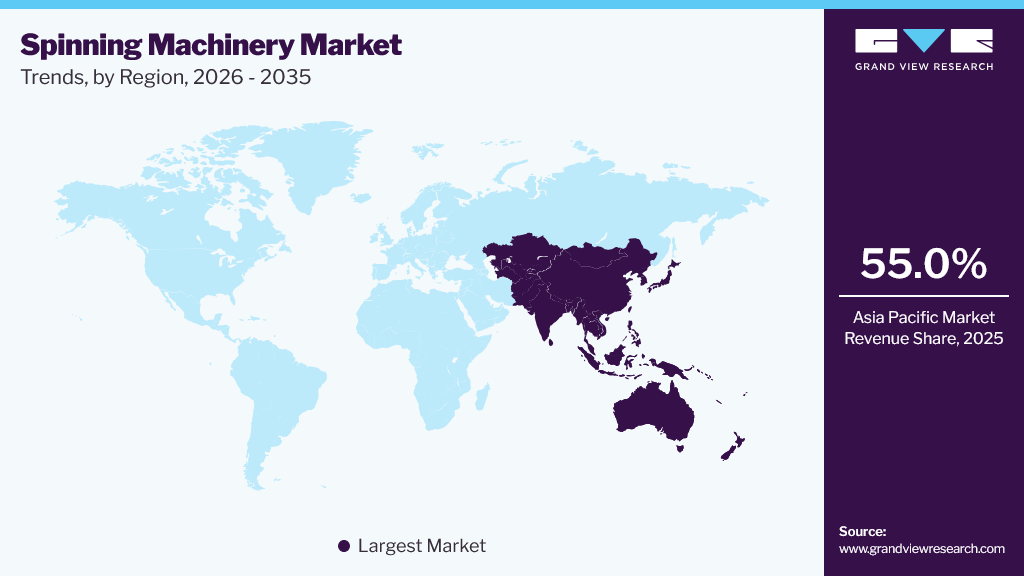
Asia Pacific spinning machinery industry dominated the market and accounted for the largest revenue share of approximately 55.0% in 2025. The region's leadership is attributed to the presence of major textile and apparel manufacturing hubs in China, India, Bangladesh, and Vietnam, along with abundant raw material availability and competitive manufacturing costs. Rising investments in modern spinning mills, expanding textile exports, and supportive government initiatives continue to drive the adoption of advanced spinning machinery across the region. For instance, in February 2025, Oerlikon Manmade Fibers Solutions highlighted India's expanding man-made fiber industry during its Innovation and Technology Day in Daman, showcasing its latest Oerlikon Barmag and Neumag spinning technologies while emphasizing significant investments in fiber production capacity and digital spinning solutions. These developments are expected to strengthen the region's leadership in advanced textile manufacturing and spinning machinery adoption.
 To learn more about this report, Download Free Sample Report
North America Spinning Machinery Market Trends
North America spinning machinery industry is expected to register the fastest CAGR during the forecast period. The region is witnessing increasing investments in advanced textile manufacturing technologies, automation, and sustainable production practices to improve operational efficiency and competitiveness. Growing demand for technical textiles, industrial fabrics, and high-performance specialty textiles is encouraging manufacturers to upgrade existing spinning infrastructure with digitally integrated and energy-efficient machinery. In addition, rising adoption of Industry 4.0 technologies, increasing reshoring initiatives, and continuous investments in innovation are expected to support long-term market growth across the region.
Key Spinning Machinery Company Insights
The global spinning machinery industry is characterized by the presence of well-established international and regional manufacturers competing through product innovation, technological advancements, strategic partnerships, acquisitions, and capacity expansion. Leading companies are focusing on developing automated, energy-efficient, and digitally integrated spinning solutions to improve yarn quality, enhance production efficiency, and reduce operating costs. Market participants are also investing in research and development, expanding their global distribution networks, and strengthening after-sales services to address the evolving requirements of textile manufacturers. In addition, the growing emphasis on sustainable textile production and Industry 4.0-enabled manufacturing is encouraging companies to introduce intelligent spinning systems and strengthen their competitive position in the global market.
Key Spinning Machinery Companies:
The following key companies have been profiled for this study on the spinning machinery market:
-
Rieter
-
Saurer Intelligent Technology AG
-
Trützschler Group SE
-
Murata Machinery, Ltd.
-
TOYOTA INDUSTRIES CORPORATION
-
LMW Limited
-
SAVIO SPA
-
Marzoli Machines Textile S.r.l.
-
Jingwei Textile Machinery Co., Ltd.
-
ZHEJIANG RIFA TEXTILE MACHINERY CO., LTD.
Recent Developments
-
In January 2025, Siemens partnered with Spinnova to deploy its Siemens Xcelerator automation and digital twin technologies at the Woodspin production facility in Finland, enabling industrial-scale sustainable fiber manufacturing, improving production efficiency, and supporting the digital transformation of textile manufacturing.
-
In December 2024, IFC invested USD 50 million in Küçükçalık Group to expand its yarn spinning capacity, establish a textile recycling facility, build a polyester chip manufacturing plant, and enhance renewable energy use, supporting sustainable textile manufacturing in Türkiye.
Spinning Machinery Market Report Scope
Report Attribute
Details
Market size in 2025
USD 5.7 billion
Estimated market size in 2026
USD 6.0 billion
Projected market size by 2035
USD 9.2 billion
Growth rate
CAGR of 4.9% from 2026 to 2035
Base year for estimation
2025
Historical data
2021 – 2024
Forecast period
2026 – 2035
Quantitative units
Revenue in USD billion and CAGR from 2026 to 2035
Report coverage
Revenue forecast, company ranking, competitive landscape, growth factors, and trends
Segments covered
Type, material, end use, region
Regional Scope
North America; Europe; Asia Pacific; Latin America; Middle East & Africa
Country Scope
U.S.; Canada; Mexico; UK; Germany; France; Italy; Spain; China; Japan; India; Australia; South Korea; Brazil; Argentina; South Africa; Saudi Arabia; UAE
Key companies profiled
Rieter; Saurer Intelligent Technology AG; Trützschler Group SE; Murata Machinery, Ltd.; TOYOTA INDUSTRIES CORPORATION; LMW Limited; SAVIO SPA; Marzoli Machines Textile S.r.l.; Jingwei Textile Machinery Co., Ltd.; ZHEJIANG RIFA TEXTILE MACHINERY CO., LTD.
Customization scope
Free report customization (equivalent to 8 analyst working days) with purchase. Addition or alteration to country, regional & segment scope.
Pricing and purchase options
Avail of customized purchase options to meet your exact research needs. Explore purchase options
Global Spinning Machinery Market Report Segmentation
This report forecasts revenue growth at the global, regional, and country levels and provides an analysis of the latest industry trends and opportunities across each sub-segment from 2021 to 2035. For this study, Grand View Research has segmented the global spinning machinery market report based on type, material, end use, and region:
-
Type Outlook (Revenue, USD Billion, 2021 - 2035)
-
Ring Spinning
-
Rotor Spinning
-
-
Material Outlook (Revenue, USD Billion, 2021 - 2035)
-
Natural
-
Synthetic
-
Others
-
-
End Use Outlook (Revenue, USD Billion, 2021 - 2035)
-
Clothing
-
Textile
-
Others
-
-
Regional Outlook (Revenue, USD Billion, 2021 - 2035)
-
North America
-
U.S.
-
Canada
-
Mexico
-
-
Europe
-
UK
-
Germany
-
France
-
Italy
-
Spain
-
-
Asia Pacific
-
China
-
Japan
-
India
-
Australia
-
South Korea
-
-
Latin America
-
Brazil
-
Argentina
-
-
Middle East and Africa (MEA)
-
South Africa
-
Saudi Arabia
-
UAE
-
-
Frequently Asked Questions About This Report
The global spinning machinery market size was valued at USD 5.7 billion in 2025 and is estimated at USD 6.0 billion for 2026.
The global spinning machinery market is expected to grow at a CAGR of 4.9% from 2026 to 2035, reaching USD 9.2 billion.
Asia Pacific dominated with an approximately 55.0% revenue share in 2025.
The ring spinning segment accounted for the largest revenue share of approximately 65.0% in 2025.
Key players in the market include Rieter, Saurer Intelligent Technology AG, Trützschler Group SE, Murata Machinery, Ltd., TOYOTA INDUSTRIES CORPORATION, LMW Limited, SAVIO SPA, Marzoli Machines Textile S.r.l., Jingwei Textile Machinery Co., Ltd., ZHEJIANG RIFA TEXTILE MACHINERY CO., LTD., and others.
About the Author(s)
Conventional Energy Research Team
Energy & Power · Conventional EnergyThis report was authored by the conventional energy research team at Grand View Research - comprising two research analysts, one senior research analyst, and one industry expert - with specialized expertise in the conventional energy segment of the energy & power industry. All findings are based on proprietary energy & power databases, executive interviews, and regulatory analysis, subject to internal peer review prior to publication.
Last Updated:
Speak to Analyst

Customize this report to your needs - add regions, segments, or data points, with 20% free customization.
Or view our licence options:


ISO 9001:2015 & 27001:2022 Certified
We are GDPR and CCPA compliant! Your transaction & personal information is safe and secure. For more details, please read our privacy policy.


