
- Home
- »
- Next Generation Technologies
- »
-
Sports Management Software Market Size Report 2026-2033GVR Report cover

Sports Management Software Market (2026 - 2033)
Size, Share & Trends Analysis Report By Component (Software, Services), By Deployment (Cloud, On-premise), By Application(Team & Player Management, Event Scheduling & Management, Marketing & Promotion), By End Use, And Segment Forecasts
Market Size, 2025
$4.3BMarket Estimate, 2026
$4.9BMarket Forecast, 2033
$14.8BCAGR, 2026–2033
17.1%Sports Management Software Market Summary
The global sports management software market size was valued at USD 4.3 billion in 2025 and is projected to grow from USD 4.9 billion in 2026 to USD 14.8 billion by 2033, at a CAGR of 17.1% from 2026 to 2033. North America dominated the global market with the largest revenue share of 34.8% in 2025. The market growth is primarily driven by the increasing digitalization of sports operations, rising demand for data-driven decision-making, and the growing need for efficient team, league, and event management.
 Source: Grand View Research, IR Documents, Primary Interviews, Paid DatabasesTo learn more about this report,
 Download Free Sample Report
 Key Market Trends & Insights
- By component: Software segment led the market with the largest revenue share of 74.8% in 2025.
- By deployment: Cloud segment accounted for the largest market revenue share in 2025.
- By application: Marketing & promotion segment is expected to grow at the fastest CAGR during forecast period.
Regional Highlights
- Largest regional market: North America (34.8% revenue share, 2025)
- Fastest-growing regional market: Asia Pacific (highest CAGR, 2026-2033)
- By country: The U.S. sports management software market held the largest share of North America in 2025.
Market Size & Forecast
- Market size in 2025: USD 4.3 Billion
- Estimated market size in 2026: USD 4.9 Billion
- Projected market size by 2033: USD 14.8 Billion
- CAGR (2026-2033): 17.1%
Three ways to get this report
Buy it, customize it, or ask a question.Ask an Analyst
Analyst response in 1 business day
- AccessReport author, directly
- Reply timeWithin 1 working day
- No sales callDirect answer only
- FormatEmail reply
- CostFree, no cost
Get the Full Report
What the study covers
- FormatsPDF · Excel · Dashboard
- Timeline2026–2033 annual, 2025 base
- Coverage20+ countries, 5 regions
- Companies10+ key players profiled
Customize the Report
20% free customization
- IncludeCountries, segments, points
- TailorTo your product definition
- ExtendDeeper competitor detail
- OrA fully bespoke study
- Turnaround5–10 working days
The expansion of grassroots and amateur sports, along with the commercialization of professional sports, is further accelerating adoption. Organizations are increasingly relying on software solutions to streamline scheduling, player performance tracking, fan engagement, and financial management. The growing focus on data analytics in sports is a key factor supporting market expansion. Teams, clubs, and organizations are adopting advanced analytics tools to gain insights into player performance, injury prevention, and game strategies. These platforms help coaches and management make informed decisions, improving overall team efficiency and competitiveness. Moreover, real-time data tracking and performance monitoring are becoming essential, especially in professional sports, where even minor improvements can significantly impact outcomes.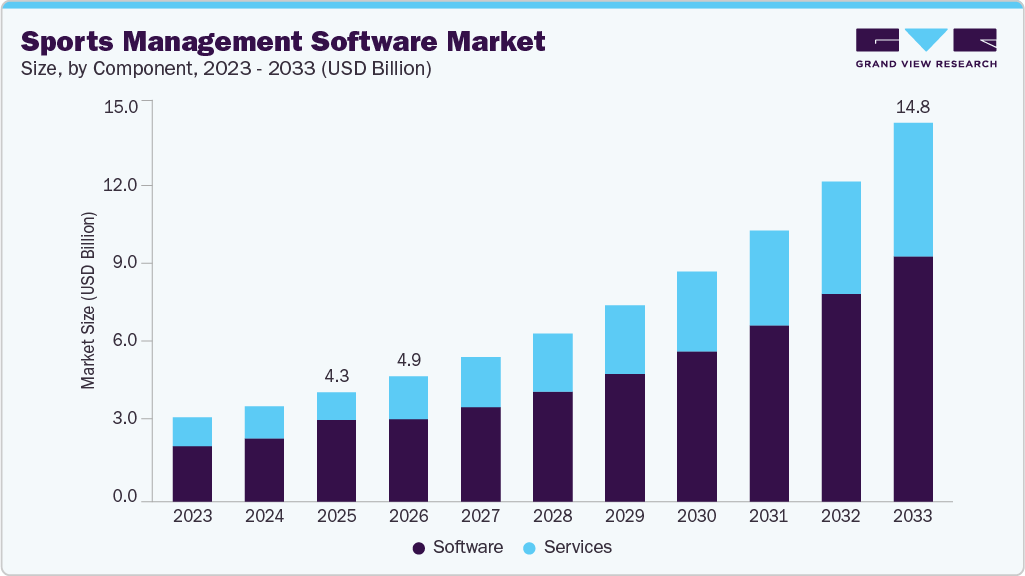 To learn more about this report, Download Free Sample Report
 The increasing need for operational efficiency and automation across sports organizations drives the market growth. Managing multiple functions such as team coordination, event scheduling, financial tracking, and compliance manually can be complex and time-consuming. Sports management software helps automate these processes, reduce administrative burden, and minimize errors. This allows organizations to focus more on performance and strategic activities rather than routine tasks.
The expansion of sports infrastructure and rising participation across schools, universities, and fitness institutions are also contributing to market growth. Educational institutions and training academies are increasingly adopting sports management software to efficiently handle registrations, scheduling, and performance tracking. In addition, government initiatives promoting sports development and healthy lifestyles are supporting the adoption of digital solutions. As the ecosystem becomes more structured and competitive, the demand for integrated and user-friendly management platforms is expected to continue growing over the forecast period.
Furthermore, the integration of advanced technologies such as artificial intelligence and machine learning is enhancing the capabilities of sports management platforms. These technologies enable predictive analytics, automated reporting, and smarter decision-making. For instance, AI-powered tools can help forecast ticket sales, optimize training schedules, and identify performance patterns. As organizations continue to prioritize efficiency, accuracy, and strategic insights, the demand for technologically advanced and automated solutions is expected to rise steadily.
Component Insights
The software segment led the market with the largest revenue share of 74.8% in 2025. This dominance is primarily driven by the growing demand for integrated platforms that streamline core operations, including team management, scheduling, performance analytics, and fan engagement. Organizations are prioritizing centralized software solutions to replace manual processes and improve efficiency, accuracy, and decision-making. In addition, the rising adoption of data analytics tools, mobile-based applications, and cloud-enabled software is further accelerating segment growth. The need for real-time data access, enhanced user experience, and scalability across professional teams, leagues, and educational institutions continues to support the strong demand for software solutions in the market.
The services segment is anticipated to grow at the fastest CAGR during the forecast period, driven by the increasing demand for implementation, integration, consulting, and support services across sports organizations. As organizations adopt advanced sports management software, they require specialized services to ensure seamless deployment, customization, and system integration with existing platforms. In addition, the growing complexity of software solutions and the need for continuous updates, maintenance, and technical support are further fueling demand. The rising preference for cloud-based solutions is also contributing to segment growth, as organizations seek managed services to optimize performance and ensure data security. Furthermore, the need for training and consulting services to maximize software utilization and improve operational efficiency is expected to accelerate the growth of the services segment.
Deployment Insights
The cloud segment accounted for the largest market revenue share in 2025 and is projected to grow at the fastest CAGR during the forecast period, driven by its scalability, cost-effectiveness, and ease of deployment. Organizations are increasingly adopting cloud-based solutions to eliminate the need for heavy upfront infrastructure investments and to enable remote access to data and applications. The growing demand for real-time data management, seamless team collaboration, and centralized platforms is further driving segment growth. In addition, cloud deployment allows for automatic updates, enhanced data security, and easy integration with advanced technologies such as analytics and mobile applications. The rising adoption among small and medium-sized sports organizations, along with the increasing shift toward digital transformation, continues to strengthen the demand for cloud-based solutions.
The on-premise segment is expected to register at a significant CAGR from 2026 to 2033, driven by the growing need for enhanced data security, control, and customization among large sports organizations and professional leagues. Many organizations prefer on-premise deployment to maintain full ownership of sensitive data, including player performance metrics, financial records, and strategic information. In addition, the ability to customize software according to specific operational requirements and integrate it with legacy systems is a key factor supporting adoption. Concerns related to data privacy, regulatory compliance, and limited reliance on internet connectivity further contribute to the demand for on-premise solutions. As organizations with complex infrastructures seek greater control and reliability, the segment is expected to witness growth over the forecast period.
Application Insights
The team & player management segment accounted for the largest market revenue share in 2025. This dominance was mainly due to the increasing need for efficient handling of player data, performance tracking, and team coordination. Sports organizations are adopting advanced software solutions to monitor player fitness, analyze performance metrics, manage training schedules, and reduce the risk of injuries. The growing focus on data-driven decision-making in both professional and amateur sports is a key factor supporting segment growth. In addition, the need for centralized platforms to manage player profiles, contracts, and communication among coaches, staff, and athletes is further accelerating adoption. As competition intensifies and performance optimization becomes critical, the demand for comprehensive team and player management solutions continues to rise.
The marketing & promotion segment is expected to register at the fastest CAGR from 2026 to 2033, driven by the increasing focus on fan engagement, digital marketing strategies, and revenue generation. Sports organizations are increasingly leveraging software solutions to manage targeted campaigns, social media engagement, sponsorship activities, and personalized fan experiences. The growing use of data analytics to understand fan behavior and optimize marketing efforts is a key factor supporting segment growth. In addition, the rise of mobile applications, online ticketing platforms, and content streaming is enabling organizations to reach wider audiences and enhance brand visibility. As competition for audience attention intensifies, the demand for advanced marketing and promotion tools is expected to grow significantly.
End Use Insights
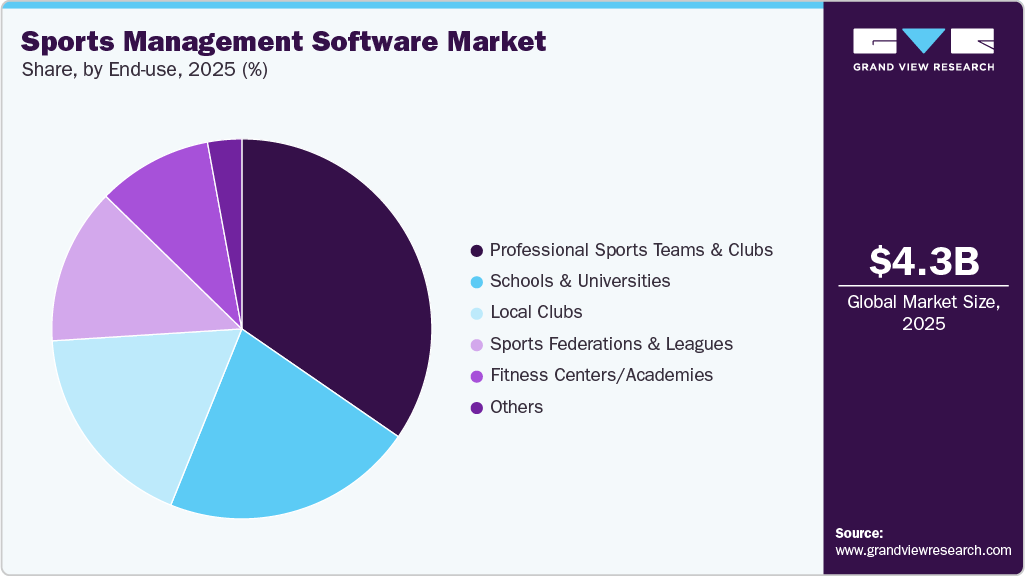
The professional sports teams & clubs segment accounted for the largest market revenue share in 2025, driven by the increasing need for advanced performance optimization, strategic decision-making, and comprehensive operational control. Professional teams are heavily investing in sophisticated software solutions to gain competitive advantages through detailed analytics, scouting insights, and injury prevention systems. In addition, the high volume of data generated across training, matches, and player health requires strong platforms for real-time processing and analysis.
 To learn more about this report, Download Free Sample Report
 The growing commercial aspects of professional sports, including sponsorship management, media rights, and revenue tracking, are further accelerating adoption. Furthermore, the need for seamless coordination across multiple departments, such as coaching, medical, and management teams, is strengthening the demand for integrated and high-performance sports management software solutions in this segment.
The local clubs segment is anticipated to register at the fastest CAGR during the forecast period. This growth is driven by the rapid growth in community-level sports participation and the increasing need for organized management of club operations. Local clubs are increasingly adopting sports management software to streamline activities such as player registration, scheduling, communication, and fee collection. Limited administrative resources and the need to reduce manual workload are key factors accelerating adoption. In addition, the availability of affordable, cloud-based solutions tailored for small organizations is further supporting growth. The rising focus on grassroots sports development and community engagement, along with growing digital awareness, is expected to drive strong demand for efficient, user-friendly management platforms in this segment.
Regional Insights
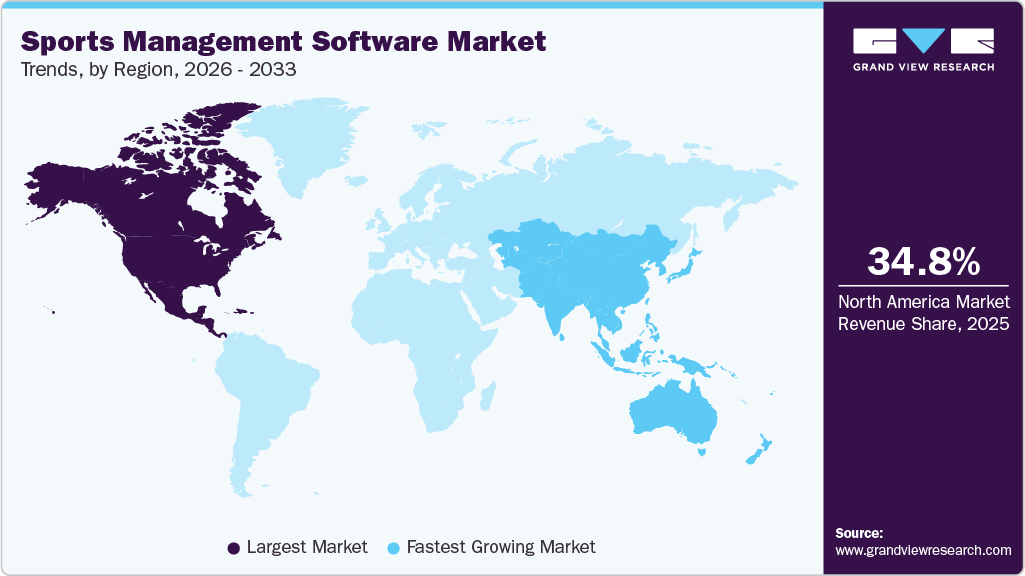
North America dominated the global sports management software market with the largest revenue share of 34.8% in 2025. The market growth is mainly driven by the strong presence of professional sports leagues, increasing investment in sports technology, and the widespread adoption of data analytics and cloud-based solutions across organizations. In addition, high digital maturity, advanced infrastructure, and the growing focus on fan engagement and performance optimization are key factors supporting growth in North America. The increasing participation in youth and community sports programs is also accelerating the demand for efficient management solutions.
 To learn more about this report, Download Free Sample Report
 U.S. Sports Management Software Market Trends
The sports management software market in the U.S. accounted for the largest market revenue share in 2025. The growth is primarily driven by the strong presence of established sports leagues, increasing adoption of advanced technologies such as data analytics and cloud computing, and the rising demand for efficient team, event, and fan management solutions.
For instance, in Oct 2024, the California government launched the 25×25 Coaches Challenge, aiming to train 25,000 youth coaches across the state to enhance sports participation, inclusivity, and overall athlete development. This initiative highlights the region’s strong focus on structured sports development and grassroots engagement, which directly drives the adoption of sports management software to organize training programs, track performance, and manage large-scale participation. As similar initiatives continue to emerge across the U.S., the demand for integrated, scalable, and data-driven sports management platforms is expected to grow steadily.
Asia Pacific Sports Management Software Market Trends
The sports management software market in the Asia Pacific is expected to grow at the fastest CAGR from 2026 to 2033. The growth is primarily driven by the rapid digitalization of the sports industry, increasing investments in sports infrastructure, and the rising popularity of sports across countries such as China, India, and Japan. Governments and private organizations are promoting sports participation and developing stadiums, training centers, and leagues, which is increasing the need for efficient management solutions. The surge in grassroots sports programs and large-scale sporting events across the region is also accelerating the demand for integrated and scalable sports management software solutions.
The India sports management software market held a significant share in the Asia Pacific in 2025. The growth is driven by increasing digital adoption across sports organizations, rapid expansion of sports leagues and grassroots programs, and rising investments in sports infrastructure. The growing penetration of smartphones, cloud technologies, and AI-based analytics is enabling organizations to streamline operations, enhance player performance tracking, and improve fan engagement. In addition, government initiatives promoting sports development, along with the increasing popularity of multiple sports beyond cricket, are supporting market growth. The rise of esports, online platforms, and data-driven training approaches is further accelerating the adoption of sports management software across professional teams, academies, and local clubs in the country.
Europe Sports Management Software Market Trends
The sports management software industry in Europe is anticipated to grow steadily from 2026 to 2033, driven by the strong presence of established sports clubs and leagues, increased regulatory focus on data management, and the growing adoption of digital platforms to improve operational efficiency. Sports organizations across the region are emphasizing the structured management of teams, events, and facilities, driving demand for integrated software solutions. In addition, the growing adoption of performance analytics, athlete monitoring systems, and digital ticketing platforms is driving market growth.
The UK sports management software market is expected to grow at a significant CAGR during the forecast period. The growth is driven by the country’s highly organized sports ecosystem and increasing investment in sports technology innovation. The widespread use of digital platforms by clubs, academies, and educational institutions to manage operations and enhance fan engagement is further supporting market expansion. In addition, the growing popularity of multiple sports, along with the integration of analytics and wearable technologies for performance tracking, is accelerating software adoption.
Key Sports Management Software Company Insights
Some prominent players in the sports management software industry include ACTIVE Network, LLC, Arbiter, CourtReserve.com, JerseyWatch, Jonas Club Software, among others.
-
ACTIVE Network, LLC is a U.S.-based multinational SaaS company founded in 1999 and headquartered in Dallas, Texas, that specializes in activity and participant management solutions for sports, events, and recreation organizations. The company offers a comprehensive cloud-based platform, such as ACTIVENet, ACTIVEWorks, and Camp & Class Manager, that enables online registration, payment processing, scheduling, marketing, data analytics, and membership management for leagues, clubs, camps, and sports facilities. ACTIVE Network operates globally across more than 100 countries and supports tens of thousands of organizations, engaging millions of participants through its marketplace and software ecosystem.
-
Jonas Club Software is a Canada-based SaaS company that specializes in delivering integrated software solutions for private clubs, golf clubs, resorts, and other member-centric organizations. The company provides a comprehensive suite of over 60 applications covering membership management, scheduling, event management, point-of-sale, accounting, and member engagement, all designed to streamline operations and enhance the customer experience. It serves more than 2,300 clubs across 20+ countries, offering tailored and fully integrated systems supported by strong service and long-term client partnerships.
Key Sports Management Software Companies:
The following key companies have been profiled for this study on the sports management software market.
- ACTIVE Network, LLC
- Arbiter
- CourtReserve.com
- JerseyWatch
- Jonas Club Software
- LeagueApps
- MonClubSportif
- Sportdata Gmbh & CO KG
- SportsEngine, LLC.
- SquadFusion
- Stack Sports
- TeamSideline.com
- TeamSnap, Inc.
- Virtuagym
- Xplor Technologies
Recent Developments
-
In June 2025, Stack Sports announced a strategic merger with PlayMetrics to create a leading global sports management software platform. This combination integrates PlayMetrics’ modern club and league operating system with Stack Sports’ large-scale SaaS infrastructure and global reach, enabling a more comprehensive, end-to-end solution for sports organizations, including clubs, leagues, tournaments, and governing bodies. The merged entity is supported by Genstar Capital, which became the majority owner.
Sports Management Software Market Report Scope
Report Attribute
Details
Market size in 2025
USD 4.3 billion
Estimated Market size in 2026
USD 4.9 billion
Projected Market size by 2033
USD 14.8 billion
Growth rate
CAGR of 17.1% from 2026 to 2033
Base year for estimation
2025
Historical data
2021 - 2024
Forecast period
2026 - 2033
Quantitative units
Revenue in USD million/billion, and CAGR from 2026 to 2033
Report coverage
Revenue forecast, company share, competitive landscape, growth factors, and trends
Segments covered
Component, deployment, application, end use, region
Regional scope
North America; Europe; Asia Pacific; Latin America; Middle East & Africa
Country scope
U.S.; Canada; Mexico UK; Germany; France; China; India; Japan; Australia; South Korea; Brazil; UAE; Saudi Arabia; and South Africa
Key companies profiled
ACTIVE Network, LLC; Arbiter; CourtReserve.com; JerseyWatch; Jonas Club Software; LeagueApps; MonClubSportif; Sportdata Gmbh & CO KG; SportsEngine, LLC.; SquadFusion; Stack Sports; TeamSideline.com; TeamSnap, Inc.; Virtuagym; Xplor Technologies
Customization scope
Free report customization (equivalent to 8 analysts working days) with purchase. Addition or alteration to country, regional & segment scope.
Pricing and purchase options
Avail customized purchase options to meet your exact research needs. Explore purchase options
Global Sports Management Software Market Report Segmentation
This report forecasts revenue growth at global, regional, and country levels and provides an analysis of the latest industry trends in each of the sub-segments from 2021 to 2033. For this study, Grand View Research has segmented the global sports management software market report based on component, deployment, application, end use, and region.
-
Component Outlook (Revenue, USD Million, 2021 - 2033)
-
Software
-
Services
-
-
Deployment Outlook (Revenue, USD Million, 2021 - 2033)
-
Cloud
-
On-premise
-
-
Application Outlook (Revenue, USD Million, 2021 - 2033)
-
Team & Player Management
-
Event Scheduling & Management
-
Marketing & Promotion
-
Financial & Payment Management
-
Others
-
-
End Use Outlook (Revenue, USD Million, 2021 - 2033)
-
Professional Sports Teams & Clubs
-
Schools & Universities
-
Local Clubs
-
Sports Federations & Leagues
-
Fitness Centers / Academies
-
Others
-
-
Regional Outlook (Revenue, USD Million, 2021 - 2033)
-
North America
-
U.S.
-
Canada
-
Mexico
-
-
Europe
-
Germany
-
UK
-
France
-
-
Asia Pacific
-
China
-
India
-
Japan
-
South Korea
-
Australia
-
-
Latin America
-
Brazil
-
-
Middle East & Africa
-
UAE
-
Saudi Arabia
-
South Africa
-
-
Frequently Asked Questions About This Report
The global sports management software market size was valued at USD 4.3 billion in 2025 and is expected to reach USD 4.9 billion in 2026.
The global sports management software market is expected to grow at a compound annual growth rate of 17.1% from 2026 to 2033 to reach USD 14.8 billion by 2033.
The software segment accounted for the largest revenue share in 2025 in the sports management software market, driven by the increasing demand for integrated platforms that streamline core operations such as team management, scheduling, performance analytics, and fan engagement.
Some key players operating in the market include ACTIVE Network, LLC; Arbiter; CourtReserve.com; JerseyWatch; Jonas Club Software; LeagueApps; MonClubSportif; Sportdata Gmbh & CO KG; SportsEngine, LLC.; SquadFusion; Stack Sports; TeamSideline.com; TeamSnap, Inc.; Virtuagym; Xplor Technologies, and Others
North America dominated the global market with the largest revenue share of 34.8% in 2025.
The software segment led the market with the largest revenue share of 74.8% in 2025.
The cloud segment accounted for the largest market revenue share in 2025.
The professional sports teams & clubs segment accounted for the largest market revenue share in 2025.
The team & player management segment accounted for the largest market revenue share in 2025.
Key factors include the increasing commercialization of sports, rising adoption of data analytics for performance tracking, growing demand for fan engagement solutions, and the digital transformation of sports organizations, which play a key role in accelerating the sports management software market.
About the Author(s)
Next Generation Technologies Research Team
Technology · Next Generation TechnologiesThis report was authored by the next generation technologies research team at Grand View Research - comprising two research analysts, one senior research analyst, and one industry expert - with specialized expertise in the next generation technologies segment of the technology industry. All findings are based on proprietary technology databases, executive interviews, and regulatory analysis, subject to internal peer review prior to publication.
Last Updated:
Speak to Analyst

Customize this report to your needs - add regions, segments, or data points, with 20% free customization.
Or view our licence options:


ISO 9001:2015 & 27001:2022 Certified
We are GDPR and CCPA compliant! Your transaction & personal information is safe and secure. For more details, please read our privacy policy.


