
- Home
- »
- Next Generation Technologies
- »
-
Spot Welding Robots Market Size, Share Report, 2026-2033GVR Report cover

Spot Welding Robots Market (2026 - 2033)
Size, Share & Trends Analysis Report By Robot (Articulated Robots, Collaborative Robots), By Welding Technology, By Payload Capacity, By End Use (Automotive, Electronics & Electrical), By Region, and Segment Forecasts
Market Size, 2025
$4.2BMarket Estimate, 2026
$4.5BMarket Forecast, 2033
$7.9BCAGR, 2026–2033
8.2%Spot Welding Robots Market Summary
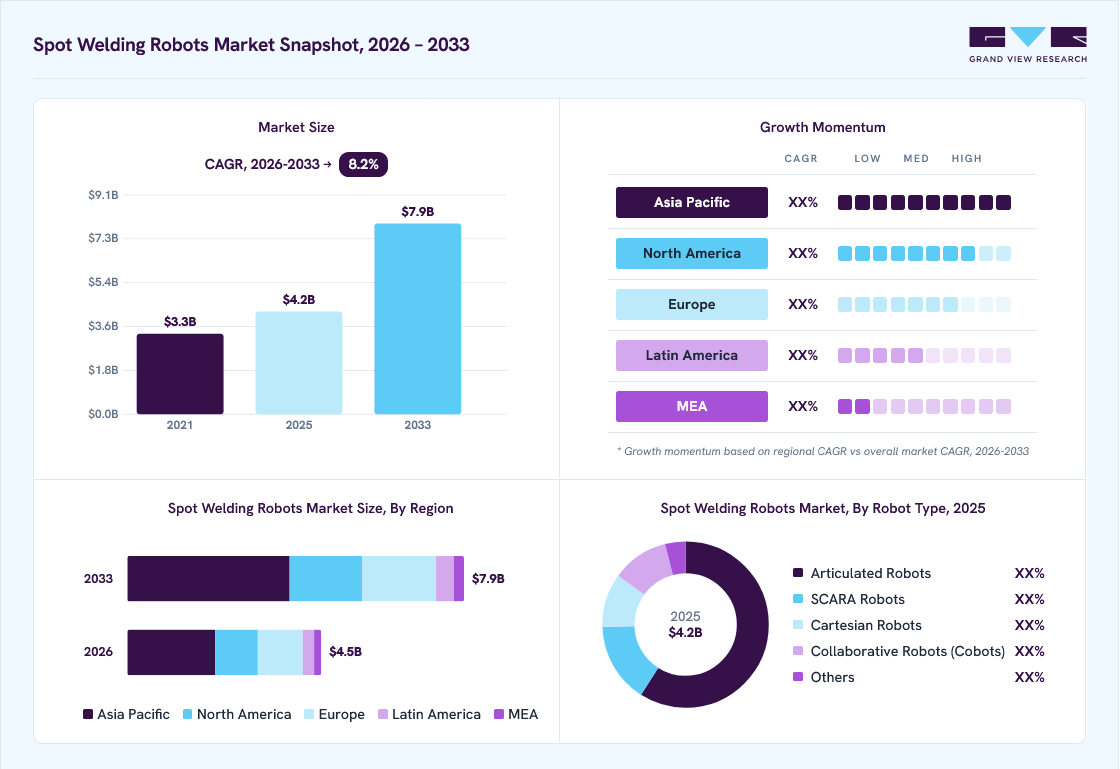
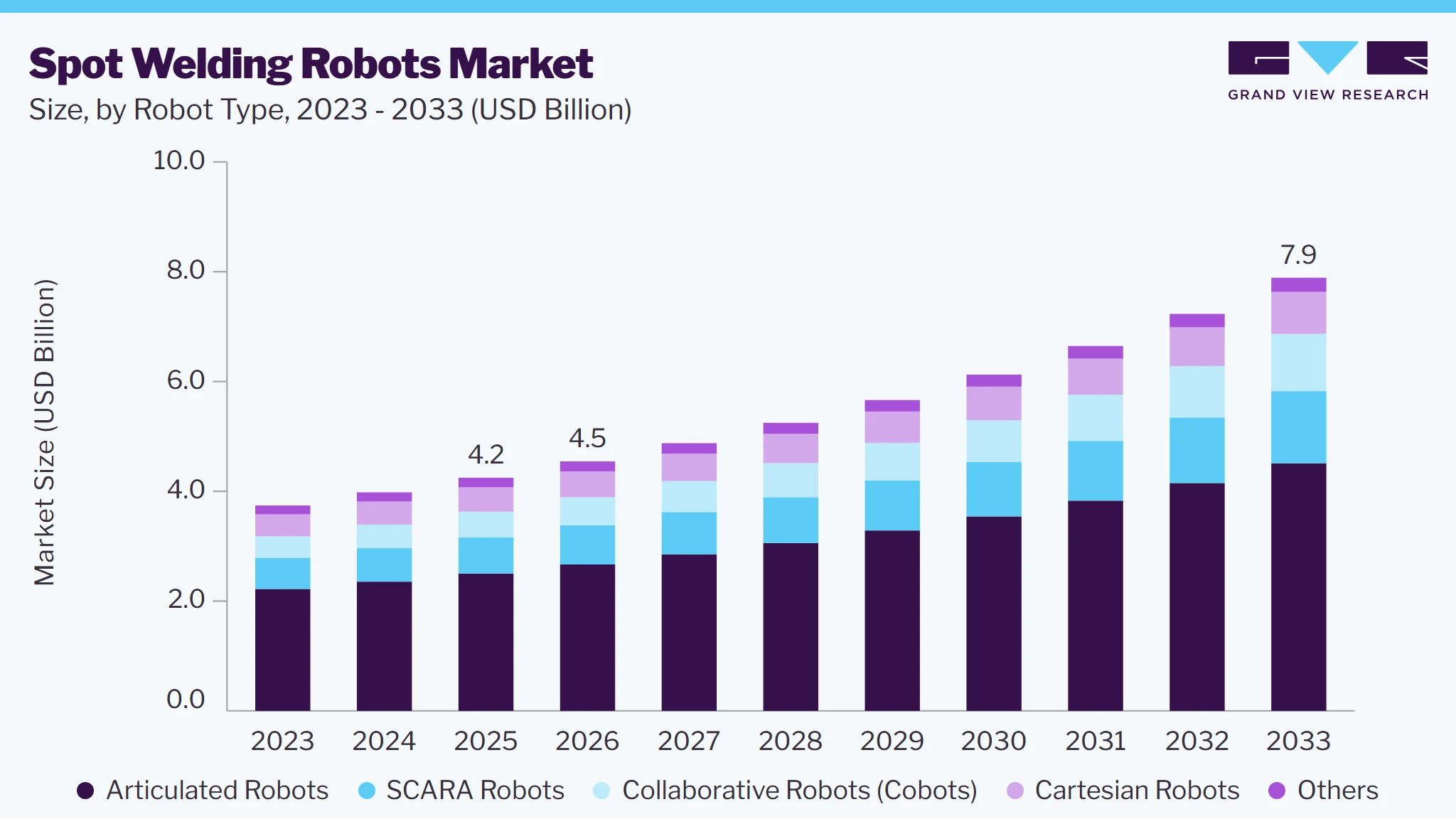
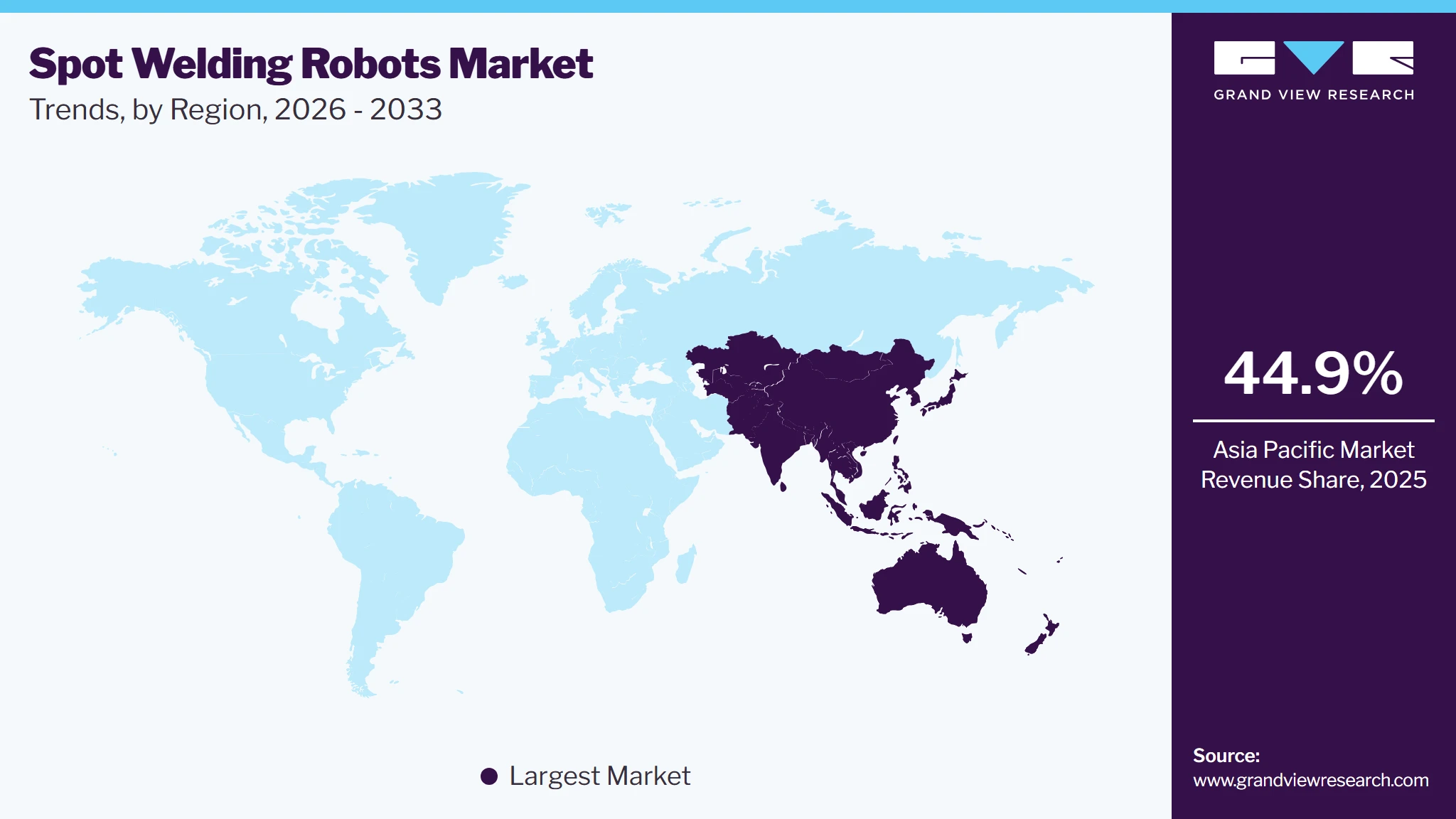
The global spot welding robots market size was valued at USD 4.2 billion in 2025 and is projected to grow from USD 4.5 billion in 2026 to USD 7.9 billion by 2033, at a CAGR of 8.2% from 2026 to 2033. Asia Pacific dominated the market, accounting for a revenue share of 44.9% in 2025. The market growth is driven by rising EV production and automation in automotive manufacturing, increasing demand for high-speed, consistent weld quality, and growing adoption of robotic welding in smart factories.
 Source: Grand View Research, IR Documents, Primary Interviews, Paid DatabasesTo learn more about this report,
 Download Free Sample Report
 Key Market Trends & Insights
- By robot: The articulated robots segment held the largest market share of around 58.9% in 2025.
- By welding technology: The resistance spot welding segment held the largest market revenue share of 74.9% in 2025.
- By payload capacity: The 151–300 kg segment led the market with the largest revenue share in 2025.
- By end use: The automotive segment held the largest market revenue share in 2025.
Regional Highlights
- Largest regional market: Asia Pacific (44.9% revenue share, 2025)
- Leading country: China held the largest share in 2025
Market Size & Forecasts
- Market size in 2025: USD 4.2 Billion
- Estimated market size in 2026: USD 4.5 Billion
- Projected market size by 2033: USD 7.9 Billion
- CAGR (2026-2033): 8.2%
Three ways to get this report
Buy it, customize it, or ask a question.Ask an Analyst
A direct answer, usually in 1 working day
- AccessReport author, directly
- Reply timeWithin 1 working day
- No sales callDirect answer only
- FormatEmail reply
- CostFree, no cost
Get the Full Report
What the study covers
- FormatsPDF · Excel · Dashboard
- Timeline2026–2033 annual, 2025 base
- Coverage20+ countries, 5 regions
- Companies10+ key players profiled
Customize the Report
20% free customization
- IncludeCountries, segments, points
- TailorTo your product definition
- ExtendDeeper competitor detail
- OrA fully bespoke study
- Turnaround5–10 working days
The expansion of automated body-in-white assembly, lightweight vehicle structures, battery enclosures, and multi-material joining is further accelerating demand for spot welding robots. The growth of the spot welding robots industry is driven by the increasing adoption of automated body-in-white manufacturing, rising demand for flexible robotic welding systems, and growing emphasis on weld quality and production traceability. The integration of adaptive welding controls, machine vision, AI-based defect detection, predictive maintenance, real-time process monitoring, and Industry 4.0 connectivity is further encouraging manufacturers to deploy intelligent spot welding robots to improve weld consistency, minimize downtime, reduce defects, and support zero-defect manufacturing.The increasing adoption of electric vehicles (EVs), battery-electric platforms, and lightweight vehicle architectures is strengthening demand for spot welding robots. Automotive manufacturers are increasingly automating body-in-white production, battery enclosure assembly, and structural component joining to achieve precise weld placement and shorter cycle times. The expansion of EV production facilities, localized vehicle manufacturing, and high-volume automated assembly lines is enabling robot manufacturers to develop higher-speed welding systems capable of handling lightweight alloys, complex body structures, and demanding production schedules.
 To learn more about this report, Download Free Sample Report
 In addition, the growing emphasis on automated weld quality control, production traceability, and operational consistency is accelerating investment in robotic spot welding systems. Manufacturers are increasingly integrating servo-controlled welding guns, weld-current monitoring, force sensing, machine vision, and real-time process analytics to identify weld deviations and maintain consistent joint quality. These capabilities enable production facilities to reduce rework and scrap, improve first-pass yield, document welding parameters, and maintain tighter quality standards across high-volume manufacturing operations.
Moreover, the increasing integration of Industry 4.0 technologies, digital twins, artificial intelligence, and connected robot controllers is creating new opportunities for spot welding robot manufacturers. Production facilities are incorporating IoT-enabled robots, predictive maintenance, remote diagnostics, simulation software, and automated production scheduling to optimize welding cells and minimize unplanned downtime. Improvements in robotic programming, offline simulation, energy-efficient servo systems, and collaborative automation are also helping manufacturers deploy flexible welding cells more efficiently, supporting faster line changeovers and greater automation across automotive, metal fabrication, appliances, and industrial machinery manufacturing.
Market Dynamics
The market is experiencing significant growth, driven by the increasing automation of automotive body-in-white production, the rising adoption of robotic welding cells, and the growing demand for high-speed, repeatable joining processes. Manufacturers are increasingly deploying articulated robots with servo-controlled welding guns, integrated positioning systems, and programmable welding parameters to improve production throughput and maintain consistent weld quality. The increasing emphasis on lightweight vehicle structures, aluminum components, battery enclosures, and flexible manufacturing lines is encouraging manufacturers to adopt advanced spot welding robots capable of handling complex geometries and changing production requirements.
The increasing deployment of automated production lines, rising demand for consistent weld quality, and greater emphasis on shorter cycle times are driving the adoption of spot welding robots. Robotic systems can perform repetitive weld points with high positioning accuracy and repeatability, while servo-controlled welding guns help optimize electrode force and welding parameters. This enables manufacturers to improve throughput, reduce weld variation, minimize rework, and maintain consistent production performance across demanding high-volume operations.
The shift toward flexible automated welding cells is further supporting demand as manufacturers seek equipment capable of handling different component geometries, material thicknesses, and production configurations. Modern spot-welding robots can integrate multiple axes, welding software, positioners, and process-monitoring capabilities into a coordinated cell. Such configurations allow manufacturers to accommodate model changes, optimize workstation utilization, and maintain repeatable welding performance without relying entirely on manual intervention.
High upfront investment for robotic welding cells remains a major restraint, particularly because deployment costs extend beyond the robot itself to include welding guns, controllers, fixtures, safety systems, positioners, programming, installation, and system integration. These expenditures can make automated spot welding difficult to justify in smaller production facilities or operations with limited production volumes, especially when existing manual processes require comparatively low initial investment.
Integration complexity can further increase implementation costs and deployment time, particularly when robots must interface with legacy equipment or be customized to meet frequently changing production requirements. Programming, fixture alignment, maintenance, and operator training require specialized expertise, while modifications to existing production layouts can cause temporary downtime. These factors can extend investment recovery periods and discourage organizations from replacing established welding processes despite the operational advantages of automation.
The integration of machine vision, AI-based inspection, adaptive welding controls, and real-time process monitoring presents an important opportunity for spot welding robot manufacturers. Intelligent systems can monitor welding parameters, identify process deviations, and adjust operating conditions to maintain consistent weld quality. Combining sensing technologies with robotic controllers can also support early defect detection, reduce rework, and provide greater visibility into welding performance across connected production environments.
Further opportunities arise from integrating spot-welding robots with digital twins, predictive maintenance platforms, offline programming, and connected production management systems. These technologies can enable virtual validation of welding sequences, optimize robot movements, anticipate equipment servicing requirements, and simplify deployment of new production configurations. As manufacturers seek more flexible and data-driven automation, intelligent welding cells can provide greater process visibility, reduce commissioning time, and improve utilization of installed robotic equipment.
Market Concentration & Characteristics
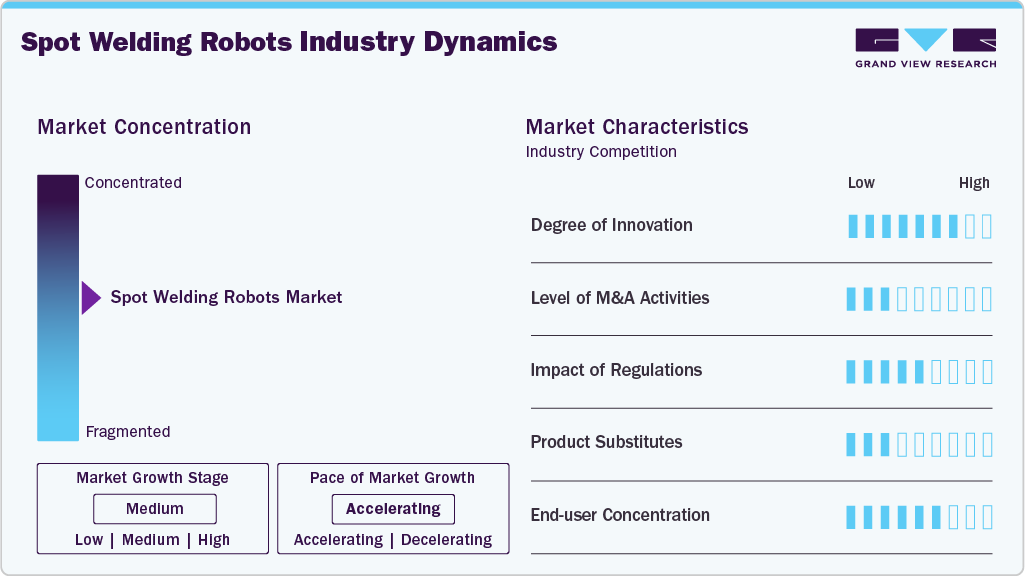
The market for spot welding robots is moderately concentrated, comprising major industrial robotics manufacturers, welding-system providers, automation companies, and specialized robotic integrators competing across automotive body assembly, metal fabrication, appliances, industrial machinery, and other high-volume manufacturing applications. The market is shaped by increasing factory automation, demand for high-speed and repeatable welding, expansion of flexible production lines, and growing adoption of intelligent robotic welding cells. Strategic technology partnerships, system-integration agreements, product development, application-specific solutions, and geographic expansion are enabling companies to strengthen their portfolios and expand their presence across global manufacturing markets.
 To learn more about this report, Download Free Sample Report
 The market is characterized by a high degree of technological innovation, supported by continuous advancements in servo-controlled welding guns, machine vision, adaptive welding, force sensing, AI-assisted quality inspection, predictive maintenance, digital twins, and connected robot controllers. The market witnesses moderate merger and acquisition activity, as established automation and welding companies seek to strengthen robotics, sensing, controls, software, and system-integration capabilities. Competition from manual welding, semi-automated systems, dedicated welding machines, and alternative joining technologies remains relevant, while increasing adoption of Industry 4.0 connectivity, flexible robotic cells, offline programming, real-time monitoring, and collaborative automation continues to strengthen product differentiation and competitive positioning.
Analyst Perspective
The market is advancing through the increasing automation of high-volume joining processes, rising demand for precise and repeatable welds, and growing deployment of flexible robotic production cells. Manufacturers are strengthening welding capabilities through servo-controlled guns, adaptive welding systems, machine vision, real-time process monitoring, offline programming, and intelligent quality inspection. The expansion of connected manufacturing environments, predictive maintenance, digital twins, modular welding cells, and AI-enabled process optimization is encouraging manufacturers to improve throughput, minimize defects, reduce downtime, and achieve greater flexibility across increasingly automated production operations.
Robot Insights
The articulated robots segment accounted for the largest market share of 58.9% in 2025, propelled by rising demand for high-speed automotive assembly, extensive multi-point welding coverage, flexible robot positioning, and consistent weld quality. Manufacturers are increasingly deploying articulated spot-welding robots with access to complex vehicle body geometries, capable of handling large welding guns and performing repetitive welding operations with high precision. Growing electric-vehicle production, flexible manufacturing systems, and increasing automation of body-in-white assembly continue to strengthen the segment’s position in the market.
The collaborative robots (cobots) segment is expected to witness the fastest CAGR of over 10% from 2026 to 2033. The segment is driven by increasing demand for flexible welding automation, compact production cells, safer human-robot collaboration, and accessible automation for smaller manufacturers. Manufacturers are increasingly deploying cobots for low-volume and mixed-model welding applications, integrating force sensing, vision systems, programmable welding parameters, and easy-to-redeploy robotic cells. The growing adoption among small and medium-sized manufacturers, shorter production runs, and demand for cost-efficient automation are expected to accelerate cobot adoption.
Payload Capacity Insights
The 151–300 kg segment accounted for the largest market share of 27.0% in 2025, driven by extensive use in automotive body-in-white production, increasing demand for high payload handling, and deployment of larger welding guns and positioning equipment. Manufacturers are increasingly adopting robots in this capacity range to handle heavy spot-welding guns, longer-reach requirements, multiple welding points, and complex vehicle body structures. Growing electric-vehicle production, heavier battery-related structures, and flexible automotive assembly lines continue to strengthen demand for 151–300 kg spot-welding robots.
The up to 50 kg segment is expected to witness the fastest CAGR from 2026 to 2033, driven by rising demand for compact robotic cells, lightweight welding applications, flexible automation, and space-efficient manufacturing systems. Manufacturers are increasingly deploying lower-payload spot welding robots for smaller components, electrical assemblies, appliances, and precision metal fabrication, where compact footprints and rapid repositioning are important. Growing adoption among small and medium-sized manufacturers, easier integration, lower installation requirements, and demand for flexible production further accelerate the deployment of lightweight spot welding robots.
End Use Insights
The automotive segment accounted for the largest market share of 50.6% in 2025, fueled by increasing vehicle production, rising adoption of automated body-in-white assembly, and growing demand for high-speed, consistent joining operations. Automotive manufacturers are increasingly deploying spot welding robots with servo-controlled welding guns, programmable welding parameters, multi-axis configurations, and integrated quality monitoring to improve weld precision and production throughput. Expanding electric-vehicle manufacturing, lightweight vehicle structures, and flexible production lines continue to strengthen demand for the spot-welding robots industry.
The electronics & electrical segment is expected to witness the fastest CAGR from 2026 to 2033, driven by increasing production of electrical enclosures, switchgear, battery components, connectors, and precision metal assemblies. Manufacturers are increasingly adopting compact spot-welding robots, vision-assisted positioning, programmable welding systems, and flexible robotic cells to achieve consistent weld quality across smaller, increasingly complex components. Growing demand for miniaturized electrical products, automated assembly, rapid product changeovers, and higher manufacturing precision is accelerating the adoption of robotic spot welding solutions.
Welding Technology Insights
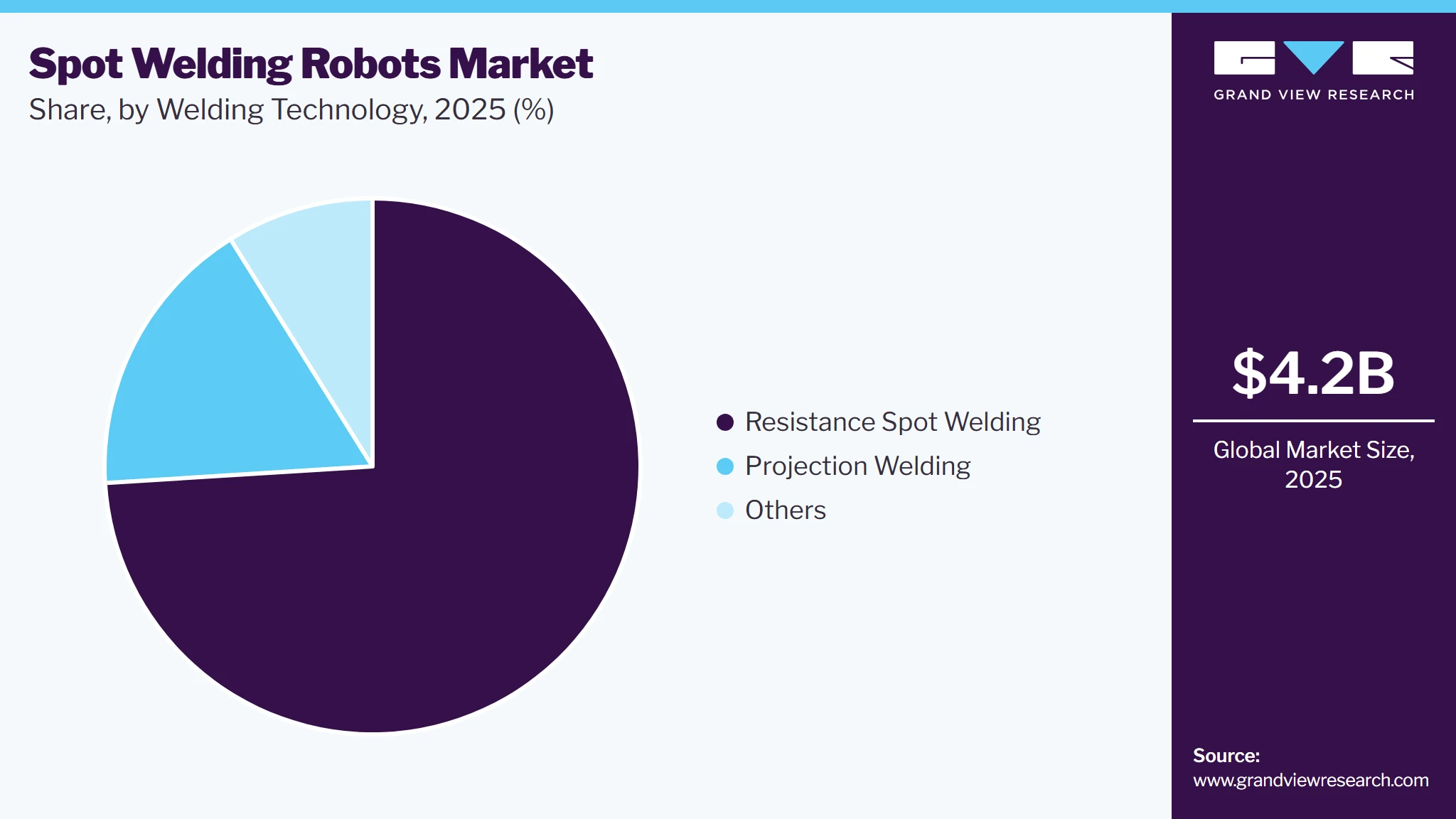
The resistance spot welding segment accounted for the largest market share of 74.0% in 2025, fueled by extensive use in automotive body-in-white production, high-speed joining requirements, consistent weld quality, and the ability to automate repetitive welding points. Manufacturers increasingly deploy resistance spot welding robots with servo-controlled guns, programmable welding parameters, integrated controllers, and real-time monitoring to achieve precise, repeatable welds across vehicle body structures. Growing electric vehicle production, lightweight body assemblies, and automated manufacturing lines continue to strengthen demand for resistance spot welding solutions.
 To learn more about this report, Download Free Sample Report
 The projection welding segment is expected to witness the fastest CAGR from 2026 to 2033, driven by increasing demand for reliable joining of nuts, studs, brackets, fasteners, and components with localized projection points. Manufacturers are increasingly adopting robotic projection welding systems to improve electrode positioning, weld consistency, production speed, and repeatability across complex metal assemblies. Growing use in electrical components, automotive subassemblies, appliances, and fabricated metal products, combined with demand for automated precision joining, is accelerating adoption of the spot welding robots industry.
Regional Insights
North America Spot Welding Robots Market Trends
The spot welding robots industry in North America is expected to grow at a significant CAGR of 7.9% from 2026 to 2033, driven by increasing automation of vehicle assembly, rising investments in advanced manufacturing facilities, and growing adoption of robotic production systems. The U.S., Canada, and Mexico are strengthening their automated manufacturing capabilities to improve production consistency, address skilled labor shortages, and reduce manufacturing cycle times. Increasing deployment of robotic welding cells, servo-controlled welding guns, machine vision, and connected production systems is further supporting demand for spot welding robots in high-volume manufacturing operations.
 To learn more about this report, Download Free Sample Report
 U.S. Spot Welding Robots Market Trends
The spot welding robots industry in the U.S. dominated the North American region, with a share of 82.5% in 2025, by extensive deployment of automated manufacturing systems, increasing modernization of production facilities, and rising investment in domestic vehicle and component manufacturing. Manufacturers are increasingly adopting robotic welding cells to improve weld repeatability and maintain consistent production schedules. The expansion of EV and battery manufacturing facilities is also encouraging the deployment of automated welding equipment for vehicle structures, battery enclosures, and related components, while the integration of real-time monitoring and predictive maintenance is improving robotic cell utilization.
Europe Spot Welding Robots Market Trends
The spot welding robots industry is Europe is expected to grow at a CAGR of 7.4% from 2026 to 2033. The market growth is driven by increasing factory automation, modernization of manufacturing infrastructure, and a strong emphasis on precision manufacturing and workplace safety. European manufacturers are increasingly replacing labor-intensive welding operations with robotic cells equipped with automated fixtures, servo-controlled welding guns, and integrated quality monitoring. The region's transition toward EV production, lightweight vehicle structures, and flexible manufacturing is further supporting demand for robotic spot welding solutions capable of handling changing component designs and production configurations.
The spot welding robots industry in the UK is expected to grow significantly in the coming years, driven by increasing investments in manufacturing automation, rising adoption of robotic production equipment, and efforts to improve productivity across manufacturing facilities. Manufacturers are increasingly using robotic spot welding to address labor availability challenges. Growth in advanced vehicle manufacturing, specialized metal fabrication, and industrial machinery production is creating demand for flexible welding cells. The increasing adoption of machine vision, automated inspection, remote diagnostics, and connected factory systems is further strengthening the integration of the spot welding robots industry.
The Germany spot welding robots industry is supported by its highly automated manufacturing infrastructure, strong robotics adoption, and extensive use of robotic systems in vehicle and machinery production. Manufacturers are increasingly implementing advanced spot welding cells with automated tool changing, servo-controlled guns, weld monitoring, and offline programming to improve production efficiency. The shift toward EV platforms and lightweight structural components is encouraging investment in flexible robotic welding systems capable of handling diverse materials and complex geometries. Germany's focus on Industry 4.0 integration is also supporting connected and data-driven welding operations.
Asia Pacific Spot Welding Robots Market Trends
The spot welding robots industry in Asia Pacific dominated the global market in 2025, with a share of 44.9% in 2025, driven by its large manufacturing base, extensive automotive production, increasing factory automation, and strong presence of robotics manufacturers. China, Japan, South Korea, and India are investing heavily in automated production facilities to increase manufacturing capacity and improve production efficiency. Rising production of EVs, batteries, electronics, and industrial equipment is driving expansion in applications for robotic spot welding. The increasing availability of locally manufactured robots, integrated welding systems, and cost-effective automation solutions is further accelerating adoption across the region.
The spot welding robots industry in Japan is gaining traction owing to its mature industrial robotics ecosystem, advanced manufacturing infrastructure, and widespread use of automated production systems. Manufacturers are increasingly deploying high-precision articulated robots, servo-controlled welding equipment, and automated inspection systems to maintain stringent production standards. The country's focus on compact production cells, energy-efficient automation, and advanced manufacturing technologies is encouraging the development of sophisticated robotic welding solutions. Increasing vehicle electrification and the demand for lightweight structures are also creating a need for flexible welding systems capable of handling evolving component designs and production processes.
The China spot welding robots industry is expanding rapidly, due to extensive vehicle production, increasing EV manufacturing capacity, and large-scale investment in automated factories. Manufacturers are deploying spot welding robots across body assembly, battery enclosure production, structural component joining, and metal fabrication to achieve high production volumes with consistent weld quality. The growing availability of domestic robotic systems and localized automation components is improving accessibility for manufacturers. Increasing integration of machine vision, intelligent welding controls, and connected factory platforms is further supporting the transition toward digitally managed robotic welding operations.
Key Spot Welding Robots Company Insights
Some of the key players operating in the market are ABB and FANUC Corporation, among others.
-
ABB holds a strong position in the spot welding robots industry through its integrated robotic platforms, dedicated welding software, servo welding guns, and extensive automotive automation capabilities. The company offers ready-to-use Spot Welding Functional Modules integrating robots, controllers, welding equipment, and software for high-volume production environments. ABB’s IRB robot portfolio supports high-payload spot welding, while its RobotWare Spot software enables optimized motion, automated sequence programming, process supervision, and weld-quality control. Its established presence across automotive body-in-white and electric vehicle manufacturing strengthens its competitive position.
-
FANUC Corporation maintains a prominent position in the spot welding robots industry by combining high-speed articulated robots, precision motion control, welding equipment integration, and extensive automotive manufacturing expertise. Its robotic solutions are designed for repetitive body assembly operations that require rapid positioning, high payload capacity, and consistent weld placement. FANUC’s broad installed base, strong relationships with automotive manufacturers, and ability to integrate robots into automated body-in-white production lines enable the company to meet high-volume spot-welding requirements across global manufacturing facilities.
DAIHEN Corporation and Comau S.p.A. are some of the emerging market participants in the market.
-
DAIHEN Corporation is strengthening its presence in the market through its integrated welding automation portfolio, combining industrial robots, resistance welding equipment, power sources, and welding process technologies. The company focuses on coordinated robotic welding systems designed to improve productivity, weld consistency, and process stability across manufacturing applications. Its expertise in welding equipment enables DAIHEN to provide integrated solutions rather than standalone robots, thereby supporting adoption among automotive component manufacturers and other metal-processing industries seeking automated resistance-welding capabilities.
-
Comau S.p.A. is expanding its competitive position through specialized robotic welding systems, high-density spot welding technologies, welding guns, positioners, and turnkey body-in-white automation solutions. The company has demonstrated its capabilities in automotive production through fully automated welding lines incorporating hundreds of spot welds per vehicle body. Comau’s N-Series robots, modular welding guns, integrated controls, and high-density welding solutions enable manufacturers to improve production throughput, reduce space requirements, and maintain repeatable weld quality across complex vehicle structures.
Key Spot Welding Robots Companies:
The following key companies have been profiled for this study on the spot welding robots market.
-
ABB
-
Comau S.p.A.
-
DAIHEN Corporation
-
DENSO Group company
-
FANUC Corporation
-
Kawasaki Heavy Industries, Ltd.
-
KUKA SE & Co. KGaA
-
Mitsubishi Electric Corporation
-
NACHI-FUJIKOSHI CORP.
-
Yaskawa Electric Corporation
Competitive Benchmarking
Operating Strategies
Competitive Edge
Weaknesses
Mature Players: [ABB, FANUC Corporation, KUKA SE & Co. KGaA]
Focus on expanding integrated robotic welding solutions through hardware, software, and automation technologies.
Invest heavily in R&D to deliver high-speed, precise, and reliable spot welding systems.
- A strong global presence, established automotive relationships, and advanced robotic welding expertise support market leadership.
- Ability to provide high-payload, high-speed, and integrated spot welding solutions for complex manufacturing applications.
- High product and integration costs can limit adoption among smaller manufacturers and cost-sensitive customers.
- Large organizational structures may reduce agility compared with specialized robotic welding technology providers.
Emerging Players: [Comau S.p.A., DENSO Group company, DAIHEN Corporation]
Focus on developing flexible, compact robotic welding solutions for specialized manufacturing applications.
Invest in innovative welding technologies, software integration, and cost-efficient automation capabilities.
- Greater operational agility enables rapid customization for evolving spot welding requirements.
- Cost-effective solutions and flexible deployment capabilities support penetration across emerging manufacturing segments.
- Limited global presence and smaller installed bases constrain competitiveness against established robotic manufacturers.
- Lower R&D resources may restrict the development of advanced high-payload spot welding technologies.
Recent Developments
-
In April 2026, ABB Robotics showcased new automation technologies at Automate 2026, including its PoWa high-speed collaborative robot family and automotive applications featuring ultrasonic spot-welding quality inspection. The company is combining robotics, software, AI-enabled training, and inspection technologies to improve automated welding quality and production efficiency. This development strengthens ABB’s position in intelligent robotic welding and supports the broader shift toward connected, flexible, and quality-focused spot welding systems in automotive manufacturing.
-
In May 2026, DAIHEN Corporation announced the launch of its ArcBuilder 3D metal additive manufacturing system, combining proprietary welding technology with high-precision robot control. Although focused on wire-arc additive manufacturing rather than spot welding, the system demonstrates DAIHEN’s continued investment in robotic welding technologies, automated process control, and advanced metal-processing applications. The company plans to expand the business internationally, targeting European and U.S. markets.
-
In June 2025, Comau S.p.A. launched its new N-WG welding gun at Automatica 2025, introducing a modular spot welding solution designed to reduce total cost of ownership, simplify maintenance, and improve operational flexibility. The single-body welding gun can be rapidly reconfigured for different welding types and forces, while its compatibility with major robot brands enables broader integration into existing production systems. This product launch strengthens Comau’s position in high-density robotic spot welding and flexible automotive manufacturing.
Spot Welding Robots Market Report Scope
Report Attribute
Details
Market size in 2025
USD 4.2 billion
Estimated market size in 2026
USD 4.5 billion
Projected market size by 2033
USD 7.9 billion
Growth rate
CAGR of 8.2% from 2026 to 2033
Base year for estimation
2025
Actual data
2021 - 2025
Forecast period
2026 - 2033
Quantitative units
Revenue in USD Billion and CAGR from 2026 to 2033
Report coverage
Revenue forecast, company share, competitive landscape, growth factors, and trends
Segments covered
Robot, welding technology, payload capacity, end use, and region
Regional scope
North America; Europe; Asia Pacific; Latin America; Middle East and Africa
Country scope
U.S.; Canada; Mexico; UK; Germany; France; China; Japan; India; South Korea; Australia; Brazil; Saudi Arabia; UAE; South Africa
Key companies profiled
ABB; Comau S.p.A.; DAIHEN Corporation; DENSO Group company; FANUC Corporation; Kawasaki Heavy Industries, Ltd.; KUKA SE & Co. KGaA; Mitsubishi Electric Corporation; NACHI-FUJIKOSHI CORP.; Yaskawa Electric Corporation
Customization scope
Free report customization (equivalent to up to 8 analyst working days) with purchase. Addition or alteration to country, regional & segment scope.
Pricing and purchase options
Avail customized purchase options to meet your exact research needs.
Global Spot Welding Robots Market Report Segmentation
This report forecasts revenue growth at global, regional, and country levels and provides an analysis of the latest industry trends in each of the sub-segments from 2021 to 2033. For this study, Grand View Research has segmented the global spot welding robots market report based on robot, welding technology, payload capacity, end use, and region.
-
Robot Outlook (Revenue, USD Billion, 2021 - 2033)
-
Articulated Robots
-
5-Axis
-
6-Axis
-
7-Axis
-
-
SCARA Robots
-
Cartesian Robots
-
Collaborative Robots (Cobots)
-
Others
-
-
Welding Technology Outlook (Revenue, USD Billion, 2021 - 2033)
-
Resistance Spot Welding
-
Projection Welding
-
Others
-
-
Payload Capacity Outlook (Revenue, USD Billion, 2021 - 2033)
-
Up to 50 kg
-
51–100 kg
-
101–150 kg
-
151–300 kg
-
Above 300 kg
-
-
End Use Outlook (Revenue, USD Billion, 2021 - 2033)
-
Automotive
-
Electronics & Electrical
-
Aerospace & Defense
-
Metal Fabrication
-
Metal Fabrication
-
Appliances
-
Construction Equipment
-
Others
-
-
Regional Outlook (Revenue, USD Billion, 2021 - 2033)
-
North America
-
U.S.
-
Canada
-
Mexico
-
-
Europe
-
UK
-
Germany
-
France
-
-
Asia Pacific
-
China
-
Japan
-
India
-
South Korea
-
Australia
-
-
Latin America
-
Brazil
-
-
Middle East and Africa
-
Saudi Arabia
-
UAE
-
South Africa
-
-
Research Methodology
The spot welding robots market figures in this report are based on a structured research process that combines primary interviews with industry executives, automation specialists, robot manufacturers, automotive OEMs, and system integrators with secondary research from company filings, product documentation, industry publications, technical studies, trade databases, and recognized manufacturing and robotics sources. Market size is developed through value-chain sizing, reconciling supply-side revenues from spot-welding robot manufacturers with demand-side deployments across automotive, electronics, metal fabrication, aerospace, and other end-use industries. Data triangulation is applied across company revenues, robot shipments, average selling prices, production investments, installed-base trends, and regional adoption patterns to validate market estimates. Each estimate undergoes multiple levels of expert review and consistency checks before publication, with every spot-welding robot segment quantified according to the revenue-capture definitions in the table below.
Segment Definition
Robot
Revenue Capture Definition
Articulated Robots
Revenue is generated from multi-axis articulated robotic arms configured for spot welding, including robot manipulators, controllers, and associated welding-integration equipment for automated metal joining.
SCARA Robots
Revenue is generated from SCARA robotic systems configured for spot welding applications, including robotic arms, controllers, end-of-arm equipment, and related automation components used for repetitive precision joining.
Cartesian Robots
Revenue is generated from Cartesian or gantry-based robotic systems used for spot welding, including linear-axis mechanisms, controllers, welding equipment, and integrated positioning systems for large or structured workpieces.
Collaborative Robots (Cobots)
Revenue is generated from collaborative robotic systems designed for spot welding, including force-limited robot arms, controllers, welding equipment, sensors, and safety-related components supporting flexible human-robot production environments.
Others
Revenue is generated from other robotic configurations used for spot welding, including specialized robotic architectures, custom manipulators, and application-specific automated welding systems not classified above.
Welding Technology
Revenue Capture Definition
Resistance Spot Welding
Revenue is generated from robotic resistance spot welding systems that use electrode pressure and electrical current to create localized welds between metal sheets, including robots, welding guns, controllers, and associated equipment.
Projection Welding
Revenue is generated from robotic projection welding systems that join components through localized projections using controlled electrical current and electrode pressure, including robots, welding equipment, controllers, and integrated automation systems.
Others
Revenue is generated from other automated spot welding technologies and specialized robotic joining systems that do not fall under resistance spot welding or projection welding classifications.
Payload Capacity
Revenue Capture Definition
Up to 50 kg
Revenue is generated from spot welding robots with payload capacities up to 50 kg, including robotic arms and integrated welding equipment designed for lightweight components and compact automated production cells.
51–100 kg
Revenue is generated from spot welding robots with payload capacities from 51 to 100 kg, including robotic manipulators and welding equipment designed to handle medium-weight welding guns and production tooling.
101–150 kg
Revenue is generated from spot welding robots with payload capacities from 101 to 150 kg, including robotic arms, controllers, and welding systems designed for heavier guns, tooling, and high-volume manufacturing applications.
151–300 kg
Revenue is generated from spot welding robots with payload capacities from 151 to 300 kg, including heavy-duty robotic arms, controllers, welding guns, and associated equipment for demanding automotive and structural welding operations.
Above 300 kg
Revenue is generated from heavy-payload spot welding robots exceeding 300 kg, including robotic manipulators, controllers, welding systems, and specialized equipment for large workpieces and demanding industrial applications.
End Use
Revenue Capture Definition
Automotive
Revenue is generated from spot welding robots deployed in vehicle body-in-white, chassis, structural components, doors, frames, and other automotive assembly operations. Automotive remains a major application because robotic spot welding enables high-speed, repeatable joining of sheet-metal structures.
Electronics & Electrical
Revenue is generated from spot welding robots used to manufacture electrical enclosures, switchgear, battery components, connectors, sheet-metal assemblies, and other electrical products requiring repeatable localized joining.
Aerospace & Defense
Revenue is generated from spot welding robots used for aircraft structures, defense equipment, sheet-metal assemblies, and specialized components requiring controlled, repeatable, and precisely positioned welds.
Metal Fabrication
Revenue is generated from spot welding robots deployed in fabricated metal products, HVAC systems, furniture, structural components, and general sheet-metal manufacturing applications.
Metal Fabrication
Revenue is generated from spot welding robots used to manufacture machinery frames, housings, structural assemblies, equipment components, and other fabricated metal parts.
Appliances
Revenue is generated from spot welding robots used in the production of refrigerators, washing machines, ovens, HVAC equipment, and other sheet-metal appliance components requiring repetitive automated joining.
Construction Equipment
Revenue is generated from spot-welding robots used to join construction machinery components, equipment housings, structural assemblies, and fabricated metal parts.
Others
Revenue is generated from spot welding robots used across additional applications, including rail equipment, general manufacturing, specialized metal products, and other automated joining operations.
Estimation Model
Layer
Key Questions
Description
End-User Demand Layer
Who requires spot welding robots?
Identifies automotive manufacturers, automotive component suppliers, electronics and electrical manufacturers, aerospace and defense companies, metal fabricators, appliance manufacturers, industrial machinery producers, and construction equipment manufacturers requiring automated, high-speed, and repeatable metal joining solutions.
Robot Development Layer
Who can provide spot welding robots?
Spot welding robot development involves industrial robot manufacturers, welding equipment providers, automation companies, system integrators, and technology developers supporting robotic arms, controllers, welding guns, servo systems, sensors, machine vision, software, and application-specific customization.
Spot Welding Robot Deployment Layer
Where are spot welding robots currently deployed?
Spot welding robots are deployed across automotive body-in-white facilities, component manufacturing plants, electronics factories, metal fabrication facilities, appliance production lines, aerospace manufacturing, industrial machinery plants, and construction equipment facilities to support repetitive, high-volume joining operations.
Revenue Generation Layer
How is revenue generated?
Revenue is generated through the sale of spot welding robots, robotic welding cells, welding guns, controllers, positioners, software, sensors, integrated automation systems, customized robotic solutions, installation and integration services, maintenance, upgrades, replacement components, training, and long-term automation service agreements.
Delivered Customizations
This report has been delivered with the following In-depth customizations
Client Request
Customization Delivered
Value Adds
Automotive Spot Welding Automation Assessment & Production Optimization
Evaluated robotic spot welding deployment across automotive body-in-white, chassis, and structural components, integrating high-payload robots, servo welding guns, automated positioning, and process monitoring to improve production efficiency.
Improves weld consistency, increases throughput, reduces defects, and supports flexible automotive manufacturing.
Payload Capacity Selection & Robotic Cell Configuration Strategy
Assessed spot welding robot requirements across payload categories, evaluating welding-gun weight, reach, tooling requirements, workpiece dimensions, positioning accuracy, and production volumes to identify suitable robotic configurations.
Optimizes robot selection, improves operational efficiency, reduces integration costs, and supports application-specific automation.
AI-Enabled Welding Quality Monitoring & Process Optimization
Evaluated integration of machine vision, sensors, AI-based quality inspection, real-time welding data, predictive maintenance, and adaptive process controls to enhance automated spot welding performance.
Enhances weld quality, reduces downtime, enables predictive maintenance, and strengthens manufacturing reliability.
Frequently Asked Questions About This Report
The articulated robots segment dominated with a 58.9% revenue share in 2025.
Asia Pacific dominated the spot welding robots market with a share of 44.9% in 2025.
Key factors that are driving the market growth include increasing EV production and automation in automotive manufacturing, increasing demand for high-speed, consistent weld quality, and growing adoption of robotic welding in smart factories. The expansion of automated body-in-white assembly, lightweight vehicle structures, battery enclosures, and multi-material joining is further accelerating demand for spot welding robots.
Some key players operating in the spot welding robots market include ABB; Comau S.p.A.; DAIHEN Corporation; DENSO Group company; FANUC Corporation; Kawasaki Heavy Industries, Ltd.; KUKA SE & Co. KGaA; Mitsubishi Electric Corporation; NACHI-FUJIKOSHI CORP.; Yaskawa Electric Corporation
The Asia Pacific is the fastest-growing region with a CAGR of over 9% from 2026 to 2033.
The 151–300 kg segment dominated with a 27.0% revenue share in 2025.
The automotive segment dominated the market with a share of 50.6% in 2025.
The global spot welding robots market size was estimated at USD 4.2 billion in 2025 and is expected to reach USD 4.5 billion in 2026.
The global spot welding robots market is expected to grow at a compound annual growth rate of 8.2% from 2026 to 2033 to reach USD 7.9 billion by 2033.
About the Author(s)
Next Generation Technologies Research Team
Technology · Next Generation TechnologiesThis report was authored by the next generation technologies research team at Grand View Research - comprising two research analysts, one senior research analyst, and one industry expert - with specialized expertise in the next generation technologies segment of the technology industry. All findings are based on proprietary technology databases, executive interviews, and regulatory analysis, subject to internal peer review prior to publication.
Last Updated:
Speak to Analyst

Customize this report to your needs - add regions, segments, or data points, with 20% free customization.
Or view our licence options:


ISO 9001:2015 & 27001:2022 Certified
We are GDPR and CCPA compliant! Your transaction & personal information is safe and secure. For more details, please read our privacy policy.


