
- Home
- »
- Advanced Interior Materials
- »
-
Stationary Air Compressor Market Size Report, 2026-2033GVR Report cover

Stationary Air Compressor Market (2026 - 2033)
Size, Share & Trends Analysis Report By Product (Reciprocating, Rotary/Screw), By Operating Mode, By Lubrication (Oil Free, Oil Filled), By Power Range (Up to 20 kW), By End-use, By Region, And Segment Forecasts
Market Size, 2025
$16.7MMarket Estimate, 2026
$17.4MMarket Forecast, 2033
$23.7MCAGR, 2026–2033
4.6%Stationary Air Compressor Market Summary
The global stationary air compressor market size was valued at USD 16.7 billion in 2025 and is projected to grow from USD 17.4 billion in 2026 to USD 23.7 billion by 2033, at a CAGR of 4.6% from 2026 to 2033. Asia Pacific dominated the market, accounting for a revenue share of a revenue share of 42.8% in 2025. The global stationary air compressor industry is experiencing a rising demand from industrial manufacturing sectors such as automotive, food and beverage, and chemical processing.
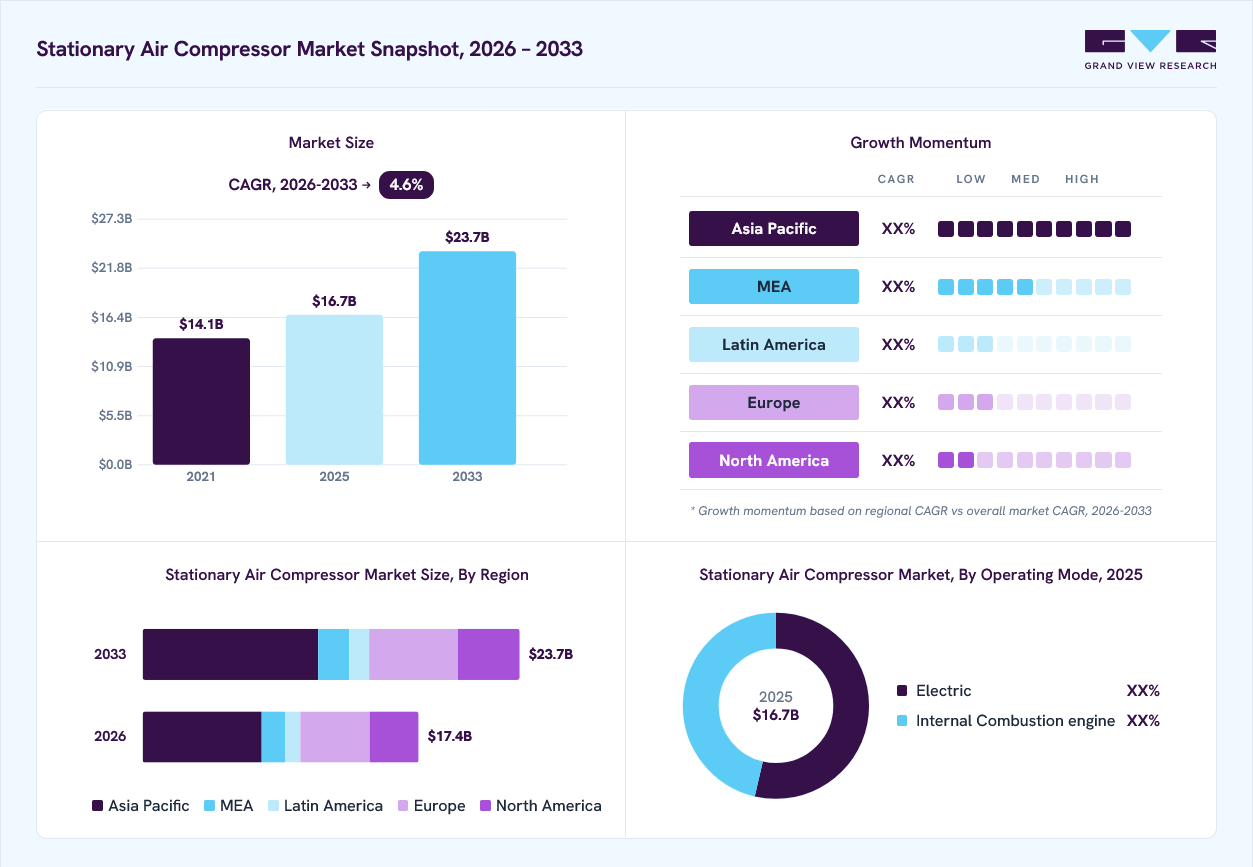 Source: Grand View Research, IR Documents, Primary Interviews, Paid DatabasesTo learn more about this report,
 Download Free Sample Report
Key Market Trends & Insights
- By power range: 51-250 kW segment led the market with the largest revenue share of 35.0% in 2025.
- By operating mode: Electric segment led the market with the largest revenue share of 53.4% in 2025.
- By lubrication: Oil filled segment led the market with the largest revenue share of 62.4% in 2025.
- By product: Rotary/screw segment led the market with the largest revenue share of 47.1% in 2025.
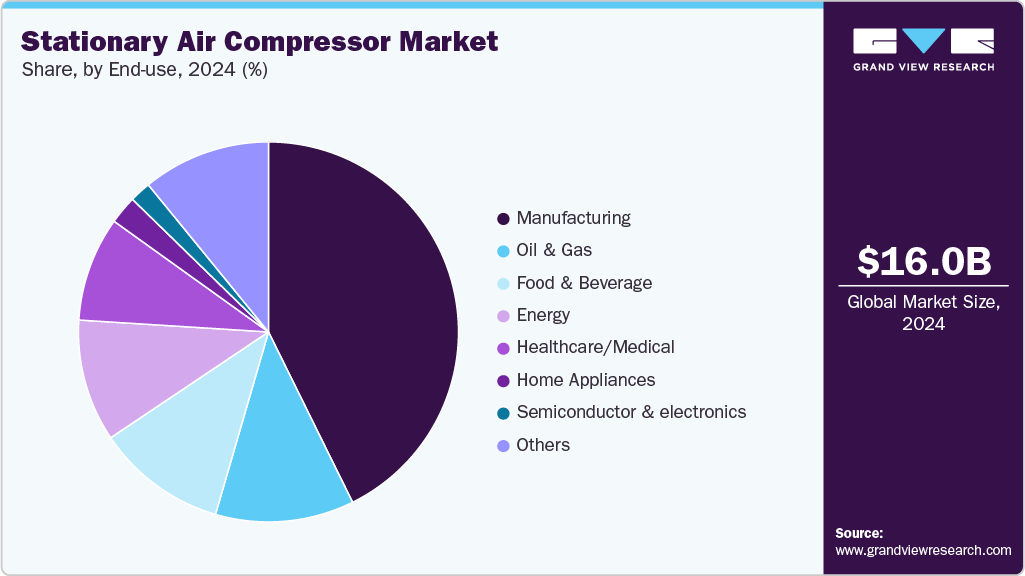
- By end use: Manufacturing segment led the market with the largest revenue share of 42.5% in 2025.
Regional Highlights
- Largest regional market: Asia Pacific (42.8%, revenue share, 2025)
- By country: China held the largest share in the Asia Pacific region in 2025.
Market Size & Forecast
- Market size in 2025: USD 16.7 Billion
- Estimated market size in 2026: USD 17.4 Billion
- Projected market size by 2033: USD 23.7 Billion
- CAGR (2026-2033): 4.6%
Three ways to get this report
Buy it, customize it, or ask a question.Ask an Analyst
Analyst response in 1 business day
- AccessReport author, directly
- Reply timeWithin 1 working day
- No sales callDirect answer only
- FormatEmail reply
- CostFree, no cost
Get the Full Report
What the study covers
- FormatsPDF · Excel · Dashboard
- Timeline2026–2033 annual, 2025 base
- Coverage20+ countries, 5 regions
- Companies10+ key players profiled
Customize the Report
20% free customization
- IncludeCountries, segments, points
- TailorTo your product definition
- ExtendDeeper competitor detail
- OrA fully bespoke study
- Turnaround5–10 working days
These industries rely heavily on stationary air compressors for consistent, high-pressure air supply to power machinery, streamline operations, and reduce energy costs through enhanced efficiency. Another major factor is the growing adoption of energy-efficient and technologically advanced compressor systems.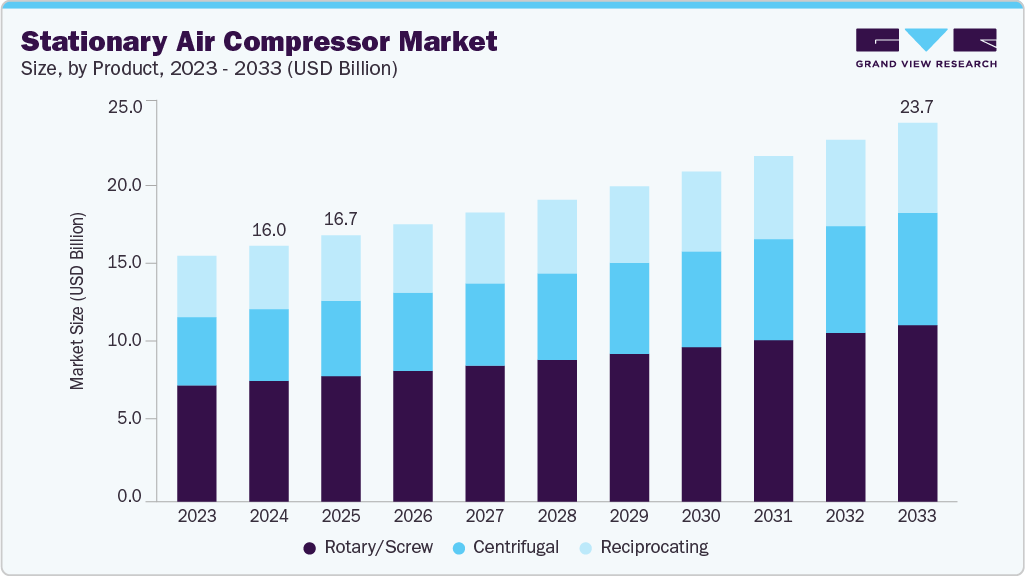 To learn more about this report, Download Free Sample Report
Regulatory pressure to reduce carbon emissions and operational costs has encouraged the development and deployment of oil-free and variable-speed compressors. This technological shift supports the expansion of the market across both developed and emerging economies.
Market Dynamics
The global stationary air compressor market is driven by sustained industrial expansion and the increasing adoption of automated production systems that require a continuous and dependable compressed air supply. Demand remains strong across manufacturing, automotive, food & beverage, pharmaceuticals, chemicals, power generation, and oil & gas industries, where stationary compressors are integral to production processes. The transition toward energy-efficient equipment, including variable speed drive (VSD) and oil-free compressor technologies, is influencing purchasing decisions as end users focus on reducing energy consumption and operational costs. High capital investment and maintenance expenses continue to limit adoption among cost-sensitive businesses.
The oil & gas and energy sectors remain major consumers of stationary air compressors due to the critical role compressed air plays in refining, gas processing, pipeline operations, and power generation activities. Large-scale industrial facilities require reliable and continuous compressed air systems for instrumentation, pneumatic control systems, material handling, and maintenance operations. High-capacity centrifugal and rotary screw compressors are increasingly preferred in these industries because of their durability, efficiency, and capability to operate under demanding industrial conditions.
Stationary air compressors are associated with substantial energy consumption and ongoing maintenance expenses, which act as a major restraint for market growth. Compressed air systems are among the most energy-intensive equipment used in industrial facilities, particularly in continuous manufacturing environments. Rising electricity prices and increasing pressure on industries to reduce operational costs are creating challenges for end users, especially small and medium-sized enterprises. In addition, oil-filled compressors require regular servicing, lubrication management, filter replacement, and component maintenance, adding to the total cost of ownership.
The replacement of conventional compressed air systems with energy-efficient stationary air compressors is creating significant growth opportunities for market participants. Industrial facilities are increasingly investing in variable speed drive (VSD), oil-free, and high-efficiency compressor systems to reduce electricity consumption and improve operational performance. At the same time, the integration of Industrial IoT (IIoT), remote monitoring, and predictive maintenance capabilities is enhancing equipment reliability, minimizing unplanned downtime, and enabling real-time performance optimization.
Analyst Perspective
The stationary air compressor market is expanding steadily as industries continue to invest in reliable and energy-efficient compressed air systems to support manufacturing and process operations. Demand is driven by increasing automation across production facilities, expansion of industrial infrastructure, and growing applications in automotive, food & beverage, pharmaceuticals, chemicals, electronics, and oil & gas industries. In addition, rising emphasis on reducing energy consumption and operating costs is encouraging the adoption of oil-free compressors, variable-speed drive (VSD) systems, and intelligent compressor controls that optimize performance and improve system efficiency. The integration of IoT-enabled monitoring, predictive maintenance, and remote diagnostics is further enhancing equipment reliability and minimizing unplanned downtime. As industrial facilities modernize and prioritize operational efficiency, manufacturers offering high-performance, energy-efficient, and application-specific stationary air compressors are expected to benefit from sustained long-term market growth.
Market Concentration & Characteristics
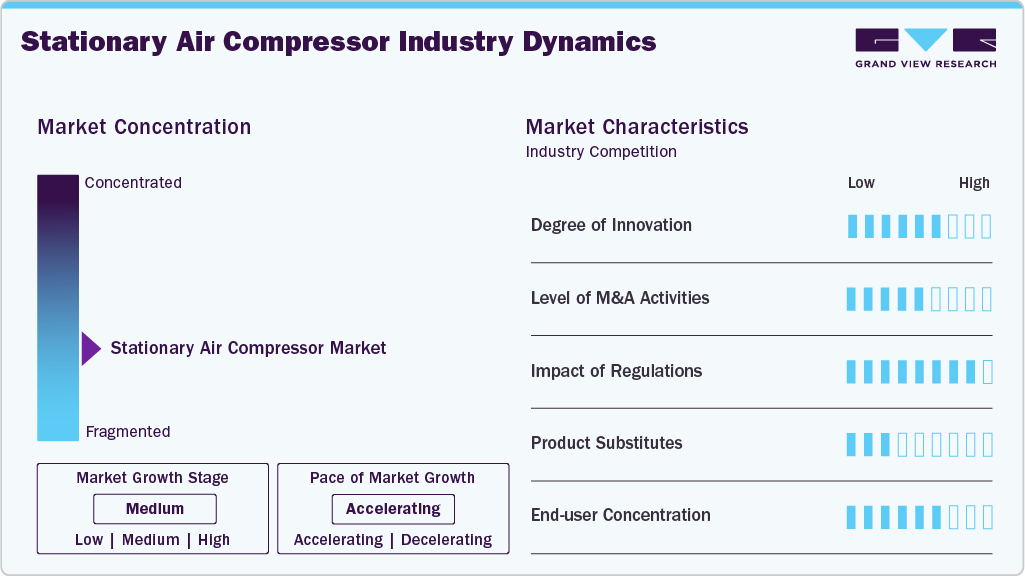
The stationary air compressor industry is moderately fragmented, with a mix of global and regional players contributing to competition. While a few large manufacturers hold significant market shares due to technological capabilities and broad distribution networks, many smaller firms operate in niche segments or local markets. This diversity in players leads to a competitive landscape with ongoing innovation and price differentiation. The market structure allows new entrants with specialized offerings to gain traction.
The stationary air compressor industry exhibits a moderate to high degree of innovation, driven by the demand for energy efficiency and reduced environmental impact. Manufacturers are investing in oil-free technology, smart monitoring systems, and variable-speed drives to enhance performance. Innovation is also focused on noise reduction and compact design to meet evolving end-user needs. These advancements help differentiate products in a competitive market.
 To learn more about this report, Download Free Sample Report
The stationary air compressor industry has witnessed a steady level of mergers and acquisitions, primarily aimed at expanding product portfolios and entering new geographic regions. Larger players often acquire specialized or regional manufacturers to gain technological advantages and market share. M&A activities are also used to streamline supply chains and improve production capabilities. This trend supports market consolidation over time.
Environmental and energy efficiency regulations have a significant impact on the stationary air compressor industry. Governments worldwide are enforcing stricter emission norms and efficiency standards, prompting manufacturers to develop compliant products. Regulations such as ISO standards and local environmental policies influence design and material choices. Compliance is now a key competitive factor in securing industrial contracts.
Product Insights
Based on product, the rotary/screw segment led the market with the largest revenue share of 47.1% in 2025, due to their high efficiency, reliability, and continuous operation capability. They are widely used across industries such as manufacturing, automotive, and food processing, where stable air output is critical. Their relatively low maintenance and energy-efficient performance make them the preferred choice for long-term industrial use. The availability of oil-injected and oil-free variants also broadens their application scope.
The centrifugal compressors segment is anticipated to grow at the fastest CAGR during the forecast period, driven by their ability to handle high-capacity operations with minimal mechanical wear. Their oil-free design and lower maintenance needs make them ideal for industries with strict air purity requirements, such as pharmaceuticals and electronics. Technological advancements are enhancing their efficiency and compactness, encouraging adoption in large-scale facilities.
Operation Mode Insights
Based on operating mode, the electric segment led the market with the largest revenue share of 53.4% in 2025, owing to its energy efficiency, lower operating costs, and reduced environmental impact. They are widely adopted in indoor and industrial settings where a stable electricity supply is available. Their quiet operation and compatibility with automation systems make them ideal for continuous-use applications. In addition, stricter emission regulations are further encouraging the shift toward electric models.
The internal combustion engine (ICE) segment is anticipated to grow at the fastest CAGR during the forecast period, especially in remote or off-grid industrial and construction sites. Their ability to operate independently of electrical infrastructure makes them highly valuable in fieldwork and mobile applications. Growth is driven by increasing infrastructure development and mining activities in emerging regions. Technological improvements are also enhancing fuel efficiency and performance, boosting adoption.
Lubrication Insights
Based on lubrication, the oil filled segment led the market with the largest revenue share of 62.4% in 2025, due to its durability, higher efficiency, and suitability for heavy-duty industrial applications. These compressors offer better cooling and lubrication, resulting in longer operational life and reduced wear and tear. They are widely used in manufacturing, automotive, and construction sectors where slight air contamination is acceptable. Their lower upfront cost compared to oil-free models also supports widespread adoption.
The oil-free compressors segment is anticipated to grow at the fastest CAGR during the forecast period, driven by increasing demand in industries requiring clean, contaminant-free air, such as pharmaceuticals, food and beverage, and electronics. Strict regulatory standards for air purity and hygiene are accelerating their adoption. Technological advancements have improved their efficiency and reduced maintenance requirements, making them a more viable long-term solution. Their environmental and health benefits further support market growth.
Power Range Insights
Based on power range, the 51-250 kW segment led the market with the largest revenue share of 35.0% in 2025, owing to its widespread use in medium to large-scale industrial operations. These compressors offer the optimal balance of power, efficiency, and capacity needed for continuous, high-demand applications in manufacturing, automotive, and processing industries. Their versatility and ability to support multiple tools and systems simultaneously make them a preferred choice for centralized air systems.
The 20 kW segment is anticipated to grow at the fastest CAGR during the forecast period, driven by rising demand from small and medium enterprises (SMEs), workshops, and localized production units. Their compact size, lower cost, and ease of installation make them ideal for light-duty and space-constrained applications. As more businesses adopt automation and pneumatic tools, the need for smaller, efficient air systems is expanding. Energy-efficient models in this range are also appealing to cost-conscious users.
End-use Insights
Based on end use, the manufacturing segment led the market with the largest revenue share of 42.5% in 2025, driven by the sector's extensive need for continuous and reliable compressed air. Applications such as powering machinery, automation systems, material handling, and tool operations make compressors essential in factories. The broad use across automotive, metalworking, and consumer goods manufacturing sustains consistent demand. High operational efficiency and scalability further strengthen their adoption in this sector.
 To learn more about this report, Download Free Sample Report
The semiconductor and electronics segment is anticipated to grow at the fastest CAGR during the forecast period, due to its stringent requirements for ultra-clean, oil-free compressed air. As global demand for chips and high-tech components rises, precision manufacturing environments are expanding rapidly. Oil-free and energy-efficient compressors are critical to maintaining contamination-free production processes. Technological advancements in electronics manufacturing are also driving higher adoption of advanced air compression systems.
Regional Insights
The stationary air compressor market in North America has experienced stable growth, driven by the adoption of advanced, energy-efficient technologies and a revival in domestic manufacturing activity. Stringent environmental regulations are prompting industries to upgrade to cleaner solutions, including oil-free and variable-speed compressors. In addition, increasing investments in automation and smart factory initiatives are boosting demand. Sectors such as food processing and pharmaceuticals are also contributing significantly to the region's market expansion.
U.S. Stationary Air Compressor Market Trends
The stationary air compressor market in the U.S. accounted for the largest market revenue share in North America in 2024, driven by its advanced manufacturing infrastructure, high demand for industrial automation, and stringent environmental regulations. Industries such as automotive, food processing, and pharmaceuticals require reliable, energy-efficient compressed air systems. Technological advancements and the presence of major manufacturers further bolster the market's dominance.
The Mexico stationary air compressor market is experiencing rapid growth, fueled by its expanding manufacturing sector, particularly in automotive and electronics. The country's strategic location, favorable trade agreements like the USMCA, and competitive labor costs attract foreign investments, increasing demand for compressed air solutions. In addition, Mexico's push towards industrial modernization and automation further accelerates the need for advanced compressor technologies.
Asia Pacific Stationary Air Compressor Market Trends
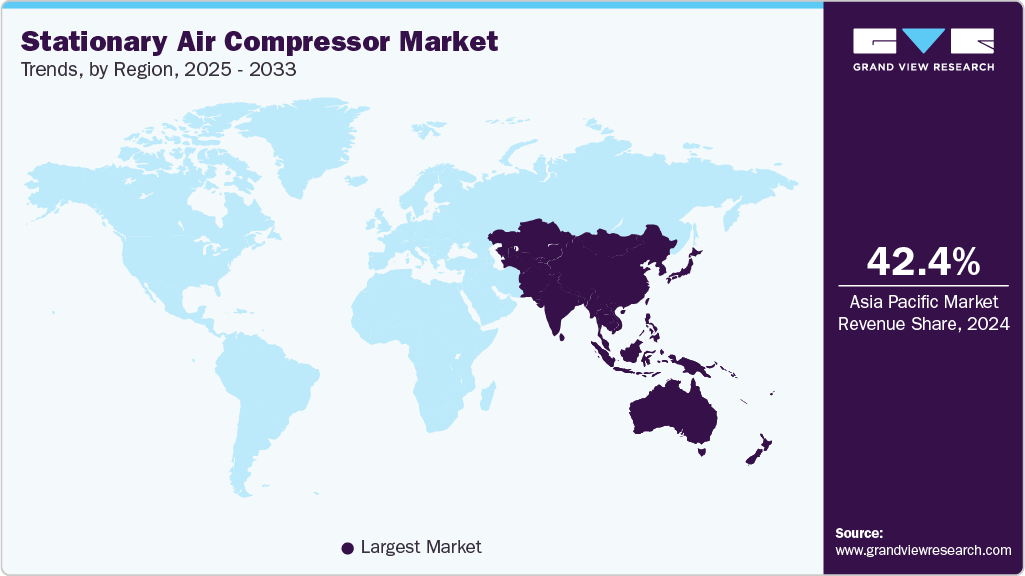
Asia Pacific dominated the stationary air compressor market with the largest revenue share of 42.8% in 2025, driven by rapid industrialization, strong manufacturing growth, and infrastructure development in countries like China, India, and Southeast Asia. The presence of large-scale production facilities and favorable government policies supporting industry and energy efficiency drive demand. In addition, expanding automotive, electronics, and construction sectors contribute significantly. Competitive production costs also attract global investments.
 To learn more about this report, Download Free Sample Report
China Stationary Air Compressor Market Trends
The stationary air compressor market in China held the largest share in the Asia Pacific region in 2025, owing to its extensive industrial base, including manufacturing, automotive, and electronics sectors. The country's rapid urbanization and infrastructure development drive significant demand for compressed air solutions.
The India stationary air compressor market is propelled by the expansion of industries such as automotive, textiles, and food processing. The government's initiatives to promote industrialization and infrastructure development create a favorable environment for market growth.
Europe Stationary Air Compressor Market Trends
The stationary air compressor market in India is driven by strict environmental regulations and a strong focus on energy-efficient and sustainable technologies. Mature industrial sectors, especially in Germany, France, and Italy, rely heavily on high-performance stationary compressors. Innovation and early adoption of oil-free and smart compressors also contribute to market growth.
The Germany stationary air compressor market leads the European region in 2024, driven by its robust industrial base encompassing automotive, chemicals, and manufacturing sectors. Germany's emphasis on energy efficiency and stringent environmental regulations further propels the demand for advanced compressor technologies.
The stationary air compressor market in UK is driven by advancements in automation and the expansion of industries such as pharmaceuticals and food processing. The UK's focus on adopting sustainable and energy-efficient technologies aligns with the increasing demand for oil-free and variable-speed compressors.
Middle East & Africa Stationary Air Compressor Market Trends
The stationary air compressor market in the Middle East & Africa is witnessing moderate growth, supported by ongoing infrastructure development, industrial diversification efforts, and government-led initiatives aimed at strengthening non-oil sectors. The expansion of industries such as construction, food & beverage, and chemicals-particularly in countries like the UAE, Saudi Arabia, and South Africa-is driving demand for reliable compressed air solutions.
The Saudi Arabia stationary air compressor market dominates the Middle East & Africa region in 2024, due to its extensive oil & gas industry and ongoing industrial diversification under Vision 2030. Large-scale investments in petrochemical, energy, and infrastructure projects drive consistent demand for high-performance compressors. The need for reliable and efficient compressed air systems in refining, drilling, and processing applications supports market growth.
Latin America Stationary Air Compressor Market Trends
The stationary air compressor market in Latin America is growing moderately, supported by infrastructure development and gradual industrialization in countries like Brazil and Argentina. Expanding mining, oil & gas, and construction sectors are key demand drivers. However, economic instability and fluctuating investment levels can limit large-scale adoption. Rising focus on localized manufacturing offers future growth opportunities.
The Brazil stationary air compressor market leads the Latin American region in 2024, due to its diverse industrial base, including automotive, mining, and manufacturing sectors. The country’s expansive infrastructure projects and growing demand for energy-efficient technologies further drive market growth. Brazil strategic location and trade agreements enhance its position as a regional industrial hub.
Key Stationary Air Compressor Company Insights
Some of the key players operating in the market include Ingersoll Rand, Atlas Copco, Husky Cooperation.
-
Atlas Copco is a global leader in the manufacturing of industrial equipment, including stationary air compressors. Known for its innovation and commitment to sustainability, the company offers a wide range of energy-efficient and reliable compressor solutions tailored to various industries such as construction, mining, and manufacturing. Atlas Copco emphasizes advanced technology, durability, and user-friendly designs, making it a preferred choice worldwide. Their strong focus on customer service and after-sales support strengthens their market presence.
-
Ingersoll Rand is a prominent player in the stationary air compressor industry, recognized for its high-quality and durable products designed for industrial and commercial use. The company delivers innovative compressor technologies that prioritize efficiency, low maintenance, and environmental compliance. Serving diverse sectors such as automotive, construction, and oil & gas, Ingersoll Rand continually invests in research and development to enhance product performance and sustainability. Their extensive global distribution network ensures wide accessibility and reliable customer support.
Key Stationary Air Compressor Companies:
The following key companies have been profiled for this study on the stationary air compressor market.
- Ingersoll Rand
- Atlas Copco
- Husky Cooperation
- Zen Air Tech Pvt. Ltd
- Stanley Black & Decker, Inc.
- Ciasons Industrial Inc.
- Kaeser Kompressoren SE
- Makita Cooperation
- Sullair, LLC
- TEWATT
- Quincy Compressor
- Rolair Systems
- Elgi Compressors USA, Inc.
- Hitachi
- Zycon
Competitive Benchmarking
Operating Strategies
Competitive Edge
Weaknesses
Mature Players: Ingersoll Rand, Atlas Copco, Kaeser Kompressoren SE, Sullair, LLC, Quincy Compressor, Elgi Compressors USA, Inc., Hitachi
- Focus on expanding energy-efficient stationary compressor portfolios, particularly oil-free and variable speed drive (VSD) systems for industrial applications.
- Strengthen global distribution and aftermarket service networks to support long-term maintenance contracts and customer retention.
- Invest in digital monitoring, predictive maintenance, and smart compressed air management solutions to improve operational efficiency.
- Strong global brand recognition and extensive installed industrial base across manufacturing, oil & gas, and energy sectors.
- Broad product portfolios covering reciprocating, rotary screw, and centrifugal stationary air compressors across multiple power ranges.
- Advanced R&D capabilities and strong financial resources enable continuous technological innovation and strategic acquisitions.
- High product and maintenance costs can limit adoption among price-sensitive small and medium enterprises.
- Large organizational structures may reduce operational flexibility and slow response to regional market shifts.
Emerging Players: Zen Air Tech Pvt. Ltd, Ciasons Industrial Inc., TEWATT, Rolair Systems, Husky Corporation, Makita Corporation, Stanley Black & Decker, Inc.
- Focus on cost-competitive compressor solutions targeting regional manufacturing and workshop applications.
- Expand presence through local distributors, OEM partnerships, and regional industrial equipment dealers.
- Increase emphasis on customized compressor systems and localized customer support for niche industries.
- Competitive pricing strategies help attract customers in developing and cost-sensitive markets.
- Faster adaptability to regional demand trends and customer-specific application requirements.
- Growing focus on compact, portable-compatible, and mid-range stationary compressor solutions supports market penetration.
- Limited global distribution and weaker brand visibility compared to established multinational manufacturers.
- Lower R&D and technological capabilities may restrict the development of advanced energy-efficient compressor systems.
Recent Developments
-
In May 2025, Tewatt introduced a low-maintenance, oil-free diesel air compressor designed for demanding applications. This model features advanced filtration and cooling systems to ensure clean, dry air delivery. Its robust design and efficient performance make it suitable for industries such as mining, construction, and oil & gas exploration.
-
In June 2024, Ingersoll Rand completed the acquisition of ILC Dover, along with three other companies-Complete Air and Power Solutions, Del PD Pumps & Gear, and Fruvac-for a combined total of $150 million. These acquisitions enhance Ingersoll Rand's capabilities in life sciences, mobile vacuum systems, and precision technologies, thereby broadening its product offerings in the air compressor sector.
Stationary Air Compressor Market Report Scope
Report Attribute
Details
Market size in 2025
USD 16.7 billion
Estimated market size in 2026
USD 17.4 billion
Projected market size by 2033
USD 23.7 billion
Growth rate
CAGR of 4.6% from 2026 to 2033
Base year for estimation
2025
Historical data
2021 - 2024
Forecast period
2026 - 2033
Quantitative units
Revenue in USD billion and CAGR from 2026 to 2033
Report coverage
Revenue forecast, company ranking, competitive landscape, growth factors, and trends
Segments covered
Product, operation mode, lubrication, power range, end-use, region
Regional scope
North America; Europe; Asia Pacific; Latin America; Middle East & Africa
Country scope
U.S.; Canada; Mexico; UK; Germany; France; Spain; Italy; China; Japan; India; Australia; South Korea; Brazil; Argentina; Saudi Arabia; South Africa; UAE
Key companies profiled
Ingersoll Rand; Atlas Copco; Husky Cooperation; Zen Air Tech Pvt. Ltd; Stanley Black & Decker, Inc.; Ciasons Industrial Inc.; Kaeser Kompressoren SE; Makita Corporation; Sullair, LLC; TEWATT; Quincy Compressor; Rolair Systems; Elgi Compressors USA, Inc.; Hitachi; Zycon.
Customization scope
Free report customization (equivalent up to 8 analysts' working days) with purchase. Addition or alteration to country, regional & segment scope.
Pricing and purchase options
Avail customized purchase options to meet your exact research needs. Explore purchase options
Global Stationary Air Compressor Market Report Segmentation
This report forecasts revenue growth at global, regional, and country levels and provides an analysis of the latest industry trends in each of the sub-segments from 2021 to 2033. For this study, Grand View Research has segmented the global stationary air compressor market report based on product, operation mode, lubrication, power range, end-use and region:
-
Product Outlook (Revenue, USD Million, 2021 - 2033)
-
Reciprocating
-
Rotary/Screw
-
Centrifugal
-
-
Operation Mode Outlook (Revenue, USD Million, 2021 - 2033)
-
Electric
-
Internal Combustion Engine
-
-
Lubrication Outlook (Revenue, USD Million, 2021 - 2033)
-
Oil Free
-
Oil Filled
-
-
Power Range Channel Outlook (Revenue, USD Million, 2021 - 2033)
-
Up to 20 kW
-
21-50 kW
-
51-250 kW
-
251-500 kW
-
Over 500 kW
-
-
End-use Outlook (Revenue, USD Million, 2021 - 2033)
-
Manufacturing
-
Oil & Gas
-
Semiconductor & electronics
-
Home Appliances
-
Healthcare/Medical
-
Food & Beverage
-
Energy
-
Others
-
-
Regional Outlook (Revenue, USD Million, 2021 - 2033)
-
North America
-
U.S.
-
Canada
-
Mexico
-
-
Europe
-
Germany
-
France
-
Italy
-
Spain
-
UK
-
-
Asia Pacific
-
China
-
India
-
Japan
-
South Korea
-
Australia
-
-
Latin America
-
Brazil
-
Argentina
-
-
Middle East and Africa
-
Saudi Arabia
-
UAE
-
South Africa
-
-
Research Methodology
The stationary air compressor Market figures in this report are based on a proven research process that combines executive interviews with secondary research from proprietary databases, company filings, and recognized regulatory and institutional sources. Market size is built through value-chain sizing - reconciling supply-side and demand-side estimates - and triangulated with bottom-up and top-down approaches. Every estimate passes multiple levels of expert validation before publication, with eachstationary air compressor segment quantified using the revenue-capture definitions in the table below.
Segment Definition
Segment - Product
Revenue Capture Definition
Reciprocating
Revenue is generated from the sale of reciprocating stationary air compressors. These systems are supplied for intermittent-duty and high-pressure industrial applications. Revenue includes sales across all end-use industries.
Rotary/Screw
Revenue is generated from the sale of rotary/screw stationary air compressors. These systems are supplied for continuous industrial operations. Revenue includes sales across all end-use industries.
Centrifugal
Revenue is generated from the sale of centrifugal stationary air compressors.
Segment - Operating Mode
Revenue Capture Definition
Electric
Revenue is generated from the sale of electric stationary air compressors. These systems are installed in industrial and commercial facilities. Revenue includes sales across all end-use industries.
Internal Combustion Engine
Revenue is generated from the sale of internal combustion engine stationary air compressors. These systems are supplied for applications where grid power is unavailable. Revenue includes sales across all end-use industries.
Segment - Lubrication
Revenue Capture Definition
Oil Free
Revenue is generated from the sale of oil-free stationary air compressors. These systems are supplied for contamination-sensitive industrial applications. Revenue includes sales across all end-use industries.
Oil Filled
Revenue is generated from the sale of oil-filled stationary air compressors. These systems are supplied for general industrial applications. Revenue includes sales across all end-use industries.
Segment - Power Range
Revenue Capture Definition
Up to 20 kW
Revenue is generated from the sale of stationary air compressors with power ratings up to 20 kW. These systems are supplied for light industrial applications. Revenue includes sales across all end-use industries.
21-50 kW
Revenue is generated from the sale of stationary air compressors with power ratings from 21 kW to 50 kW. These systems are supplied for medium-duty industrial applications. Revenue includes sales across all end-use industries.
51-250 kW
Revenue is generated from the sale of stationary air compressors with power ratings from 51 kW to 250 kW. These systems are supplied for continuous industrial operations. Revenue includes sales across all end-use industries.
251-500 kW
Revenue is generated from the sale of stationary air compressors with power ratings from 251 kW to 500 kW. These systems are supplied for heavy industrial applications. Revenue includes sales across all end-use industries.
Over 500 kW
Revenue is generated from the sale of stationary air compressors with power ratings above 500 kW. These systems are supplied for large-scale industrial facilities. Revenue includes sales across all end-use industries.
Segment - End Use
Revenue Capture Definition
Manufacturing
Revenue is generated from the sale of stationary air compressors supplied to manufacturing facilities. Revenue includes compressor sales for production and assembly applications.
Oil & Gas
Revenue is generated from the sale of stationary air compressors supplied to oil & gas facilities. Revenue includes compressor sales for upstream, midstream, and downstream operations.
Semiconductor & Electronics
Revenue is generated from the sale of stationary air compressors supplied to semiconductor and electronics manufacturing facilities. Revenue includes compressor sales for precision manufacturing applications.
Home Appliances
Revenue is generated from the sale of stationary air compressors supplied to home appliance manufacturing facilities. Revenue includes compressor sales for production applications.
Healthcare/Medical
Revenue is generated from the sale of stationary air compressors supplied to healthcare and medical facilities. Revenue includes compressor sales for medical and laboratory applications.
Food & Beverage
Revenue is generated from the sale of stationary air compressors supplied to food & beverage processing facilities. Revenue includes compressor sales for processing and packaging applications.
Energy
Revenue is generated from the sale of stationary air compressors supplied to power generation and energy facilities. Revenue includes compressor sales for plant operations.
Others
Revenue is generated from the sale of stationary air compressors supplied to other industrial sectors. These include mining, chemicals, water treatment, and similar industries. Revenue includes compressor sales to all other end-use sectors.
Estimation Model
Layer Name
Key Question
Description
Compressed Air Demand Layer
Where are stationary air compressors required?
Analyze demand across manufacturing, oil & gas, power generation, food & beverage, chemicals, pharmaceuticals, automotive, mining, construction, and other industrial sectors. Assess compressed air requirements for production processes, pneumatic tools, automation systems, and utility applications to establish the addressable demand for stationary air compressors.
Industrial Capacity Expansion Layer
Where is new equipment demand being created?
Evaluate investments in manufacturing facilities, industrial plants, warehouses, processing units, and infrastructure projects. Assess greenfield developments, production capacity expansions, plant modernization, and replacement of aging compressed air systems that drive procurement of new stationary air compressors.
Product Adoption Layer
Which stationary air compressor technologies are being deployed?
Segment demand by compressor type, lubrication type, operating mode, power range, product, and end-use industry. Apply adoption rates based on airflow requirements, operating pressure, energy efficiency, reliability, maintenance requirements, and application-specific performance. Assess the increasing adoption of oil-free, variable-speed drive (VSD), and energy-efficient stationary air compressors to improve operational efficiency and reduce lifecycle costs.
Revenue Generation Layer
How much market revenue is generated?
Estimate annual shipments of stationary air compressors by product type, operating mode, end-use industry, and region. Quantify revenues generated exclusively from the sale of new stationary air compressors supplied to industrial facilities, OEMs, distributors, and system integrators. The scope excludes installation, maintenance, spare parts, rental equipment, compressed air treatment equipment, and aftermarket services.
Delivered Customizations
This report has been delivered with the following In-depth customizations
Client Request
Customization Delivered
Value Adds
Competitive Benchmarking
A comparative evaluation of leading and developing market participants was delivered by analyzing factors such as operational strategies, product offerings, technological advancements, and geographic presence. The benchmarking further assessed each company’s competitive positioning within the global stationary air compressor industry.
The analysis provided a stronger understanding of competitor strengths, market differentiation strategies, and potential areas for improvement. It also assisted in identifying strategic opportunities related to product innovation, partnerships, and market positioning.
Regional Segmentation
The study was tailored with a region-wise breakdown of the stationary air compressor market, highlighting variations in industrial activity, manufacturing output, infrastructure development, and compressor adoption trends across major geographies. Country-specific evaluations were also incorporated to provide a clearer understanding of local market dynamics and demand patterns.
This customization enabled better identification of regional growth pockets and demand concentration areas, helping the client formulate targeted expansion and distribution strategies. It also provided clarity on region-specific regulatory and industrial trends influencing market growth.
Opportunity assessment
A focused assessment was carried out to identify emerging revenue opportunities across compressor technologies, lubrication types, power capacities, and industrial applications. The analysis emphasized evolving demand for energy-efficient systems, oil-free compressors, and digitally monitored compressed air solutions across industrial sectors.
The insights supported strategic planning by highlighting attractive investment areas and fast-growing end-use industries. It also helped the client recognize future technology trends and prioritize segments with strong long-term growth potential.
Frequently Asked Questions About This Report
Based on Lubrication, the oil filled segment led the market with the largest revenue share of 62.4% in 2025.
Asia Pacific dominated the stationary air compressor market with the largest revenue share of 42.8% in 2025.
Based on Product, the rotary/screw segment led the market with the largest revenue share of 47.1% in 2025
Based on operating mode, the electric segment led the market with the largest revenue share of 53.4% in 2025
Based on power range, the 51-250 kW segment led the market with the largest revenue share of 35.0% in 2025.
The global stationary air compressor market size was estimated at USD 16.7 billion in 2025 and is expected to be USD 17.4 billion in 2026 .
The global stationary air compressor market, in terms of revenue, is expected to grow at a CAGR of 4.6% from 2026 to 2033 to reach USD 23.7 billion by 2033.
Based on end use, the manufacturing segment led the market with the largest revenue share of 42.5% in 2025
Some of the key players operating in the global stationary air compressor market include Ingersoll Rand; Atlas Copco; Husky Cooperation; Zen Air Tech Pvt. Ltd; Stanley Black & Decker, Inc.; Ciasons Industrial Inc.; Kaeser Kompressoren SE; Makita Cooperation; Sullair, LLC; TEWATT; Quincy Compressor; Rolair Systems; Elgi Compressors USA, Inc.; Hitachi; Zycon.
The global stationary air compressor market is driven by rapid industrialization, increasing demand for energy-efficient systems, and stringent environmental regulations.
About the Author(s)
Advanced Interior Materials Research Team
Advanced Materials · Advanced Interior MaterialsThis report was authored by the advanced interior materials research team at Grand View Research - comprising two research analysts, one senior research analyst, and one industry expert - with specialized expertise in the advanced interior materials segment of the advanced materials industry. All findings are based on proprietary advanced materials databases, executive interviews, and regulatory analysis, subject to internal peer review prior to publication.
Last Updated:
Speak to Analyst

Customize this report to your needs - add regions, segments, or data points, with 20% free customization.
Or view our licence options:


ISO 9001:2015 & 27001:2022 Certified
We are GDPR and CCPA compliant! Your transaction & personal information is safe and secure. For more details, please read our privacy policy.


