
- Home
- »
- Electronic Devices
- »
-
Street Lighting Market Size And Share Report, 2026-2033GVR Report cover
![Street Lighting Market (2026 - 2033)Report]()
Street Lighting Market (2026 - 2033)
Size, Share & Trends Analysis Report By Type (Traditional Lighting, LED Lighting), By Application (Highways, Roadways), By Region (North America, Asia Pacific), And Segment Forecasts
Market Size, 2025
$10.5BMarket Estimate, 2026
$11.3BMarket Forecast, 2033
$17.1BCAGR, 2026–2033
6.1%Street Lighting Market Summary
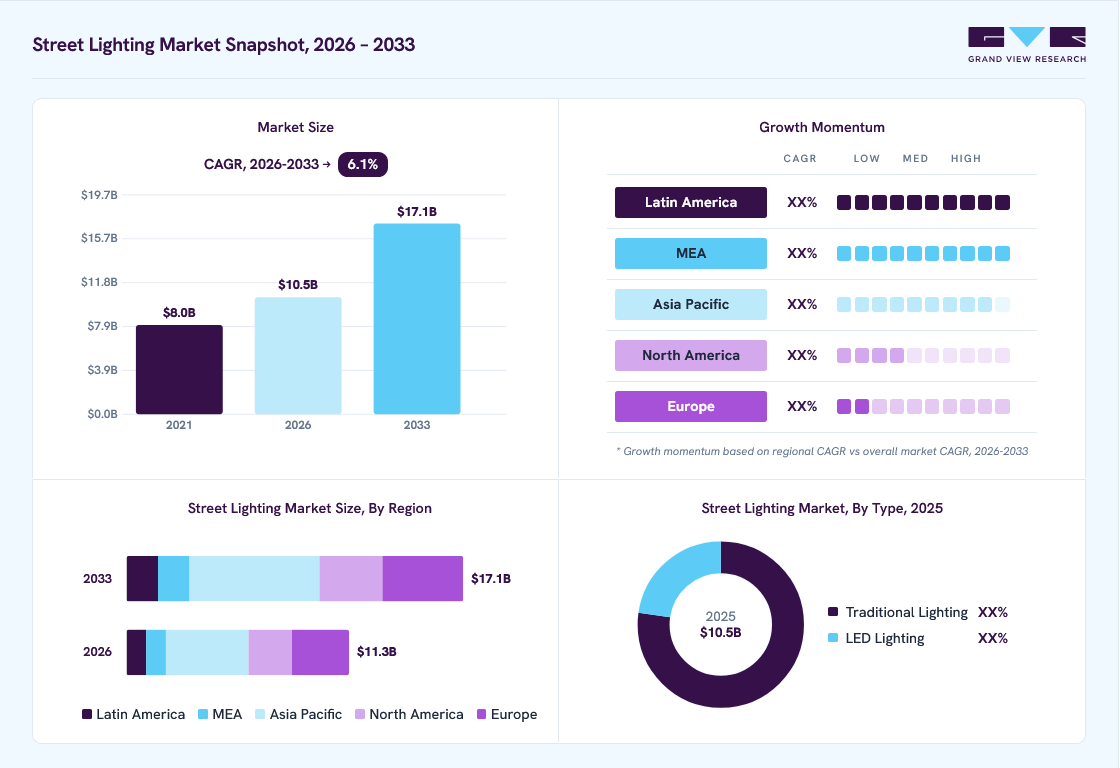
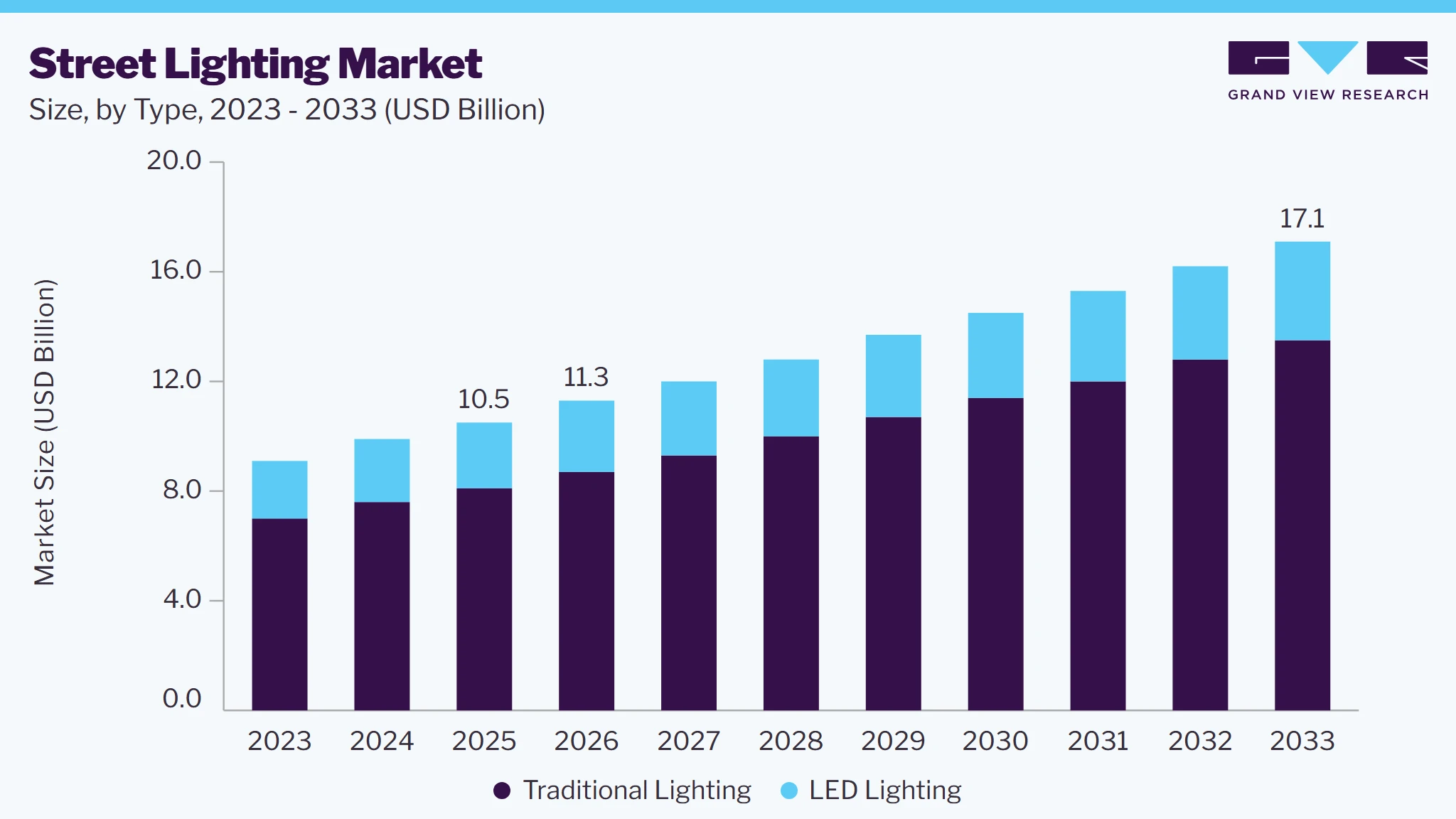
The global street lighting market size was valued at USD 10.5 billion in 2025 and is projected to grow from USD 11.3 billion in 2026 to USD 17.1 billion by 2033, at a CAGR of 6.1% from 2026 to 2033. Asia Pacific dominated the market, accounting for a revenue share of 36.9% in 2025. This growth is driven by the increasing adoption of intelligent and connected street lighting systems. Growing urbanization and infrastructure development projects are also driving market growth.
Key Market Trends & Insights
- By type: LED lighting segment dominated the market, with a revenue share of 80.3% in 2025.
- By application: Roadways segment held the largest market share of 65.6% in 2025.
Regional Highlights
- Largest regional market: Asia Pacific (36.9% revenue share, 2025)
- By country: China held the largest market share in 2025.
Market Size & Forecast
- Market size in 2025: USD 10.5 Billion
- Estimated market size in 2026: USD 11.3 Billion
- Projected market size by 2033: USD 17.1 Billion
- CAGR (2026-2033): 6.1%
As the global population increasingly moves toward urban areas, cities are expanding, and new urban zones are being developed. This rapid urbanization creates a heightened demand for infrastructure that supports safe and functional public spaces, with street lighting playing a vital role in this process. Street lighting ensures visibility and safety in urban environments, particularly during nighttime. As cities grow, the need for extensive, reliable street lighting networks becomes more pressing. New residential areas, commercial zones, and public spaces require well-planned lighting systems to enhance security, facilitate transportation, and promote social and economic activities after dark.Moreover, the growing emphasis on energy efficiency and sustainability is significantly boosting the adoption of LED street lighting. Traditional streetlights, such as high-pressure sodium lamps, are being replaced by energy-efficient LED lights, which consume less power and have a longer lifespan. This shift is driven by the need to reduce energy consumption, lower carbon emissions, and decrease municipal operational costs. Additionally, government incentives and regulations promoting green technologies accelerate the transition to LED street lighting.
Many cities and towns are undertaking retrofit and modernization projects to replace outdated street lighting infrastructure with new, energy-efficient, smart lighting systems. These projects are often driven by the need to reduce operational costs, improve lighting quality, and comply with new energy regulations. The growing trend of upgrading existing street lighting systems creates significant opportunities for market players, especially in developed regions with well-established infrastructure that need modernization.
The street lighting market is subject to various regulatory frameworks, which can vary widely across regions. A lack of standardized regulations and guidelines for deploying street lighting systems, especially smart lighting, can create confusion and slow adoption. Additionally, obtaining approvals and navigating through bureaucratic hurdles can be time-consuming, leading to delays in project implementation. These regulatory challenges can deter investments and hinder the market's overall growth.
Market Dynamics
The street lighting market is undergoing a significant transformation as municipalities, transportation authorities, and urban planners increasingly invest in modern lighting infrastructure to improve public safety, traffic visibility, and energy efficiency. The replacement of conventional lighting technologies with LED-based systems is accelerating due to lower power consumption, longer operational lifespans, and reduced maintenance requirements. In addition, smart city initiatives are driving the deployment of connected street lighting networks equipped with sensors, adaptive controls, and remote monitoring capabilities, enabling more efficient management of urban infrastructure. Growing investments in urbanization projects, roadway expansion, and public infrastructure modernization are further supporting market growth across both developed and emerging economies.
The expansion of rural electrification and remote infrastructure development is driving the adoption of solar-powered street lighting solutions. Many rural communities, remote villages, industrial sites, mining areas, and developing regions lack reliable access to centralized electricity networks. Extending grid infrastructure to these locations can be expensive, time-consuming, and economically impractical. Solar-powered street lights provide an independent lighting solution that can be deployed without extensive investments in electrical infrastructure. Their ability to operate autonomously makes them particularly suitable for areas where grid connectivity is limited or unavailable. As governments and development agencies continue investing in rural infrastructure improvements, solar street lighting installations are becoming increasingly common.
The high upfront costs of large-scale street lighting modernization projects pose a significant restraint on the street lighting market, as municipalities, government agencies, and infrastructure operators often face budget limitations when planning public infrastructure upgrades. Modernization projects typically involve replacing existing lighting fixtures with advanced LED systems, installing smart controls, integrating sensors, upgrading communication networks, and sometimes replacing poles, wiring, and supporting infrastructure. While these investments can generate long-term energy and maintenance savings, the initial capital required can be substantial, particularly for cities managing thousands of lighting points. Many local governments operate under strict financial constraints and must balance lighting upgrades against other essential public services such as transportation, healthcare, education, and public safety. As a result, even when modernization projects offer attractive long-term returns, funding challenges can delay or reduce adoption rates, limiting overall market growth.
The rapid development of smart city initiatives strengthens the opportunity for sensor-based street lighting solutions. Modern cities are increasingly integrating digital technologies into public infrastructure to improve service delivery, sustainability, and urban management. Street lighting networks are often viewed as ideal platforms for smart city deployment because they are widely distributed throughout urban environments and can support additional sensors, communication modules, and monitoring systems. Adaptive lighting solutions can collect valuable data related to traffic flow, pedestrian movement, environmental conditions, and infrastructure performance. This information can help city planners make more informed decisions regarding transportation, public safety, and resource allocation. As smart city investments continue to expand globally, sensor-based street lighting systems are poised to become a key component of connected urban ecosystems.
Analyst Perspective
The street lighting market is evolving beyond its traditional role as a public utility asset and is increasingly becoming a foundational component of smart urban infrastructure. While energy savings remain a primary purchasing criterion, decision-makers are placing greater emphasis on connectivity, operational intelligence, and long-term infrastructure value. Street lighting poles are gradually being transformed into multifunctional platforms that support sensors, surveillance systems, environmental monitoring equipment, public Wi-Fi, and future smart-city applications. Consequently, vendors that can offer scalable, interoperable, and future-ready lighting ecosystems rather than standalone luminaires are likely to secure a stronger position as cities seek to maximize the return on public infrastructure investments.
Type Insights
Based on type, the LED lighting segment led the market with the largest revenue share of 80.3% in 2025. The energy efficiency offered by LED lighting drives the segment's growth. LED lights consume significantly less electricity than traditional lighting technologies such as high-pressure sodium (HPS) or metal halide lamps. This reduction in energy consumption leads to substantial cost savings on electricity bills for municipalities and other stakeholders responsible for public lighting.
The traditional lighting segment is projected to grow significantly from 2026 to 2033. The extensive existing infrastructure drives the market's growth. Many cities and towns worldwide have long-established networks of streetlights based on older technologies such as HPS or Metal Halide lamps. Upgrading to modern systems such as LEDs can be expensive and logistically challenging, leading municipalities to maintain and replace existing traditional lighting fixtures rather than undertake costly overhauls. This entrenched infrastructure supports the ongoing demand for traditional lighting components and maintenance services.
Application Insights
Based on application, the roadways segment led the market with the largest revenue share of 65.2% in 2025. The increasing focus on smart city initiatives drives the market's growth. Smart cities aim to improve the quality of urban life through the integration of technology into infrastructure and services. Street lighting is a critical component of smart city projects, as it not only provides illumination but also serves as a platform for other smart technologies, such as traffic management systems, environmental sensors, and public safety networks.
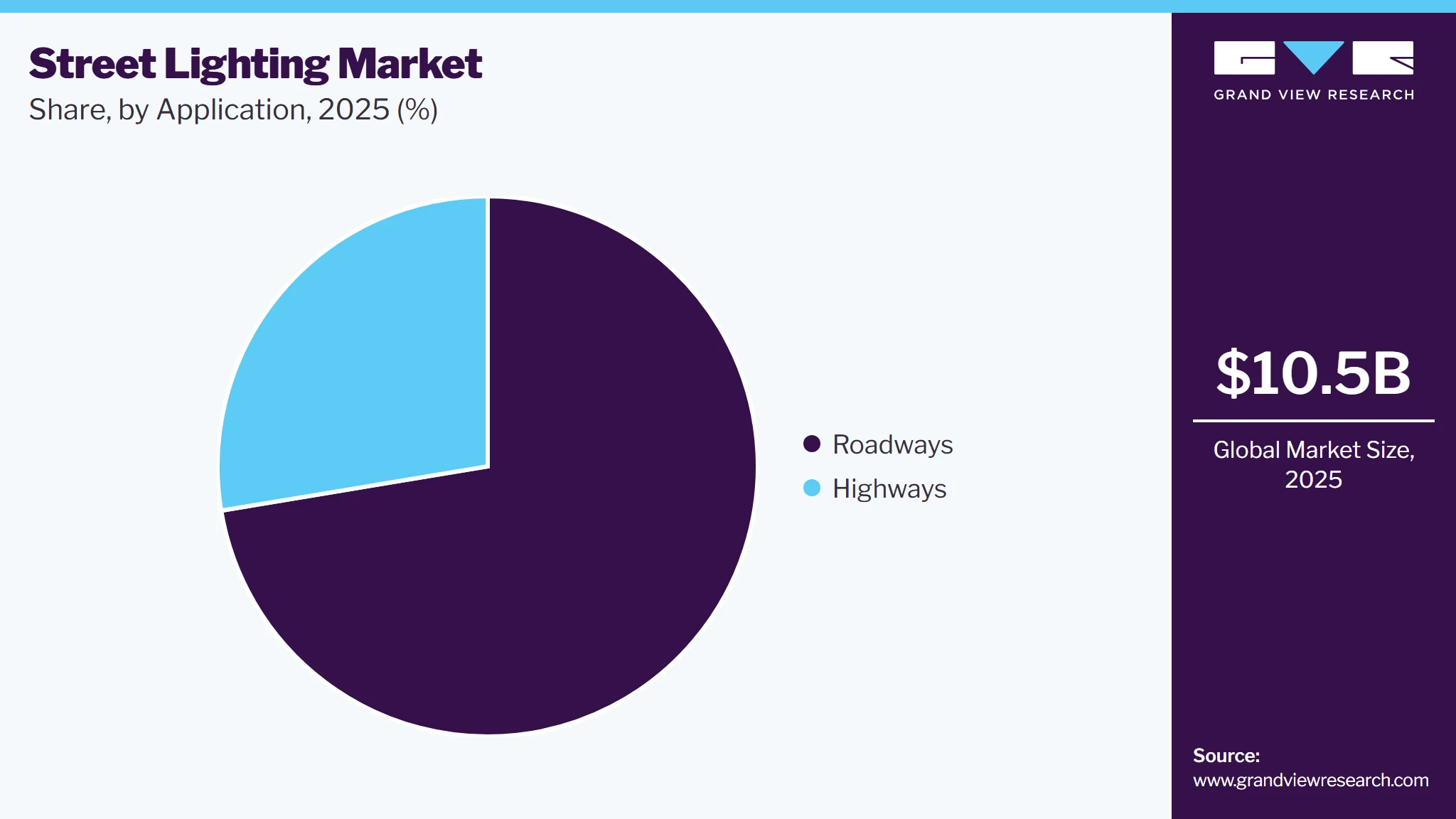
The highways segment is projected to grow significantly from 2026 to 2033. Street lighting's crucial role in enhancing road safety drives the market's growth. Well-lit highways significantly reduce the likelihood of accidents, especially during nighttime or low-visibility conditions. Adequate lighting helps drivers perceive road conditions, obstacles, and other vehicles more clearly, improving reaction times and reducing the risk of collisions.
Regional Insights
North America street lighting market held a significant share in 2025. Government initiatives and regulations in North America play a crucial role in driving the growth of the street lighting market. Many cities and states have implemented energy efficiency standards and sustainability goals that encourage the adoption of energy-efficient street lighting solutions, thus driving market growth.
U.S. Street Lighting Market Trends
The street lighting market in the U.S.is expected to grow at a significant CAGR from 2026 to 2033. The ongoing need for infrastructure upgrades and modernization in the U.S. drives the market's growth. Many existing street lighting systems in U.S. cities and towns need to be updated, often relying on traditional high-pressure sodium (HPS) or metal halide lamps that are less efficient and more costly to maintain. There is a strong push to replace these aging systems with modern, energy-efficient solutions like LEDs.
Europe Street Lighting Market Trends
The street lighting market in Europe is expected to witness notable growth from 2026 to 2033. Improving public safety and enhancing the quality of life in urban areas drives market growth in Europe. Effective street lighting contributes to safer public spaces by reducing crime and accidents. Enhanced lighting also improves the overall attractiveness of urban areas, making them more appealing for residents and visitors.
Asia Pacific Street Lighting Market Trends
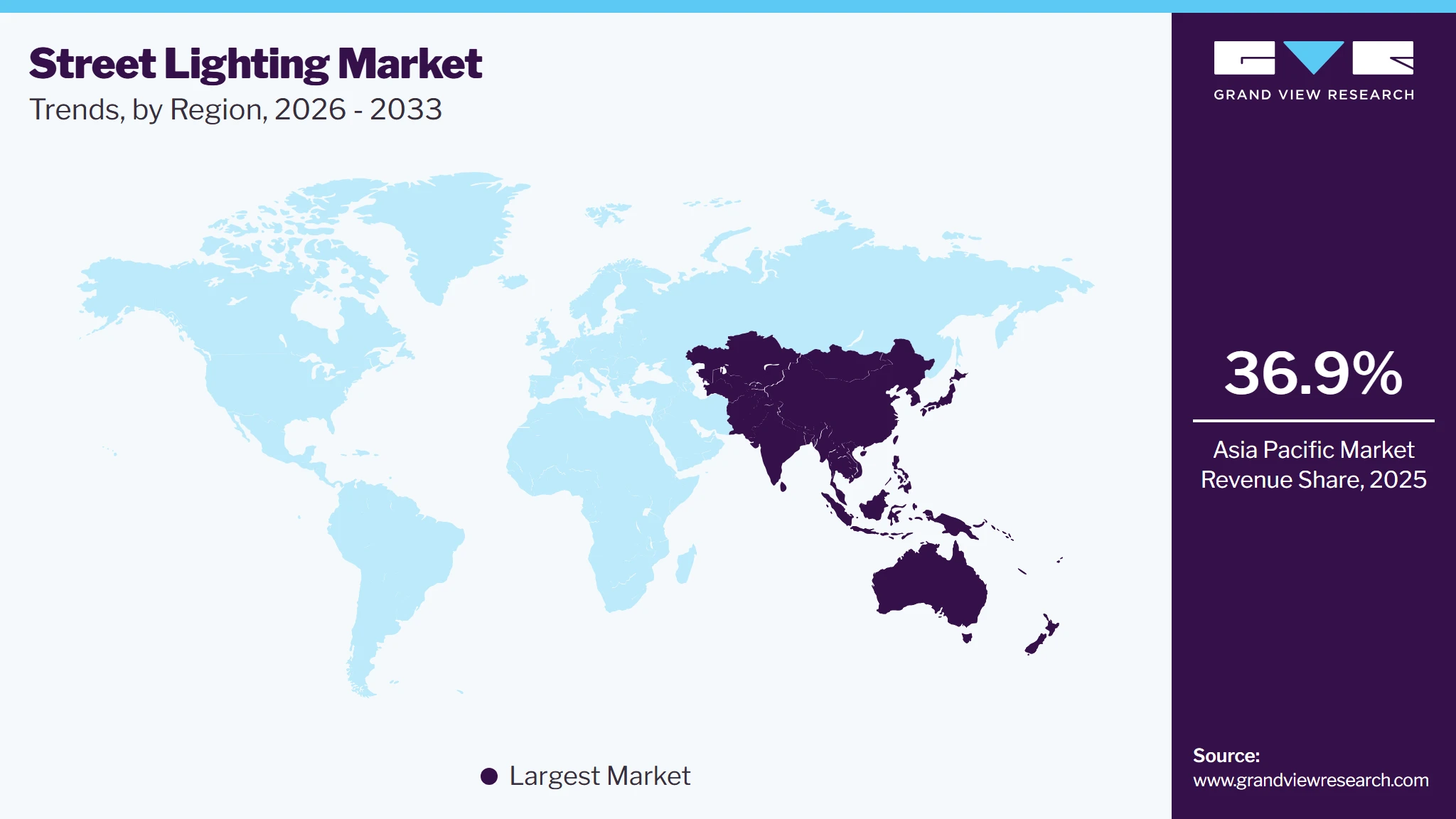
Asia Pacific dominated the global street lighting market with the largest revenue share of 36.9% in 2025. The street lighting market in the China held the largest share in the Asia Pacific region in 2025. Rapid urbanization and infrastructure development drive the market's growth. As cities expand and new urban areas are developed, the demand for street lighting solutions grows correspondingly. Rapid urbanization leads to the creation of new residential, commercial, and industrial zones, all of which require effective street lighting to ensure safety and functionality.
Key Street Lighting Company Insights
The companies are focusing on numerous strategic initiatives, including new product development, agreements, and partnerships & collaborations to gain a competitive advantage over their rivals.
For instance, in September 2024, Crompton Greaves Consumer Electricals Limited completed an LED street lighting project for the National Highways Authority of India (NHAI) in Bengaluru. This initiative involved installing energy-efficient LED street lights along key roadways, significantly enhancing visibility and safety for motorists and pedestrians. The project aligns with the government's push for sustainable infrastructure and aims to reduce energy consumption while improving the quality of urban lighting.
Key Street Lighting Companies:
The following key companies have been profiled for this study on the street lighting market.
-
Acuity Brands
-
ams-OSRAM AG
-
Signify Holding
-
Cree Lighting USA LLC
-
Zumtobel Group
-
Cooper Lighting LLC
-
Hubbell
-
Schréder
-
Thorn
-
Itron Inc.
Competitive Benchmarking
Category
Operating Strategies
Competitive Edge
Weakness
Established Players (Signify; Acuity Brands; Schréder; Zumtobel Group; Current Lighting Solutions)
- Established players focus on supplying LED street lighting systems for highways, roadways, urban streets, and public infrastructure projects. Their strategy includes smart lighting integration, centralized control systems, and long-term maintenance contracts with municipalities. They actively participate in city-wide lighting modernization programs and smart-city initiatives to strengthen market presence.
- These companies benefit from strong brand recognition, extensive project execution experience, and broad product portfolios. Their proven reliability, regulatory compliance expertise, and global distribution networks help secure large public-sector contracts. Strong after-sales support and technical capabilities further enhance customer confidence.
- Growth is often dependent on government infrastructure spending and municipal budgets. Lengthy procurement and tendering processes can delay project implementation. Intense competition and pricing pressure in mature markets may affect profit margins, while large projects require significant capital and operational resources.
Emerging Players (Telensa; Tvilight; Ubicquia; Flashnet; Dimonoff)
- Emerging players primarily focus on smart street lighting solutions featuring IoT connectivity, adaptive dimming, remote monitoring, and data analytics. Their strategy emphasizes intelligent lighting management platforms that improve energy efficiency and operational performance. Many also position streetlights as smart-city infrastructure assets that can support sensors, communication devices, and environmental monitoring systems.
- These companies offer innovative and flexible technologies that enable municipalities to optimize lighting operations and reduce maintenance costs. Their expertise in connectivity, software platforms, and real-time analytics supports the growing adoption of smart-city solutions. Agile business models allow them to respond quickly to evolving customer requirements.
- Emerging players often have smaller customer bases and lower brand recognition than established lighting manufacturers. Winning large municipal contracts can be challenging due to limited project references and financial scale. Expansion into international markets may also be constrained by lower manufacturing capacity and service network coverage.
Street Lighting Market Report Scope
Report Attribute
Details
Market size in 2025
USD 10.5 billion
Estimated market size in 2026
USD 11.3 billion
Projected market size by 2033
USD 17.1 billion
Growth rate
CAGR of 6.1% from 2026 to 2033
Base year for estimation
2025
Historical data
2021 - 2024
Forecast period
2026 - 2033
Quantitative units
Revenue in USD million/billion and CAGR from 2026 to 2033
Report coverage
Revenue forecast, company market share analysis, competitive landscape, growth factors, and trends
Segments covered
Type, application, region
Regional scope
North America; Europe; Asia Pacific; Latin America; MEA
Country scope
U.S.; Canada; Mexico; UK; Germany; France; China; India; Japan; Australia; South Korea; Brazil; UAE; Saudi Arabia; South Africa
Key companies profiled
Acuity Brands; ams-OSRAM AG; Signify Holding; Cree Lighting USA LLC; Zumtobel Group; Cooper Lighting LLC; Hubbell; Schréder; Thorn; Itron Inc.
Customization scope
Free report customization (equivalent up to 8 analysts' working days) with purchase. Addition or alteration to country, regional & segment scope.
Pricing and purchase options
Avail customized purchase options to meet your exact research needs. Explore purchase options
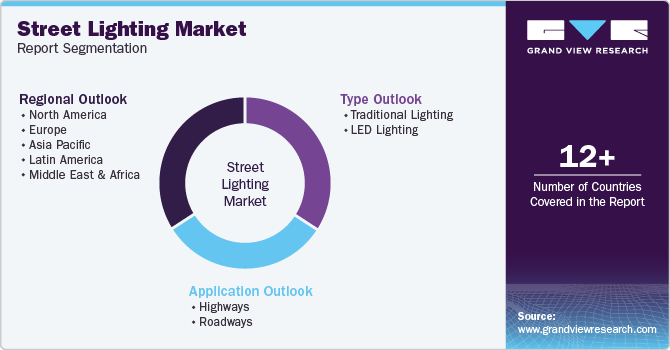
Global Street Lighting Market Report Segmentation
The report forecasts revenue growth at global, regional, and country levels and provides an analysis of the latest industry trends in each of the sub-segments from 2021 to 2033. For this study, Grand View Research has segmented the global street lighting market report based on type, application, and region:
-
Type Outlook (Revenue, USD Million, 2021 - 2033)
-
Traditional Lighting
-
LED Lighting
-
-
Application Outlook (Revenue, USD Million, 2021 - 2033)
-
Highways
-
Roadways
-
-
Regional Outlook (Revenue, USD Million, 2021 - 2033)
-
North America
-
U.S.
-
Canada
-
Mexico
-
-
Europe
-
Germany
-
U.K.
-
France
-
-
Asia Pacific
-
China
-
India
-
Japan
-
Australia
-
South Korea
-
-
Latin America
-
Brazil
-
-
Middle East & Africa
-
UAE
-
Kingdom of Saudi Arabia
-
South Africa
-
-
Research Methodology
The street lighting market figures in this report are based on a proven research process that combines executive interviews with secondary research from proprietary databases, company filings, and recognized regulatory and institutional sources. Market size is built through value-chain sizing - reconciling supply-side and demand-side estimates - and triangulated with bottom-up and top-down approaches. Every estimate passes multiple levels of expert validation before publication, with each street lighting segment quantified using the revenue-capture definitions in the table below.
Segment Definition
Segment - Type
Revenue capture definition
Traditional Lighting
Market value is sustained by replacement demand for high-pressure sodium (HPS), metal-halide, mercury-vapor, and fluorescent street lighting systems that remain operational in many developing regions. Spending is largely associated with maintenance, lamp replacement, ballast upgrades, and lifecycle support for existing infrastructure, where full LED conversion has not yet occurred.
LED Lighting
The dominant and fastest-growing segment is driven by municipal modernization programs, smart city initiatives, and energy-efficiency mandates. Manufacturers and solution providers benefit from demand for long-life luminaires, intelligent lighting controls, adaptive dimming technologies, and connected street lighting systems that reduce operating and maintenance costs.
Segment - Application
Revenue capture definition
Highways
Investment is concentrated on high-output lighting systems designed to provide long-range visibility, driver safety, and consistent illumination across major transportation corridors. Procurement typically involves large-scale infrastructure projects where durability, energy efficiency, and compliance with roadway safety standards are critical decision factors.
Roadways
The largest application segment encompasses urban streets, residential roads, commercial districts, rural roads, and municipal transportation networks. Market growth is supported by urbanization, roadway expansion projects, public safety initiatives, and increasing adoption of smart lighting technologies that enable remote monitoring and energy management.
Estimation Model
Layer
Question
Analysis
Public Illumination Infrastructure Layer
Where is street lighting infrastructure required?
Identify transportation and public-access environments that require continuous nighttime visibility and safety. These include highways, urban roads, residential streets, bridges, tunnels, pedestrian pathways, public parks, industrial zones, and smart city developments. This layer defines demand based on the need to support road safety, pedestrian security, traffic management, and urban accessibility after dark.
Municipal Investment & Planning Layer
Who is responsible for deploying and upgrading street lighting systems?
Assess the role of municipal authorities, transportation departments, utility companies, smart city agencies, and public-private infrastructure developers in funding and managing street lighting projects. Deployment decisions are influenced by urbanization rates, infrastructure modernization programs, energy-efficiency targets, public safety objectives, and government budget allocations for civic infrastructure improvements.
Networked Lighting Operations Layer
How are modern street lighting systems managed and operated?
Analyze the transition from conventional lighting infrastructure to connected and intelligent lighting networks. Operators increasingly utilize LED luminaires, centralized control systems, adaptive dimming technologies, motion sensors, remote diagnostics, and IoT-enabled monitoring platforms to optimize energy consumption, reduce maintenance requirements, and improve operational reliability across large lighting networks.
Civic Value & Lifecycle Economics Layer
How is economic and societal value generated through street lighting infrastructure?
Evaluate value creation through energy savings, reduced maintenance costs, extended asset lifespan, improved traffic safety, and enhanced public security. Revenue within the ecosystem is generated through luminaire sales, control systems, installation projects, maintenance contracts, retrofit programs, and smart city integration services. Long-term market growth is supported by infrastructure renewal initiatives and increasing investments in sustainable and digitally connected urban environments.
Delivered Customizations
This report has been delivered with the following In-depth customizations
Client Request
Customization Delivered
Value Adds
Public Infrastructure Illumination & Road Safety Enhancement Trends
Conducted a focused analysis of street lighting deployment across highways, urban roads, residential streets, industrial zones, and public spaces, focusing on visibility improvement, pedestrian safety, traffic management, and nighttime security requirements.
Helps stakeholders identify high-priority infrastructure applications, evaluate modernization trends in public lighting, and assess commercialization opportunities in roadway illumination solutions.
Municipal LED Retrofit & Energy Cost Reduction Adoption Trends
Evaluated adoption trends for LED streetlights, adaptive lighting systems, centralized lighting controls, and energy-efficient retrofit programs implemented by municipalities, utilities, and transportation authorities to reduce electricity consumption and maintenance costs.
Provides insights into public-sector investment priorities, operational cost-saving opportunities, and commercially attractive retrofit projects supporting sustainable urban development.
Smart City Lighting Networks & Connected Infrastructure Opportunity Assessment
Assessed demand for intelligent street lighting systems incorporating remote monitoring, motion sensing, environmental sensors, wireless communication modules, and smart city platform integration, along with challenges related to infrastructure funding, interoperability, and long-term asset management.
Supports investment and expansion strategies by identifying emerging smart infrastructure opportunities, evaluating technology readiness, and strengthening long-term growth potential in connected urban lighting ecosystems.
Frequently Asked Questions About This Report
The global street lighting market size was estimated at USD 10.5 billion in 2025 and is expected to reach USD 11.3 billion in 2026.
The global street lighting market is expected to grow at a compound annual growth rate of 6.1% from 2026 to 2033 to reach USD 17.1 billion by 2033.
Key factors include increasing adoption of intelligent and connected street lighting systems, rising adoption of solar-powered street lighting solutions, and rising demand for adaptive and sensor-based street lighting solutions.
Asia Pacific dominated with 36.9% revenue share in 2025.
Key players operating in the street lighting market include Acuity Brands; ams-OSRAM AG; Signify Holding; Cree Lighting USA LLC; Zumtobel Group; Cooper Lighting LLC; Hubbell; Schréder; Thorn; Itron Inc.
The LED lightning segment led with an 80.3% revenue share in 2025 and it is the fastest-growing segment.
The roadways held the largest share (over 65.6%), while highways segment is the fastest-growing segment.
About the Author(s)
Electronic Devices Research Team
Semiconductors & Electronics · Electronic DevicesThis report was authored by the electronic devices research team at Grand View Research - comprising two research analysts, one senior research analyst, and one industry expert - with specialized expertise in the electronic devices segment of the semiconductors & electronics industry. All findings are based on proprietary semiconductors & electronics databases, executive interviews, and regulatory analysis, subject to internal peer review prior to publication.
Last Updated:
Speak to Analyst


Customize this report to your needs — add regions, segments, or data points, with 20% free customization.
Or view our licence options:


ISO 9001:2015 & 27001:2022 Certified
We are GDPR and CCPA compliant! Your transaction & personal information is safe and secure. For more details, please read our privacy policy.


