
- Home
- »
- Renewable Chemicals
- »
-
Sugar-based Surfactants Market Size & Share Report, 2030GVR Report cover
![Sugar-based Surfactants Market Size, Share & Trends Report]()
Sugar-based Surfactants Market (2022 - 2030) Size, Share & Trends Analysis Report By Type (Alkyl Polyglycoside), By Raw Material (Monomeric, Dimeric), By Application, By Region, And Segment Forecasts
Report Overview
The global sugar-based surfactants market size was valued at USD 5.58 billion in 2021 and is anticipated to expand at a compound annual growth rate (CAGR) of 5.7% from 2022 to 2030. The demand for the product is anticipated to be driven by various factors such as increased demand for renewable products, less toxic, and rising awareness related to personal hygiene. Sugar-based surfactants are majorly used in personal care and home care products. They are also adopted by the textile industry. The product finds applications in hand dishwashing liquid as well as in liquid detergents. In the personal care industry, these are used effectively in various skin care, baby care, and hair care products. The growing usage of these personal care products is expected to augment the product demand in the coming years.
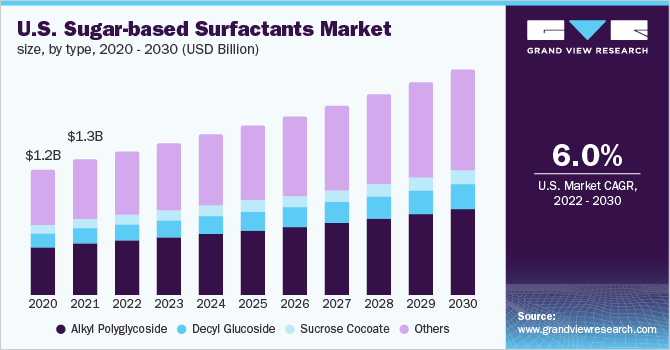
Sugar-based surfactants are surface-active agents comprising sugar groups in their structure. The type of sugar group present in the molecule of the surfactants depends on the type of raw materials used in the initial process. They are derived from sugar raw materials in various forms such as monomeric, dimeric, and polymeric. These include fructose, glucose, lactose, chitin, pectin, and starch, among others.
Some of the raw material suppliers in the market include Vijaya Enterprises, VSM AGRO, Tate & Lyle, and NOVEL CHEM, among others. These raw materials are used as starting agents in product manufacturing. These raw materials are converted into surfactants and the process is carried out by several manufacturers such as Clariant, Solvay, Evonik Industries AG, SEPPIC, and Dow.
Type Insights
Other types of segments dominated the market with a revenue share of 44.5% in 2021. This is attributed to the growing use of different natural surfactants such as cationic, sorbitan esters, and fatty acid glucamides. Sorbitan esters are nonionic surfactants that are extensively used in the production of creams, emulsions, and ointments for cosmetics and pharmaceutical uses. They are also used as a stabilizer, defoaming agent, emulsifier, rehydrating aid, and synthetic flavor in food & beverages. Fatty acid glucamides are widely used in cleaning and washing formulations as well as in the cosmetics sector as a surfactant. The increasing usage of other product types by manufacturers is likely to trigger overall market growth during the forecast period.
Alkyl polyglycosides (APG) are a type of non-ionic surfactant that is extensively used across different applications such as industrial, household cleaning products, and cosmetics. They are derived from fatty alcohol and glucose, making them biodegradable in nature. The key raw materials used for their production are fat and starch, mixed with various types of sugars including alkyl groups and hydrophilic end. The product is used to improve the concentration of foam formation in detergents. The different attributes of APG, such as excellent foaming performance, wettability, interfacial activity, and oil recovery at high temperatures, make it a green surfactant.
Sucrose cocoate is an organic moisturizer derived from sucrose esters of coconut fatty acid. It helps in enhancing the viscosity, foam density, and mildness of cleaning products. It is considered safe and gentle for usage in baby care products, including creams, shampoos, and lotions, among others. In shampoo, it helps in decreasing the electrostatic charging of hair. The growing usage of sucrose cocoate in cosmetics formulations is likely to boost its demand in the coming years.
Raw Material Insights
The monomeric segment dominated the market with a revenue share of more than 41% in 2021. This is attributed to the growing demand for non-toxic, biodegradable, and acts as solvent for biological membranes, which, in turn, makes monomeric raw material suitable for numerous end-use applications. The rising demand for the product from different applications is anticipated to propel market growth during the forthcoming years.
They are extracted from sugar raw materials occurring in the form of monomers such as glucose, fructose, and sorbitol. They are composed of carbohydrates and fatty alcohol and are widely used in the petrochemical industry. Monomeric is the old raw material used for product formulation and is used for lowering the interfacial and surface tension between water and oil in water/oil systems.
Polymeric sugar-based surfactants are widely used for providing stability to various formulations. They are used as emulsifiers and dispersants and keep the particles away from each other to avoid any type of breakdown. They are used due to numerous advantages such as higher molecular weight, strong surface adsorption, large repulsive barrier, and numerous anchoring groups per molecule. In the pharmaceutical industry, active ingredients with higher molecular concentration and stability are preferred, which, in turn, benefits the product demand.
Application Insights
The homecare & personal care segment dominated the sugar-based surfactants market with a share of 46.8% in 2021. This is attributable to its growing use in various personal care products such as body lotions, skin creams, body washes, shampoos, and sunscreens among others on the account of their mild and non-irritating properties for skin and eyes. They portray high efficiency in cleaning, washing, wetting, and foaming compounds. In addition, they help maintain the skin balance without causing any excessive dryness. Growing consumer inclination toward natural surfactants is one of the driving forces for the overall industry.
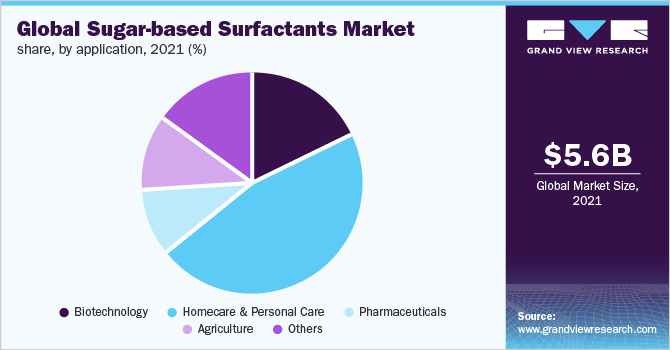
These products are also used in the separation process named micellar-enhanced ultrafiltration (MEUF). This process is used to separate low molecular pollutants from aqueous material using surfactants. In this process, the size of pollutant molecules is increased by isolating them inside the surfactant micelles. Hence, the resultant pollutants and molecules are left on the surface of the ultrafilter membrane, resulting in separation from the solution. Key manufacturers are focusing on extensive product R&D to innovate higher quality products for niche applications.
The product is used as a drug vehicle in protein formulation. They are used to substitute allergenic and toxic surfactants in protein formulations. They are extensively used in the pharmaceutical sector as they are chemically pure and have antibacterial properties. They are also used as a wetting agent and for the dispersion of active pharmaceutical ingredients. In addition, they help reduce the interfacial tension between the liquid and solid suspensions. They are used to treat respiratory issues among premature infants. The rising product penetration in different pharmaceutical applications is likely to boost industry growth in the coming years.
The rising acceptance of modern agricultural practices and technologies that involve the use of the product is one of the major factors contributing to the market growth. The product is used for improving the quality of agricultural soil by soil remediation. Moreover, it is also used to remove heavy metals and harmful hydrocarbons that are accumulated in agricultural soil. The aforementioned factors are expected to positively influence the market demand during the forecast period.
Regional Insights
Europe dominated the market with a share of 32.9% in 2021. This is attributed to the increasing product demand in personal care, food processing, and industrial cleaner applications is expected to boost market growth over the forecast period. Home care is a prominent application segment in the regional market owing to the rising utilization of detergents.
In addition, the growth of the hospitality sector in the region is likely to contribute to product demand. The tourism industry is witnessing an upward trend in countries such as the U.K., Italy, and France, thereby contributing to the need for the construction of new hotels. This is likely to boost the consumption of laundry detergents, consequently propelling the market demand over the forecast period.
The Asia Pacific market is majorly driven by the growing population in countries such as China and India and the subsequent expansion of various end-use industries including agriculture, pharmaceutical, and personal care. Along with the presence of global giants in the detergent industry, such as Procter & Gamble, various countries in the region are characterized by the presence of several domestic players that are focusing on strengthening their presence in the detergents industry. This is anticipated to trigger industry growth in the coming years.
Key Companies & Market Share Insights
The global market is fragmented in nature with few manufacturers catering to the product demand. The key market players are focusing on R&D activities and production plant expansion. For instance, in March 2021, SEPPIC inaugurated its first specialty ingredients manufacturing facility in the U.S. This site is situated near Richmond, Virginia, the U.S. This production site is the company’s second-largest production site for high-performance specialty ingredients for pharmaceutical, personal care, and beauty applications. Some prominent players in the global sugar-based surfactants market include:
-
Clariant
-
Solvay
-
Evonik
-
BASF SE
-
Shanghai Fine Chemicals Co. Ltd.
-
Stepan Company
-
Dadia Chemical Industries
-
Glycosurf
-
Jeneil
-
SEPPIC
-
Shiv Shakti India
Sugar-based Surfactants Market Report Scope
Report Attribute
Details
Market size value in 2022
USD 5.90 billion
Revenue forecast in 2030
USD 9.18 billion
Growth Rate
CAGR of 5.7% from 2022 to 2030
Base year for estimation
2021
Historical data
2018 - 2020
Forecast period
2022 - 2030
Quantitative units
Revenue in USD Million, Volume in Kilotons, and CAGR from 2022 to 2030
Report coverage
Revenue forecast, company ranking, competitive landscape, growth factors, and trends
Segments covered
Type, raw material, application, region
Regional scope
North America; Europe; Asia Pacific; Central & South America; Middle East & Africa
Country scope
U.S., Canada, Mexico, Germany, U.K., France, Italy, China, India, Japan, South Korea, Southeast Asia, Brazil, Argentina, Saudi Arabia, South Africa
Key companies profiled
Clariant; BASF SE; Solvay; Evonik; SEPPIC; Shanghai Chemical Industries; Glycosurf; Dadia Chemicals Industries; Stepan Company; Jeneil; Shiv Shakti India
Customization scope
Free report customization (equivalent to up to 8 analysts' working days) with purchase. Addition or alteration to country, regional & segment scope.
Pricing and purchase options
Avail of customized purchase options to meet your exact research needs. Explore purchase options
Segments Covered in the Report
This report forecasts revenue growth at global, regional, and country levels and provides an analysis of the latest industry trends in each of the sub-segments from 2018 to 2030. For this study, Grand View Research has segmented the global sugar-based surfactants market report based on type, raw material, application, and region:
- Sugar-based Surfactants Market Type Outlook (Revenue, USD Million, Volume, Kilotons, 2018 - 2030)
-
Alkyl Polyglycoside
-
Branched Alkyl Polyglycoside
-
Ethoxylated Alkyl Polyglycoside
-
-
Decyl Glucoside
-
Sucrose Cocoate
-
Others
-
-
Sugar-based Surfactants Market Raw Material Outlook (Revenue, USD Million, Volume, Kilotons, 2018 - 2030)
-
Monomeric
-
Polymeric
-
Dimeric
-
-
Sugar-based Surfactants Market Application Outlook (Revenue, USD Million, Volume, Kilotons, 2018 - 2030)
-
Biotechnology
-
Homecare & Personal Care
-
Pharmaceuticals
-
Agriculture
-
Others
-
-
Sugar-based Surfactants Market Regional Outlook (Revenue, USD Million, Volume, Kilotons, 2018 - 2030)
-
North America
-
U.S.
-
Canada
-
Mexico
-
-
Europe
-
Germany
-
U.K.
-
France
-
Italy
-
-
Asia Pacific
-
China
-
India
-
Japan
-
South Korea
-
Southeast Asia
-
-
Central & South America
-
Brazil
-
Argentina
-
-
Middle East & Africa
-
Saudi Arabia
-
South Africa
-
-
Frequently Asked Questions About This Report
The global sugar-based surfactants market size was estimated at USD 5.58 billion in 2021 and is expected to reach USD 5.90 billion in 2030.
The global sugar-based surfactants market is expected to grow at a compound annual growth rate of 5.7% from 2022 to 2030 to reach USD 9.18 billion by 2030.
Europe dominated the sugar-based surfactants market with a share of 33.9% in 2021. This is attributable to the increasing demand for Alkyl Polyglycosides from several end-use industries in the region, especially in the developed economies.
Some key players operating in the sugar-based surfactants market include Clariant, Evonik Industries AG, SEPPIC, BASF SE, Solvay, and Dadiac, among others
Key factors that are driving the sugar-based surfactants market growth include rising demand from end-use industries such as Biotechnology, Home & Personal Care, Pharmaceutical, Agriculture, and Others.
About the Author(s)
Renewable Chemicals Research Team
Specialty & Chemicals · Renewable ChemicalsThis report was authored by the renewable chemicals research team at Grand View Research - comprising two research analysts, one senior research analyst, and one industry expert - with specialized expertise in the renewable chemicals segment of the specialty & chemicals industry. All findings are based on proprietary specialty & chemicals databases, executive interviews, and regulatory analysis, subject to internal peer review prior to publication.
Last Updated:
Speak to Analyst -


Customize this report to your needs — add regions, segments, or data points, with 20% free customization.
Or view our licence options:


ISO 9001:2015 & 27001:2022 Certified
We are GDPR and CCPA compliant! Your transaction & personal information is safe and secure. For more details, please read our privacy policy.


