
- Home
- »
- Plastics, Polymers & Resins
- »
-
Sugarcane-based Packaging Market Size Report, 2026-2033GVR Report cover

Sugarcane-based Packaging Market (2026 - 2033)
Size, Share & Trends Analysis Report By Material (Bagasse-based, Sugarcane-based), By Product (Plates & Trays, Food Containers), By End-use, By Region, And Segment Forecasts
Market Size, 2025
$384.8MMarket Estimate, 2026
$421.6MMarket Forecast, 2033
$750.9MCAGR, 2026–2033
8.6%Sugarcane-based Packaging Market Trends
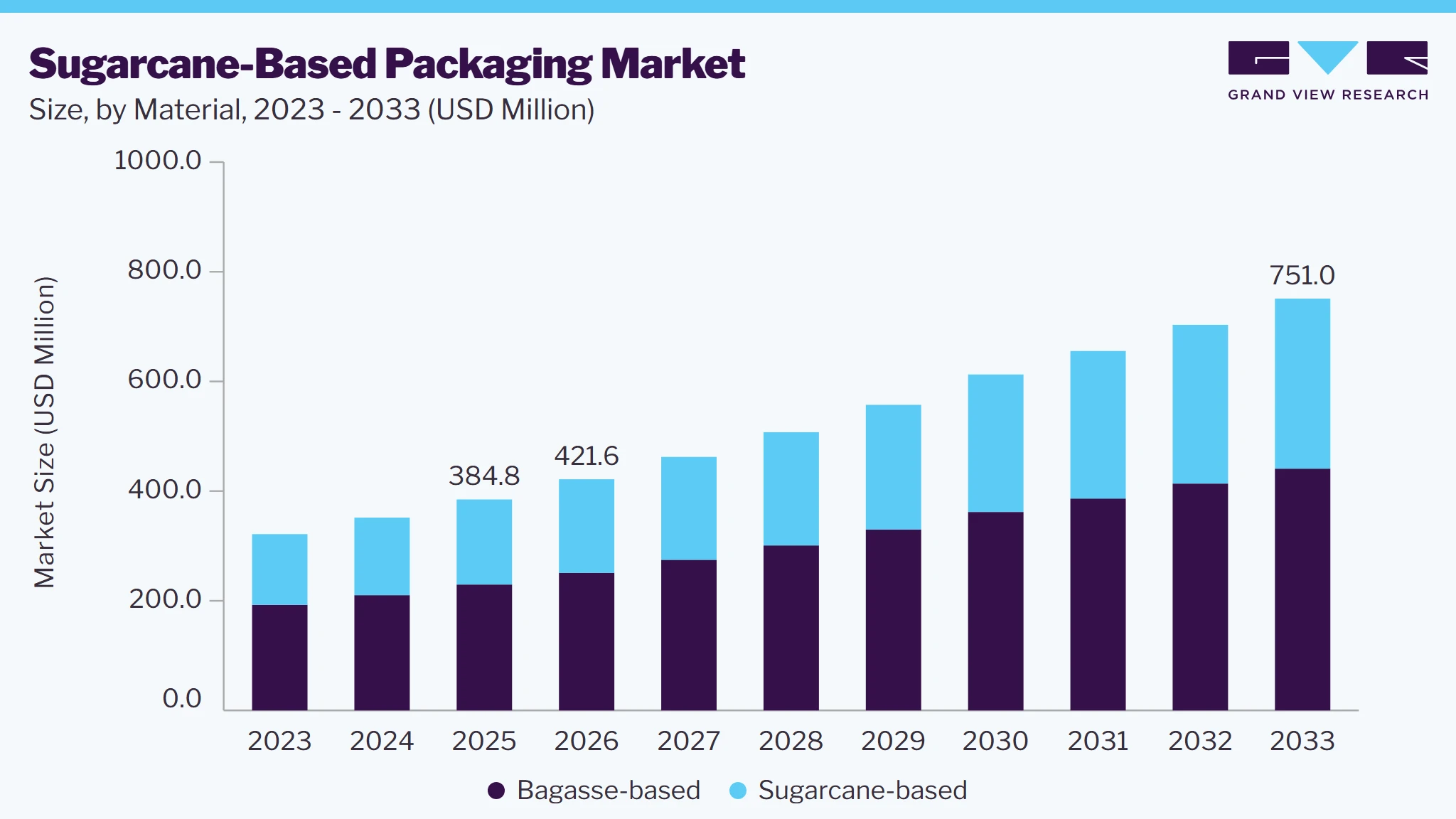
The global sugarcane-based packaging market size was valued at USD 384.8 million in 2025 and is projected to grow from USD 421.6 million in 2026 to USD 750.9 million by 2033, at a CAGR of 8.6% from 2026 to 2033. Asia-Pacific dominated the market, accounting for a revenue share of 45.9% in 2025. Large companies are committing to net-zero targets and sustainable packaging mandates, driving demand for sugarcane-based alternatives. Brands are shifting to biodegradable materials to enhance their ESG performance and meet consumer expectations.
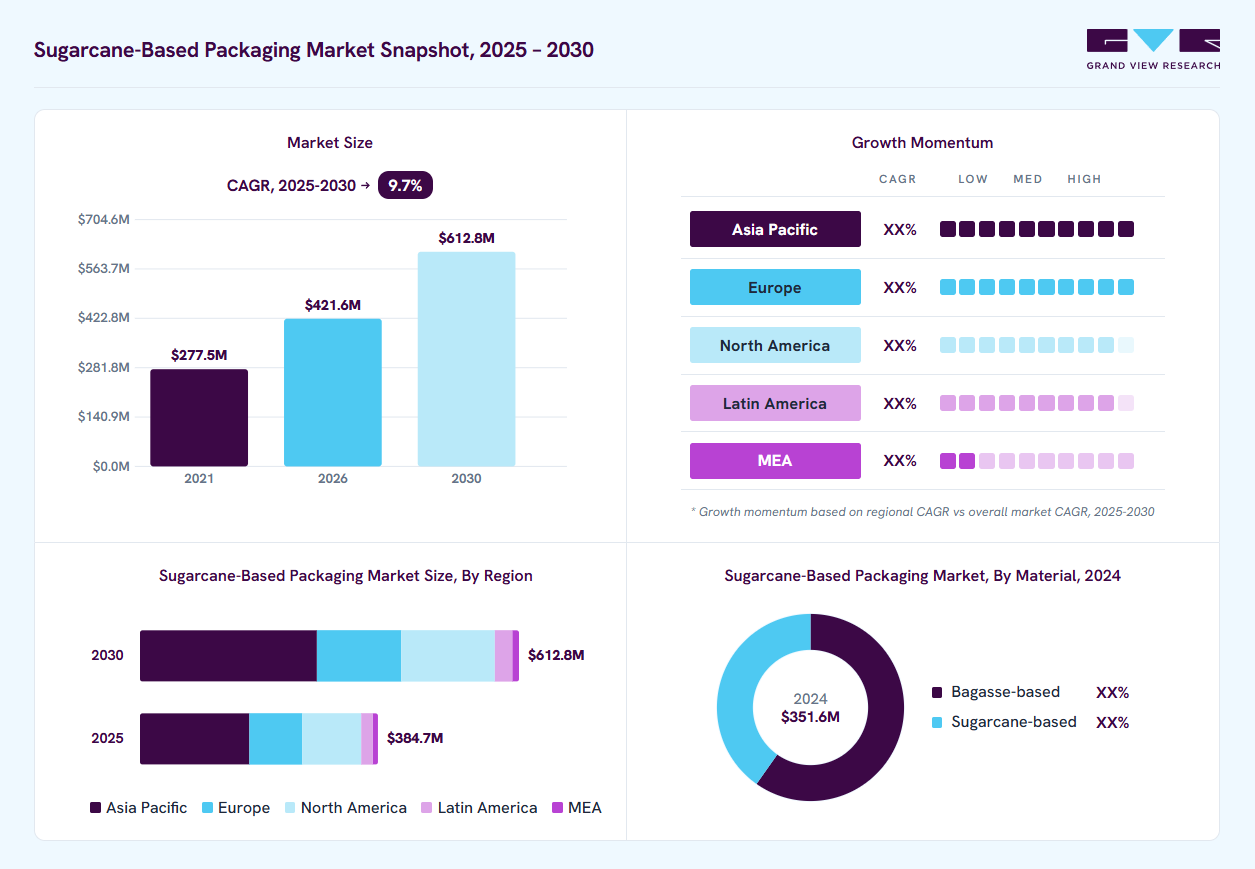 Source: Grand View Research, IR Documents, Primary Interviews, Paid DatabasesTo learn more about this report,
 Download Free Sample Report
 Key Market Trends & Insights
- By material: Baggase-based segment led the market with the largest revenue share of 59.7% in 2025.
- By product: Plates & trays segment led the market with the largest revenue share of 40.3%in 2025.
- By end use: Food service segment led the market with the largest revenue share of 44.7% in 2025.
Regional Highlights
- Largest regional market: Asia Pacific (45.9% revenue share, 2025)
- By country: China held the highest market revenue share in Asia Pacific in 2025.
Market Size & Forecast
- Market size in 2025: USD 384.8 Million
- Estimated market size in 2026: USD 421.6 Million
- Projected market size by 2033: USD 750.9 Million
- CAGR (2026-2033): 8.6%
Three ways to get this report
Buy it, customize it, or ask a question.Ask an Analyst
Analyst response in 1 business day
- AccessReport author, directly
- Reply timeWithin 1 working day
- No sales callDirect answer only
- FormatEmail reply
- CostFree, no cost
Get the Full Report
What the study covers
- FormatsPDF · Excel · Dashboard
- Timeline2026–2033 annual, 2025 base
- Coverage20+ countries, 5 regions
- Companies10+ key players profiled
Customize the Report
20% free customization
- IncludeCountries, segments, points
- TailorTo your product definition
- ExtendDeeper competitor detail
- OrA fully bespoke study
- Turnaround5–10 working days
The market is witnessing significant expansion, particularly in high-growth consumer markets such as food service, personal care, and e-commerce packaging. With global regulatory frameworks tightening around single-use plastics, multinational brands are rapidly integrating biodegradable and compostable packaging solutions. Companies like Unilever and Nestlé are investing in sustainable alternatives, and sugarcane-derived materials such as bagasse are emerging as preferred choices due to their structural integrity and environmental benefits.
 To learn more about this report, Download Free Sample Report
 Innovations in material processing, including advanced molding techniques and hybrid polymer blends, are enhancing the performance of sugarcane-based packaging, making it more competitive against traditional plastics. This trend is further amplified by growing consumer demand for sustainable packaging solutions, leading to increased production capacities across key manufacturing hubs in Asia Pacific and Latin America.
Market Dynamics
The Sugarcane-based packaging market is experiencing robust growth, driven by increasing environmental awareness, stringent regulations on single-use plastics, and the growing adoption of biodegradable packaging across multiple industries. Derived from renewable sugarcane bagasse, sugarcane-based packaging offers a sustainable alternative to conventional plastic and foam packaging while supporting circular economy goals through compostability and reduced carbon emissions. Food & beverage, foodservice, retail, healthcare, and e-commerce sectors are increasingly utilizing sugarcane-based trays, clamshells, plates, bowls, cups, and containers to meet consumer demand for eco-friendly packaging and comply with sustainability mandates. Furthermore, continuous advancements in molded fiber manufacturing, water-resistant coatings, lightweight product design, and improved barrier properties are enhancing product performance, expanding application areas, and accelerating the adoption of sugarcane-based packaging worldwide.
The growing global shift toward sustainable packaging is a major driver of the Sugarcane-based packaging market. Governments across developed and emerging economies are implementing stringent regulations to reduce plastic waste, ban single-use plastics, and encourage the adoption of biodegradable and compostable packaging materials. As a renewable byproduct of the sugar industry, sugarcane bagasse offers an environmentally friendly alternative to petroleum-based plastics by converting agricultural waste into value-added packaging products. Foodservice providers, retailers, consumer goods manufacturers, and e-commerce companies are increasingly adopting sugarcane-based trays, containers, plates, bowls, and clamshells to meet regulatory requirements and support corporate sustainability goals while reducing their environmental footprint.
In addition to regulatory support, changing consumer preferences are accelerating market growth. Consumers are becoming more conscious of the environmental impact of packaging and increasingly favor brands that use renewable, compostable, and plastic-free packaging solutions. This shift has encouraged manufacturers to invest in advanced molded fiber technologies that improve the durability, moisture resistance, and functional performance of sugarcane-based packaging. As industries continue to prioritize sustainable packaging without compromising product quality or safety, demand for sugarcane-based packaging is expected to expand steadily across food & beverage, healthcare, retail, and other end-use industries.
One of the major restraints affecting the Sugarcane-based packaging market is the relatively higher production cost compared to conventional plastic packaging. Manufacturing sugarcane-based packaging requires specialized molded fiber processing technologies, quality raw material supply, and additional treatments to enhance moisture and grease resistance, increasing production expenses. Moreover, sugarcane-based packaging may offer lower durability and barrier performance for certain applications involving extended storage, high humidity, or liquid products. Limited composting infrastructure in several regions and fluctuating availability of sugarcane bagasse due to seasonal agricultural production further pose challenges to widespread adoption, particularly in price-sensitive markets.
The rapid growth of online food delivery, takeaway services, and e-commerce presents a significant opportunity for the sugarcane-based packaging market. Restaurants, quick-service chains, grocery retailers, and online brands are increasingly replacing plastic packaging with compostable sugarcane-based alternatives to strengthen their sustainability initiatives and meet evolving consumer expectations. Continuous innovation in molded fiber technology, including enhanced barrier coatings, microwave-safe designs, freezer compatibility, and customizable packaging formats, is expanding the range of commercial applications. As investments in composting infrastructure and bio-based packaging technologies continue to grow worldwide, sugarcane-based packaging is expected to gain broader acceptance across both food and non-food packaging sectors, creating substantial long-term growth opportunities for manufacturers.
Analyst Perspective
The Sugarcane-based packaging market has evolved from a niche eco-friendly packaging solution into a rapidly growing segment of the sustainable packaging industry, driven by increasing restrictions on single-use plastics, rising consumer environmental awareness, and greater adoption of renewable materials. Initially concentrated in foodservice applications, the market has expanded into retail, e-commerce, healthcare, and consumer goods as advancements in molded fiber technology have improved product durability and functionality. Looking ahead, the market is expected to witness steady growth, supported by stricter sustainability regulations, continued innovation in compostable packaging, expanding production capacity, and growing corporate commitments to reduce environmental impact, positioning sugarcane-based packaging as a key solution in the global transition toward sustainable packaging.
Drivers, Opportunities & Restraints
Government mandates and industry-wide sustainability commitments are major driving forces behind the growth of sugarcane-based packaging. Countries such as the United States, Canada, and members of the European Union have implemented stringent plastic bans and extended producer responsibility (EPR) policies that incentivize the adoption of biodegradable alternatives. For instance, the European Green Deal’s circular economy initiatives encourage businesses to transition towards renewable materials like sugarcane bagasse to meet carbon neutrality targets. Furthermore, rising ESG (Environmental, Social, and Governance) criteria in corporate strategies are pressuring companies to integrate eco-friendly packaging into their supply chains. As a result, packaging manufacturers and FMCG brands are increasingly investing in sugarcane-based packaging technologies, fostering rapid market expansion.
One of the most promising opportunities in the market lies in the development of advanced barrier coatings that improve the material’s moisture resistance, durability, and suitability for a broader range of applications. Traditional bagasse packaging has been limited in certain segments, such as liquid packaging and frozen foods, due to its relatively high permeability. However, innovations in plant-based and biodegradable barrier coatings-such as bio-PET and PHA coatings-enable sugarcane packaging to compete with petroleum-based alternatives. Companies investing in these advancements can unlock new high-value applications, including pharmaceutical packaging and extended shelf-life food products, positioning themselves as leaders in the next generation of sustainable packaging solutions.
Despite its growing adoption, the market faces challenges related to high production costs and supply chain volatility. The processing of sugarcane bagasse into high-quality packaging materials involves complex refining, pulping, and molding processes, which are often costlier than traditional plastic manufacturing. Fluctuations in raw material availability, particularly due to climate variability affecting sugarcane harvests, can impact supply consistency and pricing. Developing economies, where sugarcane is predominantly cultivated, may also face infrastructure limitations that hinder efficient transportation and processing, further adding to cost pressures. These factors create a pricing disadvantage compared to petroleum-based plastics, requiring strategic investments in production efficiencies and economies of scale to drive long-term market competitiveness.
Material Insights
Based on material, the baggase-based segment led the market with the largest revenue share of 59.7% in 2025. The superior biodegradability and compostability of bagasse make it an ideal material for disposable food containers, aligning with stringent regulations like the European Single-Use Plastics Directive and the U.S. Plastics Pact. In addition, bagasse offers cost-effective scalability, particularly in emerging markets like India, China, and Brazil, where sugarcane processing industries generate abundant bagasse as a byproduct. Innovations in thermoforming and barrier coatings further expand its application range, allowing bagasse packaging to offer moisture-resistant and grease-proof properties, making it a preferred choice over conventional plastic and polystyrene packaging.
Sugarcane-based is expected to grow significantly over the forecast period. Recent advancements in sugarcane fiber extraction techniques drive the adoption of sugarcane-based packaging beyond traditional applications. New refining processes improve fiber purity and structural integrity, enhancing durability and flexibility, which are essential for diverse packaging solutions. As a result, manufacturers can now develop thinner, lightweight, yet robust packaging materials, reducing raw material consumption while maintaining strength and performance. This technological progress attracts major investment from multinational packaging firms aiming to create innovative solutions that align with the circular economy model.
Product Insights
Based on product, the plates & trays segment led the market with the largest revenue share of 40.3%in 2025. The demand for sugarcane-based plates and trays is surging, particularly in the catering, hospitality, and event management industries, where large-scale disposable packaging is essential. With government mandates restricting plastic disposables at public events and large-scale gatherings, businesses are turning to eco-friendly alternatives like bagasse plates and trays. Moreover, consumer preferences are shifting towards sustainable dining experiences, with an increasing number of event organizers and food vendors marketing their services as environmentally responsible. This shift leads to the widespread adoption of sugarcane-based plates and trays across food courts, corporate events, and outdoor dining setups, where durability and compostability are key purchasing factors.
The sugarcane-based bowls and cups market is experiencing strong momentum as foodservice businesses seek compostable solutions for both hot and cold beverages. Unlike traditional paper cups that require polyethylene (PE) lining for liquid resistance, emerging sugarcane-based cups incorporate biodegradable coatings, eliminating plastic barriers. This innovation is particularly relevant in markets like the U.S. and Europe, where regulations are tightening around plastic-lined cups, and consumers are actively choosing eco-friendly alternatives.
End Use Insights
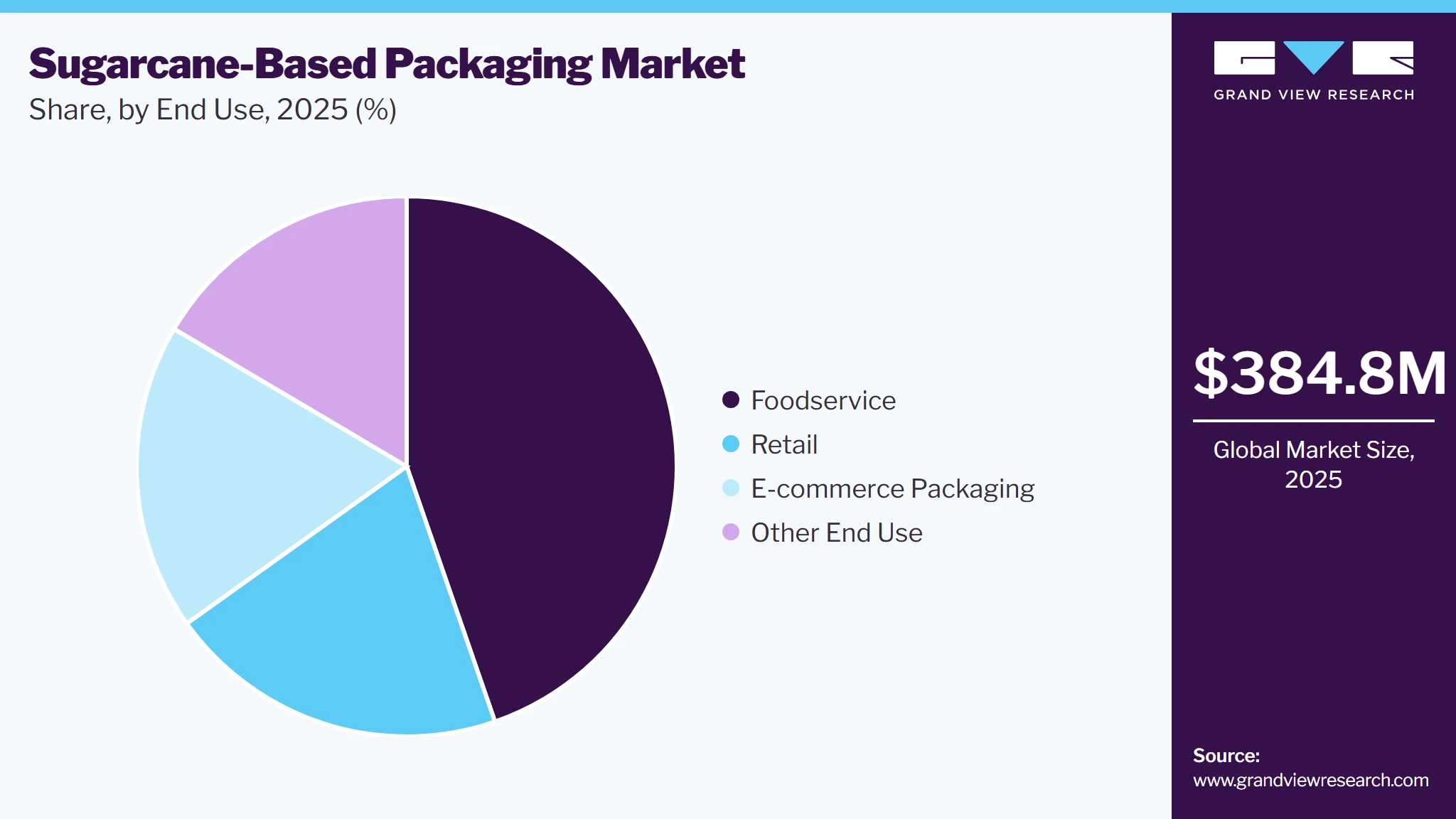
Based on end use, food service segment led the market with the largest revenue share of 44.7% in 2025. Quick-service restaurants (QSRs) and fast-casual dining chains are at the forefront of driving the adoption of sugarcane-based packaging due to mounting regulatory and consumer pressures. Major brands, including KFC, Subway, and Burger King, have pledged to transition to biodegradable and compostable packaging, significantly influencing supply chain dynamics. The increasing shift toward home delivery and takeaway services post-pandemic has further amplified the demand for sustainable food containers, with sugarcane-based packaging offering an ideal combination of strength, grease resistance, and compostability.
 To learn more about this report, Download Free Sample Report
 In the e-commerce sector, sustainability has become a key differentiator, pushing retailers and logistics providers to explore biodegradable alternatives such as sugarcane-based packaging. With a surge in online shopping, particularly in regions like North America and Europe, companies face increasing scrutiny over excessive plastic packaging waste. Eco-conscious consumers actively favor brands prioritizing green packaging, as evidenced by the growing adoption of sustainable mailers, inserts, and protective wraps made from sugarcane fibers. Market leaders such as Amazon and Shopify are investing in research to develop compostable shipping materials, positioning sugarcane-based packaging as a viable solution for minimizing carbon footprints and improving circular economy practices across global e-commerce supply chains.
Regional Insights
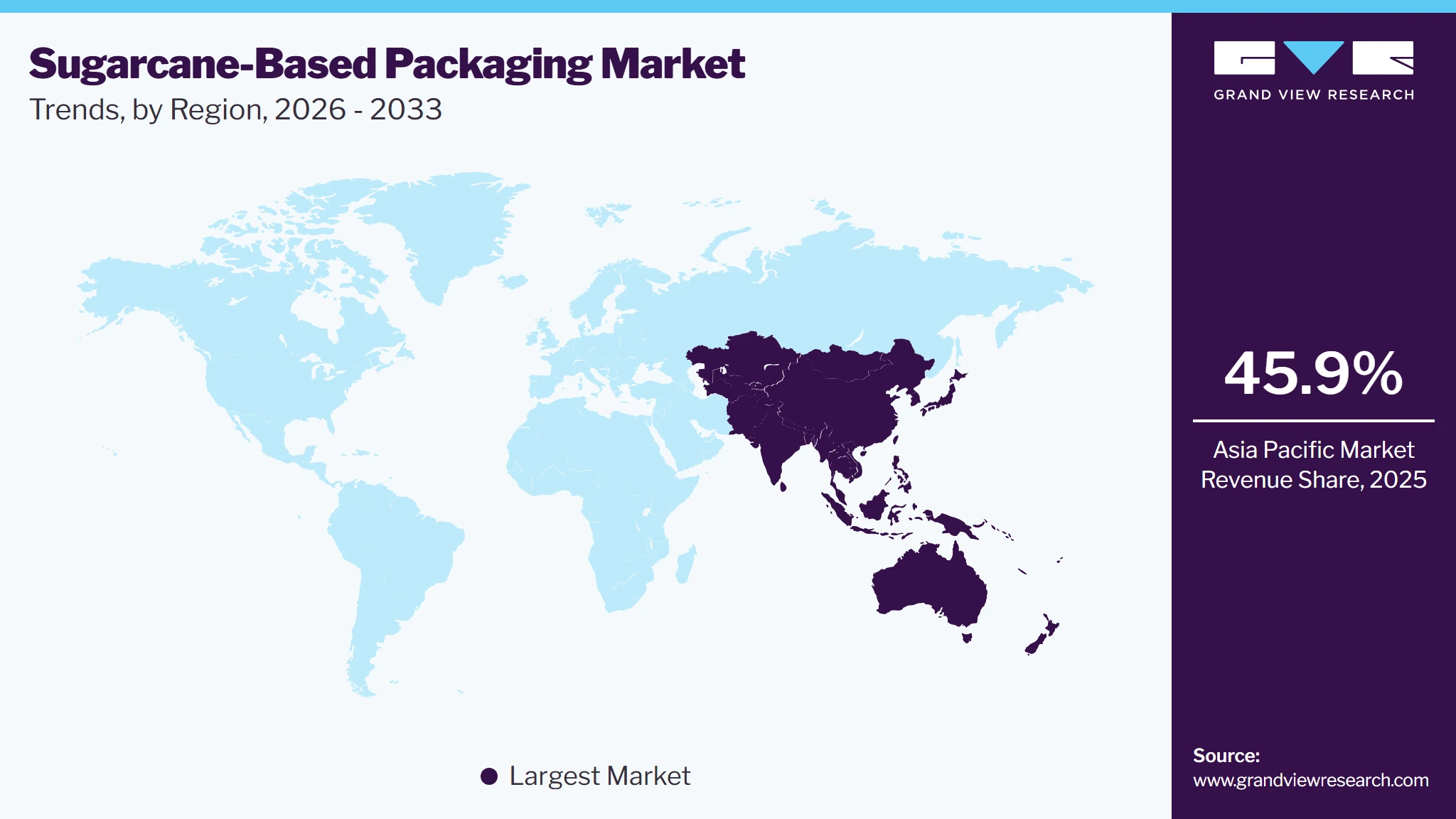
Asia-Pacific dominated the Sugarcane-based packaging market with the largest revenue share of 45.9% in 2025. The region is witnessing robust growth in the market, primarily driven by the booming online food delivery sector and rising government-led sustainability initiatives. Countries like India, Japan, and Australia are enforcing stricter regulations on plastic waste, compelling businesses to adopt eco-friendly alternatives such as bagasse-based packaging.
 To learn more about this report, Download Free Sample Report
 China Sugarcane-based Packaging Market Trends
The Sugarcane-based packaging market in China held the largest share in the North America region in 2025. The sugarcane based packaging market in China is accelerating due to strong industrial policy support and increasing domestic innovation in sustainable materials. The country’s "14th Five-Year Plan" includes ambitious targets for reducing plastic waste and increasing the adoption of biodegradable materials, making sugarcane-based packaging a strategic focus for both state-owned and private enterprises.
North America Sugarcane-based Packaging Market Trends
The sugarcane based packaging market in North America is gaining momentum due to aggressive corporate sustainability commitments and heightened consumer awareness regarding eco-friendly alternatives. Major foodservice and retail brands, including McDonald's, Starbucks, and Walmart, are actively transitioning to biodegradable and compostable packaging to meet internal sustainability goals and comply with evolving government regulations.
The sugarcane based packaging market in the U.S. is leading the charge in driving sugarcane based packaging adoption through stringent state-level plastic bans and extended producer responsibility (EPR) laws. States like California, New York, and Washington have enacted legislation restricting single-use plastics in food packaging, directly accelerating demand for biodegradable alternatives.
Europe Sugarcane-based Packaging Market Trends
The sugarcane based packaging market in Europe is experiencing rapid expansion, driven by stringent circular economy policies and the European Green Deal’s sustainability targets. The European Commission’s ban on single-use plastics, effective across member states, has mandated businesses to adopt compostable and biodegradable alternatives, positioning sugarcane-derived materials as a key solution.
Key Sugarcane-based Packaging Company Insights
The market is highly competitive, with several key players dominating the landscape. Major companies include Eco-Products, World Centric, Pappco Greenware, Vegware, BioPak, Ecoriti, Green Good, Natural Tableware, and Bio Futura. The market is characterized by a competitive landscape, with several key players driving innovation and market growth. Major companies in this sector are investing heavily in research and development to enhance their materials' performance, cost-effectiveness, and sustainability.
Key Sugarcane-based Packaging Companies
The following key companies have been profiled for this study on the sugarcane-based packaging market.
-
Eco-Products
-
World Centric
-
Pappco Greenware
-
Vegware
-
BioPak
-
Ecoriti
-
Green Good
-
Natural Tableware
-
Bio Futura
Competitive Benchmarking
Category
Operating Strategies
Competitive Edge
Weakness
Established Players (Eco-Products; World Centric; Vegware; BioPak)
- Focus on expanding comprehensive sugarcane-based packaging portfolios that include plates, trays, bowls, cups, clamshell containers, takeaway boxes, and food containers for foodservice, retail, hospitality, and institutional customers. Invest in product innovation, compostable material technologies, certified sustainable packaging, global distribution networks, and strategic partnerships with restaurants, retailers, and food delivery companies while strengthening their presence through acquisitions and continuous product development.
- Strong brand recognition, extensive product portfolios, well-established distribution channels, and long-term partnerships with leading foodservice and retail customers support recurring demand and global market presence. Continuous investments in R&D, certified compostable packaging, regulatory compliance, and sustainable packaging innovation strengthen their competitive position across developed and emerging markets.
- High dependence on agricultural fiber availability, fluctuating raw material and transportation costs, and increasing competition from alternative biodegradable packaging materials can pressure margins. Compliance with varying regional compostability standards and maintaining large-scale production capacity also increase operational complexity and costs.
Emerging Players (Pappco Greenware; Ecoriti; Green Good; Natural Tableware; Bio Futura)
- Focus on expanding regional market presence through affordable, eco-friendly sugarcane-based packaging solutions tailored for restaurants, catering services, retailers, and e-commerce businesses. Emphasize customized product offerings, flexible manufacturing, private-label production, and sustainable packaging solutions while gradually expanding export capabilities and investing in improved molded fiber technologies to address growing demand for biodegradable packaging.
- Greater operational flexibility enables rapid product customization, faster response to regional customer requirements, and competitive pricing. Strong understanding of local markets, niche product offerings, and the ability to serve small- and medium-sized businesses help these companies establish long-term customer relationships and expand their presence in emerging sustainable packaging markets.
- Limited manufacturing capacity, smaller international distribution networks, and lower financial resources restrict expansion into large global contracts. Lower brand visibility, comparatively lower investment in advanced manufacturing technologies, automation, and product innovation may reduce competitiveness against well-established multinational sustainable packaging manufacturers.
Recent Developments
-
In October 2024, Accredo Packaging collaborated with Fresh-Lock to launch a 100% bio-based resin pouch with a zipper closure at PACK EXPO International 2024. The pouch, made from sugarcane-derived resin, offers a sustainable alternative to traditional packaging, reducing greenhouse gas emissions and meeting the brand's sustainability goals.
-
In August 2023, Lifestream, a plant-based supplement company, introduced new packaging made from sugarcane-based plastic. The bottles, produced by Forward Plastics, utilize non-GMO sugarcane sourced ethically from Brazil.
Sugarcane-based Packaging Market Report Scope
Report Attribute
Details
Market size in 2025
USD 384.8 million
Estimated market size in 2026
USD 421.6 million
Projected market size by 2033
USD 750.9 million
Growth rate
CAGR of 8.6% from 2026 to 2033
Base year for estimation
2025
Historical data
2021 - 2024
Forecast period
2026 - 2033
Quantitative units
Revenue in USD million/billion, and CAGR from 2026 to 2033
Report coverage
Revenue forecast, company ranking, competitive landscape, growth factors, and trends
Segments covered
Material, product, end-use, region
Regional scope
North America; Europe; Asia Pacific; Latin America; MEA
Country scope
U.S.; Canada; Mexico; Germany; France; UK; Italy; Spain; China; India; Japan; South Korea; Australia; Brazil; Argentina; South Africa; Saudi Arabia; UAE
Key companies profiled
Eco-Products, World Centric, Pappco Greenware, Vegware, BioPak, Ecoriti, Green Good, Natural Tableware, Bio Futura
Customization scope
Free report customization (equivalent up to 8 analysts' working days) with purchase. Addition or alteration to country, regional & segment scope.
Pricing and purchase options
Avail customized purchase options to meet your exact research needs. Explore purchase options
Global Sugarcane-based Packaging Market Report Segmentation
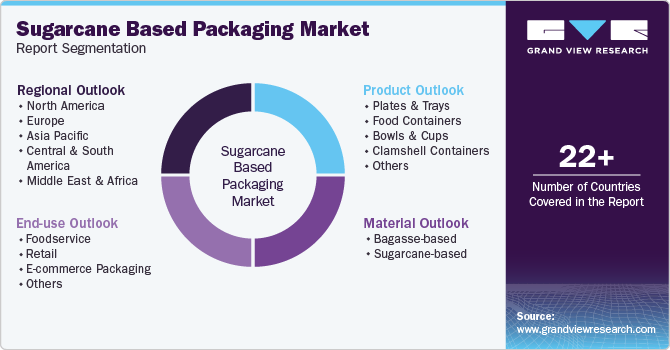
This report forecasts revenue growth at global, regional, and country levels and provides an analysis of the latest industry trends in each of the sub-segments from 2021 to 2033. For this study, Grand View Research has segmented the global sugarcane-based packaging market report based on material, product, end use, and region:
 To learn more about this report, Download Free Sample Report
 -
Material Outlook (Revenue, USD Million, 2021 - 2033)
-
Bagasse-based
-
Sugarcane-based
-
-
Product Outlook (Revenue, USD Million, 2021 - 2033)
-
Plates & Trays
-
Food Containers
-
Bowls & Cups
-
Clamshell Containers
-
Others
-
-
End Use Outlook (Revenue, USD Million, 2021 - 2033)
-
Foodservice
-
Retail
-
E-commerce Packaging
-
Others
-
-
Regional Outlook (Revenue, USD Million, 2021 - 2033)
-
North America
-
U.S.
-
Canada
-
Mexico
-
-
Europe
-
Germany
-
UK
-
France
-
Italy
-
Spain
-
-
Asia Pacific
-
China
-
India
-
Japan
-
South Korea
-
Australia
-
Central & South America
-
Brazil
-
Argentina
-
-
Middle East & Africa
-
Saudi Arabia
-
South Africa
-
UAE
-
-
Research Methodology
The sugarcane-based packaging market figures in this report are based on a proven research process that combines executive interviews with secondary research from proprietary databases, company filings, and recognized regulatory and institutional sources. Market size is built through value-chain sizing - reconciling supply-side and demand-side estimates - and triangulated with bottom-up and top-down approaches. Every estimate passes multiple levels of expert validation before publication, with each sugarcane-based packaging segment quantified using the revenue-capture definitions in the table below.
Segment Definition
Segment - Material
Revenue capture definition
Bagasse-based
Revenue generated from sugarcane-based packaging products manufactured primarily from sugarcane bagasse, the fibrous residue left after juice extraction. Includes molded fiber trays, clamshell containers, plates, bowls, cups, food containers, takeaway boxes, and other compostable packaging solutions used across foodservice, retail, healthcare, and consumer goods industries.
Sugarcane-based
Revenue generated from packaging products manufactured using processed sugarcane fiber and other sugarcane-derived renewable materials, including bagasse and related biomass. Includes biodegradable food containers, trays, cups, lids, plates, industrial packaging inserts, protective packaging, and custom molded fiber packaging designed to provide sustainable alternatives to conventional plastic and paper packaging across multiple end-use industries.
Segment - Product
Revenue capture definition
Plates & Trays
Revenue generated from sugarcane-based plates and trays manufactured from bagasse or other sugarcane-derived fibers. Includes disposable and compostable serving trays, meal trays, compartment trays, and plates used across foodservice, catering, institutional dining, and retail applications.
Food Containers
Revenue generated from sugarcane-based food containers designed for packaging, storing, and transporting hot and cold foods. Includes takeaway containers, meal boxes, lunch boxes, deli containers, and leak-resistant packaging used by restaurants, food delivery services, supermarkets, and convenience stores.
Bowls & Cups
Revenue generated from sugarcane-based bowls and cups used for serving beverages, soups, salads, desserts, and ready-to-eat meals. Includes compostable cups, bowls, and related foodservice packaging products for commercial and institutional applications.
Clamshell Containers
Revenue generated from sugarcane-based hinged clamshell containers used for takeaway, delivery, and retail food packaging. Includes single-compartment and multi-compartment clamshells designed for burgers, sandwiches, meals, bakery products, and other ready-to-eat foods.
Other Products
Revenue generated from other sugarcane-based packaging products not covered under the above categories. Includes lids, cutlery, food packaging inserts, egg cartons, produce trays, protective molded fiber packaging, and customized compostable packaging solutions for food and non-food applications.
Segment – End Use
Revenue capture definition
Foodservice
Revenue generated from sugarcane-based packaging products supplied to the foodservice industry. Includes plates, trays, bowls, cups, clamshell containers, takeaway boxes, and food containers used by restaurants, cafés, hotels, catering services, quick-service restaurants (QSRs), cloud kitchens, and institutional dining facilities.
Retail
Revenue generated from sugarcane-based packaging products used in retail applications. Includes packaging for fresh produce, bakery items, ready-to-eat meals, meat, poultry, seafood, and other consumer goods sold through supermarkets, hypermarkets, convenience stores, and specialty retail outlets.
E-commerce Packaging
Revenue generated from sugarcane-based packaging solutions used for e-commerce and direct-to-consumer shipments. Includes protective molded fiber packaging, product inserts, cushioning materials, shipping trays, and sustainable packaging components designed to protect products during storage and transportation while reducing environmental impact.
Other End Use
Revenue generated from sugarcane-based packaging products used in end-use industries other than foodservice, retail, and e-commerce. Includes packaging solutions for healthcare, consumer goods, industrial products, agriculture, electronics, cosmetics, and other commercial applications requiring biodegradable and compostable packaging.
Estimation Model
Layer No.
Layer Name
Key Question
Description
01
Sustainable Packaging Demand Base Layer
What forms the demand base?
Identify the global demand for sustainable and biodegradable packaging across industries such as food & beverage, foodservice, retail, healthcare, consumer goods, and e-commerce. This layer establishes the total addressable market based on increasing packaged food consumption, expansion of takeaway and food delivery services, growth in sustainable retail packaging, rising environmental awareness, and government regulations restricting single-use plastics.
02
Sugarcane-based Packaging Adoption Layer
Where is sugarcane-based packaging utilized?
Estimate the adoption of sugarcane-based packaging across key end-use sectors, including foodservice, retail, e-commerce packaging, healthcare, and consumer goods. Assess the penetration of sugarcane-based plates & trays, food containers, bowls & cups, clamshell containers, and other molded fiber packaging products based on sustainability targets, compostability requirements, food safety standards, and consumer preference for eco-friendly packaging solutions.
03
Packaging Consumption Intensity Layer
How much sugarcane-based packaging is utilized?
Analyze the volume of sugarcane-based packaging consumed based on food packaging demand, takeaway order volumes, retail packaging requirements, e-commerce shipments, and replacement of plastic packaging. Packaging utilization is influenced by product type, frequency of use, packaging specifications, regional regulations, seasonal demand, and advancements in molded fiber manufacturing that improve product strength, moisture resistance, and functionality.
04
Revenue Layer
How is market revenue generated?
Market revenue is quantified through the sale of sugarcane-based packaging products manufactured from bagasse and other sugarcane-derived fibers, including plates & trays, food containers, bowls & cups, clamshell containers, and other compostable packaging products. Revenue is generated from demand across foodservice providers, retailers, e-commerce companies, healthcare organizations, and consumer goods manufacturers seeking sustainable, biodegradable, and plastic-free packaging solutions that comply with environmental regulations and corporate sustainability initiatives.
Delivered Customizations
This report has been delivered with the following In-depth customizations
Client Request
Customization Delivered
Value Adds
Cross-Segmentation Analysis
Detailed cross-segmentation analysis of the Sugarcane-based Packaging Market by material, product type, end-use, and region. Includes revenue estimation, demand trends, adoption patterns, and growth opportunities across combinations such as bagasse-based food containers for foodservice, sugarcane-based clamshell containers for retail, and bowls & cups for e-commerce packaging.
Enables identification of high-growth segment combinations, supports product portfolio optimization, strengthens market entry strategies, and helps prioritize investments across the most promising application areas and regional markets.
Competitive Benchmarking
Comprehensive benchmarking of leading sugarcane-based packaging manufacturers based on product portfolio, manufacturing capabilities, geographic presence, sustainability certifications, production capacity, innovation pipeline, distribution network, strategic partnerships, and expansion initiatives.
Helps assess competitive positioning, identify market opportunities and technology gaps, support strategic planning, and benchmark business performance against key industry participants.
Pricing Analysis
In-depth pricing analysis of sugarcane-based packaging products across materials (bagasse-based and sugarcane-based), product types (plates & trays, food containers, bowls & cups, clamshell containers, and others), and major regional markets. Includes raw material cost trends, manufacturing cost structure, regional pricing variations, and competitive price comparisons.
Supports pricing optimization, procurement planning, supplier evaluation, cost competitiveness analysis, and informed decision-making for product positioning and long-term sourc
Frequently Asked Questions About This Report
The sugarcane-based segment is expected to be the fastest-growing material segment in the sugarcane-based packaging market, driven by increasing demand for renewable, biodegradable, and high-performance molded fiber packaging solutions.
The bagasse-based segment led the sugarcane-based packaging market with a revenue share of 59.7%in 2025, owing to its widespread use in compostable foodservice packaging and the abundant availability of sugarcane bagasse as a renewable raw material.
The Plates & Trays segment led the sugarcane-based packaging market with a revenue share of 40.3%in 2025, driven by strong demand from restaurants, takeaway services, food delivery platforms, and retail food packaging applications.
Key players in the sugarcane-based packaging market include Eco-Products, World Centric, Pappco Greenware, Vegware, BioPak, Ecoriti, Green Good, Natural Tableware, and Bio Futura.
The global sugarcane-based packaging market was valued at USD 384.8 million in 2025 and is estimated to reach USD 421.6 million in 2026.
The global sugarcane-based packaging market is expected to grow at a CAGR of 8.6% from 2026 to 2033, reaching USD 750.9 million by 2033.
Asia-Pacific dominated the sugarcane-based packaging market with a revenue share of 45.9%in 2025.
Asia Pacific is the fastest-growing region in the sugarcane-based packaging market, registering a CAGR of 8.9%over the forecast period.
The sugarcane-based packaging market is primarily driven by increasing restrictions on single-use plastics, rising consumer demand for sustainable and compostable packaging, growing adoption of renewable materials in the foodservice and retail sectors, expanding e-commerce and food delivery industries, and continuous advancements in molded fiber packaging technologies.
About the Author(s)
Plastics, Polymers & Resins Research Team
Bulk Chemicals · Plastics, Polymers & ResinsThis report was authored by the plastics, polymers & resins research team at Grand View Research - comprising two research analysts, one senior research analyst, and one industry expert - with specialized expertise in the plastics, polymers & resins segment of the bulk chemicals industry. All findings are based on proprietary bulk chemicals databases, executive interviews, and regulatory analysis, subject to internal peer review prior to publication.
Last Updated:
Speak to Analyst

Customize this report to your needs - add regions, segments, or data points, with 20% free customization.
Or view our licence options:


ISO 9001:2015 & 27001:2022 Certified
We are GDPR and CCPA compliant! Your transaction & personal information is safe and secure. For more details, please read our privacy policy.


