
- Home
- »
- Plastics, Polymers & Resins
- »
-
Sunglasses Coating Market Size & Share Report, 2026-2033GVR Report cover

Sunglasses Coating Market (2026 - 2033)
Size, Share & Trends Analysis Report By Coating (Anti-reflective Coating, UV Coating, Scratch-resistant Coating), By Material (Titanium Dioxide, Silicon Dioxide), By Region, And Segment Forecasts
Market Size, 2025
$414.5MMarket Estimate, 2026
$446.8MMarket Forecast, 2033
$787.1MCAGR, 2026–2033
8.4%Sunglasses Coating Market Summary
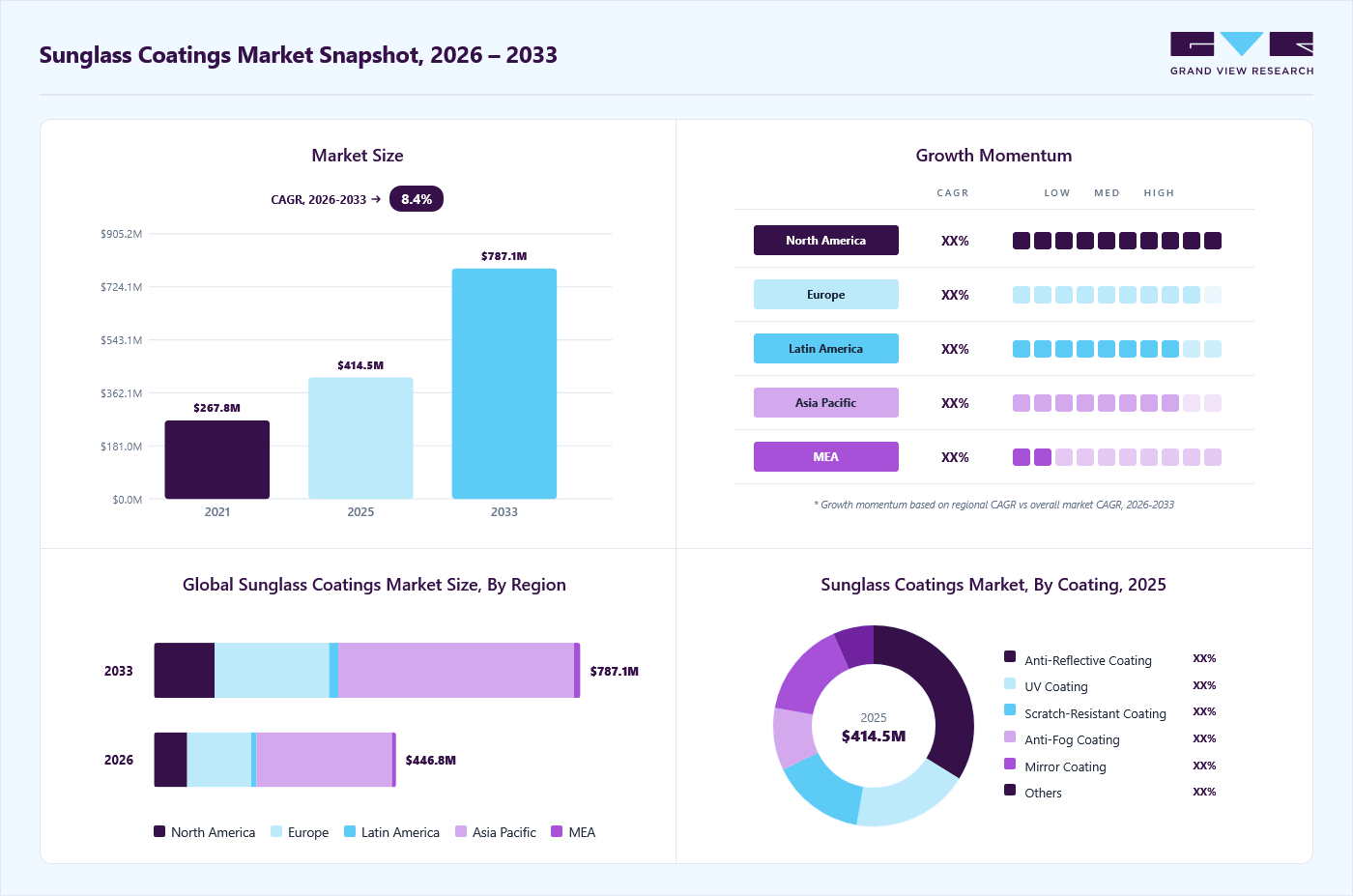
The global sunglasses coating market size was valued at USD 414.5 million in 2025 and is projected to grow from USD 446.8 million in 2026 to USD 787.1 million by 2033, at a CAGR of 8.4% from 2026 to 2033. The market in Asia Pacific dominated with a revenue share of 56.0% in 2025. The market growth is driven by the increased awareness of the harmful effects of UV radiation, leading to a rising demand for sunglasses with UV protection coatings.
 Source: Grand View Research, IR Documents, Primary Interviews, Paid DatabasesTo learn more about this report,
 Download Free Sample Report
 Key Market Trends & Insights
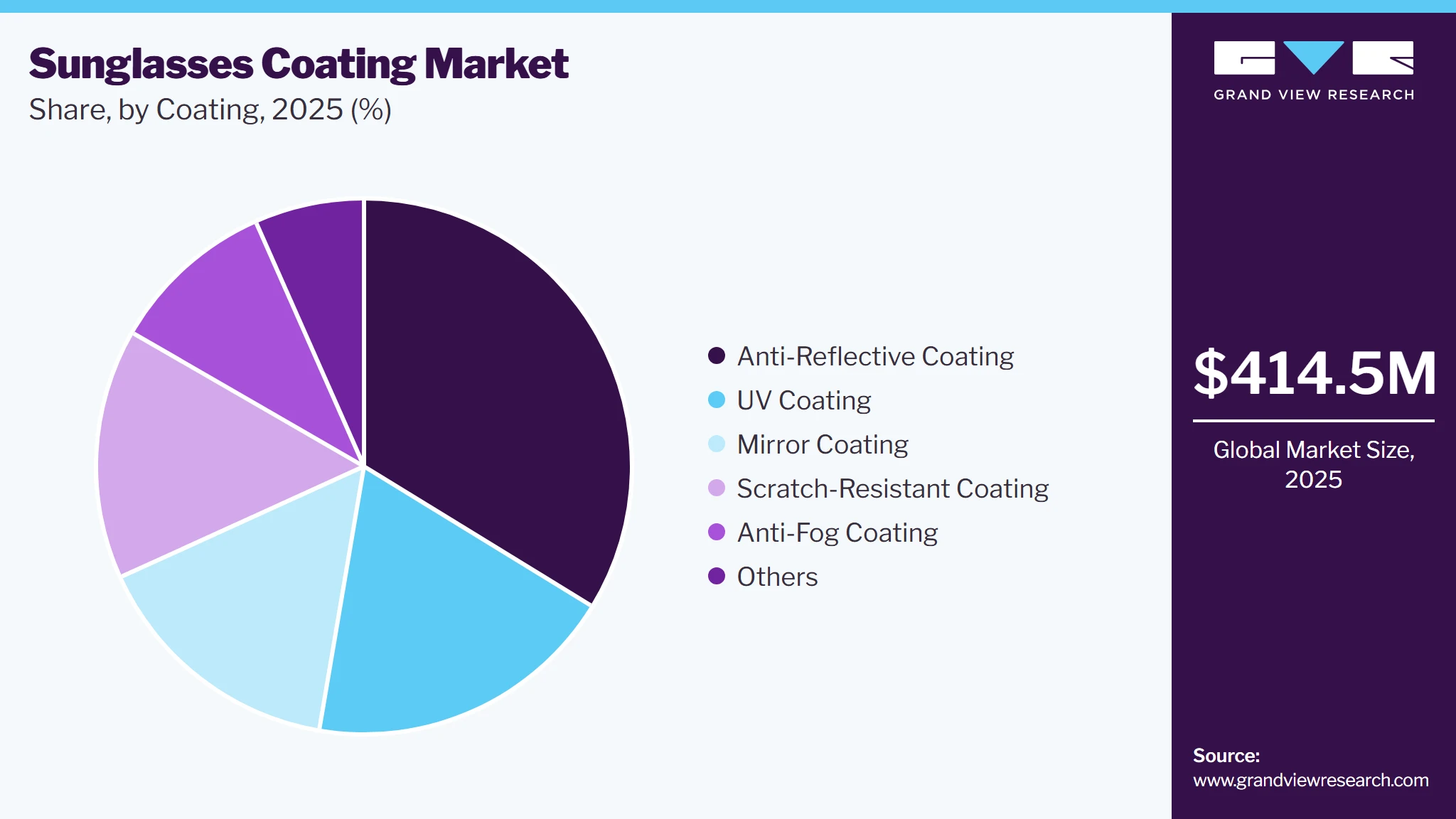
- By coating: Anti-reflective coating segment led the market with the largest revenue share of 33.8% in 2025.
- By material: Titanium dioxide segment accounted for a significant revenue share of the global sunglass coatings industry in 2024.
Regional Highlights
- Largest regional market: Asia Pacific (56.0% revenue share, 2025)
- By country: The China held the largest market share in 2025.
Market Size & Forecast
- Market size in 2025: USD 414.5 Million
- Estimated market size in 2026: USD 446.8 Million
- Projected market size by 2033: USD 787.1 Million
- CAGR (2026-2033): 8.4%
Three ways to get this report
Buy it, customize it, or ask a question.Ask an Analyst
A direct answer, usually in 1 working day
- AccessReport author, directly
- Reply timeWithin 1 working day
- No sales callDirect answer only
- FormatEmail reply
- CostFree, no cost
Get the Full Report
What the study covers
- FormatsPDF · Excel · Dashboard
- Timeline2026–2033 annual, 2025 base
- Coverage20+ countries, 5 regions
- Companies10+ key players profiled
Customize the Report
20% free customization
- IncludeCountries, segments, points
- TailorTo your product definition
- ExtendDeeper competitor detail
- OrA fully bespoke study
- Turnaround5–10 working days
Additionally, as more individuals participate in outdoor sports and activities such as hiking, cycling, and water sports, there is a growing interest in specialized coatings that enhance both comfort and protection in sunglasses. The expansion of the solar photovoltaic (PV) market, alongside the increasing demand for consumer electronics, is projected to significantly fuel market growth. Reflective coatings are particularly important in construction, telecommunications, and space industries, with their use in green buildings for heat retention and reduced energy consumption. The surge in demand for portable consumer electronics and handheld devices is expected to bolster this segment further. However, challenges such as price volatility of raw materials, particularly precious metals such as gold and platinum, can restrain market growth by impacting the profitability of manufacturers. To learn more about this report, Download Free Sample Report
 The market is characterized by high levels of innovation, with ongoing research into sustainable coating techniques and nanostructured coatings. Key regulatory bodies, such as The Vision Council and ISO, oversee quality and safety standards in manufacturing. Consumer electronics is the dominant application area of the market, driven by advancements in smart devices.
Market Dynamics
Sunglasses coatings are specialized optical surface treatments applied to lenses to improve visual performance, durability, aesthetics, and user comfort. These coatings enhance lens functionality by reducing glare, improving scratch resistance, blocking harmful ultraviolet radiation, minimizing fog formation, and enabling customized visual effects. Growing consumer preference for premium eyewear products, increasing awareness regarding eye protection, and rising demand for high-performance optical solutions continue to drive market growth globally. The market is further supported by advancements in coating technologies and the increasing penetration of branded eyewear across both developed and emerging economies.
The increasing consumer preference for premium eyewear products is a major factor driving growth in the sunglasses coatings market. Consumers are increasingly seeking lenses that provide enhanced visual clarity, superior durability, UV protection, and improved aesthetic appeal. As a result, eyewear manufacturers are integrating multiple coating technologies into premium sunglass offerings to differentiate products and improve user experience.
The growing popularity of outdoor recreational activities, sports eyewear, fashion-oriented sunglasses, and prescription sunglasses is further supporting demand for advanced coating solutions. Rising disposable incomes and increasing spending on premium eyewear products continue to strengthen market expansion globally.
The application of advanced lens coatings requires specialized equipment, precision deposition technologies, and stringent quality control procedures, resulting in relatively high production costs. Variations in coating performance, durability requirements, and manufacturing yields can impact profitability and operational efficiency.
Additionally, intense competition within the eyewear industry may limit the ability of manufacturers to fully pass increased coating costs to end users, particularly in value-oriented market segments.
Growing demand for multifunctional eyewear solutions is creating significant opportunities for coating manufacturers. Consumers increasingly prefer lenses that combine anti-reflective, UV-protective, scratch-resistant, anti-fog, and aesthetic enhancement properties within a single product.
Advancements in nanotechnology, thin-film deposition techniques, and smart optical materials are expected to enable the development of next-generation coating systems offering improved performance, durability, and user comfort. These innovations are likely to create new opportunities across premium eyewear and specialty optical applications.
Analyst Perspective
The sunglasses coatings market is increasingly evolving from a lens enhancement segment into a critical value-creation layer within the premium eyewear industry, where visual performance, durability, and user experience are becoming key purchase drivers. While anti-reflective coatings continue to account for the largest share of demand due to their direct impact on optical clarity and glare reduction, the industry is witnessing increasing adoption of multifunctional coating systems that combine UV protection, scratch resistance, anti-fog performance, and aesthetic enhancement within a single lens platform. Competitive differentiation is therefore shifting beyond basic coating functionality toward advanced material science, coating durability, and integration capabilities. As premium eyewear penetration continues to increase globally, manufacturers capable of delivering high-performance, multi-layer coating solutions while maintaining optical precision and long-term durability are expected to capture a disproportionate share of future market growth.
Coating Insights
Based on coating, the anti-reflective coating segment led the market with the largest revenue share of 33.8% in 2025. Anti-reflective coatings-based sunglasses are widely preferred by customers owing to significant benefits, such as superior glare reduction and improved eye comfort. These sunglasses are increasingly used by commuters, drivers, outdoor recreation participants, and other individuals with sensitive eyes who frequently drive for longer distances or are exposed to bright lights for a longer duration of time.
UV coatings are increasingly used in application-specific sunglasses, such as sunglasses for sports and military use. Primarily used to achieve protection from UV-A and UV-B rays, these sunglasses provide improved contrast, reduced glare, and comprehensive eye protection from the sun’s harmful UV rays. UV coatings incorporate chemical compounds capable of absorbing UV radiation. UV coatings for sunglasses commonly include additives such as Triazine UV absorbers.
Material Insights
The silicon dioxide segment by application, accounted for the dominating revenue share of 29.5% in 2025.Silicon dioxide is primarily used in the development of sunglass coatings, such as anti-reflective (AR) and anti-scratch coatings. Highly transparent SiO₂ facilitates clear vision and reduces interference in the viewing experience. It is also used to improve UV protection capacities. Silicon dioxide is abundantly available in nature. However, optical-grade applications necessitate specialized extraction and purification. After obtaining high-purity SiO₂, it is applied on lenses with the help of advanced coating technologies, such as vacuum deposition or sol-gel processes. The demand for high-end premium quality sunglasses offered by brands such as Ray-Ban, Oakley, Maui Jim, and Warby Parker is witnessing consistent growth. Factors such as growing demand for performance eyewear, inclination of professional sports participants toward adoption of application-specific premium sunglasses equipped with desired features, and rising outdoor recreation participation are expected to encourage the demand for high purity SiO₂ used in sunglass coatings.
 To learn more about this report, Download Free Sample Report
 The silicon dioxide segment by application, accounted for the dominating revenue share of 29.5% in 2025. The growth of the segment is attributed to the material's capabilities to scatter and reflect visible light, enabling enhanced opacity and facilitating UV absorption. The high refractive index of the material ensures effective light bending and aids thinner lens thickness. Naturally occurring titanium oxide provides low photocatalytic properties and is suitable for sunglass applications, especially in UV protection coatings. These properties eliminate unwanted side effects of strong photocatalysis, which include surface degradation and color changes. The availability of limited substitutes with equivalent light scattering capabilities and high refractive index is expected to fuel demand for Titanium Dioxide.
Regional Insights
The North American sunglasses coating industry is experiencing growth. The presence of multiple brands that offer performance eyewear products, including sunglasses and growing adoption of application-specific product ranges, such as sports and military sunglasses are expected to favor market growth. Product lines offered by key market participants also have an influence on market growth. Multiple companies operating across the region provide high-performance sunglasses designed to match the specific requirements of diverse end users. For instance, Oakley, Inc. operates Oakley Standard Issue (OSI), a dedicated division which offers a variety of products primarily designed for applications in military, law enforcement, government tactical operations, and homeland security, among others. Standard issue ON DUTY SUNGLASSES category product line incorporates a large variety of sunglasses that feature multiple coatings, including anti-fog, UV protection, and others
U.S. Sunglasses Coating Market Trends
Demand for a variety of sunglasses with multiple features is continuously growing in the U.S. In 2024, the U.S. imported 27,996,898 dozen sunglasses, which marked an increase of 2,320,119 dozen from 25,676,779 dozen sunglasses imported in 2023. The U.S. market for sunglass coatings is significantly driven by the growing use of specialized sunglasses designed for sports, military, and other applications.
Asia Pacific Sunglasses Coating Market Trends
Asia Pacific dominated the sunglasses coating market with the largest revenue share of 56% in 2025, owing to the numerous manufacturing facilities and raw material suppliers in countries such as China. For instance, according to Hangzhou Harmony Chemical Co., Ltd, a key supplier of natural titanium dioxide (TiO2), the total titanium dioxide production in China was nearly 388,200 tons in July 2024. Countries such as China and Japan play a vital role in the growing demand for high-end sunglasses equipped with advanced coatings designed for improved vision and reducing exposure to harmful effects of light. Penetration of online distribution channels for sunglasses, such as e-commerce websites, online portals by brands, and quick-commerce platforms, presents significant growth opportunities for the sunglasses market.
 To learn more about this report, Download Free Sample Report
 China Sunglasses Coating Market Trends
China accounted for 78.6% of the Asia Pacific sunglasses coating market in 2025.
Europe Sunglasses Coating Market Trends
Europe sunglass coatings industry is primarily influenced by noteworthy growth in demand for sunglasses equipped with specialized coatings, such as anti-fogging, and the growing adoption of sports sunglasses and performance eyewear in the region. The region is home to multiple sunglass manufacturers and brands that provide a wide range of products to global customers, including application-specific sunglasses. These include companies and brands such as Essilor, Carl Zeiss Vision, Hoya, OptoTech, and Optical Coating Laboratories (OCLI), Inc.
Latin America Sunglasses Coating Market Trends
Latin America is expected to experience a surge in the demand for sunglasses equipped with innovative coatings, including UV protective and anti-reflective coatings, owing to factors such as the influence of the tourism industry and the increasing adoption of sports sunglasses by professionals and enthusiasts. Rising participation of individuals in the region in outdoor recreation activities such as adventure sports, which necessitate the use of specific eyewear and sunglasses featuring particular coatings, is also expected to favor market growth.
Middle East & Africa Sunglasses Coating Market Trends
Increasing demand for premium-range sunglasses, sports sunglasses, and application-specific performance eyewear in the Middle East & Africa is anticipated to influence the regional market for sunglasses coatings. The presence of multiple key market participants in the regional industry has also benefitted the market growth. For instance, HOYA Corporation operates HOYA Hill Optics South Africa (Pty) Ltd in the region. In the Middle East, the urban population living in and visiting modern infrastructure-driven cities, such as Dubai, and the availability of multiple global brand products through stores and online retail have influenced the demand for sunglasses. This is expected to drive the growth of the regional sunglass coatings industry over the forecast period.
Key Sunglasses Coating Company Insights
Some of the key players operating in the market include PPG Industries, Inc. and HOYA.
-
PPG Industries, Inc. manufactures and distributes a diverse range of paints, coatings, and specialty products globally, serving numerous end-use areas including automotive, aerospace, and residential sectors. PPG's three reportable segments-Global Architectural Coatings, Performance Coatings, and Industrial Coatings-focus on innovative solutions that prioritize product performance, technology, quality, and customer service, with operations in over 70 countries.
-
HOYA Corporation is a global technology and med-tech company focused on high-tech and healthcare products. It operates through two primary segments: Life Care, which includes vision care and medical services, and Information Technology, covering imaging, electronics, and new ventures. Known for its eyeglass lenses, medical endoscopes, and semiconductor components, HOYA prioritizes innovation and global expansion.
Key Sunglasses Coating Companies:
The following key companies have been profiled for this study on the sunglasses coating market.
-
PPG Industries, Inc.
-
Essilor (Essilor Luxottica)
-
Nippon Fine Chemical
-
HOYA
-
Plexus Optix, Inc. (Vision Service Plan)
-
ZEISS Group
-
Reynard Corporation
-
Kering Eyewear S.p.A. (Kering S.A.)
-
Shangai Conant Optical Co., Ltd.
-
Silhouette International Schmied AG
Competitive Benchmarking
Category
Operating Strategies
Competitive Edge
Weakness
Established Players (ZEISS Group; EssilorLuxottica; HOYA; PPG Industries, Inc.; Kering Eyewear S.p.A.; Plexus Optix, Inc.)
- Investing in advanced coating technologies, premium lens solutions, and integrated optical product portfolios. Expanding manufacturing capabilities and strengthening relationships with global eyewear brands.
- Strong technological expertise, recognized brand equity, extensive distribution networks, and advanced coating development capabilities support market leadership.
- Established Players (ZEISS Group; EssilorLuxottica; HOYA; PPG Industries, Inc.; Kering Eyewear S.p.A.; Plexus Optix, Inc.)
Emerging Players (Tazzetti S.P.A.; Nippon Fine Chemical; Reynard Corporation; Shanghai Conant Optical Co., Ltd.; Silhouette International Schmied AG)
- Focusing on specialized coating technologies, regional expansion strategies, and customized optical solutions. Developing partnerships with eyewear manufacturers and optical laboratories.
- Strong niche expertise, operational flexibility, and ability to address specialized customer requirements support market differentiation.
- Emerging Players (Tazzetti S.P.A.; Nippon Fine Chemical; Reynard Corporation; Shanghai Conant Optical Co., Ltd.; Silhouette International Schmied AG)
Recent Developments
-
In February 2023, Mitsui Chemicals, along with SDC and Coburn Technologies, launched a compact tabletop lens coating system in the U.S., enhancing efficiency for small to medium-sized lens processing labs.
-
In November 2024, Revision Military secured a contract to supply the NATO Support and Procurement Agency (NSPA) with a range of high-performance protective eyewear.
Sunglasses Coating Report Scope
Report Attribute
Details
Market size in 2025
USD 414.5 million
Estimated market size in 2026
USD 446.8 million
Projected market size by 2033
USD 787.1 million
Growth rate
CAGR of 8.4% from 2026 to 2033
Base year for estimation
2025
Historical data
2021 - 2024
Forecast period
2026 - 2033
Quantitative units
Revenue in USD million/billion, Volume in Kilotons and CAGR from 2026 to 2033
Report coverage
Revenue forecast, company ranking, competitive landscape, growth factors, and trends
Segments covered
Coating, Material, region
Regional scope
North America; Europe; Asia Pacific; Latin America; MEA
Country scope
U.S.; Canada; Mexico; Germany; UK; France; Italy; Spain; China; Japan; India; South Korea; Brazil; Panama; UAE; South Africa;
Key companies profiled
PPG Industries, Inc.; Tazzetti S.P.A.; Nippon Fine Chemical; HOYA; Plexus Optix, Inc. (Vision Service Plan); ZEISS Group; Reynard Corporation; Kering Eyewear S.p.A. (Kering S.A.); Essilor (Essilor Luxottica); Shangai Conant Optical Co., Ltd.; Silhouette International Schmied AG
Customization scope
Free report customization (equivalent up to 8 analysts' working days) with purchase. Addition or alteration to country, regional & segment scope.
Pricing and purchase options
Avail customized purchase options to meet your exact research needs. Explore purchase options
Global Sunglasses Coating Market Report Segmentation
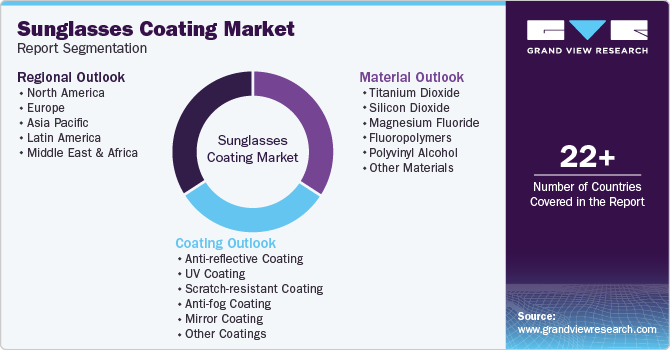
This report forecasts revenue and volume growth at global, regional, and country levels and provides an analysis of the latest industry trends in each of the sub-segments from 2021 to 2033. For the purpose of this study, Grand View Research has segmented the global sunglasses coating market report based on coating, material, and region:
 To learn more about this report, Download Free Sample Report
 -
Coating Outlook (Volume, Tons; Revenue, USD Thousand, 2021 - 2033)
-
Anti-reflective Coating
-
UV Coating
-
Scratch-resistant Coating
-
Anti-fog Coating
-
Mirror Coating
-
Other Coatings
-
-
Material Outlook (Volume, Tons; Revenue, USD Thousand, 2021 - 2033)
-
Titanium Dioxide
-
Silicon Dioxide
-
Magnesium Fluoride
-
Fluoropolymers
-
Polyvinyl Alcohol
-
Other Materials
-
-
Regional Outlook (Volume, Tons; Revenue, USD Thousand, 2021 - 2033)
-
North America
-
U.S.
-
Canada
-
Mexico
-
-
Europe
-
Germany
-
UK
-
France
-
Italy
-
Spain
-
-
Asia Pacific
-
China
-
India
-
Japan
-
South Korea
-
-
Latin America
-
Brazil
-
Argentina
-
-
Middle East & Africa
-
Saudi Arabia
-
South Africa
-
-
Research Methodology
Segment Definition
Segment - Coating
Revenue capture definition
Anti-Reflective Coating
As the dominant coating segment, revenue is generated through widespread adoption in premium sunglasses to reduce glare, improve visual clarity, and enhance wearer comfort. Demand is supported by increasing consumer preference for high-performance optical products.
UV Coating
Revenue is supported by coatings designed to block harmful ultraviolet radiation and improve eye protection. Growing awareness regarding UV exposure and eye health continues to drive adoption across mass-market and premium eyewear categories.
Scratch-Resistant Coating
Market value is generated through coatings that improve lens durability and extend product lifespan. Demand is influenced by consumer preference for long-lasting eyewear products and premium lens offerings.
Anti-Fog Coating
Revenue capture stems from applications requiring improved visibility under varying environmental conditions. Growth is supported by increasing demand for sports eyewear, performance eyewear, and specialty optical products.
Mirror Coating
Revenue is supported by decorative and performance-enhancing coatings that improve aesthetics while reducing glare. Demand is particularly strong in fashion, outdoor recreation, and sports eyewear segments.
Others
Revenue is derived from hydrophobic, oleophobic, photochromic-compatible, and specialty optical coatings developed for niche performance requirements.
Segment - Material
Revenue capture definition
Silicon Dioxide
As the leading material segment, revenue is generated through its extensive use in anti-reflective and protective coating systems due to excellent optical transparency, durability, and coating performance.
Titanium Dioxide
Revenue is supported by applications requiring enhanced UV protection, optical performance, and thin-film coating functionality.
Magnesium Fluoride
Market value is generated through its widespread use in anti-reflective coating systems due to favorable optical properties and established industry acceptance.
Fluoropolymers
Revenue is supported by hydrophobic, oleophobic, and easy-clean coating applications designed to improve user convenience and lens maintenance.
Polyvinyl-Based Materials
Demand is supported by specialty coating formulations requiring flexibility, adhesion enhancement, and customized performance characteristics.
Others
Revenue is generated from advanced coating materials used in specialized and emerging optical applications.
Estimation Model
Layer Name
Key Question
Description
Feedstock Production Layer
What forms the supply base?
Identify global Sunglasses Coating production capacity supported by raw material availability, manufacturing facilities, process technologies, and regional production capabilities. This establishes the foundational supply base available for downstream commercial applications.
Application Adoption Layer
Where is Sunglasses Coating consumed?
Estimate the proportion of Sunglasses Coating utilized across personal care, household, industrial, and other applications based on formulation requirements, end-use demand patterns, and industry adoption rates.
Consumption Intensity Layer
How much Sunglasses Coating is used?
Analyze application-specific consumption rates, product inclusion levels, industrial utilization patterns, and regional demand trends to determine annual Sunglasses Coating consumption across major end-use sectors.
Revenue Layer
How is market revenue generated?
Market revenue is quantified through the sale of cosmetic-Coating and technical-Coating Sunglasses Coating supplied to personal care manufacturers, household cleaning product producers, industrial formulators, and specialty chemical companies worldwide.
Delivered Customizations
This report has been delivered with the following In-depth customizations
Client Request
Customization Delivered
Value Adds
Regional Segmentation
The study delivers detailed country-level analysis across major eyewear manufacturing and consumption markets including the U.S., Germany, Italy, France, China, Japan, South Korea, and India, covering demand trends, production activities, and competitive dynamics.
Provides stakeholders with a comprehensive understanding of regional growth opportunities, manufacturing concentration, and market expansion potential.
Technology Assessment
The report delivers detailed evaluation of coating technologies including anti-reflective, UV, scratch-resistant, anti-fog, mirror, and multifunctional coating systems, along with emerging material innovations.
Helps stakeholders identify technology trends, product development priorities, and future growth opportunities within advanced optical coatings.
Competitive Benchmarking
The study provides detailed benchmarking of leading coating manufacturers and eyewear companies based on technology capabilities, product portfolios, manufacturing footprint, innovation strategies, and market positioning.
Supports strategic decision-making by enabling evaluation of competitive strengths, technology gaps, and partnership opportunities across the value chain.
Frequently Asked Questions About This Report
Some key players operating in the sunglass coating market include PPG Industries, Inc., Tazzetti S.P.A., Nippon Fine Chemical, HOYA, Plexus Optix, Inc. (Vision Service Plan), ZEISS Group, Reynard Corporation, Kering Eyewear S.p.A. (Kering S.A.), Essilor (Essilor Luxottica), Shangai Conant Optical Co., Ltd., and Silhouette International Schmied AG
Asia Pacific dominated the sunglass coatings market with a share of 56.0% in 2025. This is attributed to the numerous manufacturing facilities and raw material suppliers in countries such as China. For instance, according to Hangzhou Harmony Chemical Co., Ltd, a key supplier of natural titanium dioxide (TiO2), the total titanium dioxide production in China was nearly 388,200 tons in July 2024. Countries such as China and Japan play a vital role in the growing demand for high-end sunglasses equipped with advanced coatings designed for improved vision and reducing exposure to the harmful effects of light
Key factors that are driving the market growth include PPG Industries, Inc., Tazzetti S.P.A., Nippon Fine Chemical, HOYA, Plexus Optix, Inc. (Vision Service Plan), ZEISS Group, Reynard Corporation, Kering Eyewear S.p.A. (Kering S.A.), Essilor (Essilor Luxottica), Shangai Conant Optical Co., Ltd., and Silhouette International Schmied AG
Anti-reflective coating dominated the sunglass coatings market with a share of 33.8% in 2025. Anti-reflective coatings-based sunglasses are widely preferred by customers owing to significant benefits, such as superior glare reduction and improved eye comfort.
UV coating segment is likely to register the fastest CAGR of 9% during the review period. UV coatings are increasingly used in application-specific sunglasses, such as sunglasses for sports and military use. Primarily used to achieve protection from UV-A and UV-B rays, these sunglasses provide improved contrast, reduced glare, and comprehensive eye protection from the sun’s harmful UV rays.
Silicon dioxide held the highest revenue share of 29.5% in 2025. Silicon dioxide is primarily used in the development of sunglass coatings, such as anti-reflective (AR) and anti-scratch coatings. Highly transparent SiO₂ facilitates clear vision and reduces interference in the viewing experience.
Titanium dioxide is projected to grow at the highest CAGR of 8.9% during the assessment period. This is attributed to the material's capabilities to scatter and reflect visible light, enabling enhanced opacity and facilitating UV absorption.
The global sunglass coating market size was estimated at USD 414.5 million in 2025 and is expected to reach USD 446.8 million in 2026.
The global sunglass coating market is expected to grow at a compound annual growth rate of 8.4% from 2026 to 2033 to reach USD 787.1 million by 2033.
About the Author(s)
Plastics, Polymers & Resins Research Team
Bulk Chemicals · Plastics, Polymers & ResinsThis report was authored by the plastics, polymers & resins research team at Grand View Research - comprising two research analysts, one senior research analyst, and one industry expert - with specialized expertise in the plastics, polymers & resins segment of the bulk chemicals industry. All findings are based on proprietary bulk chemicals databases, executive interviews, and regulatory analysis, subject to internal peer review prior to publication.
Last Updated:
Speak to Analyst

Customize this report to your needs - add regions, segments, or data points, with 20% free customization.
Or view our licence options:


ISO 9001:2015 & 27001:2022 Certified
We are GDPR and CCPA compliant! Your transaction & personal information is safe and secure. For more details, please read our privacy policy.


