
- Home
- »
- Next Generation Technologies
- »
-
Surveillance Camera Market Size & Share Report, 2026-2033GVR Report cover

Surveillance Camera Market (2026 - 2033)
Size, Share & Trends Analysis Report By Product Type (IP Based, Cellular Camera, Analog Camera), By Deployment (Indoor, Outdoor), By Resolution Capacity (High Definition, Full High Definition), By End Use, By Region, And Segment Forecasts
Market Size, 2025
$47.9BMarket Estimate, 2026
$52.8BMarket Forecast, 2033
$118.1BCAGR, 2026–2033
12.2%Surveillance Camera Market Summary
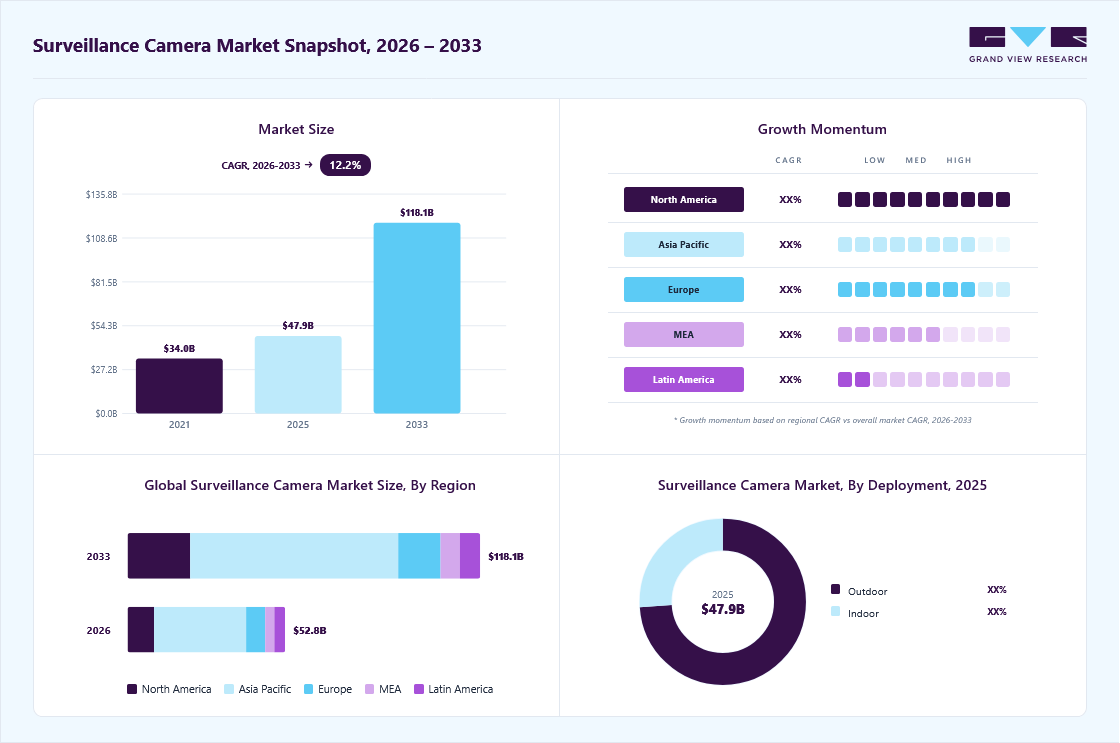
The global surveillance camera market size was valued at USD 47.9 billion in 2025 and is projected to grow from USD 52.8 billion in 2026 to USD 118.1 billion by 2033, at a CAGR of 12.2% from 2026 to 2033. The market in Asia Pacific dominated with a revenue share of 58.3% in 2025. The market growth is primarily driven by the increasing need for enhanced security and safety measures across various sectors.
 Source: Grand View Research, IR Documents, Primary Interviews, Paid DatabasesTo learn more about this report,
 Download Free Sample Report
 Key Market Trends & Insights
- By product type: The IP-based segment led the market with the largest revenue share of 45.8% in 2025.
- By deployment: The outdoor segment accounted for the largest market revenue share in 2025.
- By end use: The commercial infrastructure segment accounted for the largest market revenue share in 2025.
Regional Highlights
- Largest regional market: Asia Pacific (58.3% revenue share, 2025)
- The surveillance camera industry in the China held the largest revenue share in 2025.
Market Size & Forecast
- Market size in 2025: USD 47.9 Billion
- Estimated market size in 2026: USD 52.8 Billion
- Projected market size by 2033: USD 118.1 Billion
- CAGR (2026-2033): 12.2%
Three ways to get this report
Buy it, customize it, or ask a question.Ask an Analyst
Analyst response in 1 business day
- AccessReport author, directly
- Reply timeWithin 1 working day
- No sales callDirect answer only
- FormatEmail reply
- CostFree, no cost
Get the Full Report
What the study covers
- FormatsPDF · Excel · Dashboard
- Timeline2026–2033 annual, 2025 base
- Coverage20+ countries, 5 regions
- Companies10+ key players profiled
Customize the Report
20% free customization
- IncludeCountries, segments, points
- TailorTo your product definition
- ExtendDeeper competitor detail
- OrA fully bespoke study
- Turnaround5–10 working days
In response to accelerating concerns about security and criminal activity, enterprises, governments, and individuals are pursuing reliable surveillance solutions to monitor their premises and deter potential risks. In addition, growing urbanization and infrastructure development across the globe are further driving the demand for surveillance camera systems to monitor critical facilities and ensure public safety.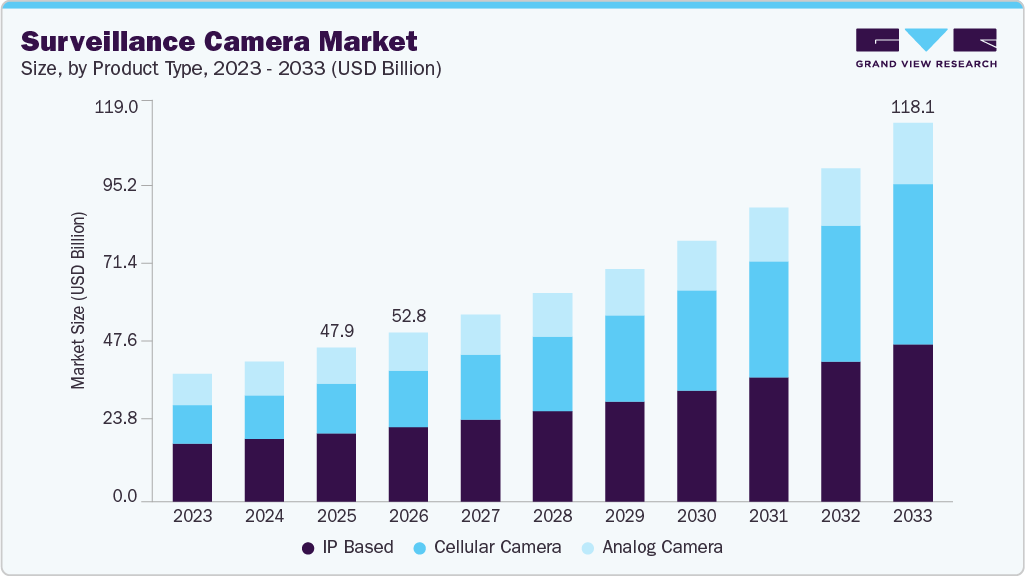 To learn more about this report, Download Free Sample Report
 Due to rapid urbanization, there is an increasing demand for commercial, residential, and infrastructure projects such as smart transport systems, airports, public transit, and large-scale housing developments. This increase in demand is also attracting a larger population toward urban areas, resulting in higher population density and elevated security risks in metropolitan environments.
According to the United Nations, 55% of the global population currently lives in urban areas, and this is projected to reach 68% by 2050, adding approximately 2.5 billion people to cities over the next three decades. Rapid urban growth necessitates the construction of high-rise buildings, transportation corridors, public spaces, and commercial zones, all of which require continuous monitoring to ensure public safety and traffic discipline. This high construction activity calls for surveillance cameras, thus supporting market growth.
Urban authorities are increasingly deploying integrated command-and-control centers to manage large camera networks and coordinate emergency response. As urban populations continue to grow and cities become more complex, surveillance cameras are integrated into core urban infrastructure rather than treated as standalone security systems, making urbanization one of the most structurally persistent drivers of long-term market demand.
Also, the increasing demand for advanced, solar-powered, and cellular connectivity-based surveillance cameras to improve the security of individuals and infrastructure in remote or temporary locations is significantly propelling market growth. Traditional surveillance systems rely on fixed power and wired network connections, which limit deployment on construction sites, in rural regions, in border areas, and in disaster-affected zones. To address these constraints, manufacturers are launching cameras that integrate solar panels, batteries, and cellular modules to enable autonomous operation.
The high initial installation cost of surveillance cameras is a major factor that is expected to restrain the market growth. Setting up a comprehensive surveillance system requires significant investment in purchasing high-quality cameras, storage devices, networking infrastructure, and other essential equipment. Apart from hardware costs, installation, and setup-related costs (such as labor, cabling, and integration with existing security systems) can further contribute to the overall initial investment. These financial expenses can pose challenges for organizations operating on tight budgets or with limited resources, making it difficult to justify the return on investment.
Product Type Insights
The IP-based segment led the market with the largest revenue share of 45.8% in 2025. The segment is further bifurcated into wired and Wi-Fi. Internet Protocol (IP) cameras offer digital video surveillance by sending and receiving video recordings over the Local Area Network (LAN) or the Internet. The increasing demand for IP cameras to improve security and safety in businesses, schools, government, healthcare, industrial, and military organizations is attributed to the segment’s growth.
The cellular camera segment is expected to grow at the fastest CAGR during the forecast period. The segment includes surveillance cameras powered by 4G and 5G connectivity. Factors such as the growing demand for 5G technology, the development of 5G infrastructure, and the adoption of 5G networks in video surveillance applications due to their increased bandwidth potential are propelling the segment's growth. Furthermore, the adoption of 4G cellular surveillance cameras for business security is growing, as they deliver a scalable, cost-effective solution that allows business owners to monitor their assets and premises.
Deployment Insights
The outdoor deployment segment accounted for the largest market revenue share in 2025 and is anticipated to grow at the fastest CAGR during the forecast period. Outdoor surveillance cameras are crucial in ensuring a premise's security and safety, serving as both surveillance tools and preventive measures. The expansion of this segment can be attributed to the rising need for and adoption of advanced security cameras for outdoor monitoring across settings such as commercial establishments, residential properties, toll collection points, roadways, vehicles, and diverse public spaces in both urban and rural areas. In addition, outdoor surveillance cameras offer benefits to businesses and property, such as access and perimeter monitoring, deterrence of criminal activity, and monitoring of property labor.
The indoor deployment segment is expected to register at a significant CAGR during the forecast period. The use of indoor surveillance cameras has grown substantially in recent years. This growth is primarily attributed to several factors, such as integrating these cameras into smart home systems, the escalating security concerns within residential and commercial applications, and the ongoing advancements in video surveillance technologies. Furthermore, the growth of this segment is also propelled by the rise in home renovation projects within urban localities and the accelerating demand for smart home devices.
Resolution Capacity Insights
The High Definition (HD) segment accounted for the largest market revenue share in 2025 and is anticipated to grow at the fastest CAGR during the forecast period. The HD surveillance camera records video at a higher resolution (720p (1280x720 pixels) or higher) than standard-definition cameras. It delivers more detailed and clearer videos and images. The increasing adoption of HD surveillance cameras, driven by their benefits such as high-quality images and video footage, improved crime deterrence, and enhanced alarm systems, is fueling the segment’s growth.
The Ultra High Definition (UHD) (4K) segment is expected to grow at a significant CAGR during the forecast period. A UHD or 4K surveillance camera provides 4K resolution, translating to approximately 3840 x 2160 pixels. These cameras deliver enhanced image quality and finer detail, making them suitable for applications that demand precise, top-notch video recording. In addition, because of their wide-angle lenses, 4K or UHD surveillance cameras can capture a broader field of view and more area than lower-resolution cameras.
End Use Insights
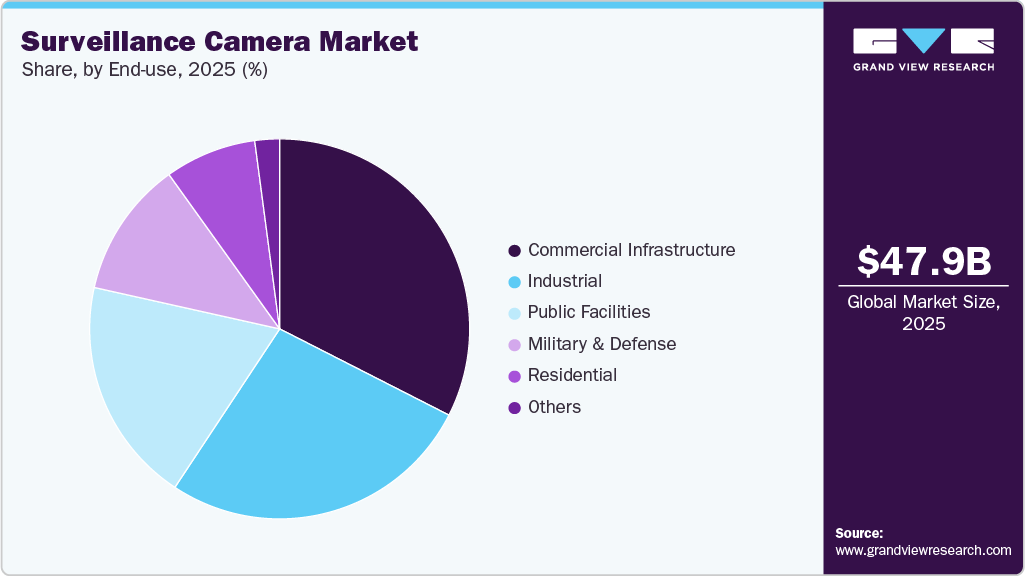
The commercial infrastructure segment accounted for the largest market revenue share in 2025.The growing adoption of surveillance cameras for monitoring commercial spaces, such as corporate offices, commercial real estate, shopping centers/malls, retail shops, and other business establishments, is driving the segment’s growth. Surveillance cameras in the aforementioned commercial spaces provide strong deterrence against theft, vandalism, and unauthorized access, ensuring the safety of assets, customers, and employees. Furthermore, increasing development and investment in commercial infrastructure across the globe is expected to drive the demand for surveillance cameras over the forecast period.
 To learn more about this report, Download Free Sample Report
 The industrial segment is anticipated to grow at the fastest CAGR during the forecast period.Industrial applications of surveillance cameras include manufacturing plants, construction sites, mining sites, and electricity distribution sites, among others. Video surveillance plays an important role in enhancing the safety, effectiveness, and efficiency of manufacturing operations at factories, plants, or mills. For instance, in the mining industry, these cameras play a crucial role in the security and safety of mine workers, equipment, and machinery. They offer real-time video monitoring capabilities, allowing operators to observe ongoing activities on the mine site.
Regional Insights
The surveillance camera market in North America is expected to grow at the fastest CAGR during the forecast period. The adoption of surveillance cameras in North America has been consistently on the rise in recent years. Several factors contribute to this trend, including rising concerns about security, the increasing incidence of urban crime, and a growing demand for improved surveillance and safety measures. Enterprises, governments, and individuals are recognizing the importance of surveillance cameras for deterring crime and facilitating investigations and evidence collection.
U.S. Surveillance Camera Market Trends
The surveillance camera market in the U.S. is expected to grow rapidly during the forecast period. Persistent concerns around crime, vandalism, and mass-casualty incidents continue to drive surveillance camera deployments across cities, schools, and commercial spaces in the U.S. The integration of real-time crime centers and digital evidence management systems has further strengthened the role of video surveillance in policing operations. As a result, municipalities and private enterprises are expanding camera networks to enhance deterrence, improve response times, and reduce liability exposure.
Asia Pacific Surveillance Camera Market Trends
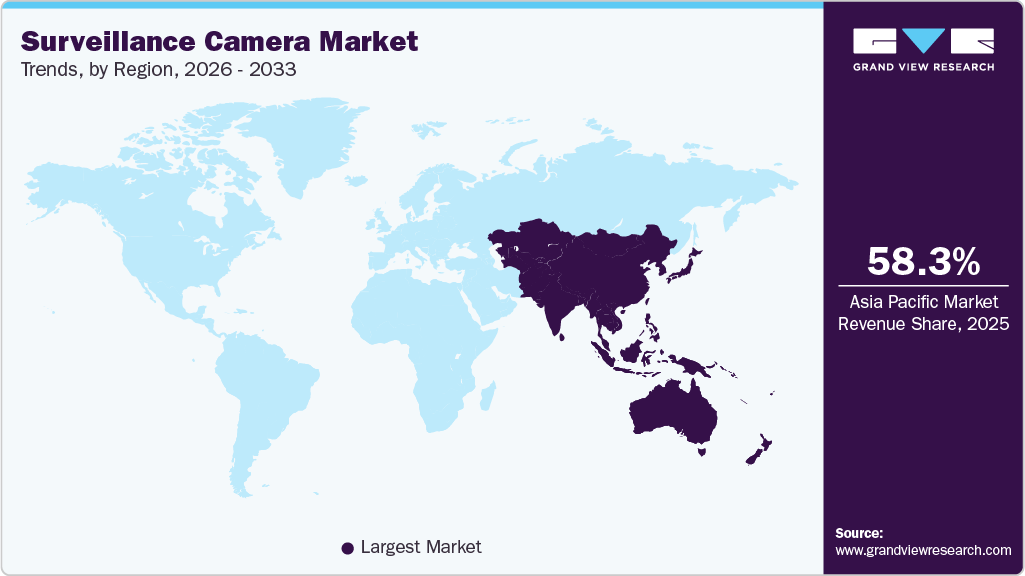
Asia Pacific dominated the global surveillance camera market with the largest revenue share of 58.29% in 2025. Numerous countries in this region are investing in smart city projects, encouraging the adoption of surveillance cameras for traffic control, urban development, and public safety. Integrating surveillance systems with Internet of Things (IoT) technology and cloud-driven solutions is progressively gaining traction in the market. This facilitates improved remote access, data storage, and scalability, addressing the evolving needs of enterprises and governmental bodies.
 To learn more about this report, Download Free Sample Report
 The surveillance camera market in Japan is expected to witness at a moderate CAGR during the forecast period. Japan remains one of the safest countries globally; however, over recent years there has been a steady increase in reported crime, particularly theft and fraud, which is strengthening demand for surveillance infrastructure. This trend has heightened public and institutional awareness around security risks in urban centers, retail environments, and transport systems. As a result, municipalities and businesses are upgrading CCTV networks and expanding coverage in high-traffic locations such as train stations, commercial districts, and convenience stores to improve deterrence and evidence collection.
The China surveillance camera market accounted for the largest market revenue share in the Asia Pacific in 2025. China’s rapid urbanization continues to be one of the most significant drivers of surveillance camera deployment. This massive urban population requires extensive monitoring across transportation networks, residential complexes, commercial districts, and public infrastructure to ensure public safety and efficient city management. As China continues to build and expand megacities and urban clusters, surveillance systems are increasingly integrated into urban planning, traffic management, and emergency response frameworks, driving sustained demand for high-density camera networks.
Europe Surveillance Camera Market Trends
The surveillance camera market in Europe is anticipated to grow steadily over the forecast period. Europe has witnessed increased adoption of surveillance cameras in recent years. In urban areas, surveillance cameras are widely deployed in public spaces, transportation hubs, and city centers to monitor crowds, deter crime, and support emergency response efforts. Moreover, businesses across industries such as retail, banking, and hospitality have integrated surveillance cameras to safeguard assets, prevent theft, and enhance employee safety.
The UK surveillance camera market is expected to grow significantly in the coming years. Increasing incidents of shoplifting and organized retail crime are driving private sector investments in surveillance systems across supermarkets, convenience stores, and shopping centers. In response, large retail chains are expanding camera coverage, deploying body-worn cameras, and adopting AI-enabled analytics to detect suspicious behavior and reduce shrinkage. This trend is accelerating the transition from basic CCTV systems to intelligent surveillance solutions, thereby contributing to sustained market growth in the commercial segment.
The surveillance camera market in Germany held a considerable market share in Europe in 2025. Germany maintains extensive crime monitoring through federal and state police systems, which rely heavily on video surveillance in transport hubs, city centers, and public spaces. The need for reliable digital evidence and real-time monitoring is encouraging municipalities and transport authorities to deploy higher-resolution cameras and upgrade legacy analog systems. Surveillance systems are increasingly integrated into public transport networks, railway stations, and large public events to improve incident response and post-event forensic analysis.
Key Surveillance Camera Company Insights
Some of the key companies in the surveillance camera industry include Dahua Technology Co., Ltd., Cisco Systems, Inc., Honeywell International Inc., and Panasonic Holdings Corporation, among others. Organizations are investing in research & development to create new, innovative products that offer improved features and benefits to customers. Therefore, key players are taking several strategic initiatives, including new product launches, mergers and acquisitions, and partnerships.
-
Dahua Technology Co., Ltd. is a global video-centric AIoT solution and service provider. The company is investing in R&D and product development and provides comprehensive security solutions, systems, and services for city operations, corporate management, and consumers.
-
Cisco Systems, Inc. designs and sells an extensive range of technologies that power the internet. The company serves businesses across multiple industries and sectors, including automotive, consumer packaged goods, education, energy, finance, manufacturing, materials, mining, retail, and transportation. The company provides network-centric video surveillance hardware and software that supports video monitoring, transmission, recording, and management.
Key Surveillance Camera Companies:
The following key companies have been profiled for this study on the surveillance camera market.
- Honeywell International Inc.
- Cisco Systems, Inc.
- Eye Trax
- Nokia Corporation
- Panasonic Holdings Corporation
- Robert Bosch GmbH
- Teledyne FLIR LLC
- Milesight
- Dahua Technology Co., Ltd.
- Swann
Recent Developments
-
In February 2026, MOBOTIX announced the launch of a new camera model, MOBOTIX S ONE DUAL. The new products are built for discreet applications such as discreet security and surveillance, and industrial machinery and production facilities, where conventional cameras are too visible or too exposed. The new product launch is expected to help the company strengthen its position in the market.
-
In January 2026, Reolink Innovation Inc. announced the launch of the New AI Box and Flagship 24 MP Triple-Lens Security Camera. The introduction of a new product is expected to help the company attract new customers and increase its revenue share.
Surveillance Camera Market Report Scope
Report Attribute
Details
Market size in 2025
USD 47.9 billion
Estimated market size in 2026
USD 52.8 billion
Projected market size by 2033
USD 118.1 billion
Growth rate
CAGR of 12.2% from 2026 to 2033
Base year for estimation
2025
Historical data
2021 - 2024
Forecast period
2026 - 2033
Quantitative units
Revenue in USD million/billion, and CAGR from 2026 to 2033
Report coverage
Revenue forecast, company market share, competitive landscape, growth factors, and trends
Segments covered
Product type, deployment, resolution capacity, end use, region
Regional scope
North America; Europe; Asia Pacific; Latin America; Middle East & Africa
Country scope
U.S.; Canada; Mexico; Germany; UK; France; China; Japan; India; South Korea; Australia; Brazil; KSA; UAE; and South Africa
Key companies profiled
Honeywell International Inc.; Cisco Systems, Inc.; Eye Trax; Nokia Corporation; Panasonic Holdings Corporation; Robert Bosch GmbH; Teledyne FLIR LLC; Milesight; Dahua Technology Co., Ltd.; Swann
Customization scope
Free report customization (equivalent up to 8 analysts working days) with purchase. Addition or alteration to country, regional & segment scope.
Pricing and purchase options
Avail customized purchase options to meet your exact research needs. Explore purchase options
Global Surveillance Camera Market Report Segmentation
This report forecasts revenue growth at global, regional, and country levels and provides an analysis of the latest industry trends in each of the sub-segments from 2021 to 2033. For this study, Grand View Research has segmented the global surveillance camera market report based on product type, deployment, resolution capacity, end use, and region:
-
Product Type Outlook (Revenue, USD Million, 2021 - 2033)
-
IP-Based
-
Wi-Fi
-
Wired
-
-
Cellular Camera
-
4G
-
5G
-
-
Analog Camera
-
-
Deployment Outlook (Revenue, USD Million, 2021 - 2033)
-
Indoor
-
Outdoor
-
-
Resolution Capacity Outlook (Revenue, USD Million, 2021 - 2033)
-
High Definition (HD)
-
Full High Definition (FHD)
-
Ultra High Definition (UHD) (4K)
-
-
End Use Outlook (Revenue, USD Million, 2021 - 2033)
-
Residential
-
Commercial Infrastructure
-
Public Facilities
-
Industrial
-
Military & Defense
-
Others
-
-
Regional Outlook (Revenue, USD Million, 2021 - 2033)
-
North America
-
U.S.
-
Canada
-
Mexico
-
-
Europe
-
Germany
-
UK
-
France
-
-
Asia Pacific
-
China
-
Japan
-
India
-
South Korea
-
Australia
-
-
Latin America
-
Brazil
-
-
Middle East and Africa (MEA)
-
KSA
-
UAE
-
South Africa
-
-
Frequently Asked Questions About This Report
Some key players operating in the surveillance camera market include Honeywell International Inc., Cisco Systems, Inc., Eye Trax, Nokia Corporation, Panasonic Holdings Corporation, Robert Bosch GmbH, Teledyne FLIR LLC, Milesight, Dahua Technology Co., Ltd., and Swann.
The growth of the surveillance camera market is primarily driven by the increasing need for enhanced security and safety measures across various sectors. In response to accelerating concerns about security and occurrences of criminal activities, enterprises, governments, and individuals are pursuing reliable surveillance solutions to monitor their premises and deter potential risks effectively.
The IP-based segment led with a 45.8% revenue share in 2025.
The outdoor segment held the largest revenue share in 2025.
The commercial infrastructure segment held the largest revenue share in 2025.
Asia Pacific dominated with a 58.3% revenue share in 2025.
The global surveillance camera market size was estimated at USD 47.9 billion in 2025 and is expected to reach USD 52.8 billion in 2026.
The global surveillance camera market is expected to grow at a compound annual growth rate of 12.2% from 2026 to 2033 to reach USD 118.1 billion by 2033.
Asia Pacific dominated the market in 2025. The regional market’s growth is accounted to the growing investments in smart city projects, encouraging the adoption of surveillance cameras for traffic control, urban development, and public safety in various countries in Asia Pacific.
About the Author(s)
Next Generation Technologies Research Team
Technology · Next Generation TechnologiesThis report was authored by the next generation technologies research team at Grand View Research - comprising two research analysts, one senior research analyst, and one industry expert - with specialized expertise in the next generation technologies segment of the technology industry. All findings are based on proprietary technology databases, executive interviews, and regulatory analysis, subject to internal peer review prior to publication.
Last Updated:
Speak to Analyst

Customize this report to your needs - add regions, segments, or data points, with 20% free customization.
Or view our licence options:


ISO 9001:2015 & 27001:2022 Certified
We are GDPR and CCPA compliant! Your transaction & personal information is safe and secure. For more details, please read our privacy policy.


