
- Home
- »
- Clothing, Footwear & Accessories
- »
-
Sustainable Fashion Market Size & Share Report, 2026-2035GVR Report cover

Sustainable Fashion Market (2026 - 2035)
Size, Share & Trends Analysis Report By Product (Apparel, Footwear, Accessories), By Material (Organic Cotton, Recycled Fabrics, Regenerated Fibers, Plant-Based Materials), By Distribution Channel, By Region, And Segment Forecasts
Market Size, 2025
$12.8BMarket Estimate, 2026
$13.8BMarket Forecast, 2035
$26.4BCAGR, 2026–2035
7.5%Sustainable Fashion Market Summary
The global sustainable fashion market size was valued at USD 12.8 billion in 2025 and is projected to grow from USD 13.8 billion in 2026 to USD 26.4 billion in 2035, at a CAGR of 7.5% from 2026 to 2035. Europe dominated the market, accounting for a revenue share of in 2025. The industry is driven by rising consumer demand for eco-friendly apparel, increasing adoption of sustainable materials, growing awareness of ethical fashion, and expanding investments in circular fashion and environmentally responsible manufacturing practices.
Key Market Trends & Insights
- By product: The apparel segment held the largest market share in 2025.
- By material: The organic cotton segment accounted for the largest market share in 2025.
- By distribution channel: The offline brand-owned stores segment held the largest market share in 2025.
Regional Highlights
- Largest regional market: Europe (largest revenue share, 2025)
- Fastest-growing regional market: Asia Pacific (highest CAGR, 2026-2035)
Market Size & Forecast
- Market size in 2025: USD 12.8 Billion
- Estimated market size in 2026: USD 13.8 Billion
- Projected market size by 2035: USD 26.4 Billion
- CAGR (2026-2035): 7.5%
Prism AI by Grand View Research Free to tryAsk a question about the sustainable fashion marketTry asking✓Every figure cited from GVR research Prefer the report? Download free sample →
Growing awareness of climate change, textile waste, and ethical labor practices is encouraging consumers to choose clothing made from organic, recycled, and responsibly sourced materials. Fashion brands are responding by investing in sustainable manufacturing processes, transparent supply chains, and circular business models, including resale, repair, and recycling. Government regulations promoting environmental responsibility, along with corporate sustainability commitments, are further supporting the transition toward more sustainable fashion practices.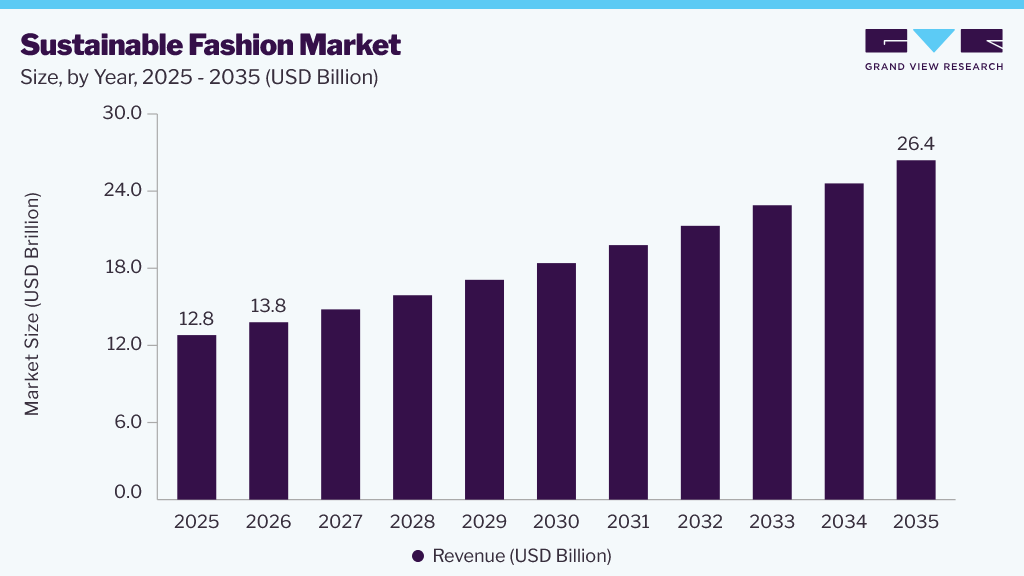 Source: Grand View Research, IR Documents, Primary Interviews, Paid DatabasesTo learn more about this report,
 Download Free Sample Report
Despite its strong growth potential, the market faces several challenges. Sustainable raw materials and environmentally friendly production methods often involve higher costs than conventional alternatives, resulting in higher prices for consumers. In addition, the limited availability of certified sustainable materials, complex supply chain requirements, and concerns about greenwashing continue to constrain market development. Many brands also face challenges in balancing affordability, scalability, and sustainability while meeting evolving consumer expectations and regulatory requirements.
The market presents significant opportunities as technological innovation and circular economy initiatives continue to reshape the fashion industry. Advances in recycled textiles, bio-based fibers, water-efficient dyeing technologies, and digital product traceability are enabling brands to reduce their environmental footprint while enhancing product quality and operational efficiency. The rapid growth of online retail, second-hand fashion platforms, rental services, and clothing recycling programs is creating new business models and revenue opportunities. Furthermore, increasing consumer demand for transparency, sustainability certifications, and environmentally responsible brands is expected to support long-term market growth across both developed and emerging economies.
Analyst Perspective
The industry is evolving from a niche segment into a mainstream industry as environmental awareness and responsible consumption become key purchasing priorities. Consumers are seeking products made from sustainable materials, while brands are investing in circular business models, ethical sourcing, and low-impact manufacturing to strengthen their position. Advances in recycled textiles, digital supply chain transparency, and innovative, eco-friendly materials are accelerating this transformation. As governments introduce stricter sustainability regulations and consumers continue to favor environmentally responsible brands, companies that combine innovation, transparency, and affordability are expected to gain a lasting competitive advantage.
Product Insights
The apparel segment held the largest market share in 2025, driven by strong consumer demand for sustainable everyday clothing, including casual wear, activewear, formal wear, and outerwear made from organic, recycled, and responsibly sourced materials. Leading fashion brands are expanding their eco-friendly apparel collections to meet rising consumer expectations for ethical and environmentally responsible products. In addition, increasing awareness of sustainable production practices, government support for circular economy initiatives, and growing demand for certified sustainable garments have further strengthened the apparel segment's leading position in the global industry.
The accessories segment is expected to register the fastest CAGR during the forecast period. Growth is fueled by increasing consumer preference for eco-friendly handbags, wallets, belts, scarves, jewelry, and other fashion accessories made from recycled, vegan, and bio-based materials. Fashion brands are introducing innovative accessory collections using sustainable alternatives such as recycled plastics, plant-based leather, and regenerated fibers to reduce environmental impact. Furthermore, the rapid expansion of online retail, growing influence of sustainable fashion trends on social media, and rising demand for premium yet environmentally conscious lifestyle products are expected to accelerate the growth of the accessories segment throughout the forecast period.
Material Insights
The organic cotton segment held the largest market share in 2025 due to the growing demand for environmentally friendly and ethically produced textiles across the fashion industry. Organic cotton is cultivated without the use of synthetic pesticides and fertilizers, reducing environmental impact while improving soil health and water conservation. Leading apparel brands are increasingly incorporating certified organic cotton into their product collections to meet consumer demand for sustainable clothing and comply with evolving environmental regulations. Additionally, rising awareness of eco-friendly fashion and expanding certification programs have further strengthened the adoption of organic cotton, reinforcing its leading position in the industry.
The recycled fabrics segment is expected to register a notable CAGR during the forecast period. Growth is driven by increasing industry efforts to reduce textile waste and promote circular fashion practices. Fashion manufacturers are expanding the use of recycled polyester, recycled nylon, and recycled cotton to lower carbon emissions, minimize resource consumption, and reduce dependence on virgin raw materials. Continuous investments in textile recycling technologies, supportive sustainability regulations, and growing consumer preference for products with lower environmental footprints are accelerating market adoption. Furthermore, collaborations between fashion brands and recycling technology providers are expected to strengthen the supply of high-quality recycled materials, supporting the rapid growth of the recycled fabrics segment over the forecast period.
For instance, in June 2025, H&M Group signed a multi-year strategic sourcing partnership with Circulose to source significant volumes of CIRCULOSE, a dissolving pulp made from 100% textile waste, for its collections. The partnership supports the adoption of textile-to-textile recycled fibers, replacing a substantial share of virgin viscose used across the group and advancing circular fashion by reducing reliance on virgin resources.
Distribution Channel Insights
The offline retail brand-owned stores segment held the largest market share in 2025, supported by consumers’ preference for physically evaluating the quality, fit, comfort, and durability of sustainable fashion products before making a purchase. Brand-owned stores also provide companies with a direct channel to communicate sustainability initiatives, ethical sourcing practices, and relevant product certifications, which can strengthen consumer trust and brand loyalty. In addition, personalized shopping experiences, exclusive product collections, and in-store sustainability initiatives can attract environmentally conscious consumers and support the segment’s position in the industry.
The online retail e-commerce marketplaces segment is expected to register a notable CAGR during the forecast period, supported by increasing consumer preference for convenient online shopping, the expansion of digital-first sustainable fashion brands, and the growing availability of eco-friendly products across major e-commerce platforms. Online marketplaces offer consumers broader product selection, access to sustainability-related product information, customer reviews, and convenient price comparisons, making sustainable fashion more accessible. Furthermore, the continued adoption of mobile commerce and social commerce, along with AI-powered product recommendations and the expansion of resale and other circular-fashion platforms, is expected to support the growth of online distribution channels during the forecast period.
For instance, in October 2024, eBay Inc. announced the global expansion of its Circular Fashion Fund, with plans to provide a total of USD 1.2 million in investment to fashion start-ups by the end of 2025. The initiative supports businesses developing circular solutions across the fashion lifecycle, including rental, repair, and other solutions designed to extend the life of clothing. eBay also announced that its venture arm, eBay Ventures, would provide an additional USD 300,000 investment to the initiative’s global “Circular Fashion Innovator of the Year.” The expansion illustrates how major online marketplaces are supporting circular-fashion businesses and technologies.
Regional Insights
The Europe sustainable fashion market held the largest share in 2025, driven by strong consumer awareness of environmental sustainability, stringent regulations promoting circular economy practices, and the presence of leading sustainable fashion brands. Countries such as Germany, France, the UK, and the Nordic nations are witnessing increasing demand for clothing made from organic, recycled, and ethically sourced materials. In addition, government policies encouraging responsible production, extended producer responsibility (EPR), and sustainable textile initiatives have accelerated the adoption of eco-friendly fashion across the region. Continuous investments in textile recycling, sustainable manufacturing, and transparent supply chains further reinforce Europe's leading position in the global sustainable fashion market. In February 2025, COS launched COS REMADE, its first limited-edition denim capsule incorporating 20% pre-loved COS cotton garments collected through the brand’s garment-collection initiative. The five-piece womenswear collection repurposes previously used cotton garments into new fashion products, demonstrating the growing adoption of circular design and textile reuse within the European fashion industry.
Asia Pacific Sustainable Fashion Market Trends
The sustainable fashion market in Asia Pacific is expected to register the fastest CAGR during the forecast period. Growth is supported by expanding sustainable textile manufacturing, rising environmental awareness, increasing disposable incomes, and growing demand for eco-friendly apparel across countries such as China, India, Japan, and South Korea. Rising incomes and greater spending power are encouraging consumers in several Asian markets to consider premium and ethically produced fashion products, while social media platforms are increasing awareness and exposure to sustainable fashion trends.
Governments and fashion companies across the region are also increasing investments in sustainable production technologies, recycled materials, textile recycling, and more transparent supply chains. China, India, and Japan are particularly important markets within the region, with China representing the largest sustainable fashion market in Asia Pacific and India showing strong growth potential. In addition, the rapid expansion of e-commerce, increasing smartphone and internet penetration, and growing consumer interest in environmentally responsible products are expected to support the adoption of sustainable fashion across the region throughout the forecast period.
Key Sustainable Fashion Market Companies Insights
The sustainable fashion market is highly competitive, with global fashion brands, apparel and textile manufacturers, and sustainability-focused fashion companies competing through product innovation, strategic partnerships, sustainable material development, and circular business models. Leading companies are investing in recycled and bio-based materials, textile recycling, resale and repair initiatives, responsible sourcing, supply-chain decarbonization, and digital transparency to strengthen their market position and respond to growing demand for more environmentally responsible fashion products. Recent industry assessments also highlight the sustainability and climate strategies of major fashion companies, including H&M Group, Inditex, adidas, lululemon, and other global players.
Key Sustainable Fashion Companies
The following key companies have been profiled for this study on the sustainable fashion market:
-
Patagonia, Inc.
-
H & M Hennes & Mauritz AB
-
Inditex, S.A.
-
Kering
-
PUMA SE
-
adidas AG
-
NIKE, Inc.
-
Levi Strauss & Co.
-
VF Corporation
-
Allbirds, Inc.
Recent Developments
- In March 2025, PUMA SE entered a multi-year collaboration with RE&UP Recycling Technologies to scale textile-to-textile recycling by incorporating next-generation recycled cotton fibers and recycled polyester into its RE:FIBRE program. This partnership supports circular fashion and reduces reliance on virgin materials.
- In July 2025, Inditex, S.A. joined an international research project to convert brewing industry waste into sustainable textile materials. The initiative focuses on developing innovative bio-based fibers from agricultural by-products, supporting circular fashion and reducing dependence on conventional raw materials.
- In December 2025, H & M Hennes & Mauritz AB partnered with Stella McCartney to launch a collection featuring recycled and responsibly sourced materials while creating an industry Insights Board to accelerate sustainable fashion innovation.
Sustainable Fashion Market Report Scope
Report Attribute
Details
Market size in 2025
USD 12.8 billion
Estimated market size in 2026
USD 13.8 billion
Projected market size in 2035
USD 26.4 billion
Growth rate
CAGR of 7.5% from 2026 to 2035
Base year for estimation
2025
Historical data
2021 – 2024
Forecast period
2026 – 2035
Quantitative units
Revenue in USD billion, and CAGR from 2026 to 2035
Report coverage
Revenue forecast, company ranking, competitive landscape, growth factors, and trends
Segments covered
Product, material, distribution channel, region
Regional scope
North America; Europe; Asia Pacific; Latin America; Middle East & Africa
Country scope
U.S.; Canada; Mexico; UK; Germany; France; Italy; Spain; China; Japan; India; Australia; South Korea; Brazil; Argentina; South Africa; Saudi Arabia; UAE
Key companies profiled
Patagonia, Inc.; H&M Hennes & Mauritz AB; Inditex, S.A.; Kering; PUMA SE; adidas AG; NIKE, Inc.; Levi Strauss & Co.; VF Corporation; Allbirds, Inc.
Customization scope
Free report customization (equivalent to 8 analyst working days) with purchase. Addition or alteration to country, regional & segment scope.
Pricing and purchase options
Avail of customized purchase options to meet your exact research needs. Explore purchase options
Sustainable Fashion Market Report Segmentation
This report forecasts revenue growth at the global, regional, and country levels and provides an analysis of the latest industry trends and opportunities across each sub-segment from 2021 to 2035. For this study, Grand View Research has segmented the global sustainable fashion market report based on product, material, distribution channel, and region:
-
Product Outlook (Revenue, USD Billion, 2021 - 2035)
-
Apparel
-
Footwear
-
Accessories
-
Others
-
-
Material Outlook (Revenue, USD Billion, 2021 - 2035)
-
Organic Cotton
-
Recycled Fabrics
-
Regenerated Fibers
-
Plant-Based Materials
-
Others
-
-
Distribution Channel Outlook (Revenue, USD Billion, 2021 - 2035)
-
Offline Retail
-
Brand-Owned Stores
-
Specialty Stores
-
Others
-
-
Online Retail
-
Brand-Owned Websites
-
E-commerce Marketplaces
-
-
-
Regional Outlook (Revenue, USD Billion, 2021 - 2035)
-
North America
-
U.S.
-
Canada
-
Mexico
-
-
Europe
-
UK
-
Germany
-
France
-
Italy
-
Spain
-
-
Asia Pacific
-
China
-
Japan
-
India
-
Australia
-
South Korea
-
-
Latin America
-
Brazil
-
Argentina
-
-
Middle East and Africa (MEA)
-
South Africa
-
Saudi Arabia
-
UAE
-
-
Frequently Asked Questions About This Report
The global sustainable fashion market size was valued at USD 12.8 billion in 2025 and is estimated at USD 13.8 billion for 2026.
The global sustainable fashion market is expected to grow at a CAGR of 7.5% from 2026 to 2035, reaching USD 26.4 billion.
The apparel segment accounted for the largest revenue share in 2025.
Europe dominated with the largest revenue share in 2025.
Key players in the market include Patagonia, Inc.; H&M Hennes & Mauritz AB; Inditex, S.A.; Kering; PUMA SE; adidas AG; NIKE, Inc.; Levi Strauss & Co.; VF Corporation; Allbirds, Inc.
About the Author(s)
Clothing, Footwear & Accessories Research Team
Consumer Goods · Clothing, Footwear & AccessoriesThis report was authored by the clothing, footwear & accessories research team at Grand View Research - comprising two research analysts, one senior research analyst, and one industry expert - with specialized expertise in the clothing, footwear & accessories segment of the consumer goods industry. All findings are based on proprietary consumer goods databases, executive interviews, and regulatory analysis, subject to internal peer review prior to publication.
Last Updated:
Speak to Analyst

Customize this report to your needs - add regions, segments, or data points, with 20% free customization.
Or view our licence options:


ISO 9001:2015 & 27001:2022 Certified
We are GDPR and CCPA compliant! Your transaction & personal information is safe and secure. For more details, please read our privacy policy.


