
- Home
- »
- Next Generation Technologies
- »
-
Sustainable Printing Market Size & Share Report, 2026-2033GVR Report cover

Sustainable Printing Market (2026 - 2033)
Size, Share & Trends Analysis Report By Type (Stationery, Flyers/Brochures, Booklets, Business Cards), By Enterprise Size (Large Enterprises, Small & Medium Enterprises), By Region, And Segment Forecasts
Market Size, 2025
$2.3BMarket Estimate, 2026
$2.4BMarket Forecast, 2033
$4.5BCAGR, 2026–2033
9.0%Sustainable Printing Market Summary
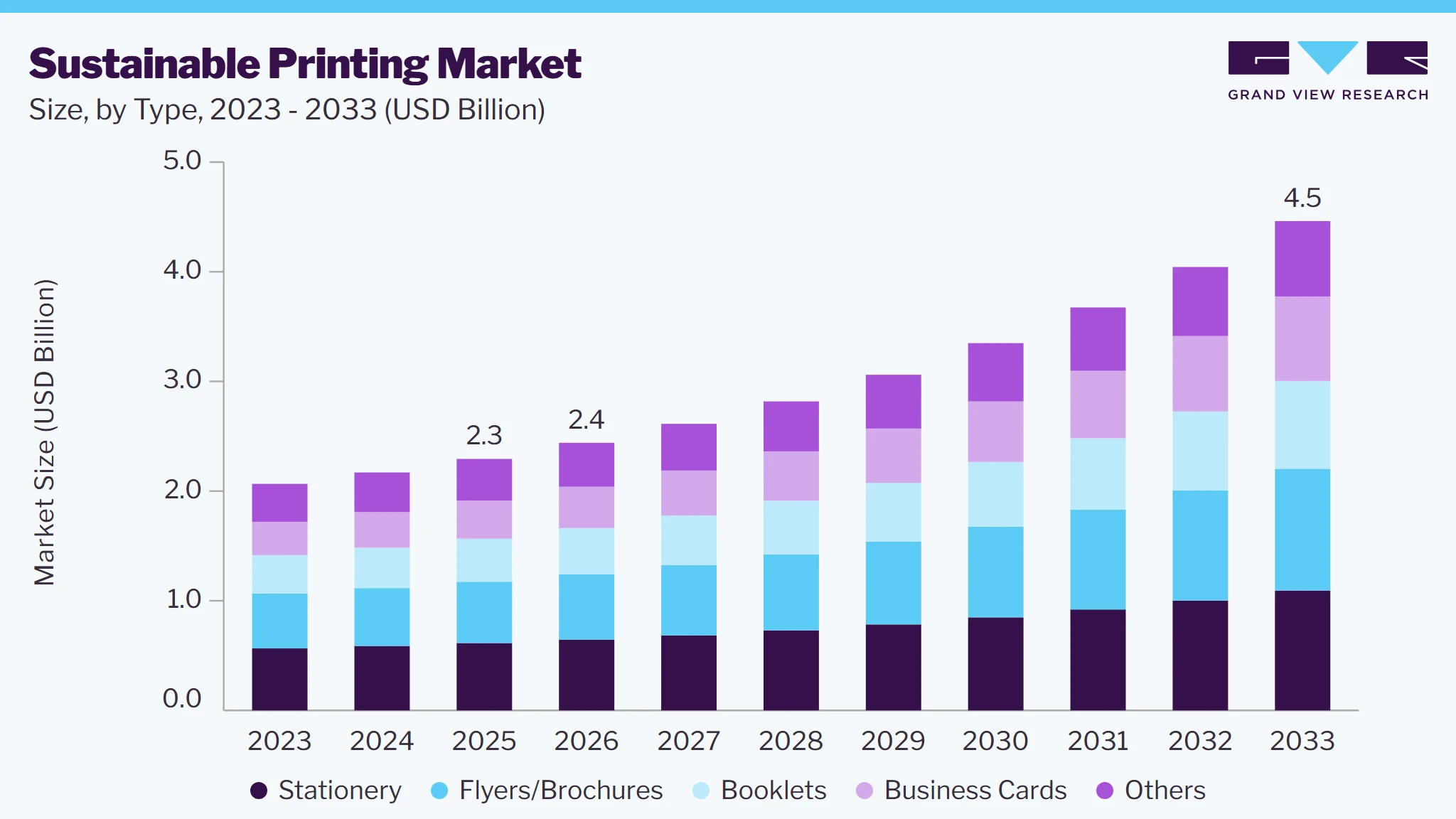
The global sustainable printing market size was valued at USD 2.3 billion in 2025 and is projected to grow from USD 2.4 billion in 2026 to USD 4.5 billion by 2033, at a CAGR of 9.0% from 2026 to 2033. The market in North America dominated with a revenue share of 34.3% in 2025. Growing awareness of environmental issues among consumers is a major factor driving the demand for sustainable printing market
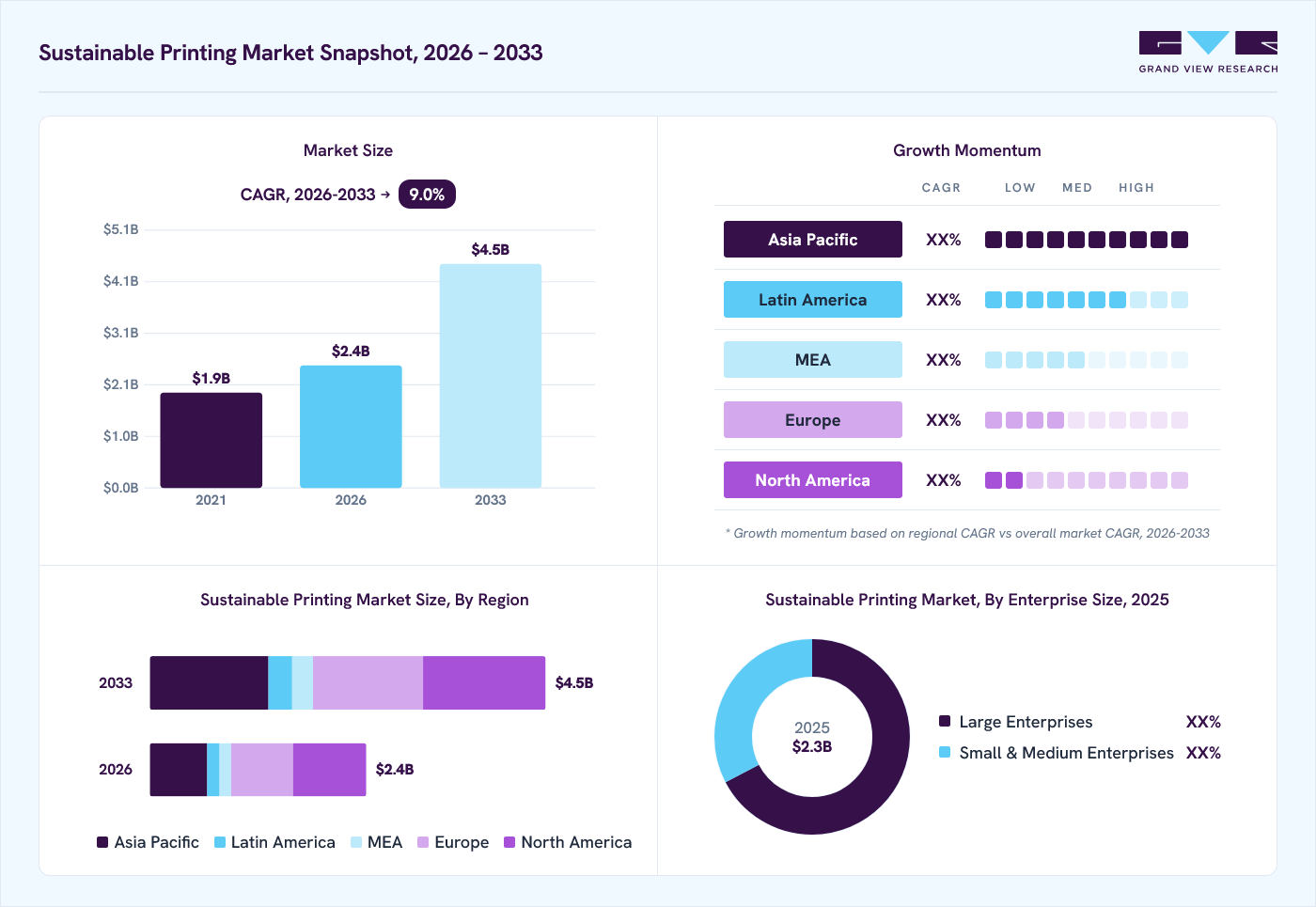 Source: Grand View Research, IR Documents, Primary Interviews, Paid DatabasesTo learn more about this report,
 Download Free Sample Report
Key Market Trends & Insights
- By type: Stationery segment dominated the market, with a revenue share of 25.0% in 2025
- By enterprise size: Large Enterprises segment held the largest market share of 69.3% in 2025
Regional Highlights
- Largest regional market: North America (34.3% revenue share, 2025)
- Fastest-growing regional market: Asia Pacific (highest CAGR, 2026-2033)
- By country: The U.S. held the largest market share in 2025.
Market Size & Forecast
- Market size in 2025: USD 2.3 Billion
- Estimated market size in 2026: USD 2.4 Billion
- Projected market size by 2033: USD 4.5 Billion
- CAGR (2026-2033): 9.0%
Three ways to get this report
Buy it, customize it, or ask a question.Ask an Analyst
Analyst response in 1 business day
- AccessReport author, directly
- Reply timeWithin 1 working day
- No sales callDirect answer only
- FormatEmail reply
- CostFree, no cost
Get the Full Report
What the study covers
- FormatsPDF · Excel · Dashboard
- Timeline2026–2033 annual, 2025 base
- Coverage20+ countries, 5 regions
- Companies10+ key players profiled
Customize the Report
20% free customization
- IncludeCountries, segments, points
- TailorTo your product definition
- ExtendDeeper competitor detail
- OrA fully bespoke study
- Turnaround5–10 working days
Today’s consumers are more informed and concerned about the impact of their purchasing decisions on the environment. As a result, there is a growing demand for products that are sustainably produced, including print materials. This shift in consumer behavior is compelling companies to adopt more sustainable practices to meet market expectations.
Technological advancements are facilitating the shift towards sustainable printing. Innovations in printing technology are making it easier and more-cost effective for companies to implement sustainable practices. For instance, the development of biodegradable and recyclable materials, low-VOC links, and waterless printing technologies are helping to reduce the environmental impact of printing processes. Moreover, the integration of AI and IoT in printing systems is enabling more efficient resource management, reducing waste and energy consumption.
 To learn more about this report, Download Free Sample Report
Rising use of biodegradable and recyclable materials is further driving the demand for the sustainable printing market. These materials are designed to break down more easily in the environment, reducing the long-term impact of printed products. Biodegradable inks made from natural ingredients such as soy or algae, which decompose more quickly than traditional petroleum-based inks. Similarly, recyclable materials, such as recycled paper or compostable packaging, are gaining popularity as companies seek to reduce their environmental footprint.
Another major trend is the adoption of energy-efficient printing technologies. Traditional printing methods are energy-intensive, contributing to higher operational costs and carbon emissions. In response, the industry is increasingly turning to energy-efficient machines and processes. For instance, modern digital printing equipment not only consumes less energy but also reduces waste by printing only what is needed, thereby minimizing overproduction and excess inventory.
The growth of 3D printing is another significant trend in the sustainable printing market. While 3D printing is still a relatively new technology, it is rapidly gaining traction in various industries including manufacturing, healthcare, and construction. Sustainable 3D printing involves the use of eco-friendly materials such as bioplastics or recycled polymers, to create three-dimensional objects. This technology offers several sustainability benefits, including reduced material waste, lower energy consumption, and the ability to produce customized products on demand, reducing the need for mass production and excess inventory.
Market Dynamics
The sustainable printing market is evolving as environmental accountability becomes a core procurement criterion across commercial, institutional, and industrial print buyers. Rising regulatory scrutiny of carbon emissions, waste generation, and chemical usage is reshaping traditional print value chains, while advancements in eco-friendly inks, recycled substrates, and energy-efficient digital presses are redefining production economics. The market is increasingly characterized by a shift from volume-driven print output toward value-driven, low-impact, and compliance-aligned printing solutions.
The increasing enforcement of environmental regulations and corporate sustainability commitments has emerged as a primary growth driver for the sustainable printing market. Governments across developed and emerging economies are tightening standards related to paper sourcing, volatile organic compound (VOC) emissions, and waste disposal. Simultaneously, enterprises are integrating ESG benchmarks into vendor selection, compelling print service providers to demonstrate measurable reductions in environmental footprint.
Sustainable printing solutions directly address these compliance pressures by enabling reduced material waste, lower energy consumption, and improved traceability of raw materials. The adoption of recycled and FSC-certified paper, water-based inks, and digital workflows allows printers to meet regulatory thresholds while maintaining operational continuity. As sustainability compliance increasingly influences purchasing decisions, demand for certified and low-impact printing solutions continues to accelerate.
Despite growing demand, the market faces restraint from the relatively higher cost of sustainable printing materials and technologies. Eco-certified papers, biodegradable inks, and energy-efficient presses typically command premium pricing compared to conventional alternatives. For cost-sensitive buyers, especially in price-driven print categories, this cost differential limits widespread adoption.
The impact of this restraint is more pronounced among small print service providers and SMEs operating in emerging markets, where margin pressures remain high. Regions with limited access to sustainable raw material supply chains experience slower adoption, as logistical costs further inflate prices. This pricing barrier constrains penetration across high-volume, low-margin segments such as promotional flyers and transactional print, thereby moderating overall market growth.
The growing adoption of digital and on-demand printing models presents a significant opportunity for sustainable printing market participants. These models minimize overproduction, reduce inventory waste, and align closely with circular economy principles. Advancements in digital press efficiency, color accuracy, and substrate compatibility are enabling sustainable printing to scale across commercial applications.
Vendors offering integrated digital platforms, automated workflows, and sustainability-certified production capabilities are best positioned to capture this opportunity. Commercial print segments such as marketing collateral, short-run publications, and personalized business materials are witnessing faster adoption. Companies combining sustainability credentials with operational flexibility are increasingly preferred by enterprises pursuing low-waste, agile print strategies.
Analyst Perspective
The sustainable printing market is transitioning from a niche compliance-driven segment to a mainstream operational standard across commercial print ecosystems. Regulatory enforcement, enterprise ESG alignment, and digital print efficiency continue to act as structural growth forces. Technology advancements in eco-inks, recycled substrates, and low-energy digital presses are reshaping cost dynamics and scalability. Investment activity is increasingly focused on automation-enabled sustainable printing platforms and certified material supply chains. Competitive differentiation is shifting toward measurable sustainability outcomes, traceability, and integrated digital workflows.
Type Insights
In terms of type, the market is classified into stationery, flyers/brochures, booklets, business cards, and others. Based on type, the stationery segment led the market with the largest revenue share of 25.0% in 2025. Businesses and consumers alike are opting for stationery products that have a lower environmental impact, such as those made from post-consumer waste and forest stewardship council-certified paper is anticipated to drive the growth of stationery segment. Moreover, the growing trend towards digital stationery, reducing the need for physical printing altogether, although the demand for tangible, eco-friendly stationery is driving the demand for sustainable printing in stationery segment.
The business cards segment is projected to witness the highest CAGR of 10.8% from 2026 to 2033. The push towards sustainable business cards is driven by corporate sustainability initiatives and the desire to project an eco-friendly image. As businesses become more aware of their carbon footprint, they are opting for business cards made from sustainable materials as part of their broader sustainability strategies. In addition, the growing popularity of digital solutions is reducing the need for physical business cards, contributing to the segment’s shift towards sustainability.
Enterprise Size Insights
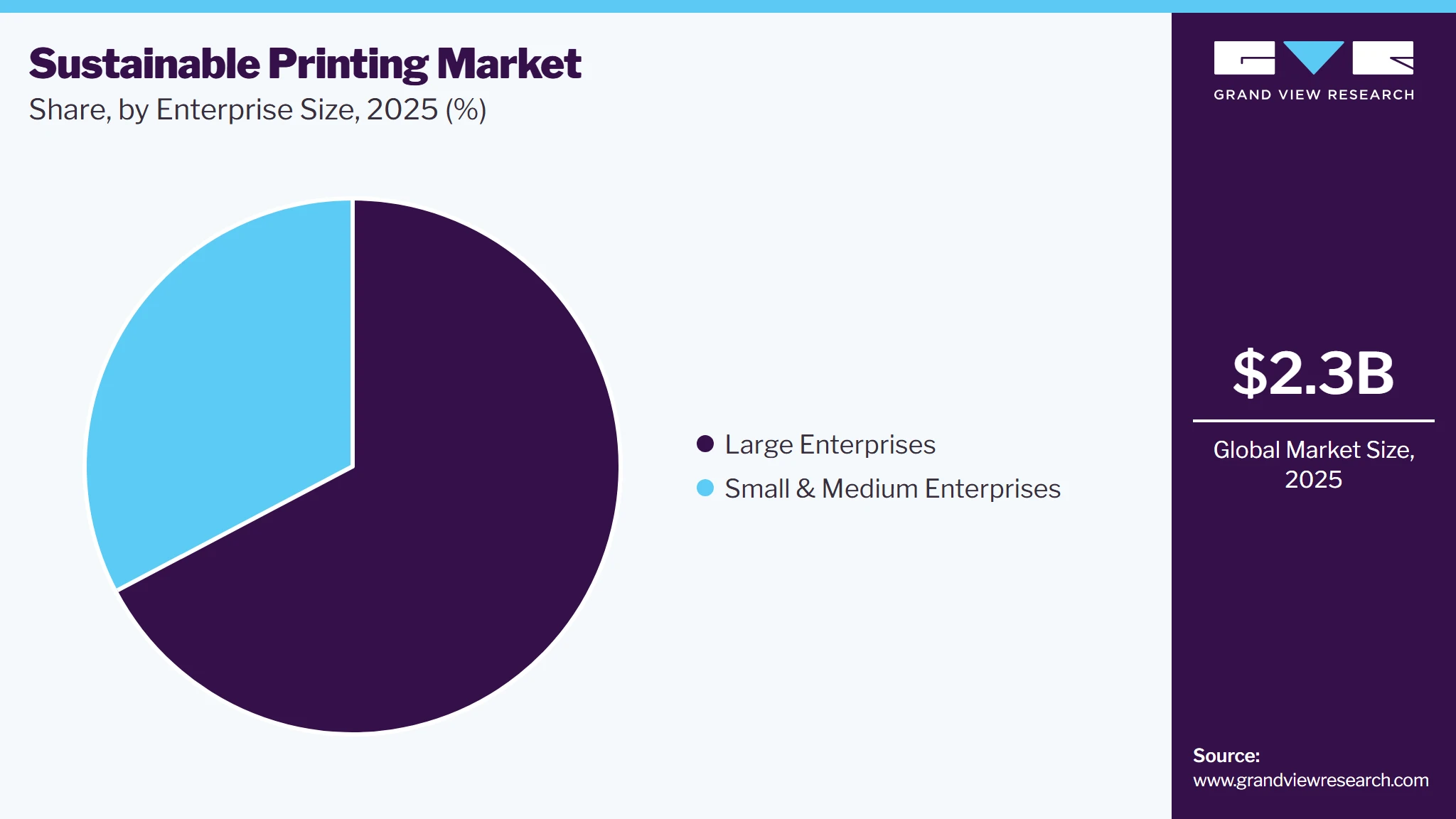
Based on enterprise size, the large enterprises segment led the market with the largest revenue share of 69.3% in 2025. Large enterprises are investing heavily in eco-friendly technologies, such as digital printing and green inks, to reduce waste and energy consumptions is driving the demand for sustainable printing in large enterprises segment. Moreover, large enterprises are increasingly adopting cloud-based print management solutions to optimize printing processes, reducing the need for physical printers and paper.
 To learn more about this report, Download Free Sample Report
The small & medium enterprises segment is projected to register a notable growth rate from 2026 to 2033. Small & medium enterprises are increasingly embracing sustainable printing practices, driven by a combination of regulatory requirements, cost savings, and growing awareness of environmental issues. Sustainable printing practices, such as reducing paper waste and adopting energy-efficient equipment, can lead to significant cost reductions, which are particularly important for smaller businesses with limited budgets. Such factors are anticipated to drive the demand for the market in the small & medium enterprises segment over the forecast period.
Regional Insights
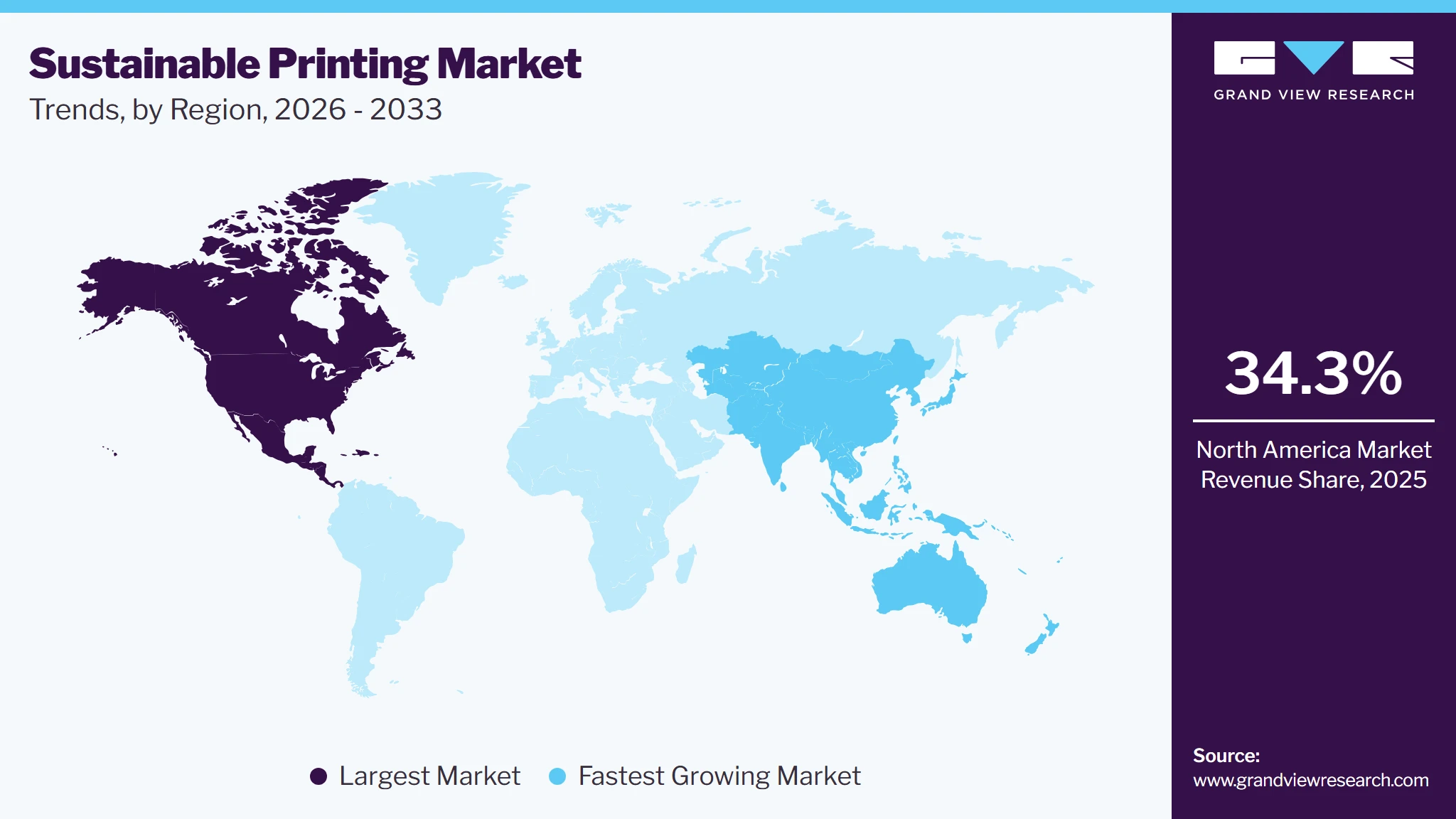
North America dominated the global sustainable printing market with the largest revenue share of 34.3% in 2025. North America has been at the forefront of the sustainable printing market driven by a robust regulatory framework and growing awareness among businesses and consumers. The region’s growth on sustainability is reflected in the increasing adoption of eco-friendly printing technologies, such as digital printing, which minimizes waste and reduces the use of harmful chemicals.
 To learn more about this report, Download Free Sample Report
U.S. Sustainable Printing Market Trends
The sustainable printing market in the U.S. held the largest share in the North America region in 2025. The growing trend towards the adoption of 3D printing technology, which reduces material wastage by using only the necessary amount of material to create products, making it a more sustainable option to traditional manufacturing processes. In addition, the rise of point-on-demand services has reduced the need for large print runs, further minimizing waste.
Asia Pacific Sustainable Printing Market Trends
The sustainable printing market in Asia Pacific is expected to grow at the highest CAGR of 10.9% from 2026 to 2033. This growth is driven by increasing industrialization, urbanization, and environmental awareness in the region. Furthermore, the rising demand for eco-friendly products in the region is pushing companies to innovate and invest in sustainable printing technologies.
Europe Sustainable Printing Market Trends
The sustainable printing market in Europe is expected to grow at a notable CAGR of 8.6% from 2026 to 2033. The rise of green certification, such as EU Ecolabel, has driven the adoption of sustainable printing practices across the region. Moreover, the increasing focus on corporate sustainability and the growing demand for eco-friendly products have further accelerated the shift towards sustainable printing in Europe.
Key Sustainable Printing Company Insights
Some of the key companies operating in the sustainable printing market include Ashley House Printing Company, HP Development Company, L.P., Bambra Press Pty Ltd, Bluetree Print Limited T/A, Greenerprinter, Impress Print Services, Instantprint, Kornit Digital, Xerox Corporation, Stora Enso, and Sustainable Printing Co.
-
Xerox Corporation, the U.S. based company engaged in providing digital document products, printers, and services. The company designs energy efficient products to minimize the environmental impact of its printing solutions. One of the company’s innovations that contribute to sustainable printing is its solid ink technology, which generates less waste compared to traditional toner cartridges.
Greenerprinter, Instantprint, and Kornit Digital are some of the emerging companies in the target market.
-
Greenerprinter, a printing service provider in the U.S. engaged in providing booklets, hang tags, calendars, cards & invitations, card decks, and brochures, among others. The company uses recycled paper and soy-based inks, which significantly reduce the environmental impact of their printing processes.
Key Sustainable Printing Companies:
The following key companies have been profiled for this study on the sustainable printing market.
- Ashley House Printing Company
- Bambra Press Pty Ltd
- Bluetree Print Limited T/A
- Greenerprinter
- Impress Print Services
- Instantprint
- Kornit Digital
- Stora Enso
- Sustainable Printing Co.
- Xerox Corporation
- HP Development Company, L.P.
Competitive Benchmarking
Category
Operating Strategies
Competitive Edge
Weakness
Established Players (Xerox Corporation, Stora Enso, Kornit Digital)
- These players are focused on investing in energy-efficient printing technologies, certified materials, and global sustainability programs
- These players have strong R&D capabilities, global reach, and established sustainability credentials.
- Higher cost base and slower customization for small-volume clients
Emerging Players (Ashley House Printing Company, Bambra Press Pty Ltd, Bluetree Print Limited T/A, Greenerprinter)
- These players are focused on localized sustainable printing, carbon-neutral operations, and eco-certifications.
- High customization, agility, and strong sustainability branding
- Limited geographic reach and lower economies of scale
Recent Developments
-
In May 2024, HP Development Company, L.P. and Canva, a graphic design company announced a partnership to provide unique design-to-print services for Canava’s users. The partnership aims to deliver sustainable printing experience to customers across the globe with localized printing options.
-
In May 2024, ColorJet India Limited in collaboration with Kromodyne Digital Solutions (KDS) Pvt. Ltd. launched Polo Earth, a sustainable printing solution at Media Expo in Mumbai, India. The company’s product is an initiation towards the respond for the growing demand for greener practices across the globe.
Sustainable Printing Market Report Scope
Report Attribute
Details
Market size in 2025
USD 2.3 billion
Estimated market size in 2026
USD 2.4 billion
Projected market size by 2040
USD 4.5 billion
Growth rate
CAGR of 9.0% from 2026 to 2040
Base year for estimation
2025
Historical data
2021 - 2024
Forecast period
2026 - 2040
Quantitative units
Revenue in USD billion and CAGR from 2026 to 2040
Report coverage
Revenue forecast, company market share, competitive landscape, growth factors, and trends
Segments covered
Type, enterprise size, region
Regional scope
North America; Europe; Asia Pacific; Latin America; MEA
Country scope
U.S.; Canada; Mexico; Germany; U.K.; France; China; Japan; India; South Korea; Australia; Brazil; Saudi Arabia; UAE; and South Africa
Key companies profiled
Ashley House Printing Company; Bambra Press Pty Ltd; Bluetree Print Limited T/A; Xerox Corporation; Greenerprinter; Impress Print Services; Instantprint; Kornit Digital; Stora Enso; Sustainable Printing Co.
Customization scope
Free report customization (equivalent up to 8 analysts' working days) with purchase. Addition or alteration to country, regional & segment scope.
Pricing and purchase options
Avail customized purchase options to meet your exact research needs. Explore purchase options
Global Sustainable Printing Market Report Segmentation
This report forecasts revenue growth at global, regional, and country levels and provides an analysis of the latest industry trends in each of the sub-segments from 2021 to 2033. For this study, Grand View Research has segmented the global sustainable printing market report based on type, enterprise size, and region.
 To learn more about this report, Download Free Sample Report
-
Type Outlook (Revenue, USD Million, 2021 - 2033)
-
Stationery
-
Flyers/Brochures
-
Booklets
-
Business Cards
-
Others
-
-
Enterprise Size Outlook (Revenue, USD Million, 2021 - 2033)
-
Large Enterprises
-
Small & Medium Enterprises
-
-
Regional Outlook (Revenue, USD Million, 2021 - 2033)
-
North America
-
U.S.
-
Canada
-
Mexico
-
-
Europe
-
UK
-
Germany
-
France
-
-
Asia Pacific
-
India
-
China
-
Japan
-
South Korea
-
Australia
-
-
Latin America
-
Brazil
-
-
Middle East and Africa (MEA)
-
Kingdom of Saudi Arabia (KSA)
-
UAE
-
South Africa
-
-
Research Methodology
The sustainable printing market figures in this report are based on a proven research process that combines executive interviews with secondary research from proprietary databases, company filings, and recognized regulatory and institutional sources. Market size is built through value-chain sizing - reconciling supply-side and demand-side estimates - and triangulated with bottom-up and top-down approaches. Every estimate passes multiple levels of expert validation before publication, with each sustainable printing segment quantified using the revenue-capture definitions in the table below.
Segment Definition
Segment - Type
Revenue capture definition
Stationery
Stationary type segment generates revenue from the production of eco-friendly letterheads, envelopes, notepads, and office stationery using recycled paper, certified substrates, and low impact inks.
Flyers/Brochures
Flyers/Brochures type segment generates revenue from short- and mid-run marketing flyers and brochures produced using sustainable paper stocks, water based inks, and energy efficient printing processes.
Booklets
Booklets type segment generates revenue from the printing of catalogs, manuals, and informational booklets emphasizing recycled materials, reduced ink coverage, and environmentally certified production
Business Cards
Business cards type segment generates revenue from premium and standard business cards produced using recycled, biodegradable, or seed-based paper with low-emission printing techniques
Others
Others type segment generate revenue from sustainable printing of posters, packaging inserts, labels, and customized promotional materials adhering to environmental compliance standards
Segment - Enterprise Size
Revenue capture definition
Large Enterprises
Large enterprises are organizations with high-volume print requirements, centralized procurement, and mandatory ESG compliance, generating recurring revenue through long-term, sustainable print contracts.
Small & Medium Enterprises
Small and medium enterprises (SMEs) have moderate printing volumes and adopt sustainable printing selectively for branding, compliance, and customer perception benefits.
Estimation Model
Layer Name
Key Question
Description
Macro Environmental Drivers
What macro factors are driving sustainable printing adoption?
This layer evaluates regulatory frameworks, corporate ESG mandates, and environmental awareness influencing print procurement decisions. It establishes baseline demand for drivers linked to sustainability compliance.
Technology & Material Adoption
Which technologies enable sustainable printing?
Assesses penetration of recycled substrates, eco-inks, digital presses, and energy-efficient equipment. Focuses on cost-performance improvements enabling scalability.
Application & End-User Demand
Where is sustainable printing revenue generated?
Analyzes demand across stationery, marketing collateral, publications, and enterprise segments. Identifies volume versus value-driven applications.
Vendor Monetization & Pricing
How do vendors capture value sustainably?
Examines pricing premiums, service bundling, certifications, and long-term contracts. Evaluates revenue sustainability across different print categories.
Delivered Customizations
This report has been delivered with the following In-depth customizations
Client Request
Customization Delivered
Value Adds
Regional Sustainable Printing Market Opportunity Assessment
Country/region-wise market sizing and forecasts
Analysis of demand, adoption trends, and regulatory landscape
Identification of high-growth regions and investment hotspots
Identified region-specific growth opportunities
Supported expansion and go-to-market strategy
Enabled informed regional investment decisions
Cross-Segmentation Analysis for the Sustainable Printing Market
Criss-cross market analysis by type, enterprise size
Demand and adoption assessment across key segments
Segment attractiveness and growth potential benchmarking
Identified high-potential market segments
Supported targeted product positioning and marketing strategy
Improved customer and segment prioritization
Competitive Benchmarking and Strategic Positioning in the Sustainable Printing Market
Benchmarking of key competitors across products, pricing, partnerships, and innovation
Comparative assessment of market share, capabilities, and strategies
Analysis of competitive strengths, gaps, and differentiation areas
Identified competitive white spaces and growth gaps
Supported strategic positioning and differentiation
Enabled data-driven competitive strategy development
Frequently Asked Questions About This Report
North America dominated the global market with the largest revenue share of 34.3% in 2025. North America has been at the forefront of the sustainable printing market driven by a robust regulatory framework and growing awareness among businesses and consumers.
Asia-Pacific is the fastest-growing region over the forecast period.
Large Enterprises segment held the largest market share of 69.3% in 2025, while small & medium enterprises is the fastest growing area.
The U.S. held the largest market share in 2025.
The global sustainable printing market size was valued at USD 2.3 billion in 2025 and is expected to reach USD 2.4 billion in 2026.
The global sustainable printing market is expected to grow at a compound annual growth rate of 9.0% from 2026 to 2033, reaching USD 4.5 billion by 2033.
The stationery segment dominated the market, with a revenue share of 25.0% in 2025.
Some of the companies operating in the sustainable printing market include Ashley House Printing Company, HP Development Company, L.P., Bambra Press Pty Ltd, Bluetree Print Limited T/A, Greenerprinter, Impress Print Services, Instantprint, Kornit Digital, Xerox Corporation, Stora Enso, and Sustainable Printing Co.
Growing awareness of environmental issues among consumers is a major factor driving the demand for sustainable printing.
About the Author(s)
Next Generation Technologies Research Team
Technology · Next Generation TechnologiesThis report was authored by the next generation technologies research team at Grand View Research - comprising two research analysts, one senior research analyst, and one industry expert - with specialized expertise in the next generation technologies segment of the technology industry. All findings are based on proprietary technology databases, executive interviews, and regulatory analysis, subject to internal peer review prior to publication.
Last Updated:
Speak to Analyst

Customize this report to your needs - add regions, segments, or data points, with 20% free customization.
Or view our licence options:


ISO 9001:2015 & 27001:2022 Certified
We are GDPR and CCPA compliant! Your transaction & personal information is safe and secure. For more details, please read our privacy policy.


