
- Home
- »
- Next Generation Technologies
- »
-
Swarm Drone Market Size And Share Report, 2026-2033GVR Report cover
![Swarm Drone Market (2026 - 2033)Report]()
Swarm Drone Market (2026 - 2033)
Size, Share & Trends Analysis Report By Component (Hardware, Software, Services), By Platform (Fixed-Wing, Rotary-Wing, Hybrid VTOL), By Technology(Semi-Autonomous, Fully Autonomous), By Application, By End-use, By Region, And Segment Forecasts
Market Size, 2025
$1.0BMarket Estimate, 2026
$1.2BMarket Forecast, 2033
$3.9BCAGR, 2026–2033
18.4%Swarm Drone Market Summary
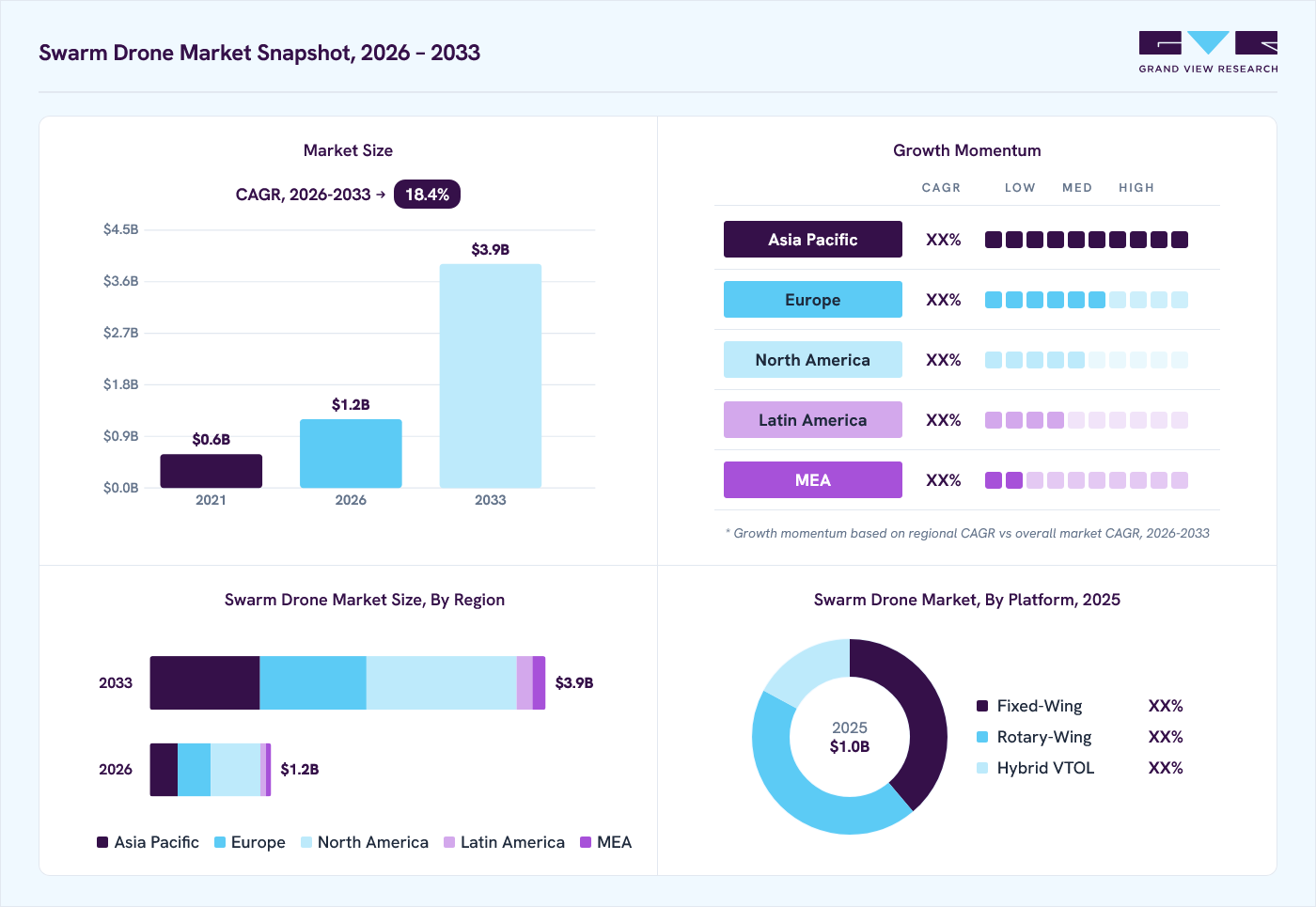
The global swarm drone market size was valued at USD 1.0 billion in 2025 and is projected to grow from USD 1.2 billion in 2026 to USD 3.9 billion by 2033, at a CAGR of 18.4% from 2026 to 2033. North America dominated the global market with the largest revenue share of 41.2% in 2025. The market growth is driven by the increasing adoption of AI-enabled autonomous swarm intelligence, the rising investments in defense modernization and collaborative unmanned aerial systems, and the growing demand for coordinated drone operations across surveillance, reconnaissance, disaster response, and precision agriculture.
Key Market Trends & Insights
- By component: Hardware segment held the largest revenue share of 60.4% in 2025.
- By platform: Rotary-wing segment held the largest revenue share of 44.0% in 2025.
- By technology: Semi-autonomous segment held the largest share of 56.7% in 2025.
- By application: Intelligence, surveillance & reconnaissance (ISR) segment held the largest share of 34.8% in 2025.
- By end use: Defense and military segment held the largest share of 60.3% in 2025.
Regional Highlights
- Largest regional market: North America (41.2% revenue share in 2025)
- Fastest growing regional market: Asia Pacific (highest CAGR 21.6%, 2026-2033)
- By Country: The U.S. held the largest market share of North America in 2025.
Market Size & Forecast
- Market size in 2025: USD 1.0 Billion
- Estimated market size in 2026: USD 1.2 Billion
- Projected market size by 2033: USD 3.9 Billion
- CAGR (2026-2033): 18.4%
The market growth is driven by the increasing adoption of AI-enabled autonomous swarm intelligence, the rising investments in defense modernization and collaborative unmanned aerial systems, and the growing demand for coordinated drone operations across surveillance, reconnaissance, disaster response, and precision agriculture. The growth of the swarm drone market is driven by the increasing investments in autonomous defense systems, the rising adoption of AI-enabled swarm intelligence technologies, and the growing demand for coordinated multi-drone operations across military and commercial applications. The adoption of advanced communication networks, edge computing, and decentralized control architectures is accelerating as organizations seek scalable, resilient, and cost-effective autonomous aerial systems capable of real-time collaboration in surveillance, reconnaissance, disaster response, infrastructure inspection, and border security missions.
The increasing focus on autonomous military operations, the growing need for coordinated unmanned aerial missions, and the rising investments in next-generation defense modernization programs are accelerating the demand for swarm drone technologies. Defense agencies are increasingly deploying AI-enabled drone swarms to enhance intelligence, surveillance, reconnaissance (ISR), border security, and tactical combat operations while minimizing risks to personnel. The ability of swarm drones to operate collaboratively, adapt to dynamic environments, and execute complex missions with high operational efficiency is significantly strengthening their adoption across modern defense ecosystems.
Additionally, the rapid advancement of artificial intelligence, edge computing, and decentralized communication technologies is driving innovation across the swarm drone market. Manufacturers and technology providers are integrating machine learning algorithms, autonomous navigation, swarm intelligence, real-time data sharing, and obstacle avoidance capabilities to improve mission coordination and decision-making. These technological advancements enable multiple drones to function as a unified system without constant human intervention, improving operational resilience, scalability, and mission success across defense, public safety, industrial inspection, and environmental monitoring applications.
Moreover, the expanding adoption of swarm drones in commercial and civil applications is significantly contributing to market growth. Industries are increasingly utilizing coordinated drone fleets for precision agriculture, infrastructure inspection, disaster response, mining operations, environmental monitoring, and logistics support to improve operational efficiency and reduce deployment costs. The growing availability of high-speed wireless communication, advanced sensors, and cloud-based fleet management platforms is enabling organizations to deploy autonomous drone swarms for large-scale operations, creating new opportunities for intelligent aerial automation across diverse commercial sectors.
Market Dynamics
The swarm drone market is witnessing significant growth, driven by the increasing emphasis on collaborative autonomous aerial operations, the rising deployment of unmanned systems for border surveillance and critical infrastructure protection, and the growing demand for cost-effective force multiplication in defense missions. Expanding investments in swarm intelligence algorithms, secure drone-to-drone communication networks, and autonomous mission planning platforms are accelerating market adoption. The integration of distributed decision-making, real-time target tracking, adaptive flight coordination, and multi-domain operational capabilities enhances mission effectiveness, operational flexibility, situational awareness, and resource optimization, creating substantial long-term growth opportunities for the global market.
The growing focus on defense modernization is encouraging military organizations to adopt autonomous swarm drone technologies capable of executing complex missions with greater coordination and operational efficiency. Governments are allocating larger budgets toward next-generation unmanned systems that improve intelligence gathering, surveillance, reconnaissance, electronic warfare, and precision targeting. These investments are supporting the transition from single-drone operations to collaborative multi-drone missions that enhance mission flexibility while reducing operational risks.
Advancements in artificial intelligence, secure communication protocols, distributed mission planning, and autonomous decision-making are further strengthening the deployment of swarm drone systems across defense forces. Modern swarm platforms enable coordinated navigation, dynamic task allocation, and resilient operations even in contested environments where conventional communication may be disrupted. As armed forces continue to prioritize autonomous capabilities for future combat scenarios, demand for sophisticated swarm-drone solutions is expected to grow across defense programs.
Managing multiple autonomous drones simultaneously requires highly sophisticated command architectures capable of maintaining secure communication, synchronized navigation, and real-time decision-making throughout a mission. Maintaining coordination becomes increasingly challenging in environments affected by electronic interference, communication latency, signal loss, or rapidly changing battlefield conditions. These technical complexities often increase development timelines, operational testing requirements, and system integration efforts before large-scale deployment becomes feasible.
The absence of standardized communication protocols and interoperability frameworks further complicates the integration of swarm drones with existing defense platforms and command systems. Organizations must invest significant resources in cybersecurity, software validation, autonomous behavior verification, and mission safety assessments before operational deployment. These implementation challenges increase procurement complexity and slow the widespread adoption of swarm drone systems across both military and commercial organizations.
The expanding use of autonomous drone swarms across civil sectors is creating significant opportunities beyond traditional defense applications. Public agencies and commercial organizations are increasingly evaluating coordinated drone fleets for disaster response, wildfire monitoring, environmental assessment, infrastructure inspection, maritime surveillance, and precision agriculture. Swarm operations enable faster coverage of large geographic areas while improving operational efficiency through synchronized aerial coordination.
Continuous improvements in edge computing, high-speed wireless connectivity, satellite navigation, and intelligent fleet management platforms are enabling the reliable deployment of swarm drones in complex civilian environments. Organizations are exploring autonomous multi-drone systems to reduce operational costs, improve data collection accuracy, and minimize human exposure in hazardous conditions. As regulatory frameworks gradually evolve to support beyond-visual-line-of-sight operations, commercial adoption of swarm drone technologies is expected to expand across multiple industries.
Market Concentration & Characteristics
The swarm drone market is moderately concentrated, comprising established defense contractors, aerospace manufacturers, autonomous drone developers, artificial intelligence solution providers, and emerging robotics startups competing across military and commercial applications. The market is experiencing strong momentum due to increasing investments in defense modernization, rising procurement of autonomous unmanned systems, and expanding adoption of coordinated multi-drone operations for surveillance, reconnaissance, border security, and critical infrastructure monitoring. Strategic collaborations, government-funded development programs, technology licensing agreements, and product innovation initiatives are enabling companies to strengthen autonomous capabilities and expand their global market presence.
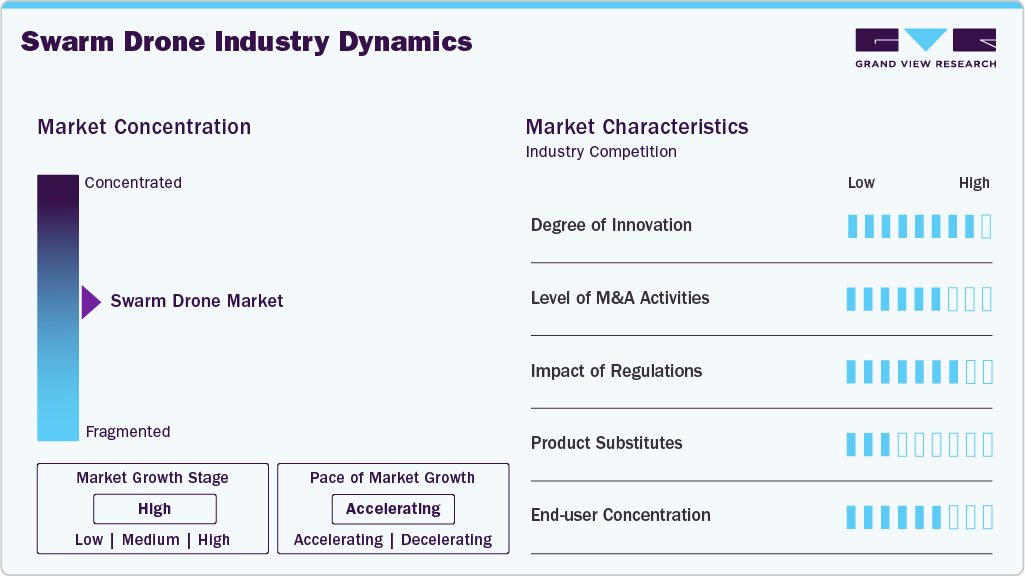
The market is characterized by a high degree of innovation, supported by continuous advancements in swarm intelligence algorithms, autonomous navigation, edge computing, secure mesh communication, and real-time mission coordination technologies. The industry is witnessing moderate merger and acquisition activity as leading defense companies and technology providers strengthen their autonomous systems portfolios through acquisitions and strategic partnerships. Competition from conventional unmanned aerial vehicles, manned surveillance assets, and other autonomous robotic platforms remains moderate, while increasing investments in intelligent fleet management and commercial drone automation continue to enhance technological differentiation and competitive positioning.
Analyst Perspective
The swarm drone market is experiencing strong momentum, driven by increasing adoption of autonomous unmanned systems, rising investment in AI-enabled defense technologies, and growing demand for coordinated multi-drone operations across military and commercial applications. Advancements in swarm intelligence, secure communication networks, real-time data processing, and autonomous mission planning are significantly improving operational efficiency, scalability, and mission effectiveness. As adoption expands, market participants are focusing on AI-driven innovation, interoperable platforms, and autonomous mission capabilities to strengthen operational performance across defense, public safety, industrial, and commercial applications.
Component Insights
The hardware segment accounted for the largest market share of 60.4% in 2025, propelled by increasing procurement of unmanned aerial platforms, advanced sensors, navigation systems, and mission-specific payloads for defense and commercial applications. Organizations are investing in high-performance airframes, propulsion systems, electro-optical cameras, and secure communication hardware to improve mission endurance, operational reliability, and swarm coordination capabilities. Continued modernization of unmanned aerial systems is reinforcing the hardware segment's leadership in the global swarm drone industry.
The software segment is expected to witness the highest CAGR of over 21% from 2026 to 2033. The segment is driven by rapid advancements in autonomous swarm intelligence algorithms, mission-planning platforms, and real-time fleet-management solutions. Defense organizations and commercial operators are increasingly deploying AI-enabled software for coordinated flight control, autonomous navigation, distributed decision-making, and predictive mission analytics to enhance operational efficiency. This trend is expected to accelerate the adoption of intelligent swarm management software across diverse mission environments.
Technology Insights
The semi-autonomous segment accounted for the largest market share of 56.7% in 2025, driven by widespread defense adoption of operator-assisted drone missions, increasing demand for reliable human-in-the-loop decision-making, and growing deployment across border surveillance and public safety operations. Semi-autonomous swarm drones enable coordinated flight, automated navigation, and collaborative mission execution while allowing operators to retain command over critical tactical decisions. Their proven operational reliability and compliance with current regulatory frameworks continue to strengthen adoption of the semi-autonomous segment in the market.
The fully autonomous segment is expected to witness the highest CAGR from 2026 to 2033, driven by rapid advancements in artificial intelligence, distributed swarm intelligence algorithms, and autonomous mission planning technologies. Defense organizations and commercial operators are increasingly investing in self-coordinating drone swarms capable of dynamic route optimization, obstacle avoidance, adaptive target tracking, and decentralized decision-making with minimal human intervention. This technological evolution is expected to accelerate the deployment of next-generation autonomous swarm drone systems across the swarm drone industry.
Application Insights
The intelligence, surveillance & reconnaissance (ISR) segment accounted for the largest market share of 34.8% in 2025, fueled by increasing investments in autonomous surveillance capabilities, rising demand for persistent real-time battlefield intelligence, and the growing deployment of AI-enabled multi-drone coordination systems. Swarm drones equipped with advanced electro-optical sensors, thermal imaging payloads, and autonomous mission planning capabilities, enhancing situational awareness, target tracking, and operational decision-making. These advancements continue to strengthen the ISR segment's leadership across the swarm drone industry.
The precision agriculture segment is expected to witness the highest CAGR from 2026 to 2033, driven by the increasing adoption of swarm drones for coordinated crop monitoring, precision spraying, soil analysis, and field mapping. Farming enterprises are investing in AI-enabled multi-drone systems capable of autonomous route optimization, real-time data collection, and synchronized aerial operations to improve productivity, reduce resource consumption, and support data-driven farm management. This trend is expected to accelerate commercial adoption across the swarm drone market.
End-use Insights
The defense and military segment accounted for the largest market share of 60.3% in 2025, propelled by rising investments in autonomous combat systems, increasing deployment of coordinated unmanned aerial operations, and growing demand for AI-enabled surveillance and electronic warfare capabilities. Defense organizations are increasingly procuring swarm drones equipped with autonomous navigation, secure communication networks, and collaborative target engagement technologies to improve operational effectiveness and support complex missions. These developments continue to reinforce the dominance of the defense and military segment in the market.
The agriculture sector segment is expected to witness the highest CAGR from 2026 to 2033. This growth is driven by the increasing adoption of swarm drones for precision crop monitoring, variable-rate spraying, field mapping, and real-time agricultural data collection. Farming enterprises are increasingly deploying AI-enabled multi-drone systems to improve input efficiency, optimize resource utilization, reduce operational costs, and enhance crop productivity across large cultivation areas. This accelerating adoption is expected to strengthen the deployment of swarm drone technologies in the market.
Platform Insights
The rotary-wing segment accounted for the largest market share of 44.0% in 2025, fueled by increasing deployment in tactical military missions, rising demand for vertical takeoff and landing capabilities, and growing adoption across intelligence, surveillance, reconnaissance, and search & rescue operations. Rotary-wing swarm drones provide superior maneuverability, hovering capability, and precise navigation in complex environments, enabling coordinated multi-drone missions in confined, challenging terrain. These operational advantages continue to reinforce the segment's leadership in the swarm drone market.
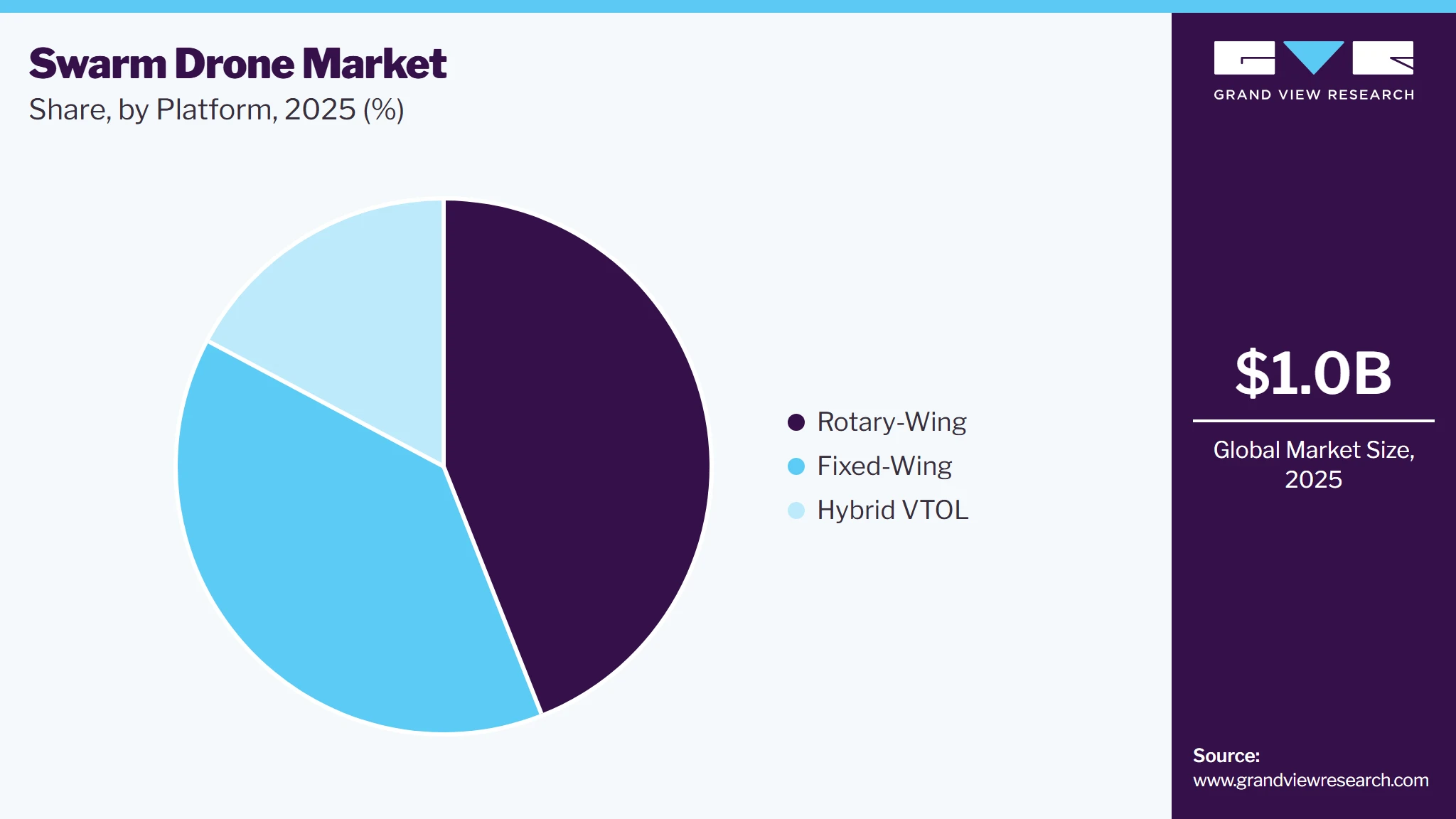
The hybrid VTOL segment is expected to witness the highest CAGR from 2026 to 2033, driven by increasing demand for long-endurance autonomous missions, expanding deployment across border surveillance and infrastructure inspection, and continuous advancements in hybrid propulsion technologies. Organizations are increasingly investing in hybrid VTOL swarm drones that combine vertical takeoff capability with efficient fixed-wing flight to improve operational flexibility, mission range, and payload efficiency. These advancements are reinforcing the role of hybrid VTOL platforms in missions that require efficient transitions between hovering and fixed-wing flight.
Regional Insights
North America swarm drone market held the largest share of 41.2% in 2025, driven by rising defense modernization initiatives, increasing procurement of autonomous unmanned aerial systems, and strong investments in artificial intelligence-enabled battlefield technologies. The region is witnessing growing deployment of collaborative drone swarms for intelligence, surveillance, reconnaissance (ISR), border security, and critical infrastructure protection. Continuous advancements in autonomous mission planning, secure mesh communication, electronic warfare capabilities, and defense-focused research programs are accelerating the adoption of swarm drone technologies across North America.

U.S. Swarm Drone Market Trends
The U.S. swarm drone market dominated, with a share of 87.7% in 2025, driven by substantial Department of Defense investments in autonomous combat systems, the strong presence of leading defense technology companies, and increasing development of next-generation collaborative unmanned platforms. Military agencies are expanding the deployment of AI-enabled swarm drones for tactical reconnaissance, force protection, electronic warfare, and precision strike missions. Continuous innovation in autonomous flight control, distributed decision-making, resilient communication systems, and multi-domain operations is supporting sustained market expansion across the country.
Europe Swarm Drone Market Trends
Europe swarm drone market is expected to grow at a significant CAGR of 18.2% from 2026 to 2033. The market growth is driven by increasing investments in collaborative European defense programs, a rising emphasis on border surveillance capabilities, and a growing demand for autonomous security technologies. The region is witnessing broader adoption of intelligent drone swarms for maritime monitoring, emergency response, environmental observation, and critical infrastructure inspection. Expanding investments in AI-based autonomy, secure communication networks, and cross-border defense collaboration are strengthening the deployment of advanced swarm drone systems across Europe.
The UK swarm drone market is expected to grow significantly in the coming years, driven by increasing defense innovation funding, expanding military autonomy programs, and rising development of next-generation unmanned combat capabilities. Defense organizations are focusing on integrating swarm drones with battlefield intelligence systems, electronic warfare platforms, and advanced command-and-control networks to improve operational effectiveness. Growing investments in autonomous mission software, secure communications, rapid technology testing, and collaborative defense research are encouraging wider deployment of swarm drone solutions throughout the country.
The Germany swarm drone market is supported by the country's strong aerospace engineering capabilities, increasing investment in autonomous defense technologies, and growing focus on intelligent robotics development. Government agencies and industrial organizations are evaluating coordinated drone systems for defense applications, infrastructure inspection, disaster management, and environmental monitoring. Rising investments in artificial intelligence research, autonomous navigation technologies, secure wireless communication, and advanced sensor integration are strengthening the country's position in the development and deployment of swarm drone solutions.
Asia Pacific Swarm Drone Market Trends
The Asia Pacific swarm drone market is expected to grow at the highest CAGR of 21.6% from 2026 to 2033, driven by increasing defense modernization across emerging economies, rising investments in indigenous unmanned aerial technologies, and expanding demand for autonomous surveillance capabilities. The region is witnessing strong adoption of drone swarms for border monitoring, maritime security, disaster response, and critical infrastructure protection. Growing investments in artificial intelligence, next-generation communication networks, domestic drone manufacturing, and autonomous systems development are significantly accelerating swarm drone deployment throughout Asia Pacific.
The Japan swarm drone market is gaining traction owing to increasing investments in autonomous disaster response technologies, growing adoption of intelligent robotics, and rising demand for advanced aerial inspection solutions. Government agencies and industrial enterprises are integrating swarm drones with artificial intelligence, precision navigation systems, and real-time environmental monitoring platforms to improve operational efficiency. Expanding applications in disaster management, infrastructure maintenance, public safety, and industrial automation are supporting the increasing deployment of swarm drone technologies across Japan.
The China swarm drone market is expanding rapidly, driven by strong domestic drone manufacturing capabilities, increasing investments in autonomous military technologies, and rising deployment of intelligent unmanned systems across defense and commercial sectors. The country is witnessing growing implementation of coordinated drone swarms for border patrol, smart city surveillance, logistics operations, and industrial inspection. Continuous advancements in swarm intelligence algorithms, high-speed communication infrastructure, and domestic semiconductor technologies are accelerating the development and large-scale adoption of advanced swarm drone solutions across China.
Key Swarm Drone Company Insights
Some of the key players operating in the market are Lockheed Martin Corporation and Northrop Grumman, among others.
-
Lockheed Martin Corporation is a leading player in the swarm drone market, offering advanced autonomous unmanned systems, artificial intelligence-enabled mission software, and collaborative drone technologies for defense applications. The company is focused on developing next-generation swarm capabilities that enhance ISR, electronic warfare, and multi-domain operations. Its strong investments in autonomous systems, secure communication, defense modernization programs, and AI-driven mission planning continue to strengthen its leadership in the global swarm drone industry.
-
Northrop Grumman is a prominent player in the swarm drone industry, leveraging its expertise in autonomous systems, advanced sensors, command-and-control technologies, and network-centric warfare solutions. The company develops intelligent unmanned platforms capable of collaborative operations across air, land, and maritime domains while supporting complex military missions. Continuous investments in artificial intelligence, resilient autonomous architectures, and next-generation defense technologies are reinforcing Northrop Grumman's competitive position in the global swarm drone ecosystem.
AeroVironment, Inc. and Elbit Systems Ltd. are some of the emerging market participants in the swarm drone market.
-
AeroVironment, Inc. is an emerging player in the swarm drone market, specializing in tactical unmanned aircraft systems, loitering munitions, and autonomous multi-drone technologies for defense and security applications. The company is expanding its capabilities through investments in swarm intelligence, autonomous flight control, secure communications, and AI-enabled mission coordination. Its focus on lightweight, rapidly deployable drone solutions and advanced battlefield autonomy is strengthening its presence in the evolving swarm drone market.
-
Elbit Systems Ltd. is an emerging player in the swarm drone industry, providing autonomous unmanned aerial solutions, intelligent mission management software, and advanced defense electronics for military operations. The company is enhancing its swarm capabilities by integrating artificial intelligence, distributed decision-making, secure communication networks, and real-time battlefield intelligence into its drone platforms. Its emphasis on innovation, defense modernization, and integrated autonomous solutions is expanding its role in the global swarm drone market.
Key Swarm Drone Companies:
The following key companies have been profiled for this study on the swarm drone market
-
Lockheed Martin Corporation
-
Northrop Grumman
-
RTX Corporation
-
BAE Systems plc
-
Thales Group
-
Leonardo S.p.A.
-
Saab AB
-
Elbit Systems Ltd.
-
AeroVironment, Inc.
-
Rheinmetall AG
Competitive Benchmarking
Category
Operating Strategies
Competitive Edge
Weakness
Established Players (Lockheed Martin Corporation, Northrop Grumman, RTX Corporation)
- Focus on expanding autonomous swarm capabilities through AI, secure communication, and partnerships in defense technology.
- Invest heavily in R&D and defense programs to develop scalable, multi-drone mission-coordination platforms.
- A strong global defense presence, extensive procurement networks, and advanced expertise in autonomous systems strengthen market leadership.
- Ability to deliver secure, mission-critical swarm drone solutions for complex military and security operations.
- Dependence on lengthy defense procurement cycles can delay the commercialization of emerging swarm technologies.
- Large organizational structures may reduce agility compared to specialized autonomous drone technology developers.
Emerging Players (AeroVironment, Inc., Elbit Systems Ltd., Rheinmetall AG)
- Emerging players are focused on advancing AI-enabled swarm intelligence through autonomous software development and strategic defense collaborations.
- Invest in agile drone platforms that support tactical surveillance, reconnaissance, and decentralized multi-drone missions.
- Strong innovation capabilities enable rapid development of intelligent, mission-focused swarm drone technologies.
- Flexible product development enables customized, autonomous solutions to evolving defense and public safety requirements.
- Limited global manufacturing scale restricts participation in large-volume defense procurement programs.
- Smaller financial resources may constrain long-term R&D investments and international market expansion.
Recent Developments
-
In July 2026, Lockheed Martin Corporation entered into a partnership with Rheinmetall AG to strengthen defense manufacturing capabilities across Europe. The collaboration supports localized production of advanced defense systems while enhancing autonomous mission technologies and future collaborative unmanned operations. The partnership reflects the growing emphasis on strengthening autonomous defense ecosystems and accelerating the deployment of next-generation swarm-drone capabilities.
-
In June 2026, Rheinmetall AG entered a strategic partnership with ERC System and the State of North Rhine-Westphalia to support the industrialization of the Victor U250 heavy-lift drone. The initiative includes establishing production capabilities and supply chains for advanced autonomous drone platforms, strengthening Europe's unmanned aviation ecosystem. The partnership reinforces the growing investment in scalable drone technologies applicable to future swarm-based operations in the swarm drone industry.
-
In April 2025, Thales Group launched its AI-powered SwarmMaster solution to enable autonomous control of multiple drones during complex military missions. The platform integrates swarm intelligence, intelligent software agents, and supervised autonomy to improve coordination, mission adaptability, and real-time decision-making across collaborative drone operations. This launch highlights the growing adoption of AI-driven swarm management technologies in the swarm drone industry.
Swarm Drone Market Report Scope
Report Attribute
Details
Market size value in 2025
USD 1.0 billion
Market size value in 2026
USD 1.2 billion
Revenue forecast in 2033
USD 3.9 billion
Growth rate
CAGR of 18.4% from 2026 to 2033
Base year for estimation
2025
Historical data
2021-2024
Forecast period
2026- 2033
Quantitative units
Revenue in USD Million and CAGR from 2026 to 2033
Report Product
Revenue forecast, company ranking, competitive landscape, growth factors, and trends
Segments covered
Component, platform, technology, application, end use, region
Region scope
North America; Europe; Asia Pacific; Latin America; Middle East & Africa
Country scope
U.S.; Canada; Mexico; UK; Germany; France; China; Japan; India; South Korea; Australia; Brazil; Saudi Arabia; UAE; South Africa
Key companies profiled
Lockheed Martin Corporation; Northrop Grumman; RTX Corporation; BAE Systems plc; Thales Group; Leonardo S.p.A.; Saab AB; Elbit Systems Ltd.; AeroVironment, Inc.; Rheinmetall AG
Customization scope
Free report customization (equivalent to up to 8 analyst’s working days) with purchase. Addition or alteration to country, regional & segment scope.
Pricing and purchase options
Avail customized purchase options to meet you exact research needs. Explore purchase options
Global Swarm Drone Market Report Segmentation
This report forecasts revenue growth at global, regional, and country levels and provides an analysis of the latest technological trends in each of the sub-segments from 2021 to 2033. For this study, Grand View Research has segmented the global swarm drone market report based on component, platform, technology, application, end-use, and region:
-
Component Outlook (Revenue, USD Million, 2021 - 2033)
-
Hardware
-
Software
-
Services
-
-
Platform Outlook (Revenue, USD Million, 2021 - 2033)
-
Fixed-Wing
-
Rotary-Wing
-
Hybrid VTOL
-
-
Technology Outlook (Revenue, USD Million, 2021 - 2033)
-
Semi-Autonomous
-
Fully Autonomous
-
-
Application Outlook (Revenue, USD Million, 2021 - 2033)
-
Intelligence, Surveillance & Reconnaissance (ISR)
-
Search & Rescue
-
Border & Maritime Surveillance
-
Precision Agriculture
-
Environmental Monitoring
-
Others
-
-
End-use Outlook (Revenue, USD Million, 2021 - 2033)
-
Defense and Military
-
Agriculture Sector
-
Government Agencies
-
Others
-
-
Regional Outlook (Revenue, USD Million, 2021 - 2033)
-
North America
-
U.S.
-
Canada
-
-
Mexico
-
Europe
-
UK
-
Germany
-
France
-
-
Asia Pacific
-
China
-
Japan
-
India
-
South Korea
-
Australia
-
-
Latin America
-
Brazil
-
-
Middle East and Africa (MEA)
-
Saudi Arabia
-
UAE
-
South Africa
-
-
Research Methodology
The swarm drone market figures in this report are based on a proven research process that combines executive interviews with secondary research from proprietary databases, company filings, and recognized regulatory and institutional sources. Market size is built through value-chain sizing—reconciling supply-side and demand-side estimates—and triangulated with bottom-up and top-down approaches. Every estimate passes multiple levels of expert validation before publication, with each swarm drone segment quantified using the revenue-capture definitions in the table below.
Segment Definition
Segment - Component
Revenue capture definition
Hardware
Revenue is generated through physical components used to build, operate, and coordinate swarm drone systems for autonomous missions across defense and commercial applications. This segment is driven by increasing procurement of advanced drone platforms and mission-critical equipment.
Software
Revenue is generated through swarm-intelligence platforms, mission-planning software, AI-based navigation, autonomous flight management, and fleet-coordination solutions. This segment is supported by the growing adoption of artificial intelligence and autonomous decision-making technologies.
Services
Revenue is captured through integration, maintenance, consulting, operator training, and technical support services for swarm drone deployments. This segment benefits from increasing system complexity and the growing need for lifecycle support.
Segment - Platform
Revenue capture definition
Fixed-Wing
Revenue is generated through fixed-wing swarm drones deployed for long-range surveillance, reconnaissance, mapping, and border monitoring missions. This segment benefits from extended flight endurance and wide-area operational coverage.
Rotary-Wing
Revenue is generated through rotary-wing swarm drones supporting vertical takeoff, hovering, close-range surveillance, inspection, and tactical operations. This segment is driven by demand for maneuverability in complex operating environments.
Hybrid VTOL
Revenue is generated by hybrid VTOL swarm drones that combine vertical takeoff capability with efficient fixed-wing flight for multi-mission operations. This segment is gaining adoption for flexible deployment across diverse mission profiles.
Segment - Technology
Revenue capture definition
Semi-Autonomous
Revenue is generated by swarm drone systems that perform predefined tasks under operator supervision during mission execution. This segment continues to dominate applications requiring human oversight and regulatory compliance.
Fully Autonomous
Revenue is generated through AI-enabled swarm drone systems capable of independently coordinating navigation, communication, and mission execution with minimal human intervention. This segment is expanding as autonomous swarm intelligence advances.
Segment - Application
Revenue capture definition
Intelligence, Surveillance &
Reconnaissance (ISR)Revenue is generated through swarm drones deployed for intelligence gathering, persistent surveillance, reconnaissance, and real-time situational awareness across defense and security operations. This segment represents the largest share of market demand.
Search & Rescue
Revenue is captured through swarm drone solutions used to locate missing persons, assess emergency situations, and support disaster response operations. This segment benefits from rapid deployment and coordinated aerial coverage.
Border & Maritime Surveillance
Revenue is generated through swarm drone systems monitoring land borders, coastlines, maritime zones, and critical infrastructure to enhance security and threat detection. This segment is driven by increasing homeland security investments.
Precision Agriculture
Revenue is generated through swarm drones supporting crop monitoring, precision spraying, field mapping, and agricultural data collection. This segment is expanding with the increasing adoption of smart farming technologies.
Environmental Monitoring
Revenue is captured through swarm drones used for wildlife observation, pollution assessment, forest monitoring, and environmental data collection. This segment benefits from growing sustainability and conservation initiatives.
Others
Revenue is generated through swarm drone applications including infrastructure inspection, industrial monitoring, scientific research, mapping, telecommunications, and public safety operations. This segment continues to expand with emerging commercial use cases.
Segment - End Use
Revenue capture definition
Defense and Military
Revenue is generated through swarm drone deployments supporting combat operations, tactical missions, surveillance, reconnaissance, electronic warfare, and force protection. This segment accounts for the largest share owing to rising global defense modernization programs.
Agriculture Sector
Revenue is captured through swarm drone solutions deployed for crop health monitoring, spraying, precision farming, and agricultural resource optimization. This segment is supported by increasing investments in digital agriculture technologies.
Government Agencies
Revenue is generated through swarm drones used by government organizations for border security, disaster management, law enforcement, environmental monitoring, and public safety operations. This segment is driven by expanding public-sector drone adoption.
Others
Revenue is generated through swarm drone deployments across energy, utilities, mining, construction, logistics, telecommunications, research institutions, and commercial enterprises. This segment benefits from the expanding adoption of autonomous aerial solutions across industries.
Estimation Model
Layer Name
Key Question
Description
End-User Adoption Layer
Who are the potential adopters?
Identifies organizations adopting swarm drone technologies, including defense and military forces, homeland security agencies, border protection authorities, government organizations, agricultural enterprises, energy and utility operators, emergency response teams, research institutions, and commercial enterprises seeking autonomous multi-drone capabilities for operations, surveillance, inspection, and monitoring.
Technology Enablement Layer
Who can deploy swarm drone technologies?
Deployment depends on drone manufacturers, AI and swarm-intelligence software developers, navigation and communication technology providers, sensor and payload manufacturers, systems integrators, cloud computing providers, and defense technology partners, all of which enable coordinated autonomous swarm operations.
Mission Deployment Layer
Where are swarm drone technologies currently being used?
Swarm drone technologies are deployed across defense operations, border surveillance, maritime security, disaster response, precision agriculture, environmental monitoring, infrastructure inspection, logistics, and scientific research to execute coordinated autonomous aerial missions with enhanced operational efficiency.
Revenue Generation Layer
How is revenue generated?
Revenue is generated through drone hardware sales, swarm intelligence software licensing, AI-enabled mission management platforms, sensor and payload integration, maintenance contracts, operator training, technical support, and long-term software and fleet management subscriptions.
Delivered Customizations
This report has been delivered with the following In-depth customizations
Client Request
Customization Delivered
Value Adds
Autonomous Swarm Coordination Assessment & Mission Optimization
Conducted detailed assessment of AI-enabled swarm coordination technologies, autonomous mission planning platforms, distributed decision-making algorithms, secure communication networks, and collaborative flight control architectures to evaluate mission efficiency, scalability, and operational reliability across defense and commercial deployments.
Improves mission coordination, enhances autonomous operations, strengthens reliability, supports scalable deployments, and increases operational efficiency.
Multi-Domain Swarm Drone Deployment & Interoperability Strategy
Evaluated swarm drone deployment across land, maritime, and aerial operations, integrating interoperable communication protocols, edge computing platforms, sensor fusion technologies, and real-time command systems to improve synchronized mission execution and operational flexibility.
Enhances multi-domain interoperability, improves situational awareness, increases mission flexibility, supports coordinated operations, and strengthens operational readiness.
AI-Driven Swarm Intelligence & Payload Integration Analysis
Assessed implementation of artificial intelligence-based swarm intelligence software, adaptive navigation algorithms, intelligent payload integration, real-time data processing, and autonomous target recognition capabilities to improve mission effectiveness, decision-making accuracy, and coordinated drone performance.
Enhances autonomous intelligence, improves mission accuracy, supports advanced payload integration, increases responsiveness, and optimizes operational performance.
Frequently Asked Questions About This Report
The global swarm drones market size was valued at USD 1.0 billion in 2025 and is estimated at USD 1.2 billion for 2026.
North America dominated with a revenue share of 41.2% in 2025.
Key factors that are driving market growth include the increasing adoption of AI-enabled autonomous swarm intelligence, the rising investments in defense modernization and collaborative unmanned aerial systems, and the growing demand for coordinated drone operations across surveillance, reconnaissance, disaster response, and precision agriculture.
The key players in the swarm drone market include Lockheed Martin Corporation, Northrop Grumman, RTX Corporation, BAE Systems plc, Thales Group, Leonardo S.p.A., Saab AB, Elbit Systems Ltd., AeroVironment, Inc., Rheinmetall AG
The hardware segment dominated with a 60.4% revenue share in 2025.
The rotary-wing segment dominated the market with a share of 44.0% in 2025.
The defense and military segment accounted for the largest share, with 60.3% of revenue in 2025.
The global swarm drone market expected to grow at a CAGR of 18.4% from 2026 to 2033, reaching USD 3.9 billion by 2033.
The Asia Pacific is the fastest-growing region with a CAGR of over 21.6% from 2026 to 2033.
About the Author(s)
Next Generation Technologies Research Team
Technology · Next Generation TechnologiesThis report was authored by the next generation technologies research team at Grand View Research - comprising two research analysts, one senior research analyst, and one industry expert - with specialized expertise in the next generation technologies segment of the technology industry. All findings are based on proprietary technology databases, executive interviews, and regulatory analysis, subject to internal peer review prior to publication.
Last Updated:
Speak to Analyst


Customize this report to your needs — add regions, segments, or data points, with 20% free customization.
Or view our licence options:


ISO 9001:2015 & 27001:2022 Certified
We are GDPR and CCPA compliant! Your transaction & personal information is safe and secure. For more details, please read our privacy policy.


