
- Home
- »
- Advanced Interior Materials
- »
-
Synthetic Diamond Market Size & Share Report, 2026-2033GVR Report cover

Synthetic Diamond Market (2026 - 2033)
Size, Share & Trends Analysis Report By Color (Colored, Colorless), By End-use (Jewelry & Fashion, Industrial), By Region (North America, Europe, Asia Pacific, Latin America, Middle East & Africa), And Segment Forecasts
Market Size, 2025
$12.1BMarket Estimate, 2026
$12.6BMarket Forecast, 2033
$16.3BCAGR, 2026–2033
3.8%Synthetic Diamond Market Summary
The global synthetic diamond market size was valued at USD 12.1 billion in 2025 and is projected to grow from USD 12.6 billion in 2026 to USD 16.3 billion by 2033, at a CAGR of 3.8% from 2026 to 2033. The North America held the largest share of over 32.0% of the global market in 2025. The market is experiencing robust growth, primarily driven by rising demand for industrial applications, particularly cutting, grinding, drilling, and polishing tools, where synthetic diamonds offer superior hardness, thermal conductivity, and cost efficiency compared to natural diamonds.
 Source: Grand View Research, IR Documents, Primary Interviews, Paid DatabasesTo learn more about this report,
 Download Free Sample Report
 Key Market Trends & Insights
- By color: The colorless diamonds segment accounted for the largest revenue share of over 71.0% in 2025.
- By end use: The jewelry & fashion segment currently held the largest revenue share.
Regional Highlights
- Largest regional market: North America (over 32.0% revenue share, 2025)
- Fastest-growing regional market: Asia Pacific (highest CAGR, 2026-2033)
- By country: The U.S. held a dominant position in 2025.
Market Size & Forecast
- Market size in 2025: USD 12.1 Billion
- Estimated market size in 2026: USD 12.6 Billion
- Projected market size by 2033: USD 16.3 Billion
- CAGR (2026-2033): 3.8%
Three ways to get this report
Buy it, customize it, or ask a question.Ask an Analyst
Analyst response in 1 business day
- AccessReport author, directly
- Reply timeWithin 1 working day
- No sales callDirect answer only
- FormatEmail reply
- CostFree, no cost
Get the Full Report
What the study covers
- FormatsPDF · Excel · Dashboard
- Timeline2026–2033 annual, 2025 base
- Coverage20+ countries, 5 regions
- Companies10+ key players profiled
Customize the Report
20% free customization
- IncludeCountries, segments, points
- TailorTo your product definition
- ExtendDeeper competitor detail
- OrA fully bespoke study
- Turnaround5–10 working days
Sustainability has emerged as a key driver in the synthetic diamond industry, as lab-grown diamonds have a significantly lower environmental and social footprint than mined diamonds. Synthetic diamonds eliminate the need for large-scale mining activities, thereby reducing land degradation, water consumption, and carbon emissions. Moreover, they address concerns related to unethical mining practices and supply chain transparency, making them increasingly attractive to environmentally conscious consumers and institutional buyers. As sustainability commitments strengthen across jewelry brands, electronics manufacturers, and industrial tool producers, synthetic diamonds are gaining preference as a responsible and traceable alternative.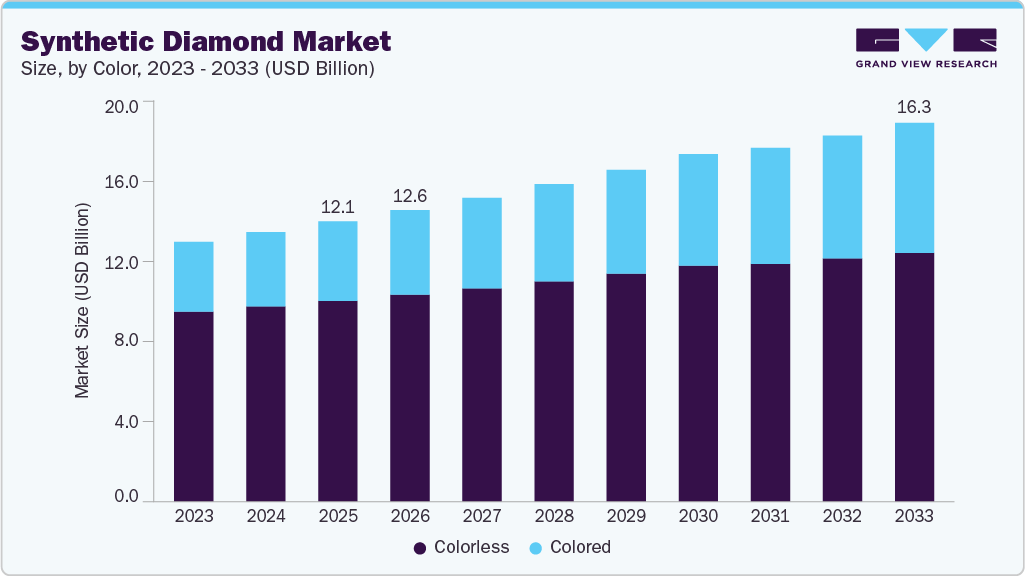 To learn more about this report, Download Free Sample Report
 Consumer and industry preference is further shifting toward synthetic diamonds due to their cost competitiveness, consistent quality, and customizable properties. Lab-grown diamonds are typically priced 30-50% lower than natural diamonds while offering identical physical, chemical, and optical characteristics. This price-quality advantage has accelerated adoption in fine jewelry, particularly among younger consumers who prioritize value, ethics, and design flexibility. In industrial and electronic applications, the ability to engineer diamonds with specific thermal, electrical, and mechanical properties enhances performance reliability, reinforcing the growing preference for synthetic diamonds across both consumer and high-technology end-use segments.
Drivers, Opportunities & Restraints
The industry is witnessing strategic capacity expansions and investments by leading producers to meet rising demand across jewelry and industrial sectors. For example, in May 2025, Element Six, a De Beers subsidiary and major synthetic diamond manufacturer, expanded its chemical vapor deposition (CVD) diamond production capacity in China to better serve both jewelry and industrial applications amid accelerating market demand. This expansion underscores how established players are scaling operations to capture growth and reinforce supply chains globally.
A significant opportunity lies in mergers and acquisitions that broaden production capabilities and market reach, particularly in key regions such as India, which is rapidly emerging as a global hub for both cutting/polishing and LGD consumption. In August 2025, Adamas One, a U.S.-based lab-grown diamond manufacturer, signed a letter of intent to acquire Flawless Allure Grown Diamonds, an India-based diamond-cutting and polishing company, to expand its production footprint and accelerate growth in the synthetic diamond market. This presents an opportunity to integrate value chains and tap high-growth regional markets.
Despite growth momentum, the industry faces constraints from strategic retrenchments by legacy players, signaling a shifting industry focus and competitive pressures. For instance, in May 2025, the De Beers Group announced its intention to close its Lightbox lab-grown diamond jewelry brand to double down on natural diamonds rather than lab-grown products in the luxury jewelry segment. This retreat highlights how entrenched producers may deprioritize synthetic diamonds in premium markets due to pricing pressures and brand-positioning challenges, thereby restraining broader market adoption.
Color Insights
The colorless diamonds accounted for the largest market revenue share of over 71.0% in 2025, and is projected to register the highest CAGR over the forecast period as consumer interest in unique, customizable gemstones continues to grow. Advances in Chemical Vapor Deposition (CVD) processes enable manufacturers to engineer diamonds in a range of hues (yellow, blue, pink, green) with controlled color saturation, appealing to designers and younger buyers seeking distinctive fashion statements. The rising influence of social media trends and celebrity endorsements around colored stones is expanding this segment’s appeal beyond traditional colorless diamond markets, accelerating adoption in bespoke jewelry lines and limited-edition collections.
Colorless synthetic diamonds still dominate in terms of total revenue share, driven primarily by their broad usage across both jewelry and industrial applications. In jewelry, Colorless stones are the closest economic and optical substitute for natural diamonds, making them the most widely purchased category for engagement rings and classic jewelry pieces. On the industrial side, Colorless synthetic diamonds are preferred for cutting, grinding, and polishing tools due to their consistent crystal structure and hardness. The combination of extensive industrial demand and strong consumer familiarity ensures that Colorless diamonds retain the largest share of overall market revenue.
End-use Insights
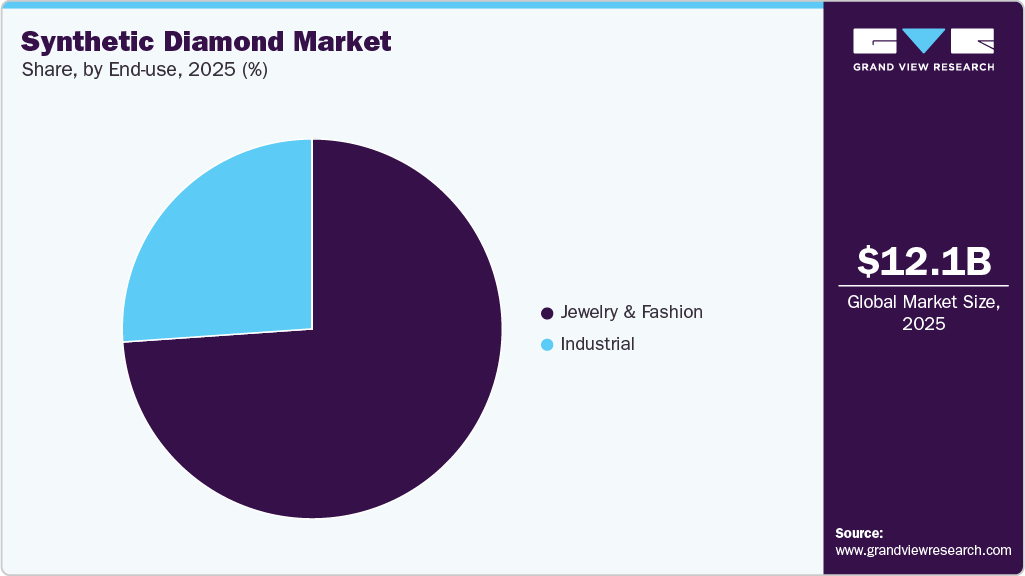
The jewelry & fashion segment currently holds the highest revenue share and is projected to deliver the fastest CAGR of 4.3% from 2026 to 2033. This growth is fuelled by shifting consumer preferences toward lab-grown stones that offer comparable brilliance and durability to natural diamonds at significantly lower prices. Younger demographics, especially Millennials and Gen Z, increasingly prioritize factors such as sustainability, ethical sourcing, and value, which lab-grown diamonds deliver. As major jewelry brands expand their lab-grown collections and innovate with fashion-forward designs, this segment’s market dominance is intensifying, capturing an increasing share of global diamond sales each year.
 To learn more about this report, Download Free Sample Report
 Industrial applications remain a critical demand pillar for synthetic diamonds, thanks to their superior hardness, thermal conductivity, and wear resistance compared to conventional materials. These properties make synthetic diamonds indispensable in manufacturing tools for cutting, drilling, grinding, and polishing across automotive, aerospace, construction, and electronics sectors. Additionally, emerging technological uses, such as semiconductor heat spreaders, optics, and sensor components, are expanding industrial demand into high-value, performance-driven markets. As global manufacturing and precision engineering investments grow, the industrial segment remains a stable and expanding contributor to overall synthetic diamond consumption.
Regional Insights
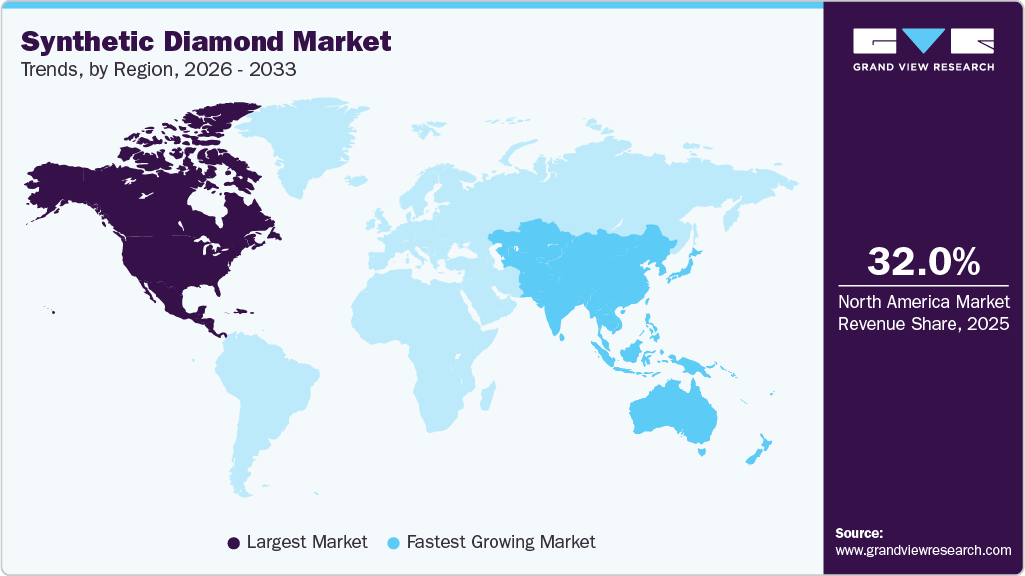
North America dominated the synthetic diamond market with the largest market revenue share of over 32.0% in 2025. The North America market is supported by strong consumer acceptance of lab-grown jewelry and advanced industrial applications. Ethical sourcing, sustainability narratives, and price transparency have driven widespread retail adoption, particularly through omnichannel jewelry brands. The region also benefits from demand in high-performance applications such as precision tooling, electronics, and thermal management, supported by robust R&D ecosystems and technology-driven manufacturing.
 To learn more about this report, Download Free Sample Report
 U.S. Synthetic Diamond Market Trends
The synthetic diamond market in the U.S. is driven primarily by jewelry and fashion consumption. Millennials and Gen Z consumers have rapidly normalized lab-grown diamonds for engagement rings and everyday fine jewelry, driven by affordability and ethical positioning. In parallel, the U.S. maintains steady industrial demand for synthetic diamonds in aerospace, defense, electronics, and machining tools, bolstered by domestic innovation and a strong advanced materials startup ecosystem.
Europe Synthetic Diamond Market Trends
The synthetic diamond market in Europe is shaped by a strong emphasis on sustainability, ESG compliance, and responsible luxury. Consumers in countries such as the U.K., Germany, and France increasingly favor lab-grown diamonds as a lower-impact alternative to mined stones, supporting growth in jewelry applications. Additionally, Europe’s advanced manufacturing base drives demand for synthetic diamonds in precision engineering, optics, and cutting tools, supported by strict quality and environmental standards.
Asia Pacific Synthetic Diamond Market Trends
The synthetic diamond market in Asia Pacific is driven by its integrated role across production, processing, and consumption. China leads in reactor manufacturing and industrial synthetic diamond output, while India serves as a global hub for cutting, polishing, jewelry manufacturing, and exports. Rising disposable incomes, expanding middle-class populations, and strong industrial growth across electronics, automotive, and construction sectors continue to fuel regional demand.
Latin America Synthetic Diamond Market Trends
The synthetic diamond market in Latin America represents a developing market with growth concentrated in urban centers and emerging jewelry retail segments. Countries such as Brazil and Mexico are witnessing increasing awareness of lab-grown diamonds as affordable alternatives for fine jewelry, while industrial demand is gradually expanding in manufacturing, mining tools, and construction applications. Market growth remains moderate due to economic sensitivity but benefits from improving retail access and consumer education.
Middle East & Africa Synthetic Diamond Market Trends
The synthetic diamond market in the Middle East & Africa region is led by luxury retail hubs such as the UAE and Saudi Arabia, where tourism and high disposable incomes support jewelry sales. Lab-grown diamonds are gaining traction as value-driven, sustainable alternatives to natural diamonds. In Africa, industrial demand remains relevant, particularly in cutting, drilling, and tooling applications, while gradual exposure to lab-grown alternatives is supporting long-term market development.
Key Synthetic Diamond Company Insights
Key players operating in the market are undertaking various initiatives to strengthen their presence and increase the reach of their products and services. Strategies such as expansion activities and partnerships are key in propelling the market growth. Some of the key players operating in the market include Diamond Foundry Inc., Element Six, and others
-
Diamond Foundry Inc. is a U.S.-based lab-grown diamond producer founded in 2015, with commercial-scale production and jewelry supply ramping up from 2018 onward. The company specializes in CVD-grown gem-quality diamonds and is recognized for its sustainability-focused approach, using renewable energy in its manufacturing operations. Diamond Foundry supplies lab-grown diamonds to multiple global jewelry brands and has played a key role in accelerating mainstream acceptance of lab-grown diamonds in the jewelry & fashion segment.
-
Element Six, a subsidiary of the De Beers Group, is a global leader in synthetic diamond manufacturing with decades of expertise across HPHT and CVD technologies. While historically focused on industrial and advanced material applications, Element Six has significantly expanded its CVD diamond capabilities since the late 2010s to support electronics, thermal management, optics, and emerging quantum technologies. The company operates large-scale manufacturing facilities across Europe, Asia, and North America, making it one of the most technologically advanced and vertically integrated players in the synthetic diamond market.
-
New Diamond Technology LLC (NDT) is a Russia-based lab-grown diamond producer established in 2014, specializing in large-carat, high-purity HPHT synthetic diamonds for the premium jewelry market. The company is known for producing some of the world’s largest lab-grown gem diamonds, including multi-carat stones exceeding traditional commercial sizes. NDT’s focus on high-quality crystal growth and scalability has positioned it as a key supplier for high-end lab-grown diamond jewelry brands globally.
Key Synthetic Diamond Companies:
The following key companies have been profiled for this study on the synthetic diamond market.
- ALTR Created Diamonds
- Diamond Foundry Inc.
- Element Six
- Henan Huanghe Whirlwind Co., Ltd.
- IIa Technologies Pte. Ltd.
- ILJIN Diamond Co., Ltd.
- New Diamond Technology LLC
- Pure Grown Diamonds
- Scio Diamond Technology Corporation
- Zhongnan Diamond Co., Ltd.
Recent Developments
-
De Beers’ Element Six announced on 12 February 2025 the acquisition of Jinan Zhongwu New Materials Co., Ltd. (China), expanding its footprint in the fast-growing lab-grown diamond segment in Asia. This strategic move enhances Element Six’s technological capabilities and supply chain capacity to better serve both industrial and jewelry applications globally.
-
Diamond Foundry announced on 18 June 2025 the launch of a new eco-diamond line developed using renewable energy-powered CVD reactors. The initiative aims to meet consumer demand for sustainable, environmentally responsible lab-grown diamonds across U.S. and European jewelry and industrial markets.
-
ALTR Created Diamonds unveiled in July 2025 a flagship 5-carat lab-grown diamond line designed for luxury jewelry brands, accompanied by an enhanced sustainability and ethics certification framework to support traceability and consumer confidence.
Synthetic Diamond Market Report Scope
Report Attribute
Details
Market definition
Market size represents the total revenue generated from the sale of synthetic diamonds across all applications within that year.
Market size in 2025
USD 12.1 billion
Estimated Market size in 2026
USD 12.6 billion
Projected Market size by 2033
USD 16.3 billion
Growth rate
CAGR of 3.8% from 2026 to 2033
Base year for estimation
2025
Historical data
2021 - 2024
Forecast period
2026 - 2033
Quantitative units
Revenue in USD million/billion, and CAGR from 2026 to 2033
Report coverage
Revenue forecast, competitive landscape, growth factors, and trends
Segments covered
Color, end-use, region
Regional scope
North America; Europe; Asia Pacific; Latin America; Middle East & Africa
Country scope
U.S.; Canada; Mexico; UK; Germany; Spain; France; Russia; Italy; China; India; Japan; South Korea; Australia; Brazil; Argentina; Saudi Arabia; UAE; South Africa
Key companies profiled
ALTR Created Diamonds; Diamond Foundry Inc.; Element Six; Henan Huanghe Whirlwind Co., Ltd.; IIa Technologies Pte. Ltd.; ILJIN Diamond Co., Ltd.; New Diamond Technology LLC; Pure Grown Diamonds; Scio Diamond Technology Corporation; Zhongnan Diamond Co., Ltd.
Customization scope
Free report customization (equivalent up to 8 analysts working days) with purchase. Addition or alteration to country, regional & segment scope.
Pricing and purchase options
Avail customized purchase options to meet your exact research needs. Explore purchase options
Global Synthetic Diamond Market Report Segmentation
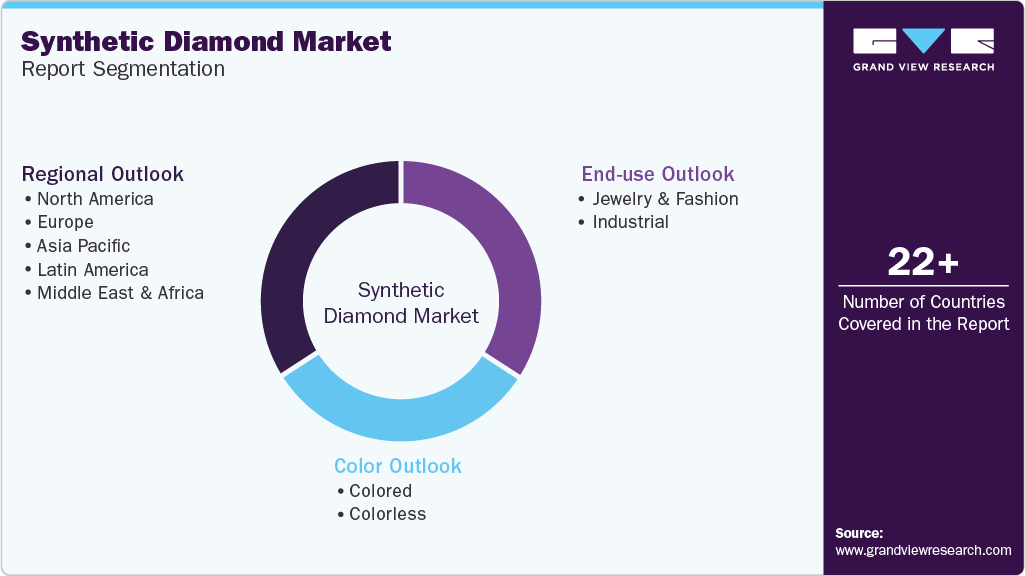
This report forecasts revenue growth at the global, regional, and country levels and analyzes the latest trends in each sub-segment from 2021 to 2033. For this study, Grand View Research has segmented the global synthetic diamond market report by color, end-use, and region:
 To learn more about this report, Download Free Sample Report
 -
Color Outlook (Revenue, USD Billion, 2021 - 2033)
-
Colored
-
Colorless
-
-
End-use Outlook (Revenue, USD Billion, 2021 - 2033)
-
Jewelry & Fashion
-
Industrial
-
-
Regional Outlook (Revenue, USD Billion, 2021 - 2033)
-
North America
-
U.S.
-
Canada
-
Mexico
-
-
Europe
-
Germany
-
UK
-
France
-
Spain
-
Italy
-
Russia
-
-
Asia Pacific
-
China
-
India
-
Japan
-
South Korea
-
Australia
-
-
Latin America
-
Brazil
-
Argentina
-
-
Middle East & Africa
-
Saudi Arabia
-
UAE
-
South Africa
-
-
Frequently Asked Questions About This Report
The global synthetic diamond market size was valued at USD 12.1 billion in 2025 and is expected to reach USD 12.6 billion in 2026.
The key driver of the synthetic diamond market is the rising demand for cost-effective, ethically sourced, and environmentally sustainable alternatives to natural diamonds across jewelry and industrial applications
North America dominated the synthetic diamond market with the largest market revenue share of over 32.0% in 2025.
Asia Pacific is the fastest growing regional market.
The colorless diamonds segment accounted for the largest market revenue share of over 71.0% in 2025.
The jewelry & fashion segment held the largest revenue share in 2025.
Some key players in the synthetic diamond market include ALTR Created Diamonds, Diamond Foundry Inc., Element Six, Henan Huanghe Whirlwind Co., Ltd., and IIa Technologies Pte. Ltd.; ILJIN Diamond Co., Ltd.; New Diamond Technology LLC; Pure Grown Diamonds; Scio Diamond Technology Corporation; Zhongnan Diamond Co., Ltd., and others.
About the Author(s)
Advanced Interior Materials Research Team
Advanced Materials · Advanced Interior MaterialsThis report was authored by the advanced interior materials research team at Grand View Research - comprising two research analysts, one senior research analyst, and one industry expert - with specialized expertise in the advanced interior materials segment of the advanced materials industry. All findings are based on proprietary advanced materials databases, executive interviews, and regulatory analysis, subject to internal peer review prior to publication.
Last Updated:
Speak to Analyst

Customize this report to your needs - add regions, segments, or data points, with 20% free customization.
Or view our licence options:


ISO 9001:2015 & 27001:2022 Certified
We are GDPR and CCPA compliant! Your transaction & personal information is safe and secure. For more details, please read our privacy policy.


