
- Home
- »
- Next Generation Technologies
- »
-
Synthetic Image Generation Market Size Report, 2025-2033GVR Report cover
![Synthetic Image Generation Market (2025 - 2033)Report]()
Synthetic Image Generation Market (2025 - 2033)
Size, Share & Trend Analysis Report By Technology (AI-based Image Generation, Hybrid Techniques), By Quality Level (Fully synthetic, Partially synthetic), By End Use, By Region, And Segment Forecasts
Market Size, 2024
$1.8BMarket Estimate, 2026
$2.5BMarket Forecast, 2033
$9.0BCAGR, 2025–2033
19.9%Synthetic Image Generation Market Summary
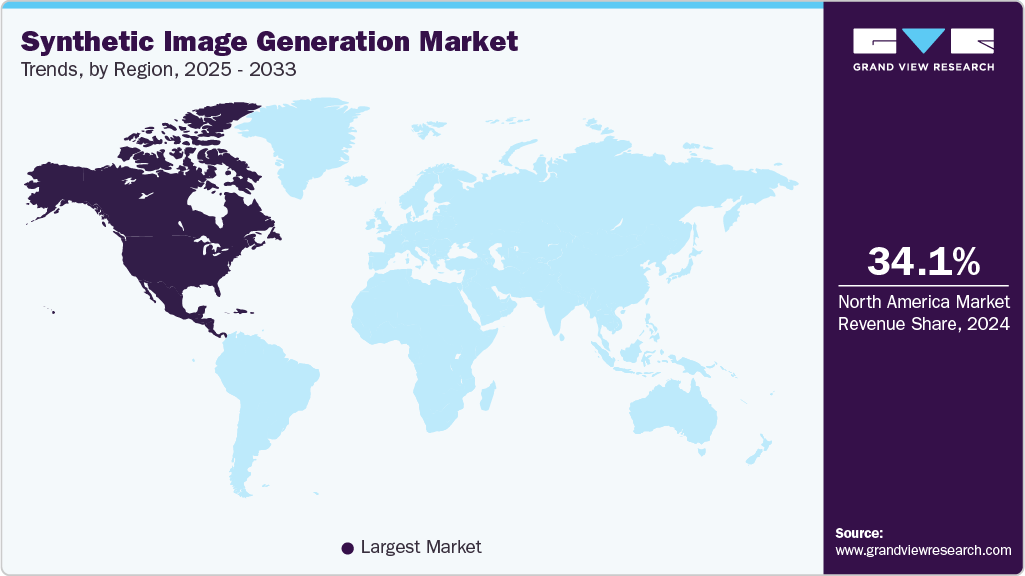
The global synthetic image generation market size was valued at USD 1.8 billion in 2024 and is projected to grow from USD 2.5 billion in 2026 to USD 9.0 billion by 2033, at a CAGR of 19.9% from 2025 to 2033. North America dominated the market, accounting for a revenue share of 34.1% in 2024. Significant advancement in deep learning, AI-based image generation, hybrid techniques and more especially models capable of mapping CGI & Procedural Techniques to images are driving the new frontier of synthetic image generation.

Key Market Trends & Insights
- The synthetic image generation market in the U.S. led the North America market and held the largest revenue share in 2024.
- By technology, AI-based image generation segment led the market and held the largest revenue share of 53.7% in 2024.
- By quality level, fully synthetic segment held the dominant position in the market and accounted for the leading revenue share of 63.0% in 2024.
- By end use, marketing & advertising segment is expected to grow at a significant CAGR of 21.2% from 2025 to 2033.
Market Size & Forecast
- 2024 Market Size: USD 1.8 Billion
- 2030 Projected Market Size: USD 9.0 Billion
- CAGR (2025-2030): 19.9%
- North America: Largest market in 2024
Three ways to get this report
Buy it, customize it, or ask a question.Get the Full Report
What the study covers
- FormatsPDF · Excel · Dashboard
- Timeline2025–2033 annual, 2024 base
- Coverage20+ countries, 5 regions
- Companies10+ key players profiled
Customize the Report
20% free customization
- IncludeCountries, segments, points
- TailorTo your product definition
- ExtendDeeper competitor detail
- OrA fully bespoke study
- Turnaround5–10 working days
Ask an Analyst
A direct answer, usually in 1 working day
- AccessReport author, directly
- Reply timeWithin 1 working day
- No sales callDirect answer only
- FormatEmail reply
- CostFree, no cost
Furthermore, combining conditional generation with generative architectures enables more controllable outputs. With growing computing power, better architectures (GANs, diffusion models, transformers) and richer training datasets, the use of synthetic image generation is expanding rapidly. Major initiatives by major players have also significantly contributed to wards market growth, for instance, in March 2023, Adobe unveiled Firefly, a new generative AI suite aimed at creating synthetic images and custom font designs. The Firefly models let users generate high‑quality visuals and typography using simple prompts, tightly integrated into Adobe’s creative tools. With a focus on safe content and commercial use licensing, Adobe positions Firefly as a nextgen tool for designers, marketers, and content creators.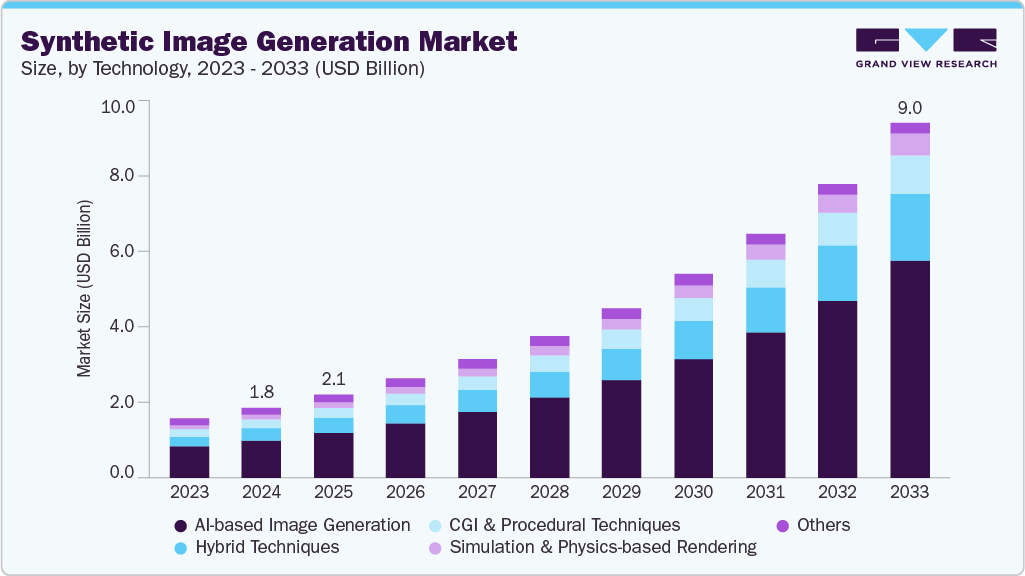
The synthetic image generation market is poised for rapid growth, driven predominantly by advances in AI-based techniques such as GANs and diffusion models, which currently dominate the technology segment with over 50% revenue share. Hybrid approaches that combine classical CGI and AI methods are also gaining traction, offering enhanced realism and control. Fully synthetic images, accounting for roughly 60% of the market, are increasingly preferred for their scalability and privacy benefits, particularly in industries with stringent data regulations. Partially synthetic solutions serve niche use cases where blending real and generated data is essential.
Vertically, marketing and advertising lead demand due to their heavy reliance on visual content creation, followed closely by entertainment, gaming, healthcare, and e-commerce sectors. These industries leverage synthetic images to reduce costs, accelerate time-to-market, and create personalized user experiences. With a projected CAGR of around 18% from 2025 to 2033, the market is expected to expand significantly as improved generative models, larger datasets, and integration into creative workflows drive adoption. The combination of technology maturity, diversified applications, and evolving user preferences underscores synthetic image generation’s transformative impact across sectors.
Technology Insights
The AI-based image generation segment led the market and accounted for 53.7% of the global revenue in 2024. The growth is driven due to its ability to produce high-quality, diverse, and customizable images at scale. This growth is fueled by advanced models like GANs and diffusion techniques, which are widely adopted across key verticals such as marketing, entertainment, gaming, and e-commerce. For instance, in August 2024, Amazon announced the general availability of Amazon Titan Image Generator v2 in Amazon Bedrock, offering advanced features for creative workflows. The latest version introduces image conditioning using Canny edge and segmentation maps, precise color palette control, one-step background removal, and subject consistency through fine-tuning with reference images. These enhancements enable users to guide generation using reference visuals, maintain brand style, and automate complex editing tasks securely.
The hybrid techniques segment is predicted to foresee significant growth in the forecast period. Hybrid techniques, which combine AI-based models with traditional CGI and procedural graphics, are gaining momentum in synthetic image generation. These approaches offer enhanced realism and precision, making them ideal for industries such as entertainment, gaming, and defense where visual fidelity is critical. By taking major initiatives in this market major players are fueling the expansion for this segment for instance, in December 2025, Google Cloud announced the introduction of Veo and Imagen 3, its newest generative AI models now available on Vertex AI. Veo, developed by Google DeepMind, enables companies to generate high-definition videos swiftly from either CGI & Procedural Techniques or image prompts, enhancing creative workflows by transforming existing assets into dynamic visuals. Imagen 3, now generally available to all Vertex AI customers, delivers the most photorealistic and detailed images to date from simple CGI & Procedural Techniques prompts, along with advanced editing and brand customization features.
Quality Level Insights
The fully synthetic segment accounted for the largest market revenue share in 2024. Fully synthetic, high-quality image generation is experiencing rapid expansion in the synthetic data market, driven by the need for scalable, privacy-preserving, and customizable training data for advanced AI and machine learning applications. The adoption of synthetic imagery is accelerating across automotive, robotics, healthcare, and enterprise analytics, with leading technology providers launching platforms that offer photorealistic, artifact-free outputs to enable robust model development. Strategic investments and high-profile collaborations are propelling innovations in this space, making synthetic visuals a cornerstone for simulation, automated labeling, and generative media production. With regulatory pressures intensifying, organizations are increasingly leveraging synthetic imagery to address data scarcity and compliance challenges, fueling double-digit market growth.
The partially synthetic segment is predicted to foresee significant growth in the forecast period. The growth driven by increasing demand for balancing data privacy with data utility. Organizations are adopting partially synthetic data to produce realistic data that preserves important patterns and characteristics while mitigating risks of re-identification. This approach is especially valuable in sectors with sensitive data such as healthcare and finance. The market growth is supported by advancements in generative AI models that enhance the fidelity and utility of partial synthetic data. This segment benefits from the rising emphasis on compliance with data privacy regulations and the need for high-quality training datasets in AI applications.
End Use Insights
The marketing & advertising segment accounted for the largest market revenue share in 2024. The market is driven as global brands adopt AI-powered solutions for personalized, brand-accurate content at scale and speed. NVIDIA Omniverse and OpenUSD frameworks are one of the key enablers, helping companies like Coca-Cola, Moet Hennessy, Nestle, and Unilever accelerate content creation by producing millions of localized content variations faster and at lower costs. These AI-driven platforms streamline workflows, ensuring creative consistency while significantly reducing production time and expenses Unilever, for instance, achieves content creation twice as fast and at half the cost. This accelerated content pipeline boosts customer engagement by delivering highly personalized and immersive visuals, driving growth in the synthetic image generation market within advertising.
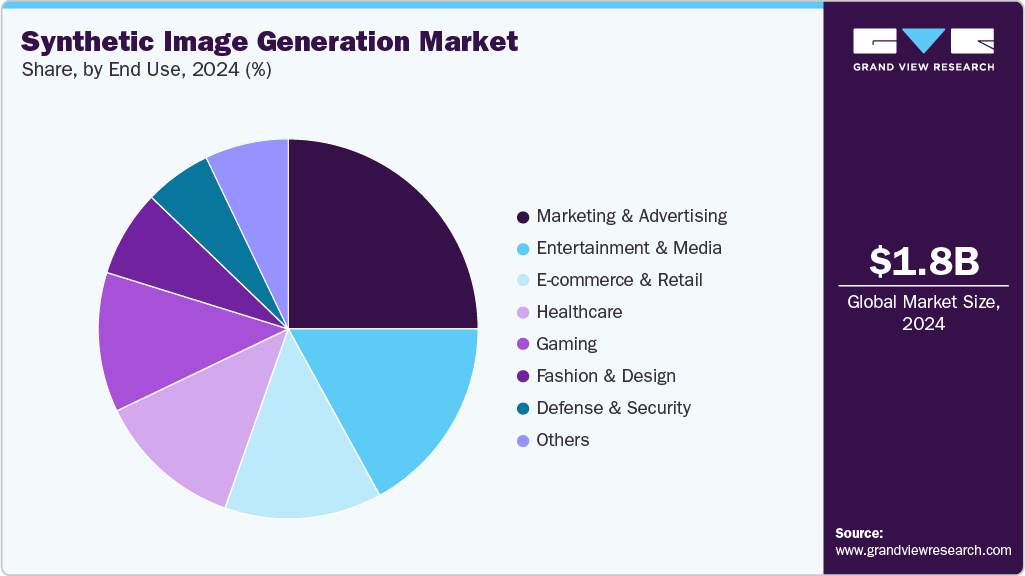
The commerce and retail segment is projected to grow significantly over the forecast period. This rapid expansion is driven by the rising demand for realistic, personalized synthetic visuals that enhance product listings, improve customer engagement, and enable immersive virtual try-ons. The digital transformation in retail and increasing adoption of AI-powered content creation tools significantly contribute to this growth. In addition, stringent data privacy regulations and the need for scalable content at reduced costs make synthetic image generation increasingly valuable. As a result, this segment is poised to lead the synthetic image generation market by providing innovative, high-quality visual content tailored for evolving consumer expectations.
Regional Insights
North America synthetic image generation market dominated the market by 34.1% revenue share in 2024 and is driven by its advanced initiatives by major players operating here. For instance, in March 2025, OpenAI launched GPT-4o Image Generation, a natively multimodal model that delivers highly precise, photorealistic, and useful image outputs integrated directly into ChatGPT. This advanced technology excels at following intricate prompts, rendering detailed CGI & Procedural Techniques within images, and maintaining visual coherence across multiple iterations. GPT-4o supports in-conCGI & Procedural Techniques learning by analyzing user-uploaded images to enhance generation quality, making it a powerful tool for creative, educational, and professional applications.
U.S. Synthetic Image Generation Market Trends
The synthetic image generation market in U.S. is rapidly expanding, driven by cutting-edge AI technologies and strong demand across sectors such as marketing, entertainment, and healthcare. Advances in generative models such as GANs and diffusion techniques have enabled the creation of highly realistic and customizable synthetic images, reducing reliance on traditional content creation methods. Major companies like OpenAI, Stability AI, and Adobe are pioneering innovative solutions that enhance efficiency and creativity.
Europe Synthetic Image Generation Market Trends
Europe’s synthetic image generation market is growing steadily, fueled by advancements in AI technologies and strong emphasis on ethical AI development and data privacy regulations. Countries such as Germany, the UK, and France are leading innovation across key sectors such as healthcare, automotive, and retail, leveraging synthetic images for training, marketing, and design. The region benefits from robust public-private partnerships and significant investment in AI research, which accelerates technology adoption. European companies are focusing on building trustworthy and compliant AI models, balancing innovation with regulatory requirements. This cautious yet progressive approach positions Europe as a significant player in the global synthetic image generation landscape.
Asia Pacific Synthetic Image Generation Market Trends
The Asia Pacific region is experiencing rapid growth in synthetic image generation, driven by advancements in AI technologies and increasing demand across various sectors. Countries such as China, India, and South Korea are at the forefront, with significant investments in AI research and development. For instance, China's policy initiatives, such as the Deep Synthesis Provisions, are shaping content-safety norms and encouraging enterprises to adopt compliant synthetic media tools.
Key Synthetic Image Generation Market Company Insights
Some key companies in the Synthetic Image Generation industry are Adobe (Firefly); AWS (Amazon Web Services); Google; IBM; Meta and more.
-
Meta is a global company that builds social platforms like Facebook, Instagram, Threads and invests heavily in AI research and infrastructure. In recent years, Meta has developed and deployed generative AI tools such as Imagine with Meta, powered by its Emu foundation model, which allows users to generate high‑resolution images from CGI & Procedural Techniquesual prompts. The company provides generative features for advertisers tools that can automatically generate image variations, backgrounds, aspect ratio fitting, and CGI & Procedural Techniques overlay to make ad creative more efficient. To promote transparency and trust, Meta labels images generated by its models and is developing watermarking / metadata schemes and labeling policies across its platforms.
-
NVIDIA is a global player for accelerated computing and AI, providing hardware, software and platforms that power advanced machine intelligence. Under its AI for Good initiatives, NVIDIA offers tools such as NeMo, which enables developers to build, customize, and deploy multimodal generative AI models. Combined with its GPU‑accelerated infrastructureDGX systems, cloud computing, and its NGC catalog of models and SDKsNVIDIA's stack enables high‑fidelity synthetic image generation at scale. These capabilities support applications in simulation, virtual worlds (via Omniverse), content creation, scientific visualization, and more, helping organizations turn bold ideas into visual reality.
Key Synthetic Image Generation Companies:
The following are the leading companies in the synthetic image generation market. These companies collectively hold the largest market share and dictate industry trends.
- Adobe (Firefly)
- AWS (Amazon Web Services)
- Deepbrain AI
- Google (Imagen, Veo, etc.)
- IBM
- Meta
- Microsoft
- Mostly AI
- NVIDIA
- OpenAI
- Synthesis AI
Recent Developments
-
In April 2025, OpenAI announced the launch of a new image generation feature built natively into ChatGPT, powered by its GPT-4o “omnimodal” model. The upgrade enables users to generate visual content directly within chat, blending CGI & Procedural Techniques and imagery in seamless conversations. The feature is available across Free, Plus, Pro, and Team plans, with safeguards to prevent misuse and maintain content safety. OpenAI claims this marks a major step toward making image generation a standard, useful tool rather than a separate service.
-
In March 2025, NVIDIA today unveiled a major upgrade to its AI toolkit with the launch of the Cosmos world foundation models (WFMs) and new physical-AI data tools. The new models enable scalable, controllable world generation and reasoning, aimed at advancing robotics, autonomous vehicles and simulations. Two new blueprints built on Omniverse and Cosmos provide high-volume synthetic data generation for post-training tasks. Industry leaders including Agility Robotics, Figure AI, Skild AI and 1X are early adopters. Nvidia likely to make Cosmos Predict and Cosmos Transfer available via Hugging Face and GitHub, with Cosmos Reason entering early access.
Synthetic Image Generation Market Report Scope
Report Attribute
Details
Market size in 2024
USD 1.8 billion
Estimated market size in 2026
USD 2.5 billion
Projected market size by 2033
USD 9.0 billion
Growth Rate
CAGR of 19.9% from 2025 to 2033
Base year for estimation
2024
Actual data
2021 - 2023
Forecast period
2025 - 2033
Quantitative units
Revenue in USD million/billion and CAGR from 2025 to 2033
Report coverage
Revenue forecast, company ranking, competitive landscape, growth factors, and trends
Segments covered
Technology, quality level, end use, region
Regional scope
North America; Europe; Asia Pacific; Latin America; and MEA
Country scope
U.S.; Canada; UK; Germany; France; China; Japan; India; South Korea; Australia; Brazil; KSA; UAE; South Africa
Key companies profiled
Adobe; AWS; Deepbrain AI; Google LLC; IBM; Meta; Microsoft; Mostly AI; NVIDIA; OpenAI; Synthesis AI
Customization scope
Free report customization (equivalent up to 8 analysts working days) with purchase. Addition or alteration to country, regional & segment scope.
Pricing and purchase options
Avail customized purchase options to meet your exact research needs. Explore purchase options
Global Synthetic Image Generation Market Report Segmentation
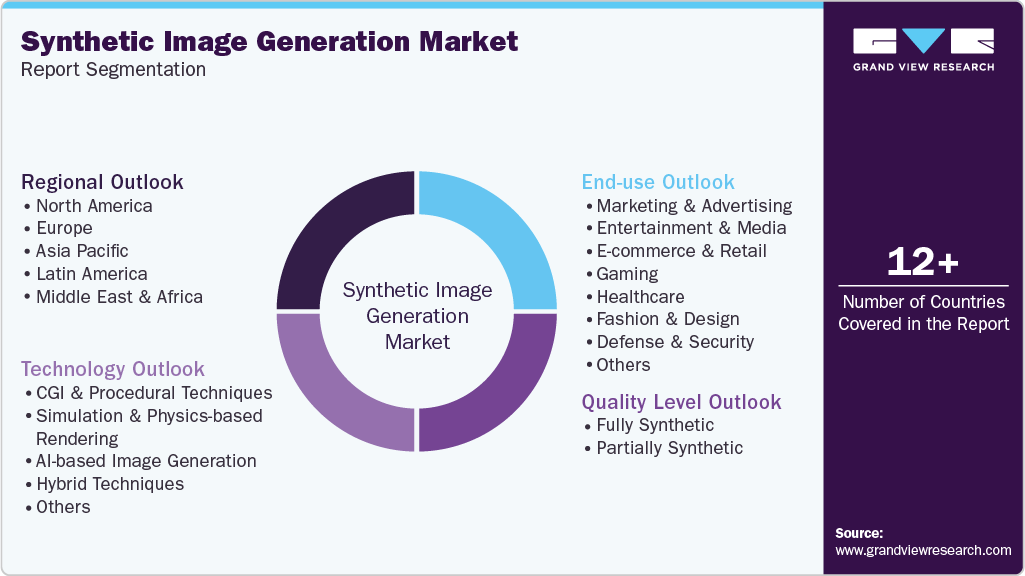
This report forecasts revenue growth at global, regional, and country levels and provides an analysis of the latest industry trends in each of the sub-segments from 2021 to 2033. For this study, Grand View Research has segmented the global synthetic image generation market report based on technology, quality level, end use, and region.
-
Technology Outlook (Revenue, USD Million, 2021 - 2033)
-
CGI & Procedural Techniques
-
Simulation & Physics-based Rendering
-
AI-based Image Generation
-
Hybrid Techniques
-
Others
-
-
Quality Level Outlook (Revenue, USD Million, 2021 - 2033)
-
Fully synthetic
-
Partially synthetic
-
-
End Use Outlook (Revenue, USD Million, 2021 - 2033)
-
Marketing & Advertising
-
Entertainment & Media
-
E-commerce & Retail
-
Gaming
-
Healthcare
-
Fashion & Design
-
Defense & Security
-
Others
-
-
Regional Outlook (Revenue, USD Million, 2021 - 2033)
-
North America
-
U.S.
-
Canada
-
Mexico
-
-
Europe
-
UK
-
Germany
-
France
-
-
Asia Pacific
-
China
-
Japan
-
India
-
South Korea
-
Australia
-
-
Latin America
-
Brazil
-
-
Middle East and Africa (MEA)
-
KSA
-
UAE
-
South Africa
-
-
Frequently Asked Questions About This Report
The global synthetic image generation market size was valued at USD 1.8 billion in 2024 and is estimated at USD 2.5 billion for 2026.
The global synthetic image generation market is expected to grow at a CAGR of 19.9% from 2025 to 2033, reaching USD 9.0 billion by 2033.
North America dominated the energy retrofit systems market with a share of 34.1% in 2024. Cutting-edge AI technologies and strong demand across sectors like marketing, entertainment, and healthcare drive this
Some key players operating in the energy retrofit systems market include Adobe, AWS, Deepbrain AI, Google LLC, IBM, Meta, Microsoft, Mostly AI, NVIDIA, OpenAI, Synthesis AI.
Key factors that are driving the market growth include Significant advancement in deep learning, AI-based image generation, hybrid techniques and more especially models capable of mapping CGI & Procedural Techniques to images are driving the new frontier of synthetic image generation
About the Author(s)
Next Generation Technologies Research Team
Technology · Next Generation TechnologiesThis report was authored by the next generation technologies research team at Grand View Research - comprising two research analysts, one senior research analyst, and one industry expert - with specialized expertise in the next generation technologies segment of the technology industry. All findings are based on proprietary technology databases, executive interviews, and regulatory analysis, subject to internal peer review prior to publication.
Last Updated:
Speak to Analyst


Customize this report to your needs - add regions, segments, or data points, with 20% free customization.
Or view our licence options:


ISO 9001:2015 & 27001:2022 Certified
We are GDPR and CCPA compliant! Your transaction & personal information is safe and secure. For more details, please read our privacy policy.


