
- Home
- »
- Next Generation Technologies
- »
-
Synthetic Media Market Size And Share Report, 2025-2033GVR Report cover

Synthetic Media Market (2025 - 2033)
Size, Share & Trends Analysis Report By Component (Solution, Services), By Technology (Generative AI, Speech Synthesis, Computer Vision, NLP), By Application, By Region, And Segment Forecasts
Market Size, 2024
$5.1BMarket Estimate, 2026
$6.6BMarket Forecast, 2033
$21.7BCAGR, 2025–2033
18.1%Synthetic Media Market Summary
The global synthetic media market size was valued at USD 5.1 billion in 2024 and is projected to grow from USD 6.6 billion in 2026 to USD 21.7 billion by 2033, at a CAGR of 18.1% from 2025 to 2033. North America dominated the market, accounting for a revenue share of 34.3% in 2024. The market growth is anticipated to be accelerated by the growing use of AI technologies in the media and entertainment industry and advancements in deep learning technologies, AR, and digital media content, which further promote the increased demand for this media across industries such as education, advertising, and especially entertainment.
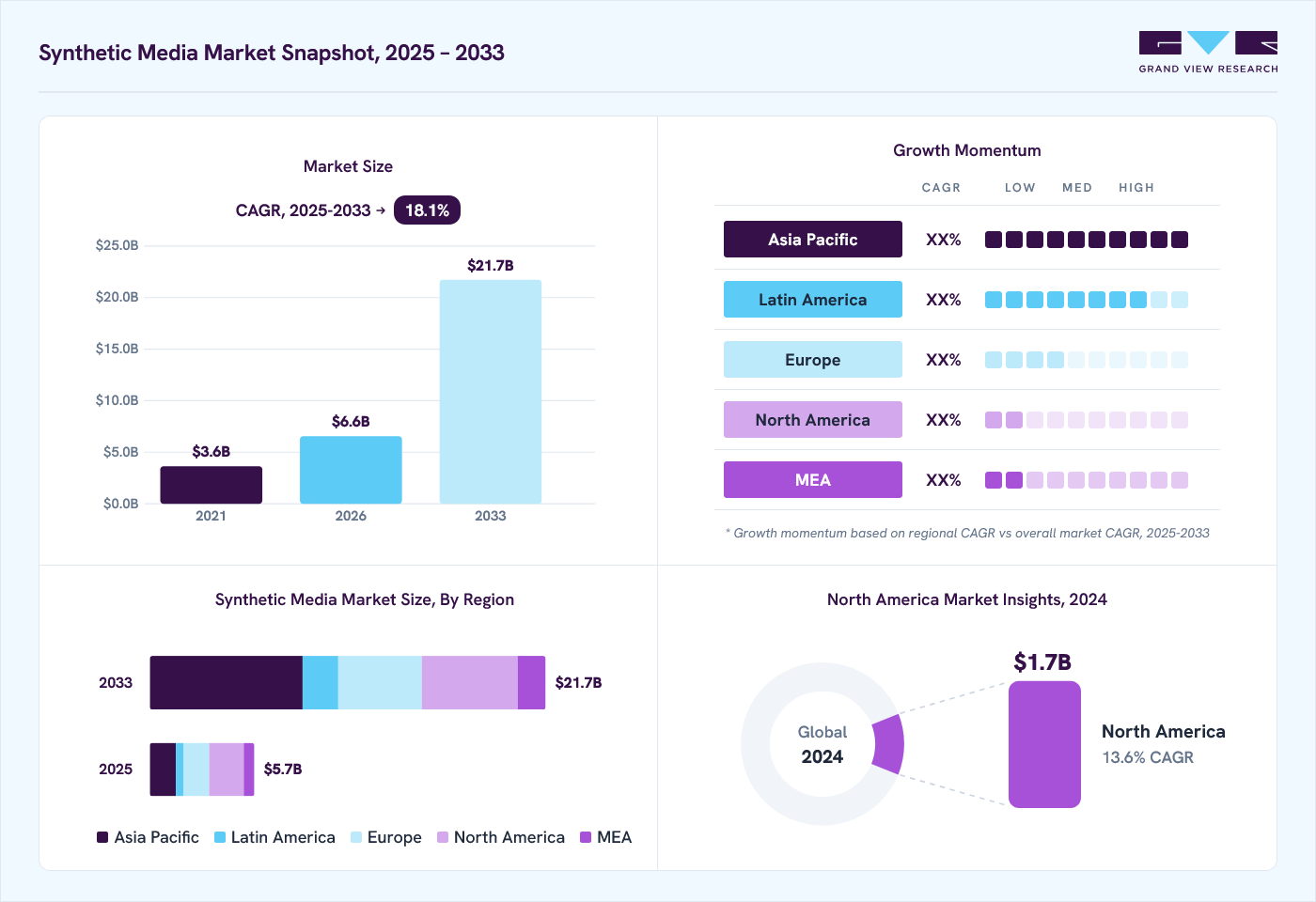 Source: Grand View Research, IR Documents, Primary Interviews, Paid DatabasesTo learn more about this report,
 Download Free Sample Report
 Key Market Trends & Insights
- The synthetic media market in the U.S. accounted for the largest market revenue share in North America in 2024.
- By component, the solution segment led the market with the largest revenue share of 68.1% in 2024.
- By technology, the generative AI segment led the market with the largest revenue share of 37.6% in 2024.
- By application, the gaming segment is expected to grow at the fastest CAGR of 22.6% from 2025 to 2033.
Market Size & Forecast
- 2024 Market Size: USD 5.1 Billion
- 2033 Projected Market Size: USD 21.7 Billion
- CAGR (2025-2033): 18.1%
- North America: Largest market in 2024
Three ways to get this report
Buy it, customize it, or ask a question.Ask an Analyst
Analyst response in 1 business day
- AccessReport author, directly
- Reply timeWithin 1 working day
- No sales callDirect answer only
- FormatEmail reply
- CostFree, no cost
Get the Full Report
What the study covers
- FormatsPDF · Excel · Dashboard
- Timeline2025–2033 annual, 2024 base
- Coverage20+ countries, 5 regions
- Companies10+ key players profiled
Customize the Report
20% free customization
- IncludeCountries, segments, points
- TailorTo your product definition
- ExtendDeeper competitor detail
- OrA fully bespoke study
- Turnaround5–10 working days
Synthetic media consists of the production and using of content that is generated artificially, such as text, media, video, and audio, which is further generated with the help of advanced technologies. There are tools and platforms that allow the user to create media that mimics human actions and attributes such as AI generated audio, speech synthesis, text, and virtual humans and avatars, thus, providing the solutions that are innovative for content generation, marketing and communication in the diverse industries for advertising and gaming sectors.The synthetic media industry is driven by the developments in machine learning (ML) and artificial intelligence (AI) that produce realistic digital content. Technologies such as natural language processing (NLP) and Generative Adversarial Networks (GANs) models can create synthetic text, images, videos, and audio that is similar to real-world content. These advances are primarily required by sectors such as entertainment, marketing, education, and journalism by offering new methods for content creation, personalization, and immersive experiences.
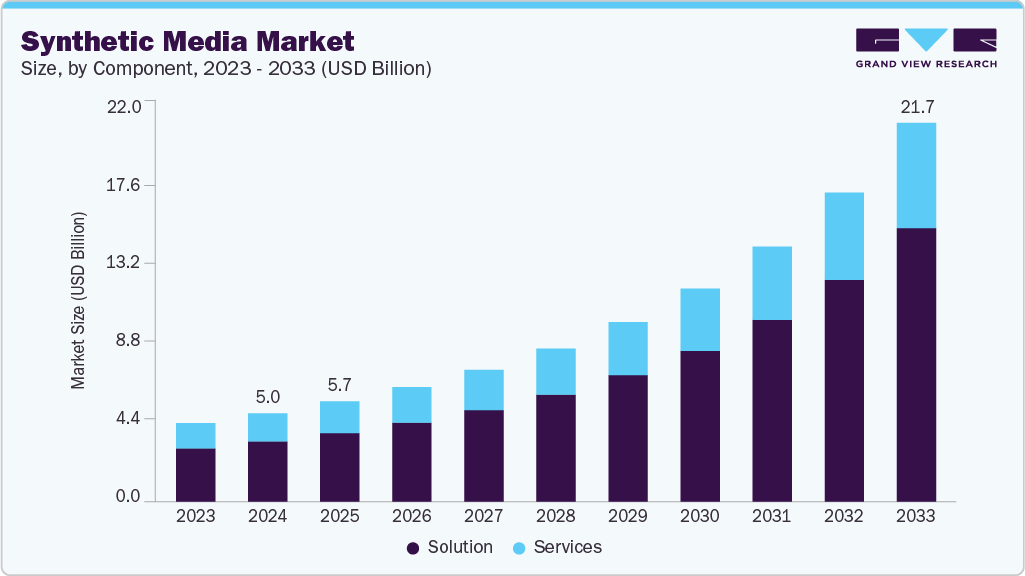 To learn more about this report, Download Free Sample Report
 Another major factor driving growth is the increasing need for cost-effective and scalable content creation. Synthetic media enables the efficient production of digital content by automating the process, reducing dependency on traditional resources like actors, sets, and physical equipment. For instance, marketers leverage AI-generated images and voiceovers to produce ads that are primarily focused on boosting customer engagement while reducing the costs of traditional ways of creation. Similarly, virtual avatars and AI-driven customer service agent bots enhance efficiency in industries such as gaming and customer support services in healthcare, education, and many more sectors.
Component Insights
The solution segment led the market with the largest revenue share of 68.1% in 2024, driven by the AI-driven text-to-speech (TTS) and text-to-video technologies that improve accessibility, personalization, and operational efficiency. TTS allows publishers and content creators to transform written text into natural-sounding audio, making information available to visually impaired individuals and those with reading challenges, while also enabling hands-free consumption across devices. It cuts production costs by removing the need for human voice actors and supports multilingual content delivery to engage global audiences.
At the same time, AI-powered text-to-video solutions automate the creation of videos from scripts, democratizing media production by allowing quick, affordable development of personalized, engaging videos complete with voiceovers and animations. This broadens content reach and interactivity across multiple platforms and languages. Together, these advancements are fundamentally changing how media is produced, experienced, and scaled worldwide.
The services segment is expected to grow at the fastest CAGR during the forecast period, driven by rising demand for faster, cost-effective content creation that reduces the dependence on traditional methods. Customized content can also be created through AI-driven personalization that enhances audience engagement with tools such as captions and audio descriptions. Moreover, synthetic media supports consistent brand representation and provides high-quality, hyper-realistic visuals, making it crucial for marketing and media sectors.
For instance, in June 2025, NVIDIA introduced Media2, an AI-driven platform launched to transform content creation, streaming, and live media experiences. By advancing technologies such as NVIDIA NIM micro services, AI Blueprints, and the energy-efficient Blackwell architecture, Media2 provides more intelligent, personalized, and engaging media focused to viewers’ interests.
Technology Insights
The generative AI segment accounted for the largest market revenue share in 2024, due to its AI algorithms and cloud computing that provide the efficient production of real-time images, audio, and video. Synthetic media is scalable and cost-effective due to the combination of large datasets and easily available cloud infrastructure. Moreover, the rising demand for personalized, interesting content in advertising is driving businesses to use generative AI for innovative, budget-friendly campaigns in the market. This technology allows brands to create unique, localized content, transforming media and marketing approaches.
The natural language processing (NLP) segment is expected to grow at the fastest CAGR over the forecast period, driven by enabling computers to understand, analyze, and produce human language, which allows creators to interact using natural language instead of programming code, simplifying the content creation process. NLP models generate human-like text for a wide range of uses, from chatbots to automated content production. In addition, NLP supports technologies like speech synthesis and voice cloning, enabling AI to mimic human voices for text-to-speech applications and audiobook narration. By allowing users to generate and fine-tune media simply by describing what they want, NLP makes content creation more accessible, efficient, scalable, and interesting.
Application Insights
The media & entertainment segment accounted for the largest market revenue share in 2024, driven by the increasing use of synthetic media in film production, visual effects, and AI-powered dubbing and avatars, which promote multilingual, high-quality content creation at low costs. Producing hyper-realistic synthetic content is easier due to the advancements in AI, machine learning, deep learning, and cloud computing, which increases the demand for innovation across movies, gaming, and virtual reality industries. Moreover, the use of 5G networks and the growth of metaverse platforms are further demanding synthetic media adoption by enhancing content scalability and interactivity.
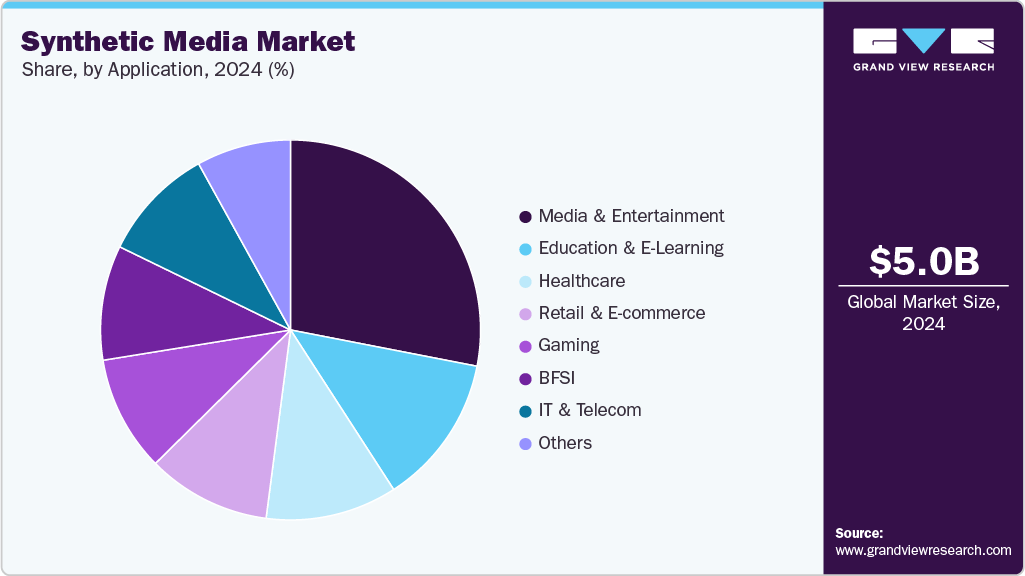 To learn more about this report, Download Free Sample Report
 The gaming segment is anticipated to grow at the fastest CAGR during the forecast period, driven by the progress in technology such as AI and machine learning. It makes it possible to create realistic, dynamic game elements like lifelike avatars, interactive environments, and adaptive gameplay. The increasing adoption of virtual and augmented reality technologies further raises the demand for synthetic media by offering more engaging and interactive gaming experiences. In addition, the gaming industry is rising with the growth of mobile and cloud gaming platforms, which is enhancing the need for scalable and personalized content creation to provide a realistic environment in the gaming experience.
Regional Insights
North America dominated the synthetic media market with the largest revenue share of 34.3% in 2024, driven by the advancements in technologies, which facilitate the fast, cost-efficient creation of high-quality, personalized synthetic content spanning text, audio, and visuals. The region’s well-developed technology infrastructure and best venture capital landscape further drive innovation and adoption, particularly within the entertainment, advertising, and education industries. Rising demand for immersive, focused media experiences also contributes to market growth, with major players such as Adobe, Amazon, Google, and Meta heavily investing in AI-driven media technologies.
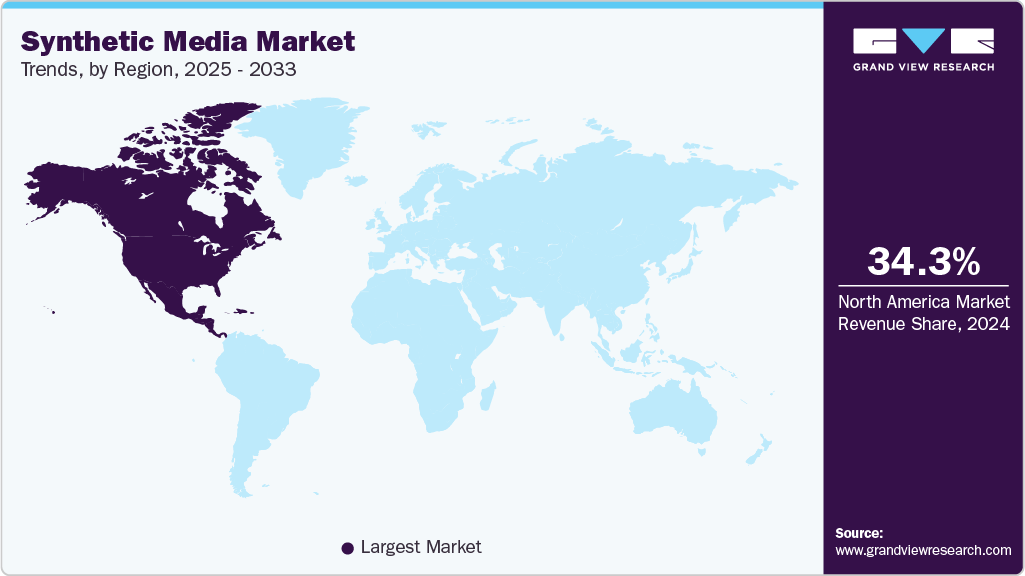 To learn more about this report, Download Free Sample Report
 U.S. Synthetic Media Market Trends
The synthetic media market in the U.S. is expected to grow at a significant CAGR during the forecast period, driven by smooth and fast advancements in AI and machine learning, which make it possible to produce hyper-realistic, personalized synthetic content at scale. The country’s strong media and entertainment sector promotes widespread use of AI-powered content creation tools, while significant investments in AI R&D continue to produce better innovation. Meanwhile, recent U.S. impositions on hardware components offered strategies for cost optimization and adapting hybrid cloud solutions, affecting supply chains but also promoting innovation in the synthetic media industry.
Europe Synthetic Media Market Trends
The synthetic media market in Europe is anticipated to witness at a steady CAGR over the forecast period,due to the strict regulatory standards, such as the region’s strong data protection laws and ethical AI directives, which drive investment in privacy-focused and explainable synthetic media solutions. There is a strong focus on creating transparent, responsible AI systems to promote trust and meet compliance requirements. Moreover, Europe’s focus on delivering interactive experiences is increasing the growth of augmented and virtual reality in the market, such as in gaming and entertainment. The market is further supported by a diverse audience, including businesses, educational institutions, and creative professionals who are adopting synthetic media for personalized content, interactive storytelling, and scalable production processes.
Asia Pacific Synthetic Media Market Trends
The synthetic media market in the Asia Pacific is anticipated to grow at the fastest CAGR over the forecast period, led by the rapid digital transformation and high levels of content consumption, with major economies such as China, India, Japan, and South Korea making substantial investments in AI-driven content creation and personalization. Both government initiatives and private sector funding are accelerating the adoption of generative AI technologies, including AI-powered dubbing for international media and virtual influencers. In new markets, synthetic media helps address infrastructure limitations by prioritizing mobile-friendly entertainment and interactive educational content.
Key Synthetic Media Company Insights
Some key companies in the synthetic media industry include DataRobot, Microsoft, IBM, Baidu, Inc. ABB.
-
DataRobot is an AI and machine learning platform provider dedicated to enhancing business outcomes through AI. Its platform streamlines the entire AI lifecycle from data preparation to model training and deployment, making it especially valuable for synthetic media use cases that demand scalable, data-driven content creation. DataRobot also prioritizes transparency and interpretability in its AI models, which is essential for the ethical development of synthetic media.
-
Synthesis AI, a San Francisco-based tech company, is developing synthetic data solutions to move computer vision and perception AI forward. By merging generative AI with advanced cinematic CGI workflows, they produce large volumes of photorealistic, precisely labeled synthetic images and videos on demand. Their platform caters to a wide range of applications, including biometrics, AR/VR, virtual try-on, driver monitoring, and security, enabling faster, scalable, and privacy-friendly AI training.
Key Synthetic Media Companies:
The following are the leading companies in the synthetic media market. These companies collectively hold the largest market share and dictate industry trends.
- IBM
- Microsoft
- Synthesis AI, Inc.
- NVIDIA Corporation
- Deepbrain AI.
- Baidu, Inc.
- Adobe
- DataRobot, Inc.
- OpenAI
Recent Developments
-
In July 2025, Baidu launched MuseStreamer, its latest AI-powered video generator designed to transform content creation for business users. This innovative tool enables rapid production of short videos from images, streamlining advertising and digital marketing efforts. By using advanced generative AI, MuseStreamer offers scalable, cost-effective solutions for enterprises seeking engaging and personalized video content.
-
In June 2025, Adobe launched its new AI-driven image generation app for smartphones, further enhancing its portfolio of creative tools with advanced generative AI features. This app empowers users to effortlessly produce high-quality, customizable images, fostering creativity wherever they are. Additionally, Adobe revealed new collaborations to embed AI capabilities across its platforms, with the goal of transforming digital content creation.
-
In March 2025, NVIDIA introduced its Physical AI Data Tools and Cosmos World Foundation Models (WFMs), allowing developers to generate synthetic worlds for physical AI use cases. Built on the NVIDIA Cosmos platforms and Omniverse, these solutions enable the large-scale creation of photorealistic synthetic data, making the training faster and smoother for robotics and autonomous vehicle systems.
-
In January 2024, DeepBrain AI introduced the cloud-based SaaS solution for deepfake detection. This platform can identify manipulated images, videos, and AI-generated voices across four languages such as Korean, English, Chinese, and Japanese. By using advanced frequency and time-domain analysis, it detects deepfake methods such as face generation, face swapping, lip syncing, and synthetic speech. With interest surging from government bodies and media organizations, especially ahead of key elections in South Korea and the U.S., DeepBrain AI is focused on addressing the growing threat of deepfake misuse.
Synthetic Media Market Report Scope
Report Attribute
Details
Market size in 2024
USD 5.1 billion
Estimated market size in 2026
USD 6.6 billion
Projected market size by 2033
USD 21.7 billion
Growth rate
CAGR of 18.1% from 2025 to 2033
Base year for estimation
2024
Historical data
2021 - 2023
Forecast period
2025 - 2033
Quantitative units
Revenue in USD million/billion & CAGR from 2025 to 2033
Report coverage
Revenue forecast, company ranking, competitive landscape, growth factors, and trends
Segments covered
Component, technology, application, regional
Regional scope
North America; Europe; Asia Pacific; Latin America; MEA
Country scope
U.S.; Canada; UK; Germany; France; China; India; Japan; South Korea; Australia; Brazil; Mexico; KSA; UAE; South Africa
Key companies profiled
IBM; Microsoft; Synthesis AI, Inc.; NVIDIA Corporation; Deepbrain AI.; Baidu, Inc.; Adobe; DataRobot, Inc.; OpenAI; Google
Customization scope
Free report customization (equivalent up to 8 analysts working days) with purchase. Addition or alteration to the country, regional, and segment scope.
Pricing and purchase options
Avail customized purchase options to meet your exact research needs. Explore purchase options
Global Synthetic Media Market Report Segmentation
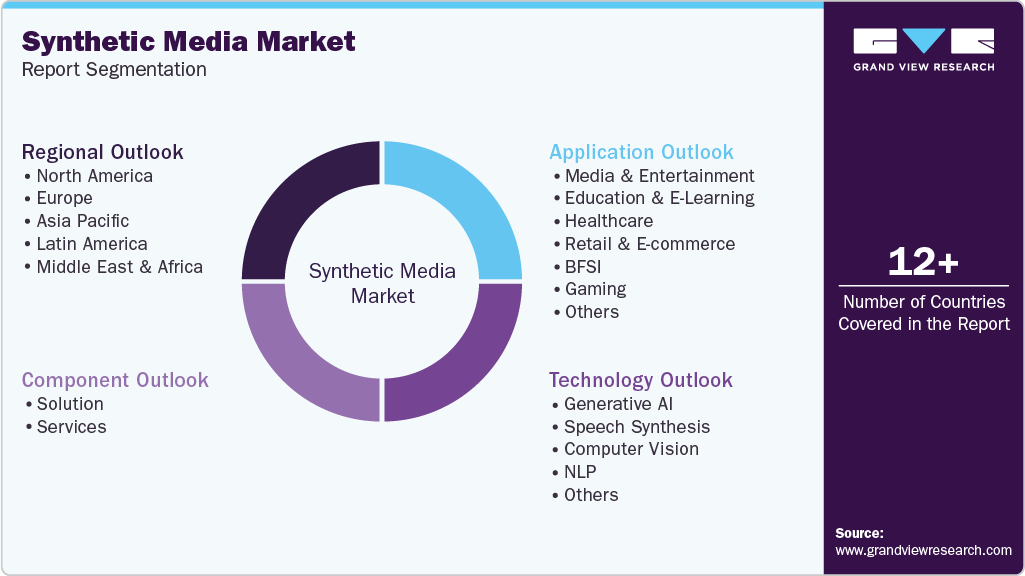
This report forecasts revenue growth on global, regional, and country levels and provides an analysis of the industry trends in each of the sub-segments from 2021 to 2033. For this study, Grand View Research has segmented the global synthetic media market report based on the component, technology, application, and region:
 To learn more about this report, Download Free Sample Report
 -
Component Outlook (Revenue, USD Million, 2021 - 2033)
-
Solution
-
Services
-
-
Technology Outlook (Revenue, USD Million, 2021 - 2033)
-
Generative AI
-
Speech Synthesis
-
Computer Vision
-
NLP
-
Others
-
-
Application Outlook (Revenue, USD Million, 2021 - 2033)
-
Media & Entertainment
-
Education & E-Learning
-
Healthcare
-
Retail & E-commerce
-
BFSI
-
Gaming
-
IT & Telecom
-
Others
-
-
Regional Outlook (Revenue, USD Million, 2021 - 2033)
-
North America
-
U.S.
-
Canada
-
Mexico
-
-
Europe
-
UK
-
Germany
-
France
-
-
Asia Pacific
-
China
-
India
-
Japan
-
South Korea
-
Australia
-
-
Latin America
-
Brazil
-
-
Middle East and Africa
-
KSA
-
UAE
-
South Africa
-
-
Frequently Asked Questions About This Report
The global synthetic media market size was valued at USD 5.1 billion in 2024 and is estimated at USD 6.6 billion for 2026.
Some key players operating in the synthetic media market include Key companies profiled IBM; Microsoft; Synthesis AI, Inc.; NVIDIA Corporation; Deepbrain AI.; Baidu, Inc.; Adobe; DataRobot, Inc.; OpenAI; Google
Key factors that are driving the market growth is driven synthetic media consists of the production and using of content which is generated artificially such as text, media, video and audio which is further generated with the help of advanced technologies.
The global synthetic media market is expected to grow at a CAGR of 18.1% from 2025 to 2033, reaching USD 21.7 billion by 2033.
North America dominated with a revenue share of 34.3% in 2024.
About the Author(s)
Next Generation Technologies Research Team
Technology · Next Generation TechnologiesThis report was authored by the next generation technologies research team at Grand View Research - comprising two research analysts, one senior research analyst, and one industry expert - with specialized expertise in the next generation technologies segment of the technology industry. All findings are based on proprietary technology databases, executive interviews, and regulatory analysis, subject to internal peer review prior to publication.
Last Updated:
Speak to Analyst

Customize this report to your needs - add regions, segments, or data points, with 20% free customization.
Or view our licence options:


ISO 9001:2015 & 27001:2022 Certified
We are GDPR and CCPA compliant! Your transaction & personal information is safe and secure. For more details, please read our privacy policy.


