
- Home
- »
- Advanced Materials
- »
-
Tamping Machine Market Size, Share & Trends Report, 2033GVR Report cover
![Tamping Machine Market Size, Share & Trends Report]()
Tamping Machine Market (2026 - 2033) Size, Share & Trends Analysis Report By Type (Plain-Line Tamping Machines, Universal Tamping Machines), By Application (Construction, Maintenance), By Configuration, By End Use, By Region And Segment Forecasts
Market Size, 2025
$3.8BMarket Estimate, 2026
$3.9BMarket Forecast, 2033
$5.0BCAGR, 2026–2033
3.7%Tamping Machine Market Summary
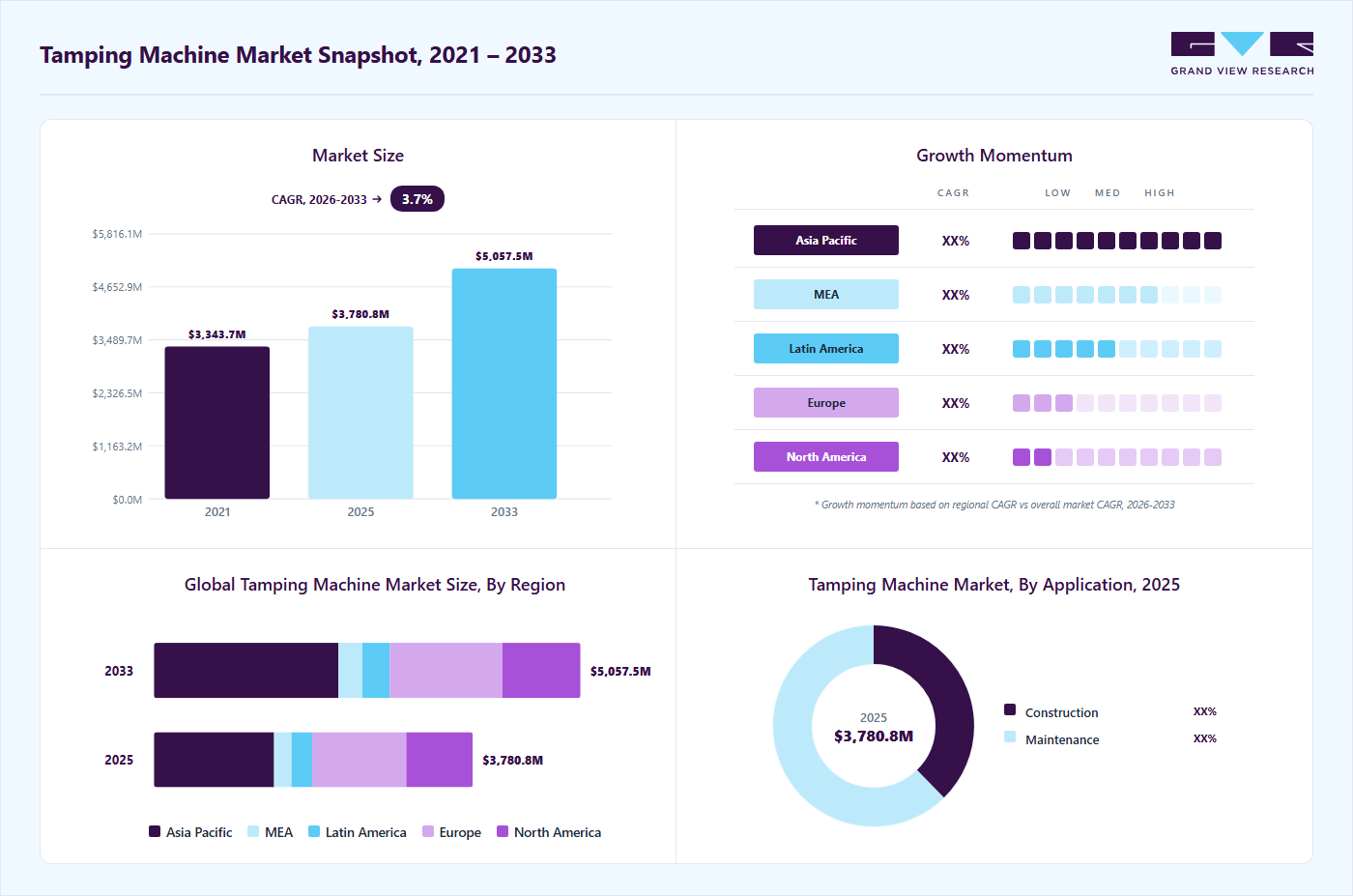
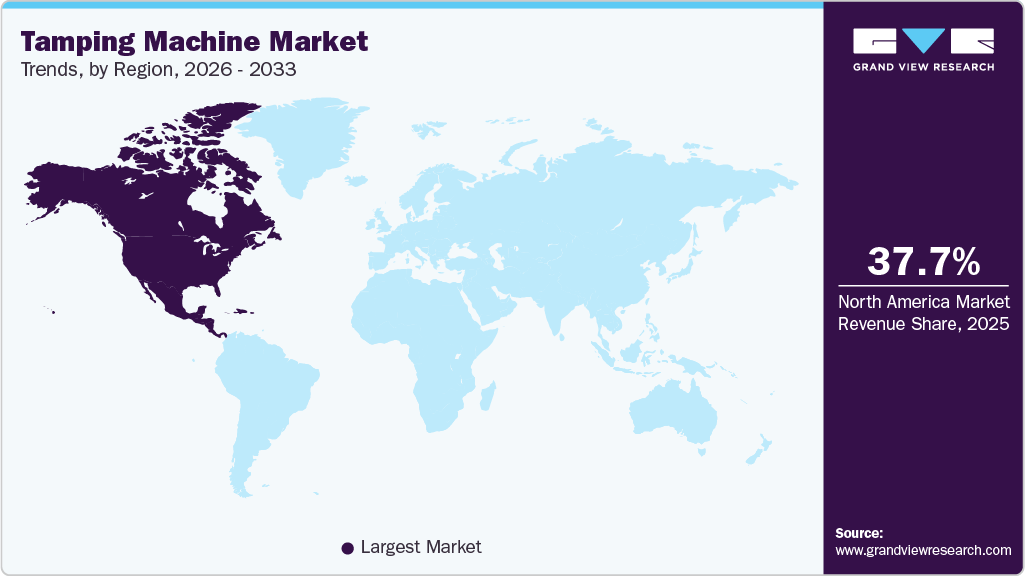
The global tamping machine market size was valued at USD 3.8 billion in 2025 and is projected to grow from USD 3.9 billion in 2026 to USD 5.0 billion by 2033, at a CAGR of 3.7% from 2026 to 2033. The Asia Pacific held the largest share of 37.7% of the global market in 2025. The global tamping machine industry is experiencing steady growth, supported by the continuous expansion and modernization of railway infrastructure worldwide.
Key Market Trends & Insights
- By type: Universal tamping machine segment held the largest market share of 51.8% in 2025.
- By application: Maintenance segment held the largest market share of 62.4% in 2025.
- By configuration: Single-sleeper segment held the largest market share of 51.6% in 2025.
- By end use: Rail operators segment held the largest market share of 67.4% in 2025.
Regional Highlights
- Largest regional market: Asia Pacific (37.7% revenue share, 2025)
- Fastest-growing regional market: Asia Pacific (highest CAGR, 2026-2033)
- By country: China held the largest market share in 2025.
Market Size & Forecast
- Market size in 2025: USD 3.8 Billion
- Estimated market size in 2026: USD 3.9 Billion
- Projected market size by 2033: USD 5.0 Billion
- CAGR (2026-2033): 3.7%
Tamping machines are essential for maintaining track geometry by packing ballast under railway sleepers, thereby ensuring operational safety, ride comfort, and higher train speeds. As governments and private operators prioritize reliable, efficient rail networks for passenger and freight transport, demand for advanced tamping solutions across construction and maintenance activities is growing.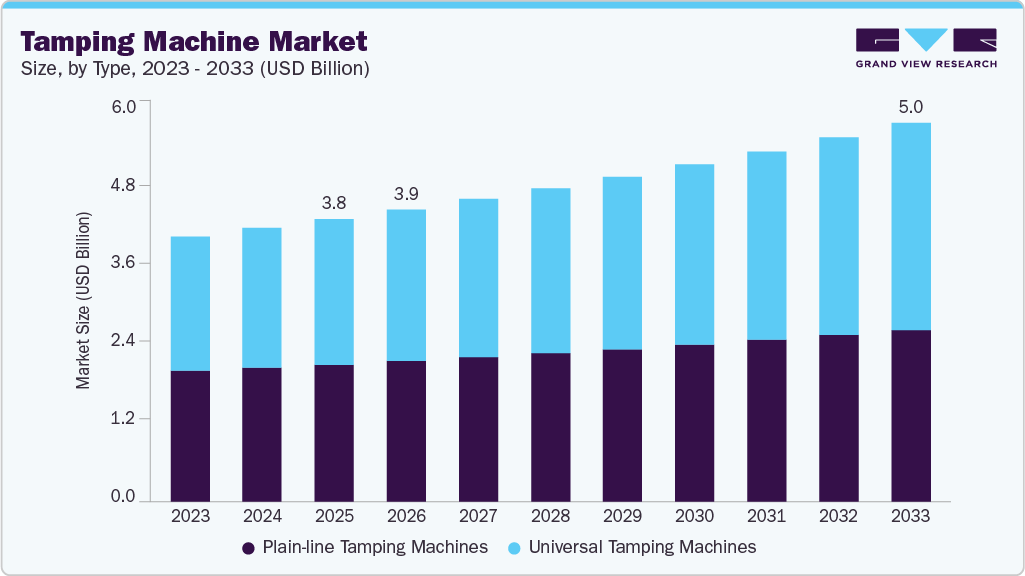
The integration of digital monitoring systems, automation, and precision control technologies is improving tamping accuracy and reducing human intervention, encouraging fleet upgrades. The rising emphasis on predictive maintenance strategies is further driving the adoption of high-performance machines capable of handling complex track geometries.
Market Concentration & Characteristics
The tamping machine industry is moderately fragmented, with the presence of several global and regional manufacturers competing across railway maintenance projects. Established players focus on technological innovation, automation, and high-performance equipment, while smaller regional companies offer cost-effective solutions for local rail networks. Market competition is influenced by infrastructure investments, product reliability, after-sales services, and customization capabilities, leading to diversified supplier participation across developed and emerging railway markets.
The tamping machine industry is experiencing innovation driven by the need for efficient railway maintenance and operational safety. Manufacturers are integrating automation, GPS-based track alignment systems, and digital monitoring technologies to improve precision and productivity. Advanced hydraulic systems and predictive maintenance solutions are also being adopted to reduce downtime, enhance track stability, and optimize railway maintenance operations.
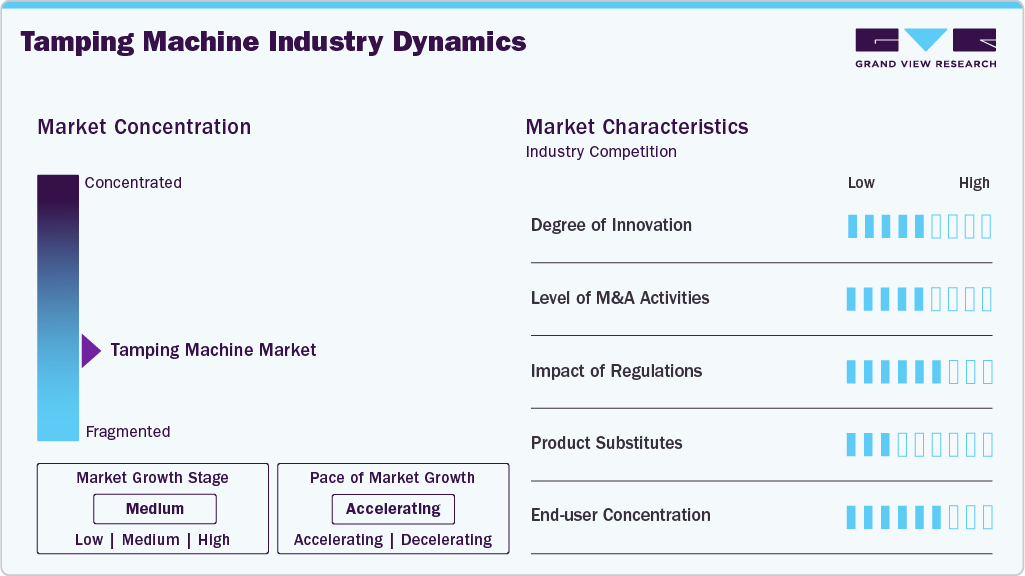
Merger and acquisition activities in the tamping machine industry are focused on expanding technological capabilities and strengthening regional presence. Key players are acquiring specialized rail equipment manufacturers and service providers to enhance product portfolios and maintenance solutions. These strategic partnerships enable companies to improve service networks, access new railway infrastructure projects, and increase competitiveness in global rail maintenance markets.
Regulations related to railway safety, infrastructure quality, and maintenance standards are significantly shaping the tamping machine industry. Governments and railway authorities mandate regular track inspection and maintenance to ensure operational safety and reliability. Compliance with stringent rail safety norms is encouraging the adoption of advanced tamping machines with improved accuracy, automation, and environmental performance, supporting the modernization of railway maintenance operations worldwide.
Drivers, Opportunities & Restraints
The primary growth drivers include expanding railway infrastructure and the rising need for structured track maintenance. Urbanization and intercity rail projects are increasing new track construction, driving demand for plain-line and universal tamping machines. At the same time, aging rail networks, particularly in developed regions, require regular ballast correction to maintain safety and performance. Moreover, public funding and long-term modernization programs further support steady procurement by rail operators and contractors.
The tamping machine industry presents significant opportunities through the expansion of high-speed rail corridors, metro rail systems, and dedicated freight networks, particularly across the Asia Pacific and the Middle East. Emerging economies are investing in new railway lines to enhance trade connectivity and urban mobility, creating sustained demand for both construction and maintenance equipment. The increasing adoption of automated, digitally integrated tamping machines also offers growth potential, as rail operators seek precision, reduced labor dependence, and faster turnaround during maintenance windows.
The high capital costs associated with advanced railway maintenance equipment, which limit adoption among smaller rail operators, are a significant challenge in the market. In addition, maintenance complexity and the requirement for skilled operators increase operational expenses. Irregular railway infrastructure investments and project delays in developing regions further affect equipment demand and market growth stability.
Type Insights
The universal tamping machines segment led the market with the largest revenue share of 51.4% in 2025 and is projected to grow at the fastest CAGR during the forecast period, owing to high demand for versatile railway maintenance equipment capable of handling switches, crossings, and plain tracks. The expansion of railway modernization projects and the need for efficient, multi-functional maintenance solutions are encouraging rail operators to adopt universal tamping machines to improve operational flexibility and reduce maintenance time.
The plain-line tamping machine segment is anticipated to grow at a significant CAGR during the forecast period, as investments in mainline railway infrastructure and track renewal projects rise. These machines are widely used for routine maintenance of straight railway tracks, ensuring track stability and safety. Growing rail traffic and continuous track maintenance requirements are supporting demand for high-performance plain-line tamping equipment.
Application Insights
The maintenance segment led the market with the largest revenue share of 62.4% in 2025 and is anticipated to grow at the fastest CAGR during the forecast period, driven by increasing emphasis on routine track inspection and maintenance to ensure railway safety and operational efficiency. Rising rail traffic and aging railway infrastructure are encouraging railway operators to invest in advanced tamping machines for routine maintenance activities and track stabilization.
The construction segment is projected to grow at a significant CAGR during the forecast period, as investments in new railway lines, metro systems, and high-speed rail projects worldwide expand. Tamping machines play a critical role during track installation by ensuring proper ballast compaction and alignment, supporting efficient railway construction, and improving long-term track performance and durability.
Configuration Insights
The single-sleeper segment led the market with the largest revenue share of 51.6% in 2025, driven by its suitability for precision maintenance tasks and operations in complex track sections such as switches and crossings. The increasing demand for targeted maintenance and greater flexibility in urban rail and metro networks is driving the adoption of single-sleeper configurations.
The multi-sleeper tamping machines segment is anticipated to grow at the fastest CAGR over the forecast period, owing to its high productivity and efficiency in large-scale railway maintenance projects. These machines enable simultaneous tamping of multiple sleepers, reducing operational time and labor costs, making them ideal for mainline railways and high-traffic rail corridors.
End Use Insights
The rail operators segment led the market with the largest revenue share of 67.4% in 2025, as railway authorities increasingly invest in advanced maintenance equipment to ensure track safety and operational efficiency. Rising passenger and freight traffic is driving demand for routine track maintenance, prompting rail operators to adopt modern tamping machines to improve performance and reduce downtime.
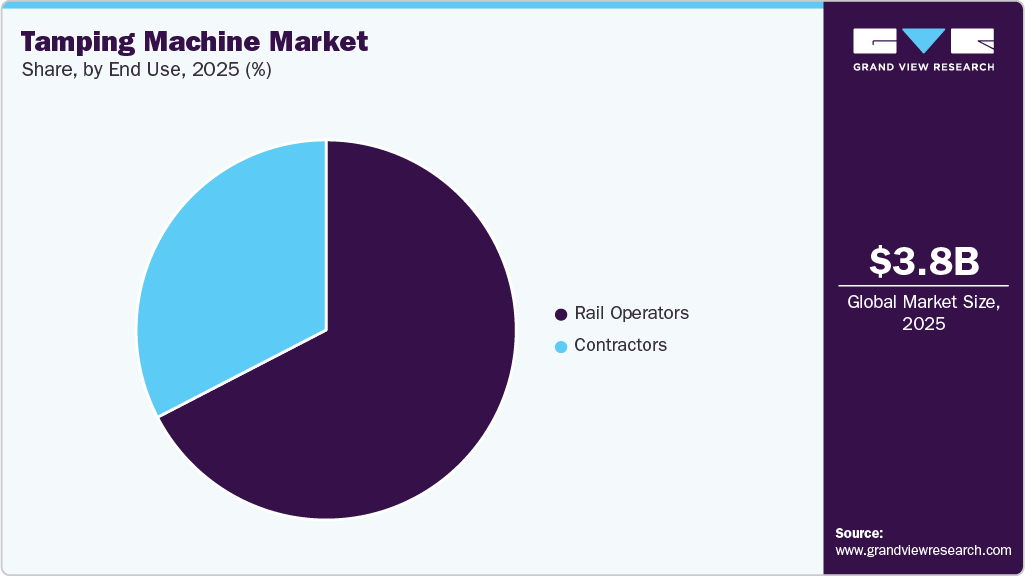
The contractors segment is projected to grow at the fastest CAGR during the forecast period, driven by increased outsourcing of railway construction and maintenance activities. Governments and rail authorities are engaging specialized contractors for infrastructure expansion and track renewal projects. This trend is boosting demand among contractors for high-performance tamping machines to enhance project efficiency and meet strict maintenance timelines.
Regional Insights
The tamping machine market in North America is anticipated to grow at a moderate CAGR during the forecast period. The increasing investments in railway modernization and freight corridor upgrades is fueling the market in North America. Aging rail infrastructure across the U.S. and Canada requires continuous maintenance, boosting demand for advanced tamping equipment. The adoption of automated track maintenance technologies and the rising focus on railway safety and operational efficiency are further supporting regional market expansion.
U.S. Tamping Machine Market Trends
The tamping machine market in the U.S. is growing due to significant investments in freight rail network maintenance and passenger rail improvement programs. For instance, in January 2026, BNSF Railway announced a USD 3.6 billion capital investment plan for 2026, with USD 2.8 billion allocated to network maintenance, supporting track renewal, infrastructure reliability, and improved freight rail operational efficiency. Expansion of rail logistics and rehabilitation of aging tracks are increasing the demand for high-performance tamping machines. Technological adoption, including automated and precision track alignment systems, is helping railway operators improve maintenance efficiency and reduce operational disruptions.
Asia Pacific Tamping Machine Market Trends
Asia Pacific dominated the global tamping machine market with the largest revenue share of 38.4% in 2025 and is projected to grow at the fastest CAGR during the forecast period, due to rapid railway expansion, urban transit development, and high-speed rail projects. Countries across the region are investing heavily in rail infrastructure to support economic growth and mobility needs. Rising maintenance requirements for expanding rail networks are significantly increasing demand for tamping machines.
The tamping machine market in China accounted for the largest market revenue share in the Asia Pacific in 2025, due to the continuous expansion of high-speed rail and freight railway networks. Large-scale infrastructure investments and regular track maintenance programs are driving equipment demand. Adoption of advanced automated tamping technologies is helping improve maintenance efficiency and ensure operational safety across extensive railway systems.
The India tamping machine market is witnessing strong growth, supported by railway electrification, track doubling, and modernization initiatives. Increasing investments in freight corridors, metro rail systems, and high-speed rail projects are boosting demand for advanced maintenance machinery. For instance, in February 2026 Indian Government approved three railway infrastructure projects worth covering eight districts across four states to enhance rail capacity and connectivity. The projects include doubling of the Gondia–Jabalpur section and construction of third and fourth rail lines between Punarakh–Kiul and Gamharia–Chandil, supporting improved freight and passenger operations
Europe Tamping Machine Market Trends
The tamping machine market in Europe is experiencing strong growth, supported by extensive railway modernization and expansion of high-speed rail networks. Strict rail safety standards and regular maintenance requirements are encouraging the adoption of advanced tamping technologies. Investments in sustainable rail transportation and cross-border rail connectivity projects continue to drive equipment demand across the region.
The Germany tamping machine market is supported by continuous investments in rail infrastructure upgrades and maintenance programs. The country’s advanced railway network requires precise and efficient maintenance equipment to ensure operational reliability. Increasing adoption of automated tamping machines and digital monitoring systems is supporting efficient track maintenance and long-term infrastructure performance.
The tamping machine market in the UK is expanding as railway authorities focus on improving network reliability and reducing service disruptions. Ongoing rail modernization and track renewal projects are driving demand for advanced maintenance equipment. Increasing investments in commuter rail and metro infrastructure, along with strict safety and maintenance standards, are supporting market growth.
Latin America Tamping Machine Market Trends
The tamping machine market in Latin America is witnessing moderate growth due to railway rehabilitation and freight transport improvement initiatives. Governments are investing in upgrading aging rail infrastructure to enhance logistics efficiency. Increasing maintenance requirements and expansion of regional rail connectivity projects are driving the adoption of tamping machines.
The Brazil tamping machine market is growing, driven by rising investments in freight railway modernization and mining transport corridors. The expansion of rail networks supporting agriculture and industrial logistics is increasing the need for routine track maintenance. Adoption of advanced tamping equipment is helping railway operators improve operational efficiency and infrastructure reliability. In June 2025, Brazil announced the expansion of railway infrastructure through projects such as the West-East Integration Railway (FIOL) and the proposed Transoceanic Railway to improve the efficiency of commodity transportation. These initiatives aim to reduce logistics costs, strengthen export connectivity, and enhance trade integration with Asian markets by establishing faster and more cost-effective transport corridors.
Middle East & Africa Tamping Machine Market Trends
The tamping machine market in the Middle East and Africa is growing rapidly, due to expanding railway infrastructure and urban transit projects. Governments are investing in rail networks to improve connectivity and economic diversification. The increased focus on maintaining newly developed rail lines is driving demand for efficient tamping machines across regional railway projects.
The Saudi Arabia tamping machine market is expanding with growing investments in railway infrastructure and freight transport networks. The development of intercity rail and metro projects is increasing the demand for advanced track maintenance equipment. The need to ensure long-term rail performance and operational safety is encouraging the adoption of modern tamping machines. In October 2025, Saudi Arabia initiated construction of the USD 7 billion Landbridge railway, the region’s first sea-to-sea rail corridor connecting Jeddah on the Red Sea to Dammam on the Arabian Gulf. The project aims to enhance freight and passenger transportation, strengthen logistics connectivity, and support industrial and trade development across major economic hubs.
Key Tamping Machine Company Insights
Some of the key players operating in the market include Plasser & Theurer and CRRC Corporation Limited, among others.
-
Plasser & Theurer is an Austria-based manufacturer specializing in railway track construction and maintenance machinery, including tamping machines. The company develops advanced equipment designed for precise track alignment, ballast compaction, and efficient maintenance operations. Its solutions support modernization, automation, and improved operational reliability of railway infrastructure across global rail networks.
-
CRRC Corporation Limited is a China-based railway equipment manufacturer producing rail transportation and maintenance machinery, including tamping machines. The company provides equipment for railway construction, inspection, and maintenance applications. With extensive manufacturing capabilities and technological development, CRRC supports expanding railway infrastructure and maintenance requirements across domestic and international markets.
Key Tamping Machine Companies:
The following key companies have been profiled for this study on the tamping machine market.
- Plasser & Theurer
- Harsco Rail
- CRRC Corporation Limited
- MATISA (Matisa Group)
- Robel Bahnbaumaschinen GmbH
- System7 Rail Holding GmbH
- Gemac Engineering Machinery Co., Ltd.
- Sinara Transport Machines
- Beijing Yan Hong Da Railway Equipment Co., Ltd.
- China Railway Construction High-Tech Equipment Corporation (CRCHI)
- Loram Maintenance of Way
- GRITS - Geismar Rail Industry Technologies & Services)
- Salcef Group S.p.A.
- Track Machines Connected Gesellschaft m.b.H.
- Remputmash Group
Recent Developments
-
In October 2025, Rhomberg Sersa Australia expanded its railway maintenance fleet with the launch of the M612 tamping machine, designed to enhance track stabilization and alignment efficiency. The addition supports improved railway maintenance productivity and strengthens operational capabilities for large-scale rail infrastructure projects across Australia.
-
In August 2024, STM unveiled the PMA-3 tamping machine, designed to improve railway track maintenance efficiency through enhanced tamping accuracy and operational performance. The machine supports effective ballast compaction and track alignment, helping railway operators achieve improved safety, reliability, and maintenance productivity.
Tamping Machine Market Report Scope
Report Attribute
Details
Market size in 2025
USD 3.8 billion
Estimated market size in 2026
USD 3.9 billion
Projected market size by 2033
USD 5.0 billion
Growth rate
CAGR of 3.7% from 2026 to 2033
Base year for estimation
2025
Historical data
2021 - 2024
Forecast period
2026 - 2033
Quantitative units
Revenue in USD million/billion and CAGR from 2026 to 2033
Report coverage
Revenue forecast, company market position analysis, competitive landscape, growth factors, and trends
Segments covered
Type, application, configuration, end use, region
Regional scope
North America; Europe; Asia Pacific; Latin America; Middle East & Africa
Country Scope
U.S.; Canada; Mexico; UK; Germany; France; Italy; Spain; China; India; Japan; South Korea; Australia; Brazil;
Argentina; South Africa; Saudi Arabia; UAE
Key companies profiled
Plasser & Theurer; Harsco Rail; CRRC Corporation Limited; MATISA (Matisa Group); Robel Bahnbaumaschinen GmbH; System7 Rail Holding GmbH; Gemac Engineering Machinery Co., Ltd.; Sinara Transport Machines; Beijing Yan Hong Da Railway Equipment Co., Ltd.; China Railway Construction High-Tech Equipment Corporation (CRCHI); Loram Maintenance of Way; GRITS – Geismar Rail Industry Technologies & Services; Salcef Group S.p.A.; Track Machines Connected Gesellschaft m.b.H.; Remputmash Group
Customization scope
Free report customization (equivalent up to 8 analysts working days) with purchase. Addition or alteration to country, regional & segment scope.
Pricing and purchase options
Avail customized purchase options to meet your exact research needs. Explore purchase options
Global Tamping Machine Market Report Segmentation
This report forecasts revenue growth at global, regional & country levels and provides an analysis on the industry trends in each of the sub-segments from 2021 to 2033. For this study, Grand View Research has segmented the global tamping machine market report based on the type, application, configuration, end use, and region:
-
Type Outlook (Revenue, USD Million, 2021 - 2033)
-
Plain-line tamping machines
-
Universal tamping machines
-
-
Application Outlook (Revenue, USD Million, 2021 - 2033)
-
Construction
-
Maintenance
-
-
Configuration (Revenue, USD Million, 2021 - 2033)
-
Single sleeper
-
Multi-sleeper
-
-
End Use (Revenue, USD Million, 2021 - 2033)
-
Rail Operators
-
Contractors
-
-
Regional Outlook (Revenue, USD Million, 2021 - 2033)
-
North America
-
U.S.
-
Canada
-
Mexico
-
-
Europe
-
UK
-
Germany
-
France
-
Italy
-
Spain
-
-
Asia Pacific
-
China
-
India
-
Japan
-
South Korea
-
Australia
-
-
Latin America
-
Brazil
-
Argentina
-
-
Middle East & Africa
-
South Africa
-
Saudi Arabia
-
UAE
-
-
Frequently Asked Questions About This Report
The global tamping machine market size was valued at USD 3.8 billion in 2025 and is estimated at USD 3.9 billion in 2026.
Some of the key players operating in the tamping machine market Plasser & Theurer, Harsco Rail, CRRC Corporation Limited, MATISA (Matisa Group), Robel Bahnbaumaschinen GmbH, System7 Rail Holding GmbH, Gemac Engineering Machinery Co., Ltd., Sinara Transport Machines, Beijing Yan Hong Da Railway Equipment Co., Ltd., China Railway Construction High-Tech Equipment Corporation (CRCHI), Loram Maintenance of Way, GRITS – Geismar Rail Industry Technologies & Services, Salcef Group S.p.A., Track Machines Connected Gesellschaft m.b.H., Remputmash Group.
The tamping machine market is driven by increasing railway infrastructure investments, rising demand for efficient track maintenance, expansion of high-speed rail networks, growing freight transportation, and strict railway safety and operational reliability requirements.
Asia Pacific is projected to grow at the fastest CAGR during the forecast period from 2026 to 2033.
The universal tamping machine segment led the market with the largest revenue share of 51.4% in 2025 and is also projected to grow at the fastest CAGR during the forecast period.
The maintenance segment held the largest revenue share of 62.4% in 2025 and is expected to remain the fastest-growing segment over the forecast period.
The single-sleeper segment accounted for the largest revenue share of 51.6% in 2025, while the multi-sleeper tamping machines segment is anticipated to grow at the fastest CAGR over the forecast period.
The rail operators segment held the largest revenue share of 67.4% in 2025, while the contractors segment is projected to grow at the fastest CAGR during the forecast period.
The global tamping machine market is expected to grow at a CAGR of 3.7% from 2026 to 2033, reaching USD 5.0 billion by 2033.
Asia Pacific dominated the global tamping machine market with a revenue share of 37.7% in 2025.
About the Author(s)
Advanced Materials Research Team
Research · Advanced MaterialsThis report was authored by the advanced materials research team at Grand View Research - comprising two research analysts, one senior research analyst, and one industry expert - with specialized expertise in the advanced materials segment of the research industry. All findings are based on proprietary research databases, executive interviews, and regulatory analysis, subject to internal peer review prior to publication.
Last Updated:
Speak to Analyst


Customize this report to your needs — add regions, segments, or data points, with 20% free customization.
Or view our licence options:


ISO 9001:2015 & 27001:2022 Certified
We are GDPR and CCPA compliant! Your transaction & personal information is safe and secure. For more details, please read our privacy policy.


