
- Home
- »
- Healthcare IT
- »
-
Tele-monitoring Services Market Size Report, 2026-2033GVR Report cover

Tele-monitoring Services Market (2026 - 2033)
Size, Share & Trends Analysis Report By Application (Primary Care, Mental Health), By Service, By Payment Model, By Device, By Facility, By End-use (Patients, Payers), By Region, And Segment Forecasts
Market Size, 2025
$24.4BMarket Estimate, 2026
$29.9BMarket Forecast, 2033
$104.5BCAGR, 2026–2033
19.6%Tele-monitoring Services Market Summary
The global tele-monitoring services market size was valued at USD 24.4 billion in 2025 and is projected to grow from USD 29.9 billion in 2026 to USD 104.5 billion by 2033, at a CAGR of 19.6% from 2026 to 2033. North America dominated the market, accounting for a revenue share of 34.4% in 2025. Tele-monitoring services enable patients to connect with healthcare providers 24/7 from remote locations, enhancing patient engagement and facilitating personalized care right at home.
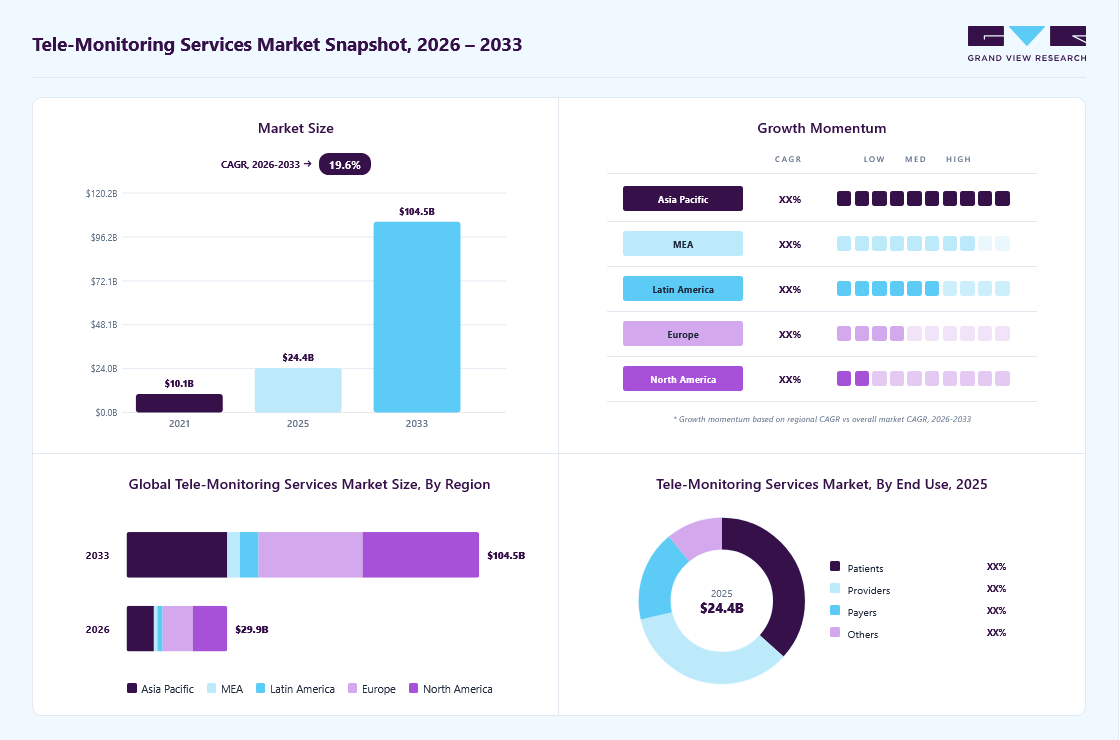 Source: Grand View Research, IR Documents, Primary Interviews, Paid DatabasesTo learn more about this report,
 Download Free Sample Report
Key Market Trends & Insights
- By application: Mental health segment dominated the market, with a revenue share of 36.2% in 2025.
- By service: Remote patient monitoring (RPM) segment held the largest market share of 50.1% in 2025.
- By payment model: Government/public payers segment held the largest revenue share of 40.2% in 2025.
- By device: Wearables/remote sensor segment accounted for the largest revenue share of 58.7% in 2025.
- By facility: Tele-hospitals segment dominated the market, with a revenue share of 50.9% in 2025.
- By end use: Patients segment held the largest market share of 36.6% in 2025.
Regional Highlights
- Largest regional market: North America (34.4% revenue share, 2025)
- Fastest-growing regional market: Asia Pacific (highest CAGR, 2026-2033)
- By country: The U.S. held the largest market share in 2025.
Market Size & Forecast
- Market size in 2025: USD 24.4 Billion
- Estimated market size in 2026: USD 29.9 Billion
- Projected market size by 2033: USD 104.5 Billion
- CAGR (2026-2033): 19.6%
Prism AI by Grand View Research Free to tryAsk a question about the tele-monitoring services marketTry asking✓Every figure cited from GVR research Prefer the report? Download free sample →
This technology-driven healthcare approach utilizes Bluetooth connectivity to integrate at-home monitoring devices with user-friendly software, allowing remote patient observation and assessment. Many healthcare environments benefit from telemonitoring, and home health agencies have experienced notable improvements in their clinical, operational, and financial performance. A home health agency (HHA) is an organization-public or private-that provides skilled nursing and other therapy services directly to patients in their homes instead of in traditional healthcare facilities. For example, the Southcoast Health Visiting Nurse Association (VNA) reduced its annual in-home nursing visits by an average of four. Utilizing remote patient monitoring in collaboration with Health Recovery Solutions maintained a readmission rate of 7% for more than 2,600 patients. To learn more about this report, Download Free Sample Report
Furthermore, the increasing shift toward home-based and outpatient care demands real-time, intelligent health monitoring solutions. Companies are increasingly investing in developing advanced monitoring tools powered by AI, thereby benefiting patients from enhanced quality care and encouraging providers to adopt these technologies.
Following are some of the investments made by companies,
Company
Year
Months
Investment in USD Million
Description
VitalConnect, Inc.
2025
February
100
VitalConnect, Inc., which focuses on ambulatory cardiac monitoring, has secured USD 100 million in funding. Ally Bridge Group led this financing round, which was substantially financed by the company’s current investors, such as MVM, Revelation Partners, and EW Healthcare Partners.
Doccla
2024
September
38.6
Doccla, a provider of remote patient monitoring services and virtual wards, received USD 38.6 million in a Series B funding round. The new funding permits Doccia to grow across Europe, particularly France and the DACH countries (Austria, Switzerland, and Germany), while expanding beyond Europe.
General Prognostics
2022
September
3.25
General Prognostics, a medical device startup, raised USD 3.25 million in a seed funding round to introduce a wearable monitoring device that noninvasively tracks blood biomarkers and mitigates heart failure problems.
The growing prevalence of anxiety and depression disorders and growing awareness of mental health are significantly contributing to market expansion. Tele-monitoring solutions offer remote tracking and management of mental health conditions, making them an essential tool in addressing the rising demand for accessible and continuous care. According to the World Health Organization (WHO), an estimated 3.8% of the global population experienced depression in 2023, including 5% of adults (6% among women and 4% among men) and 5.7% of adults aged 60 years and older. As mental health issues become more widespread, the adoption of tele-monitoring technologies is accelerating, particularly due to their ability to provide real-time patient data, enhance clinical decision-making, and improve treatment adherence outside traditional healthcare settings.
 To learn more about this report, Download Free Sample Report
The rising prevalence of chronic illnesses, including diabetes, cardiovascular and neurological disorders, as well as respiratory issues, is increasing the demand for effective monitoring solutions. Artificial intelligence (AI) is essential in RPM systems by processing large volumes of data from wearable devices such as fitness trackers, smartwatches, wearable ECG monitors, and continuous glucose monitors. This analysis helps identify health trends and alerts healthcare providers before a patient's condition worsens. Furthermore, these devices lead to considerable cost savings for healthcare providers and patients. By facilitating early detection and intervention, AI-powered RPM systems help minimize the need for emergency visits and hospital admissions, ultimately lowering healthcare costs.
Furthermore, AI streamlines routine activities such as data analysis and alert generation, enabling healthcare professionals to save more time on patient care. This improved operational efficiency optimizes resource use and enhances the overall quality of healthcare services. For instance, in January 2022, OMRON Healthcare, Inc., a remote blood pressure monitoring provider and personal health technology, launched new remote patient monitoring services at the 2022 Consumer Electronics Show (CES), showcasing connected blood pressure monitors and an advanced mobile application.
Market Dynamics
The tele monitoring services market is experiencing significant growth due to the increasing prevalence of chronic diseases such as cardiovascular disorders, diabetes, chronic respiratory diseases, and hypertension, coupled with the rapidly aging global population that requires continuous health monitoring. Tele monitoring services enable healthcare providers to remotely track patients’ vital signs, detect early signs of deterioration, and intervene promptly, reducing hospital admissions and improving clinical outcomes. The growing preference for home-based care, supported by advancements in connected medical devices, wearable technologies, cloud computing, artificial intelligence (AI), and secure digital health platforms, has further accelerated the adoption of these services. Governments and healthcare organizations across several countries are also promoting telehealth and remote patient monitoring through favorable reimbursement policies, digital health initiatives, and investments in healthcare infrastructure to improve access to care and reduce healthcare costs.
The growing adoption of remote patient monitoring (RPM) is a major driver of the tele monitoring services market. Healthcare providers are increasingly shifting toward continuous, home-based patient monitoring to improve clinical outcomes, reduce hospital readmissions, and optimize healthcare resources. Tele monitoring services enable clinicians to remotely track patients' vital signs, identify early signs of deterioration, and deliver timely interventions, particularly for individuals with chronic diseases, post-acute conditions, and the elderly. The increasing availability of connected medical devices, wearable biosensors, cloud-based platforms, and artificial intelligence (AI) has enhanced the efficiency and scalability of tele monitoring services, allowing providers to deliver personalized care beyond traditional healthcare settings. As healthcare systems continue to prioritize value-based care and hospital-at-home models, demand for comprehensive tele monitoring services is expected to accelerate significantly.
• In June 2026, Prevounce Health announced that patients had transmitted more than 25 million vital readings through its Pylo remote patient monitoring devices. The milestone reflected the accelerating adoption of remote patient monitoring services, enabling continuous patient surveillance, AI-driven clinical insights, and earlier interventions to improve care outcomes.
• In September 2024, Doccla secured USD 38.6 million in a Series B funding round to expand its virtual ward and remote patient monitoring services across Europe. The investment supported geographic expansion, strengthened its presence in life sciences, and enhanced technology-enabled home-based patient monitoring and clinical care delivery.
The adoption of tele monitoring services is constrained by growing concerns regarding data privacy, cybersecurity, and compliance with healthcare regulations. These services rely on the continuous collection, transmission, and storage of sensitive patient health information through connected medical devices, cloud-based platforms, and mobile applications, making them vulnerable to cyberattacks, data breaches, ransomware incidents, and unauthorized access. As tele monitoring services expand across healthcare systems, providers must comply with stringent data protection regulations, such as the Health Insurance Portability and Accountability Act (HIPAA) in the U.S. and the General Data Protection Regulation (GDPR) in Europe, which require substantial investments in secure IT infrastructure, encryption technologies, and regulatory compliance. In January 2025, the U.S. Food and Drug Administration issued a safety communication warning of cybersecurity vulnerabilities in Contec CMS8000 and Epsimed MN-120 patient monitors.
The expansion of hospital-at-home and virtual care programs presents a significant growth opportunity for the tele monitoring services market. Healthcare systems worldwide are increasingly adopting home-based care models to reduce hospital overcrowding, lower treatment costs, and improve patient satisfaction while delivering hospital-level care in non-traditional settings. Advancements in connected medical devices, wearable sensors, artificial intelligence (AI), and cloud-based analytics have further enhanced the ability of providers to manage acute and chronic conditions outside hospital settings. In February 2024, GE HealthCare expanded its Care at Home solutions by integrating remote patient monitoring technologies, AI-enabled analytics, and virtual care capabilities to support healthcare providers in managing patients outside traditional hospital settings, thereby improving care coordination and reducing hospital readmissions.
Case Study: Nurse-Led Telemonitoring for Complex Chronic Disease Management in Canada
Background
Patients with complex chronic conditions often require continuous monitoring and coordinated care, particularly those experiencing coexisting mental health disorders such as anxiety and depression. To address these challenges, a study published in JMIR Nursing (April 2022) evaluated the integration of telemonitoring into a nurse-led care model in Canada. The initiative aimed to improve continuity of care, enhance patient self-management, and reduce avoidable healthcare utilization through remote monitoring.
Objective
To assess the effectiveness of nurse-led telemonitoring in improving clinical outcomes, patient engagement, mental well-being, and healthcare resource utilization among patients with complex chronic conditions.
Program Implementation
The telemonitoring program incorporated the following components:
Component
Description
Patient Population
Individuals with multiple chronic conditions, including cardiovascular disease, diabetes, and associated mental health disorders.
Monitoring Technology
Digital telemonitoring devices captured blood pressure, blood glucose, body weight, and other disease-specific health parameters.
Data Transmission
Patient data were securely transmitted in real time to healthcare providers through a connected telemonitoring platform.
Clinical Oversight
Nursing teams reviewed patient data daily, identified abnormalities, and conducted follow-up consultations via telephone or video conferencing.
Care Model
Nurses provided clinical guidance, patient education, medication support, lifestyle counseling, and psychological reassurance while coordinating ongoing care with physicians when necessary.
Key Outcomes
Outcome Area
Impact
Improved Chronic Disease Management
Enhanced control of key clinical indicators, including blood pressure and blood glucose levels, through continuous monitoring and timely clinical interventions.
Better Mental Health Outcomes
Participants reported lower levels of anxiety and depression due to regular communication, improved confidence in self-management, and continuous clinical support.
Higher Patient Engagement & Satisfaction
Frequent interactions with nursing teams increased patient engagement, strengthened trust, and improved adherence to treatment plans.
Reduced Healthcare Utilization
Early identification of clinical deterioration contributed to fewer emergency department visits and hospital admissions, reducing overall healthcare system burden.
Success Factors
• Continuous remote monitoring enabled early identification of health deterioration.
• Nurse-led care improved care coordination and personalized patient support.
• Real-time data sharing facilitated timely clinical decision-making.
• Virtual follow-up improved patient adherence while reducing unnecessary in-person visits.
• Integration of physical and mental healthcare enhanced overall patient outcomes.
Strategic Implications
The Canadian nurse-led telemonitoring model demonstrates the potential of remote patient monitoring to improve chronic disease management while reducing healthcare costs and resource utilization. The case highlights the growing role of nursing professionals, connected medical devices, and digital health platforms in delivering proactive, patient-centric care. As healthcare systems continue to shift toward value-based and home-based care models, similar telemonitoring programs are expected to support scalable, cost-effective, and clinically effective chronic disease management globally.
Market Concentration & Characteristics
The global tele-monitoring services industry is characterized by a high degree of innovation, owing to the development of technologically advanced solutions driven by factors such as advancements in artificial intelligence (AI) functionalities. For instance, in January 2024, Apollo Hospital Seshadripuram partnered with LifeSigns, an AI-powered health monitoring technology provider. This initiative aims to enhance patient care by implementing an advanced monitoring system that tracks vital signs, including ECG, blood pressure, and SpO2.
The tele-monitoring services industry is characterized by a high level of merger and acquisition (M&A) activity by the leading players, owing to several factors, including the desire to expand the business to cater to the growing demand for monitoring solutions and to maintain a competitive edge. In April 2024, OMRON Healthcare, Co., Ltd. acquired Luscii Healthtech, a digital health and remote consultation platform provider, to expand access to remote patient monitoring services.
 To learn more about this report, Download Free Sample Report
Regulations such as HIPAA in the U.S. and GDPR in Europe set guidelines for protecting the privacy and security of patient data. Compliance with these regulations is essential for telemonitoring solutions in healthcare, as it ensures the safe and secure management of patient information, thereby minimizing the risk of data breaches and unauthorized access.
Market players are expanding their business by entering new geographical regions and launching new tools to strengthen their market position and expand their product portfolio. For instance, in October 2024, Newfoundland and Labrador (NL) Health Services launched Halo, a telemonitoring solution implemented in four acute care hospitals and healthcare centers across the Eastern Rural region. This technology is designed to remotely track eligible patients and notify care providers of potential health risks.
Analyst Perspective
The tele-monitoring services market is driven by the increasing prevalence of chronic diseases such as cardiovascular disorders, diabetes, respiratory diseases, and hypertension, along with the growing demand for continuous remote patient monitoring and home-based healthcare. Technological advancements in wearable medical devices, connected sensors, artificial intelligence (AI), cloud-based platforms, and Internet of Medical Things (IoMT) technologies are accelerating market growth. Furthermore, the expanding aging population, rising healthcare expenditure, increasing adoption of telehealth services, and favorable reimbursement policies are supporting the widespread adoption of tele-monitoring services across healthcare settings.
Application Insights
Based on application, the mental health segment led the market with the largest revenue share of 36.2% in 2025. The growing shift from conventional care approaches to more personalized, patient-focused approaches drives the rise of tele-monitoring services for mental health. The increase in suicide rates has fueled the expansion of the mental health industry. This expansion is attributed to a growing recognition of mental health concerns, resulting in an increased need for readily available support options. Moreover, the rise in funding to develop various mental health services highlights the substantial growth opportunities within this market. The National Institute of Mental Health (NIMH) is the federal agency for research on mental disorders in the U.S. Following is the funding history of NIMH,
 To learn more about this report, Download Free Sample Report
Cardiology is anticipated to grow at the fastest CAGR over the forecast period, owing to the global prevalence of cardiovascular diseases (CVDs). Tele-monitoring enables real-time tracking of vital signs such as blood pressure, heart rate, and ECG, facilitating early diagnosis and timely medical intervention. This improves patient outcomes and helps reduce hospital readmissions and emergency visits, making it a highly cost-effective solution for patients and healthcare systems. For instance, in May 2025, Octagos, a company focused on AI-driven cardiac remote monitoring, launched OctaLink, a novel clinical companion mobile app. This app is designed to enhance clinicians' mobility while maintaining robust functionality. Its user-friendly mobile interface enables care teams to efficiently review, triage, and respond without any delays.
Service Insights
Based on service, the remote patient monitoring (RPM) segment led the market with the largest revenue share of 50.1% in 2025 and is anticipated to grow at the fastest CAGR over the forecast period. Remote monitoring systems enhance chronic disease management by providing early warning signs and progress tracking, leading to increased demand on a global scale during the forecast period. Moreover, the rising partnerships among healthcare organizations to improve patient monitoring initiatives are anticipated to drive market growth. For instance, in August 2023, EPIC Health collaborated with OMRON Healthcare, Inc. to tackle health disparities in Detroit, U.S. As part of this partnership, OMRON Healthcare plans to implement VitalSight, a remote patient monitoring service to diagnose patients with high blood pressure, especially those with uncontrolled Stage 2 hypertension.
Chronic disease management is anticipated to grow at a significant CAGR over the forecast period, owing to the prevalence of chronic conditions such as diabetes, hypertension, heart failure, chronic obstructive pulmonary disease (COPD), and asthma. These long-term illnesses require continuous care, monitoring, and timely intervention to prevent complications and hospitalizations. Telemonitoring offers a proactive approach by enabling healthcare providers to remotely track patients’ health metrics and intervene when abnormalities are detected, ultimately enhancing patient outcomes and quality of life. For instance, in July 2024, TeleMedCare, a company specializing in telehealth technology, launched a remote monitoring program for chronic patients in partnership with a leading health insurance and service provider in the U.S. This initiative targets patients with chronic illnesses. The first pilot phase involves 300 individuals suffering from chronic conditions, including congestive heart failure (CHF), COPD, diabetes, and hypertension.
Payment Model Insights
Based on payment model, the government/public payers segment led the market with the largest revenue share of 40.2% in 2025. Government and public payers are significant in funding and regulating tele-monitoring services. Key public payers include Medicare, Medicaid, and state-level health insurance programs. These payers ensure access to tele-monitoring services for vulnerable populations and set reimbursement policies. For example, Medicare Plus Blue is a Medicare Advantage plan that ensures coverage at least equivalent to Original Medicare (Part A and Part B) while offering additional benefits beyond what Original Medicare provides, all within one healthcare plan. This flexibility enables Blue Cross to develop enhanced plans by incorporating Original Medicare as a foundational program and including various benefit options. Members who qualify and choose to participate in the Chronic Condition Management program receive coverage for remote patient monitoring (telemonitoring) across all individual and group Medicare Plus Blue PPO plans.
Insurance reimbursement is anticipated to grow at the fastest CAGR over the forecast period. Insurance companies are increasingly reimbursed for tele-monitoring (remote patient monitoring or RPM) services. This is through various methods, including fee-for-service, where the provider is paid for each service rendered, or bundled payments, where a single fee covers a range of services. Companies such as CoachCare and RemetricHealth provide reimbursement for remote patient monitoring services.
Device Insights
Based on device, the wearables/remote sensor segment led the market with the largest revenue share of 58.7% in 2025 and is anticipated to grow at the fastest CAGR over the forecast period. Similar to most digital technologies, the adoption of wearable devices varies according to socioeconomic factors, such as income, education, and occupation. The rise in strategic alliances and the increasing demand for health monitoring features in wearable devices drive the segment growth. For instance, in April 2024, Royal Philips, a health technology company, partnered with smartQare, a provider of patient monitoring solutions, to integrate smartQare's solution, viQtor, with Philips' clinical patient monitoring systems. This partnership is designed to facilitate the future of continuous patient monitoring, both inside and outside hospitals, starting in Europe.
The mobile devices segment is expected to grow significantly during the forecast period. Mobile devices, such as smartphones and smartwatches, are increasingly used in remote patient monitoring (RPM) to collect and transmit health data, enhancing healthcare delivery and patient engagement. These devices provide clinicians with valuable insights into a patient's health status, enabling them to make informed decisions regarding care and treatment. Thus, such factors are expected to boost the segment growth over the forecast period.
Facility Insights
Based on facility, the tele-hospitals segment led the market with the largest revenue share of 50.9% in 2025. There is an increasing demand for continuous patient monitoring and remote management of chronic conditions, particularly in regions with limited access to specialized healthcare. Tele-hospitals enable centralized monitoring of patients across multiple locations, thereby addressing disparities in healthcare access and improving outcomes through timely interventions.
Examples of Hospitals with RPM Services:
-
Johns Hopkins Medicine: Offers Care at Home services with a long history of using remote monitoring technology.
-
University of Virginia Health System (UVA Health): Launched multiple RPM programs for chronic care patients.
-
Goshen Health: Uses RPM for post-acute care.
-
Cleveland Clinic: Collaborates with Masimo for hospital-based RPM, including TeleCritical Care.
The tele-home segment is expected to grow at a fastest rate during the forecast period. Technological advancements in wearable devices, mobile health applications, and secure data transmission platforms are accelerating the adoption of tele-home monitoring. These innovations have made it easier to gather, transmit, and analyze patient data in real-time, allowing for early detection of health issues and proactive medical interventions. Integrating electronic health records and AI-driven analytics enhances care coordination, making tele-home a suitable long-term solution for personalized and preventive healthcare delivery.
End-use Insights
Based on end use, the patients segment led the market with the largest revenue share of 36.6% in 2025. Patients are increasingly aware and accepting of wearable health technology and mobile health applications. These tools allow real-time monitoring of vital signs such as blood pressure, heart rate, oxygen saturation, and glucose levels. When integrated with tele-monitoring platforms, they provide continuous data streams that are analyzed for early signs of complications. Patients value the reassurance of continuously monitoring and receiving timely feedback from healthcare providers, improving treatment adherence and health outcomes. Such factors boost the segment growth.
 To learn more about this report, Download Free Sample Report
The providers segment is expected to grow fastest during the forecast period, owing to rising chronic disease prevalence, increasing demand for personalized and cost-effective care, and advancements in wearable and telehealth technologies. RPM offers ongoing, real-time health monitoring and facilitates the early identification of complications, which helps reduce hospitalizations and enhance patient outcomes. For instance, in November 2023, Cera Care, the AI-driven home healthcare provider, is set to assist the UK government and hospitals save USD 114.52 this winter by conducting five million care visits.
Regional Insights
North America dominated the tele-monitoring services market with the largest revenue share of 34.4% in 2025. Numerous factors, such as growth in coverage networks, rapid smartphone usage, changes in lifestyle, and growing health consciousness among people, are expected to drive the adoption of tele-monitoring services in North America. North America is one of the very first regions to adopt smart healthcare solutions that include various technologies, such as smart wearables, mobile apps, and eHealth services such as telemedicine & Electronic Health Record (EHR) services, for remote access to information on serious and chronic healthcare conditions.
 To learn more about this report, Download Free Sample Report
U.S. Tele-monitoring Services Market Trends
The market in the U.S. held the largest share in the North America region in 2025 due to innovative software development and advanced healthcare management. For instance, in April 2025, Validic, an intelligent digital health solutions provider, partnered with Tenovi, a connected care provider, to enhance the accessibility and effectiveness of remote patient monitoring (RPM) programs. This partnership allows healthcare organizations to provide a seamless, scalable, cost-effective RPM experience for patients and care teams, focusing on rural and underserved areas.
Europe Tele-monitoring Services Market Trends
The tele-monitoring services market in Europe is expected to grow significantly over the forecast period. The UK, Germany, Norway, and Spain have emerged as key contributors to Europe's telemonitoring market growth. Favorable government policies and an increased focus on digital health infrastructure drive this expansion. For instance, in June 2023, the European Commission invested nearly USD 1.40 billion in mental health initiatives across the 27-member European Union. This funding highlights a broader commitment to integrating digital solutions such as telemonitoring platforms into national health systems, thereby reinforcing the role of remote monitoring technologies in enhancing healthcare delivery and patient outcomes.
The UK tele-monitoring services industry is expected to grow significantly during the forecast period, as there is a significant expenditure on health. The rising demand for mobile healthcare applications among consumers in the UK is anticipated to boost market growth. Several health technology companies are collaborating with academic institutions, healthcare professionals, and policymakers to develop telemonitoring solutions that cater to the needs of both patients and clinicians. For instance, in January 2023, Viso, an Omron Healthcare remote patient monitoring service, was introduced in the UK. It enables patients to make informed decisions to improve their health while seamlessly sharing data with clinicians to support more effective, personalized care.
Asia Pacific Tele-monitoring Services Market Trends
The tele-monitoring services industry in Asia Pacific is expected to register the fastest growth rate over the forecast period. Several countries in the region are adopting digital and mobile health technologies to ensure better outcomes and manage healthcare delivery. Thus, such initiatives are projected to boost the adoption of telemonitoring solutions over the forecast period. In addition, the widespread adoption of smartphones and improved Internet connectivity has made telemonitoring services more accessible to a broader audience. According to The Mobile Economy 2023 by GSMA, unique mobile subscriptions in Asia Pacific reached 1.73 billion by the end of 2022, estimated to reach 2.11 billion by 2023.
Japan tele-monitoring services market is anticipated to register significant growth during the forecast period. The market growth is attributed to the country's growing strategic alliances. For instance, in January 2024, Nihon Kohden, a MedTech company, introduced RemoteSense, a remote patient monitoring solution developed to assist healthcare providers in responding to staffing shortages and providing high-quality patient care.
Latin America Tele-monitoring Services Market Trends
The tele-monitoring services market in Latin America is anticipated to grow considerably over the forecast period. Government support for expanding telehealth and digital health networks is boosting market growth. For instance, the telemedicine network in Bolivia provided improved access to specialty care in health centers using tele-education and teleconsultation. Moreover, the high prevalence of chronic diseases, such as cardiovascular disease, arthritis, and cancer, necessitates ongoing medical supervision, and rising investments are fueling the demand for telehealth in Latin America.
Brazil tele-monitoring services market is anticipated to register lucrative growth during the forecast period. Increasing smartphone penetration and internet connectivity have made tele-monitoring services more accessible to a broader population. As per the Kepios estimates, in January 2022, Brazil had 165.3 million internet users. This indicates a large pool of users turning to digital health tools.
Middle East and Africa Tele-monitoring Services Market Trends
The tele-monitoring services market in the MEA is anticipated to grow considerably over the forecast period. With the increasing penetration of smartphones and government initiatives, entrepreneurs and healthcare professionals are inclined toward smartphones for better and healthier lifestyles. In addition, the rising awareness regarding digital health among people has increased the potential for market growth.
UAE tele-monitoring services industry is anticipated to register considerable growth during the forecast period. In February 2023, Emirates Health Services (EHS) introduced its IT Innovation Strategy for 2023-2026, with the primary objective of modernizing healthcare delivery and fostering a culture of innovation within the organization. This strategic plan helps respond to the ever-changing healthcare landscape, aiming to enhance sustainability and bolster internal capabilities over the next few years.
Key Tele-Monitoring Services Company Insights
Key participants in the tele-monitoring services industry are focusing on devising innovative business growth strategies, such as expanding their product portfolios, partnerships and collaborations, mergers and acquisitions, and business footprints.
Key Tele-monitoring Services Companies:
The following key companies have been profiled for this study on the tele-monitoring services market.
-
OMRON Healthcare, Inc.
-
Philips Healthcare
-
Teladoc Health, Inc.
-
AMD Global Telemedicine
-
Koninklijke Philips N.V
-
Twilio Inc.
-
Nihon Kohden Corporation
-
Medtronic
-
GE Healthcare
-
TeleMedCare
Competitive Benchmarking
Category
Operating Strategies
Competitive Edge
Weakness
Established Players (e.g., OMRON Healthcare, Inc., Philips Healthcare, Teladoc Health, Inc., AMD Global Telemedicine, Koninklijke Philips N.V., Twilio Inc., Nihon Kohden Corporation, Medtronic, GE HealthCare, TeleMedCare)
- Invest in AI-powered remote patient monitoring (RPM) platforms, connected medical devices, cloud-based tele-monitoring infrastructure, and integration with electronic health records (EHRs). Strengthen capabilities through partnerships, acquisitions, and collaborations with hospitals, health systems, insurers, and digital health providers while expanding chronic disease management and home healthcare services.
- Strong global presence, comprehensive tele-monitoring ecosystems, established relationships with healthcare providers, broad product and service portfolios, advanced data analytics and AI capabilities, robust regulatory expertise, and scalable cloud-based platforms.
- High implementation and operational costs, complex integration with legacy healthcare IT systems, dependence on reimbursement policies and healthcare regulations, cybersecurity and data privacy risks, and longer sales and deployment cycles for large healthcare organizations.
Emerging Players (e.g., CoachCare, Prevounce Health, Biofourmis, Current Health, Health Recovery Solutions)
- Develop specialized remote patient monitoring platforms focused on chronic disease management, AI-driven predictive analytics, mobile health applications, and virtual care solutions. Emphasize rapid product innovation, customizable SaaS platforms, and partnerships with hospitals, physician practices, and home healthcare providers.
- High agility, faster innovation cycles, customized disease-specific monitoring solutions, flexible deployment models, strong patient engagement tools, and the ability to quickly adapt to evolving clinical and provider requirements.
- Limited global footprint, smaller customer base, lower brand recognition, limited financial resources, challenges in scaling internationally, and greater reliance on strategic partnerships and external funding for expansion.
Recent Developments
-
In February 2025, BioIntelliSense, a company specializing in clinical intelligence, partnered with Hicuity Health, a provider of virtual care services, to deliver comprehensive, fully managed, continuous patient monitoring for hospitals and healthcare systems. This collaboration tackles significant infrastructure and staffing challenges that these facilities encounter. It enables them to implement reliable and scalable monitoring solutions for in-hospital care, hospital-at-home programs, post-discharge management, and chronic remote care.
-
In May 2024, LG Electronics introduced a new Primefocus Health initiative to develop a healthcare delivery platform for providers. This platform will utilize various technologies and therapies to enhance remote patient monitoring and provide patients access to innovative treatments through tech applications.
Tele-monitoring Services Market Report Scope
Report Attribute
Details
Market size in 2025
USD 24.4 billion
Estimated market size in 2026
USD 29.9 billion
Projected market size by 2033
USD 104.5 billion
Growth rate
CAGR of 19.6% from 2026 to 2033
Historical data
2021 - 2025
Forecast period
2026 - 2033
Quantitative units
Revenue in USD billion and CAGR from 2026 to 2033
Report coverage
Revenue forecast, company ranking, competitive landscape, growth factors, and trends
Segments covered
Application, Services, payment model, device, facility, end use, region
Regional scope
North America; Europe; Asia Pacific; Latin America; MEA
Country scope
U.S.; Canada; Mexico; Germany; UK; France; Italy; Spain; Norway; Denmark; Sweden; China; Japan; India; South Korea; Australia; Thailand; Brazil; Argentina; Saudi Arabia; South Africa; UAE; Kuwait
Key companies profiled
OMRON Healthcare, Inc., Philips Healthcare, Teladoc Health, Inc., AMD Global Telemedicine, Koninklijke Philips N.V., Twilio Inc., Nihon Kohden Corporation, Medtronic, GE Healthcare, TeleMedCare
Customization scope
Free report customization (equivalent up to 8 analysts' working days) with purchasse. Addition or alteration to country, regional & segment scope.
Pricing and purchase options
Avail customized purchase options to meet your exact research needs. Explore purchase options
Global Tele-monitoring Services Market Report Segmentation
This report forecasts revenue growth and provides at the global, regional, and country levels an analysis of the latest trends in each of the sub-segments from 2021 to 2033. For this report, Grand View Research has segmented the global tele-monitoring services market report based on application, service, payment model, device, facility, end-use, and region:
-
Application Outlook (Revenue USD Million, 2021 - 2033)
-
Primary Care
-
Mental Health
-
Cardiology
-
Dermatology
-
Others (Endocrinology, Orthopedics, Gynecology, etc.)
-
-
Service Outlook (Revenue USD Million, 2021 - 2033)
-
Remote Patient Monitoring (RPM)
-
Chronic Disease Management
-
Post-Operative Monitoring
-
-
Payment Model Outlook (Revenue USD Million, 2021 - 2033)
-
Self-Pay (Out-of-pocket)
-
Insurance Reimbursement
-
Employer-sponsored
-
Government/Public Payers
-
Others
-
-
Device Outlook (Revenue USD Million, 2021 - 2033)
-
Wearables/Remote Sensor
-
Mobile Devices
-
-
Facility Outlook (Revenue USD Million, 2021 - 2033)
-
Tele-hospitals
-
Tele-home
-
-
End-use Outlook (Revenue USD Million, 2021 - 2033)
-
Patients
-
Payers
-
Providers
-
Others
-
-
Regional Outlook (Revenue, USD Million, 2021 - 2033)
-
North America
-
U.S.
-
Canada
-
Mexico
-
-
Europe
-
UK
-
Germany
-
France
-
Italy
-
Spain
-
Denmark
-
Sweden
-
Norway
-
-
Asia Pacific
-
Japan
-
China
-
India
-
Australia
-
South Korea
-
Thailand
-
-
Latin America
-
Brazil
-
Argentina
-
-
Middle East & Africa
-
South Africa
-
Saudi Arabia
-
UAE
-
Kuwait
-
-
Research Methodology
The tele-monitoring services market figures in this report are based on a proven research process that combines executive interviews with secondary research from proprietary databases, company filings, and recognized regulatory and institutional sources. Market size is built through value-chain sizing - reconciling supply-side and demand-side estimates - and triangulated with bottom-up and top-down approaches. Every estimate passes multiple levels of expert validation before publication, with each tele-monitoring services segment quantified using the revenue-capture definitions in the table below.
Segment Definition
Segment - Application
Revenue capture definition
Primary Care
Tele monitoring services used to deliver routine healthcare, preventive care, chronic disease follow-ups, and general medical consultations. These services enable continuous patient monitoring while improving access to primary healthcare providers.
Mental Health
Tele monitoring services designed to support mental and behavioral healthcare through remote assessment, symptom tracking, medication adherence, and virtual follow-up for conditions such as anxiety, depression, and other psychiatric disorders.
Cardiology
Remote monitoring services that continuously track cardiovascular health using connected devices to monitor parameters such as heart rate, blood pressure, and cardiac rhythm, enabling early detection of potential complications.
Dermatology
Tele monitoring services that facilitate remote assessment and follow-up of skin conditions through digital images, virtual consultations, and ongoing monitoring of treatment outcomes.
Others (Endocrinology, Orthopedics, Gynecology, etc.)
Tele monitoring services supporting specialty care by enabling remote management of endocrine disorders, musculoskeletal conditions, women's health, and other clinical specialties through continuous patient monitoring and virtual care.
Segment - Service
Revenue capture definition
Remote Patient Monitoring (RPM)
A tele monitoring service that uses connected medical devices and digital platforms to collect, transmit, and analyze patient health data in real time, allowing healthcare providers to monitor patients remotely and intervene when necessary.
Chronic Disease Management
Tele monitoring services focused on the long-term management of chronic conditions such as diabetes, hypertension, heart failure, and COPD through continuous monitoring, patient education, and regular clinical follow-up.
Post-Operative Monitoring
Remote monitoring services that track patients after surgical procedures to assess recovery, detect complications early, monitor wound healing, and reduce unnecessary hospital readmissions.
Segment - Payment Model
Revenue capture definition
Self-Pay (Out-of-pocket)
A reimbursement model in which patients directly pay for tele monitoring services without financial support from insurance providers or government healthcare programs.
Insurance Reimbursement
A payment model where private health insurance companies reimburse healthcare providers for eligible tele monitoring services based on policy coverage and reimbursement guidelines.
Employer-sponsored
Tele monitoring services funded through employer-sponsored health benefit programs to support employee wellness, chronic disease management, and preventive healthcare initiatives.
Government/Public Payers
Tele monitoring services reimbursed through government-funded healthcare programs or public insurance schemes, improving access to remote healthcare for eligible populations.
Others (Reimbursement)
Includes alternative reimbursement approaches such as subscription-based models, bundled payments, value-based care agreements, and other customized payment arrangements.
Segment - Device / Technology
Revenue capture definition
Wearables/Remote Sensor
Connected wearable devices and remote sensors that continuously collect physiological data, including heart rate, blood pressure, blood glucose, oxygen saturation, and activity levels, for remote clinical monitoring.
Mobile Devices
Smartphones and tablets used to support tele monitoring services by enabling patients to record health data, communicate with healthcare providers, receive alerts, and access digital health applications.
Segment - Facility
Revenue capture definition
Tele-hospitals
Hospital-based tele monitoring programs that enable clinicians to remotely monitor admitted or recently discharged patients, improving care coordination and supporting virtual hospital models.
Tele-home
Tele monitoring services delivered directly to patients in their homes, allowing continuous health monitoring while reducing hospital visits and supporting independent living.
Segment - End Use
Revenue capture definition
Patients
Individuals receive tele monitoring services for disease management, recovery monitoring, preventive care, or long-term health supervision from their homes or other remote settings.
Payers
Public and private organizations, including insurance companies and government agencies, finance or reimburse tele monitoring services to improve healthcare outcomes and reduce costs.
Providers
Hospitals, clinics, physician groups, home healthcare agencies, and telehealth organizations that deliver tele monitoring services using digital health technologies and remote clinical teams.
Others (End User)
Includes research organizations, long-term care facilities, nursing homes, employers, and academic institutions that utilize tele monitoring services for healthcare delivery, research, or employee health programs.
Estimation Model
The tele monitoring services market is estimated using a triangulated analytical framework that combines bottom-up, demand-side, and supply-side approaches. The objective is to estimate the market size and segment-wise revenue by validating results across multiple independent analytical models. The study integrates primary interviews, secondary research, industry benchmarks, reimbursement data, and modeled assumptions to develop a comprehensive assessment of the global tele monitoring services market.
Model 1: Remote Patient Monitoring (RPM) Utilization Model
This model estimates market revenue based on the adoption of tele monitoring services across healthcare settings.
Approach: Bottom-up demand estimation
Key Inputs:
-
Number of patients enrolled in remote monitoring programs
-
Prevalence of chronic diseases requiring continuous monitoring
-
Adoption rate of tele monitoring services
-
Average annual revenue generated per monitored patient
-
Care setting distribution (home healthcare, hospitals, ambulatory care)
Method:
Market revenue is estimated by calculating the number of patients using tele monitoring services across different clinical applications and multiplying it by the average annual revenue generated per monitored patient.
Model 2: Provider and Service Revenue Model
This model estimates revenue generated by healthcare providers and tele monitoring service vendors.
Approach: Supply-side service revenue modeling
Key Inputs:
-
Number of healthcare providers offering tele monitoring services
-
Average number of monitored patients per provider
-
Monthly monitoring service fees
-
Reimbursement rates for remote monitoring programs
-
Service contract and subscription revenues
Method:
Market size is derived by estimating the revenue generated through patient monitoring subscriptions, provider service contracts, reimbursement payments, and clinical monitoring services.
Model 3: Digital Health Infrastructure Model
This model estimates revenue generated from digital platforms supporting tele monitoring services.
Approach: Ecosystem-based modeling
Key Inputs:
-
Adoption of remote patient monitoring platforms
-
Connected medical device utilization
-
Cloud-based monitoring platform subscriptions
-
AI-enabled patient monitoring services
-
Healthcare SaaS licensing revenue
Method:
Revenue is estimated from digital health platforms, remote monitoring software, clinical monitoring centers, analytics solutions, and platform licensing that support tele monitoring service delivery.
Data Inputs
The analysis is based on a combination of:
-
Remote patient monitoring adoption statistics
-
Hospital and home healthcare utilization data
-
Digital health platform reports and company annual reports
-
Government reimbursement policies for tele monitoring services
-
Healthcare provider surveys and industry benchmarks
-
Pricing benchmarks for tele monitoring service contracts and subscriptions
Key Assumptions
The model incorporates the following assumptions:
-
Continued growth in remote patient monitoring adoption for chronic disease management
-
Increasing demand for home-based and hospital-at-home care models
-
Expansion of reimbursement coverage for tele monitoring services
-
Rising integration of AI-enabled monitoring platforms and connected medical devices
-
Regional differences in healthcare infrastructure, digital adoption, and reimbursement policies
Validation Approach
Model outputs are validated through:
-
Cross comparison of demand-side and supply-side estimates
-
Benchmarking against historical adoption trends of tele monitoring services
-
Sensitivity analysis of patient enrollment, reimbursement rates, and provider adoption
-
Regional consistency checks using healthcare expenditure and digital health infrastructure data
This estimation framework is tailored specifically to the Tele Monitoring Services Market and aligns with the methodology commonly used in healthcare market research reports.
Delivered Customizations
This report has been delivered with the following In-depth customizations
Client Request
Customization Delivered
Value Adds
Disease-wise & Patient Population Assessment
Delivered a comprehensive assessment of the tele-monitoring services market based on disease areas, including cardiovascular diseases, diabetes, respiratory disorders, hypertension, neurological disorders, and other chronic conditions. The analysis covers patient population trends, remote monitoring adoption, disease burden, and utilization across major therapeutic applications.
Enables stakeholders to identify high-growth disease segments, align tele-monitoring programs with patient needs, prioritize service expansion, and evaluate emerging opportunities in chronic disease management.
Competitive Landscape & Service Provider Benchmarking
Assessed the competitive landscape across telemonitoring service providers, digital health companies, healthcare systems, and remote monitoring platforms. The analysis benchmarks service portfolios, pricing models, reimbursement capabilities, geographic presence, strategic partnerships, and technology capabilities.
Enables stakeholders to benchmark competitors, identify partnership and acquisition opportunities, evaluate market gaps, and develop effective go-to-market and expansion strategies.
Patient Journey & Care Pathway Assessment
Conducted an end-to-end assessment of the patient journey from diagnosis and enrollment into remote monitoring programs through continuous monitoring, clinical intervention, and long-term disease management. The study evaluates physician referral pathways, patient adherence, reimbursement models, provider workflows, and clinical decision-making across different healthcare systems.
Provides actionable insights into service adoption, identifies barriers to patient engagement, supports commercialization strategies, and enables healthcare providers and service vendors to optimize care delivery and patient retention.
Frequently Asked Questions About This Report
The global tele-monitoring services market size was valued at USD 24.4 billion in 2025 and is estimated at USD 29.9 billion for 2026.
The global tele-monitoring services market is expected to grow at a CAGR of 19.6% from 2026 to 2033, reaching USD 104.5 billion in 2033.
Key factors include the rising prevalence of chronic diseases, increasing adoption of hospital-at-home and virtual care programs, advancements in AI-enabled connected medical devices and wearable technologies, growing geriatric population, supportive reimbursement policies for remote patient monitoring, and increasing focus on reducing healthcare costs through continuous remote care.
North America dominated the tele-monitoring services market with a 34.4% revenue share in 2025.
The remote patient monitoring (RPM) segment led the market with a 50.1% revenue share in 2025 and is expected to register the fastest growth over the forecast period, driven by the rising prevalence of chronic diseases, increasing adoption of home-based care, expanding use of connected medical devices, and favorable reimbursement policies.
Wearables/remote sensor held the largest share of 58.7% in 2025 while mobile devices segment is second fastest growing market
Asia Pacific is the fastest-growing region over the forecast period.
Key players include OMRON Healthcare, Inc., Philips Healthcare, Teladoc Health, Inc., AMD Global Telemedicine, Koninklijke Philips N.V., Twilio Inc., Nihon Kohden Corporation, Medtronic, GE Healthcare, TeleMedCare
The mental health segment led the market with a 36.2% revenue share in 2025
About the Author(s)
Healthcare IT Research Team
Healthcare · Healthcare ITThis report was authored by the healthcare it research team at Grand View Research - comprising two research analysts, one senior research analyst, and one industry expert - with specialized expertise in the healthcare it segment of the healthcare industry. All findings are based on proprietary healthcare databases, executive interviews, and regulatory analysis, subject to internal peer review prior to publication.
Last Updated:
Speak to Analyst

Customize this report to your needs - add regions, segments, or data points, with 20% free customization.
Or view our licence options:


ISO 9001:2015 & 27001:2022 Certified
We are GDPR and CCPA compliant! Your transaction & personal information is safe and secure. For more details, please read our privacy policy.


