
- Home
- »
- Plastics, Polymers & Resins
- »
-
Thermoformed Plastics For Printing Market Size Report 2033GVR Report cover
![Thermoformed Plastics For Printing Market (2026 - 2033)Report]()
Thermoformed Plastics For Printing Market (2026 - 2033)
Size, Share & Trends Analysis Report By Product (Polycarbonate), By Process (Plug Assist Forming), By Application (Display & Outdoor Signages), By Region, And Segment Forecasts
Market Size, 2025
$47.9MMarket Estimate, 2026
$51.1MMarket Forecast, 2033
$85.9MCAGR, 2026–2033
7.7%Thermoformed Plastics For Printing Market Summary
The global thermoformed plastics for printing market size was valued at USD 47.9 million in 2025 and is projected to grow from USD 51.1 million in 2026 to USD 85.9 million by 2033, at a CAGR of 7.7% from 2026 to 2033. The market in North America dominated with a revenue share of 51.9% in 2025. The thermoformed plastics for printing market is experiencing steady growth, driven by the expansion of the advertising industry and increasing investments in promotional and point-of-sale display materials.

Key Market Trends & Insights
- By application: Display & outdoor signages segment held the largest market share of 56.3% in 2025.
- By process: Thick gauge thermoforming segment held the largest market share of 49.3% in 2025.
- By product: Polycarbonate segment held the largest market share of 34.2% in 2025.
Regional Highlights
- Largest regional market: North America (51.9% revenue share, 2025)
- By country: The U.S. held the largest market share in 2025
Market Size & Forecast
- Market size in 2025: USD 47.9 Million
- Estimated market size in 2026: USD 51.1 Million
- Projected market size by 2033: USD 85.9 Million
- CAGR (2026-2033): 7.7%
Additionally, rising demand for visually appealing gaming panels and graphics is supporting product adoption. Growing consumer preference for online retail channels, coupled with continuous advancements in printing technologies that enhance design quality, efficiency, and customization capabilities, is further creating significant growth opportunities for the market globally. The global thermoformed plastics for printing market size was valued at USD 45.02 million in 2024 and is expected to expand at a CAGR of 7.2% from 2025 to 2030. This growth can be attributed to the expansion of the advertising industry, as companies increasingly invest in promotional materials such as printed signboards. In addition, the growing gaming industry has led to increased demand for visually appealing gaming panels. Furthermore, the rising consumer preference for online channels and advancements in print technology further enhance market opportunities.
Thermoformed plastics for printing refer to a category of materials created through the thermoforming process, where plastic sheets are heated and molded into specific shapes, allowing for detailed printing applications. A significant factor propelling the growth of this market is the increasing demand for lightweight and durable packaging solutions. These plastics are particularly favored for their strength and printability, making them suitable for diverse applications such as food, beverages, pharmaceuticals, and consumer goods.
The rising adoption of digital printing technologies provides advantages over traditional printing techniques, including greater flexibility, reduced lead times, and cost efficiency. In addition, there is a notable shift towards sustainable packaging solutions as consumers become more environmentally conscious. The demand for eco-friendly options is prompting companies to seek materials that offer recyclability and reusability. Thermoformed plastics align well with these sustainability goals due to their potential for recycling and biodegradability.
Furthermore, the thermoformed plastics for printing market is expected to expand due to technological innovations and changing consumer preferences. This combination of lightweight design, advanced printing capabilities, and a focus on sustainability positions thermoformed plastics as a key player in the future of packaging and promotional products.
Market Dynamics
The thermoformed plastics for printing market is transitioning into a vital segment of the advanced packaging and printing materials industry, supported by growing demand for lightweight, durable, and highly printable solutions across food, beverage, pharmaceutical, and consumer goods applications. Increasing adoption of digital printing technologies is enhancing production flexibility, cost efficiency, and design customization, further strengthening market prospects. Simultaneously, rising environmental awareness and demand for recyclable and reusable packaging materials are encouraging the use of sustainable thermoformed plastics. Continuous technological advancements, evolving consumer preferences, and the growing emphasis on eco-friendly packaging solutions are collectively driving market expansion and innovation.
The increasing use of printed packaging, labels, product displays, and promotional materials is driving demand for thermoformed plastics for printing. Thermoformed plastic substrates provide consistent surfaces for high-quality graphics, branding, product information, and decorative printing. Growth in consumer goods, food and beverage, electronics, and retail applications is supporting demand for printed thermoformed products. Advancements in digital and UV printing technologies are further enhancing the compatibility of thermoformed plastics with complex designs and short-run customization, enabling brands to achieve higher visual impact and faster turnaround times.
The availability of alternative substrates, including paperboard, coated paper, flexible films, and other printable materials, limits the adoption of thermoformed plastics in price-sensitive applications. These alternatives can offer lower material costs, established printing infrastructure, or easier recycling in specific applications. In addition, fluctuations in plastic resin prices can increase production costs and reduce the cost competitiveness of thermoformed plastic products.
The growing demand for customized packaging, short-run printing, labels, and promotional materials presents an opportunity for thermoformed plastics, as these materials provide design flexibility, durability, and compatibility with high-quality printing processes. Increasing adoption of personalized products and visually differentiated packaging is expected to support demand for printable thermoformed sheets and components, particularly in consumer goods, food packaging, and retail applications.
Analyst Perspective
The Thermoformed Plastics for Printing Market is expected to shift from a volume-driven to a value-driven market focused on advanced printing, customization, sustainability, and application-specific performance. Demand from signage, promotional products, gaming panels, retail displays, and specialty communication applications will remain strong. Advances in UV digital printing, high-resolution graphics, smart printing, and sustainable substrates will support growth, while plastic waste regulations will encourage recyclable, lower-impact materials. Competition will increasingly focus on integrated thermoforming and printing, material expertise, customization, shorter lead times, and sustainability. However, raw material volatility, pricing pressures, environmental regulations, and technology investment may challenge profitability. Companies balancing cost efficiency, design flexibility, sustainability, and innovation will be best positioned for long-term growth.
Product Insights
Based on product, the polycarbonate segment led the market with the largest revenue share of 34.2% in 2025, primarily driven by its exceptional properties. Polycarbonates are highly durable and strong, making them suitable for various applications. In addition, their lightweight nature and ease of shaping enhance their usability in printing processes. Furthermore, certain grades of polycarbonate are optically transparent, allowing for high-quality printing outcomes.
The acrylic segment is expected to grow at a CAGR of 8.9% over the forecast period, owing to its excellent clarity and aesthetic appeal. Acrylic thermoformed plastics are favored for their ability to mimic glass while being significantly lighter and more impact-resistant. This makes them ideal for applications requiring visual transparency, such as display cases and signage. Furthermore, acrylic's resistance to UV light ensures that printed graphics remain vibrant over time, which is crucial for outdoor advertising. Moreover, as businesses increasingly seek visually striking materials, the demand for acrylic in the thermoformed plastics for printing market continues to rise.
Process Insights
Based on the process, the thick gauge thermoforming segment led the market with the largest revenue share of 49.3% in 2025. This growth can be attributed to its ability to produce large, robust parts with high durability and structural integrity. In addition, this process allows for the use of thicker plastic sheets, enabling manufacturers to create products that can withstand harsh environments and heavy-duty applications. Furthermore, thick gauge thermoforming supports intricate designs and customization, making it suitable for a wide range of industries, including automotive and medical.
Plug-assist forming is expected to grow at a CAGR of 7.7% from 2026 to 2033, owing to its enhanced precision and efficiency in creating complex shapes. This method utilizes a plug to assist in forming the plastic sheet, allowing for better control over material distribution and wall thickness. In addition, plug-assist forming is particularly advantageous for producing parts with deep draws and detailed features. Moreover, achieving high-quality finishes and reducing material waste further contribute to its appeal in the thermoformed plastics market.
Application Insights
Based on application, the display & outdoor signages segment led the market with the largest revenue share of 56.3% in 2025, primarily driven by the increasing demand for effective advertising solutions. In addition, businesses are investing significantly in visually appealing signage to attract customers, leading to a rise in the use of thermoformed plastics for creating durable and weather-resistant displays. Furthermore, these materials offer excellent print quality and versatility, making them ideal for various outdoor applications, including promotional boards and directional signs.

Promotional and branding products are expected to grow at a CAGR of 7.6% over the forecast period, owing to the rising need for customized merchandise that enhances brand visibility. In addition, thermoformed plastics are lightweight and can be easily molded into unique shapes, making them perfect for creating promotional items such as keychains, trophies, and packaging. Furthermore, as companies increasingly focus on innovative marketing strategies, the demand for eye-catching promotional products made from thermoformed plastics continues to grow, supporting brand recognition and customer engagement.
Regional Insights
North America dominated the thermoformed plastics for printing market with the largest revenue share of 51.9% in 2025. This growth can be attributed to the region's robust advertising industry. In addition, companies are increasingly investing in effective marketing strategies, leading to a higher demand for display and outdoor signage made from thermoformed plastics. Furthermore, advancements in printing technology enhance the quality and versatility of these materials, making them ideal for promotional products. Moreover, the thriving healthcare sector also contributes to market expansion, as thermoformed plastics are widely used for medical packaging and devices.

The thermoformed plastics for printing market in the U.S. accounted for the largest market revenue share in North America in 2025, driven by various industries, including food packaging and consumer goods. In addition, the increasing focus on sustainable packaging solutions is prompting manufacturers to adopt recyclable materials, which aligns with consumer preferences. Furthermore, the rapid growth of e-commerce and online retailing further fuels the need for innovative packaging solutions that ensure product safety during transit.
Asia Pacific Thermoformed Plastics for Printing Market Trends
Asia Pacific thermoformed plastics for printing market is expected to grow at a CAGR of 8.4% over the forecast period, owing to rapid industrialization, and urbanization. In addition, the expanding population and rising disposable incomes contribute to increased demand for consumer goods and packaging solutions. Furthermore, the region's growing focus on sustainable practices encourages manufacturers to explore eco-friendly thermoformed plastic options. As various sectors, including automotive and electronics, continue to expand, the market for thermoformed plastics is expected to thrive.
The thermoformed plastics for printing market in China dominated the Asia Pacific market and accounted for the largest revenue share in 2025, driven by its status as a manufacturing powerhouse. The country's booming automotive and electronics industries drive significant demand for durable and lightweight packaging solutions. Furthermore, government initiatives promoting environmental sustainability are pushing manufacturers towards adopting recyclable thermoformed plastics. Moreover, as urbanization progresses and consumer preferences evolve, China's market for thermoformed plastics is poised for substantial growth.
Europe Thermoformed Plastics for Printing Market Trends
Europe thermoformed plastics for printing market is expected to grow significantly over the forecast period, primarily driven by experiencing growth fueled by increasing environmental awareness among consumers and businesses alike. In addition, the demand for sustainable packaging solutions is leading manufacturers to invest in eco-friendly materials, including recyclable thermoformed plastics. Furthermore, advancements in printing technologies are enhancing product customization capabilities, making these materials more appealing for promotional applications. Moreover, the thriving retail sector further supports market expansion as companies seek innovative ways to engage customers through effective branding.
The growth of the thermoformed plastics for printing market in Germany is expected to be driven by its strong manufacturing base and emphasis on quality. In addition, the country's focus on sustainability drives demand for recyclable packaging solutions across various industries, including food and pharmaceuticals. Furthermore, Germany's advanced technological landscape fosters innovation in printing techniques, enabling high-quality outputs on thermoformed plastics. Moreover, as businesses prioritize brand differentiation and environmental responsibility, the market for thermoformed plastics in Germany continues to grow.
Key Thermoformed Plastics For Printing Company Insights
Key companies in the global thermoformed plastics for printing industry include Omega Plastics LLC, Productive Plastics, Inc., Sulapac Oy, and others. These players are adopting various strategies to enhance their competitive edge. New product launches are a significant focus, with companies developing innovative thermoformed solutions tailored to meet evolving customer demands. In addition, strategic partnerships and collaborations with suppliers and technology providers are also common, facilitating access to advanced materials and production techniques. Furthermore, companies are investing in research and development to improve sustainability practices and expand their product offerings, ensuring alignment with market trends and consumer preferences.
-
Universal Plastics Group, Inc. specializes in custom thermoforming, injection molding, and blow molding, focusing on manufacturing large, complex plastic parts. The company operates in various segments, including medical device housings, aerospace components, and consumer products. Their expertise in thermoformed plastics allows them to produce aesthetically appealing and functional items, such as enclosures and trays, catering to diverse industries.
-
Aero-Plastics Inc. provides custom thermoforming solutions for various applications. The company operates within the packaging and display segments, manufacturing products such as protective packaging, trays, and promotional displays. Aero-Plastics focuses on delivering high-quality thermoformed products that meet the specific needs of its clients across industries such as food service, retail, and medical.
Key Thermoformed Plastics For Printing Companies:
The following key companies have been profiled for this study on the thermoformed plastics for printing market.
-
Omega Plastics LLC
-
Productive Plastics, Inc.
-
Universal Plastics Group, Inc
-
Aero-Plastics Inc.
-
Sulapac Oy
-
Sriyug Print Production
-
MANGALAM PLASTIC INDUSTRIES
-
HIP LIK
-
Zhejiang Sayeah Machinery Co.,ltd.
-
Desu Technology (Shanghai) Co., Ltd.
Competitive Benchmarking
Category
Operating Strategies
Competitive Edge
Weakness
Established Players (Omega Plastics LLC; Productive Plastics, Inc.; Universal Plastics Group, Inc.; Aero-Plastics Inc.; Zhejiang Sayeah Machinery Co., Ltd.)
- Broad thermoforming and plastics manufacturing portfolios serving display & outdoor signage, promotional & branding products, gaming panels, retail displays, packaging graphics, transportation signage, and specialty industrial printing applications.
- Strong focus on custom thermoformed solutions, advanced tooling capabilities, precision manufacturing, and compatibility with digital and conventional printing technologies. Continuous investments in production automation, design engineering, mold development, and customer-specific product customization support expansion across advertising, retail, entertainment, packaging, and commercial display markets.
- Strategic partnerships with brand owners, signage manufacturers, packaging converters, and printing companies further strengthen market positioning and revenue generation opportunities.
- Extensive expertise in thermoforming technologies, product design, tooling development, and large-scale manufacturing capabilities enables the production of high-quality printed plastic components with superior dimensional accuracy, durability, and aesthetic performance.
- Established customer relationships across retail, advertising, gaming, packaging, and commercial sectors support recurring demand and long-term contracts.
- Strong technical capabilities in material selection, prototyping, custom fabrication, and value-added services provide competitive differentiation while supporting rapid project execution and application-specific product development.
- Dependence on petroleum-based plastic resins such as PETG, PVC, HIPS, ABS, and polycarbonate exposes manufacturers to raw material price volatility and margin pressures.
- High capital requirements for tooling, automation systems, production equipment, and advanced printing integration can increase operating costs.
- The market is also influenced by evolving environmental regulations, growing demand for sustainable alternatives, and competitive pricing pressures from regional manufacturers, which may affect profitability and long-term market expansion in certain application segments.
Emerging Players (Sulapac Oy; Sriyug Print Production; MANGALAM PLASTIC INDUSTRIES; HIP LIK; Desu Technology (Shanghai) Co., Ltd.)
- Focus on expanding presence in thermoformed plastics for printing applications across display & outdoor signage, promotional & branding products, gaming panels, retail displays, and specialty printed plastic solutions through product innovation and application-specific customization.
- Emphasis is placed on improving printability, surface quality, thermoforming performance, and sustainable material offerings to address evolving customer requirements.
- Strategic partnerships with packaging converters, display manufacturers, advertising agencies, brand owners, and printing service providers support market penetration and customer acquisition. Increasing investments in digital printing compatibility, advanced thermoforming technologies, customized production capabilities, and regional distribution networks further strengthen competitive positioning in high-growth visual communication and promotional products markets.
- Strong expertise in customized plastic fabrication, printing integration, thermoforming processes, and niche application development supports participation in specialized printing markets.
- Competitive advantage is enhanced through flexible manufacturing capabilities, shorter production cycles, customer-specific design support, and the ability to serve diverse end-use industries.
- Sustainability-focused product development, growing adoption of advanced printing technologies, and responsiveness to changing branding and display requirements enable these companies to address evolving market demands. Their regional market knowledge and specialized production capabilities further support competitiveness in targeted application segments.
- Exposure to fluctuations in raw material prices, including PVC, PETG, polycarbonate, acrylic, and other plastic substrates, can impact profitability and cost competitiveness.
- Compared with larger global thermoforming and plastic sheet manufacturers, relatively limited production scale and geographic reach may restrict access to large-volume contracts and multinational customers.
- Dependence on advertising, retail, and promotional spending cycles can create demand volatility. In addition, increasing competition from established players, evolving sustainability regulations, and ongoing investment requirements for advanced printing and thermoforming technologies may place pressure on growth, operational efficiency, and margin expansion.
Thermoformed Plastics For Printing Market Report Scope
Report Attribute
Details
Market size in 2025
USD 47.9 million
Estimated market size in 2026
USD 51.1 billion
Projected market size by 2033
USD 85.9 million
Growth rate
CAGR of 7.7% from 2026 to 2033
Base year for estimation
2025
Historical data
2021 - 2024
Forecast period
2026 - 2033
Quantitative units
Revenue in USD million/billion, volume in kilotons, and CAGR from 2026 to 2033
Report coverage
Revenue forecast, company ranking, competitive landscape, growth factors, and trends
Segments covered
Product, application, process, region
Regional scope
North America; Europe; Asia Pacific; Latin America; Middle East & Africa
Country scope
U.S., Canada, Mexico, China, India, Japan, Germany, UK, France, Italy
Key companies profiled
Omega Plastics LLC; Productive Plastics, Inc.; Universal Plastics Group, Inc.; Aero-Plastics Inc.; Sulapac Oy; Sriyug Print Production; MANGALAM PLASTIC INDUSTRIES; HIP LIK; Zhejiang Sayeah Machinery Co.,ltd.; Desu Technology (Shanghai) Co., Ltd.
Customization scope
Free report customization (equivalent up to 8 analysts' working days) with purchase. Addition or alteration to country, regional & segment scope.
Pricing and purchase options
Avail customized purchase options to meet your exact research needs. Explore purchase options
Global Thermoformed Plastics For Printing Market Report Segmentation
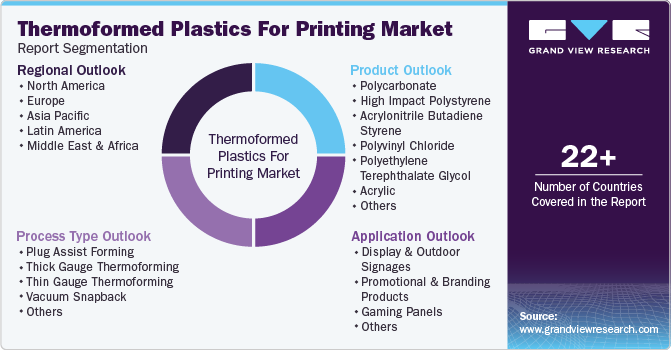
This report forecasts revenue growth at global, regional, and country levels and analyzes the latest industry trends in each sub-segment from 2021 to 2033. For this study, Grand View Research has segmented the global thermoformed plastics for printing market report based on product, process, application, and region.
-
Product Outlook (Volume, Tons; Revenue, USD Thousand, 2021 - 2033)
-
Polycarbonate
-
High Impact Polystyrene (HIPS)
-
Acrylonitrile Butadiene Styrene
-
Polyvinyl Chloride (PVC)
-
Polyethylene Terephthalate Glycol (PETG)
-
Acrylic
-
Others
-
-
Process Type Outlook (Volume, Tons; Revenue, USD Thousand, 2021 - 2033)
-
Plug Assist Forming
-
Thick Gauge Thermoforming
-
Thin Gauge Thermoforming
-
Vacuum Snapback
-
Others
-
-
Application Outlook (Volume, Tons; Revenue, USD Thousand, 2021 - 2033)
-
Display & Outdoor Signages
-
Promotional & Branding Products
-
Gaming Panels
-
Others
-
-
Regional Outlook (Volume, Tons; Revenue, USD Thousand, 2021 - 2033)
-
North America
-
U.S.
-
Canada
-
Mexico
-
-
Europe
-
Germany
-
UK
-
France
-
Italy
-
-
Asia Pacific
-
China
-
India
-
Japan
-
-
Latin America
-
Middle East and Africa
-
Research Methodology
The thermoformed plastics for printing market figures in this report are based on a proven research process that combines executive interviews with secondary research from proprietary databases, company filings, and recognized regulatory and institutional sources. Market size is built through value-chain sizing - reconciling supply-side and demand-side estimates - and triangulated with bottom-up and top-down approaches. Every estimate passes multiple levels of expert validation before publication, with each thermoformed plastics for printing segment quantified using the revenue-capture definitions in the table below.
Segment Definition
Segment - Product
Revenue capture definition
Polycarbonate (PC)
Revenue is captured through the production and sale of polycarbonate smart plastic grades utilized across packaging, automotive, electronics, retail displays, and industrial applications. Demand is driven by its superior impact resistance, optical clarity, dimensional stability, and print compatibility, enabling manufacturers to develop durable and visually appealing products while supporting advanced smart packaging and display solutions.
High Impact Polystyrene (HIPS)
Revenue is captured through the supply of HIPS-based smart plastic materials used in thermoformed packaging, point-of-purchase displays, signage, and consumer product applications. Growth is supported by its excellent printability, ease of thermoforming, cost-effectiveness, and impact resistance, making it a preferred material for high-volume applications requiring attractive graphics and functional performance.
Acrylonitrile Butadiene Styrene (ABS)
Revenue is captured through the commercialization of ABS smart plastic products utilized in automotive components, consumer electronics, industrial equipment, and customized display applications. Demand is driven by its high mechanical strength, toughness, surface finish quality, and compatibility with advanced printing technologies, supporting the development of durable and aesthetically enhanced products.
Polyvinyl Chloride (PVC)
Revenue is captured through the sale of PVC-based smart plastic materials used in signage, promotional displays, retail graphics, packaging, and industrial applications. Growth is supported by its versatility, durability, chemical resistance, and ability to accommodate high-quality printing and decorative finishes, enabling cost-effective production of visually impactful products.
Polyethylene Terephthalate Glycol (PETG)
Revenue is captured through the production and supply of PETG smart plastic solutions utilized in packaging, healthcare products, retail displays, protective barriers, and specialty applications. Demand is driven by its excellent transparency, toughness, thermoformability, and print performance, supporting growing requirements for premium packaging and high-clarity display products.
Acrylic
Revenue is captured through the commercialization of acrylic smart plastic materials used in premium signage, architectural displays, retail fixtures, consumer products, and decorative applications. Growth is supported by its exceptional optical clarity, weather resistance, surface quality, and ability to deliver vibrant printed graphics, making it suitable for high-value visual communication applications.
Others
Revenue is captured through the sale of specialty smart plastic materials, including polypropylene, polyethylene, biodegradable plastics, and advanced composite formulations designed for niche and emerging applications. Demand is driven by requirements for customized performance characteristics, sustainability objectives, lightweight construction, and compatibility with advanced printing and smart packaging technologies across multiple end-use industries.
Segment - Process
Revenue capture definition
Plug Assist Forming
Revenue is captured through the utilization of thermoformed plastics for printing in plug assist forming processes used to manufacture deep-draw packaging, retail displays, appliance panels, and specialty containers requiring uniform wall thickness and high-quality printed surfaces. Demand is driven by the need for enhanced material distribution, improved structural integrity, and superior graphic appearance, enabling manufacturers to produce complex thermoformed products with consistent print quality and reduced material waste.
Thick Gauge Thermoforming
Revenue is captured through the utilization of thermoformed plastics for printing in thick gauge thermoforming applications such as durable signage, equipment housings, transportation components, kiosks, and industrial panels. Growth is supported by increasing demand for large-format printed products offering high impact resistance, structural strength, weatherability, and long service life, making thick gauge thermoforming a preferred process for heavy-duty commercial and industrial applications.
Thin Gauge Thermoforming
Revenue is captured through the utilization of thermoformed plastics for printing in thin gauge thermoforming processes used across food packaging, consumer goods packaging, pharmaceutical trays, blister packs, clamshells, and retail display packaging. Demand is driven by high-volume production requirements, lightweight material characteristics, cost efficiency, and the ability to deliver vibrant printed graphics that enhance product visibility, branding, and consumer engagement at the point of sale.
Vacuum Snapback
Revenue is captured through the utilization of thermoformed plastics for printing in vacuum snapback forming processes used for complex-shaped packaging, promotional displays, automotive trim components, and specialty printed products requiring precise detail reproduction. Growth is supported by the process's ability to achieve superior depth definition, improved material distribution, and enhanced surface aesthetics, enabling manufacturers to produce visually appealing thermoformed products with high-quality graphics and consistent dimensional accuracy.
Segment - Application
Revenue capture definition
Display & Outdoor Signage
Revenue is captured through the use of thermoformed plastics for printing in retail displays, outdoor advertising boards, wayfinding systems, point-of-sale displays, exhibition graphics, and illuminated signage. Demand is driven by increasing investments in advertising and brand visibility, growing retail infrastructure, and the need for lightweight, durable, weather-resistant materials capable of supporting high-quality graphics and long-term outdoor performance.
Promotional & Branding Products
Revenue is captured through the utilization of thermoformed plastics for printing in promotional displays, branded merchandise, product showcases, marketing materials, event signage, and corporate branding applications. Growth is supported by rising marketing expenditures, increasing focus on customer engagement, growing demand for customized promotional solutions, and the ability of thermoformed plastics to deliver superior print quality, visual appeal, and cost-effective production.
Gaming Panels
Revenue is captured through the incorporation of thermoformed plastics for printing in gaming machine panels, arcade displays, casino equipment, interactive kiosks, simulator interfaces, and entertainment system components. Demand is driven by the expansion of the gaming and entertainment industry, increasing adoption of visually enhanced user interfaces, and the need for durable, scratch-resistant materials that support high-resolution graphics, vibrant colors, and complex design requirements.
Others
Revenue is captured through thermoformed plastics for printing applications across packaging displays, industrial graphics, transportation signage, educational displays, healthcare communication materials, and specialty visual communication solutions. Growth is supported by advancements in digital printing technologies, increasing demand for customized graphics, expanding commercial infrastructure development, and the need for durable, lightweight, and aesthetically appealing printed plastic products across diverse end-use sectors.
Estimation Model
Layer Name
Key Question
Description
Top-Down Thermoformed Plastics for Printing Demand Scan Layer
What defines market boundaries?
This layer begins with global demand for thermoformed plastics used in printing applications across display & outdoor signage, promotional & branding products, gaming panels, retail displays, packaging graphics, and specialty visual communication applications. Demand is filtered based on advertising expenditure, retail infrastructure development, print media consumption, promotional product production volumes, digital printing adoption rates, and requirements for durable, high-quality printed plastic substrates.
End-Use Application Validation Layer
Where is demand generated?
This layer evaluates demand distribution across display & outdoor signage, promotional & branding products, gaming panels, retail marketing displays, transportation graphics, and specialty printing applications. Market revenue is aligned with key performance requirements such as printability, surface finish, dimensional stability, impact resistance, weather ability, color retention, and compatibility with advanced printing technologies across major end-use sectors.
Product & Material Conversion Layer
Who captures market revenue?
This layer converts application-level consumption into thermoformed plastics for printing revenue by applying product mix ratios across polycarbonate, PETG, PVC, HIPS, acrylic, ABS, and other specialty plastic sheets. The analysis incorporates material specifications, sheet thickness requirements, thermoforming characteristics, printing compatibility, product performance standards, manufacturing efficiencies, and supplier pricing structures across the value chain.
Regional Commercial Cross-Check Layer
How are assumptions validated?
This layer validates demand concentration by comparing North America's mature advertising and retail display industry, Europe’s focus on sustainable printing materials and premium visual merchandising, and Asia Pacific’s expanding retail, entertainment, gaming, and commercial infrastructure sectors. It also evaluates emerging opportunities in Latin America and the Middle East, driven by increasing promotional spending, retail modernization, tourism development, and growing adoption of advanced printing and display technologies.
Delivered Customizations
This report has been delivered with the following In-depth customizations
CLIENT REQUEST
CUSTOMIZATION DELIVERED
VALUE ADDS
Regional Segmentation
Detailed market breakdown by North America, Europe, Asia Pacific, Central and South America, and Middle East & Africa, with country-level analysis for key markets including the U.S., Canada, Germany, France, U.K., Italy, China, Japan, South Korea, India, Brazil, Mexico, Saudi Arabia, and UAE. Assessment includes demand patterns, manufacturing hubs, advertising expenditure trends, retail infrastructure development, and regulatory landscape.
Enables identification of high-growth regions, investment hotspots, regional demand drivers, and market entry opportunities. Supports strategic expansion planning and regional resource allocation.
Cross-Segmentation
Comprehensive cross-analysis of product, process, application, and geography. Includes evaluation of polycarbonate, PVC, PETG, acrylic, HIPS, and specialty plastics across display & outdoor signage, promotional & branding products, gaming panels, and other applications.
Provides deeper visibility into niche revenue pockets, emerging application areas, and high-value material segments. Helps clients prioritize product development and target profitable customer groups.
Competitive Benchmarking
Benchmarking of leading and emerging participants based on production capabilities, product portfolio breadth, printing compatibility, thermoforming expertise, sustainability initiatives, geographic presence, strategic partnerships, innovation focus, and customer reach. Includes comparative SWOT and market positioning assessment.
Helps clients evaluate competitive strengths and weaknesses, identify market gaps, benchmark performance, and develop effective differentiation strategies.
Frequently Asked Questions About This Report
Key factors driving the thermoformed plastics for printing market growth include the growth of the advertising industry, growing gaming industry, coupled with companies penetrating the untouched regional market.
The global thermoformed plastics for printing market size was valued at USD 47.9 million in 2025 and is estimated at USD 51.1 million for 2026.
The global thermoformed plastics for printing market is expected to grow at a CAGR of 7.7% from 2026 to 2033, reaching USD 85.9 million by 2033.
The thermoformed plastics for printing market is transitioning into a vital segment of the advanced packaging and printing materials industry, supported by growing demand for lightweight, durable, and highly printable solutions across food, beverage, pharmaceutical, and consumer goods applications. Increasing adoption of digital printing technologies is enhancing production flexibility, cost efficiency, and design customization, further strengthening market prospects.
The rapid advancement of digital printing technologies is creating significant opportunities for the smart plastic market. Manufacturers are increasingly adopting UV-curable inkjet and large-format flatbed printing systems to produce high-resolution graphics, customized designs, and enhanced visual effects on smart plastic substrates.
Based on process, thick gauge thermoforming segment dominated the market with a share of 49.3% in 2025.
North America dominated the thermoformed plastics for printing market with a share of 51.9% in 2025. This is attributable to the rising demand for thermoformed plastics for printing in the advertising industry to gain the majority of the consumer base in the region.
Based on product, the polycarbonate segment led with a 34.2% revenue share in 2025.
Some of the key players operating in the thermoformed plastics for printing market include Omega Plastics LLC; Productive Plastics, Inc.; Universal Plastics Group, Inc.; Aero-Plastics Inc.; Sulapac Oy; Sriyug Print Production; MANGALAM PLASTIC INDUSTRIES; HIP LIK; Zhejiang Sayeah Machinery Co.,ltd.; Desu Technology (Shanghai) Co., Ltd.
The Asia Pacific thermoformed plastics for printing market is expected to grow at the fastest CAGR of 8.4% over the forecast period.
About the Author(s)
Plastics, Polymers & Resins Research Team
Bulk Chemicals · Plastics, Polymers & ResinsThis report was authored by the plastics, polymers & resins research team at Grand View Research - comprising two research analysts, one senior research analyst, and one industry expert - with specialized expertise in the plastics, polymers & resins segment of the bulk chemicals industry. All findings are based on proprietary bulk chemicals databases, executive interviews, and regulatory analysis, subject to internal peer review prior to publication.
Last Updated:
Speak to Analyst


Customize this report to your needs — add regions, segments, or data points, with 20% free customization.
Or view our licence options:


ISO 9001:2015 & 27001:2022 Certified
We are GDPR and CCPA compliant! Your transaction & personal information is safe and secure. For more details, please read our privacy policy.


