
- Home
- »
- Advanced Interior Materials
- »
-
Thermoforming Machines Market Size Report, 2026-2033GVR Report cover

Thermoforming Machines Market (2026 - 2033)
Size, Share & Trends Analysis Report By Operation Mode (Automatic, Semi-automatic), By Machine (Roll-fed Thermoforming Machines, Sheet-fed Thermoforming Machines), By End Use, By Region, And Segment Forecasts
Market Size, 2025
$1.0BMarket Estimate, 2026
$1.1BMarket Forecast, 2033
$1.5BCAGR, 2026–2033
5.6%Thermoforming Machines Market Summary
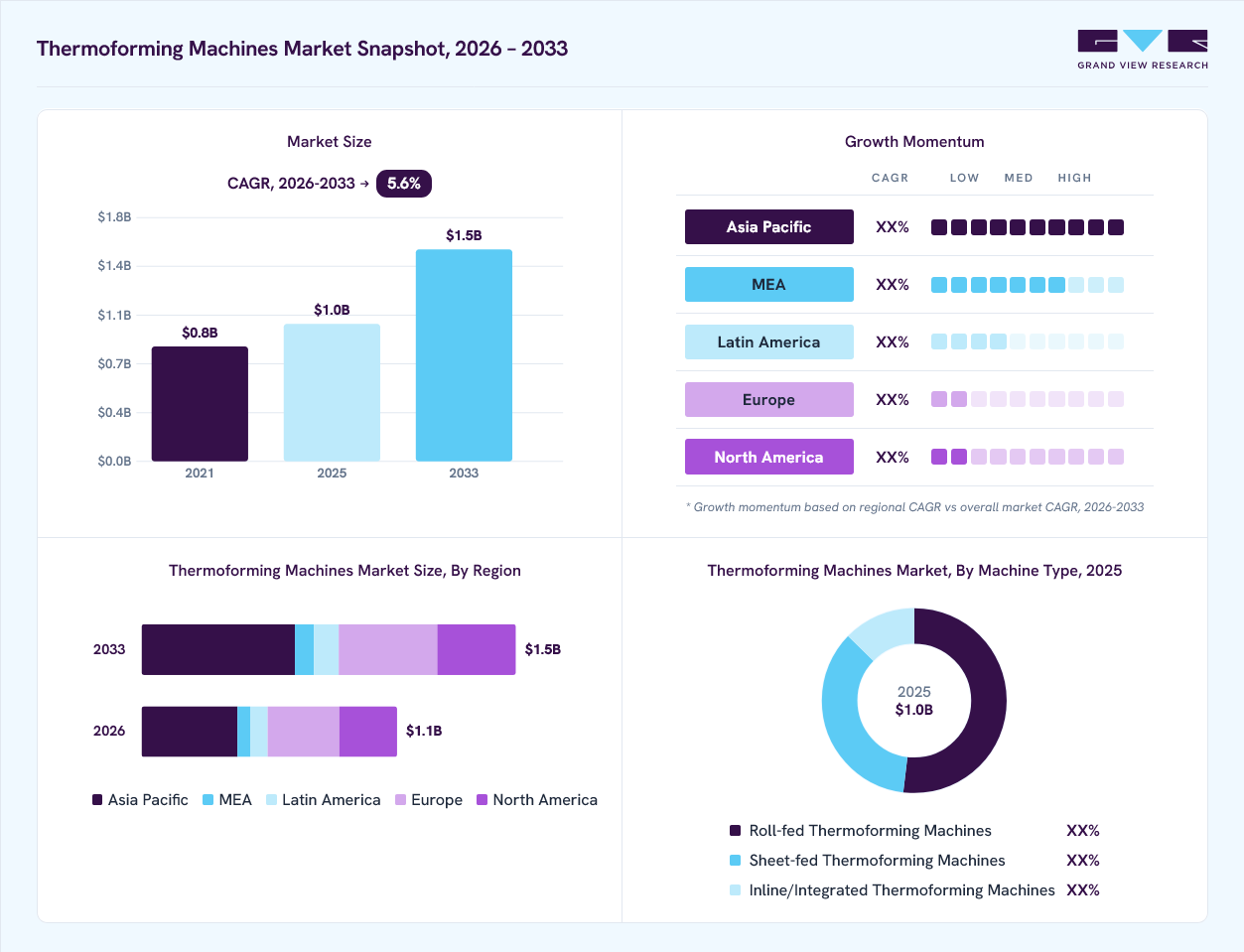
The global thermoforming machines market size was valued at USD 1.0 billion in 2025 and is projected to grow from USD 1.1 billion in 2026 to USD 1.5 billion by 2033, at a CAGR of 5.6% from 2026 to 2033. The market in Asia Pacific dominated with a revenue share of 37.1% in 2025. The market is driven by demand for lightweight, cost-efficient packaging in food & beverages, pharmaceutical, healthcare, consumer goods, electronics, and automotive applications.
 Source: Grand View Research, IR Documents, Primary Interviews, Paid DatabasesTo learn more about this report,
 Download Free Sample Report
Key Market Trends & Insights
- By operation mode: Automatic segment held the largest market share of 64.0% in 2025.
- By machine: Roll-fed thermoforming machines segment held the largest market share of 51.9% in 2025.
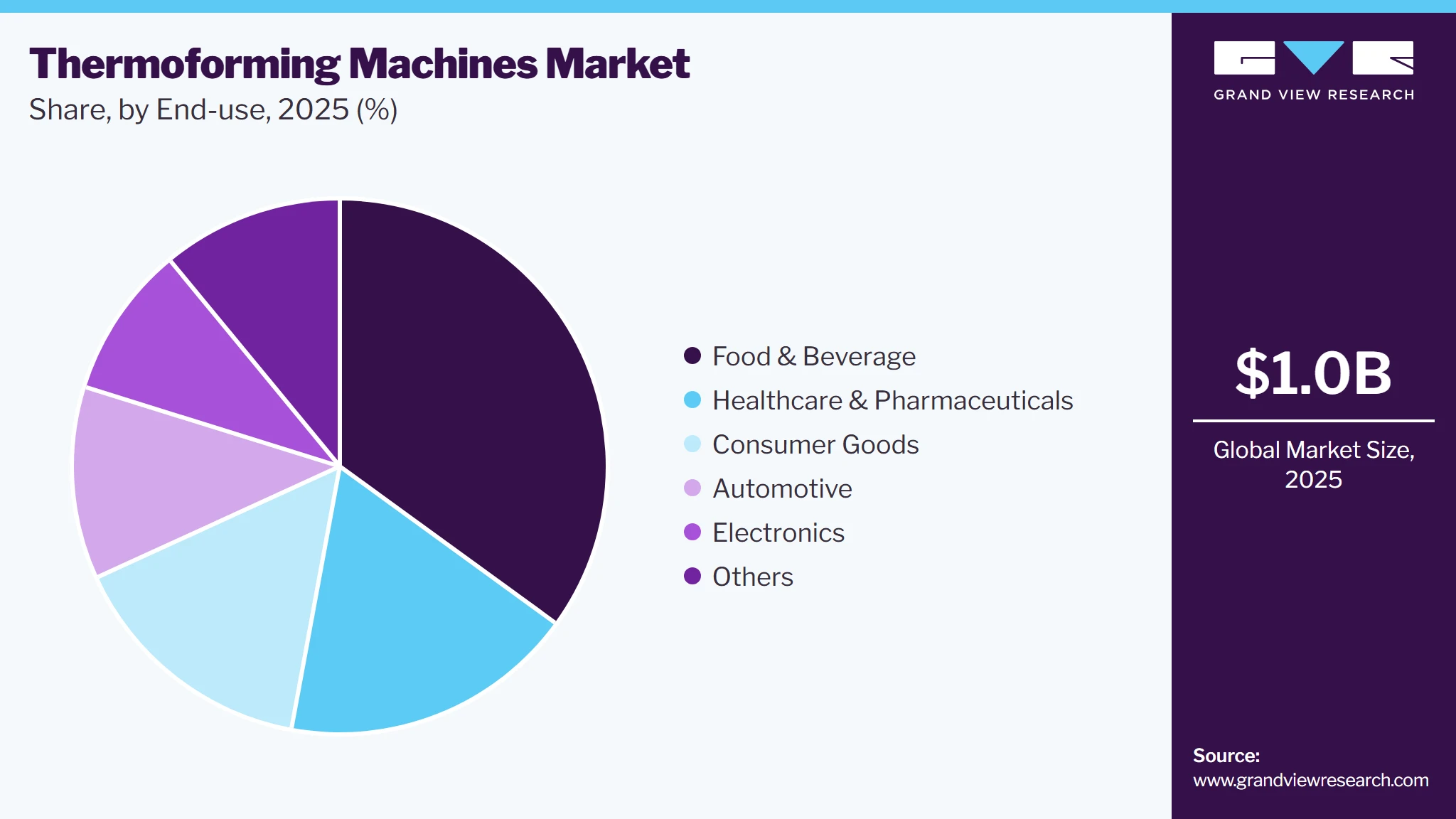
- By end use: Food & beverage segment held the largest market share of 35.0% in 2025.
Regional Highlights
- Largest regional market: Asia Pacific (37.1% revenue share, 2025)
- By country: China held the largest market share in 2025
Market Size & Forecast
- Market size in 2025: USD 1.0 Billion
- Estimated market size in 2026: USD 1.1 Billion
- Projected market size by 2033: USD 1.5 Billion
- CAGR (2026-2033): 5.6%
GVR research-powered AIAsk Prism AI about the thermoforming machines marketGet cited answers from GVR research on market growth, segments, regulations and forecasts.Start with✓ Source-linked answers ✓ Market-specific context ✓ Traceable figuresExplore Prism AI ↗
Adoption of automated, high-speed, and servo-driven systems is increasing as manufacturers seek higher throughput, lower labor requirements, consistent forming quality, and better material utilization. Advances in digital controls, robotic handling, and energy-efficient heating are further supporting equipment upgrades. Additionally, growing adoption of recyclable and recycled-content thermoplastics is encouraging converters to upgrade equipment capable of processing alternative materials with consistent forming quality. Packaging-waste regulations and sustainability targets are increasing demand for machines that improve material utilization and reduce scrap. Smart manufacturing is also driving demand for equipment through real-time monitoring, predictive maintenance, automated inspection, and digital process control.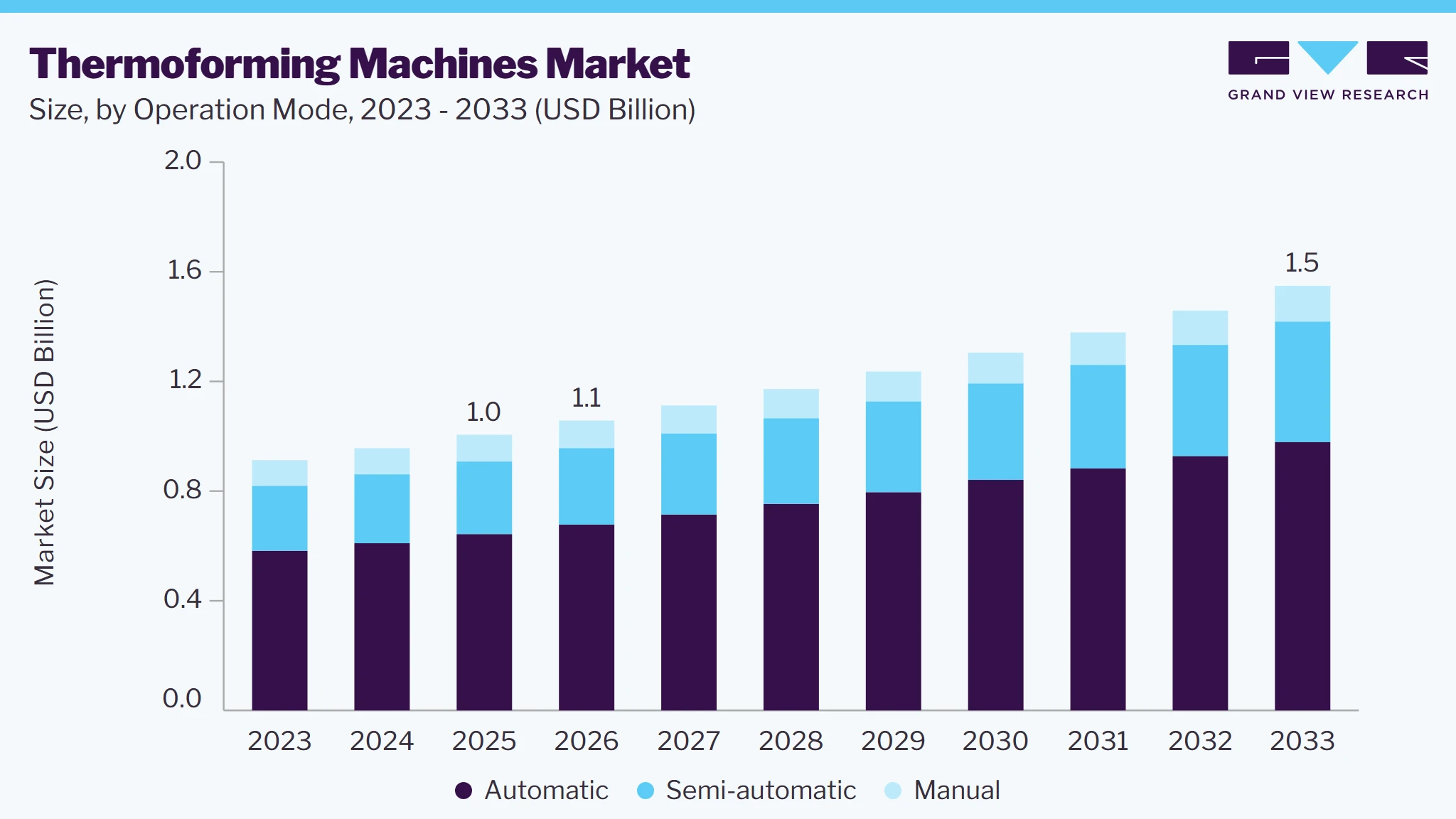 To learn more about this report, Download Free Sample Report
Market Dynamics
The global thermoforming machines market is shaped by technological advancements, expanding packaging applications, and demand for efficient, high-throughput forming equipment. Manufacturers are developing machines with improved automation, precision control, energy efficiency, and material-handling capabilities to meet production requirements across food and beverage, healthcare, pharmaceutical, consumer goods, electronics, and automotive industries. Integration of servo-driven systems, digital monitoring, and automated material feeding is enhancing operational consistency while reducing production losses and labor requirements.
Demand for lightweight, durable, and economical packaging is increasing the use of thermoforming equipment across food, pharmaceutical, healthcare, and consumer goods applications. The expansion of ready-to-eat meals, convenience foods, blister packs, medical trays, and protective packaging is creating requirements for high-volume forming capabilities. Thermoforming also enables manufacturers to produce complex shapes with efficient material utilization, making it suitable for applications where production speed, product protection, and cost control are important.
Thermoforming machines require substantial capital investment, particularly for automated systems equipped with advanced controls, servo technology, and integrated production functions. Installation, maintenance, tooling, and operator training can further increase ownership costs. Small and medium-sized manufacturers may face difficulties adopting sophisticated equipment when production volumes are insufficient to justify the initial expenditure. Changes in material specifications and tooling requirements can also add complexity to production operations.
Advances in automation, machine controls, and energy management are creating opportunities for manufacturers to develop more productive and flexible thermoforming systems. Servo-driven motion control, automated trimming, predictive maintenance, digital process monitoring, and intelligent temperature management can improve throughput and product consistency while lowering energy consumption. The development of machines capable of processing recycled and bio-based polymers also offers growth potential as packaging manufacturers seek solutions aligned with material-efficiency and sustainability objectives.
Market Concentration & Characteristics
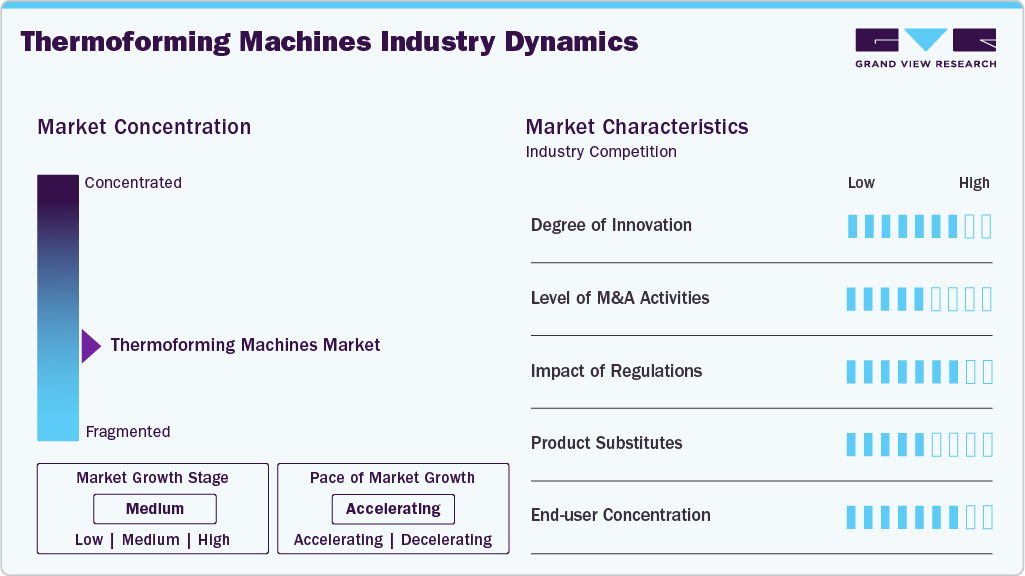
The global thermoforming machines industry is characterized by a competitive landscape comprising established equipment manufacturers, specialized technology providers, and regional suppliers. Competition centers on machine performance, engineering capabilities, product customization, service coverage, and the ability to provide comprehensive production solutions. Established manufacturers typically focus on advanced automated systems and integrated production lines, while specialized suppliers differentiate through application-specific equipment, flexible configurations, and cost-efficient offerings. Product development, technical expertise, and after-sales support remain important factors shaping competitive positioning across the market.
The market is defined by demand for automated, high-throughput, and application-specific equipment across packaging, food and beverage, pharmaceuticals, consumer goods, automotive, and electronics. Product differentiation centers on forming accuracy, cycle speed, material compatibility, energy efficiency, mold flexibility, and integration of forming, trimming, stacking, sealing, and inspection functions. Manufacturers are increasingly developing systems that provide greater process control, production consistency, and flexibility across different thermoplastic materials and product formats.
 To learn more about this report, Download Free Sample Report
The industry maintains a broad supplier base beyond established manufacturers, creating opportunities for specialized companies serving heavy-gauge forming, medical packaging, automotive components, and customized production requirements. Suppliers differentiate themselves through tooling expertise, installation capabilities, spare parts availability, technical assistance, and lifecycle services rather than equipment pricing alone. Sustainability is also influencing product development, with greater attention to energy-efficient heating, material optimization, recyclable polymer compatibility, and improved process control. Strategic partnerships, product innovation, and expansion of integrated solutions continue to shape competitive dynamics within the market.
Analyst Perspective
The global thermoforming machines market is positioned for sustained expansion as manufacturers across the packaging, healthcare, food and beverage, electronics, and automotive industries seek efficient methods to produce lightweight, precisely formed components. Demand is shifting toward automated equipment that combines high production capacity with improved process control, material efficiency, and lower operating requirements. Increasing use of recyclable polymers, customized packaging formats, and advanced forming technologies is encouraging equipment manufacturers to enhance machine flexibility and digital capabilities. Competitive positioning is therefore likely to depend on automation performance, energy efficiency, tooling versatility, after-sales support, and the ability to accommodate evolving material and application requirements.
Operation Mode Insights
The automatic segment accounted for the largest revenue share of 64.0% in 2025, reflecting its suitability for high-volume production environments that require consistent output, precise process control, and reduced manual intervention. These systems are widely preferred by manufacturers seeking to improve production efficiency and maintain uniform product quality across demanding packaging and component-forming applications.
The semi-automatic segment is projected to register the fastest CAGR during the forecast period, supported by lower investment requirements, operational flexibility, and suitability for manufacturers with moderate production volumes. Their ability to combine automated forming processes with selective manual operations makes them an attractive option for small and mid-sized producers seeking improved productivity without the capital commitment associated with fully automated systems.
Machine Insights
The roll-fed thermoforming machines segment held the largest revenue share of 51.9% in 2025, mainly attributed to its suitability for continuous, high-volume production and efficient material handling. These systems are widely used for packaging applications that require consistent forming quality, rapid processing, and reduced material waste. Their integration with automated feeding and forming processes further supports productivity across large-scale manufacturing operations.
The sheet-fed thermoforming machines segment is projected to register the fastest CAGR of 6.2% during the forecast period. Their flexibility in processing individual sheets and accommodating varied materials, dimensions, and product designs makes them well-suited to customized, lower-volume production requirements. Growing demand for specialized packaging formats and precision-formed components is creating opportunities for sheet-fed systems across diverse end-use industries.
End Use Insights
The food & beverage segment accounted for the largest revenue share of 35.0% in 2025, driven by extensive use of thermoformed trays, containers, cups, lids, and other packaging formats. High-volume production requirements, growing demand for convenient food packaging, and the need for lightweight, protective formats continue to drive adoption across food processing and packaging operations.
 To learn more about this report, Download Free Sample Report
The healthcare & pharmaceuticals segment is projected to register the fastest CAGR of 6.6% from 2026 to 2033, supported by increasing requirements for sterile, protective, and precisely formed packaging solutions. Thermoforming machines are used to manufacture blister packs, medical trays, diagnostic packaging, and other healthcare components where dimensional accuracy and product protection are essential. Expansion of pharmaceutical production and healthcare infrastructure is further creating opportunities for advanced thermoforming equipment in this segment.
Regional Insights
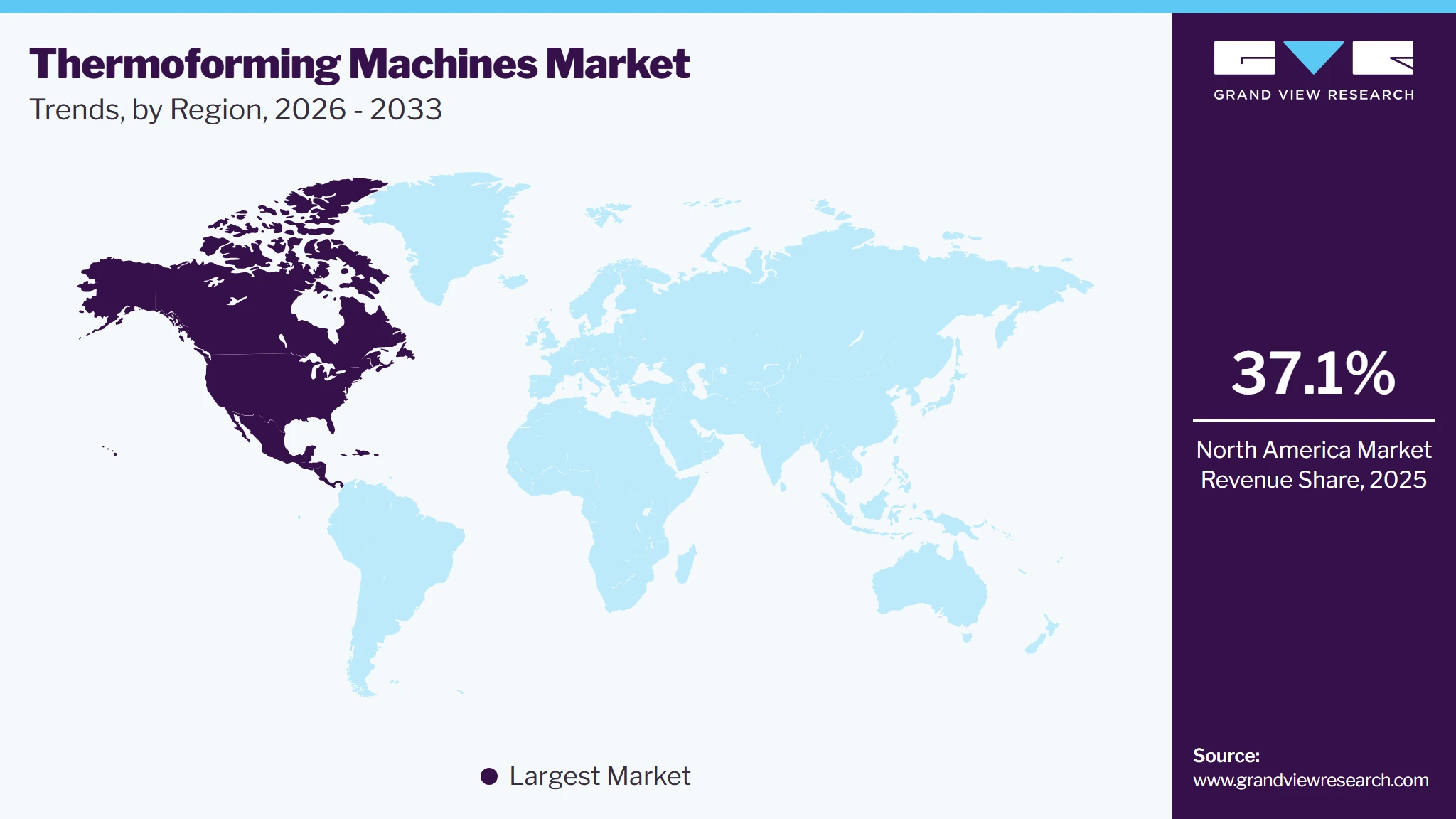
The Asia Pacific thermoforming machines market dominated the global industry, accounting for the largest revenue share of 37.1% in 2025, and it is also expected to grow at the fastest CAGR over the forecast period. The growth is driven by the expansion of packaging production across the food & beverage, pharmaceuticals, healthcare, consumer goods, electronics, and automotive industries. The region benefits from large-scale manufacturing bases, increasing consumption of packaged products, and the ongoing expansion of domestic processing capacity. Demand is also shifting toward automated systems that can deliver higher output, consistent forming quality, faster changeovers, and efficient material utilization.
China Thermoforming Machines Market Trends
The thermoforming machines market in China remains prominent, benefiting from the country’s extensive plastics processing and packaging manufacturing ecosystem. Growth in processed food, pharmaceutical packaging, consumer products, and electronics manufacturing is encouraging producers to upgrade their forming lines with high-speed, automated equipment. Demand is also influenced by the need to manufacture varied container sizes, thin-wall packaging, and customized formats while maintaining production efficiency.
The India thermoforming machines market is gaining traction as packaged food consumption, pharmaceutical production, healthcare infrastructure, and organized retail expand. Local packaging manufacturers are increasing production capacity for trays, cups, containers, and blister formats, creating opportunities for thermoforming equipment suppliers. Investment in modern machinery is also increasing as converters seek greater automation, improved forming accuracy, and the ability to process recyclable and lightweight materials.
North America Thermoforming Machines Market Trends
The thermoforming machines market in North America accounted for a substantial share of the global industry, reflecting its established packaging sector, high-value pharmaceutical and medical applications, and extensive food processing industry. Equipment demand is increasingly linked to the replacement of older production lines, automation of labor-intensive processes, and requirements for precise, high-throughput forming. Manufacturers are also placing greater emphasis on machines capable of handling recycled polymers, lightweight structures, and shorter production runs without compromising productivity.
 To learn more about this report, Download Free Sample Report
The thermoforming machines market in the U.S. represents the largest market in the region, supported by extensive production of fresh and processed food, medical products, pharmaceuticals, consumer goods, and industrial packaging. Demand spans high-volume systems for standardized containers as well as flexible equipment for customized and specialty formats. Continued modernization of packaging plants and adoption of servo-driven, automated machinery are creating opportunities for suppliers offering energy-efficient and digitally controlled thermoforming systems.
The Canada thermoforming machines market is experiencing steady market development, with demand concentrated in food processing, healthcare, pharmaceuticals, and consumer product manufacturing. Packaging producers are investing in equipment that improves throughput while accommodating changing product specifications and material requirements. The country's focus on efficient resource use is also encouraging the adoption of machines designed for precise sheet handling, reduced scrap generation, and compatibility with recyclable polymers.
Europe Thermoforming Machines Market Trends
The thermoforming machines market in Europe is mature, shaped by advanced packaging infrastructure, stringent quality standards, and strong requirements for resource-efficient production. Food, pharmaceutical, medical, and consumer packaging remain important areas of demand, while manufacturers are upgrading equipment to meet requirements for thinner packaging, recyclable materials, and precise material distribution. Machine suppliers are also developing systems with improved process monitoring, automated controls, and flexible tooling to serve diverse production requirements.
The Germany thermoforming machines market is supported by its advanced industrial manufacturing base and strong presence of packaging machinery producers and converters. Demand for thermoforming equipment is driven by food packaging, medical applications, industrial components, and consumer products that require consistent dimensions and high forming accuracy. Manufacturers are increasingly integrating automation, servo technology, and process controls to improve machine performance and reduce production losses.
The thermoforming machines market in France is witnessing steady adoption of thermoforming machines across food, pharmaceutical, healthcare, and consumer packaging applications. The market benefits from continued investment in modern packaging facilities and demand for formats that combine product protection with lower material consumption. Equipment capable of handling multiple polymers, rapid tooling changes, and shorter production cycles is gaining relevance among converters seeking greater manufacturing flexibility.
Middle East & Africa Thermoforming Machines Market Trends
The thermoforming machines market in the Middle East & Africa is developing steadily as regional manufacturers expand food processing, pharmaceutical, healthcare, and consumer goods production. Demand is particularly strong for locally produced trays, cups, containers, and protective packaging, helping converters reduce their dependence on imported finished packaging. Growth in modern retail and packaged food distribution is also broadening the requirement for reliable forming equipment with scalable production capacity.
The Saudi Arabia thermoforming machines market has gained ground from industrial diversification, expansion of food manufacturing, and development of pharmaceutical and consumer product industries. Investments in domestic production capacity are encouraging packaging converters to introduce automated thermoforming lines for higher-volume applications. The UAE also contributes to regional demand through its established food, logistics, and packaging industries, where flexible machinery is valued for handling a wide range of products and packaging specifications.
Latin America Thermoforming Machines Market Trends
The thermoforming machines market in Latin America is experiencing steady development as food processing, beverage production, pharmaceuticals, and consumer goods manufacturing expand across the region. The growing availability of packaged products is increasing the requirements for rigid plastic trays, cups, containers, and protective formats. Packaging converters are also seeking equipment that can accommodate changing product volumes and material specifications while maintaining efficient production economics.
The Brazil thermoforming machines market represents the largest market in the region, supported by its sizable food and beverage processing industry, pharmaceutical production, and broad consumer market. Expansion of domestic packaging capacity is encouraging investment in higher-output thermoforming systems, particularly for food trays, containers, and other rigid packaging formats. Mexico is also gaining importance through its food, pharmaceutical, electronics, and automotive manufacturing base, where thermoformed packaging and components are used across multiple production applications.
Key Thermoforming Machines Company Insights
Some of the key players operating in the market include ILLIG Maschinenbau GmbH & Co. KG and Kiefel GmbH, among others.
-
ILLIG Maschinenbau GmbH & Co. KG is a Germany-based manufacturer specializing in thermoforming and packaging machinery. The company offers sheet-processing and roll-fed thermoforming machines using vacuum forming, pressure forming, or a combination of both. Its portfolio includes forming, cutting, stacking, packaging, blister, and form-fill-seal systems, along with tooling and auxiliary equipment. ILLIG serves applications across food packaging, consumer goods, automotive, medical, and other industrial sectors.
-
Kiefel GmbH is a Germany-based manufacturer specializing in thermoforming and joining technologies for polymers and natural fibers. The company develops automated thermoforming systems for packaging, medical, pharmaceutical, and appliance applications. Its product portfolio includes high-speed thermoforming machines for cups, trays, lids, blister packs, and other packaging, as well as large-format systems for refrigerator and door liners.
Key Thermoforming Machines Companies
The following key companies have been profiled for this study on the thermoforming machines market.
-
ILLIG Maschinenbau GmbH & Co. KG
-
Kiefel GmbH
-
WM Thermoforming Machines
-
MAAC Machinery Corporation
-
Brown Machine Group
-
MULTIVAC Group
-
GABLER Thermoform GmbH & Co. KG
-
CMS S.p.A.
-
Asano Laboratories Co., Ltd.
-
GEISS AG
-
AMUT-COMI S.p.A.
-
ZED Industries
-
Ossid (ProMach)
-
Colimatic
-
OMG S.p.A.
Competitive Benchmarking
Category
Operating Strategies
Competitive Edge
Weakness
Established Players (e.g., ILLIG Maschinenbau GmbH & Co. KG; Kiefel GmbH; WM Thermoforming Machines; Brown Machine Group; MULTIVAC Group; GABLER Thermoform GmbH & Co. KG; CMS S.p.A.)
- Invest in automated, high-speed thermoforming systems with advanced heating, forming, trimming, stacking, and material-handling capabilities.
- Expand global market reach through broad product portfolios, application-specific solutions, technical service networks, and strategic partnerships.
- Strong engineering capabilities, established global service networks, and comprehensive machine portfolios support diverse packaging applications.
Advanced automation, material compatibility, and customized machine configurations strengthen differentiation across food, healthcare, consumer goods, and industrial applications.
- High R&D, tooling, and manufacturing investments increase operating costs and machine prices.
- Dependence on capital expenditure and packaging production cycles can affect equipment demand.
Emerging & Regional Players (e.g., MAAC Machinery Corporation; Asano Laboratories Co., Ltd.; GEISS AG; AMUT-COMI S.p.A.; ZED Industries; Ossid (ProMach); Colimatic; OMG S.p.A.)
- Focus on customized thermoforming solutions, specialized applications, automation upgrades, and flexible production systems.
- Strengthen regional presence through distributors, industry partnerships, aftermarket services, and application-specific machine offerings.
- Flexible customization, specialized engineering expertise, responsive customer support, and competitive pricing support penetration in niche applications.
- Regional market knowledge enables closer customer relationships and faster adaptation to application requirements.
- Smaller international distribution networks and manufacturing scale compared with established players.
- Narrower product portfolios and lower brand visibility can limit participation in large multinational projects.
Recent Developments
-
In May 2026, GEA introduced the PowerPak 5000 thermoforming packaging machine for medium-sized food producers seeking flexible packaging formats, reliable daily operation, and scalable automation. The machine supports MAP, vacuum, skin, and steam packaging on a single platform, enabling applications across meat, poultry, seafood, dairy, bakery, ready meals, and plant-based foods. Its modular design allows manufacturers to adapt the system as production requirements change, while features focused on simplified operation, faster changeovers, cleaning, maintenance, and process stability help improve efficiency and control lifecycle costs.
-
In March 2025, ULMA Packaging introduced the TFX series of high-performance thermoformers, featuring synchronized machine movements, an optimized vacuum system, automatic film alignment, precise heating and sealing controls, and faster format changeovers. The machines are designed to improve productivity, reduce material consumption, support thinner and recyclable films, and provide greater flexibility for food packaging applications.
Thermoforming Machines Market Report Scope
Report Attribute
Details
Market size in 2025
USD 1.0 billion
Estimated market size in 2026
USD 1.1 billion
Projected market size by 2033
USD 1.5 billion
Growth rate
CAGR of 5.6% from 2026 to 2033
Base year for estimation
2025
Historical data
2021-2024
Forecast period
2026 - 2033
Quantitative units
Revenue in USD billion and CAGR from 2026 to 2033
Report coverage
Revenue forecast, company market position analysis, competitive landscape, growth factors, and trends
Segments covered
Operation mode, machine, end use, region
Regional scope
North America; Europe; Asia Pacific; Latin America; Middle East & Africa
Country Scope
U.S.; Canada; Mexico; Germany; UK; Italy; Spain; France; China; Japan; India; Australia; South Korea; Brazil; Argentina; Saudi Arabia; UAE; South Africa
Key companies profiled
ILLIG Maschinenbau GmbH & Co. KG; Kiefel GmbH; WM Thermoforming Machines; MAAC Machinery Corporation; Brown Machine Group; MULTIVAC Group; GABLER Thermoform GmbH & Co. KG; CMS S.p.A.; Asano Laboratories Co., Ltd.; GEISS AG; AMUT-COMI S.p.A.; ZED Industries; Ossid (ProMach); Colimatic; OMG S.p.A.
Customization scope
Free report customization (equivalent up to 8 analysts working days) with purchase. Addition or alteration to country, regional & segment scope.
Pricing and purchase options
Avail customized purchase options to meet your exact research needs. Explore purchase options
Global Thermoforming Machines Market Report Segmentation
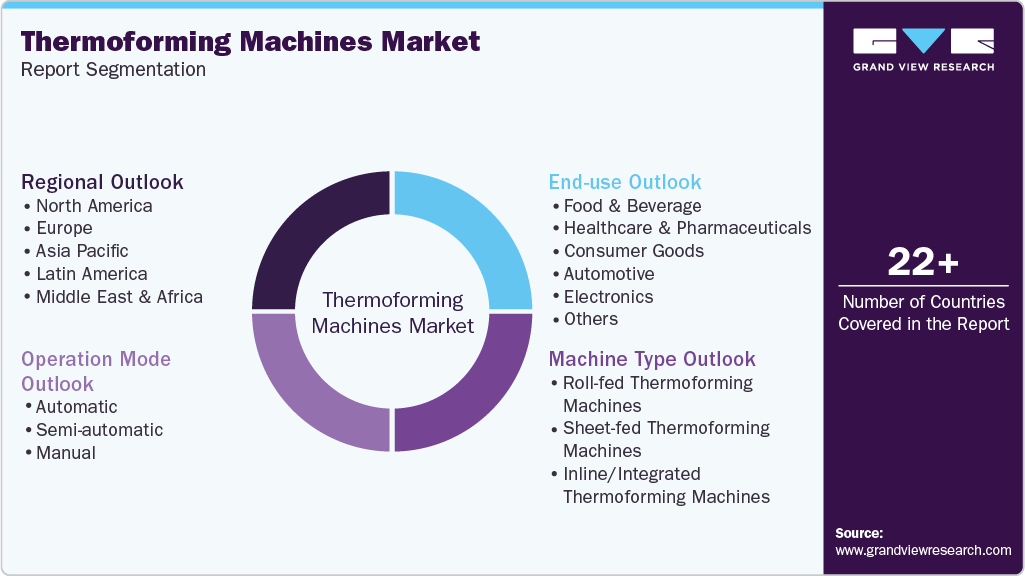
This report forecasts revenue growth at global, regional & country levels and provides an analysis on the industry trends in each of the sub-segments from 2021 to 2033. For this study, Grand View Research has segmented the global thermoforming machines market report on the basis of operation mode, machine, end use, and region:
 To learn more about this report, Download Free Sample Report
-
Operation Mode Outlook (Revenue, USD Billion, 2021 - 2033)
-
Automatic
-
Semi-automatic
-
Manual
-
-
Machine Outlook (Revenue, USD Billion, 2021 - 2033)
-
Roll-fed Thermoforming Machines
-
Inline/Integrated Thermoforming Machines
-
Sheet-fed Thermoforming Machines
-
-
End Use Outlook (Revenue, USD Billion, 2021 - 2033)
-
Food & Beverage
-
Healthcare & Pharmaceuticals
-
Consumer Goods
-
Automotive
-
Electronics
-
Others
-
-
Regional Outlook (Revenue, USD Billion, 2021 - 2033)
-
North America
-
U.S.
-
Canada
-
Mexico
-
-
Europe
-
Germany
-
France
-
UK
-
Spain
-
Italy
-
-
Asia Pacific
-
China
-
India
-
Japan
-
South Korea
-
Australia
-
-
Latin America
-
Brazil
-
Argentina
-
-
Middle East & Africa
-
Saudi Arabia
-
UAE
-
South Africa
-
-
Research Methodology
The thermoforming machines market figures in this report are based on a proven research process that combines executive interviews with secondary research from proprietary databases, company filings, and recognized regulatory and institutional sources. Market size is built through value-chain sizing-reconciling supply-side and demand-side estimates-and triangulated with bottom-up and top-down approaches. Every estimate passes multiple levels of expert validation before publication, with eachthermoforming machinessegment quantified using the revenue-capture definitions in the table below.
Segment Definition
Operation Mode
Revenue Capture Definition
Automatic
Revenue generated from the sale of fully automated thermoforming machines that perform forming operations with minimal operator intervention.
Semi-automatic
Revenue generated from the sale of thermoforming machines requiring partial operator involvement for loading, forming, unloading, or other production functions.
Manual
Revenue generated from the sale of manually operated thermoforming machines in which operators perform a substantial portion of the machine operation and material handling.
Machine
Revenue Capture Definition
Roll-fed Thermoforming Machines
Revenue generated from the sale of thermoforming machines designed to process plastic material supplied continuously from rolls into formed products.
Inline/Integrated Thermoforming Machines
Revenue generated from the sale of thermoforming machines integrated with upstream or downstream production processes, forming, trimming, and other operations within a connected production line.
Sheet-fed Thermoforming Machines
Revenue generated from the sale of thermoforming machines that process pre-cut plastic sheets into formed products.
End Use
Revenue Capture Definition
Food & Beverage
Revenue generated from the sale of thermoforming machines purchased by food and beverage manufacturers and packaging converters for their production operations.
Healthcare & Pharmaceuticals
Revenue generated from the sale of thermoforming machines purchased for manufacturing pharmaceutical, medical, and healthcare packaging and components.
Consumer Goods
Revenue generated from the sale of thermoforming machines purchased by consumer goods manufacturers for producing packaging and related formed components.
Automotive
Revenue generated from the sale of thermoforming machines purchased by automotive manufacturers and suppliers for producing thermoformed vehicle components and related parts.
Electronics
Revenue generated from the sale of thermoforming machines purchased for manufacturing packaging, protective structures, and formed components used in electronics production.
Others
Revenue generated from the sale of thermoforming machines to industries outside the specified end-use segments, including industrial, construction, and other manufacturing applications.
Estimation Model
Layer Name
Key Question
Description
Packaging & Manufacturing Demand Layer
Where are thermoforming machines required?
Analyze demand across food & beverage, healthcare & pharmaceuticals, consumer goods, automotive, electronics, and other manufacturing applications. Assess production volumes of thermoformed packaging and components, including trays, containers, cups, lids, blister packs, clamshells, and technical parts, to establish the addressable requirement for thermoforming equipment.
Production Capacity & Investment Layer
Where is new machine demand being created?
Evaluate investments in new packaging and manufacturing facilities, capacity expansions, production-line modernization, replacement of aging equipment, and automation projects. Assess the conversion of manufacturing capacity requirements into demand for new thermoforming machines across regions and end-use industries.
Machine Adoption Layer
Which thermoforming machines are being deployed?
Segment machine demand by operation mode, machine, end use, material compatibility, production capacity, automation level, and regional requirements. Apply adoption rates based on throughput, forming precision, labor requirements, material efficiency, production flexibility, automation, and suitability for specific packaging and component applications.
Revenue Generation Layer
How much market revenue is generated?
Estimate annual revenue from the sale of new thermoforming machines by operation mode, machine, end use, and region. Quantify revenues generated exclusively from equipment sales to packaging manufacturers, converters, industrial producers, and other machine buyers.
Customization Table
Client Request
Customization Delivered
Value Adds
Competitive Benchmarking
A competitive benchmarking analysis was conducted by evaluating leading global thermoforming machine manufacturers based on product portfolio, machine, operation mode, automation level, forming technology, processing capabilities, material compatibility, production capacity, energy efficiency, technical specifications, pricing strategy, manufacturing footprint, distribution network, strategic initiatives, and market presence.
Enabled stakeholders to compare competitive positioning, assess technological capabilities, identify product differentiation and innovation trends, evaluate manufacturing strengths, and develop effective product positioning and market expansion strategies.
Regional Segmentation
A comprehensive regional assessment was conducted across North America, Europe, Asia Pacific, Latin America, and the Middle East & Africa, analyzing thermoforming machine demand across food & beverage, healthcare & pharmaceuticals, consumer goods, electronics, automotive, and other industrial applications.
Helped stakeholders identify high-potential markets, understand regional demand patterns, assess industry-specific growth drivers, optimize distribution strategies, and prioritize investments across markets with expanding manufacturing and packaging capacity.
Opportunity Assessment
A detailed opportunity assessment was conducted by evaluating the adoption of automated and high-speed thermoforming systems, demand for lightweight and sustainable packaging, increasing use of recyclable materials, expansion of pharmaceutical and food packaging production, and technological advancements in forming and process control.
Enabled stakeholders to identify attractive revenue opportunities, prioritize technology and product development, support investment decisions, strengthen market-entry strategies, and align business plans with automation, sustainability, packaging, and manufacturing efficiency trends.
Frequently Asked Questions About This Report
The semi-automatic segment is projected to register the fastest growth, expanding at a CAGR of 6.7% from 2026 to 2033, supported by demand for flexible and cost-efficient production systems.
Automatic thermoforming machines held the leading position in 2025, driven by high productivity, consistent output, precise process control, and reduced manual intervention.
Asia Pacific dominated the thermoforming machines market with the largest revenue share of 37.1% in 2025.
The food & beverage segment represented the largest share in 2025, driven by extensive use of thermoformed trays, containers, cups, lids, and other packaging formats.
Market growth is driven by increasing demand for packaged and convenience foods, expansion of pharmaceutical and healthcare packaging, adoption of automated production systems, demand for lightweight packaging, and the need for high-throughput and material-efficient manufacturing.
The roll-fed thermoforming machines segment led with a 51.9% revenue share in 2025.
The global thermoforming machines market size was valued at USD 1.0 billion in 2025 and is estimated at USD 1.1 billion for 2026.
The global thermoforming machines market is expected to grow at a CAGR of 5.6% from 2026 to 2033, reaching USD 1.5 billion by 2033.
Major companies include ILLIG Maschinenbau GmbH & Co. KG, Kiefel GmbH, WM Thermoforming Machines, MAAC Machinery Corporation, Brown Machine Group, MULTIVAC Group, GABLER Thermoform GmbH & Co. KG, CMS S.p.A., Asano Laboratories Co., Ltd., GEISS AG, AMUT-COMI S.p.A., ZED Industries, Ossid (ProMach), Colimatic, and OMG S.p.A
About the Author(s)
Advanced Interior Materials Research Team
Advanced Materials · Advanced Interior MaterialsThis report was authored by the advanced interior materials research team at Grand View Research - comprising two research analysts, one senior research analyst, and one industry expert - with specialized expertise in the advanced interior materials segment of the advanced materials industry. All findings are based on proprietary advanced materials databases, executive interviews, and regulatory analysis, subject to internal peer review prior to publication.
Last Updated:
Speak to Analyst

Customize this report to your needs - add regions, segments, or data points, with 20% free customization.
Or view our licence options:


ISO 9001:2015 & 27001:2022 Certified
We are GDPR and CCPA compliant! Your transaction & personal information is safe and secure. For more details, please read our privacy policy.


