
- Home
- »
- IT Services & Applications
- »
-
Third-party AI Assurance Services Market Report, 2026-2033GVR Report cover

Third-party AI Assurance Services Market (2026 - 2033)
Size, Share & Trends Analysis Report By Service Type, By Engagement Stage (Pre-deployment, Deployment, Post-deployment), By Technology, By End-use, By Region, and Segment Forecasts
Market Size, 2025
$687.6MMarket Estimate, 2026
$922.8MMarket Forecast, 2033
$8,369.2MCAGR, 2026–2033
37.0%Third-party AI Assurance Services Market Summary
The global third-party AI assurance services market size was valued at USD 687.6 million in 2025 and is projected to grow from USD 922.8 million in 2026 to USD 8,369.2 million by 2033, at a CAGR of 37.0% from 2026 to 2033. North America dominated the market, accounting for a revenue share of 40.9% in 2025. The market is growing as increasing AI adoption and concerns over reliability, transparency, cybersecurity, and regulatory compliance drive demand for independent third-party AI assurance, model validation, and risk assessment services.
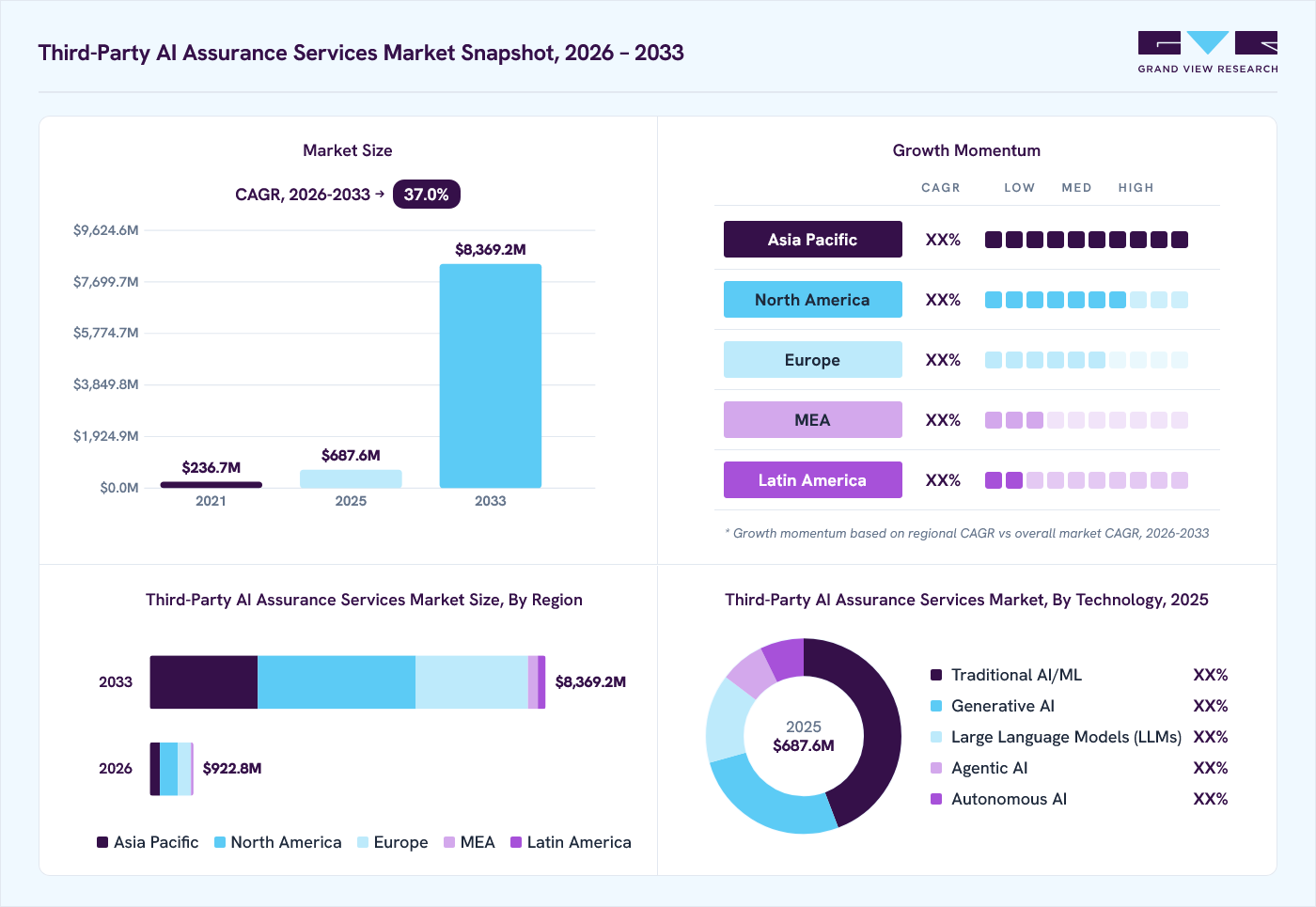 Source: Grand View Research, IR Documents, Primary Interviews, Paid DatabasesTo learn more about this report,
 Download Free Sample Report
Key Market Trends & Insights
- By service type: AI Governance, Risk & Controls Assurance segment held the largest market share of around 27.8% in 2025.
- By engagement stage: Pre-deployment segment held the largest market revenue share in 2025.
- By technology: Traditional AI/ML segment led the market with the largest revenue share in 2025.
- By end use: BFSI segment held the largest market revenue share in 2025.
Regional Highlights
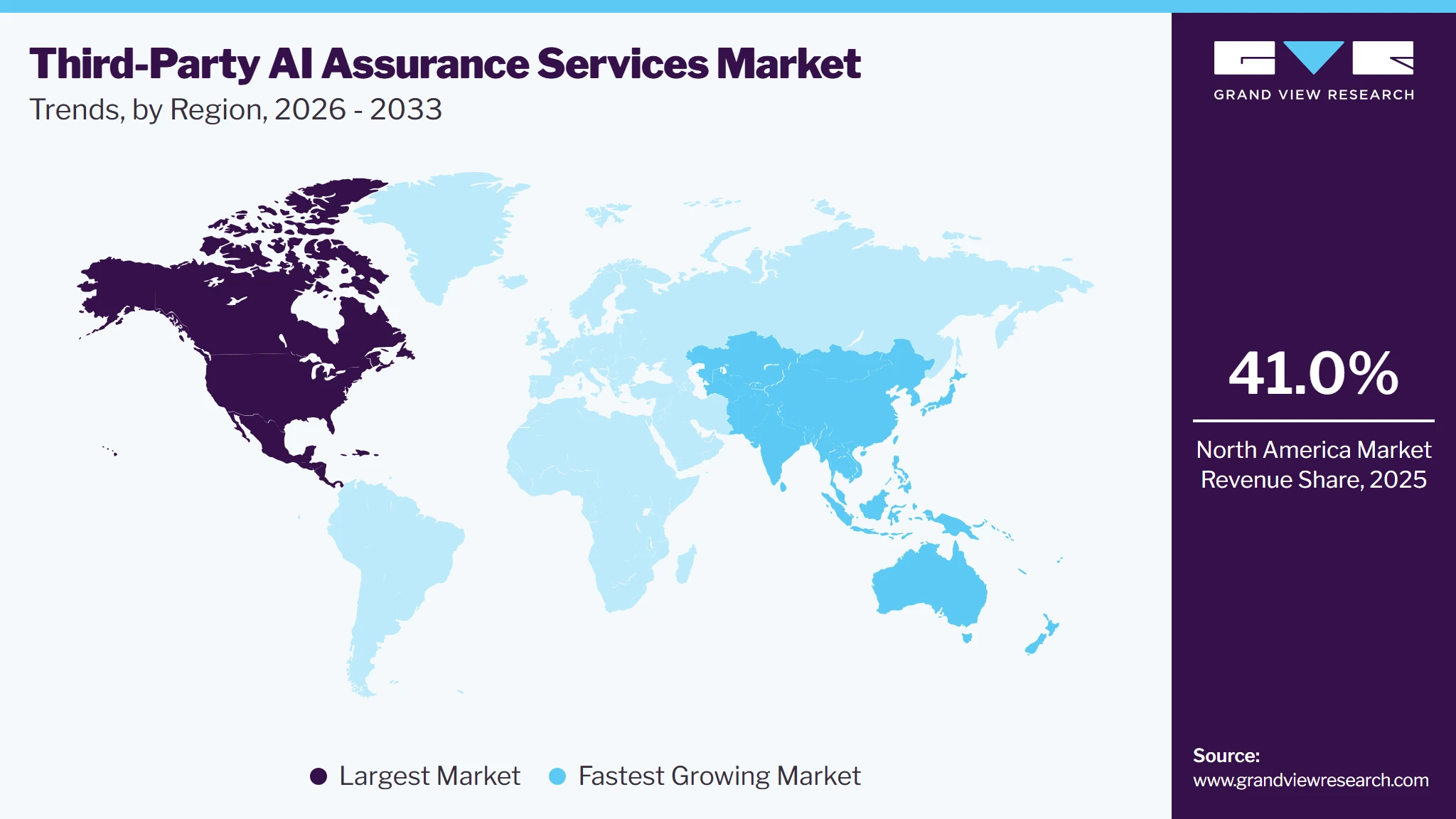
- Largest regional market: North America (40.9% revenue share, 2025)
- Fastest-growing regional market: Asia Pacific (highest CAGR, 2026-2033)
- By country: U.S. held the largest share in 2025
Market Size & Forecasts
- Market size in 2025: USD 687.6 Million
- Estimated market size in 2026: USD 922.8 Million
- Projected market size by 2033: USD 8,369.2 Million
- CAGR (2026-2033): 37.0%
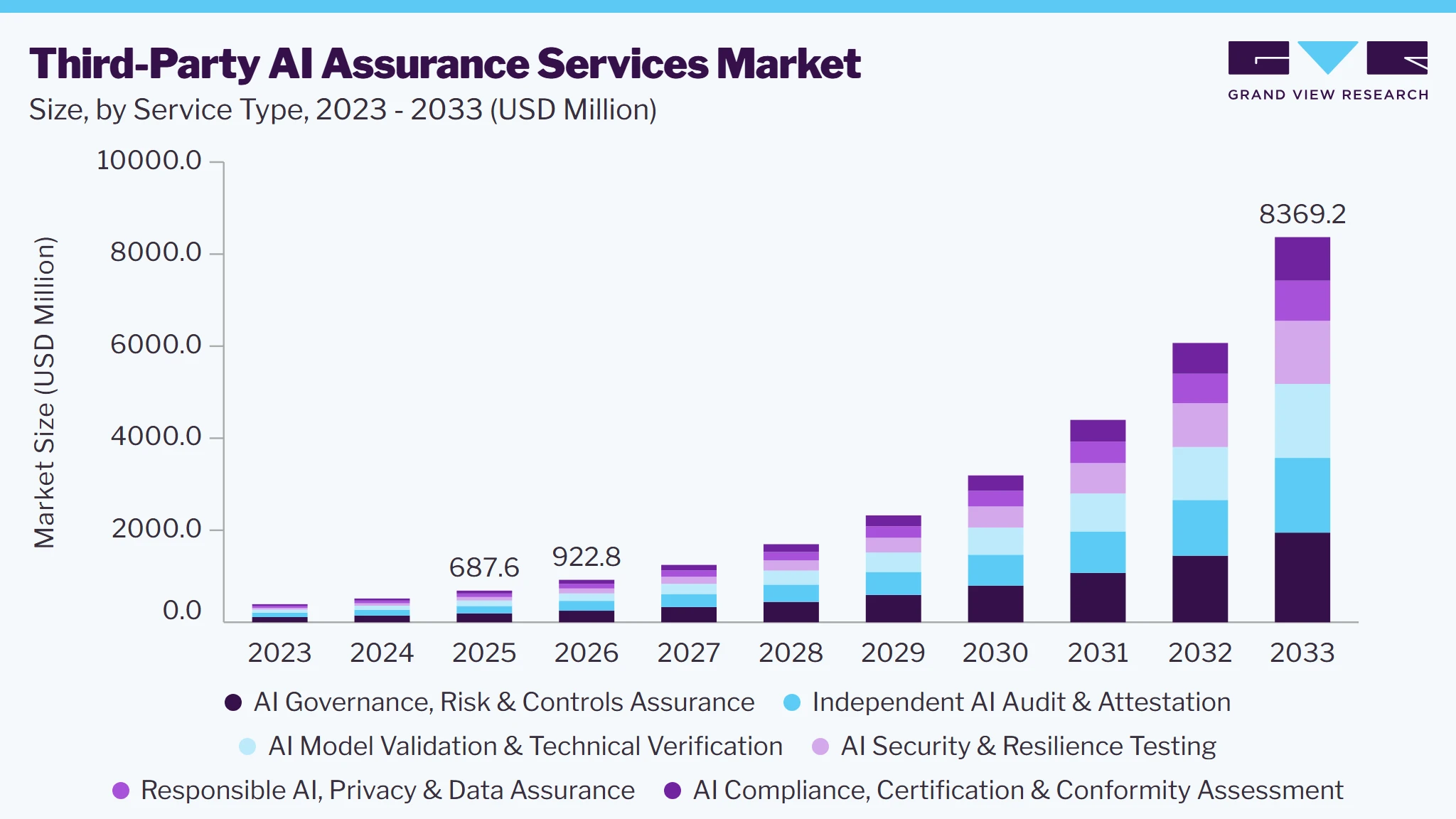
Prism AI by Grand View Research Free to tryAsk a question about the third-party AI assurance services marketTry asking✓Every figure cited from GVR research Prefer the report? Download free sample →The global third-party AI assurance services market is growing as organizations increasingly require independent evaluations of AI systems. Rising AI adoption is driving demand for model validation and performance assessments. Concerns regarding AI reliability, fairness, and security are increasing the need for independent testing. Evolving regulatory requirements is further strengthening demand for AI compliance assessments. Organizations are also seeking external expertise to identify risks and strengthen AI governance. These factors are supporting market growth. For instance, in June 2025, PwC, a UK-based professional services firm, launched its Assurance for AI services to help organizations assess AI reliability, fairness, governance, and regulatory compliance. This development highlights the growing demand for independent AI assurance services.
 To learn more about this report, Download Free Sample Report
The global third-party AI assurance services market is witnessing growing demand for independent testing of AI applications before their deployment. Increasing use of generative AI and AI agents is creating a need to evaluate system accuracy, security, and reliability. Organizations are seeking external expertise to identify vulnerabilities and reduce risks associated with AI-generated outputs. This is encouraging service providers to expand their AI testing and assurance capabilities. For instance, in July 2026, Checkpoint Technologies, a U.S.-based software testing company, partnered with TestSavant.AI to provide AI assurance assessments and testing for enterprise customers. The collaboration supports the evaluation of generative AI applications, AI assistants, and agentic workflows before production deployment.
The global third-party AI assurance services market is witnessing growing demand for continuous AI monitoring and risk assessment. Organizations are increasingly evaluating AI systems throughout their operational lifecycle. This approach helps identify performance deviations, security vulnerabilities, and unintended outcomes. The growing deployment of AI in critical business functions is increasing the need for independent oversight. Businesses are also seeking to verify that AI systems continue to meet established performance and governance standards. Regular assessments help organizations identify emerging risks and maintain system reliability. These requirements are encouraging assurance providers to expand their monitoring and evaluation services. Demand is also increasing for periodic audits and independent compliance reviews. These factors are supporting the growth of the global market.
Market Dynamics
The global third-party AI assurance services market is growing as organizations increasingly adopt artificial intelligence across business operations and decision-making processes. The need to evaluate AI system reliability, fairness, security, and regulatory compliance is increasing demand for independent assessment services. Evolving AI governance frameworks and growing concerns regarding model risks are encouraging organizations to engage external assurance providers. However, the lack of standardized assessment approaches and the complexity of evaluating rapidly evolving AI technologies may influence market growth.
The increasing adoption of artificial intelligence across industries is driving demand for third-party AI assurance services. Organizations are seeking independent evaluations to assess the accuracy, reliability, fairness, and security of AI systems before and after deployment. These services help identify potential biases, operational risks, and vulnerabilities that may affect business outcomes. The growing use of generative AI in customer service, content creation, business analytics, and automated decision-making is further increasing the need for structured AI evaluation. As AI applications become more complex, organizations are placing greater emphasis on independent validation to maintain system performance and build user confidence.
Moreover, evolving regulatory requirements and the development of AI governance frameworks are encouraging organizations to strengthen their compliance practices. Businesses are increasingly seeking external expertise to validate AI systems against established standards, document risk management procedures, and improve transparency. The need to demonstrate responsible AI deployment to customers, regulators, and business partners is supporting demand for independent assurance services. This trend is creating opportunities for assurance providers to offer specialized assessments aligned with industry-specific regulations and emerging AI governance requirements.
The third-party AI assurance services market faces challenges associated with the absence of universally accepted evaluation methodologies across AI applications. Differences in AI models, training datasets, deployment environments, and intended uses can make it difficult to establish consistent assessment criteria. Assurance providers may need to develop customized testing approaches to evaluate model accuracy, fairness, robustness, explainability, and security. These requirements can increase assessment time and service delivery costs. The lack of standardized benchmarks may also complicate comparisons of assessment results across different AI systems and industries.
Furthermore, evaluating complex AI systems requires specialized expertise in machine learning, cybersecurity, data governance, and regulatory compliance. The limited availability of professionals with combined technical and assurance capabilities may constrain service delivery. Rapid changes in AI technologies can also require providers to regularly update their assessment tools and methodologies. These factors may increase operational complexity and affect the scalability of third-party AI assurance services. Smaller assurance providers may face additional difficulties in maintaining the technical resources and expertise needed to address these evolving requirements.
The growing deployment of generative AI applications and AI agents is creating opportunities for third-party assurance providers to expand their service offerings. Organizations require independent testing to evaluate hallucinations, harmful outputs, data leakage, prompt injection vulnerabilities, and model reliability. These requirements are creating demand for specialized services covering AI model validation, security testing, risk assessment, and governance reviews. Providers that develop comprehensive testing capabilities for generative AI applications may be well positioned to address emerging enterprise requirements.
The increasing integration of AI into critical business processes is also creating opportunities for continuous monitoring and recurring assurance services. Organizations need to assess AI systems as models, datasets, business requirements, and regulatory expectations change over time. Independent providers can support these needs through periodic audits, performance monitoring, risk reviews, and compliance assessments. The growing emphasis on responsible AI deployment is expected to create further opportunities for specialized third-party assurance services.
Market Concentration & Characteristics
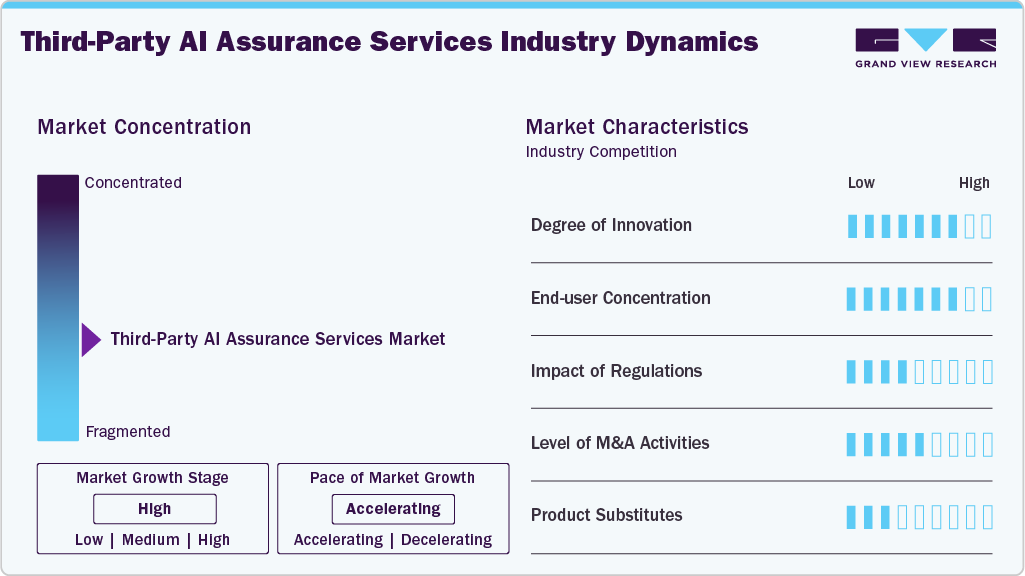
The global third-party AI assurance services market is moderately fragmented, with established consulting firms, technology service providers, and specialized assurance companies offering a range of AI risk assessment and validation services. Competition is influenced by technical expertise, regulatory knowledge, assessment methodologies, and the ability to evaluate AI systems across their development and deployment stages. Major players leverage their risk management capabilities, industry experience, and established client relationships to strengthen their market positions. Specialized providers participate in the market by offering independent AI audits, model validation, bias and fairness assessments, and AI governance services. Demand for independent evaluation is also shaped by growing concerns regarding AI transparency, reliability, security, and regulatory compliance.
 To learn more about this report, Download Free Sample Report
The global third-party AI assurance services market is characterized by growing demand for independent evaluation of AI systems across industries. Organizations increasingly seek external expertise to assess model performance, identify risks, and establish responsible AI practices. Service offerings include AI system testing, model validation, bias detection, explainability assessments, security evaluations, and compliance reviews. The scope of assurance services varies according to AI applications, industry requirements, and applicable regulatory frameworks. Providers also support organizations in establishing governance processes, monitoring AI performance, and documenting risk management practices. The market continues to evolve as generative AI and autonomous AI applications introduce new requirements for testing, oversight, and accountability.
Analyst Perspective
The market is poised for growth, driven by increasing enterprise adoption of artificial intelligence and the need for independent evaluation of AI systems. The expansion of generative AI, agentic AI, and AI-enabled business processes is expected to increase demand for model validation, risk assessment, and governance services. Evolving regulatory requirements and concerns regarding AI reliability, transparency, security, and fairness will create further opportunities for service providers. However, limited standardization of assurance methodologies and the complexity of evaluating rapidly evolving AI systems may pose challenges. The market outlook remains positive, supported by growing emphasis on responsible AI adoption and independent risk assessment.
Service Type Insights
The AI governance, risk & controls assurance segment dominated the third-party AI assurance services market in 2025, accounting for a 27.8% revenue share. Its prominent position shows the growing need for structured AI governance frameworks and risk management practices. Organizations are increasingly focusing on identifying AI-related risks and establishing effective internal controls. Regulatory developments and responsible AI requirements are further encouraging the adoption of assurance services. The increasing complexity of AI models is also driving demand for independent assessments of system reliability, transparency, and accountability. The segment is expected to remain important as businesses expand AI deployment across operational functions.
The AI security & resilience testing segment is expected to grow as organizations increasingly deploy AI systems across business operations. Rising cybersecurity threats and vulnerabilities in AI models are increasing the need for specialized testing services. Organizations are focusing on protecting sensitive data and preventing unauthorized access to AI systems. The growing use of generative AI and agentic AI is further increasing the importance of security and resilience assessments. Independent testing also helps organizations evaluate AI systems' ability to withstand adversarial attacks and maintain reliable performance. These factors are expected to support demand for AI security & resilience testing services.
Engagement Stage Insights
The pre-deployment assurance dominated segment dominated the third-party AI assurance, driven by the need to evaluate AI systems before their operational rollout. Organizations conduct pre-deployment assessments to identify potential risks, validate model performance, and verify compliance with internal policies. These evaluations help address issues related to accuracy, fairness, security, and reliability before AI systems are integrated into business processes. Growing adoption of AI across critical business functions is increasing the importance of initial assurance assessments. Early identification of potential weaknesses also helps organizations reduce deployment risks and improve system readiness.
The continuous/recurring external assurance segment is expected to grow as organizations increasingly require ongoing evaluation of AI systems after deployment. Frequent model updates, changing data patterns, and evolving regulatory requirements are increasing demand for recurring assessments. Organizations are seeking independent monitoring to identify performance deviations, emerging risks, and compliance gaps. The expansion of generative AI and agentic AI applications is further increasing the need for continuous oversight. Regular external assessments can help organizations maintain AI system reliability and address emerging risks throughout the deployment lifecycle.
Technology Insights
Traditional AI/ML dominated the third-party AI assurance services market, driven by the widespread adoption of predictive analytics, machine learning models, and automated decision-making systems. Organizations rely on independent assessments to validate model accuracy, fairness, reliability, and compliance with internal policies. The use of traditional AI/ML across BFSI, healthcare, manufacturing, and retail further supports demand for assurance services. Model validation and bias assessment help organizations identify potential risks before deploying AI systems. The established use of these models across business applications reinforces the segment's market position.
The agentic AI segment is expected to grow as organizations increasingly adopt autonomous AI agents to execute multi-step tasks and automate business workflows. The ability of these systems to make decisions and interact with enterprise applications creates additional requirements for risk assessment and independent testing. Organizations are focusing on evaluating agent behavior, access controls, security, and operational boundaries. The growing complexity of autonomous AI systems is increasing the need for specialized assurance frameworks. This creates new opportunities for third-party providers to assess the safety and reliability of autonomous AI applications.
End Use Insights
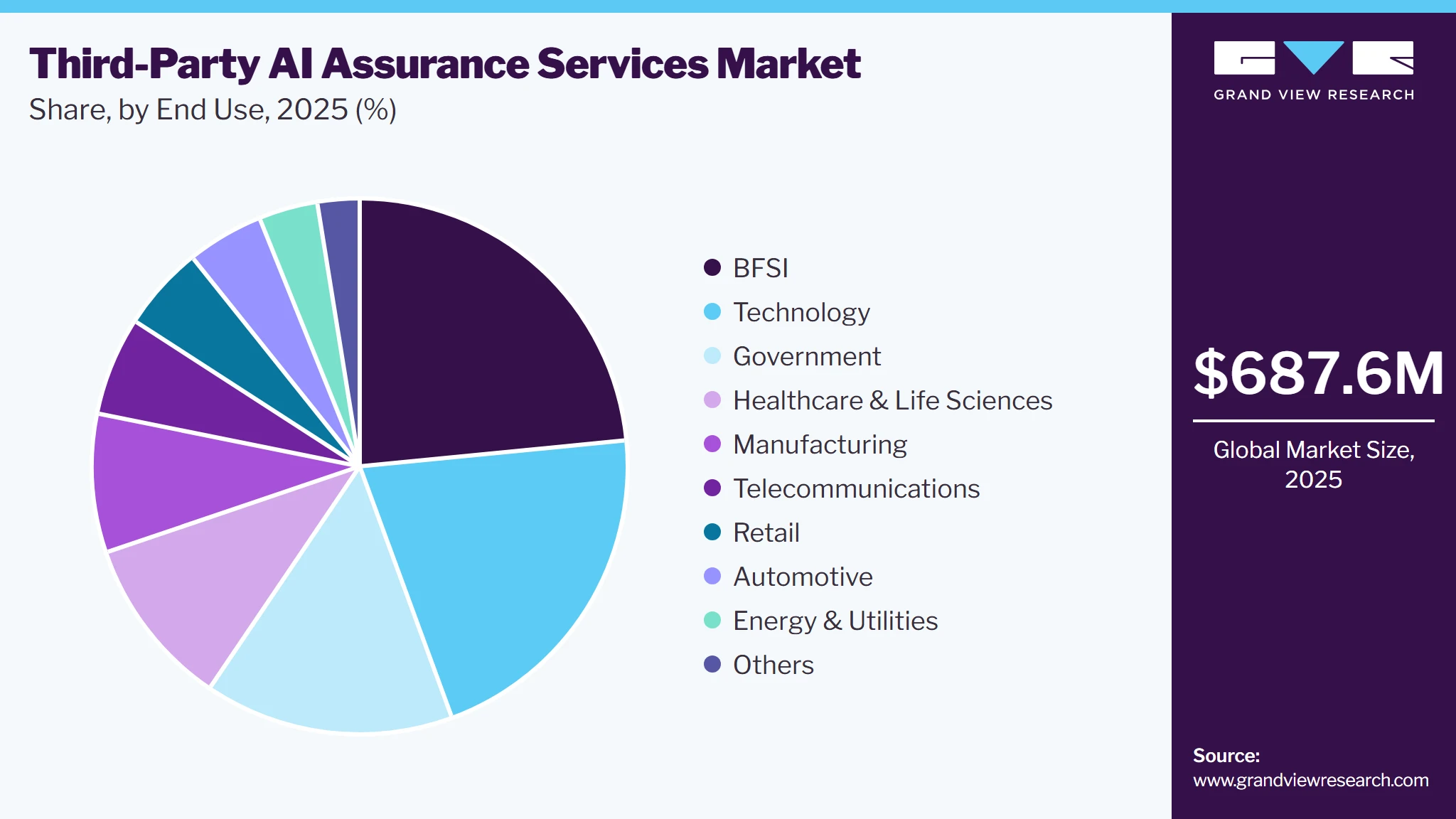
BFSI dominated the third-party AI assurance services market, driven by the widespread adoption of AI in fraud detection, credit risk assessment, customer service, and financial decision-making. Financial institutions require independent assessments to evaluate model accuracy, data security, fairness, and regulatory compliance. The sensitive nature of financial data and the potential impact of AI-driven decisions increase the need for robust assurance services. Growing use of AI in banking, insurance, and investment management further supports demand for independent evaluation. These requirements strengthen the adoption of AI assurance services across the BFSI sector.
 To learn more about this report, Download Free Sample Report
The automotive segment is expected to grow as manufacturers increasingly integrate AI into autonomous driving, advanced driver-assistance systems (ADAS), and connected vehicle technologies. These applications require rigorous testing to assess system safety, reliability, cybersecurity, and performance under different operating conditions. The growing complexity of AI-enabled vehicle functions is increasing the need for independent validation and risk assessment. Automotive companies are also focusing on evaluating AI systems against applicable safety and regulatory requirements. This creates opportunities for third-party assurance providers to support the safe deployment of AI technologies in vehicles.
Regional Insights
North America dominated the third-party AI assurance services market in 2025, accounting for a 41.0% revenue share, driven by rising AI adoption and demand for assurance services. The presence of major technology companies and AI service providers supports regional growth. Increasing adoption of generative AI and machine learning is driving demand for independent assurance. Regulatory developments and responsible AI practices are strengthening governance and risk management. Growing concerns about data privacy, bias, and cybersecurity further support demand. North America is expected to maintain its prominent position as AI adoption expands.
 To learn more about this report, Download Free Sample Report
U.S. Third-party AI Assurance Services Market Trends
The U.S. third-party AI assurance services market is supported by increasing AI adoption across industries and growing demand for independent risk assessments. The expansion of generative AI and machine learning applications is increasing the need for model validation and security testing. Regulatory developments and responsible AI initiatives are encouraging organizations to strengthen governance and compliance practices. Growing concerns regarding data privacy, algorithmic bias, and AI reliability are further supporting demand.
Europe Third-party AI Assurance Services Market Trends
Europe’s third-party AI assurance services market is supported by increasing AI adoption and a strong focus on responsible AI practices. The EU AI Act is driving demand for AI risk assessment and compliance services. Growing concerns regarding model bias, transparency, and data protection are encouraging independent evaluations. The adoption of generative AI across industries is further increasing demand for assurance services. The presence of established consulting firms and specialized providers supports regional market growth.
Asia Pacific Third-party AI Assurance Services Market Trends
The Asia Pacific third-party AI assurance services market is expected to grow rapidly, driven by increasing AI adoption across industries. Growing deployment of generative AI and machine learning is increasing demand for independent testing and validation. Governments across the region are introducing AI policies and governance frameworks, supporting demand for assurance services. Rising concerns regarding data privacy, cybersecurity, and responsible AI use are further encouraging adoption. The expanding technology ecosystem in countries such as China, India, Japan, and South Korea is expected to create growth opportunities.
Key Third-party AI Assurance Services Market Company Insights
Key players operating in the third-party AI assurance services market include Accenture; BABL AI; The British Standards Institution; Capgemini; Deloitte; EY; IBM Corporation; KPMG; PwC; SGS; TÜV Rhineland; TÜV SÜD.
-
Capgemini provides AI assurance-related services through its AI testing, cybersecurity, and risk management capabilities. The company supports organizations in evaluating AI system performance, reliability, and security. Its testing services help identify vulnerabilities and potential operational risks in AI applications. Capgemini also offers AI governance and responsible AI capabilities to address emerging requirements. These services position the company within the third-party AI assurance services ecosystem.
-
Deloitte provides AI assurance services focused on governance, risk management, regulatory compliance, and independent assessment. The company helps organizations evaluate AI systems for accuracy, fairness, transparency, and security. Its services include assessing AI-related controls and identifying potential model risks. Deloitte also supports organizations in developing responsible AI frameworks and strengthening oversight practices. These capabilities support its participation in the third-party AI assurance services market
Key Third-party AI Assurance Services Market Companies
The following key companies have been profiled for this study on the third-party AI assurance services market.
-
Accenture
-
Armilla AI
-
BABL AI
-
Capgemini
-
Deloitte
-
EY
-
IBM Corporation
-
KPMG
-
LatticeFlow AI
-
PwC
-
SGS
-
TÜV Rheinland
-
TÜV SÜD
Competitive Benchmarking
Operating Strategies
Competitive Edge
Weaknesses
Mature Players: Accenture, Capgemini, Deloitte, EY, IBM Corporation
- Focus on AI governance, risk management, regulatory compliance, independent assessments, and integration of assurance services with broader consulting capabilities.
- Established client relationships, global delivery networks, multidisciplinary expertise, and broad risk and compliance capabilities.
- Higher service costs, complex delivery structures, and potential challenges in scaling specialized assessments across rapidly evolving AI technologies.
Emerging Players: BABL AI, Armilla AI, LatticeFlow AI
- Focus on specialized AI testing, model validation, bias and fairness assessments, security testing, and automated assurance tools.
- Specialized technical expertise, focused service offerings, and flexibility in addressing emerging AI assurance requirements.
- Limited global reach, smaller client networks, resource constraints, and challenges in establishing market credibility and scaling service delivery.
Recent Developments
-
In October 2026, TÜV SÜD and Accenture introduced the concept of a Physical AI Safety Suite in collaboration with NVIDIA Corporation to accelerate independent safety assessment and certification of AI-powered robots and automated industrial facilities. The solution uses digital twins, AI agents, and simulations to identify potential hazards, support compliance, and reduce the time required to bring factories and warehouses into operation.
-
In October 2026, The British Standards Institution launched three AI assessment and certification schemes covering large language model performance, product-level AI risk management, and readiness for EU AI Act conformity assessment requirements. The services provide independent testing and evaluation to help organizations assess AI safety, reliability, risk controls, and regulatory compliance.
-
In June 2025, IBM Corporation introduced enhanced integrations between watsonx.governance and Guardium AI Security to unify AI governance and security for enterprise AI agents and generative AI systems. The updates include automated red-team testing, AI risk detection, lifecycle monitoring, and compliance capabilities, supported by a collaboration with AllTrue.ai to improve AI discovery and governance workflows.
Third-party AI Assurance Services Market Report Scope
Report Attribute
Details
Market size in 2025
USD 687.6 million
Estimated market size in 2026
USD 922.8 million
Projected market size by 2033
USD 8,369.2 million
Growth rate
CAGR of 37.0% from 2026 to 2033
Actual data
2021 - 2025
Forecast period
2026 - 2033
Quantitative units
Revenue in USD million and CAGR from 2026 to 2033
Report coverage
Revenue forecast, company share, competitive landscape, growth factors, and trends
Segments covered
Service type, engagement stage, technology, end use, region
Regional scope
North America; Europe; Asia Pacific; Latin America; Middle East & Africa
Country scope
U.S.; Canada; Mexico; U.K.; Germany; France; China; Japan; India; South Korea; Australia; Brazil; UAE; KSA; South Africa
Key companies profiled
Accenture; Armilla AI; BABL AI; Capgemini; Deloitte; EY; IBM Corporation; KPMG; LatticeFlow AI; PwC; SGS; TÜV Rhineland; TÜV SÜD
Customization scope
Free report customization (equivalent to up to 8 analyst working days) with purchase. Addition or alteration to country, regional & segment scope.
Pricing and purchase options
Avail customized purchase options to meet your exact research needs. Explore purchase options
Global Third-party AI Assurance Services Market Report Segmentation
This report forecasts revenue growth at global, regional, and country levels and provides an analysis of the latest industry trends in each of the sub-segments from 2021 to 2033. For this study, Grand View Research has segmented the global third-party AI assurance services market report based on service type, engagement stage, technology, end use, and region.
-
Service Type Outlook (Revenue, USD Million, 2021 - 2033)
-
Independent AI Audit & Attestation
-
AI Governance, Risk & Controls Assurance
-
AI Model Validation & Technical Verification
-
Responsible AI, Privacy & Data Assurance
-
AI Security & Resilience Testing
-
AI Compliance, Certification & Conformity Assessment
-
-
Engagement Stage Outlook (Revenue, USD Million, 2021 - 2033)
-
Pre-deployment
-
Deployment
-
Post-deployment
-
Continuous/Recurring External Assurance
-
-
Technology Outlook (Revenue, USD Million, 2021 - 2033)
-
Traditional AI/ML
-
Generative AI
-
Large Language Models (LLMs)
-
Agentic AI
-
Autonomous AI
-
-
End Use Outlook (Revenue, USD Million, 2021 - 2033)
-
BFSI
-
Healthcare & Life Sciences
-
Technology
-
Government
-
Manufacturing
-
Retail
-
Telecommunications
-
Automotive
-
Energy & Utilities
-
Others
-
-
Regional Outlook (Revenue, USD Million, 2021 - 2033)
-
North America
-
U.S.
-
Canada
-
Mexico
-
-
Europe
-
U.K.
-
Germany
-
France
-
-
Asia Pacific
-
China
-
Japan
-
India
-
South Korea
-
Australia
-
-
Latin America
-
Brazil
-
-
Middle East and Africa
-
UAE
-
KSA
-
South Africa
-
-
Research Methodology
The third-party AI assurance services market figures in this report are based on a proven research process that combines executive interviews with secondary research from proprietary databases, company filings, and recognized regulatory and institutional sources. Market size is built through value-chain sizing-reconciling supply-side and demand-side estimates-and triangulated with bottom-up and top-down approaches. Every estimate passes multiple levels of expert validation before publication, with each third-party AI assurance services segment quantified using the revenue-capture definitions in the table below.
Segment Definition
Service Type
Revenue Capture Definition
Independent AI Audit & Attestation
Revenue generated through independent audits and attestation engagements that verify AI systems and organizational practices against established assurance criteria and standards.
AI Governance, Risk & Controls Assurance
Revenue earned from reviewing AI governance structures, evaluating risk management procedures, and verifying the adequacy of controls for responsible AI use.
AI Model Validation & Technical Verification
Revenue attributable to technical verification and validation of AI models, covering accuracy, robustness, reliability, explainability, and performance against intended requirements.
Responsible AI, Privacy & Data Assurance
Revenue from independent evaluations of AI fairness, algorithmic bias, transparency, privacy safeguards, and the quality and appropriate use of data.
AI Security & Resilience Testing
Revenue derived from AI-focused security testing, including adversarial simulations, red-team assessments, vulnerability testing, and evaluations of system resilience.
AI Compliance, Certification & Conformity Assessment
Revenue earned by assessing AI systems against relevant regulatory and technical requirements and issuing certifications or conformity assessment outcomes where applicable.
Engagement Stage
Revenue Capture Definition
Pre-deployment
Revenue from assessments performed before an AI system enters production, including initial risk reviews, model testing, security evaluations, and deployment-readiness checks.
Deployment
Revenue associated with validating AI system implementation, including integration testing, configuration reviews, access-control checks, and verification of deployment requirements.
Post-deployment
Revenue generated by independent assessments of AI systems already in operation, covering performance issues, emerging risks, incidents, and ongoing compliance.
Continuous/Recurring External Assurance
Revenue from repeat or ongoing third-party engagements that periodically assess AI systems for changes in performance, risk exposure, security, governance, and regulatory adherence.
Technology
Revenue Capture Definition
Traditional AI/ML
Revenue from assurance engagements covering conventional machine learning and AI applications, such as predictive analytics, classification, recommendation systems, and automated decision-making.
Generative AI
Revenue generated by evaluating AI systems that create content, including text, images, audio, video, and code, with assessments covering output quality, safety, reliability, and potential misuse.
Large Language Models (LLMs)
Revenue from specialized evaluations of language models, including testing for factual accuracy, relevance, bias, robustness, security, and suitability for intended applications.
Agentic AI
Revenue earned from assessing AI agents that independently plan and execute tasks or interact with tools and business systems, with a focus on permissions, decision boundaries, control mechanisms, and operational risks.
Autonomous AI
Revenue from evaluating AI systems capable of operating with limited human intervention, particularly their decision-making behavior, operational safety, reliability, and response to changing conditions.
End Use
Revenue Capture Definition
BFSI
Revenue generated through assurance engagements for financial-sector AI applications, including credit scoring, fraud prevention, risk modeling, insurance decisions, and customer-facing services.
Healthcare & Life Sciences
Revenue from evaluating AI applications used in diagnostics, medical imaging, clinical decision support, drug discovery, clinical trials, and healthcare administration.
Technology
Revenue earned from assurance services for AI products and applications developed or deployed by software companies, cloud providers, AI vendors, and other technology businesses.
Government
Revenue from independent evaluations of public-sector AI systems used in citizen services, public administration, eligibility decisions, public safety, and government operations.
Manufacturing
Revenue attributable to AI assurance in industrial environments, including assessments of predictive maintenance, automated inspection, robotics, production systems, and digital twins.
Retail
Revenue from assessing retail AI applications such as personalized recommendations, demand forecasting, dynamic pricing, inventory planning, and automated customer interactions.
Telecommunications
Revenue earned from assurance services for telecom AI applications involving network performance, predictive maintenance, fraud prevention, customer experience, and network security.
Automotive
Revenue from evaluating AI-enabled automotive technologies, including driver-assistance systems, autonomous driving functions, connected vehicles, and AI-based manufacturing processes.
Energy & Utilities
Revenue generated by assessing AI applications in power generation, grid operations, energy forecasting, asset management, predictive maintenance, and utility services.
Others
Revenue from AI assurance engagements across industries not separately classified, including education, agriculture, logistics, transportation, media, and professional services.
Estimation Model
Layer Name
Key Question
Description
End-user Industry Layer
Which industries and organizations generate demand for third-party AI assurance services?
Identifies demand across BFSI, healthcare and life sciences, technology, government, manufacturing, automotive, retail, telecommunications, energy and utilities, and other industries adopting AI systems.
AI Assurance Service Layer
What types of independent assurance services do organizations require?
Examines demand for independent AI audits and attestation, governance and risk assurance, model validation, responsible AI assessments, security and resilience testing, and compliance and certification services.
Technology & AI System Layer
Which AI technologies and systems require independent assessment?
Evaluates assurance requirements across traditional AI and machine learning, generative AI, large language models, agentic AI, and autonomous AI, considering their technical complexity, risk exposure, and intended use.
Engagement Stage Layer
At which stages of the AI lifecycle are third-party assurance services engaged?
Assesses revenue opportunities across pre-deployment assessments, deployment-stage evaluations, post-deployment reviews, and continuous or recurring external assurance engagements.
Delivered Customizations
This report has been delivered with the following In-depth customizations
Client Objective
Custom Research Modules Delivered
Strategic Value / Business Impact
AI Assurance Service & Capability Assessment
Analysis of third-party AI assurance services and assessment methodologies.
Evaluation of AI governance, risk management, model validation, and security testing capabilities.
Assessment of assurance requirements across traditional AI/ML, generative AI, LLMs, and agentic AI.
Review of regulatory requirements, assurance frameworks, and certification approaches.
Identified relevant AI assurance services and capability requirements.
Supported the development of service offerings and assurance methodologies.
Helped align assurance capabilities with emerging AI risks and compliance needs.
Informed service development and capability expansion decisions.
Service Positioning & Competitive Intelligence
Benchmarking of third-party AI assurance service portfolios across major providers.
Comparison of AI audit, model validation, governance, security testing, and certification offerings.
Evaluation of service delivery models, technical expertise, industry coverage, and assessment capabilities.
Analysis of competitive positioning, service differentiation, partnerships, and provider capabilities.
Identified competitive strengths and service portfolio gaps.
Supported service differentiation and portfolio planning.
Helped align offerings with client requirements and industry-specific assurance needs.
Identified opportunities to strengthen technical capabilities and strategic partnerships.
Informed competitive positioning and service strategy decisions.
Market Entry & Growth Assessment
Global and regional market sizing and forecasting for third-party AI assurance services.
Segmentation by service type, engagement stage, AI technology, and end-use industry.
Assessment of regulatory developments, AI adoption trends, and demand drivers.
Evaluation of regional opportunities, emerging assurance requirements, and competitive dynamics.
Identified growth opportunities across regions, service categories, and industries.
Supported market entry and geographic expansion planning.
Helped prioritize target industries, customer groups, and assurance services.
Identified potential opportunities arising from evolving AI regulations and adoption patterns.
Informed business development and long-term growth strategies.
About the Author(s)
IT Services & Applications Research Team
Technology · IT Services & ApplicationsThis report was authored by the it services & applications research team at Grand View Research - comprising two research analysts, one senior research analyst, and one industry expert - with specialized expertise in the it services & applications segment of the technology industry. All findings are based on proprietary technology databases, executive interviews, and regulatory analysis, subject to internal peer review prior to publication.
Last Updated:
Speak to Analyst

Customize this report to your needs - add regions, segments, or data points, with 20% free customization.
Or view our licence options:


ISO 9001:2015 & 27001:2022 Certified
We are GDPR and CCPA compliant! Your transaction & personal information is safe and secure. For more details, please read our privacy policy.


