
- Home
- »
- Automotive & Transportation
- »
-
Third-party Logistics Software Market Size Report 2026-2033GVR Report cover

Third-party Logistics Software Market (2026 - 2033)
Size, Share & Trends Analysis Report By Type (Transportation Management System (TMS)), By End-use Industry (E-commerce & Fulfilment Centers), By Application, By Region, And Segment Forecasts
Market Size, 2025
$2.0BMarket Estimate, 2026
$2.1BMarket Forecast, 2033
$3.4BCAGR, 2026–2033
6.8%Third-party Logistics Software Market Summary
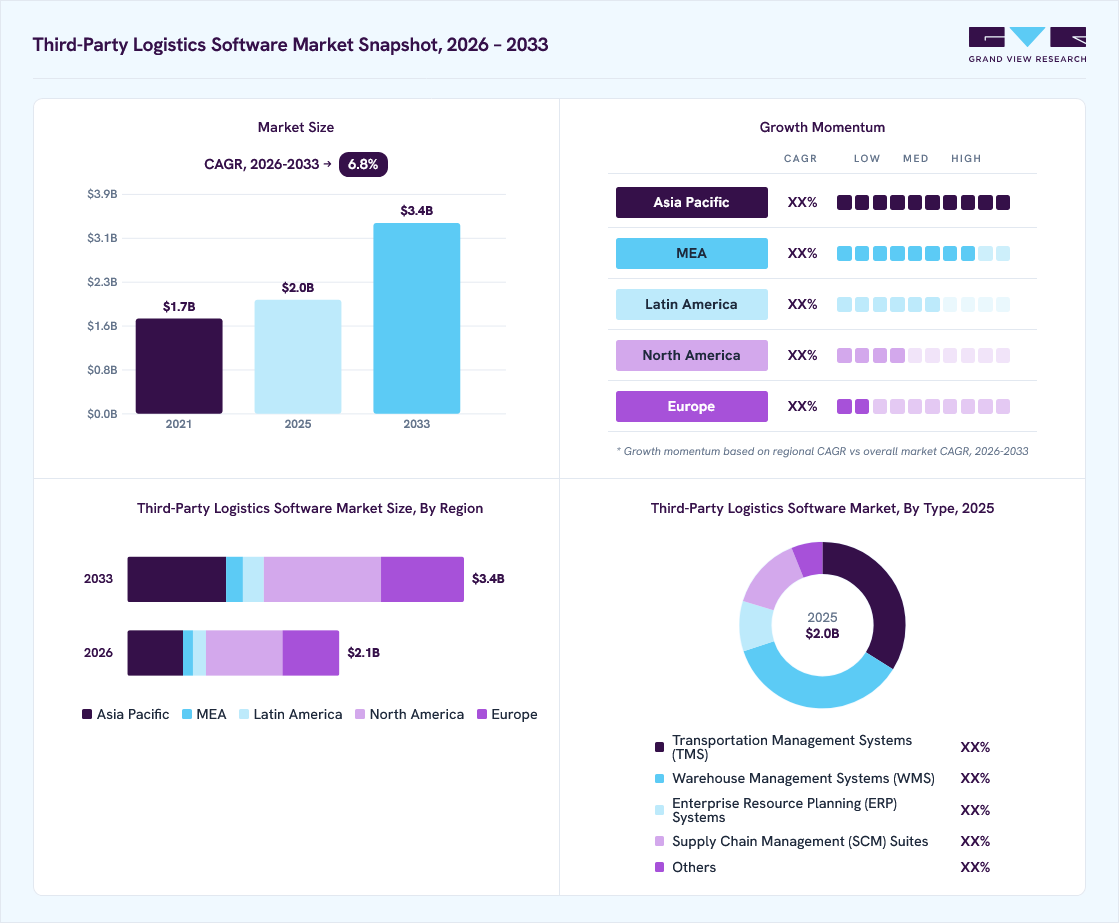
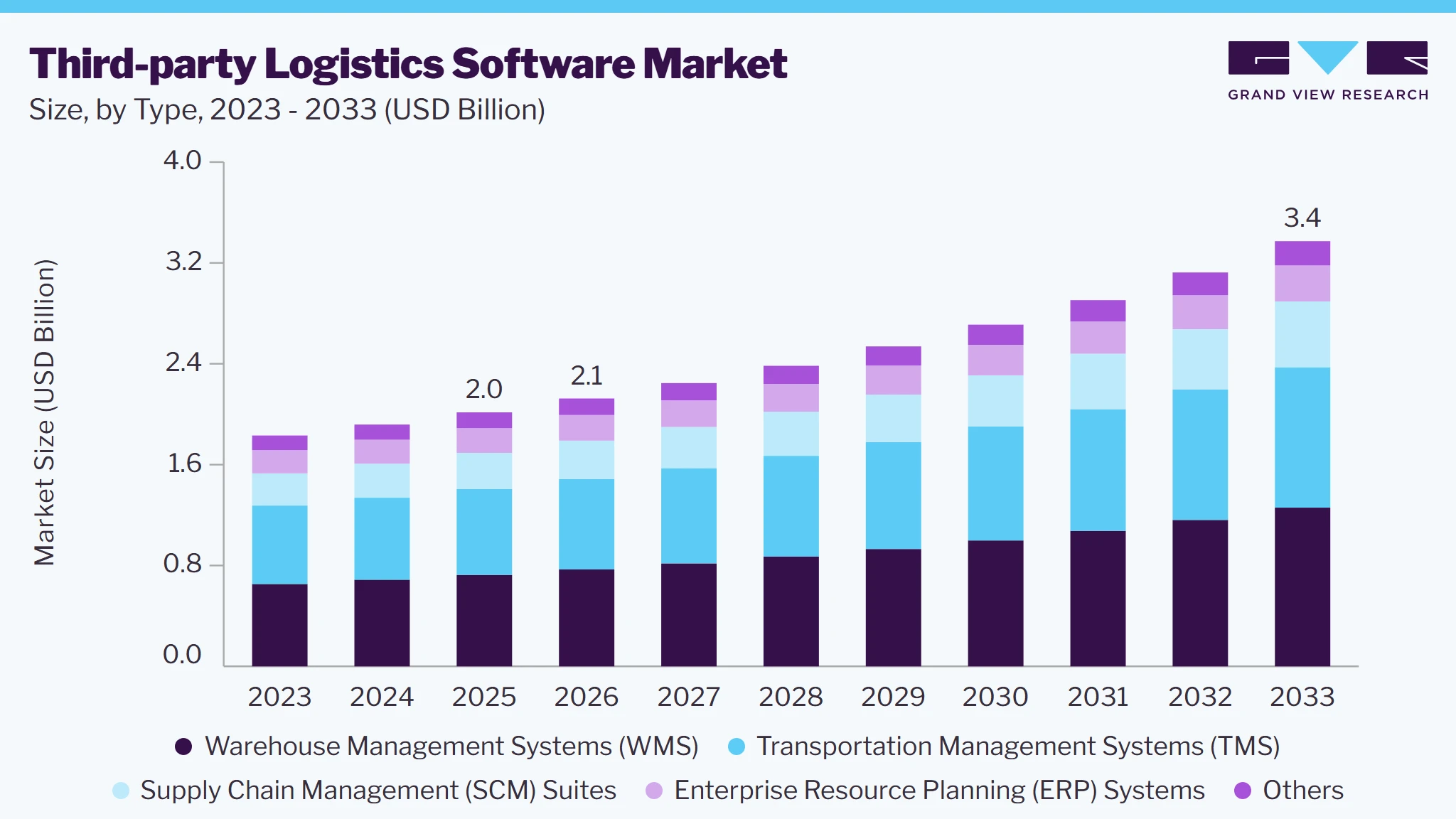
The global third-party logistics software market size was valued at USD 2.0 billion in 2025 and is projected to grow from USD 2.1 billion in 2026 to USD 3.4 billion by 2033, at a CAGR of 6.8% from 2026 to 2033. North America dominated the market, accounting for a revenue share of 36.2% in 2025. Increasing demand for real-time shipment tracking and inventory visibility across complex supply chain networks is driving the adoption of third-party logistics (3PL) software.
 Source: Grand View Research, IR Documents, Primary Interviews, Paid DatabasesTo learn more about this report,
 Download Free Sample Report
Key Market Trends & Insights
- By Type: Warehouse Management Systems (WMS) segment led the market and accounted for 36.0% of the global revenue in 2025.
- By deployment: Cloud segment led the market and accounted for 62.8% of the global revenue in 2025.
- By end-use industry: E-commerce and fulfilment centers segment led the market and accounted for the global revenue in 2025
Regional Highlights
- Largest regional market: North America (36.2% revenue share, 2025)
- By country: The U.S. held the largest market share in 2025.
Market Size & Forecast
- Market Size in 2025: USD 2.0 Billion
- Estimated Market Size in 2026: USD 2.1 Billion
- Projected Market Size by 2033: USD 3.4 Billion
- CAGR (2026-2033): 6.8%
Prism AI by Grand View Research Free to tryAsk a question about the third-party logistics software marketTry asking✓Every figure cited from GVR research Prefer the report? Download free sample →The increasing complexity of global supply chains is encouraging third-party logistics providers to adopt software solutions that improve operational efficiency and service quality. Rising shipment volumes, expanding distribution networks, and changing customer expectations are increasing the need for centralized logistics management. 3PL software enables service providers to monitor shipments, manage inventory, coordinate transportation, and streamline warehouse activities through a unified platform. Growing demand for real-time information and faster order processing is further encouraging businesses to replace manual logistics operations with automated systems. These developments are accelerating the adoption of 3PL software to improve resource utilization, reduce operating costs, and strengthen customer satisfaction.
 To learn more about this report, Download Free Sample Report
The integration of artificial intelligence, machine learning, and advanced analytics is emerging as a significant trend in the market. Logistics providers are incorporating intelligent technologies to improve demand forecasting, optimize delivery routes, automate order processing, and identify potential supply chain disruptions. The increasing availability of real-time operational data is supporting more accurate planning and faster business decisions. Software providers are also introducing intelligent automation capabilities to improve warehouse productivity and transportation management. This shift toward data-driven logistics operations is creating opportunities for advanced 3PL software solutions across different industries.
Government authorities across major economies are introducing regulations and digital reporting requirements to improve transportation transparency, product traceability, and supply chain accountability. In the U.S., the FDA's Food Safety Modernization Act (FSMA) traceability requirements establish additional recordkeeping obligations for businesses handling specified food products, with enforcement scheduled no earlier than July 20, 2028. In Europe, the Electronic Freight Transport Information (eFTI) Regulation establishes a framework for electronic exchange of freight information, with full application scheduled for July 9, 2027. These regulatory developments are encouraging logistics providers to invest in software that supports digital documentation, shipment tracking, and standardized information exchange. Consequently, regulatory compliance requirements are creating additional opportunities for 3PL software providers.
The increasing digitalization of logistics operations exposes 3PL software platforms to cybersecurity threats, data breaches, and unauthorized access to sensitive business information. These platforms handle confidential customer records, shipment details, inventory information, and financial transactions across multiple supply chain partners. The growing connectivity between logistics providers, suppliers, and customers increases the complexity of maintaining data security across integrated systems. Concerns regarding information protection and potential operational disruptions create hesitation among businesses, restricting software adoption among security-sensitive logistics providers.
Market Dynamics
The 3PL software market is experiencing increasing adoption as logistics service providers focus on improving operational efficiency, shipment visibility, inventory accuracy, and customer service. The expansion of e-commerce, rising outsourcing of logistics activities, and growing complexity of global supply chains are increasing the need for integrated logistics management platforms. Advancements in cloud computing, artificial intelligence (AI), automation, and real-time data analytics are reshaping software capabilities. Market participants are increasingly focusing on scalable, flexible, and integrated solutions that support multi-client operations, automated billing, warehouse management, and transportation planning.
Third-party logistics providers manage complex activities involving transportation, warehousing, inventory handling, order fulfilment, freight coordination, and customer communication. The increasing volume of shipments, expansion of multi-channel distribution networks, and growing customer expectations for timely deliveries are creating operational challenges for logistics companies. Traditional manual processes and disconnected software systems often lead to delayed information, gaps in shipment tracking, inventory discrepancies, and inefficient resource utilization. These challenges increase the need for centralized software platforms that provide real-time information and improve coordination across logistics operations. Consequently, logistics providers are investing in specialized software to strengthen operational control and maintain service quality.
Third-party logistics (3PL) software solutions address these requirements through transportation management, warehouse management, shipment tracking, inventory monitoring, and automated order processing capabilities. Integrated platforms enable logistics providers to monitor shipment movements, coordinate warehouse activities, manage multiple customer accounts, and improve delivery planning through centralized information. Automated billing and reporting functionalities also help reduce manual work and improve revenue accuracy. The integration of cloud platforms, analytics, and AI-based capabilities further supports operational decision-making and resource utilization. These benefits encourage logistics providers to adopt advanced software solutions, supporting market growth.
The implementation of third-party logistics software entails considerable costs for software licensing, system customization, data migration, employee training, integration, and ongoing maintenance. Logistics providers frequently operate with existing enterprise resource planning systems, warehouse applications, transportation platforms, and customer-specific software. Integrating new solutions with these existing systems requires technical resources and operational adjustments. Smaller logistics companies often face budget limitations and a shortage of skilled IT personnel, making software implementation more challenging. Uncertainty regarding implementation timelines and return on investment further influences purchasing decisions, particularly among small and medium-sized logistics providers.
High implementation costs and integration requirements primarily affect small and medium-sized 3PL operators, regional logistics providers, and companies operating across multiple locations with different legacy systems. These businesses often postpone technology upgrades or continue using spreadsheets and basic software applications to control operating expenditure. Complex implementation requirements also increase the risk of operational disruptions during system migration and employee transition. Consequently, adoption remains comparatively slower among cost-sensitive providers and businesses operating in developing logistics markets. This limits the penetration of comprehensive enterprise-level platforms and creates a preference for modular, subscription-based, and cloud-deployed solutions.
The increasing adoption of cloud computing and artificial intelligence is creating significant opportunities in the market. Logistics providers require flexible platforms that support multiple warehouses, customer accounts, transportation networks, and distribution locations without requiring substantial investments in physical IT infrastructure. Cloud-based software provides remote accessibility, centralized data management, and flexible deployment options. Additionally, AI-enabled capabilities support demand forecasting, inventory planning, route optimization, automated document processing, and operational analytics. These developments are encouraging logistics companies to modernize existing systems and adopt technology platforms that improve service performance and operational flexibility.
Cloud-based and AI-enabled solutions offer considerable growth potential across transportation management, warehouse management, and integrated supply chain software segments. Software vendors offering scalable, subscription-based platforms, automated billing, multi-client management, and seamless integration capabilities are well positioned to capture this opportunity. Small and medium-sized 3PL providers represent an important customer group because cloud deployment reduces the need for extensive internal IT infrastructure. Meanwhile, larger logistics companies are expected to invest in advanced analytics, AI-driven optimization, and integrated platforms to manage complex distribution networks. Vendors that combine operational automation with flexible deployment and customer-specific configurations are positioned to strengthen their competitive presence.
Market Concentration & Characteristics
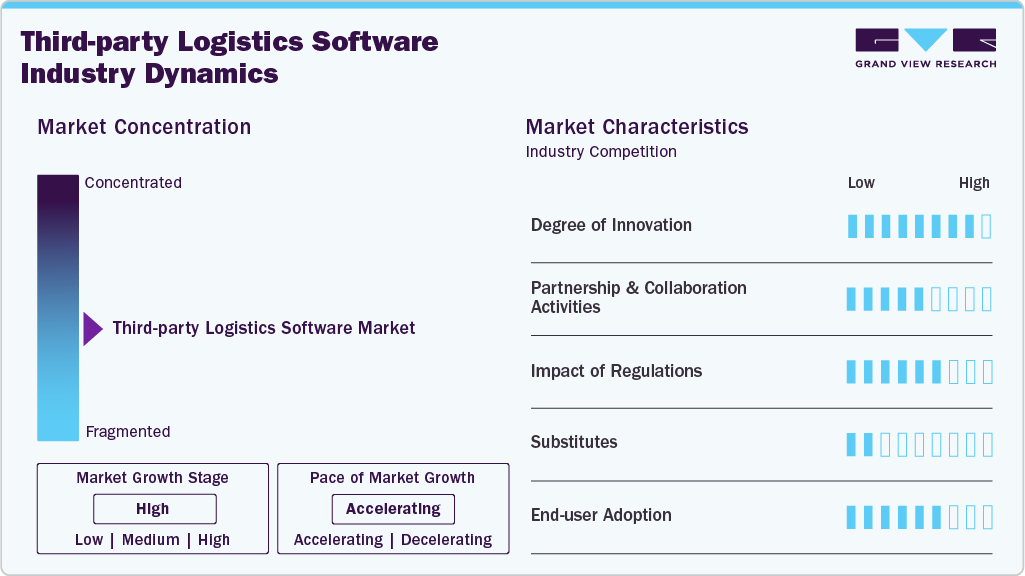
The 3PL software market is moderately fragmented, characterized by the presence of several established software providers, specialized technology companies, and emerging solution providers competing across different logistics applications. Competition is influenced by the availability of transportation management, warehouse management, order management, shipment tracking, and supply chain visibility solutions. The market does not depend entirely on a limited number of providers, as customers have access to multiple software options based on business size, operational requirements, and budget. This competitive environment encourages providers to strengthen their software capabilities, expand service portfolios, and improve customer experience.
 To learn more about this report, Download Free Sample Report
The market demonstrates high partnership and collaboration activities, as software providers collaborate with logistics operators, technology companies, transportation carriers, and e-commerce platforms to improve service integration and operational efficiency. The impact of regulations is moderate, as data protection, cybersecurity, transportation compliance, and electronic documentation requirements influence software development and implementation. The availability of substitutes is relatively moderate, with in-house software, manual processes, and broader supply chain management platforms offering alternative solutions, although specialized 3PL software provides more focused logistics functionalities. End-user adoption remains high as logistics service providers and businesses increasingly implement digital platforms to improve inventory visibility, shipment management, delivery coordination, and warehouse operations. These factors collectively support market competition and continued technology development.
Analyst Perspective
The 3PL software market is expanding as logistics providers increasingly prioritize operational efficiency, shipment visibility, and integrated supply chain management. The growing adoption of cloud-based platforms, AI-enabled analytics, automated warehouse operations, and transportation optimization is reshaping the competitive landscape. Investment is expected to focus on scalable software platforms, multi-client management, automated billing, real-time tracking, and system integration capabilities. Cloud deployment is gaining importance among smaller logistics providers, while larger enterprises are prioritizing advanced automation and integrated software suites. Competition is increasingly shifting toward vendors offering flexible, industry-specific solutions with comprehensive warehouse and transportation management capabilities.
Type Insights
Based on type, the warehouse management systems type segment accounted for 36.0%, the largest share of global revenue in 2025. The Warehouse Management Systems (WMS) segment dominance in the market due to the extensive requirement for efficient inventory handling, order processing, and warehouse operations among third-party logistics providers. Increasing shipment volumes and expanding distribution facilities are encouraging service providers to implement software that improves storage utilization and inventory accuracy. WMS solutions support receiving, picking, packing, sorting, and dispatching activities, helping businesses manage high-volume warehouse operations. The widespread adoption of these systems across retail, manufacturing, and e-commerce distribution networks continues to support their dominance in these segments.
The supply chain management (SCM) suites segment is expected to register the fastest CAGR during the forecast period. Increasing demand for integrated supply chain operations is prompting third-party logistics providers to adopt comprehensive software platforms that connect procurement, inventory, transportation, and order management. These solutions improve coordination between suppliers, warehouses, distributors, and customers while providing greater visibility across logistics operations. The increasing complexity of multi-location distribution networks is creating opportunities for SCM suites that support centralized planning, operational monitoring, and informed decision-making.
Deployment Insights
Based on deployment, the cloud segment accounted for 62.8%, the largest share of global revenue in 2025 and projected to grow at the fastest CAGR over the forecast period. The increasing demand for flexible software infrastructure is encouraging logistics providers to adopt cloud-based platforms that enable real-time information sharing across geographically distributed operations. Cloud deployment reduces dependence on extensive internal IT infrastructure and provides access to software through subscription-based models. Furthermore, its easy integration with transportation, warehouse, and enterprise management applications is driving adoption among businesses seeking scalable logistics operations.
The on-premise segment is expected to experience significant growth as established logistics providers continue to invest in software infrastructure that offers greater control over business data and system configurations. Large enterprises handling sensitive customer information and complex logistics operations prioritize customized platforms that align with existing IT infrastructure. On-premise deployment also supports organizations that require direct control over system access, internal security policies, and software maintenance. Continued investment in enterprise technology infrastructure is supporting demand for on-premise 3PL software solutions.
End-use Industry Insights
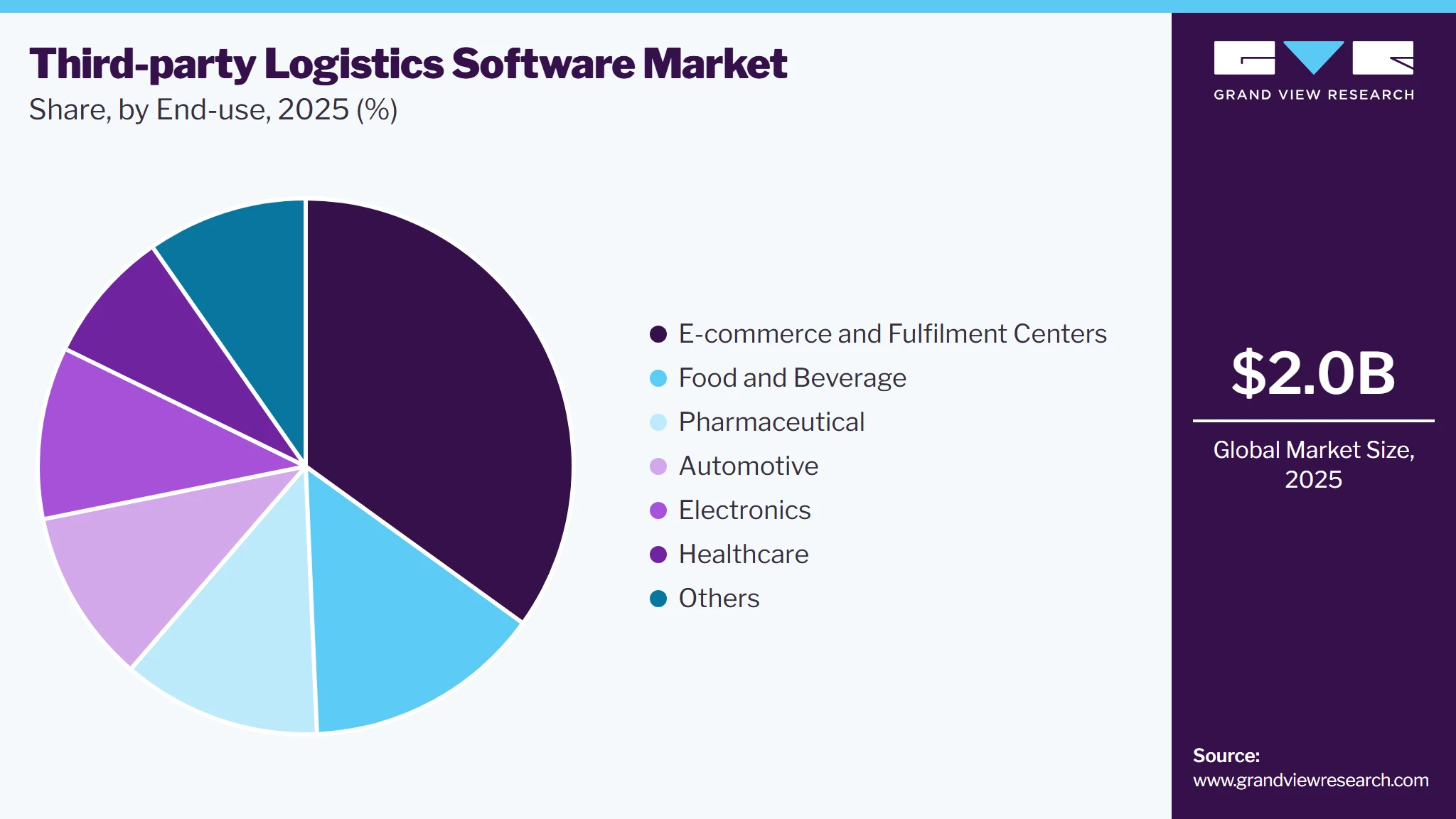
Based on end-use industry, the e-commerce and fulfilment centers segment dominated the market and is expected to register the fastest CAGR during the forecast period. Factors such as increasing online shopping activity, rising parcel volumes, and growing expectations for faster deliveries are encouraging e-commerce businesses to outsource logistics operations to third-party service providers. These providers are adopting 3PL software to manage order fulfilment, inventory allocation, warehouse operations, shipment tracking, and return processing. The increasing requirement for accurate order execution and efficient last-mile coordination is further strengthening software adoption across e-commerce distribution networks.
 To learn more about this report, Download Free Sample Report
The pharmaceutical segment is expected to experience moderate growth as manufacturers and logistics providers increasingly prioritize product traceability, inventory accuracy, and controlled distribution. The transportation of medicines, vaccines, and temperature-sensitive pharmaceutical products requires consistent shipment monitoring and reliable inventory management. Regulatory requirements, including the U.S. Drug Supply Chain Security Act (DSCSA), are encouraging businesses to strengthen product tracking and information exchange across distribution networks. These requirements are supporting the adoption of specialized 3PL software for pharmaceutical logistics and distribution management.
Regional Insights
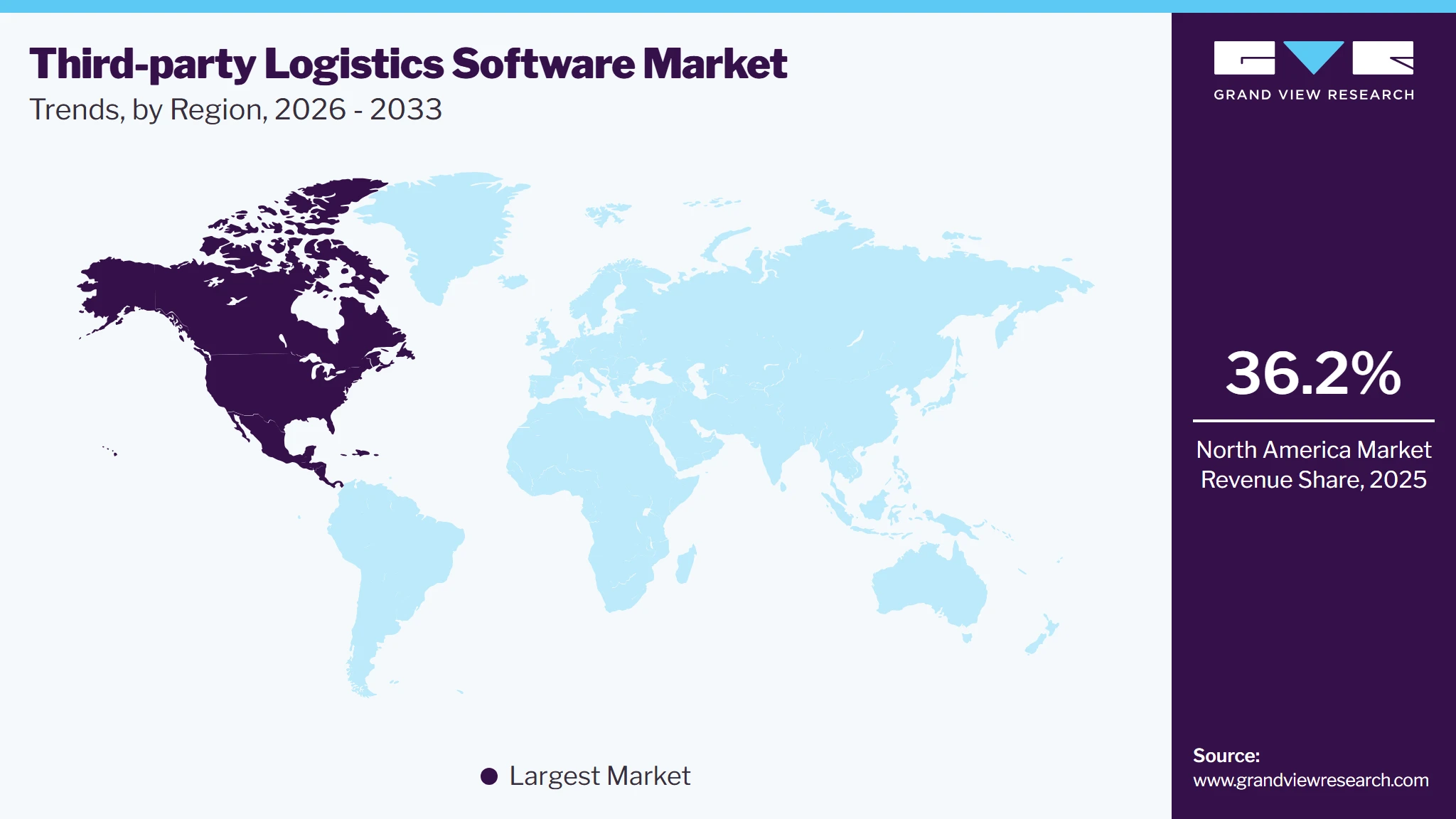
North America third-party logistics software market led the global market and accounted for 36.2% of the global revenue in 2025. North America represents a prominent regional market due to the presence of established third-party logistics providers, advanced distribution infrastructure, and strong enterprise technology adoption. The expanding e-commerce sector and increasing requirements for efficient inventory management are encouraging businesses to invest in integrated logistics software. Furthermore, the focus on shipment visibility, operational automation, and regulatory compliance is supporting the deployment of advanced 3PL software across the region.
 To learn more about this report, Download Free Sample Report
U.S. Third-party Logistics Software Market Trends
The U.S. 3PL software market is anticipated to register a largest growth from 2026 to 2033, due to its well-established logistics industry, extensive warehousing infrastructure, and strong presence of e-commerce businesses. The increasing demand for faster order fulfilment and more efficient transportation coordination is prompting logistics providers to adopt advanced warehouse and supply chain management platforms. Additionally, regulatory requirements related to pharmaceutical distribution security and food traceability are strengthening the need for digital documentation and tracking capabilities.
Asia Pacific Third-party Logistics Software Market Trends
The Asia Pacific 3PL software market is expected to register the fastest growth from 2026 to 2033. Asia Pacific is witnessing increasing adoption of 3PL software due to expanding manufacturing activities, rising e-commerce penetration, and the development of modern logistics infrastructure. Businesses across the region are investing in digital platforms to improve inventory management, transportation planning, and distribution network efficiency. Government initiatives promoting digital supply chains and logistics modernization are further supporting software adoption. The growing demand for cost-effective, scalable logistics operations is creating significant opportunities across regional markets.
China held a dominant share in the Asia Pacific third-party logistics (3PL) software market, driven by its extensive manufacturing ecosystem, large-scale e-commerce, and well-developed distribution networks. Government initiatives promoting digital and intelligent supply chains are encouraging businesses to integrate artificial intelligence, Internet of Things, and data analytics into logistics operations. The country's focus on improving supply chain connectivity, reducing logistics costs, and strengthening operational visibility is supporting demand for advanced 3PL software platforms.
Japan 3PL software market is expected to grow at a significant CAGR over the forecast period, Japan's market is supported by the increasing requirement for logistics automation, transportation efficiency, and improved warehouse productivity. Driver shortages and operational constraints in the country's logistics sector are prompting businesses to adopt digital platforms for shipment planning, delivery coordination, and resource allocation. The Japan government's Comprehensive Physical Distribution Policy Outline for FY2026-FY2030 emphasizes logistics digitalization, standardization, and operational efficiency. These initiatives are strengthening opportunities for 3PL software providers offering integrated logistics management solutions.
Europe Third-party Logistics Software Market Trends
The Europe 3PL Software market is poised for significant growth from 2026 to 2033. The region’s growth can be attributed to the increasing digitalization of freight transportation and the presence of established logistics service providers. The implementation of standardized electronic freight information requirements is encouraging businesses to modernize logistics documentation and information-sharing processes. Furthermore, cross-border trade activities and the growing emphasis on supply chain transparency are supporting demand for integrated 3PL software solutions across Europe.
The UK Third-party Logistics (3PL) Software market is driven by the increasing digitalization of cross-border trade and customs procedures. Government initiatives focused on border digitalization and the development of the Single Trade Window are encouraging logistics providers to streamline documentation and information exchange. This is increasing demand for 3PL software that improves shipment tracking, customs coordination, and transportation management across international supply chains.
The Germany held a largest share in the Europe third-party logistics (3PL) software market, due to its strong manufacturing base, established transportation networks, and extensive industrial distribution activities. The increasing need for coordinated material movement among manufacturers, suppliers, warehouses, and distributors is driving demand for integrated logistics management platforms. Furthermore, the country's emphasis on industrial digitalization and operational efficiency is encouraging logistics providers to adopt advanced warehouse management and supply chain planning solutions.
Key Third-party Logistics Software Company Insights
Key players operating in the third-party logistics (3PL) software market include Extensiv, Made4net, Logiwa, Inc., Softeon., Magaya Corporation., CartonCloud, ShipHero, Ramco Systems., Körber AG., and Deposco, Inc. Key players in the third-party logistics (3PL) software market are focusing on expanding their software capabilities through cloud-based platforms, warehouse automation, transportation management, real-time shipment tracking, and integrated supply chain solutions. Companies are prioritizing product innovation, strategic partnerships, platform integration, and geographical expansion to strengthen their market presence.
-
Extensiv is a software company that provides warehouse management and omnichannel fulfilment solutions for third-party logistics providers and businesses. Its platform supports inventory management, order processing, shipping, warehouse operations, and logistics billing. The company focuses on improving operational visibility, automating workflows, and streamlining fulfilment activities through integrated software solutions.
-
Made4net is a supply chain software company that provides warehouse management and logistics execution solutions for businesses. Its solutions support inventory control, order fulfilment, warehouse operations, transportation planning, and real-time operational visibility. The company focuses on improving warehouse productivity, streamlining logistics activities, and reducing operational costs through scalable software solutions.
Key Third-party Logistics Software Companies
The following key companies have been profiled for this study on the third-party logistics software market.
-
Extensiv
-
Made4net
-
Logiwa, Inc.
-
Softeon.
-
Magaya Corporation.
-
CartonCloud
-
ShipHero
-
Ramco Systems.
-
Körber AG.
-
Deposco, Inc.
Competitive Benchmarking
Operating Strategies
Competitive Edge
Weaknesses
Mature Players: Körber AG, Ramco Systems, Softeon, Magaya Corporation, Extensiv
- Mature players in the third-party logistics (3PL) software market are focus on expanding logistics software offerings across warehouse, transportation, freight, and inventory management. These companies improve their products and form partnerships to serve more logistics activities and attract customers from different industries.
- Mature players gain a competitive advantage through customer relationships and broad software offerings help these companies serve different logistics requirements. Their experience in managing warehouse, freight, and transportation activities helps build customer trust and support large-scale operations.
- These companies often face challenges related to offering multiple software solutions increases product management and implementation costs. Customers also require additional time and support to adopt these solutions, making them less affordable and accessible for smaller logistics providers.
Emerging Players: Made4net, Logiwa, Inc.
- Emerging players in the third-party logistics (3PL) software market are focused on improving cloud-based warehouse software, order fulfilment, and inventory management. These companies develop flexible solutions to meet customer requirements and attract growing logistics providers and e-commerce businesses.
- Emerging players gain market traction through specialized warehouse software and flexible solutions help logistics providers manage daily operations more efficiently. A focused product offering also allows these companies to address specific customer needs more effectively.
- Emerging players face limitations due to narrower range of software offerings limits their ability to serve customers requiring complete logistics management solutions. Expanding into additional services requires further investment in product development and customer support.
Recent Developments
-
In February 2026, Made4net introduced an AI-focused roadmap to enhance its warehouse management and supply chain software. The initiative focuses on intelligent assistance, automated decision-making, and AI-driven warehouse operations to improve productivity, inventory management, and operational efficiency.
-
In September 2026, Extensiv was acquired by Descartes Systems Group Inc, provider of technology solutions, for approximately USD 120 million to expand its warehouse management and omnichannel fulfilment capabilities. The acquisition strengthens Extensiv's integration with transportation, inventory management, shipment visibility, and AI-enabled logistics solutions.
Third-party Logistics Software Market Report Scope
Report Attribute
Details
Market size in 2025
USD 2.0 billion
Estimated market size in 2026
USD 2.1 billion
Revenue forecast in 2033
USD 3.4 billion
Growth rate
CAGR of 6.8% from 2026 to 2033
Base year for estimation
2025
Historical data
2021 - 2024
Forecast period
2026 - 2033
Quantitative units
Revenue in USD billion and CAGR from 2026 to 2033
Report coverage
Revenue forecast, company ranking, competitive landscape, growth factors, and trends
Segments covered
Type, deployment, end-use industry, region
Regional scope
North America; Europe; Asia Pacific; Latin America; MEA
Country scope
U.S.; Canada; Mexico; Germany; U.K.; France; China; Japan; India; South Korea; Australia; Brazil; KSA; UAE; South Africa
Key companies profiled
Extensiv; Made4net; Logiwa, Inc.; Softeon.; Magaya Corporation.; CartonCloud; ShipHero; Ramco Systems.; Körber AG.; Deposco, Inc.
Customization scope
Free report customization (equivalent up to 8 analysts working days) with purchase. Addition or alteration to country, regional & segment scope.
Pricing and purchase options
Avail customized purchase options to meet your exact research needs. Explore purchase options
Global Third-party Logistics Software Market Report Segmentation
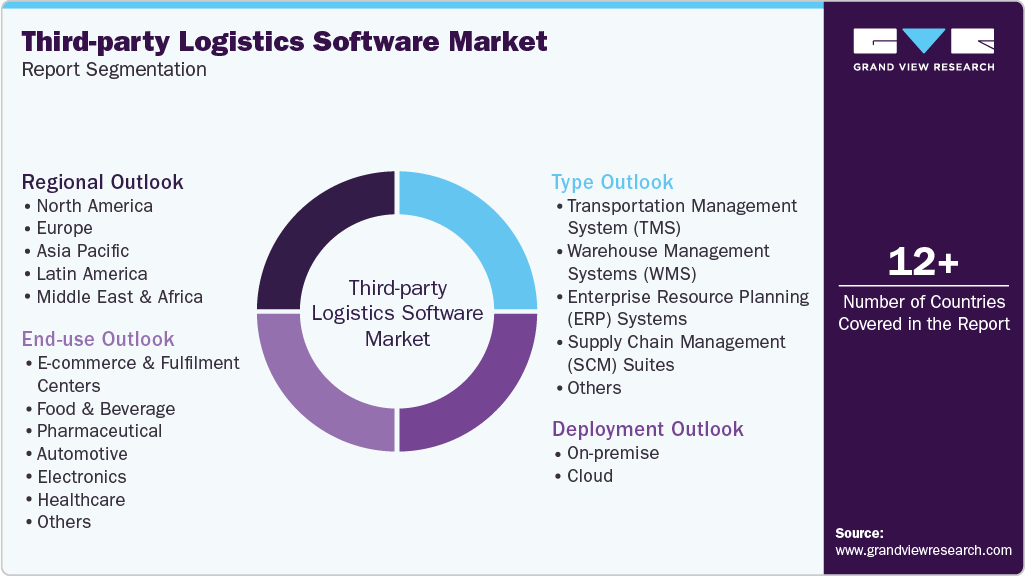
This report forecasts and estimates revenue growth at the global, regional, and country levels along with analyzes the latest market trends and opportunities in each one of the sub-segments 2021 to 2033. For this study, Grand View Research has segmented the global third-party logistics software market report based on type, deployment, end-use industry, and region:
 To learn more about this report, Download Free Sample Report
-
Type Outlook (Revenue, USD Billion, 2021 - 2033)
-
Transportation Management System (TMS)
-
Warehouse Management Systems (WMS)
-
Enterprise Resource Planning (ERP) Systems
-
Supply Chain Management (SCM) Suites
-
Others
-
-
Deployment Outlook (Revenue, USD Billion, 2021 - 2033)
-
On-premise
-
Cloud
-
-
End-use Industry Outlook (Revenue, USD Billion, 2021 - 2033)
-
E-commerce & Fulfilment Centers
-
Food & Beverage
-
Pharmaceutical
-
Automotive
-
Electronics
-
Healthcare
-
Others
-
-
Regional Outlook (Revenue, USD Billion, 2021 - 2033)
-
North America
-
U.S.
-
Canada
-
Mexico
-
-
Europe
-
Germany
-
U.K.
-
France
-
-
Asia Pacific
-
China
-
India
-
Japan
-
South Korea
-
Australia
-
-
Latin America
-
Brazil
-
-
Middle East & Africa (MEA)
-
UAE
-
Kingdom of Saudi Arabia (KSA)
-
South Africa
-
-
Research Methodology
The third-party logistics software market figures in this report are based on a proven research process that combines executive interviews with secondary research from proprietary databases, company filings, and recognized regulatory and institutional sources. Market size is built through value-chain sizing - reconciling supply-side and demand-side estimates - and triangulated with bottom-up and top-down approaches. Every estimate passes multiple levels of expert validation before publication, with each third-party logistics software segment quantified using the revenue-capture definitions in the table below.
Segment Definition
Segment - Type
Revenue capture definition
Transportation Management Systems (TMS)
The segment revenue is generated from software licensing, subscriptions, transaction-based charges, and maintenance fees for transportation planning, freight management, carrier selection, shipment tracking, route optimization, freight auditing, and delivery management solutions.
Warehouse Management Systems (WMS)
The segment revenue is generated from software subscriptions, licensing, implementation, customization, and maintenance fees for inventory management, warehouse receiving, put-away, picking, packing, order fulfilment, stock monitoring, labour management, and warehouse billing solutions.
Enterprise Resource Planning (ERP) Systems
The segment revenue is generated from licensing, subscriptions, implementation, integration, and maintenance of enterprise software modules supporting logistics accounting, financial management, procurement, order processing, invoicing, customer management, and operational resource planning.
Supply Chain Management (SCM) Suites
The segment revenue is generated from software subscriptions, licensing, implementation, and support services for integrated supply chain planning, demand forecasting, inventory optimization, procurement management, order orchestration, supplier coordination, and end-to-end supply chain visibility.
Others
The segment revenue is generated from licensing, subscriptions, transaction fees, and maintenance of specialized logistics applications, including freight forwarding software, fleet management systems, yard management solutions, last-mile delivery platforms, shipment visibility applications, and logistics analytics tools.
Segment - Deployment
Revenue capture definition
On-premise
The segment revenue is generated from perpetual software licensing, installation, infrastructure configuration, customization, system integration, technical support, and annual maintenance contracts for software hosted on the customer's internal servers and IT infrastructure.
Cloud
The segment revenue is generated from recurring software-as-a-service (SaaS) subscriptions, usage-based charges, transaction fees, cloud hosting, storage services, platform upgrades, and additional cloud-based modules accessed through internet-connected infrastructure.
Segment - End-use Industry
Revenue capture definition
E-commerce and Fulfilment Centers
The segment revenue is generated from software subscriptions, licensing, and transaction-based charges for order processing, inventory synchronization, multi-channel fulfilment, warehouse management, returns processing, shipment tracking, and last-mile delivery coordination.
Food and Beverage
The segment revenue is generated from software licensing, subscriptions, and implementation fees for perishable inventory management, temperature-controlled shipment monitoring, batch tracking, expiry management, cold-chain coordination, warehouse operations, and distribution planning.
Pharmaceutical
The segment revenue is generated from software licensing, subscriptions, and support fees for pharmaceutical inventory tracking, batch and lot management, expiry monitoring, regulatory documentation, temperature-controlled transportation, traceability, and distribution management.
Automotive
The segment revenue is generated from software licensing, subscriptions, and integration services for spare parts inventory management, component tracking, inbound and outbound logistics, warehouse coordination, transportation planning, and production-related material distribution.
Electronics
The segment revenue is generated from software subscriptions, licensing, and implementation services for high-value inventory tracking, serial number management, order fulfilment, reverse logistics, warehouse operations, shipment monitoring, and distribution coordination.
Healthcare
The segment revenue is generated from software licensing, subscriptions, and support services for medical equipment inventory management, healthcare product distribution, shipment tracking, temperature monitoring, medical supply fulfilment, and healthcare warehouse management.
Others
The segment revenue is generated from software subscriptions, licensing, customization, and maintenance fees for logistics operations across retail, chemicals, industrial manufacturing, agriculture, consumer goods, and other industries requiring transportation, warehousing, inventory, and distribution management.
Estimation Model
Layer No.
Layer Name
Key Question
Description
01
Industry Demand Assessment
What is the overall demand for 3PL Software?
This layer evaluates the demand for software solutions among third-party logistics providers, freight forwarders, warehouse operators, and fulfilment companies. It considers the expansion of outsourced logistics activities, e-commerce shipments, warehouse networks, and transportation operations. The assessment identifies the major industries and geographical markets adopting logistics software. It establishes the overall addressable demand for 3PL software solutions.
02
Software Revenue Identification
Which software solutions generate market revenue?
This layer identifies revenue-generating software categories, including Transportation Management Systems (TMS), Warehouse Management Systems (WMS), Enterprise Resource Planning (ERP) systems, and Supply Chain Management (SCM) suites. It evaluates revenue generated through software licensing, SaaS subscriptions, transaction-based pricing, implementation, customization, and maintenance services. The analysis also considers the contribution of specialized logistics applications. It establishes the revenue distribution across software types.
03
Deployment and End-use Assessment
Where and how are software solutions deployed?
This layer evaluates revenue generated through cloud-based and on-premise deployment models. It assesses adoption across e-commerce and fulfilment centres, food and beverage, pharmaceutical, automotive, electronics, healthcare, and other industries. The analysis considers differences in operational requirements, software integration, data management, and customer-specific workflows. It identifies the deployment models and end-use industries contributing to software demand.
04
Market Revenue Validation and Forecasting
What is the validated market revenue and future growth potential?
This layer consolidates revenue estimates across software types, deployment models, and end-use industries. The estimates are cross-checked against vendor financial disclosures, software adoption trends, product portfolios, customer presence, and industry developments. Historical revenue patterns and industry-specific adoption trends are evaluated to establish market estimates. The validated estimates form the basis for market sizing, revenue projections, and competitive analysis.
Delivered Customizations
This report has been delivered with the following In-depth customizations
Client Request
Customization Delivered
Value Adds
Regional Third-party Logistics (3PL) Software Market Opportunity Assessment
Country/region-wise market sizing and forecasts
Analysis of demand, adoption trends, and regulatory landscape
Identification of high-growth regions and investment hotspots
Identified region-specific growth opportunities
Supported expansion and go-to-market strategy
Enabled informed regional investment decisions
Cross-Segmentation Analysis for the Third-party Logistics (3PL) Software Market
Criss-cross market analysis by type, deployment, end-use industry
Demand and adoption assessment across key segments
Segment attractiveness and growth potential passenger benchmarking
Identified high-potential market segments
Supported targeted Type positioning and marketing strategy
Improved customer and segment prioritization
Competitive Benchmarking and Strategic Positioning in the Third-party Logistics (3PL) Software Market
Benchmarking of key competitors across Type s, pricing, partnerships, and innovation
Comparative assessment of market share, capabilities, and strategies
Analysis of competitive strengths, gaps, and differentiation areas
Identified competitive white spaces and growth gaps
Supported strategic positioning and differentiation
Enabled data-driven competitive strategy development
About the Author(s)
Automotive & Transportation Research Team
Technology · Automotive & TransportationThis report was authored by the automotive & transportation research team at Grand View Research - comprising two research analysts, one senior research analyst, and one industry expert - with specialized expertise in the automotive & transportation segment of the technology industry. All findings are based on proprietary technology databases, executive interviews, and regulatory analysis, subject to internal peer review prior to publication.
Last Updated:
Speak to Analyst

Customize this report to your needs - add regions, segments, or data points, with 20% free customization.
Or view our licence options:


ISO 9001:2015 & 27001:2022 Certified
We are GDPR and CCPA compliant! Your transaction & personal information is safe and secure. For more details, please read our privacy policy.


