
- Home
- »
- Next Generation Technologies
- »
-
Threat Modeling Tools Market Size, Share Report, 2026-2033GVR Report cover

Threat Modeling Tools Market (2026 - 2033)
Size, Share & Trends Analysis Report By Component (Solutions, Services), By Deployment (Cloud, On-premise, Hybrid Deployment), By Enterprise Size (Large Enterprise), By Industry Vertical, By Region, And Segment Forecasts
Market Size, 2025
$1.3BMarket Estimate, 2026
$1.5BMarket Forecast, 2033
$4.0BCAGR, 2026–2033
15.4%Threat Modeling Tools Market Summary
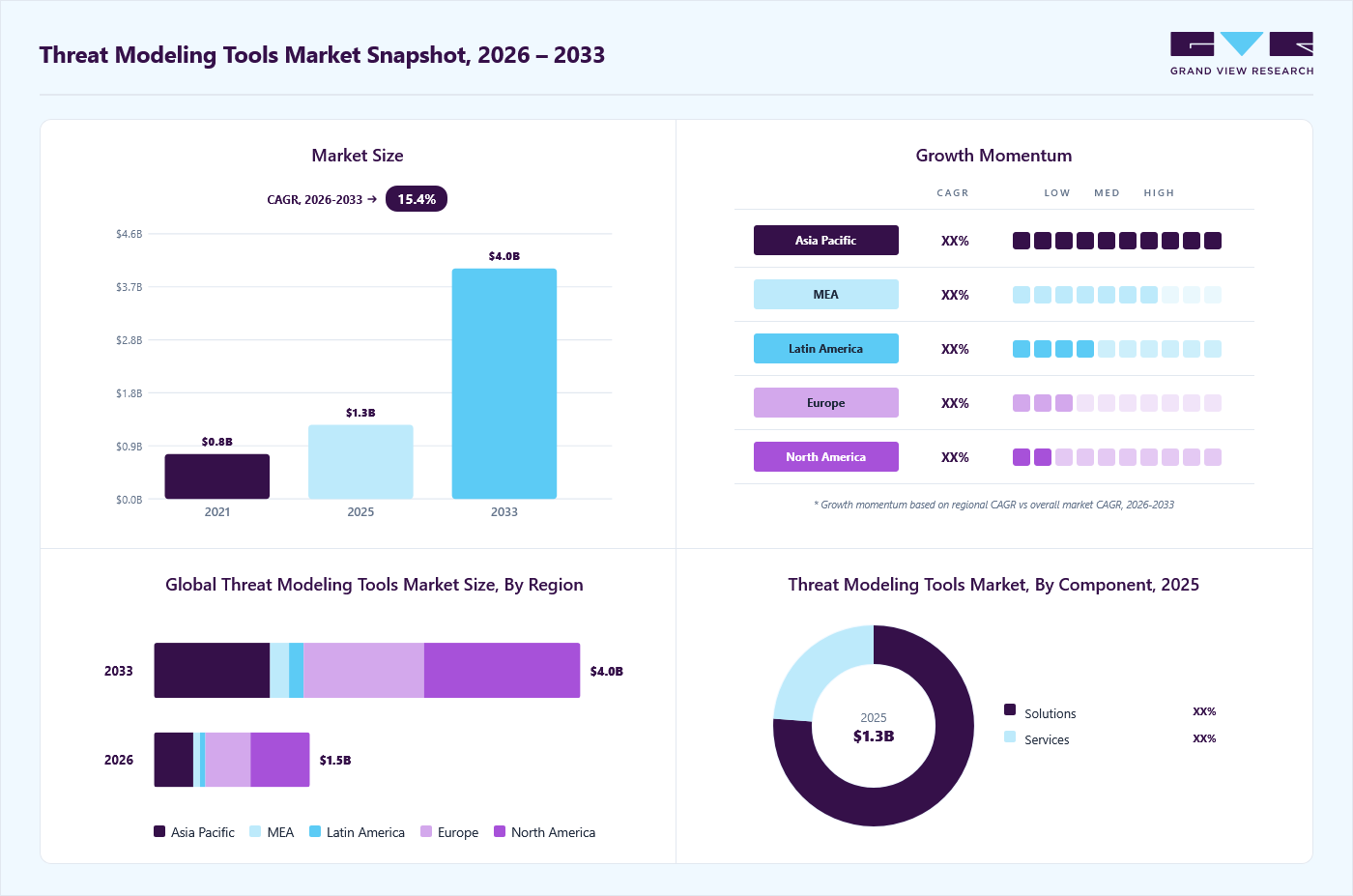
The global threat modeling tools market size was valued at USD 1.3 billion in 2025 and is projected to grow from USD 1.5 billion in 2026 to USD 4.0 billion by 2033, at a CAGR of 15.4% from 2026 to 2033. The market in North America dominated with a revenue share of 38.3% in 2025. The rapid pace of digital transformation across industries is expected to drive growth.
 Source: Grand View Research, IR Documents, Primary Interviews, Paid DatabasesTo learn more about this report,
 Download Free Sample Report
 Key Market Trends & Insights
- By component: Solutions segment held the largest market share of 76.1% in 2025.
- By deployment: Cloud-based (SaaS) segment held the largest market share in 2025.
- By enterprise size: Large enterprise segment held the largest market share in 2025.
- By industry vertical: BFSI segment held the largest market share in 2025.
Regional Highlights
- Largest regional market: North America (38.3% revenue share, 2025)
- By country: The U.S. held the largest market share in 2025
Market Size & Forecast
- Market size in 2025: USD 1.3 Billion
- Estimated market size in 2026: USD 1.5 Billion
- Projected market size by 2033: USD 4.0 Billion
- CAGR (2026-2033): 15.4%
Three ways to get this report
Buy it, customize it, or ask a question.Ask an Analyst
Analyst response in 1 business day
- AccessReport author, directly
- Reply timeWithin 1 working day
- No sales callDirect answer only
- FormatEmail reply
- CostFree, no cost
Get the Full Report
What the study covers
- FormatsPDF · Excel · Dashboard
- Timeline2026–2033 annual, 2025 base
- Coverage20+ countries, 5 regions
- Companies10+ key players profiled
Customize the Report
20% free customization
- IncludeCountries, segments, points
- TailorTo your product definition
- ExtendDeeper competitor detail
- OrA fully bespoke study
- Turnaround5–10 working days
Organizations are adopting advanced technologies such as cloud computing, APIs, microservices, and IoT, leading to highly complex IT environments. While these technologies enhance operational efficiency and scalability, they also significantly increase the potential attack surface. This growing complexity makes it difficult to identify vulnerabilities using traditional methods, thereby driving the adoption of threat modeling tools to proactively visualize risks, simulate attack scenarios, and prioritize security controls. To learn more about this report, Download Free Sample Report
 The growth of the threat modeling tools market is driven by the rising complexity of cyber threats and the need for proactive security approaches. Increasing incidents of ransomware, data breaches, and advanced persistent threats are pushing organizations to strengthen their security posture. Traditional reactive methods are no longer sufficient, as they address threats only after damage occurs. As a result, enterprises are shifting toward preventive strategies that focus on identifying vulnerabilities early in the development lifecycle. Threat modeling tools play a critical role in this transition by enabling organizations to analyze potential attack scenarios, detect weaknesses before deployment, and implement effective security controls, thereby reducing risks, minimizing financial losses, and ensuring stronger overall cybersecurity resilience.
The rise of DevSecOps and “threat modeling as code” presents a significant opportunity in the market. As organizations adopt agile and DevOps practices, security must be integrated into fast-paced development cycles. This drives demand for tools that seamlessly fit into CI/CD pipelines. Vendors can capitalize on this by offering solutions that automate threat modeling within development workflows. Such automation reduces manual effort, improves consistency, and enables real-time risk identification. As a result, organizations can scale security practices efficiently while maintaining speed and innovation in software development.
The shortage of skilled cybersecurity professionals, especially those with expertise in threat modeling, is hindering market growth. These tools require a strong understanding of system architecture, attack vectors, and compliance frameworks to be used effectively. However, many organizations face difficulty in finding qualified talent, which limits proper implementation. This skill gap reduces the effectiveness of threat modeling practices and slows down adoption across enterprises.
Component Insights
The solutions segment dominated the threat modeling tools industry, accounting for a revenue share of 76.1% in 2025 due to the increasing need for automated security tools. Organizations are shifting away from manual, time-consuming threat modeling processes toward automated platforms that can efficiently identify vulnerabilities and simulate potential attack paths. These solutions provide real-time insights and actionable recommendations, enabling faster decision-making. Automation also improves accuracy and consistency while reducing human error. As IT environments become more complex, scalable software platforms are essential, further driving the adoption of automated threat modeling solutions across enterprises.
The services segment is anticipated to grow at the fastest CAGR during the forecast period. The growing adoption of DevSecOps is driving demand for services in the market. As organizations integrate security into fast-paced development cycles, they require expert support to embed threat modeling within CI/CD pipelines. Service providers assist with process setup, seamless tool integration, and workflow optimization. This ensures security is consistently applied across development stages, improves efficiency, and helps organizations scale secure software delivery while minimizing vulnerabilities and operational risks.
Deployment Insights
The cloud-based (SaaS) segment dominated the threat modeling tools market, accounting for the largest revenue share in 2025. As organizations migrate workloads to cloud platforms, their IT environments become more dynamic and distributed. This increases the complexity of identifying and managing security risks. Cloud-native threat modeling tools are designed to address these challenges by providing real-time visibility, scalability, and automated risk analysis. They help organizations secure modern architectures such as microservices and containers, driving higher demand for cloud-based threat modeling solutions.
The hybrid segment is expected to grow at a significant CAGR during the forecast period. Organizations in regulated industries such as BFSI, healthcare, and government must ensure strict data protection and regulatory adherence. Hybrid deployment allows them to keep sensitive data on-premises while leveraging cloud capabilities for scalability and advanced analytics. This balance helps organizations maintain security, meet compliance requirements, and optimize operational efficiency.
Enterprise Size Insights
The large enterprise segment dominated the market with the largest revenue share in 2025. Large enterprises face significant exposure to cyber threats, making them prime targets for ransomware, data breaches, and advanced persistent threats. Their vast IT infrastructure, valuable data assets, and global operations increase the likelihood and impact of attacks. As cyber risks continue to evolve, these organizations are shifting toward proactive security strategies. This drives significant investment in advanced threat modeling tools that help identify vulnerabilities early, simulate attack scenarios, and strengthen overall security posture, ensuring better protection against increasingly sophisticated cyber threats.
The small & medium enterprises segment is expected to grow at a significant CAGR during the forecast period. Growing awareness of cybersecurity risks is driving adoption among SMEs in the threat modeling tools market. Small and medium enterprises are increasingly recognizing the financial losses and reputational damage caused by cyberattacks such as data breaches and ransomware. As a result, they are shifting from reactive to preventive security approaches. This heightened awareness is encouraging SMEs to invest in threat modeling tools that help identify vulnerabilities early and strengthen their overall security posture.
Industry Vertical Insights
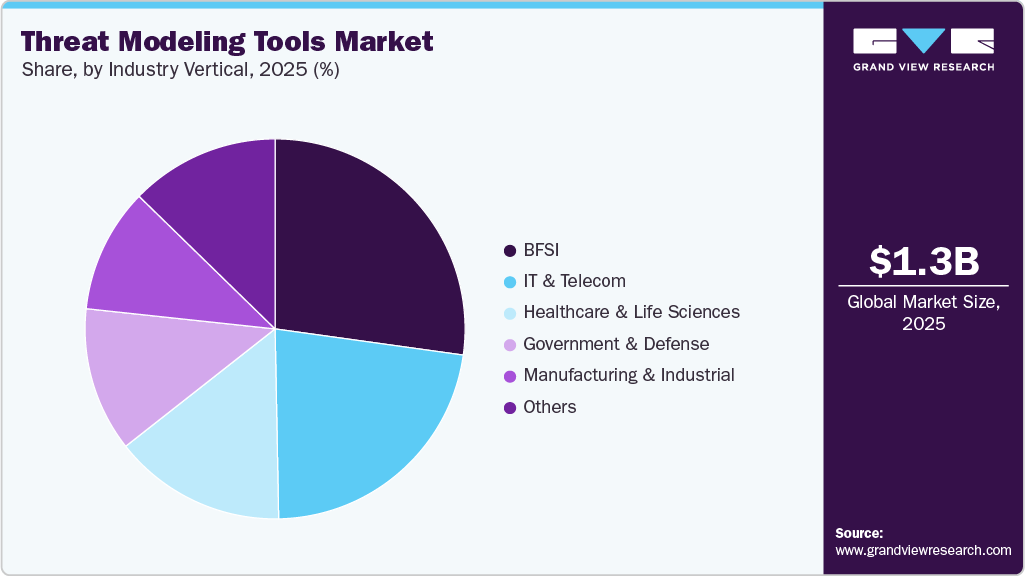
The BFSI segment dominated the threat modeling tools market, accounting for the largest revenue share in 2025. Banks and financial institutions manage critical information such as customer details, account data, and transaction records, making them prime targets for cyberattacks. Any breach can lead to severe financial losses and reputational damage. As a result, these organizations prioritize strong security measures. Threat modeling tools help identify potential vulnerabilities early, simulate attack scenarios, and implement preventive controls, ensuring robust protection of sensitive financial data.
 To learn more about this report, Download Free Sample Report
 The healthcare & life sciences segment is expected to grow at a significant CAGR over the forecast period. Healthcare systems manage critical information, including electronic health records (EHRs), patient histories, and clinical data, making them prime targets for cyberattacks. Ensuring data confidentiality and integrity is essential to maintain trust and comply with regulations. Threat modeling tools help identify vulnerabilities early and strengthen security measures, enabling better protection of sensitive healthcare information.
Regional Insights
North America dominated the global market, accounting for the largest revenue share of 38.30% in 2025. Growth in North America is driven by the early adoption of advanced cybersecurity practices and a strong emphasis on secure software development. Organizations across industries actively implement “shift-left” security approaches, integrating threat modeling into the development lifecycle. Additionally, the strong presence of leading cybersecurity vendors and continuous innovation in application security tools further accelerates adoption across enterprises.
 To learn more about this report, Download Free Sample Report
 U.S. Threat Modeling Tools Market Trends
The threat modeling tools industry in the U.S. is expected to grow at a significant CAGR of 14.5% from 2026 to 2033. High investments in cybersecurity innovation and strong venture capital funding primarily drive the market growth. The presence of a large number of tech companies, startups, and cloud-native businesses creates continuous demand for advanced threat modeling tools to secure modern applications and infrastructure.
Europe Threat Modeling Tools Market Trends
The threat modeling tools industry in Europe is anticipated to grow significantly from 2026 to 2033. The growth in Europe is fueled by stringent data protection regulations and privacy-focused policies. Organizations are required to implement robust risk assessment and documentation processes, making threat modeling tools essential for compliance and governance across industries.
The UK threat modeling tools market is expected to grow rapidly in the coming years. The UK market is driven by the rapid expansion of fintech and digital banking ecosystems. As financial services become more digital and interconnected, the need to secure applications and APIs is growing, driving demand for threat modeling tools.
The threat modeling tools market in Germany held a substantial share in 2025. Germany’s growth is supported by Industry 4.0 initiatives and industrial cybersecurity needs. The integration of digital technologies into manufacturing systems increases exposure to cyber risks, driving the adoption of threat modeling tools to secure industrial environments.
Asia Pacific Threat Modeling Tools Market Trends
The Asia Pacific threat modeling tools industry held a significant global revenue share in 2025. The Asia Pacific region is experiencing growth due to rapid digital transformation across emerging economies. The increasing adoption of cloud, mobile applications, and digital services is expanding the attack surface, prompting organizations to adopt proactive security solutions.
The Japan threat modeling tools market is expected to grow rapidly in the coming years. Japan’s market growth is driven by a focus on secure digital infrastructure and the modernization of legacy systems. Enterprises are upgrading traditional IT environments, creating demand for tools that can assess risks in both legacy and modern architectures.
The threat modeling tools market in China held a substantial market share in 2025. China’s growth is fueled by strong government initiatives in cybersecurity and data sovereignty. Increasing emphasis on protecting national data and digital assets is driving organizations to adopt advanced threat modeling tools for risk assessment and compliance.
Key Threat Modeling Tools Company Insights
Key players operating in the threat modeling tools industry are Microsoft Corporation, IBM Corporation, Cisco, Synopsys, OpenText, Splunk, IriusRisk, ThreatModeler, Security Compass, Foreseeti, Sparx Systems, Kroll, Apiiro, CAIRIS, and Tutamen. The companies are focusing on various strategic initiatives, including new product development, partnerships & collaborations, and agreements to gain a competitive advantage over their rivals. The following are some instances of such initiatives.
-
In March 2026, Apiiro introduced AI Threat Modeling as part of its Guardian Agent platform to enhance application security in modern development environments. The solution automatically generates architecture-aware threat models and identifies security and compliance risks even before code is written. By leveraging deep code analysis and continuous monitoring, it enables real-time risk detection across code, cloud, and infrastructure. This approach shifts security from reactive to proactive, helping organizations prevent vulnerabilities early and secure AI-driven and cloud-native applications more effectively.
-
In January 2026, ThreatModeler completed the acquisition of IriusRisk to combine two leading threat modeling platforms and strengthen its position as a global market leader. The deal aims to expand scale, accelerate innovation, and enhance customer value, particularly in the AI-driven, cloud-security era. By integrating both companies’ technologies, the combined platform delivers improved automation, deeper threat intelligence, and scalable solutions, enabling enterprises to embed secure-by-design practices across development while achieving higher productivity and cost efficiency.
-
In September 2025, ThreatModeler announced the launch of Intelligent Threat Modeling, a new solution designed to address security challenges in AI-driven and cloud-native environments. The platform enhances traditional threat modeling by providing automated mapping, AI-driven insights, and continuous risk visibility. It helps enterprises identify vulnerabilities, visualize attack paths, and mitigate risks without slowing development. The solution also enhances cloud security modeling and supports secure-by-design practices, enabling organizations to better manage evolving threats associated with AI and complex cloud infrastructures.
Key Threat Modeling Tools Companies:
The following key companies have been profiled for this study on the threat modeling tools market.
- Apiiro
- CAIRIS
- Cisco
- Foreseeti
- IBM Corporation
- IriusRisk
- Kroll
- Microsoft Corporation
- OpenText
- Security Compass
- Sparx Systems
- Splunk
- Synopsys
- ThreatModeler
- Tutamen
Threat Modeling Tools Market Report Scope
Report Attribute
Details
Market size in 2025
USD 1.3 billion
Estimated market size in 2026
USD 1.5 billion
Projected market size by 2033
USD 4.0 billion
Growth rate
CAGR of 15.4% from 2026 to 2033
Actual data
2021 - 2025
Forecast period
2026 - 2033
Quantitative units
Revenue in USD billion and CAGR from 2026 to 2033
Report enterprise size
Revenue forecast, company share, competitive landscape, growth factors, and trends
Segments covered
Component, deployment, enterprise size, industry vertical, region
Regional scope
North America; Europe; Asia Pacific; Latin America; MEA
Country scope
U.S.; Canada; Mexico; UK; Germany; France; China; India; Japan; Australia; South Korea; Brazil; UAE; Kingdom of Saudi Arabia; South Africa
Key companies profiled
Apiiro; CAIRIS; Cisco; Foreseeti; IBM Corporation; IriusRisk; Kroll; Microsoft Corporation; OpenText; Security Compass; Sparx Systems; Splunk; Synopsys; ThreatModeler; Tutamen
Customization scope
Free report customization (equivalent to 8 analysts working days) with purchase. Addition or alteration to country, regional & segment scope.
Pricing and purchase options
Avail customized purchase options to meet your exact research needs. Explore purchase options
Global Threat Modeling Tools Market Report Segmentation
This report forecasts revenue growth at the global, regional, and country levels and provides an analysis of the latest industry trends in each of the sub-segments from 2021 to 2033. For this study, Grand View Research has segmented the threat modeling tools market report based on component, deployment, enterprise size, industry vertical, and region:
-
Component Outlook (Revenue, USD Billion, 2021 - 2033)
-
Solutions
-
Services
-
-
Deployment Outlook (Revenue, USD Billion, 2021 - 2033)
-
Cloud
-
On-premise
-
Hybrid Deployment
-
-
Enterprise Size Outlook (Revenue, USD Billion, 2021 - 2033)
-
Small & Medium Enterprises
-
Large Enterprise
-
-
Industry Vertical Outlook (Revenue, USD Billion, 2021 - 2033)
-
BFSI
-
Government and Defense
-
Healthcare and Life Sciences
-
IT & Telecom
-
Manufacturing and Industrial
-
Others
-
-
Regional Outlook (Revenue, USD Billion, 2021 - 2033)
-
North America
-
U.S.
-
Canada
-
Mexico
-
-
Europe
-
UK
-
Germany
-
France
-
-
Asia Pacific
-
China
-
India
-
Japan
-
South Korea
-
Australia
-
-
Latin America
-
Brazil
-
-
Middle East & Africa
-
UAE
-
Saudi Arabia
-
South Africa
-
-
Frequently Asked Questions About This Report
North America dominated with a 38.3% revenue share in 2025.
The cloud-based (SaaS) segment held the largest revenue share in 2025.
The large enterprise segment accounted for the largest revenue share in 2025.
BFSI segment dominated the market and accounted for the largest revenue share in 2025.
The global threat modeling tools market size was valued at USD 1.3 billion in 2025 and is estimated at USD 1.5 billion for 2026.
The global threat modeling tools market is expected to grow at a CAGR of 15.4% from 2026 to 2033, reaching USD 4.0 billion by 2033.
Key players include Apiiro; CAIRIS; Cisco; Foreseeti; IBM Corporation; IriusRisk; Kroll; Microsoft Corporation; OpenText; Security Compass; Sparx Systems; Splunk; Synopsys; ThreatModeler; Tutamen.
The solutions segment dominated the market and accounted for the revenue share of 76.1% in 2025 due to the increasing need for automated security tools. Organizations are shifting away from manual, time-consuming threat modeling processes toward automated platforms that can efficiently identify vulnerabilities and simulate potential attack paths. These solutions provide real-time insights and actionable recommendations, enabling faster decision making.
The growth of the threat modeling tools market is driven by the rising complexity of cyber threats and the need for proactive security approaches. Increasing incidents of ransomware, data breaches, and advanced persistent threats are pushing organizations to strengthen their security posture.
About the Author(s)
Next Generation Technologies Research Team
Technology · Next Generation TechnologiesThis report was authored by the next generation technologies research team at Grand View Research - comprising two research analysts, one senior research analyst, and one industry expert - with specialized expertise in the next generation technologies segment of the technology industry. All findings are based on proprietary technology databases, executive interviews, and regulatory analysis, subject to internal peer review prior to publication.
Last Updated:
Speak to Analyst

Customize this report to your needs - add regions, segments, or data points, with 20% free customization.
Or view our licence options:


ISO 9001:2015 & 27001:2022 Certified
We are GDPR and CCPA compliant! Your transaction & personal information is safe and secure. For more details, please read our privacy policy.


