
- Home
- »
- Next Generation Technologies
- »
-
Time tracking software Market Size, Share Report, 2026-2033GVR Report cover

Time Tracking Software Market (2026 - 2033) Size, Share, & Trends Analysis Report By Component (Software, Services), By Deployment (Cloud, On-premise), By Enterprise Size, By Application, By End Use, By Region, And Segment Forecasts
Market Size, 2025
$6.1BMarket Estimate, 2026
$6.8BMarket Forecast, 2033
$17.3BCAGR, 2026–2033
14.2%Time Tracking Software Market Summary
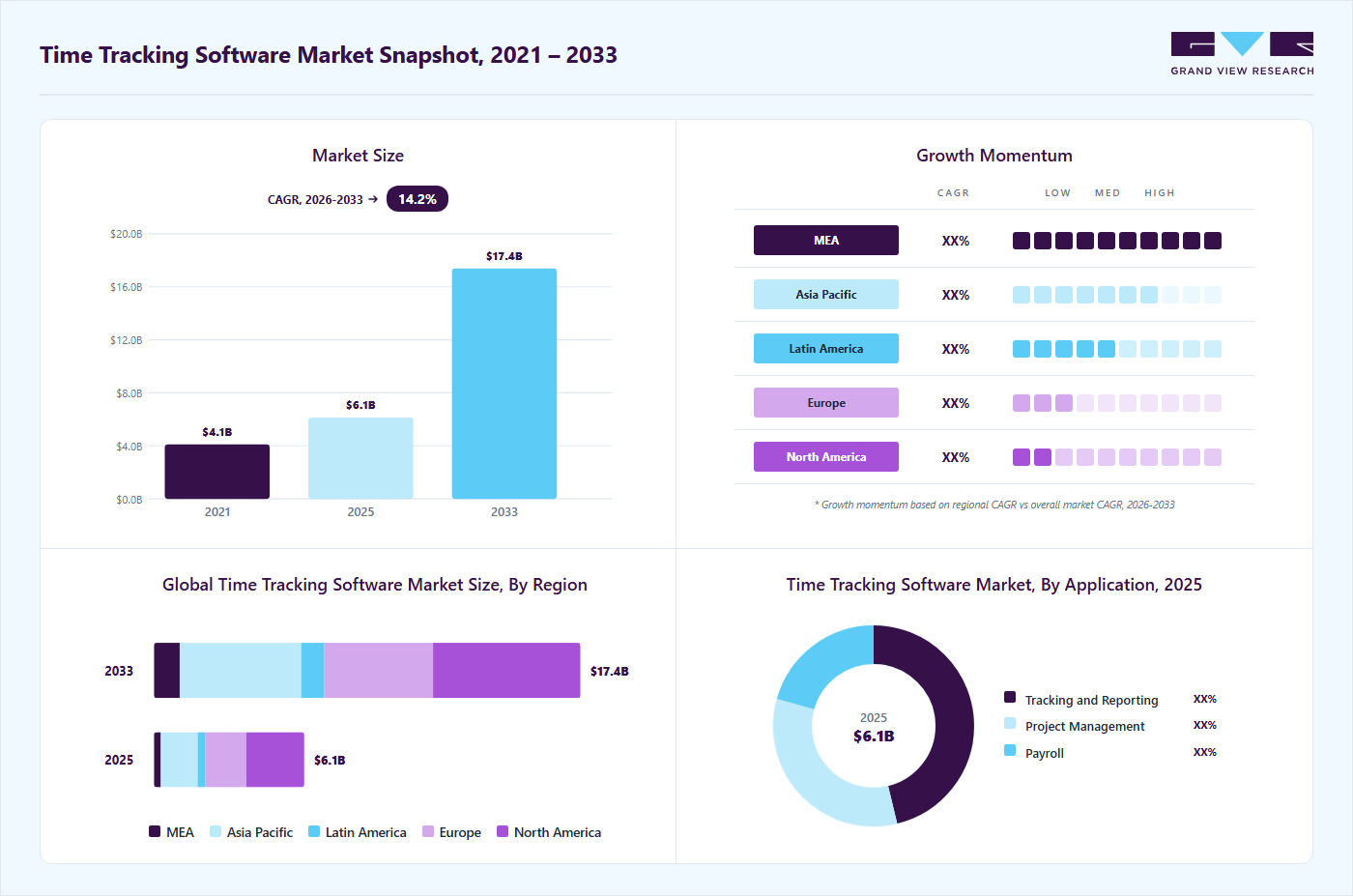
The global time tracking software market size was valued at USD 6.1 billion in 2025 and is projected to grow from USD 6.8 billion in 2026 to USD 17.3 billion by 2033, at a CAGR of 14.2% from 2026 to 2033. The North America market held the largest share of 38.6% of the global market in 2025., driven by structural shifts in workforce models, increased emphasis on productivity analytics, and rapid enterprise digitalization. Organizations are increasingly managing distributed workforces across geographies, making manual time monitoring impractical.
 Source: Grand View Research, IR Documents, Primary Interviews, Paid DatabasesTo learn more about this report,
 Download Free Sample Report
 Key Market Trends & Insights
- By component: The software segment dominated the market and accounted for the revenue share of 74.3% in 2025.
- By deployment: The cloud segment dominated the market and accounted for the largest revenue share in 2025.
- By enterprise size: The large enterprises segment dominated the market and accounted for the largest revenue share in 2025.
- By application: The project management segment accounted for a notable revenue share in 2025.
Regional Highlights
- Largest regional market: North America (38.2% revenue share, 2025)
- By country: The U.S. held the largest market share in 2025.
Market Size & Forecast
- Market size in 2025: USD 6.1 Billion
- Estimated market size in 2026: USD 6.8 Billion
- Projected market size by 2033: USD 17.3 Billion
- CAGR (2026-2033): 14.2%
Three ways to get this report
Buy it, customize it, or ask a question.Ask an Analyst
Analyst response in 1 business day
- AccessReport author, directly
- Reply timeWithin 1 working day
- No sales callDirect answer only
- FormatEmail reply
- CostFree, no cost
Get the Full Report
What the study covers
- FormatsPDF · Excel · Dashboard
- Timeline2026–2033 annual, 2025 base
- Coverage20+ countries, 5 regions
- Companies10+ key players profiled
Customize the Report
20% free customization
- IncludeCountries, segments, points
- TailorTo your product definition
- ExtendDeeper competitor detail
- OrA fully bespoke study
- Turnaround5–10 working days
Time tracking tools provide real-time visibility into employee productivity, attendance, and task allocation, ensuring accountability while supporting flexible work arrangements. This shift has made such solutions a core component of modern workforce management strategies.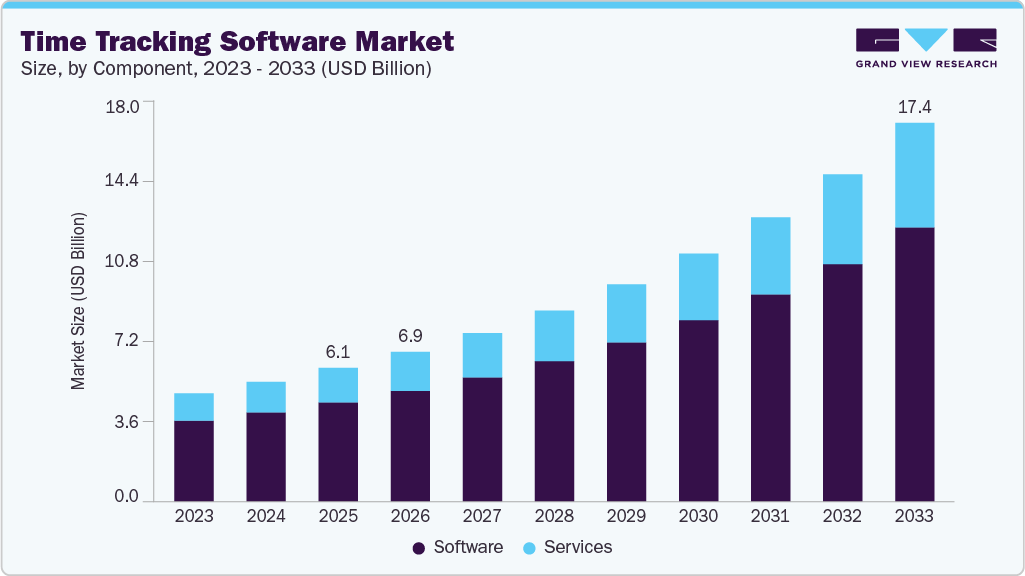 To learn more about this report, Download Free Sample Report
 The rising emphasis on productivity optimization and operational efficiency contributes to the growth of the time tracking software industry. Businesses are under pressure to maximize output while controlling labor costs, especially in competitive and margin-sensitive industries such as IT services, consulting, construction, and healthcare. Time tracking software provides detailed analytics on time utilization, project progress, and workforce performance, allowing organizations to identify inefficiencies, optimize resource allocation, and improve project profitability.
The increasing integration of time tracking solutions with broader enterprise systems is also accelerating market expansion. Modern platforms are often embedded within or integrated with project management, payroll, human resource management systems (HRMS), and enterprise resource planning (ERP) solutions. This interoperability streamlines workflows, reduces administrative overhead, and enhances data accuracy, making time tracking tools more valuable within a unified digital ecosystem. In addition, the growing adoption of cloud-based solutions is significantly contributing to market growth. Cloud deployment offers scalability, cost-effectiveness, and ease of access, particularly appealing to small and medium-sized enterprises (SMEs) that lack extensive IT infrastructure. Subscription-based pricing models further lower entry barriers, enabling wider adoption across diverse industry verticals.
Market Dynamics
The increasing adoption of remote work models, hybrid workplace strategies, and digital workforce management solutions is a major factor driving the growth of the time tracking software market. Organizations across industries, including IT and telecom, BFSI, healthcare, retail, manufacturing, education, and professional services, are increasingly deploying cloud-based time tracking and workforce analytics platforms to improve employee productivity, optimize labor utilization, and streamline project management operations. The growing need for real-time employee attendance monitoring, automated payroll processing, task allocation, billable hour tracking, and workforce compliance management has significantly accelerated the demand for advanced time tracking software solutions across enterprises of all sizes.
In addition, organizations are increasingly adopting AI-enabled workforce analytics, automated scheduling, biometric attendance systems, and mobile-based tracking applications to improve operational visibility and workforce efficiency. Several major software providers are also expanding investments in AI-powered productivity analytics, cloud-native workforce management platforms, and integrated collaboration tools to strengthen digital workplace transformation capabilities. For instance, in October 2025, Atlassian expanded its workforce productivity ecosystem by introducing enhanced time management and project tracking capabilities integrated with AI-powered workflow automation and collaborative work management tools. The updates were designed to improve operational efficiency, resource planning, and employee productivity across distributed enterprise environments. Such developments highlight the increasing industry focus on workforce optimization, digital collaboration, and operational transparency, thereby supporting the growth of the time tracking software market.
The time tracking software market faces significant challenges due to growing employee privacy concerns, implementation complexity, and increased scrutiny of workforce surveillance practices. Many advanced time tracking solutions incorporate activity monitoring, screen capture, location tracking, keystroke logging, and productivity analytics, which may raise concerns about employee trust, workplace ethics, and data privacy compliance. As organizations increasingly deploy monitoring technologies across remote and hybrid work environments, maintaining transparency, employee consent, and compliance with regional labor regulations and privacy laws becomes increasingly complex.
In addition, enterprises operating across multiple departments and geographic regions often face integration challenges associated with legacy HR systems, payroll platforms, enterprise resource planning (ERP) software, and project management tools. Inconsistent data formats, interoperability limitations, and vendor lock-in concerns across cloud-based and on-premise infrastructures may further increase deployment complexity and operational costs.
Market Concentration & Characteristics
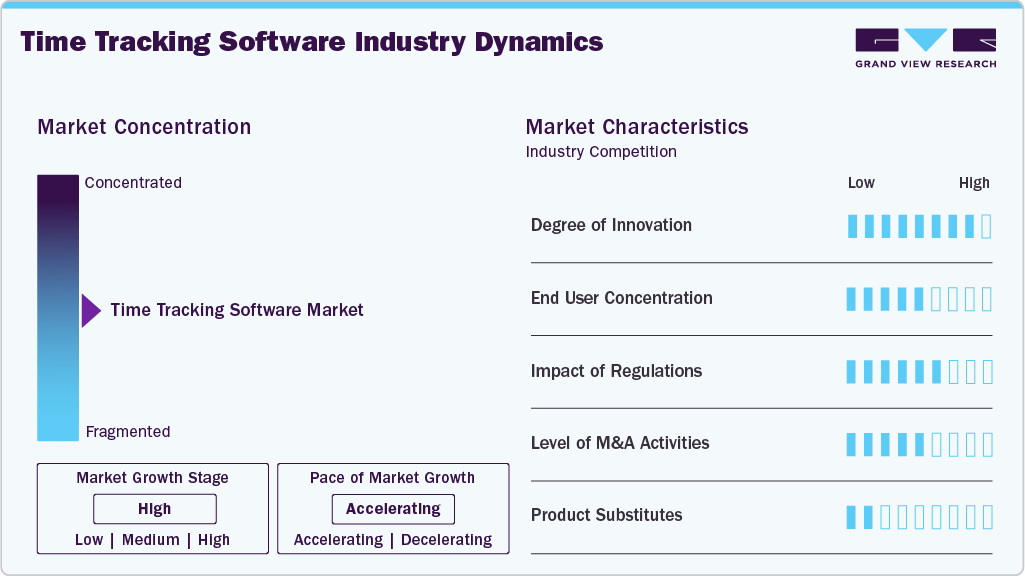
The time tracking software market is moderately fragmented to moderately concentrated, with the presence of established workforce management software providers, human capital management (HCM) companies, project management platform vendors, and emerging SaaS-based productivity software firms. Leading companies maintain strong market positions through comprehensive workforce management ecosystems, cloud-based deployment capabilities, AI-powered productivity analytics, and extensive integrations with payroll, accounting, collaboration, and enterprise resource planning (ERP) platforms. Major players offer integrated solutions including employee attendance tracking, automated timesheets, project and task management, workforce scheduling, payroll synchronization, productivity monitoring, mobile workforce management, and real-time analytics, creating competitive advantages through scalability, user-friendly interfaces, and cross-platform compatibility. Market entry barriers arise from the need for continuous software innovation, enterprise-grade data security, compliance with labor regulations, and the growing demand for highly customizable and scalable workforce management solutions.
 To learn more about this report, Download Free Sample Report
 In terms of market characteristics, the industry is highly software-driven and characterized by rapid innovation in artificial intelligence, workforce analytics, automation, cloud computing, mobile accessibility, and employee productivity monitoring technologies. The rising adoption of hybrid work models, remote workforce management, freelance and gig economy employment, and digital workplace transformation initiatives are major demand drivers supporting market growth. Moreover, the market is characterized by increasing demand for real-time workforce visibility, automated compliance management, seamless integration with collaboration and HR platforms, and enhanced employee experience capabilities. Vendors are increasingly focusing on AI-enabled workforce insights, predictive scheduling, biometric attendance systems, and low-code workflow customization to improve operational efficiency and workforce optimization.
Component Insights
The software segment dominated the market and accounted for the revenue share of 74.3% in 2025 due to the increasing demand for customizable and industry-specific solutions that can adapt to diverse business workflows. Vendors are offering highly configurable platforms with modular features such as task-level tracking, client billing integration, and role-based access controls, enabling organizations to tailor the software to their operational requirements.
The services segment is anticipated to grow at the fastest CAGR during the forecast period due to the growing need for implementation support, system integration, and continuous optimization of deployed solutions. As organizations adopt more sophisticated platforms, they require consulting, customization, data migration, and training services to ensure seamless deployment and alignment with internal processes.
Deployment Insights
The cloud segment dominated the market and accounted for the largest revenue share in 2025 due to the increasing need for real-time, cross-device accessibility and seamless collaboration across geographically dispersed teams. Cloud-based time tracking platforms enable users to log, monitor, and analyze work hours from any location or device, supporting dynamic work environments and field-based operations.
The on-premise segment is anticipated to grow at the fastest CAGR during the forecast period, driven by organizations that require greater data control, system sovereignty, and internal security governance, particularly in industries that handle sensitive or regulated information, such as finance, government, and healthcare. These enterprises often prefer on-premise solutions to maintain direct oversight of data storage, access protocols, and infrastructure, minimizing exposure to external vulnerabilities and third-party dependencies.
Enterprise Size Insights
The large enterprises segment dominated the market and accounted for the largest revenue share in 2025, driven by the increasing complexity of managing multi-departmental operations, global teams, and large-scale project portfolios. These organizations require advanced time tracking solutions that can support large user volumes, multiple cost centers, and cross-functional workflows while delivering consolidated enterprise-level reporting.
The small & medium enterprises (SMEs) segment is expected to grow at a significant CAGR during the forecast period due to the increasing need for cost visibility and streamlined workforce management without heavy administrative overhead. SMEs are adopting time tracking software to better control billable hours, manage lean teams more effectively, and improve cash flow through accurate invoicing and client billing.
Application Insights
The project management segment accounted for a notable revenue share in 2025, as organizations increasingly seek tighter alignment between time tracking and project execution to enhance delivery outcomes. Integrating time tracking within project management workflows enables real-time monitoring of task progress, milestone adherence, and resource utilization, helping managers proactively address delays and bottlenecks.
The tracking and reporting segment is expected to grow at a significant CAGR during the forecast period due to the rising demand for data-driven decision-making and real-time workforce insights. Organizations are increasingly leveraging advanced reporting capabilities such as customizable dashboards, KPI tracking, and predictive analytics to monitor performance trends and identify anomalies across teams and projects. These tools enable management to make faster, evidence-based decisions, improve transparency, and support strategic planning.
End Use Insights
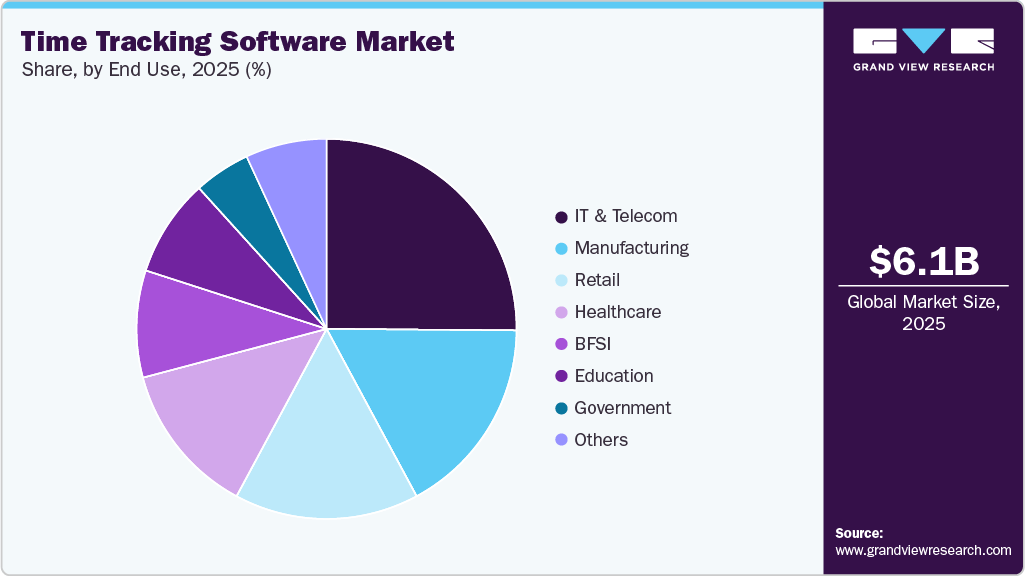
The IT & telecom segment dominated the market, accounting for the largest revenue share in 2025, driven by the increasing prevalence of project-based delivery models, agile development practices, and globally distributed engineering teams. Organizations in this sector require precise tracking of development cycles, sprint timelines, and resource utilization across multiple concurrent projects to ensure timely delivery and optimal workforce allocation.
 To learn more about this report, Download Free Sample Report
 The healthcare segment is expected to grow at a significant CAGR over the forecast period, due to the increasing need for accurate workforce coordination across clinical and administrative functions in complex care environments. Hospitals, clinics, and diagnostic centers require precise tracking of staff hours, shift rotations, and time spent on patient care activities to optimize staffing levels and reduce operational bottlenecks. Time tracking solutions also support better management of contract and temporary staff, which are widely used in healthcare settings.
Regional Insights
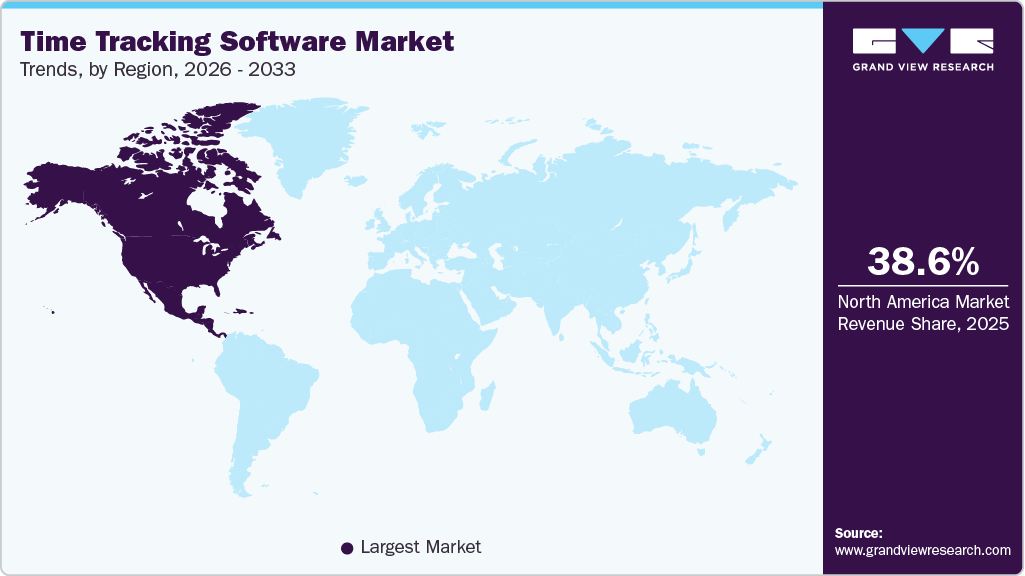
The North America time tracking software industry dominated the global market with the largest revenue share of 38.6% in 2025, driven by the strong presence of a mature SaaS ecosystem and early adoption of workforce analytics technologies across enterprises. Organizations are increasingly leveraging time tracking tools as part of broader digital workplace strategies, emphasizing employee experience, transparency, and performance benchmarking.
 To learn more about this report, Download Free Sample Report
 U.S. Time Tracking Software Market Trends
The time tracking software industry in the U.S. is expected to grow significantly at a CAGR of 12.7% from 2026 to 2033, due to the widespread gig economy and freelance workforce, where accurate time logging is critical for contract-based engagements and outcome-based billing. The growing reliance on independent professionals across sectors such as IT, media, and consulting is pushing demand for flexible, user-centric time tracking platforms that support dynamic work arrangements.
Europe Time Tracking Software Market Trends
The time tracking software industry in Europe is anticipated to register considerable growth from 2026 to 2033 due to stringent labor directives and evolving workplace policies emphasizing employee rights, work-hour limitations, and transparency. Organizations are adopting time tracking systems to align with regional standards around fair working hours, leave policies, and documentation requirements, while also supporting cross-border workforce management within the EU.
The UK time tracking software industry is expected to grow rapidly in the coming years, owing to the rise of professional services firms focusing on precise client billing and utilization rates. Businesses in legal, accounting, and consulting domains are implementing time tracking solutions to enhance fee transparency, optimize billable utilization, and maintain competitive pricing structures in a highly service-driven economy.
The Germany time tracking software industry held a substantial market share in 2025 due to its strong industrial base and emphasis on structured work environments, where accurate time documentation is essential for operational discipline. The increasing digitalization of traditional industries such as manufacturing and engineering is driving the integration of time tracking into shop floor management and technical project workflows.
Asia Pacific Time Tracking Software Market Trends
The time tracking software industry in the Asia Pacific held a significant share in the global market in 2025, due to the surge in startups and digital-native enterprises that require scalable and lightweight operational tools. Rapid urbanization, growing internet penetration, and increasing adoption of mobile-first business applications are encouraging organizations to implement time tracking solutions to support agile and fast-growing business environments.
The Japan time tracking software industry is expected to grow rapidly in the coming years, driven by corporate reforms aimed at improving work-life balance and reducing excessive working hours. Enterprises are adopting time tracking software to enforce internal policies, monitor overtime, and promote more efficient work practices, aligning with national initiatives focused on workplace productivity and employee well-being.
The time tracking software industry in China held a substantial market share in 2025, due to the rapid expansion of large-scale digital enterprises and platform-based business models that require monitoring of extensive workforces. Companies are increasingly deploying time tracking tools to manage high employee volumes, streamline internal operations, and support performance evaluation in fast-paced, technology-driven business environments.
Key Time Tracking Software Company Insights
Key players in the time tracking software industry are Harvest, Clockify, Toggl, Hubstaff, and TimeCamp. The companies are focusing on various strategic initiatives, including new product development, partnerships & collaborations, and agreements to gain a competitive advantage over their rivals. The following are some instances of such initiatives.
-
In March 2026, Apploye launched an enhanced version of its employee monitoring and productivity platform, featuring real-time activity tracking, productivity analytics, and detailed workforce reporting. The update also introduces client-facing proof-of-work sharing and improved security controls to monitor application and web usage across remote teams. It aims to expand beyond basic time logging into advanced workforce analytics and accountability tools.
-
In January 2026, ConnectWise acquired zofiQ, a Canada-based I-powered software company, to integrate agentic AI more deeply into the core workflows used by managed service providers (MSPs). The acquisition aims to transform service desk operations by embedding AI directly within professional services automation (PSA) systems, enabling automation of routine tasks while allowing teams to focus on higher-value activities and customer engagement. This move comes as MSPs face rising workloads, constrained hiring, and margin pressures, positioning AI-driven automation as a key lever for operational efficiency and scalability. By embedding agentic AI into PSA platforms, routine activities such as time entry, task tracking, and workflow monitoring can be automated and enriched with contextual insights, reducing manual input and improving accuracy.
Key Time Tracking Software Companies:
The following key companies have been profiled for this study on the time tracking software market.
- Apploye
- Clarizen Inc.
- ClickTime
- Clockify
- ConnectWise LLC
- Everhour
- Harvest
- Hubstaff
- Microsoft
- RescueTime
- SAP SE
- TimeCamp
- Timely
- Toggl
- TSheets
Competitive Benchmarking
Operating Strategies
Competitive Edge
Weakness
Mature Players: Harvest; Clockify; Toggl; Hubstaff; Microsoft; SAP SE; TimeCamp
- Expanding AI-enabled workforce analytics, automated timesheet management, and cloud-based workforce productivity platforms.
- Investing in integrations with payroll, HRMS, ERP, accounting, and collaboration platforms such as Microsoft Teams, Slack, Jira, and QuickBooks.
- Strengthening mobile workforce management, hybrid work monitoring, and enterprise productivity optimization capabilities.
- Enhancing workforce compliance management, project tracking, and real-time employee performance analytics.
- Strong enterprise customer base and global SaaS distribution capabilities.
- Broad end-to-end workforce management ecosystems integrating attendance tracking, payroll synchronization, project management, and workforce analytics.
- Strong brand recognition and extensive partner ecosystems supporting enterprise-wide deployment.
- High scalability, advanced reporting capabilities, and cross-platform accessibility supporting large distributed workforces.
- Complex pricing models and feature-heavy platforms may reduce adoption among SMEs and freelancers.
- Privacy concerns associated with employee monitoring and productivity tracking capabilities.
- Legacy enterprise systems may increase integration complexity and implementation timelines.
- Large organizational structures may slow customization and rapid feature innovation.
Emerging Players: Apploye; ConnectWise; TSheets; Toggl
- Focusing on lightweight SaaS-based deployment models, user-friendly interfaces, and flexible subscription pricing strategies.
- Developing AI-driven automatic time tracking, employee productivity analytics, and workflow automation features.
- Expanding integrations with project management, remote collaboration, and freelance workforce platforms.
- Targeting remote workforces, SMEs, agencies, freelancers, and gig economy users with mobile-first workforce management solutions.
- Faster innovation cycles and greater flexibility in addressing evolving hybrid work and remote workforce requirements.
- Strong specialization in productivity analytics, employee monitoring, project-based billing, and automated time capture technologies.
- Easier deployment, lower implementation costs, and simplified user experience supporting SME adoption.
- Strong focus on niche workforce management requirements and customer-centric feature development.
- Limited enterprise-scale infrastructure and smaller global support ecosystems compared to major enterprise software providers.
- Lower brand recognition in highly regulated industries and large multinational enterprise environments.
- Dependence on third-party integrations and cloud platforms for ecosystem expansion.
- Limited financial resources for large-scale global expansion, acquisitions, and advanced AI development initiatives.
Time Tracking Software Market Report Scope
Report Attribute
Details
Market size in 2025
USD 6.13 Billion
Estimated market size in 2026
USD 6.87 billion
Projected market size by 2033
USD 17.39 billion
Growth rate
CAGR of 14.2% from 2026 to 2033
Actual data
2021 - 2025
Forecast period
2026 - 2033
Quantitative units
Revenue in USD million/billion and CAGR from 2026 to 2033
Report enterprise size
Revenue forecast, company share, competitive landscape, growth factors, and trends
Segments covered
Component, deployment, enterprise size, application, end use, region
Regional scope
North America; Europe; Asia Pacific; Latin America; Middle East and Africa
Country scope
U.S.; Canada; Mexico; UK; Germany; France; China; India; Japan; Australia; South Korea; Brazil; UAE; Kingdom of Saudi Arabia; South Africa
Key companies profiled
Apploye; Clarizen Inc.; ClickTime; Clockify; ConnectWise LLC; Everhour; Harvest; Hubstaff; Microsoft; RescueTime; SAP SE; TimeCamp; Timely; Toggl; TSheets
Customization scope
Free report customization (equivalent to 8 analysts working days) with purchase. Addition or alteration to country, regional & segment scope.
Pricing and purchase options
Avail customized purchase options to meet your exact research needs. Explore purchase options
Global Time Tracking Software Market Report Segmentation
This report forecasts revenue growth at the global, regional, and country levels and provides an analysis of the latest industry trends in each of the sub-segments from 2021 to 2033. For this study, Grand View Research has segmented the global time tracking software market report based on component, deployment, enterprise size, application, end use, and region.
-
Component Outlook (Revenue, USD Billion, 2021 - 2033)
-
Software
-
Services
-
-
Deployment Outlook (Revenue, USD Billion, 2021 - 2033)
-
Cloud
-
On-premise
-
-
Enterprise Size Outlook (Revenue, USD Billion, 2021 - 2033)
-
Large Enterprises
-
Small & Medium Enterprises (SMEs)
-
-
Application Outlook (Revenue, USD Billion, 2021 - 2033)
-
Tracking and Reporting
-
Project Management
-
Payroll
-
-
End Use Outlook (Revenue, USD Billion, 2021 - 2033)
-
BFSI
-
IT & Telecom
-
Healthcare
-
Retail
-
Manufacturing
-
Government
-
Education
-
Others
-
-
Regional Outlook (Revenue, USD Billion, 2021 - 2033)
-
North America
-
U.S.
-
Canada
-
Mexico
-
-
Europe
-
UK
-
Germany
-
France
-
-
Asia Pacific
-
China
-
India
-
Japan
-
South Korea
-
Australia
-
-
Latin America
-
Brazil
-
-
Middle East & Africa
-
UAE
-
Saudi Arabia
-
South Africa
-
-
Delivered Customizations
This report has been delivered with the following In-depth customizations
Client Request
Customization Delivered
Value Adds
Workforce productivity and remote work adoption assessment across industries
- Analysis of time tracking software adoption trends across IT & telecom, BFSI, healthcare, retail, manufacturing, education, and professional services sectors.
- Evaluation of enterprise use cases, including remote workforce monitoring, project-based billing, employee attendance management, freelance workforce tracking, and hybrid workplace productivity optimization.
- Identified high-growth industry verticals and emerging workforce management use cases.
- Supported industry-focused expansion and customer acquisition strategies.
- Highlighted sector-specific compliance, workforce monitoring, and productivity management requirements.
Time tracking software opportunities in hybrid work and gig economy ecosystems
- Assessment of workforce management opportunities linked to hybrid work environments, distributed teams, freelancing platforms, and gig economy expansion.
- Analysis of enterprise investments in cloud-based collaboration tools, mobile workforce management, and remote employee monitoring platforms.
- Identified emerging revenue streams in hybrid workforce and gig economy ecosystems.
- Supported expansion into remote workforce management and mobile productivity markets.
- Highlighted strategic opportunities in cloud-based workforce collaboration and employee engagement platforms.
Regional startup and innovation landscape assessment
- Analysis of emerging startups, innovation hubs, and venture-backed workforce management software companies across North America, Europe, and Asia Pacific.
- Tracking of new product launches and innovation trends.
- Identified emerging competitors and acquisition targets.
- Supported innovation scouting and partnership strategies.
- Highlighted disruptive technologies influencing future market growth.
Frequently Asked Questions About This Report
North America dominated with a 38.6% revenue share in 2025.
The software segment dominated the market and accounted for the revenue share of 74.3% in 2025, while services segment is anticipated to grow at the fastest CAGR.
The cloud segment dominated the market and accounted for the largest revenue share in 2025, while on-premise segment is anticipated to grow at the fastest CAGR.
The global time tracking software market size was estimated at USD 6.1 billion in 2025 and is expected to reach USD 6.9 billion in 2026.
The global time tracking software market is expected to grow at a compound annual growth rate of 14.2% from 2026 to 2033 to reach USD 17.3 billion by 2033.
North America dominated the global market with the largest revenue share of 38.6% in 2025.
Some key players operating in the time tracking software market include Apploye, Clarizen Inc., ClickTime, Clockify, ConnectWise LLC, Everhour, Harvest, Hubstaff, Microsoft, RescueTime, SAP SE, TimeCamp, Timely, Toggl, TSheets
Key factors driving the market include structural shifts in workforce models, increasing emphasis on productivity analytics, and rapid enterprise digitalization.
About the Author(s)
Next Generation Technologies Research Team
Technology · Next Generation TechnologiesThis report was authored by the next generation technologies research team at Grand View Research - comprising two research analysts, one senior research analyst, and one industry expert - with specialized expertise in the next generation technologies segment of the technology industry. All findings are based on proprietary technology databases, executive interviews, and regulatory analysis, subject to internal peer review prior to publication.
Last Updated:
Speak to Analyst

Customize this report to your needs - add regions, segments, or data points, with 20% free customization.
Or view our licence options:


ISO 9001:2015 & 27001:2022 Certified
We are GDPR and CCPA compliant! Your transaction & personal information is safe and secure. For more details, please read our privacy policy.


