
- Home
- »
- Petrochemicals
- »
-
Tire Pyrolysis Oil Market Size And Share Report, 2026-2033GVR Report cover

Tire Pyrolysis Oil Market (2026 - 2033) Size, Share & Trends Analysis Report By Source (Passenger Vehicle Tires, Commercial Vehicle Tires), By Production Process (Slow, Fast, Flash), By End Use (Fuel, Chemicals Other End Use), By Region, And Segment Forecasts
Market Size, 2025
$362.8MMarket Estimate, 2026
$381.1MMarket Forecast, 2033
$564.2MCAGR, 2026–2033
5.8%Tire Pyrolysis Oil Market Summary
The global tire pyrolysis oil market size was valued at USD 362.8 million in 2025 and is projected to grow from USD 381.1 million in 2026 to USD 564.2 million by 2033, at a CAGR of 5.8% from 2026 to 2033. The Asia Pacific tire pyrolysis oil industry dominated the market, accounting for the largest revenue share of 49.2% in 2025. The market is expanding due to rising tire waste generation, increasing demand for fuel recovery, and growing commercial interest in circular hydrocarbon utilization.
 Source: Grand View Research, IR Documents, Primary Interviews, Paid DatabasesTo learn more about this report,
 Download Free Sample Report
Key Market Trends & Insights
- The China tire pyrolysis oil industry accounted for the largest share in 2025 in the Asia Pacific.
- By source, passenger vehicle tires held the largest revenue share of 47.6% in 2025.
- By production process, the fast pyrolysis segment is projected to record the fastest growth, with a CAGR of 6.8% from 2026 to 2033.
- By end use, the fuel segment led the market in 2025, accounting for 67.7% of total revenue.
Market Size & Forecast
- 2025 Market Size: USD 362.8 Million
- 2026 Market Size: USD 381.1 Million
- 2033 Projected Market Size: USD 564.2 Million
- CAGR (2026-2033): 5.8%
- Asia Pacific: Largest market in 2025
- Europe: Fastest-growing market
Prism AI by Grand View Research Free to tryAsk a question about the tire pyrolysis oil marketTry asking✓Every figure cited from GVR research Prefer the report? Download free sample →
The market is gaining steady momentum as industries seek economically viable methods for converting discarded tires into usable fuel and chemical feedstock. Tire pyrolysis oil provides a practical solution for managing non-biodegradable tire waste while recovering energy value from materials that would otherwise accumulate in landfills or open disposal sites. Continuous pressure on industries to improve waste utilization efficiency is encouraging investments in pyrolysis facilities with larger processing capacities and better oil recovery rates.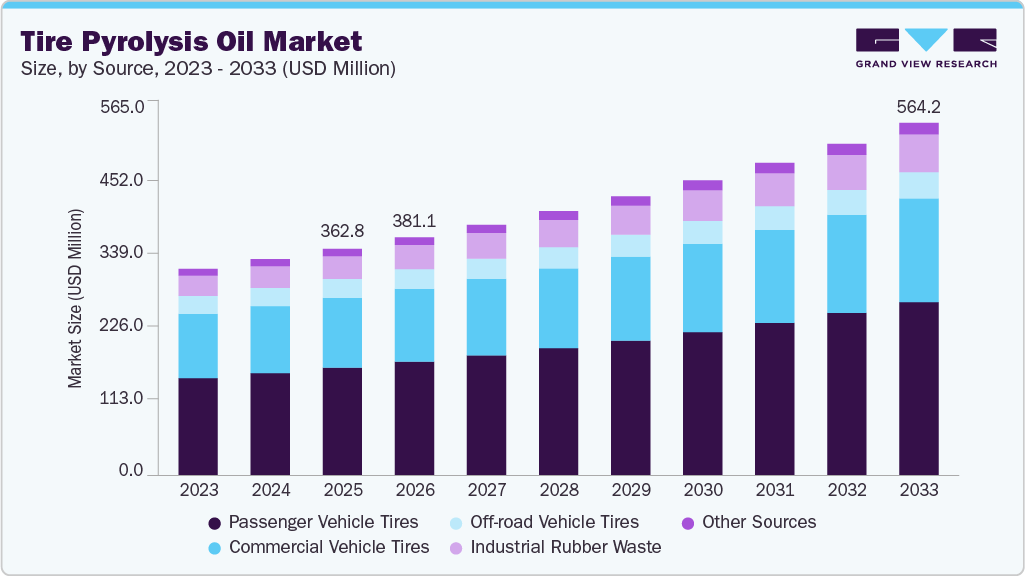 To learn more about this report, Download Free Sample Report
Growing consumption of alternative industrial fuels is creating favorable conditions for tire pyrolysis oil adoption across heating systems, furnaces, and energy-intensive operations. Rising volatility in conventional fuel pricing has increased interest in low-cost recovered oils that can partially substitute traditional petroleum-derived products. Refining improvements are also enabling producers to enhance oil quality, sulfur reduction performance, and fuel stability, making tire-derived oil more commercially acceptable for broader industrial applications.
The market is also benefiting from increasing integration between waste management companies, recycling operators, and downstream fuel users seeking long-term feedstock security. The expansion of continuous and fast pyrolysis systems is improving operational efficiency, production consistency, and scalability compared to conventional batch processing methods. Commercial focus is gradually shifting toward higher-value chemical recovery opportunities, where upgraded tire pyrolysis oil can serve as a secondary raw material for petrochemical and specialty processing industries.
Market Dynamics
The growing accumulation of end-of-life tires is increasing the need for commercially viable recycling and fuel recovery solutions across industrial waste management systems. Discarded tires occupy large landfill space, degrade very slowly, and create long-term environmental risks when improperly disposed of or openly burned. Tire pyrolysis oil production offers an effective method for converting non-biodegradable rubber waste into usable fuel, recovered carbon black, and recyclable steel. Industries and waste processing operators are increasingly adopting pyrolysis systems to reduce disposal burdens while generating economic value from waste materials.
Industrial fuel consumers are showing greater interest in recovered oil products amid rising pressure on conventional fuel procurement costs and on raw material utilization efficiency. Continuous pyrolysis systems are improving oil yield consistency and operational productivity, encouraging larger-scale commercial deployment. Expansion of circular economy practices is also increasing investment in waste-to-energy infrastructure, where tire-derived oil can serve as an alternative hydrocarbon source for industrial heating and secondary fuel applications.
Strict environmental emission standards are limiting the expansion of small and medium-scale tire pyrolysis oil facilities in several industrial markets. Pyrolysis operations can release sulfur compounds, particulate matter, volatile organic compounds, and other emissions if plants lack advanced gas-cleaning and temperature-control systems. Compliance with environmental monitoring requirements increases capital investment and operational expenses for producers, especially for batch processing facilities using older technologies. Regulatory approvals for waste handling, emissions management, and fuel quality certification also extend project development timelines. These factors reduce profitability for smaller operators and restrict the rapid commercialization of low-efficiency pyrolysis units.
Market Concentration & Characteristics
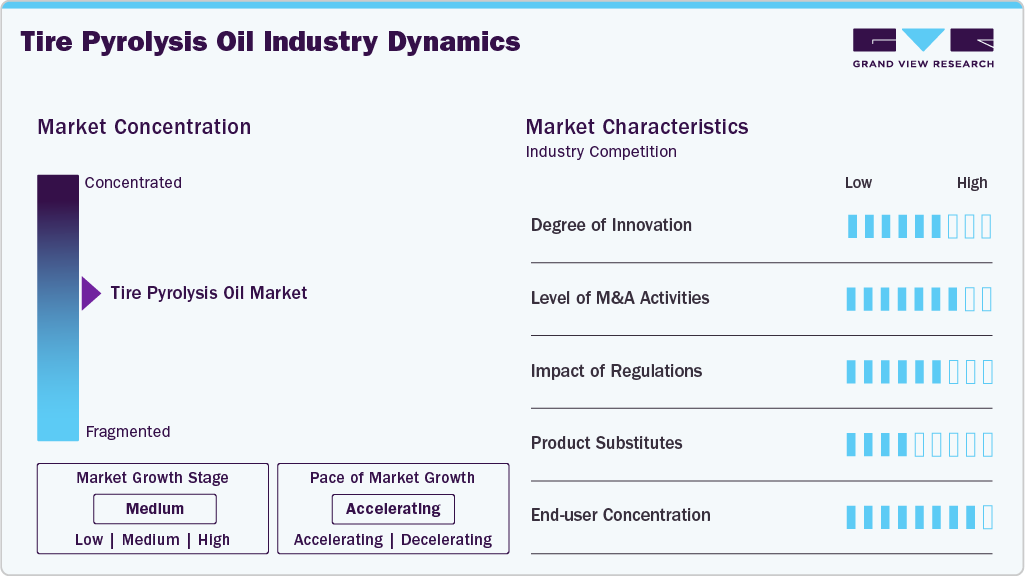
The tire pyrolysis oil market remains moderately fragmented, with participation from independent pyrolysis operators, waste recycling companies, fuel recovery firms, and integrated environmental processing businesses. Market activity is influenced by access to a steady supply of waste tires, operational efficiency, oil recovery capability, and compliance with environmental processing standards. Companies with continuous processing systems and stable downstream industrial customers maintain stronger commercial positioning because they can deliver more consistent oil quality and production output compared to smaller batch-based facilities.
 To learn more about this report, Download Free Sample Report
The market is characterized by strong dependence on feedstock availability, fuel substitution economics, and process optimization efficiency. Commercial success is closely linked to the ability to improve oil refinement quality, manage emissions, and maximize recovery of secondary products such as carbon black and steel. Long-term supply agreements between tire collection networks and pyrolysis operators are becoming increasingly important because consistent raw material access directly affects plant utilization rates, production continuity, and overall operating profitability.
Source Insights
Passenger vehicle tires held the largest share of the tire pyrolysis oil market in 2025, accounting for 47.6% of revenue. The segment maintained its leading position due to the high global volume of discarded passenger tires generated from private transportation fleets and regular replacement cycles. Passenger tires are widely available through organized collection networks, making feedstock procurement easier and more cost-efficient for pyrolysis operators. These tires also provide balanced hydrocarbon recovery and stable oil yield characteristics suitable for industrial fuel production. Increasing vehicle ownership and shorter tire usage duration continued to raise annual waste tire generation, supporting large-scale processing activity and sustaining strong commercial demand for passenger tire-derived pyrolysis oil across multiple industrial applications.
Industrial rubber waste is projected to grow at the fastest rate, with a CAGR of 6.6% from 2026 to 2033. Growth is being driven by an increased recovery of industrial rubber scrap, conveyor belts, molded rubber components, production rejects, and elastomer waste generated by manufacturing operations. Industrial facilities are focusing more on waste utilization efficiency and disposal cost reduction, encouraging greater adoption of pyrolysis-based recovery systems. Compared to mixed tire feedstock, industrial rubber waste often provides a more uniform material composition, improving processing stability and consistent oil quality. Expansion of circular manufacturing practices and rising interest in converting industrial waste streams into usable fuel and secondary hydrocarbon products are expected to accelerate commercial demand throughout the forecast period.
Production Process Insights
The slow pyrolysis segment dominated the tire pyrolysis oil market in 2025, accounting for 62.4% of total revenue. The segment maintained its leading position due to widespread installation of batch and semi-continuous pyrolysis systems that operate with lower capital investment and simpler processing requirements. Many small and medium-scale operators continue to prefer slow pyrolysis because the technology supports flexible feedstock handling and stable recovery of oil, carbon black, and steel. The process also remains commercially attractive in regions with developing waste tire recycling infrastructure, where affordability and operational simplicity are prioritized. Long operating cycles and established plant availability continued to support large-scale adoption of slow pyrolysis systems across industrial fuel recovery applications.
The fast pyrolysis segment is projected to record the fastest growth, with a CAGR of 6.8% from 2026 to 2033. Growth in this segment is being driven by increasing commercial preference for higher liquid oil yield, improved processing efficiency, and better product consistency compared to conventional slow pyrolysis methods. Fast pyrolysis systems enable quicker heat transfer and shorter reaction times, allowing producers to improve throughput capacity and operational productivity. Rising demand for upgraded pyrolysis oil suitable for refinery integration and chemical feedstock applications is also encouraging investment in continuous fast pyrolysis technologies. Expansion of larger industrial processing facilities and a growing focus on scalable fuel recovery operations are expected to strengthen adoption during the forecast period.
End Use Insights
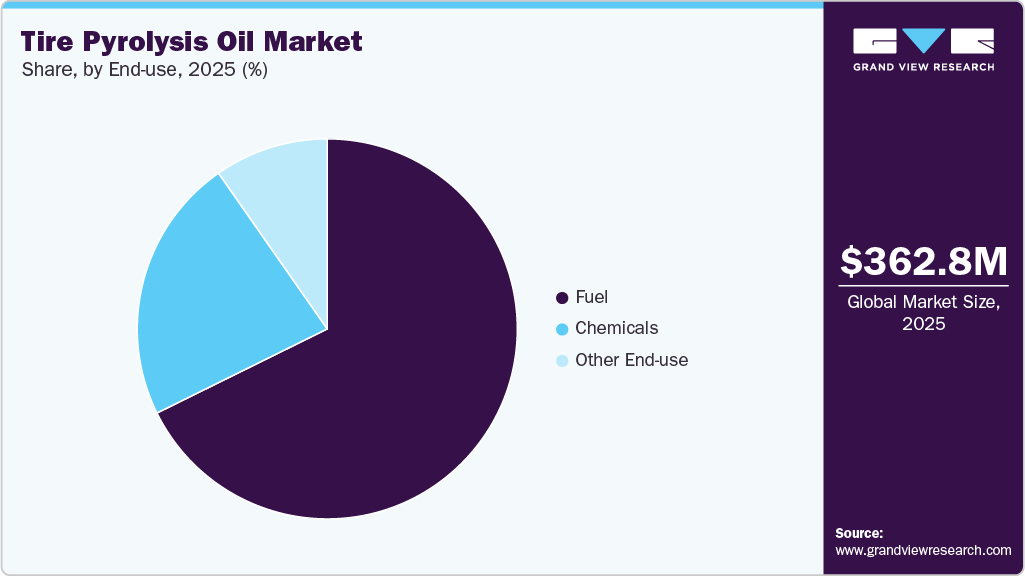
The fuel segment led the tire pyrolysis oil market in 2025, accounting for 67.7% of total revenue. The segment maintained its dominance due to strong industrial demand for alternative fuel sources used in boilers, furnaces, cement kilns, and heating systems. Tire pyrolysis oil offers a lower-cost substitute for conventional furnace oil and heavy fuel oil in energy-intensive industries seeking operational cost optimization. Large volumes of crude pyrolysis oil are directly consumed in industrial thermal applications because they require less upgrading than chemical-grade processing. Stable demand from manufacturing facilities and continuous consumption across industrial operations supported high commercial utilization of fuel-grade tire pyrolysis oil throughout the year.
 To learn more about this report, Download Free Sample Report
The chemicals segment is expected to grow at the fastest rate, with a CAGR of 6.9% from 2026 to 2033. Growth is being supported by increasing interest in converting tire-derived hydrocarbons into higher-value chemical feedstocks and specialty processing materials. Refining improvements are enabling producers to recover aromatic compounds, light hydrocarbons, and reusable petrochemical intermediates from pyrolysis oil streams with better efficiency. Chemical manufacturers are also evaluating recycled hydrocarbon sources to reduce dependence on virgin fossil feedstocks and improve material circularity. Rising commercial focus on sustainable chemical production and expansion of advanced oil upgrading technologies are expected to strengthen demand for chemical-grade tire pyrolysis oil during the forecast period.
Regional Insights
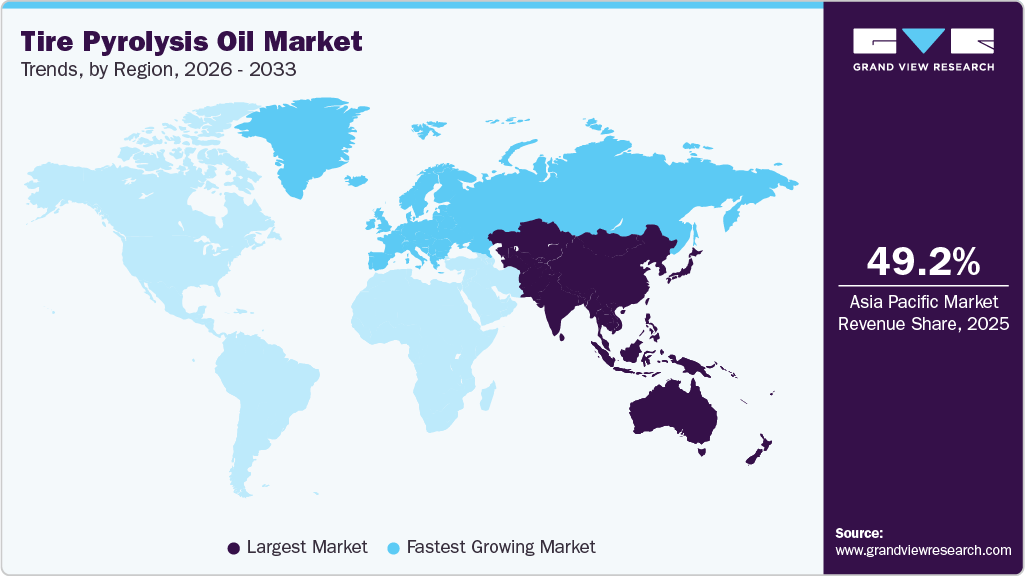
The Asia Pacific tire pyrolysis oil industry dominated the market, accounting for the largest revenue share of 49.2% in 2025. The region maintained its leading position due to high generation volumes of end-of-life tires from expanding automotive usage and large transportation fleets. Strong availability of low-cost feedstock and increasing investment in waste tire recycling infrastructure supported large-scale pyrolysis operations across industrial processing facilities. Industrial sectors with high fuel consumption also contributed to the stronger adoption of tire-derived oil as an alternative energy source. The presence of numerous small and medium-scale pyrolysis operators and the growing commercialization of continuous processing systems further strengthened regional market revenue generation throughout 2025.
 To learn more about this report, Download Free Sample Report
The China tire pyrolysis oil industry accounted for the largest share in 2025 in the Asia Pacific, due to the country’s large end-of-life tire generation volume and extensive presence of domestic recycling and waste processing facilities. Strong manufacturing activity, high commercial transportation usage, and continuous replacement of passenger and truck tires supported stable feedstock availability for pyrolysis operators. Industrial demand for alternative fuel sources across cement, steel, and heavy processing sectors also contributed to sustained consumption of tire-derived oil. The expansion of continuous pyrolysis systems and the increasing focus on regulated waste recovery practices are supporting the further commercialization of upgraded tire pyrolysis oil applications in the country.
North America Tire Pyrolysis Oil Market Trends
The tire pyrolysis oil industry in North America is experiencing steady development due to increasing investment in advanced tire recycling infrastructure and growing interest in sustainable hydrocarbon recovery technologies. Industrial operators are focusing on improving recovery efficiency and reducing landfill dependence for waste tires through large-scale pyrolysis projects. Strong presence of organized tire collection systems and rising commercial evaluation of pyrolysis oil as a refinery-compatible feedstock are supporting market expansion. Demand for recovered carbon products and increasing integration between recycling companies and downstream fuel processors are also contributing to gradual industry growth across the region.
U.S. Tire Pyrolysis Oil Market Trends
The U.S. tire pyrolysis oil industry is witnessing increasing adoption of continuous pyrolysis technologies supported by rising investment in waste-to-energy and circular material recovery projects. Large volumes of discarded tires generated from extensive vehicle ownership are creating long-term feedstock availability for domestic pyrolysis facilities. Industrial sectors are evaluating tire pyrolysis oil for blending as an alternative fuel and for secondary hydrocarbon applications, as companies seek improved waste utilization efficiency. Expansion of private sector partnerships, environmental recovery initiatives, and advanced refining projects is strengthening commercialization opportunities for tire-derived oil products across the country.
Europe Tire Pyrolysis Oil Market Trends
The tire pyrolysis oil industry in Europe is expected to grow at the fastest CAGR of 6.5% from 2026 to 2033. Growth is being driven by increased focus on circular-economy implementation, stricter landfill restrictions on waste tires, and rising investment in sustainable fuel recovery technologies. Industrial operators are showing greater interest in advanced pyrolysis systems capable of producing higher-quality oil suitable for refinery and chemical processing applications. Strong emphasis on emission-controlled recycling methods and material recovery efficiency is also encouraging the adoption of continuous pyrolysis technologies. The expansion of partnerships among recycling companies, tire manufacturers, and petrochemical processors is expected to accelerate the commercial deployment of tire pyrolysis oil projects across the region.
The Germany tire pyrolysis oil industry is growing due to strong emphasis on regulated waste management systems, advanced recycling practices, and industrial sustainability targets. Strict landfill restrictions for end-of-life tires are encouraging higher recovery rates through controlled pyrolysis processing facilities. Industrial companies are increasingly investing in advanced continuous pyrolysis systems capable of producing cleaner, more stable oil suitable for refinery and chemical applications. The presence of established engineering expertise and increasing collaboration between recycling firms and petrochemical companies are supporting the development of higher-value tire-derived hydrocarbon products in the country.
Latin America Tire Pyrolysis Oil Market Trends
The tire pyrolysis oil industry in Latin America is expanding gradually due to rising pressure on waste tire disposal management and increasing industrial interest in low-cost alternative fuel sources. Growth in transportation activity and commercial vehicle usage is contributing to higher annual tire waste generation across several economies in the region. Pyrolysis operators are focusing on improving local tire collection networks and expanding small to medium-scale processing facilities to support industrial fuel demand. Industrial sectors, including cement manufacturing and heavy processing, are showing increasing utilization of tire-derived fuel oil for thermal energy applications.
Middle East & Africa Tire Pyrolysis Oil Market Trends
The tire pyrolysis oil industry in the Middle East and Africa is developing steadily due to growing focus on waste recovery infrastructure and increasing interest in converting discarded tires into usable industrial fuel products. Expansion of construction, transportation, and mining activities is contributing to higher tire consumption and rising end-of-life tire volumes across multiple countries. Industrial users are evaluating tire pyrolysis oil as a supplementary fuel source for energy-intensive operations where fuel cost optimization remains important. Investment in environmental waste management projects and the gradual adoption of continuous pyrolysis technologies are supporting long-term market development across the region.
Key Tire Pyrolysis Oil Company Insights
The two key dominant manufacturers in the tire pyrolysis oil market are Bridgestone Corporation and Pyrum Innovations AG. These companies are recognized for their strong focus on sustainable tire recycling technologies, advanced pyrolysis processing capabilities, and increasing integration of circular material recovery solutions within industrial operations.
-
Bridgestone Corporation is actively expanding its tire recycling and circular economy initiatives through investment in advanced pyrolysis technologies and recovered material utilization programs. The company focuses on converting end-of-life tires into reusable hydrocarbon products, recovered carbon black, and sustainable raw materials for industrial applications. Its long term sustainability strategy supports the development of closed-loop tire recycling systems and lower environmental impact manufacturing practices.
-
Pyrum Innovations AG specializes in thermolysis technology for processing waste tires into tire pyrolysis oil, recovered carbon black, steel, and gas products. The company is recognized for its continuous pyrolysis systems designed to improve recovery efficiency and product consistency. Pyrum focuses on environmentally controlled recycling operations and collaborates with industrial partners to expand commercial adoption of sustainable tire-derived hydrocarbon recovery solutions.
Key Tire Pyrolysis Oil Companies
The following key companies have been profiled for this study on the tire pyrolysis oil market.
-
Bridgestone Corporation
-
Scandinavian Enviro Systems
-
Pyrum Innovations AG
-
Klean Industries
-
Contec S.A.
-
Bolder Industries
-
Green Fuel Nordic Oy
-
Ecolomondo Corporation
-
Wastefront AS
-
Circtec
Competitive Benchmarking
Operating Strategies
Competitive Edge
Weaknesses
Mature Players: Bridgestone Corporation; Pyrum Innovations AG; Scandinavian Enviro Systems; Circtec; Contec S.A.
- Major companies focus on continuous pyrolysis expansion, refinery integration, and long-term tire recovery agreements.
- They prioritize scalable processing systems and commercial partnerships supporting stable oil output, recovered carbon black utilization, and circular hydrocarbon production across industrial applications.
- These companies possess stronger processing infrastructure, advanced thermolysis technologies, and established industrial collaborations.
- Their ability to produce consistent oil quality and recover higher value secondary materials improves commercial positioning within regulated waste recovery and sustainable fuel processing markets.
- Large-scale facilities require substantial capital investment, complex environmental approvals, and continuous feedstock availability.
- Dependence on industrial fuel economics and fluctuating recovered material pricing can affect profitability, especially during periods of volatile conventional energy market conditions.
Emerging Players: Wastefront AS; Bolder Industries; Ecolomondo Corporation; Green Fuel Nordic Oy; Klean Industries
- Emerging companies focus on pilot commercialization, regional tire collection expansion, and modular pyrolysis deployment.
- Many emphasize technology validation, sustainable fuel recovery projects, and strategic collaborations aimed at increasing processing capacity and improving operational efficiency gradually.
- These players maintain flexibility in adopting newer pyrolysis configurations and specialized recovery systems.
- Their smaller operational structures allow quicker technology adaptation and targeted development of niche recycling opportunities linked to local waste tire management requirements.
- Emerging companies face limitations related to financing access, smaller processing scale, and lower commercial visibility.
- Restricted production capacity and dependence on regional feedstock supply can slow expansion and reduce competitiveness against established continuous pyrolysis operators.
Recent Developments
- In February 2026, Pyrum Innovations AG announced that France officially recognized pyrolysis oil from end-of-life tires as a raw material for the chemical industry. The development strengthens regulatory acceptance of tire pyrolysis oil within chemical value chains and supports long-term commercialization opportunities for recycled hydrocarbon feedstocks in the tire pyrolysis oil market.
Tire Pyrolysis Oil Market Report Scope
Report Attribute
Details
Market size value in 2025
USD 362.8 million
Market size value in 2026
USD 381.1 million
Revenue forecast in 2033
USD 564.2 million
Growth rate
CAGR of 5.8% from 2026 to 2033
Base year for estimation
2025
Historical data
2021 - 2024
Forecast period
2026 - 2033
Quantitative units
Revenue in USD million, Volume in Kilotons, and CAGR from 2026 to 2033
Report coverage
Revenue forecast, company ranking, competitive landscape, growth factors, and trends
Segments covered
Source, production process, end use, region
Regional scope
North America; Europe; Asia Pacific; Latin America; Middle East & Africa
Country scope
U.S.; Canada; Mexico; Brazil; Argentina; Germany; UK; Italy; Spain; France; China; Japan; South Korea; Saudi Arabia; South Africa
Key companies profiled
Bridgestone Corporation; Scandinavian Enviro Systems; Pyrum Innovations AG; Klean Industries; Contec S.A.; Bolder Industries; Green Fuel Nordic Oy; Ecolomondo Corporation; Wastefront AS; Circtec
Customization scope
Free report customization (equivalent to up to 8 analysts’ working days) with purchase. Addition or alteration to country, regional & segment scope.
Pricing and purchase options
Avail customized purchase options to meet your exact research needs. Explore purchase options
Global Tire Pyrolysis Oil Market Report Segmentation
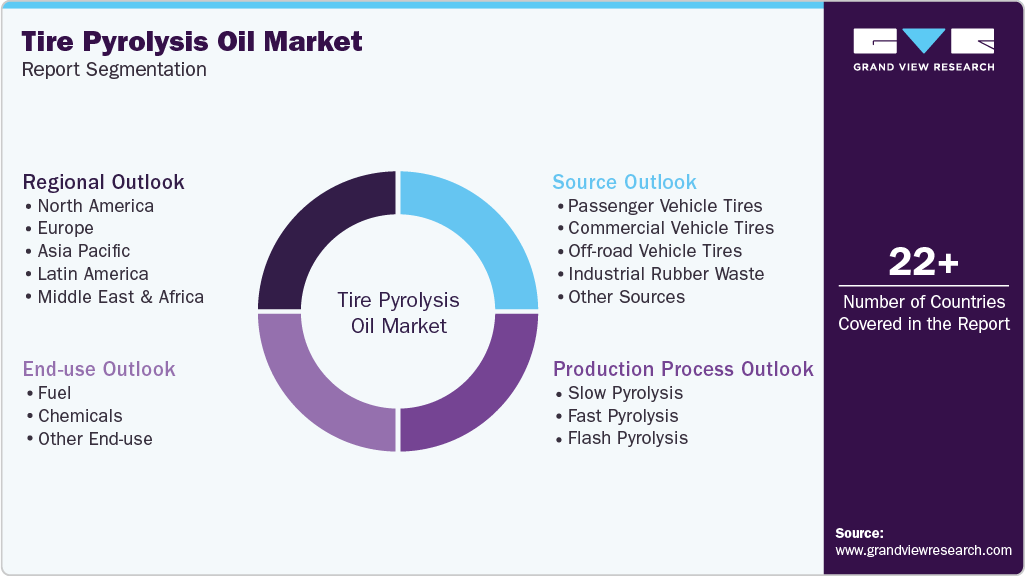
This report forecasts revenue growth at global, regional, and country levels and provides an analysis of the latest industry trends in each of the sub-segments from 2021 to 2033. For this study, Grand View Research has segmented the global tire pyrolysis oil market report based on source, production process, end use, and region.
 To learn more about this report, Download Free Sample Report
-
Source Outlook (Volume, Kilotons; Revenue, USD Million, 2021 - 2033)
-
Passenger Vehicle Tires
-
Commercial Vehicle Tires
-
Off-road Vehicle Tires
-
Industrial Rubber Waste
-
Other Sources
-
-
Production Process Outlook (Volume, Kilotons; Revenue, USD Million, 2021 - 2033)
-
Slow Pyrolysis
-
Fast Pyrolysis
-
Flash Pyrolysis
-
-
End Use Outlook (Volume, Kilotons; Revenue, USD Million, 2021 - 2033)
-
Fuel
-
Chemicals
-
Other End Use
-
-
Regional Outlook (Volume, Kilotons; Revenue, USD Million, 2021 - 2033)
-
North America
-
U.S.
-
Canada
-
Mexico
-
-
Europe
-
Germany
-
UK
-
Italy
-
Spain
-
France
-
-
Asia Pacific
-
China
-
Japan
-
South Korea
-
-
Latin America
-
Brazil
-
Argentina
-
-
Middle East & Africa
-
Saudi Arabia
-
South Africa
-
-
Delivered Customizations
This report has been delivered with the following In-depth customizations
Client Request
Customization Delivered
Value Adds
Cross-segmentation
Detailed evaluation of the interconnection between source, process, end use, and regional segments within the tire pyrolysis oil market, including analysis of how passenger vehicle tires influence fuel applications, fast pyrolysis adoption, and regional consumption trends.
Supports identification of high-growth segment combinations and improves strategic planning through better understanding of commercially attractive processing pathways, feedstock utilization patterns, and end use demand alignment across different regional markets.
Competitive Benchmarking
Comparative assessment of tire pyrolysis oil companies based on processing technology type, continuous versus batch operational capability, product recovery efficiency, refinery integration potential, sustainability initiatives, and expansion strategies related to tire recycling infrastructure.
Assists competitive intelligence activities by providing deeper visibility into operational strengths, commercialization approaches, technology positioning, and long term strategic focus areas influencing market competitiveness and industrial collaboration potential.
Opportunity Assessment
Analysis of future opportunities associated with advanced pyrolysis systems, upgraded chemical-grade tire pyrolysis oil production, industrial fuel substitution trends, circular economy initiatives, and increasing recovery of industrial rubber waste streams.
Helps identify emerging investment areas, commercially scalable processing technologies, and high-potential application segments aligned with evolving waste recovery priorities, sustainable fuel demand, and secondary hydrocarbon utilization trends.
Frequently Asked Questions About This Report
The global tire pyrolysis oil market size was estimated at USD 362.8 million in 2025 and is expected to reach USD 381.1 million in 2026.
The global tire pyrolysis oil market is expected to grow at a compound annual growth rate of 5.8% from 2026 to 2033, reaching USD 564.2 million by 2033.
The fuel segment accounted for the largest share of the tire pyrolysis oil market due to strong industrial consumption across boilers, furnaces, cement kilns, and thermal processing operations. High demand for lower cost alternative fuels and direct usability of crude pyrolysis oil supported segment dominance in 2025.
Some of the key players operating in the tire pyrolysis oil market include Bridgestone Corporation, Scandinavian Enviro Systems, Pyrum Innovations AG, Klean Industries, Contec S.A., Bolder Industries, Green Fuel Nordic Oy, Ecolomondo Corporation, Wastefront AS, Circtec.
Rising generation of end of life tires, increasing demand for alternative industrial fuels, and growing focus on sustainable waste recovery are driving the tire pyrolysis oil market. Expansion of circular economy practices, improving pyrolysis processing efficiency, and rising commercial interest in recovered hydrocarbon products are also supporting market growth.
About the Author(s)
Petrochemicals Research Team
Bulk Chemicals · PetrochemicalsThis report was authored by the petrochemicals research team at Grand View Research - comprising two research analysts, one senior research analyst, and one industry expert - with specialized expertise in the petrochemicals segment of the bulk chemicals industry. All findings are based on proprietary bulk chemicals databases, executive interviews, and regulatory analysis, subject to internal peer review prior to publication.
Last Updated:
Speak to Analyst

Customize this report to your needs - add regions, segments, or data points, with 20% free customization.
Or view our licence options:


ISO 9001:2015 & 27001:2022 Certified
We are GDPR and CCPA compliant! Your transaction & personal information is safe and secure. For more details, please read our privacy policy.


