
- Home
- »
- Consumer F&B
- »
-
Tonic Water Market Size And Share, Industry Report, 2033GVR Report cover
![Tonic Water Market Size, Share & Trends Report]()
Tonic Water Market (2026 - 2033) Size, Share & Trends Analysis Report By Product (Regular, Diet), By Distribution Channel (Hypermarket, Supermarket & Convenience Stores, On-trade, Online), By Region, And Segment Forecasts
Market Size, 2025
$2.6BMarket Estimate, 2026
$2.9BMarket Forecast, 2033
$4.8BCAGR, 2026–2033
8.0%Tonic Water Market Summary
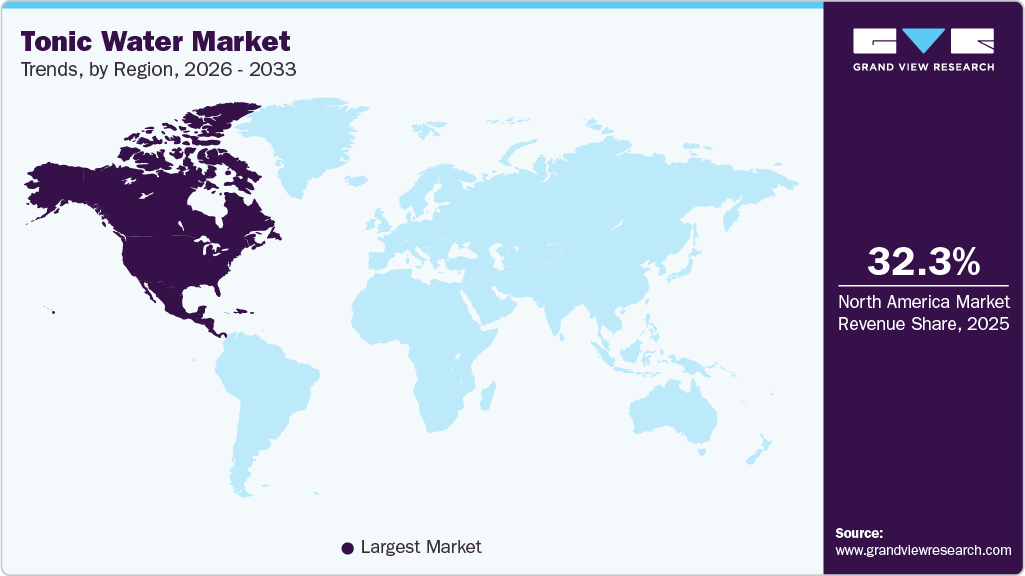
The global tonic water market size was valued at USD 2.6 billion in 2025 and is projected to grow from USD 2.9 billion in 2026 to USD 4.8 billion by 2033, at a CAGR of 8.0% from 2026 to 2033. The market in North America dominated with a revenue share of 32.3% in 2025. As the cocktail culture, especially the Gin & Tonic (G&T) drink, continues to expand, tonics water has become a fundamental component in cocktail preparation.

Key Market Trends & Insights
- By product: The regular tonic water segment led the market with the largest revenue share of 74.8% in 2025.
- By distribution channel: The hypermarket supermarkets & convenience stores segment led the market with the largest revenue share of 54.1% in 2025.
Regional Highlights
- Largest regional market: North America (32.3% revenue share, 2025)
- By country: The U.S. held the largest market share in 2025.
Market Size & Forecast
- Market size in 2025: USD 2.6 Billion
- Estimated market size in 2026: USD 2.9 Billion
- Projected market size by 2033: USD 4.8 Billion
- CAGR (2026-2033): 8.0%
Three ways to get this report
Buy it, customize it, or ask a question.Get the Full Report
What the study covers
- FormatsPDF · Excel · Dashboard
- Timeline2026–2033 annual, 2025 base
- Coverage20+ countries, 5 regions
- Companies10+ key players profiled
Customize the Report
20% free customization
- IncludeCountries, segments, points
- TailorTo your product definition
- ExtendDeeper competitor detail
- OrA fully bespoke study
- Turnaround5–10 working days
Ask an Analyst
A direct answer, usually in 1 working day
- AccessReport author, directly
- Reply timeWithin 1 working day
- No sales callDirect answer only
- FormatEmail reply
- CostFree, no cost
Consumers are increasingly seeking higher-quality, more flavorful mixers, driving demand for premium, craft, and artisanal tonic waters. These products are often marketed with a focus on natural ingredients and complex flavor profiles, appealing to consumers looking for a sophisticated drinking experience.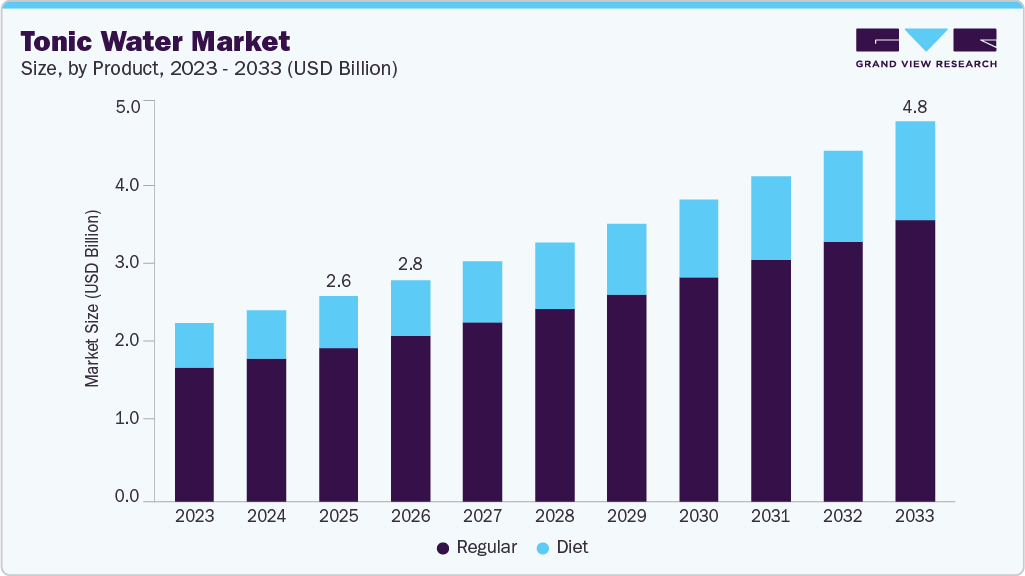
Another important factor contributing to the market's growth is the shift in consumer preferences towards healthier, low-sugar, and low-calorie alternatives. With an increasing focus on wellness, many consumers are opting for drinks with fewer artificial ingredients and less sugar, and tonic water fits this demand. The rise of diet and flavored tonic waters, which offer a variety of botanicals and natural ingredients, has aligned well with health-conscious trends. This is especially significant among younger consumers and those who are becoming more selective about the beverages they consume.
The market benefits from product innovation and the growing availability of new and exciting flavors. Traditional tonic water is no longer the only option on the market; consumers are now experimenting with a wide range of flavors, including cucumber, elderflower, citrus, and hibiscus. In September 2024, Mossant Fermentary launched India’s first clean-label, low-sugar tonic waters made from natural, additive-free ingredients to meet rising health-conscious consumer demand. The range includes unique botanical flavors (like rosemary and passionfruit) and reflects the growing trend toward healthier, transparent, and premium beverage options in the tonic water market.
This diversification not only enhances the drinking experience but also appeals to those looking for variety and novelty in their beverages. Tonic water is no longer limited to alcoholic mixers but is also used in mocktails and non-alcoholic drinks, allowing it to reach a broader audience. The versatility of tonic water, combined with its sophisticated image, has made it a popular choice for both alcoholic and non-alcoholic beverages.
Moreover, global urbanization and rising disposable incomes in emerging markets have further fueled the demand for tonic water. As more people in urban centers gain access to a variety of beverage options, they are increasingly exposed to global drinking trends, including mixed drinks and premium beverages. This has created an expanding market for tonic water in regions such as Asia, Latin America, and the Middle East, where consumers are experimenting with new products and drinks.
Consumer Insights
The demand for tonic water has been rising due to several key consumer trends and shifts in beverage preferences. A significant growth driver for the tonic water industry is the increased popularity of alcoholic beverages, particularly spirits such as gin. Gin has seen a resurgence in recent years, largely due to its versatility in mixed drinks and cocktails, with the Gin & Tonic (G&T) becoming a quintessential offering at bars and in home settings. As more consumers experiment with spirits, tonic water has emerged as an essential mixer, particularly for those seeking refreshing, low-alcohol options.
Additionally, flavored tonic waters are gaining traction as consumers become more adventurous in their taste preferences. Traditional tonic water, with its signature bitter taste, is evolving into a broader category that includes infusions of botanicals, fruits, and herbs, such as citrus, elderflower, and ginger. The increasing demand for unique, premium beverage experiences is fueling this shift. Consumers are seeking out these new flavors not only to elevate their drinking experience but also to enhance the versatility of tonic water in various drink recipes, including mocktails and non-alcoholic cocktails.
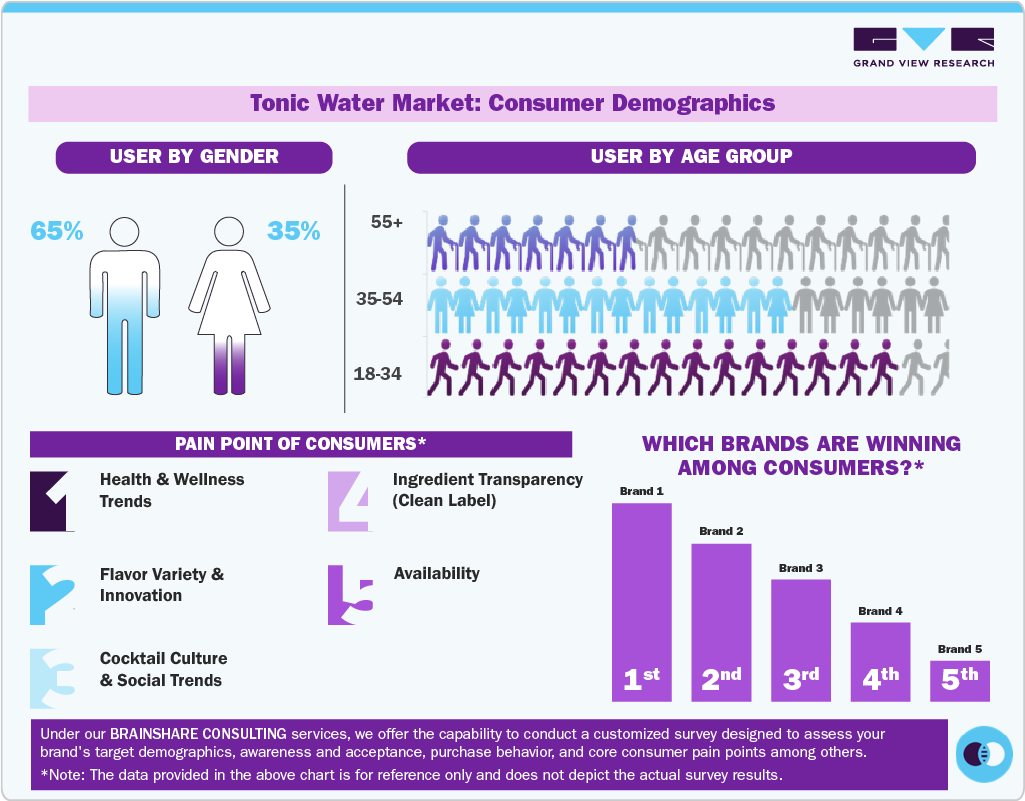
Moreover, there is a growing consumer interest in health-conscious alternatives to sugary sodas and high-calorie mixers. Tonic waters with reduced sugar, natural sweeteners, or botanical extracts are catering to this shift, appealing to consumers who are more mindful of their calorie intake but still desire a flavorful beverage. In March 2026, London Essence launched a premium zero-sugar tonic water free from artificial sweeteners, targeting consumers seeking healthier, low-calorie drink options without compromising taste. These trends align with the broader movement towards healthier drinking habits, where consumers are opting for lighter, less sugary options while still enjoying the social and cultural experiences associated with drinking.
The rise in alcohol consumption, particularly the increasing popularity of gin, tequila, rum, and other spirits, is a major factor fueling the demand for tonic water. As consumers embrace a more diverse range of spirits, tonic water is seen as a staple for mixed drinks. The growing craft cocktail scene, which emphasizes high-quality mixers alongside premium spirits, further enhances tonic water's appeal. This trend is not only prevalent in Western markets but is also gaining momentum in emerging markets, where the cocktail culture is beginning to take root.
Moreover, the growing number of consumers embracing premium and craft mixers has added another layer of demand for tonic water. Many consumers are now willing to pay a premium for artisanal, small-batch tonic waters that promise better quality and more sophisticated flavors. These products are marketed not just as mixers, but also as symbols of refined taste and a premium drinking experience.
Product Insights
Regular tonic water accounted for a dominant global revenue share of 74.8% in 2025. Demand for regular tonic water has been rising as consumers increasingly seek a dependable, versatile beverage that can serve as both a classic cocktail mixer and a refreshing standalone drink. Many consumers appreciate the familiar and consistent bitter‑sweet flavor profile of tonic water, which adds balance and depth to mixed drinks (especially gin‑ or vodka‑based cocktails), while also being palatable on its own. The widespread availability of regular tonic water across retail and hospitality channels ensures easy access for both home consumption and social occasions.
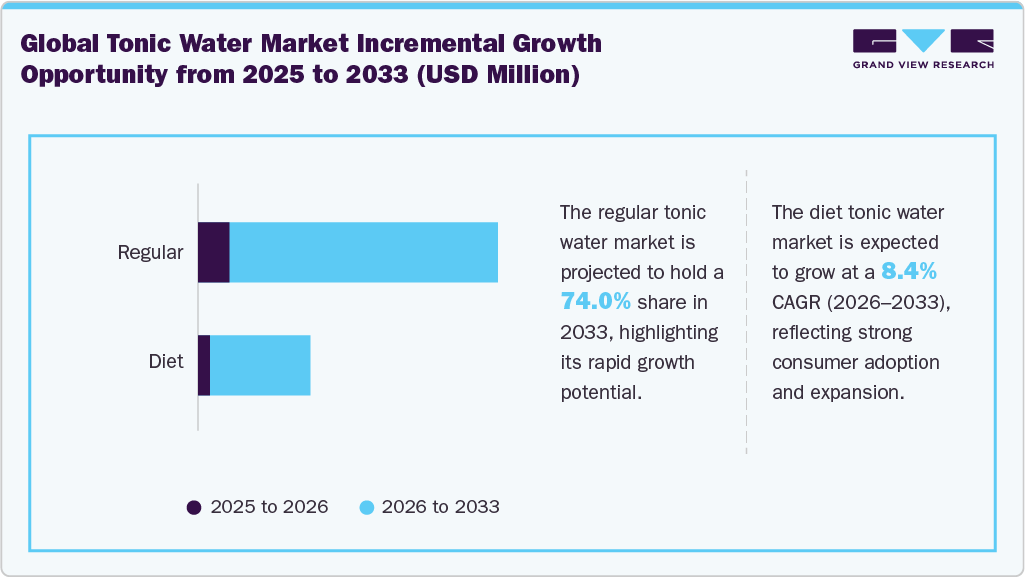
Diet tonic water is expected to grow at a CAGR of 8.4% from 2026 to 2033. With rising health consciousness and growing awareness of the negative impacts of excessive sugar consumption, many individuals are choosing low‑sugar or zero‑sugar drinks, and diet tonic water offers a way to enjoy a classic mixer or refreshing drink without added calories. Moreover, the growing popularity of craft cocktails, home mixology, and premium drink experiences has strengthened demand for lighter, refined mixers that complement spirits and align with wellness‑oriented lifestyles.
Distribution Channel Insights
Sales of tonic water through hypermarkets, supermarkets, and convenience stores accounted for a revenue share of 54.1% in 2025. As these retail channels offer a wide selection, easy accessibility, and competitive pricing, tonic water becomes more visible and available to a broad consumer base. The convenience of picking up tonic water during routine grocery or convenience‑store visits, coupled with the growing popularity of home mixing and ready‑to‑drink cocktails or mocktails, has encouraged increased trial and purchase frequency. Moreover, supermarkets and hypermarkets often lead with promotions, diverse brand portfolios (including premium, flavored, and low‑calorie tonic water), and strong shelf visibility, all of which drive consumer adoption beyond traditional bar or restaurant settings.
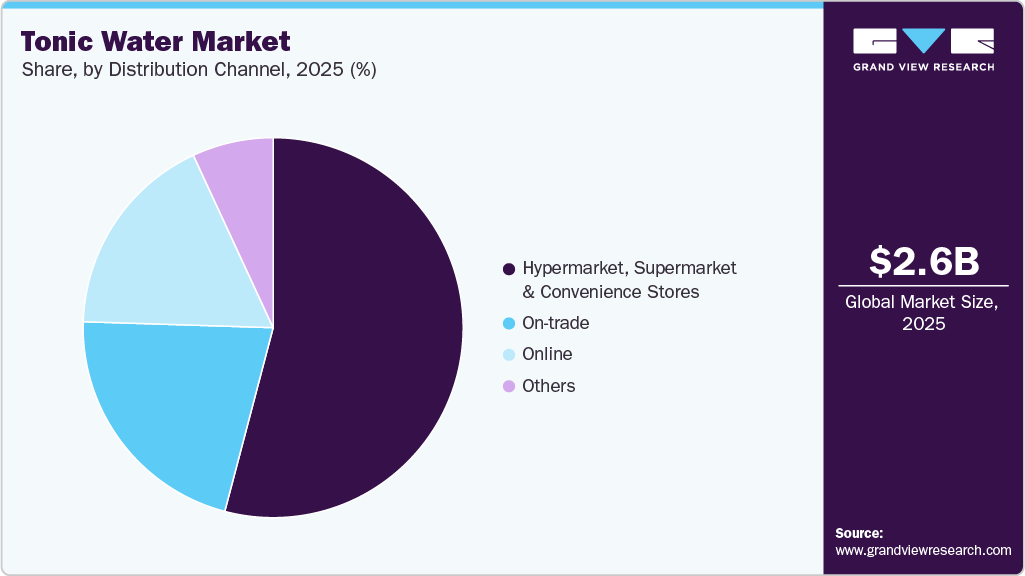
Sales of tonic water through online channels are expected to grow at a CAGR of 8.5% from 2026 to 2033. Demand for tonic water through online channels is rising as consumers increasingly prefer the convenience of home delivery, broader product variety, and access to premium and craft tonic brands that are not always available in physical stores. E-commerce platforms allow shoppers to easily compare flavors, ingredients, and pricing, enabling more informed choices, especially for health-conscious buyers seeking low-sugar or botanical-infused variants. Additionally, the growing trend of at-home mixology has encouraged consumers to purchase tonic water online in bulk or as part of curated beverage bundles, further driving online sales momentum.
Regional Insights
The North America tonic water market made the largest contribution in 2025, accounting for 32.3% of the total revenue share. In North America, demand for tonic water is climbing rapidly, driven by the growing popularity of home‑mixology and craft‑cocktail culture. Consumers increasingly seek high‑quality mixers to recreate bar‑style drinks at home. Another major driver is the evolving health and wellness trends. Many tonic water variants now offer low‑sugar or “clean label” options with botanical flavors, appealing to consumers wanting refreshing beverages without the sugar overload of sodas. At the same time, the increasing popularity of alcohol-free and low-alcohol beverages, including mocktails, has expanded the use of tonic water beyond traditional spirit-based applications. This trend continues to broaden the consumer base and supports sustained growth in the U.S. and Canada tonic water market.
U.S. Tonic Water Market Trends
The U.S. tonic water industry held the largest revenue share of 77.9% in 2025, driven by a strong craft cocktail and home mixology culture, increasing demand for high-quality mixers. Consumers are increasingly choosing low-calorie, low-sugar, and clean-label beverages as part of healthier lifestyles. There is also rising interest in premium and flavored tonic waters with unique botanical profiles. Widespread retail availability and a trend toward experiential drinking at home and in bars further support growth. Additionally, companies are forming strategic collaborations to expand distribution and strengthen market presence. In January 2025, Molson Coors entered a strategic partnership with Fever-Tree, gaining exclusive rights to produce, market, and distribute its tonic waters and mixers in the U.S., along with an equity stake in the company. The deal aims to expand Fever-Tree’s reach using Molson Coors’ large distribution network, supporting growth in premium and non-alcoholic beverages across the U.S. market.
Europe Tonic Water Market Trends
The Europe tonic water industry is projected to grow at a CAGR of 8.1% from 2026 to 2033. Demand for tonic water in Europe has been rising steadily, driven by several interlinked consumer trends and shifts in beverage culture. The Germany tonic water industry plays a significant role in this growth, supported by strong consumption of gin-based cocktails and a well-established premium beverage culture. The continued rise in consumption of gin and other mixed drinks across the region has boosted demand for high-quality mixers, with tonic water remaining the default mixer.
The UK tonic water market led Europe, accounting for the largest revenue share of 30.4% in 2025. In the UK, demand is driven by a strong gin and premium mixer culture, where tonic water is a staple pairing. Consumers show a clear preference for high-quality, artisanal, and craft beverages. There is also growing interest in low-sugar, natural-ingredient drinks due to increased health awareness. Additionally, premium branding and sophisticated packaging play a major role in influencing purchases.
Asia Pacific Tonic Water Market Trends
The Asia Pacific tonic water industry is projected to grow at a CAGR of 8.5% from 2026 to 2033, driven by a confluence of shifting lifestyles, expanding disposable incomes, and evolving consumer tastes. Urbanization and growth of the middle class have spurred greater interest in premium, ready‑to‑drink, and mixer‑style beverages, especially among younger consumers exploring new drinking experiences. In this context, the India tonic water industry is emerging as a key contributor, supported by rising urban consumption and increasing exposure to global beverage trends. At the same time, the growing cocktail and mixology culture-both in bars and restaurants and among home drinkers-has increased the consumption of spirits such as gin, whisky, and rum, with tonic water remaining a go-to mixer for these drinks.
The tonic water market in China led Asia Pacific, accounting for the largest revenue share of 24.5% in 2025. In China, rising urbanization and exposure to Western drinking habits are boosting tonic water consumption. Younger consumers are experimenting with new flavors and modern beverage trends, including cocktail-style drinks. The expansion of e-commerce and digital retail platforms improves product accessibility. There is also increasing curiosity around premium imported beverages and lifestyle products.
Central & South America Tonic Water Market Trends
The tonic water industry in Central & South America is expected to grow at a CAGR of 7.6% during the forecast period. Across Central and South America, growth is supported by a vibrant social drinking culture and outdoor lifestyle. Consumers are drawn to refreshing, carbonated beverages suited to warm climates. The expansion of the tourism and hospitality sectors increases demand in bars and restaurants. Local preferences also favor affordable yet flavorful drink options.
Middle East & Africa Tonic Water Market Trends
The tonic water industry in the Middle East & Africa is expected to grow at a CAGR of 7.3% during the forecast period. In Middle East and Africa, demand is influenced by a growing non-alcoholic beverage segment, as many consumers seek premium soft drink alternatives. Urban populations are increasingly adopting global lifestyle trends and modern retail experiences. The rise of hospitality, including hotels and fine dining, supports tonic water as both a mixer and a standalone drink. There is also a shift toward health-conscious and premium beverage choices.
Key Tonic Water Company Insights
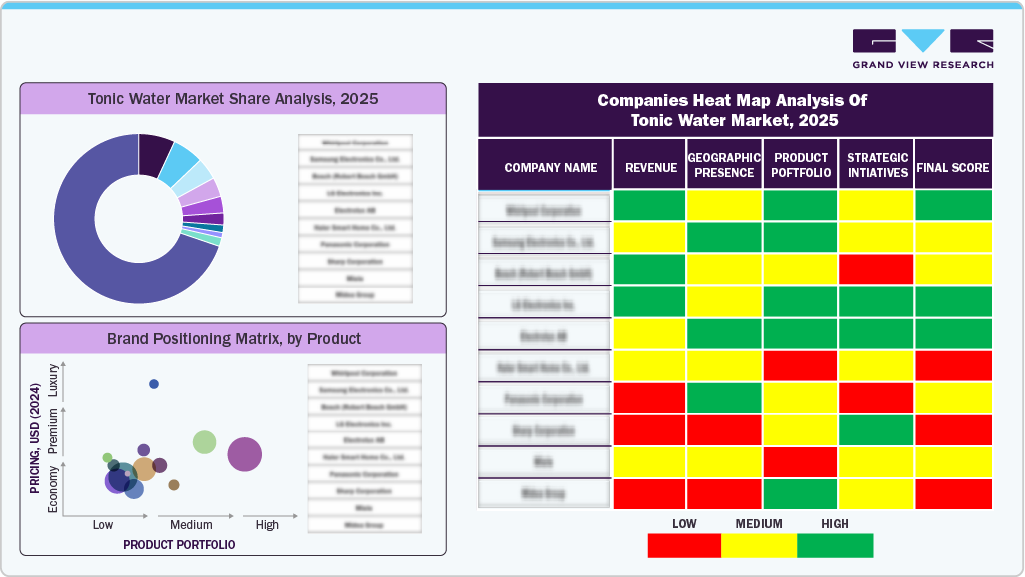
The tonic water industry is highly fragmented across the globe, owing to the presence of a large number of domestic as well as international players. Key manufacturers have significant market share in Europe, North America, and some parts of Asia. A growing trend toward healthy eating is anticipated to focus on high-quality, low-calorie products. A large number of manufacturers in the tonic water industry are offering healthier alternatives to high-sugar products, which is anticipated to be a primary driver of market growth. Increasing product launches with artificial sweeteners in the tonic water industry are also anticipated to positively impact overall industry growth.
Key Tonic Water Companies:
The following key companies have been profiled for this study on the tonic water market.
- FENTIMANS
- Fever-Tree
- Keurig Dr. Pepper
- Q MIXERS
- THE COCA-COLA COMPANY
- White Rock Products Corporation
- Zevia
- Asahi Group Holdings, Ltd.
- Hansen Beverage
- Bradley’s Tonic Co.
Recent Developments
-
In September 2025, Double Dutch launched Riviera Tonic Water, a new Mediterranean‑inspired mixer flavored with thyme, rosemary, wormwood, and lemon, designed to meet demand for coastal‑style, premium serves in hospitality venues. Built on the brand’s Indian tonic base, it pairs well with citrus or herbaceous gins, spritzes, and low/no‑alcohol cocktails, and arrives alongside Double Dutch’s 10th‑anniversary bottle redesign and growing listings in high‑end UK and global hotels and bars.
-
In October 2024, Dappled Tonic is a women‑owned, Oregon‑based craft tonic water brand launched nationally in late 2024 with three flavors: Citrus, Floral, and Aromatic, positioned as premium mixers that can also be enjoyed on their own. Crafted by experienced distillers, the tonics are designed to match the intensity of Pacific Northwest craft spirits and stand out in what the founders describe as an overlooked, largely unchanged tonic category, giving bars, retailers, and consumers a more flavorful, regionally driven option.
Tonic Water Market Report Scope
Report Attribute
Details
Market size in 2025
USD 2.6 Billion
Estimated market size in 2026
USD 2.9 billion
Projected market size by 2033
USD 4.8 billion
Growth rate
CAGR of 8.0% from 2026 to 2033
Actual data
2021 - 2025
Forecast period
2026 - 2033
Quantitative units
Revenue in USD million/billion, and CAGR from 2026 to 2033
Report coverage
Revenue forecast, company ranking, competitive landscape, growth factors, and trends
Segments covered
Product, distribution channel, region
Regional scope
North America, Europe, Asia Pacific, Central & South America, Middle East & Africa
Country scope
U.S.; Canada; Mexico; Germany; UK; France; Italy; Spain: China; Japan; India; Australia & New Zealand; Brazil; South Africa, UAE
Key companies profiled
FENTIMANS; Fever-Tree; Keurig Dr Pepper; Q MIXERS; THE COCA-COLA COMPANY; White Rock Products Corporation; Zevia; Asahi Group Holdings, Ltd., Hansen Beverage, Bradley’s Tonic Co
Customization scope
Free report customization (equivalent up to 8 analysts’ working days) with purchase. Addition or alteration to country, regional & segment scope.
Pricing and purchase options
Avail customized purchase options to meet your exact research needs. Explore purchase options
Global Tonic Water Market Report Segmentation
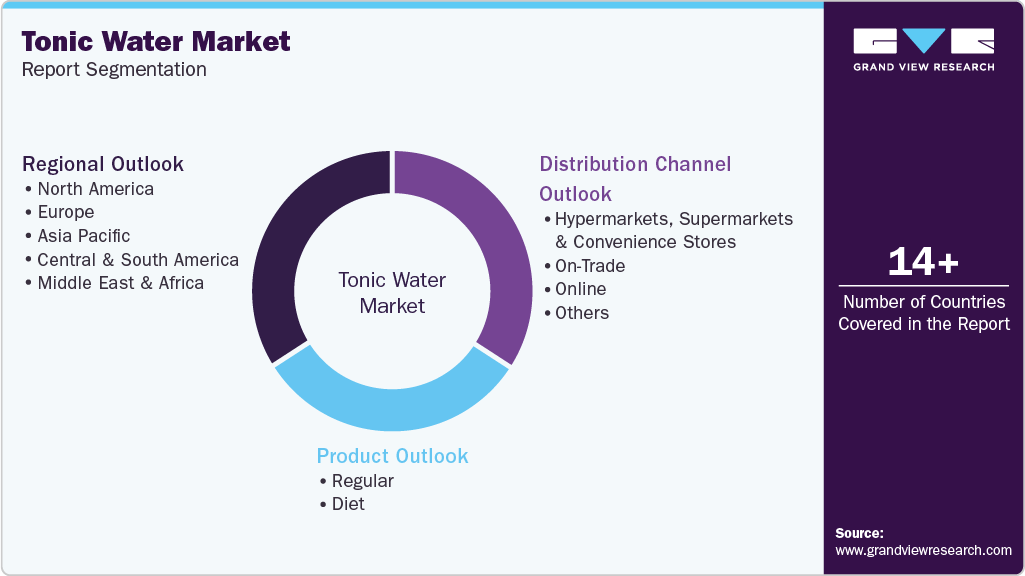
This report forecasts revenue growth at the global, regional & country levels and provides an analysis of the latest trends and opportunities in each of the sub-segments from 2021 to 2033. For this study, Grand View Research has segmented the global tonic water market report based on product, distribution channel, and region:
-
Product Outlook (Revenue, USD Million, 2021 - 2033)
-
Regular
-
Diet
-
-
Distribution Channel Outlook (Revenue, USD Million, 2021 - 2033)
-
Hypermarkets, Supermarkets & Convenience Stores
-
On-Trade
-
Online
-
Others
-
-
Regional Outlook (Revenue, USD Million, 2021 - 2033)
-
North America
-
U.S.
-
Canada
-
Mexico
-
-
Europe
-
Germany
-
UK
-
France
-
Italy
-
Spain
-
-
Asia Pacific
-
China
-
Japan
-
India
-
Australia & New Zealand
-
-
Central & South America
-
Brazil
-
-
Middle East & Africa
-
South Africa
-
UAE
-
-
Frequently Asked Questions About This Report
The global tonic water market size was estimated at USD 2.6 billion in 2025 and is expected to reach USD 2.8 billion in 2026.
The global tonic water market is expected to grow at a compound annual growth rate of 8.0% from 2026 to 2033 to reach USD 4.8 billion by 2033.
Key players include FENTIMANS, Fever-Tree, Keurig Dr Pepper, Q MIXERS, THE COCA-COLA COMPANY, White Rock Products Corporation, Zevia, Asahi Group Holdings, Ltd.
Key factors that are driving the market growth include increasing consumption of alcoholic beverages such as gin, vodka, and other various types of cocktails and new product launches.
The hypermarket supermarkets & convenience stores held the largest revenue share of 54.1% in 2025.
North America dominated with a 32.3% revenue share in 2025.
Regular tonic water accounted for a dominant share of 74.8% of the global revenue in 2025.
About the Author(s)
Consumer F&B Research Team
Consumer Goods · Consumer F&BThis report was authored by the consumer f&b research team at Grand View Research - comprising two research analysts, one senior research analyst, and one industry expert - with specialized expertise in the consumer f&b segment of the consumer goods industry. All findings are based on proprietary consumer goods databases, executive interviews, and regulatory analysis, subject to internal peer review prior to publication.
Last Updated:
Speak to Analyst


Customize this report to your needs - add regions, segments, or data points, with 20% free customization.
Or view our licence options:


ISO 9001:2015 & 27001:2022 Certified
We are GDPR and CCPA compliant! Your transaction & personal information is safe and secure. For more details, please read our privacy policy.


