
- Home
- »
- Consumer F&B
- »
-
UK Honey Market Size, Share And Trends Report, 2026-2033GVR Report cover
![UK Honey Market Size, Share & Trends Report]()
UK Honey Market (2026 - 2033 ) Size, Share & Trends Analysis Report By Type (National Brand, Private Label), By Price Range (Economy, Mid-Range, Premium), By Distribution Channel (Hypermarkets & Supermarkets, Convenience Stores), By Nature, And Segment Forecasts
- Report ID: GVR-4-68040-928-7
- Number of Report Pages: 150
- Format: PDF
- Historical Range: 2021 - 2025
- Forecast Period: 2026 - 2033
- Industry: Consumer Goods
- Report Summary
- Table of Contents
- Segmentation
- Methodology
- Download FREE Sample
-
 Download Sample Report
UK Honey Market Summary
The UK honey market size was valued at USD 420.5 million in 2025 and projected to grow from USD 427.3 million in 2026 to USD 575.6 million by 2033, at a CAGR of 4.3% from 2026 to 2033. The major factors for the growth of the market are shifting consumer preferences toward natural sweeteners, increased awareness of the health benefits of honey, and widening use of honey in the areas of food, beverages, and personal care products. The preference for honey in the UK is gradually rising as people are moving from refined sugar to naturally sourced alternatives.
Key Market Trends & Insights
- By price range, the mid-range segment held the largest market share of 70.0% in 2025.
- By distribution channel, hypermarkets & supermarkets remained the leading segment with 43.9% revenue share in 2025.
- By type, the private label segment is expected to grow at a CAGR of 5.4% from 2026 to 2033.
Market Size & Forecast
- 2025 Market Size: USD 420.5 Million
- 2026 Market Size: USD 427.3 Million
- 2033 Projected Market Size: USD 575.6 Million
- CAGR (2026-2033): 4.3%
Besides, the increasing focus on functional foods and products that help boost one's immunity has resulted in higher honey consumption among households. The introduction of premium and specialty honey varieties, such as organic and monofloral honey, is helping the market to grow in terms of value. The UK honey industry is driven by increasing consumer awareness regarding the health benefits of natural sweeteners and the growing preference for healthier alternatives to refined sugar. Rising concerns related to obesity, diabetes, and excessive sugar consumption are encouraging consumers to incorporate honey into beverages, breakfast meals, and other daily food applications. Additionally, the growing demand for clean-label, natural, and functional food products is further supporting market growth in the UK.Furthermore, the market is benefiting from the rising popularity of wellness-oriented lifestyles and the increasing use of honey in home cooking, bakery products, and health remedies. Consumers are also showing a stronger preference for organic and raw honey varieties due to their perceived nutritional and medicinal properties. In addition, expanding product innovation and availability across retail channels is making honey more accessible, further strengthening its adoption among health-conscious consumers in the UK.

The increasing focus on preventive healthcare and home-based remedies is another important growth driver. Honey is commonly used in the UK as a natural remedy for minor health conditions, particularly coughs and sore throats. The National Health Service recommends honey as a first-line treatment for cough symptoms, especially for children over one year of age.
This endorsement has reinforced consumer confidence in honey as more than just a sweetener. It is now frequently incorporated into daily routines for perceived immunity support and overall wellness. The shift toward functional food consumption has therefore expanded the role of honey in regular diets.
The availability of honey products across multiple retail formats is also contributing to market growth. Supermarkets continue to play a major role due to convenience and wide product selection. However, online platforms are becoming increasingly important, particularly for premium and specialty honey products.
E-commerce allows consumers to access a broader range of options, including raw, organic, and single-origin honey, along with detailed product information and customer reviews. This has made it easier for smaller producers and niche brands to reach consumers directly, supporting overall market expansion.
Market Dynamics
The industry is also benefiting from increasing consumer interest in natural sweeteners and minimally processed food products. Buyers are increasingly seeking honey varieties with clear origin labeling, sustainable beekeeping practices, and higher nutritional value. Growing awareness regarding the health benefits associated with raw and unfiltered honey, including antioxidant and immunity-supporting properties, is further supporting premium product demand. In addition, foodservice operators and specialty food brands are expanding the use of artisanal and floral-source honey varieties, contributing to the growth of value-added honey segments across the UK.
Increasing environmental awareness and support for local agriculture are further influencing purchasing decisions in the industry. Consumers are showing a greater preference for products sourced from domestic beekeepers that promote biodiversity and sustainable farming practices. This shift is encouraging honey producers to emphasize ethical sourcing, eco-friendly packaging, and transparency in production methods. Moreover, rising demand for specialty honey variants such as organic, wildflower, Manuka-inspired, and infused honey products is creating new premiumization opportunities for manufacturers and retailers operating in the market.
Climate variability and declining bee productivity are emerging as major restraints for the industry. Unpredictable rainfall, colder springs, prolonged wet seasons, and biodiversity loss are negatively affecting nectar flow and reducing honey yields across the country. According to the British Beekeepers Association, average honey production per hive has steadily declined in recent years, increasing operational pressure on domestic producers. The market also remains heavily dependent on imports due to insufficient local production capacity. Industry reports further highlight that climate stress, pesticides, and bee diseases are weakening colony health and limiting long-term supply stability for British honey producers.
Consumer Insights
Organic and natural food products are increasingly perceived as healthier and of superior quality compared to highly processed alternatives; as a result, honey has gained significant popularity among consumers in the UK. Over the past few years, demand for honey has been rising steadily as consumers shift away from refined sugar and artificial sweeteners. This transition is largely driven by growing awareness regarding the nutritional and functional properties of honey, including its antioxidant and antimicrobial characteristics. Manufacturers and retailers in the UK honey industry are also expanding their product offerings to cater to this demand, with a growing presence of raw, organic, and monofloral honey variants across major retail chains and online platforms.

Responsible consumption and sustainability have become key trends influencing purchasing behavior in the UK honey market. Consumers are increasingly seeking products that offer transparency in sourcing, ethical beekeeping practices, and minimal processing. It is particularly important for consumers that honey is traceable to its origin and produced without adulteration. Concerns over food authenticity have intensified in recent years, especially following investigations into honey adulteration.
According to findings supported by the Food Standards Agency, honey is primarily consumed within households in the UK, with limited usage in foodservice channels. Consumer usage patterns indicate that honey is most used as a spread and as an ingredient in hot beverages such as tea, as well as in breakfast foods including cereals and yogurt. The agency also highlights that consumers are paying closer attention to labeling, ingredient lists, and country-of-origin information, reflecting a broader shift toward informed purchasing decisions across the UK.
Additionally, increasing digitalization is influencing consumer purchasing behavior, with online platforms enabling access to a wider range of premium and specialty honey products. Consumers are increasingly exploring niche offerings such as raw, organic, and single-origin honey through e-commerce channels, where product transparency and customer reviews play a key role in decision-making. This shift is supporting the growth of premium segments and enabling smaller producers to reach a broader consumer base.
Overall, consumer behavior is evolving toward a more health-conscious, sustainability-driven, and quality-focused approach, where authenticity, traceability, and nutritional value are becoming central to purchasing decisions across the UK honey industry.
Type Insights
The national brand segment accounted for a revenue share of 61.5% in 2025. National brands continue to dominate the market due to strong consumer trust, consistent quality standards, and wide availability across major retail channels. Established brands invest significantly in quality assurance, packaging, and marketing, which enhances consumer confidence, particularly in a market increasingly affected by concerns around product authenticity. According to the Food Standards Agency, consumers are placing growing emphasis on food labeling, origin transparency, and authenticity, especially for products such as honey that are vulnerable to adulteration.
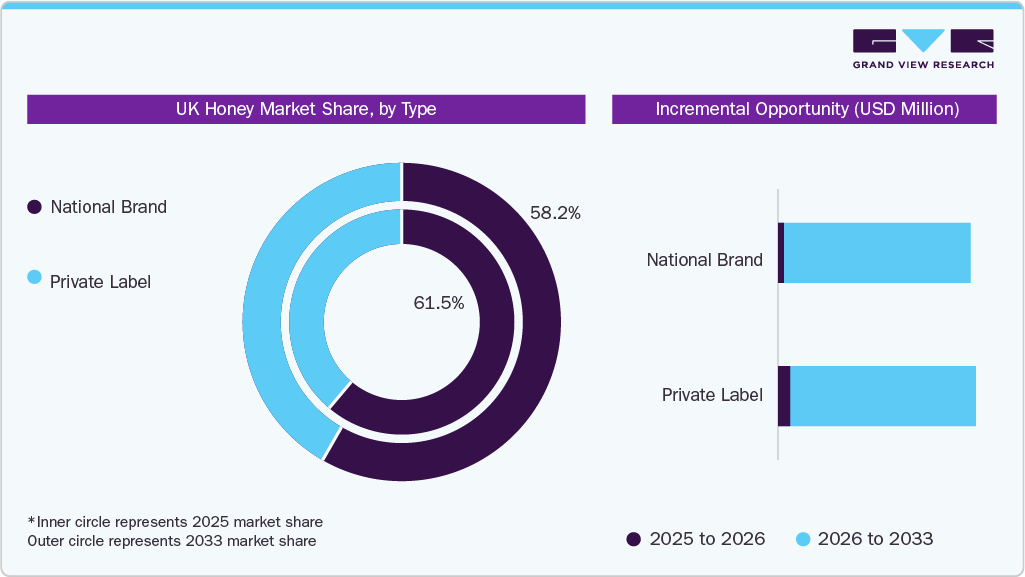
National brands have an advantage over their competitors when it comes to meeting new regulations regarding the purity and authenticity of honey products. According to research by Cranfield University, honey falls under the category of a product with a higher risk of food fraud, making it essential to ensure product traceability. Therefore, customers prefer trusted brand names that guarantee the quality of the product. Finally, there has been an increasing trend among national brands towards developing premium honey products, such as organic and single-origin honey, thereby boosting market growth during the forecast period.
The private label segment is expected to grow at a CAGR of 5.4% from 2026 to 2033. Private label honey products are gaining traction in the UK due to their competitive pricing and improving quality standards. Retailers are increasingly investing in their own brands to offer cost-effective alternatives while maintaining acceptable quality levels, making these products attractive to price-sensitive consumers.
The retailers have responded to the evolving consumer demands by offering an increasing number of private-label brands with organic and sustainable honey varieties. These developments are consistent with the overall trends of sustainability, as there is a rising demand from consumers for food items that are ethically produced and sustainable. As the quality of the products improves further, coupled with their affordable nature, private label honey sales are projected to increase steadily.
Price Range Insights
The mid-range segmentaccounted for the largest share of 70.0% in 2025, driven by its balance between affordability and perceived quality. This segment continues to benefit from widespread availability across supermarkets and private label offerings, making it the preferred choice among mass consumers.

The economy segment is expected to grow at a CAGR of 6.3% from 2026 to 2033 due to increasing consumer demand for affordable honey products amid rising food inflation and cost-conscious purchasing behavior. Budget-friendly honey variants are gaining popularity among households seeking everyday natural sweeteners. Expanding private-label offerings and wider availability of blended honey products are further supporting segment growth across the UK market.
Nature Insights
The conventional honey segment accounted for a revenue share of 87.2% in 2025. This segment continues to dominate the market due to its wide availability, lower price points, and strong presence across supermarkets and private label offerings. Conventional honey is typically the default choice for everyday consumption, particularly among households that prioritize affordability and accessibility.
The organic honey segment is expected to grow at a CAGR of 6.0% from 2026 to 2033, making it the fastest-growing segment within the nature category. Although it accounted for a smaller share of 12.8% in 2025, demand for organic honey is steadily increasing as consumers become more conscious of food quality, environmental impact, and production practices.
Distribution Channel Insights
The sales of honey through supermarkets & hypermarkets accounted for a revenue share of 43.9% in 2025. These retail formats continue to be the primary point of purchase for honey in the UK, mainly due to convenience, product visibility, and competitive pricing. Consumers tend to purchase honey as part of routine grocery shopping, which naturally favors large-format stores. Supermarkets also offer a wide assortment ranging from economy to premium products, including private label and branded honey, allowing consumers to compare options easily.
Established retail chains have strengthened consumer confidence by improving labeling transparency and offering clearer information on origin and ingredients. This has become particularly important considering ongoing concerns around honey authenticity. The Food Standards Agency highlights that accurate labeling and traceability are critical for products such as honey, influencing purchasing decisions at the shelf level. As a result, supermarkets remain the most trusted and accessible channel for everyday honey purchases.

The sales of honey through online retail channels are expected to grow at a CAGR of 5.7% from 2026 to 2033. Online platforms are becoming increasingly important as consumers look for a wider variety of products that are not always available in physical stores. This includes raw, organic, and single-origin honey, as well as products from small-scale and local producers.
The shift toward online purchasing is supported by broader retail trends in the UK. According to the Office for National Statistics, online retail sales have seen sustained growth in recent years, with more consumers turning to digital platforms for food and grocery purchases. Online channels also provide detailed product descriptions, origin information, and customer reviews, which help consumers make more informed decisions, particularly important in a category where authenticity is a concern.
Key UK Honey Company Insights
The UK honey market features a balanced mix of large-scale manufacturers, retailer-led private label brands, and specialized artisanal producers competing across value and premium segments. Established players leverage extensive retail distribution, diversified sourcing networks, and strong pricing competitiveness, while smaller producers focus on premiumization through raw, locally sourced, and traceable honey offerings. The market is increasingly shaped by product differentiation strategies centered on authenticity, sustainability, specialty variants, and packaging innovation. In addition, growing private label penetration across supermarkets and discount retailers is intensifying competition and encouraging continuous innovation in sourcing transparency, product quality, and consumer-focused branding strategies.

Key UK Honey Companies:
-
Rowse Honey Ltd
-
Hilltop Honey Ltd
-
Littleover Honey
-
Honeyfields Bee Farm
-
Real Raw Honey
-
Wilson’s Honey
-
Egmont Honey
-
Pasieka u Kazia
-
The London Honey Company
-
Scott’s Honey
-
Tesco Finest (Private Label)
-
Sainsbury's Supermarkets Ltd. (Private Label)
-
Essential Waitrose & Partners (Private Label)
-
ASDA (Private Label)
-
Aldi (Private Label)
-
Lidl (Private Label)
-
Morrisons (Private Label)
-
Co-op Honey (Private Label)
-
Marks & Spencer Honey (Private Label)
-
Holland & Barrett (Private Label)
-
B&M Stores (Private Label) - Three Bears Honey
Recent Developments
-
In April 2026, Hilltop Honey expanded its product portfolio with the launch of Organic Wildflower Honey and a premium Gold Edition range across major UK retailers, including Asda and Tesco. The new products feature enhanced traceability through QR codes and unique tracking numbers, allowing consumers to verify sourcing and origin, reflecting growing demand for transparency and premium-quality honey products.
-
In November 2025, The Groovy Food Company introduced a new Hot Honey product as part of its expanded syrup and sweetener range in the UK. The launch forms part of a broader strategy to innovate within natural sweeteners and cater to evolving consumer taste preferences.
-
In February 2025, The Scottish Bee Company unveiled a refreshed brand identity as part of its strategy to expand its product portfolio and strengthen its position in the market, with a focus on sustainability and supporting bee populations.
-
In January 2026, MONIN launched a Hot Honey syrup in the UK, targeting bars, cafés, and restaurants. The product was developed to support menu innovation in beverages and reflects increasing demand for honey-based flavor profiles in the hospitality sector.
UK Honey Market Report Scope
Report Attribute
Details
Market size value in 2025
USD 420.5 million
Market size value in 2026
USD 427.3 million
Revenue forecast in 2033
USD 575.6 million
Growth rate (revenue)
CAGR of 4.3% from 2026 to 2033
Actuals
2021 - 2025
Forecast period
2026 - 2033
Quantitative units
Volume in metric tons; revenue in USD million, CAGR from 2026 to 2033
Report coverage
Volume & revenue forecast, company ranking, competitive landscape, growth factors, and trends
Segments covered
Type, price range, distribution channel, nature
Key companies profiled
Rowse Honey Ltd.; Hilltop Honey Ltd.; Littleover Honey; Honeyfields Bee Farm; Real Raw Honey; Wilson’s Honey; Egmont Honey; Pasieka u Kazia; The London Honey Company; Scott’s Honey; Tesco Finest (Private Label); Sainsbury's Supermarkets Ltd. (Private Label); Essential Waitrose & Partners (Private Label); ASDA (Private Label); Aldi (Private Label); Lidl (Private Label); Morrisons (Private Label); Co-op Honey (Private Label); Marks & Spencer Honey (Private Label); Holland & Barrett (Private Label); B&M Stores (Private Label) - Three Bears Honey
Customization scope
Free report customization (equivalent up to 8 analysts working days) with purchase. Addition or alteration to country, regional & segment scope.
Pricing and purchase options
Avail customized purchase options to meet your exact research needs. Explore purchase options
UK Honey Market Report Segmentation
This report forecasts volume & revenue growth at the country level and presents an assessment of key industry trends and growth opportunities across major segments from 2021 to 2033. For this study, Grand View Research has segmented the UK honey market based on price range, distribution channel, type, and nature:
-
Type Outlook (Volume, Metric Tons; Revenue, USD Million, 2021 - 2033)
-
Natural Brand
-
Private Label
-
-
Price Range Outlook (Volume, Metric Tons; Revenue, USD Million, 2021 - 2033)
-
Economy (Less than 5 USD/unit)
-
Mid-Range (6-15 USD/unit)
-
Premium (More than 15 USD/unit)
-
-
Distribution Channel Outlook (Volume, Metric Tons; Revenue, USD Million, 2021 - 2033)
-
Hypermarkets & Supermarkets
-
Convenience Stores
-
Online
-
Others
-
-
Nature Outlook (Volume, Metric Tons; Revenue, USD Million, 2021 - 2033)
-
Organic
-
Conventional
-
Delivered Customizations
This report has been delivered with the following In-depth customizations
Client Request
Customization Delivered
Value Adds
Organic Honey Market Penetration
Assessment of organic honey demand trends across retail, online, and specialty channels in the UK. Analysis of consumer preference for clean-label, chemical-free, and sustainably sourced honey products. Evaluation of pricing trends, certification landscape, competitive positioning, and growth potential of organic honey brands.
Identify high-growth organic honey segments and premium pricing opportunities. Support product positioning, certification strategy, and channel expansion. Enable targeted investment decisions through demand benchmarking and consumer trend analysis.
Brand Share Analysis
Delivered brand share analysis for the UK honey market includes detailed benchmarking of leading branded, private-label, and organic honey producers. It assesses market positioning, competitive intensity, retail penetration, and brand-wise revenue contribution across key distribution channels and product categories in the UK market landscape.
Provides deeper insights into competitive structure, identifies dominant and emerging players, highlights private-label growth, and supports strategic decisions on branding, market entry, and partnership opportunities within the UK honey industry.
Pricing Trend Analysis
Delivered pricing trend analysis for the UK honey market, evaluating historical and current price movements across raw, processed, organic, and flavored honey variants. It examines price variations across product types, pack sizes, and quality tiers, supported by retail benchmarking and weighted average price assessment.
Enables understanding of inflation impact, premiumization trends, and consumer price sensitivity, while supporting pricing strategy development, margin optimization, and competitive pricing positioning across UK honey product segments.
About the authors:
Author: GVR Consumer F&B Research Team | Last Updated:


Share this report with your colleague or friend.
Need a Tailored Report?
Customize this report to your needs — add regions, segments, or data points, with 20% free customization.


ISO 9001:2015 & 27001:2022 Certified
We are GDPR and CCPA compliant! Your transaction & personal information is safe and secure. For more details, please read our privacy policy.












