UK Lab Grown Stones Market Summary
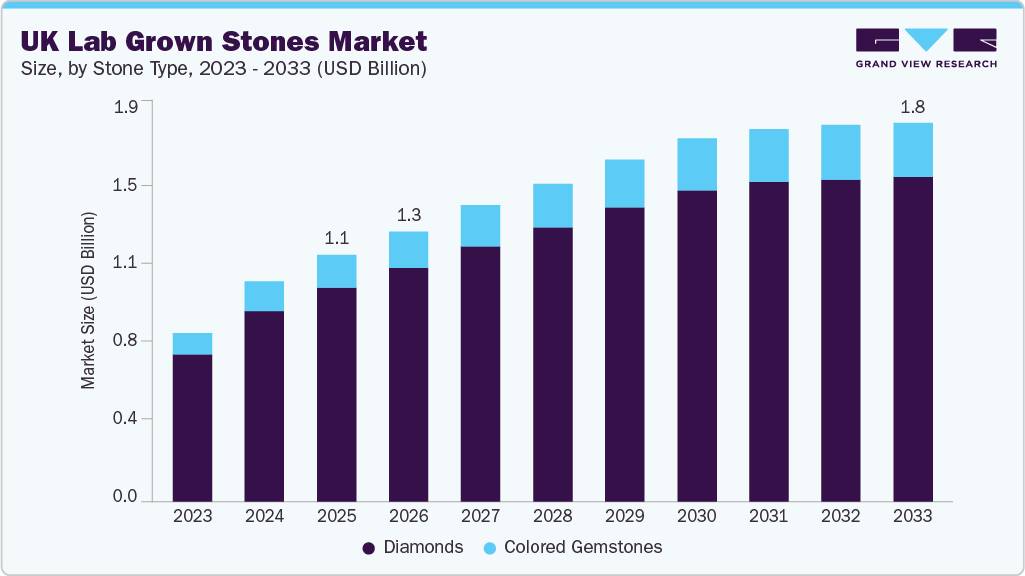
The UK lab grown stones market size was estimated at USD 1.14 billion in 2025 and is projected to reach USD 1.76 billion by 2033, growing at a CAGR of 5.0% from 2026 to 2033. The market is experiencing robust growth, primarily due to rising consumer preferences for ethically sourced and environmentally sustainable gemstones, the increasing acceptance of lab-grown diamonds in the bridal and fine jewelry segments, technological advancements that have narrowed the visual and chemical differences between mined and lab-grown stones, and competitive pricing that appeals to both retailers and end-consumers.
Key Market Trends & Insights
- By end use, the jewelry segment accounted for the largest revenue share of over 87.0% in 2025.
- By stone type, the diamonds segment accounted for the largest revenue share of over 86.0% in 2025.
- By production method, the chemical vapor deposition segment is anticipated to register the fastest CAGR of 5.7% from 2026 to 2033.
Market Size & Forecast
- 2025 Market Size: USD 1.14 Billion
- 2033 Projected Market Size: USD 1.76 Billion
- CAGR (2026-2033): 5.0%
The growth of the UK lab grown stones industry is driven primarily by the increasing emphasis of consumers on sustainability and ethical sourcing. Unlike mined diamonds, which are often associated with high carbon emissions, environmental degradation, and complex traceability issues, lab-grown stones offer a transparent and eco-friendly alternative. With drastically lower mining impact, reduced water consumption, and the use of renewable energy in advanced production facilities, lab-grown stones are becoming the preferred choice among environmentally conscious buyers, brands, and retailers. Jewelry houses across the UK are actively promoting sustainability credentials in their product portfolios, further accelerating mainstream adoption.
Consumer preference is also shifting rapidly in favour of lab-grown diamonds due to their affordability, visual brilliance, and identical physical and chemical composition compared to natural stones. Millennials and Gen-Z demographics, who prioritise value, modern aesthetics, and clear product traceability, are driving strong demand within the bridal and personalised jewelry category. Retailers are increasingly showcasing lab-grown stones alongside mined diamonds, giving customers broader flexibility in terms of size, clarity, and customisation without compromising quality. This growing acceptance, driven by digital-first jewelry platforms, increased marketing transparency, and shifting perceptions of luxury, continues to bolster the overall preference for lab-grown stones in the UK market.
Drivers, Opportunities & Restraints
The growth of the UK lab grown stones market is largely driven by the rising consumer demand for ethical, environmentally friendly, and affordable alternatives to mined stones. Lab-grown diamonds offer significantly lower environmental impact, reduced carbon emissions, minimal water usage, and avoid the ethical issues often associated with mining. Moreover, their relative affordability compared to natural diamonds, while delivering almost identical visual and physical characteristics, makes them highly attractive to value-conscious buyers and younger demographics seeking budget-savvy luxury.
There is a substantial opportunity for growth in the UK market as technological advancements and evolving consumer attitudes open the door for broader adoption. Improvements in modern production methods are reducing costs and increasing scalability, enabling a wider selection of customized finishes across cut, size, color, and clarity to suit diverse design preferences. Additionally, as sustainability becomes a mainstream consideration, particularly among younger consumers, lab-grown stones are gaining traction across both jewelry categories and emerging non-jewelry applications, supporting further expansion beyond traditional retail.
Despite the advantages, the lab-grown diamond sector faces notable restraints, the most significant being overproduction and the resulting price erosion that has begun to undermine value perception among retailers and consumers. For instance, in October 2025, industry leaders publicly highlighted that wholesale lab-grown diamond prices had fallen sharply due to oversupply, raising concerns about long-term price stability and consumer confidence. Additionally, pockets of buyers still favour mined diamonds due to traditional sentiment, perceived status, and better resale value, which continues to limit full-scale market penetration for lab-grown stones in the UK.
Stone Type Insights
Diamonds held a dominant share of the UK lab grown stones industry in 2025, driven largely by their extensive use in bridal jewelry, fine jewelry, and premium fashion collections. The rise of younger, sustainability-focused consumers has accelerated the shift toward lab-grown diamonds, driven by their ethical production, carbon-efficient footprint, and cost advantage compared to mined stones. Retail participation has also played a crucial role in maintaining dominance, with both brick-and-mortar jewelry chains and online platforms increasingly positioning lab-grown diamonds as a mainstream luxury option, offering high purity, brilliance, and customization options at affordable pricing.
Colored gemstones, including lab-grown emeralds, rubies, and sapphires, represent a growing secondary segment driven by demand for distinctive and personalized jewelry pieces. Their rising appeal among Gen-Z consumers and trend-driven buyers has encouraged jewelry brands to expand catalogue offerings, incorporating vivid hues and unconventional center stones. Although colored gemstones currently account for a smaller market share than diamonds, they are expected to gain traction as fashion-forward product launches, celebrity-influenced styling, and social media-led aesthetics continue to shape contemporary jewelry purchases in the UK.
Production Method Insights
Chemical vapor deposition (CVD) dominates the production method landscape due to its ability to generate high-clarity, high-purity stones suitable for premium jewelry applications. The technique offers superior control over crystal growth, enabling manufacturers to produce large, uniform diamonds with fewer internal defects and improved light performance. The scalability and efficiency of CVD technology have also contributed to its leadership position, as large-scale producers in both domestic and global supply chains continue to adopt it to meet rising demand for high-quality, aesthetically consistent stones across the UK retail industry.
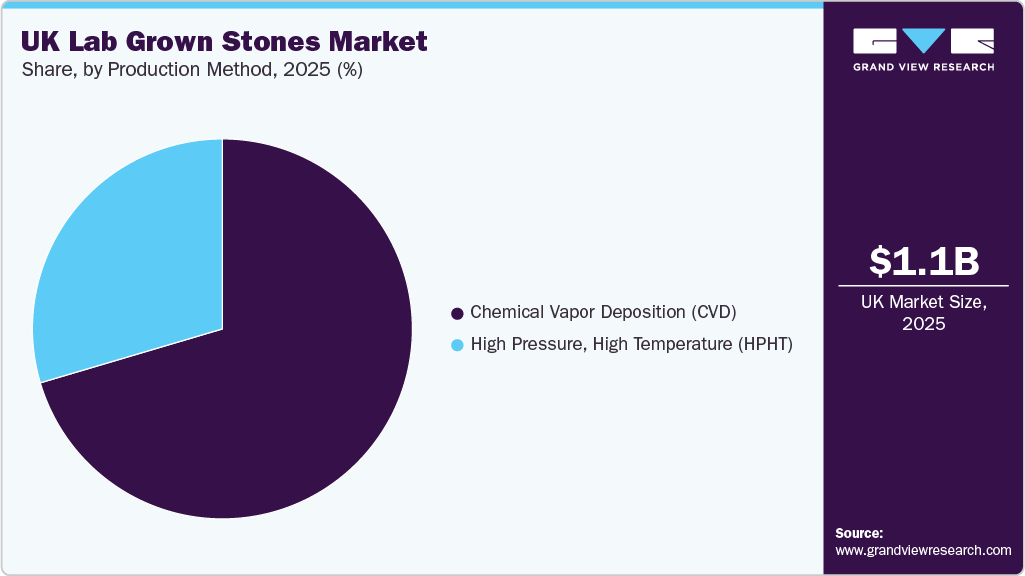
High pressure, high temperature (HPHT) technology remains a significant contributor to the UK lab-grown stone market, particularly for industrial-grade stones, smaller jewelry stones, and colored diamonds. Its ability to enhance hardness and durability makes HPHT-grown stones well-suited for precision tools, machinery components, and cutting applications. At the same time, its use in colour enhancement further supports the growing market for coloured gemstones. Although its share in the jewelry segment is smaller than CVD, HPHT retains relevance due to its cost-effectiveness and the ability to serve diverse product categories across both ornamental and industrial applications.
End Use Insights
By end use, the jewelry segment accounted for the largest revenue share of over 87.0% in 2025. Jewellery remains the leading end-use segment in the UK lab-grown stones market, driven by strong demand across engagement rings, wedding bands, luxury gifting, and personalized jewellery. Consumers are increasingly drawn to lab-grown stones because they offer the same brilliance and durability as mined stones at a significantly lower cost, aligning with ethical and sustainable purchasing values. Retailers, both online and offline, are expanding their lab-grown collections, and bespoke jewelers are leveraging the wide availability of cuts, colors, and clarity grades to offer highly customized designs.
Industrial applications are gaining momentum as lab-grown diamonds exhibit exceptional hardness, thermal conductivity, and precision performance, making them increasingly suitable for sectors such as cutting and drilling tools, thermal management systems, semiconductors, optics, and advanced electronics. Although still a smaller segment in terms of revenue contribution, demand from industries is expected to grow as manufacturing technologies advance and the need for reliable and high-performance materials intensifies. The expansion of research in electronics and quantum computing is also projected to open new avenues for the utilization of lab-grown diamonds in the coming years.
Key Companies & Market Share Insights
Some of the key players operating in the market include Novita Diamonds, Skydiamond, and others
-
Novita Diamonds is a UK-based lab-grown diamond specialist, formally incorporated in 2021. The company supplies a large inventory of certified lab-grown diamonds and focuses heavily on the ethical luxury segment, offering stones that match the optical and chemical properties of natural diamonds while remaining more affordable. Its product line spans engagement rings, wedding bands, studs, necklaces, and fashion jewelry, all built around lab-grown stones, targeting consumers keen on ethically sourced and cost-effective diamonds.
-
Skydiamond is a UK lab-grown diamond producer that publicly launched a jewelry collection in 2021. The company is unique in claiming a fully carbon-negative diamond creation process. Its “Sky Lab” in Gloucestershire utilizes atmospheric CO₂, rainwater hydrogen, and renewable energy to grow diamonds, offering one of the most sustainable production models in the industry.
-
Quality Diamonds (UK) is a privately held jewelry supplier, incorporated in 2006. The company specializes in retail and mail-order sales of diamonds, offering a broad catalogue that includes lab-grown diamonds alongside traditional ones, catering to bespoke jewelry customers as well as retail buyers. Through its online platform and physical operations, Quality Diamonds offers customers a range of cuts, clarity levels, and carat weights, providing access to certified stones at competitive prices. Its business model emphasizes transparency, affordability, and customization, helping to widen the reach of lab-grown diamonds among mainstream UK consumers.
Key UK Lab Grown Stones Companies:
- Grown Diamond Corporation
- Diamonds Factory
- Finegrown Diamonds
- Madestones
- Novita Diamonds
- Quality Diamonds
- Queensmith
- Serendipity Diamonds
- Skydiamond
- Stone Lab Diamonds
Recent Developments
-
Novita Diamonds announced in March 2025 the launch of a new line of custom lab-grown diamond engagement rings targeting the UK bridal market. The initiative expands Novita’s sustainable luxury portfolio, offering fully certified CVD and HPHT stones with enhanced clarity and cut options, while promoting ethical sourcing and reduced environmental impact. The launch also includes an online customization platform, enabling consumers to design personalized jewelry pieces with full transparency on stone origin and certification.
-
Skydiamond revealed in June 2025 the opening of its expanded Sky Lab facility in Gloucestershire, increasing in-house production capacity by 40%. The development supports the company’s mission to create carbon-negative lab-grown diamonds at scale, using atmospheric carbon and renewable energy. The expanded facility enables the handling of larger stones and offers improved colour and clarity ranges, thereby strengthening Skydiamond’s position in the UK fine jewelry market while maintaining its sustainability-first approach.
-
Quality Diamonds (UK) announced in September 2025 a strategic partnership with a leading UK jewelry retailer to supply lab-grown diamonds for an exclusive bridal collection. The partnership aims to increase accessibility to certified lab-grown stones while highlighting the importance of ethical sourcing and affordability. The initiative also features a customer education campaign on the environmental and social benefits of lab-grown diamonds, positioning Quality Diamonds as a trusted supplier in the mainstream UK jewelry segment.
UK Lab Grown Stones Market Report Scope
|
Report Attribute
|
Details
|
|
Market definition
|
The market includes the total revenue generated from the sale of lab-grown stones within the United Kingdom.
|
|
Market size value in 2026
|
USD 1.25 billion
|
|
Revenue forecast in 2033
|
USD 1.76 billion
|
|
Growth rate
|
CAGR of 5.0% from 2026 to 2033
|
|
Base year for estimation
|
2025
|
|
Historical data
|
2021 - 2024
|
|
Forecast period
|
2026 - 2033
|
|
Quantitative units
|
Revenue in USD million/billion and CAGR from 2026 to 2033
|
|
Report coverage
|
Revenue forecast, competitive landscape, growth factors, and trends
|
|
Segments covered
|
Stone type, production method, end use
|
|
Country scope
|
UK
|
|
Key companies profiled
|
Grown Diamond Corporation; Diamonds Factory; Finegrown Diamonds; Madestones; Novita Diamonds; Quality Diamonds (UK); Queensmith (Grown by Queensmith); Serendipity Diamonds; Skydiamond; Stone Lab Diamonds
|
|
Customization scope
|
Free report customization (equivalent up to 8 analysts working days) with purchase. Addition or alteration to country, regional & segment scope.
|
|
Pricing and purchase options
|
Avail customized purchase options to meet your exact research needs. Explore purchase options
|
UK Lab Grown Stones Market Report Segmentation
This report forecasts country revenue growth and analyzes the latest trends in each sub-segment from 2021 to 2033. For this study, Grand View Research has segmented the UK lab grown stones market report based on stone type, production method, and end use:
-
Stone Type Outlook (Revenue, USD Billion, 2021 - 2033)
-
Diamonds
-
Colored Gemstones
-
Production Method Outlook (Revenue, USD Billion, 2021 - 2033)
-
End Use Outlook (Revenue, USD Billion, 2021 - 2033)
Frequently Asked Questions About This Report
b. The UK lab grown stones market size was estimated at USD 1.14 billion in 2025 and is expected to reach USD 1.25 billion in 2026.
b. The UK lab grown stones market is expected to grow at a compound annual growth rate of 5.0% from 2026 to 2033 to reach USD 1.76 billion by 2033.
b. By stone type, diamonds accounted for the largest market revenue share of over 86.0% in 2025.
b. Some of the key players of the UK lab-grown stones market are Grown Diamond Corporation, Diamonds Factory, Finegrown Diamonds, Madestones, Novita Diamonds, Quality Diamonds (UK), Queensmith, Serendipity Diamonds, Skydiamond, Stone Lab Diamonds, and others.
b. The key factor driving the growth of the UK lab-grown stones market is the rising consumer preference for ethical, sustainable, and affordable alternatives to mined diamonds. Lab-grown stones offer comparable visual and physical properties to natural diamonds while significantly reducing environmental impact, avoiding conflict-related concerns, and providing cost-effective options for value-conscious and younger consumers

 Download Sample Report
















