
- Home
- »
- Advanced Interior Materials
- »
-
Ultrasonic Cutter Market Size And Share Report, 2026-2033GVR Report cover

Ultrasonic Cutter Market (2026 - 2033)
Size, Share & Trends Analysis Report By Frequency (20 - 24 kHz, 25 - 29 kHz, 30 - 34 kHz, 35 - 40 kHz), By Application (Food Processing, Textiles & Nonwovens, Rubber & Elastomers, Plastics, Composites), By Region, And Segment Forecasts
Market Size, 2025
$1.3BMarket Estimate, 2026
$1.4BMarket Forecast, 2033
$2.3BCAGR, 2026–2033
7.5%Ultrasonic Cutter Market Summary
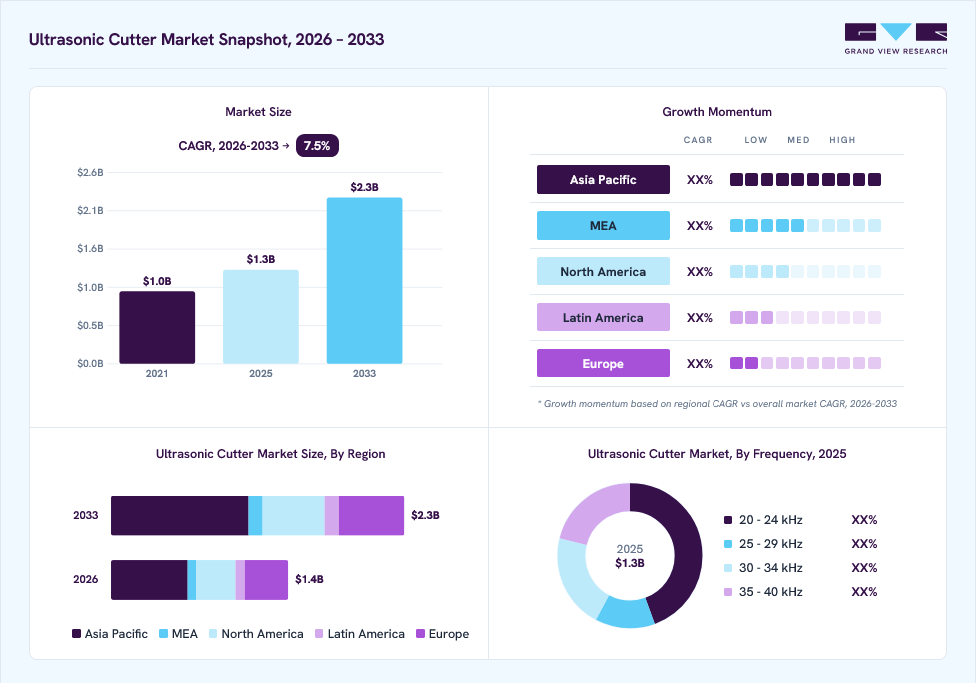
The global ultrasonic cutter market size was valued at USD 1.3 billion in 2025 and is projected to grow from USD 1.4 billion in 2026 to USD 2.3 billion by 2033, at a CAGR of 7.5% from 2026 to 2033. Asia Pacific dominated the market, accounting for a revenue share of 42.7% in 2025. The global ultrasonic cutter market is driven by increasing demand for precise and efficient cutting across food processing, textiles, automotive, plastics, and composites.
 Source: Grand View Research, IR Documents, Primary Interviews, Paid DatabasesTo learn more about this report,
 Download Free Sample Report
Key Market Trends & Insights
- By frequency: 20-24 kHz segment accounted for the largest revenue share of 44.4% in 2025.
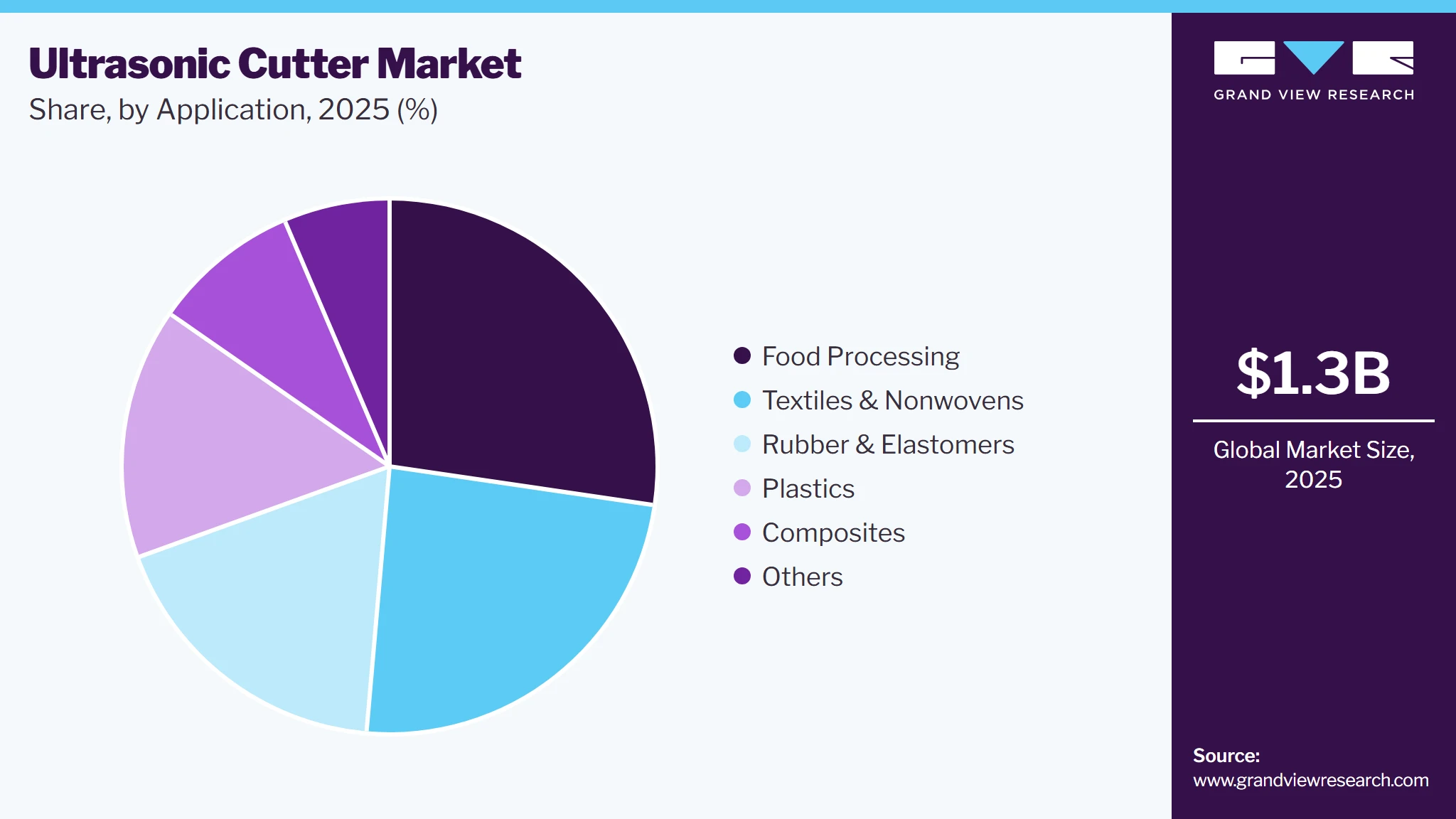
- By application: Food processing segment dominated the market in 2025, holding 27.3% market share.
Regional Highlights
- Largest regional market: Asia Pacific (42.7% revenue share, 2025)
- By country: China held the largest market share in 2025.
Market Size & Forecast
- Market Size in 2025: USD 1.3 Billion
- Estimated market size in 2026: USD 1.4 Billion
- Projected Market Size by 2033: USD 2.3 Billion
- CAGR (2026-2033): 7.5%
GVR research-powered AIAsk Prism AI about the ultrasonic cutter marketGet cited answers from GVR research on market growth, segments, regulations and forecasts.Start with✓ Source-linked answers ✓ Market-specific context ✓ Traceable figuresExplore Prism AI ↗
High-frequency blade vibrations enable clean cuts with lower material deformation, product adhesion, and edge damage than conventional methods, making the technology suitable for delicate, multilayered, and thermoplastic materials. In food processing, ultrasonic cutting improves portioning accuracy while reducing product waste, whereas textile applications benefit from simultaneous cutting and edge sealing.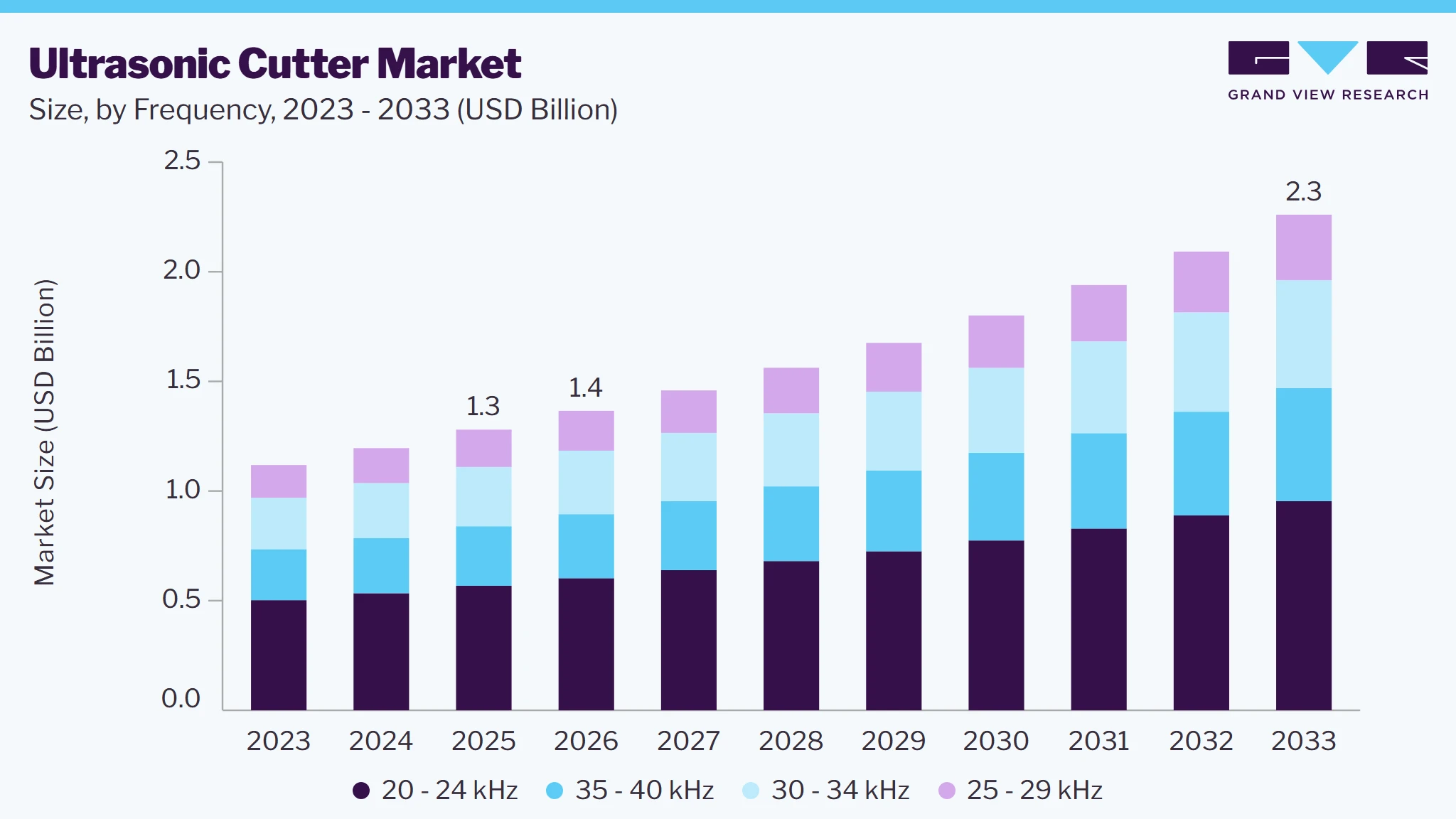 To learn more about this report, Download Free Sample Report
In addition, integration with automated production lines, robotic systems, and computer-controlled equipment is increasing the use of ultrasonic cutters in high-volume manufacturing. These systems provide consistent cutting quality, shorter processing cycles, lower tool wear, and reduced operator intervention. Their capability to process technical textiles, nonwovens, films, composites, rubber, and specialized food products is broadening industrial applications, while customized tooling facilitates integration into existing production systems.
Market Dynamics
The global ultrasonic cutter market is shaped by evolving manufacturing requirements, technological advancements, and the increasing need to optimize cutting operations across diverse industrial processes. Market development is influenced by production complexity, equipment investment requirements, material compatibility, and the transition toward more controlled and efficient processing methods. The competitive environment is also affected by application-specific requirements, as manufacturers seek cutting solutions that can meet tighter quality specifications while fitting existing production workflows.
The global ultrasonic cutter market is driven by increasing demand for high-precision cutting across food processing, textiles, automotive, plastics, and composites. High-frequency blade vibrations enable clean cuts with lower material deformation, product adhesion, and edge damage than conventional methods. Increasing requirements for consistent product quality, accurate portioning, and reduced material loss are encouraging manufacturers to adopt ultrasonic cutting systems, particularly where conventional cutting can compromise product integrity or processing efficiency.
High initial equipment costs and the technical requirements associated with ultrasonic generators, transducers, specialized blades, and tooling can constrain adoption, particularly among small and medium-sized manufacturers. Integration with existing production lines may require application-specific engineering, process trials, and operator expertise, increasing implementation complexity. Maintenance and replacement of specialized components can also raise lifecycle costs where equipment is operated under demanding production conditions.
Growing use of composites, technical textiles, nonwovens, films, and engineered plastics is creating opportunities for ultrasonic cutters in applications requiring controlled cutting and high edge quality. Emerging applications in medical products, electronics, and lightweight components can further expand the addressable market as manufacturers process increasingly specialized materials. Development of compact systems and application-specific tooling can facilitate adoption in production environments requiring flexible cutting configurations.
Market Concentration & Characteristics
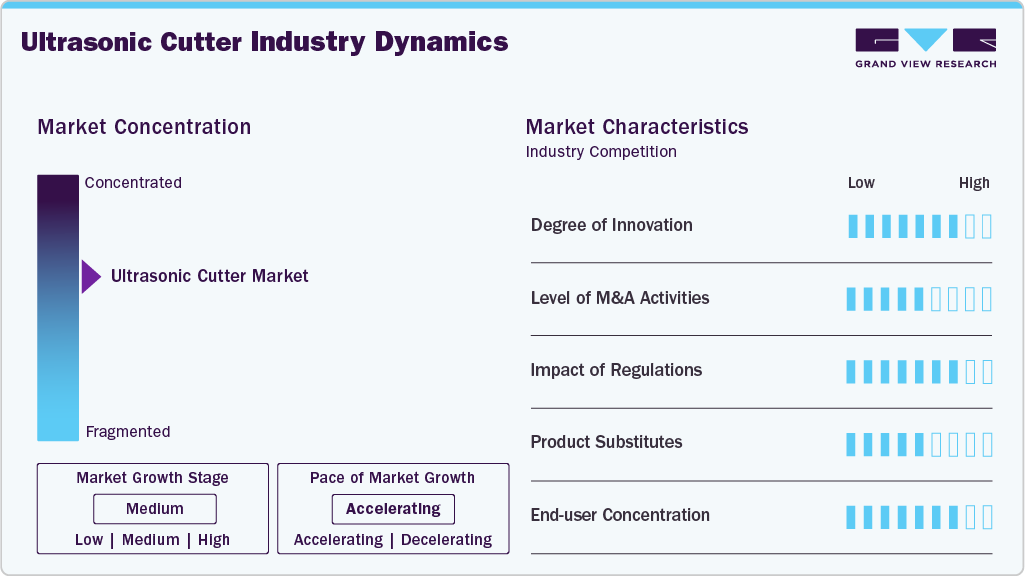
The global ultrasonic cutter market exhibits a fragmented competitive structure, with competition influenced by engineering expertise, product reliability, manufacturing capabilities, technical support, and service reach. Suppliers seek differentiation through equipment performance, customization, and after-sales assistance, while specialized manufacturers compete in application-focused niches. Customer relationships, demonstration capabilities, and the ability to meet project-specific specifications also influence supplier selection, particularly for industrial users integrating ultrasonic systems into established production processes.
Technology differentiation is centered on transducer efficiency, generator control, operating frequency, vibration stability, blade design, and tooling configuration. Product development increasingly focuses on precise energy delivery and stable operating parameters to accommodate varying material characteristics and cutting conditions. Integration with programmable controls, sensors, automated handling, and robotic equipment is also shaping product development, particularly where manufacturers require repeatable output and limited manual intervention.
 To learn more about this report, Download Free Sample Report
Demand characteristics vary substantially by end use and production scale. Food processors place emphasis on hygienic operation, portion consistency, and minimal product deformation, whereas industrial users prioritize cutting accuracy, edge quality, throughput, and compatibility with engineered materials. Purchasing decisions are commonly shaped by production volume, material properties, required tolerances, tooling configuration, maintenance requirements, and integration with existing equipment. This creates demand for both standardized machines and customized systems tailored to individual production environments.
Analyst Perspective
The global ultrasonic cutter market is positioned for steady expansion as manufacturers place greater emphasis on precision processing, material utilization, and production consistency. Adoption is likely to remain strongest where ultrasonic technology offers measurable advantages over conventional cutting, particularly for delicate, multilayered, sticky, or engineered materials. Market development will depend on suppliers' ability to demonstrate productivity and quality benefits while addressing equipment costs and integration requirements. Continued advances in application-specific systems and tooling are likely to broaden adoption across specialized manufacturing segments.
Frequency Insights
Based on frequency, the 20-24 kHz segment accounted for the largest revenue share of 44.4% in the global ultrasonic cutter market in 2025. Its position reflects broad adoption in applications requiring higher cutting force and greater penetration, particularly for rubber, composites, thermoplastics, and other relatively demanding materials. Lower-frequency systems generally provide higher vibration amplitude, making them suitable for heavy-duty processing where robust cutting performance and stable material separation are important.
The 35-40 kHz segment is projected to register the fastest CAGR during the forecast period, reflecting its growing relevance in applications that prioritize finer cutting and controlled material interaction. Higher-frequency systems generally operate at lower amplitudes and are therefore suited to thinner materials, textiles, nonwovens, films, and other applications requiring cleaner edges and limited deformation. Increasing availability of 35 kHz equipment for textile processing and automated cutting applications is further broadening the segment's use across specialized manufacturing processes.
Application Insights
The food processing segment accounted for the largest revenue share of 27.3% in 2025. Its dominant position is associated with the technology's ability to handle sticky, fragile, frozen, and multilayered food products while maintaining portion consistency and minimizing crumbling, smearing, and product waste. The established use of ultrasonic cutting across bakery, confectionery, dairy, meat, and prepared-food applications continues to reinforce demand from industrial food manufacturers seeking reliable high-throughput processing solutions.
 To learn more about this report, Download Free Sample Report
The composites segment is projected to register the fastest CAGR of 8.9% during the forecast period. Growing use of composite materials across lightweight structures and engineered components is creating demand for cutting technologies capable of maintaining dimensional accuracy while limiting edge damage and delamination. Ultrasonic cutting is increasingly relevant for processing reinforced and layered materials where conventional mechanical methods can generate excessive forces or secondary finishing requirements, supporting broader adoption in advanced manufacturing applications.
Regional Insights
North America represents a mature market for ultrasonic cutters, supported by established food processing, automotive, aerospace, medical device, and advanced manufacturing industries. Demand is increasingly linked to precision-oriented production, automation, and the processing of composites, technical materials, and engineered plastics. Manufacturers across the region are adopting advanced cutting equipment to improve dimensional consistency, reduce material losses, and integrate cutting operations with automated production lines.
U.S. Ultrasonic Cutter Market Trends
The U.S. ultrasonic cutter market benefits from the country's extensive manufacturing base and strong adoption of automated production technologies. Food processing remains an important application area, while aerospace, automotive, electronics, and medical device manufacturing create demand for equipment capable of handling specialized materials with tight cutting tolerances. The presence of advanced manufacturing facilities and continued investment in production automation is encouraging the deployment of digitally controlled and application-specific ultrasonic cutting systems.
Mexico is emerging as an attractive market within North America as manufacturing activity expands across automotive, electronics, food processing, packaging, and consumer goods. The country's integration into regional manufacturing supply chains is increasing demand for modern production equipment capable of delivering consistent quality and higher processing efficiency. Growth in nearshoring-related industrial investment is creating opportunities for ultrasonic cutters, particularly where manufacturers require precise processing of plastics, textiles, composites, and lightweight components.
Europe Ultrasonic Cutter Market Trends
Europe maintains a strong position in the ultrasonic cutter market owing to its advanced manufacturing ecosystem, stringent quality requirements, and high penetration of industrial automation. Demand is distributed across food processing, automotive, aerospace, textiles, electronics, and engineered-material applications. Manufacturers are placing greater emphasis on resource-efficient production and reduced material waste, favoring cutting technologies that provide controlled processing and consistent output. The region's focus on high-value manufacturing is also encouraging development of customized and application-specific ultrasonic systems.
Germany represents one of the prominent European markets, supported by its strong machinery, automotive, aerospace, electronics, and industrial manufacturing sectors. The country's emphasis on precision engineering and automated production creates demand for ultrasonic cutters capable of processing composites, plastics, technical textiles, and other specialized materials. Increasing integration of robotics and digitally controlled equipment into manufacturing facilities is also creating opportunities for ultrasonic cutting systems that can operate within automated production environments.
The UK ultrasonic cutter market is characterized by demand from food manufacturing, aerospace, automotive, medical technology, textiles, and specialized engineering applications. Manufacturers are increasingly focusing on flexible production systems capable of handling diverse materials and shorter production runs. Adoption is also being encouraged by the need to improve cutting accuracy, reduce processing waste, and maintain consistent product specifications across high-value manufacturing operations.
Asia Pacific Ultrasonic Cutter Market Trends
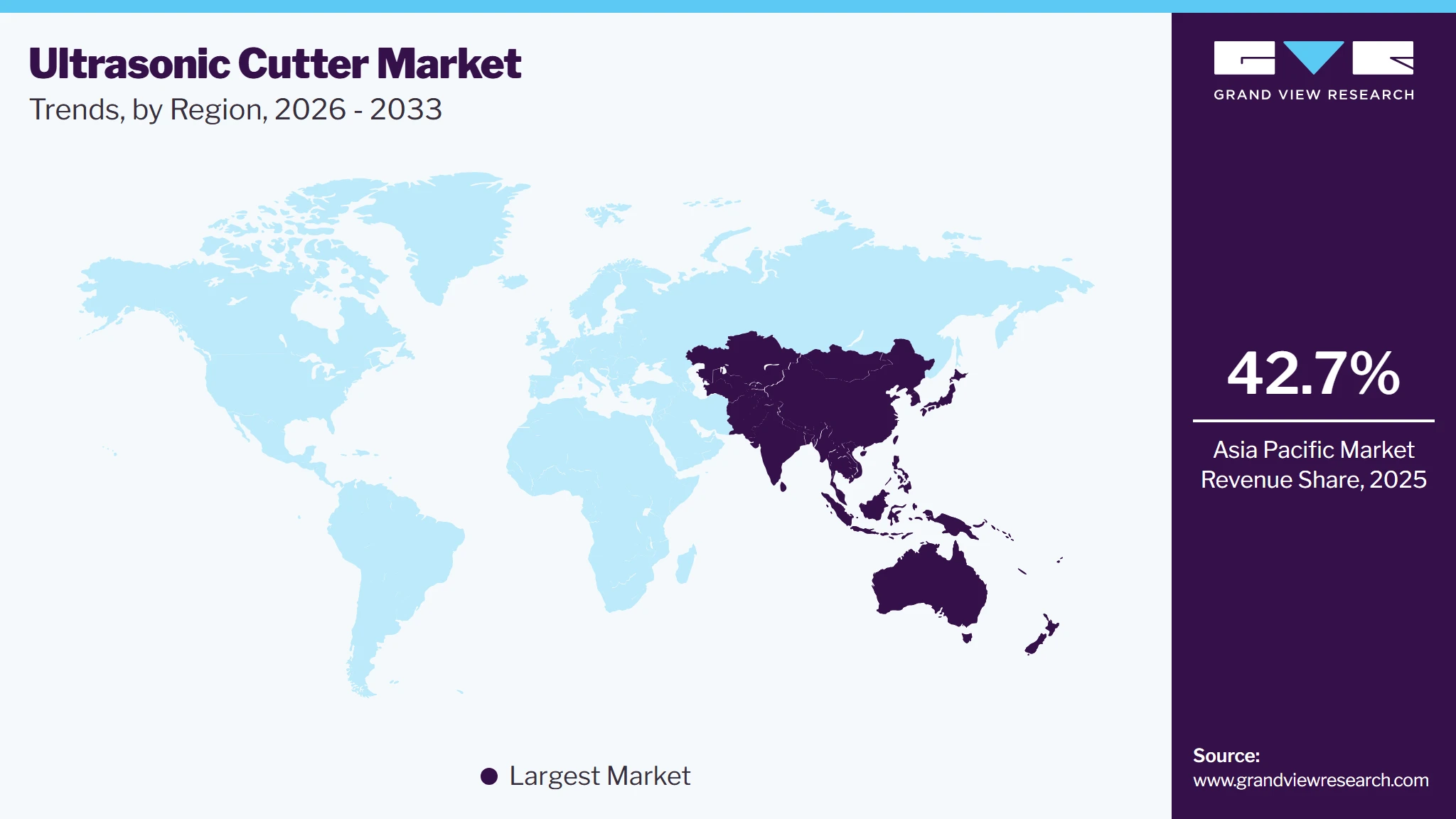
Asia Pacific dominated the market, accounting for a revenue share of 42.7% in 2025. Asia Pacific is positioned as a high-growth market for ultrasonic cutters, driven by expanding manufacturing capacity, industrial automation, and increasing production of electronics, automotive components, food products, textiles, and engineered materials. The region's large manufacturing base provides a broad application landscape, while investments in modern production facilities are increasing demand for automated and precision-based cutting technologies.
 To learn more about this report, Download Free Sample Report
China represents a significant market within Asia Pacific, supported by its extensive industrial base spanning electronics, automotive, food processing, textiles, plastics, and machinery manufacturing. The increasing sophistication of domestic production and expansion of automated manufacturing facilities are creating demand for ultrasonic cutters with higher accuracy and repeatability. Greater use of composites, technical textiles, and engineered plastics is further expanding application potential across industrial processing.
India's ultrasonic cutter market is developing alongside the country's expanding food processing, automotive, textile, packaging, electronics, and manufacturing sectors. Increasing investment in modern production infrastructure is creating demand for equipment that can improve processing consistency while reducing material losses. The gradual shift toward automated manufacturing and higher-value production is also opening opportunities for ultrasonic cutting technologies in applications involving specialized materials and precision components.
Middle East & Africa Ultrasonic Cutter Market Trends
The Middle East and Africa ultrasonic cutter market remains comparatively developing but offers opportunities through industrial diversification, food manufacturing expansion, packaging production, and investment in modern manufacturing infrastructure. Adoption is gradually shifting from conventional processing toward automated and technology-intensive equipment as manufacturers seek greater productivity and product consistency. Demand is expected to remain concentrated in applications where ultrasonic cutting can provide clear operational benefits, particularly food processing and specialized industrial manufacturing.
Saudi Arabia is emerging as an important market within the Middle East as industrial diversification and manufacturing development create demand for advanced production technologies. Expansion of food processing, packaging, plastics, consumer goods, and other non-oil manufacturing activities is broadening the potential application base for ultrasonic cutters. Investment in modern industrial facilities and automation is likely to encourage adoption of precision cutting equipment as manufacturers seek to improve production efficiency and align operations with increasingly sophisticated manufacturing standards.
Latin America Ultrasonic Cutter Market Trends
Latin America presents an emerging opportunity for ultrasonic cutter manufacturers, with demand concentrated in food processing, textiles, packaging, plastics, automotive components, and general manufacturing. Industrial modernization and investments in production efficiency are encouraging manufacturers to evaluate advanced cutting technologies for applications where conventional methods generate higher waste or inconsistent finishing. Expansion of food and consumer-goods manufacturing is particularly relevant to the regional market, while greater integration with automated equipment can support future adoption.
Brazil accounts for a significant portion of regional industrial activity and provides a broad application base for ultrasonic cutting equipment. Its food and beverage, automotive, textile, plastics, packaging, and manufacturing industries create requirements for precise and repeatable processing. Modernization of production facilities and growing interest in automation are supporting demand for equipment that can improve material handling and cutting consistency, particularly in high-volume industrial operations.
Key Ultrasonic Cutter Company Insights
Some of the key players operating in the market include Dukane, RINCO ULTRASONICS, Weber Ultrasonics, UCM Ultrasonics Holding A/S, MECASONIC.
-
Dukane is a U.S.-based manufacturer of ultrasonic cutting systems for thermoplastics, textiles, films, rubber, nonwovens, and aerospace materials. Its portfolio includes handheld and automation-ready solutions, with application-specific frequencies and tooling designed to deliver precise cuts, reduce blade wear, and improve production efficiency.
-
RINCO ULTRASONICS AG is a Switzerland-based provider of ultrasonic technology, offering cutting solutions for food, plastics, textiles, and other industrial applications. Its portfolio includes ultrasonic cutting systems designed for precise, clean, and efficient processing, with solutions that can be integrated into automated production environments.
Key Ultrasonic Cutter Companies
The following key companies have been profiled for this study on the ultrasonic cutter market.
-
Dukane
-
RINCO ULTRASONICS
-
Weber Ultrasonics
-
Sino Sonics
-
UCM Ultrasonics
-
Johnson Plastosonic
-
Ultraautosonic
-
SONOTRONIC
-
Herrmann Ultrasonics
-
TELSONIC
-
MS Ultrasonic Technology Group
-
MECASONIC
-
Sonics & Materials
-
Emerson (Branson)
-
Sonic Italia
Competitive Benchmarking
Category
Operating Strategies
Competitive Edge
Weakness
Established Players (e.g., Dukane; RINCO ULTRASONICS; Weber Ultrasonics; Sino Sonics; UCM Ultrasonics; Johnson Plastosonic; Ultraautosonic)
- Develop ultrasonic cutting systems, generators, cutting heads, and specialized sonotrodes for diverse industrial applications.
- Strengthen market reach through distributors, OEM relationships, customization, and technical service networks.
- Established expertise in ultrasonic cutting technology and application engineering.
- Broad material-processing capabilities and established relationships support customer retention.
- Higher customization and engineering requirements can increase project costs.
- Dependence on specialized tooling and application validation can lengthen implementation cycles.
Emerging & Regional Players (e.g., SONOTRONIC; Herrmann Ultrasonics; TELSONIC; MS Ultrasonic Technology Group; MECASONIC; Sonics & Materials; Emerson (Branson); Sonic Italia)
- Develop specialized cutting solutions for composites, textiles, food, plastics, and automated manufacturing applications.
- Expand through regional partnerships, OEM integration, application development, and customized equipment.
- Flexible product development enables solutions for specialized materials and production conditions.
- Integration with automation and advanced ultrasonic controls supports differentiated offerings.
- Smaller focus on dedicated cutting products within broader ultrasonic portfolios can limit segment specialization.
- Regional scale and service coverage may be narrower than those of established suppliers.
Recent Developments
-
In August 2026, SonicMax Inc. introduced the Slice 10, a cordless ultrasonic cutter designed for 3D-print post-processing. The system incorporates adaptive output control, thermal management, active cooling, motion sensing, and an OLED display, targeting support removal from FDM and resin-printed parts while reducing heat-related interruptions and surface damage.
-
In May 2025,HOZO Design launched the NeoBlade, a wireless 40 kHz ultrasonic cutter designed for precise cutting of materials such as foam, leather, ABS, and acrylic. The product features automatic power adjustment, dual cutting modes, active cooling, a modular battery system, and replaceable blades. Its Kickstarter launch attracted 4,151 backers from more than 60 countries, establishing NeoBlade as the most-funded ultrasonic cutter on Kickstarter at the time.
Global Ultrasonic Cutter Market Report Scope
Report Attribute
Details
Market size value in 2025
USD 1.3 billion
Market size value in 2026
USD 1.4 billion
Revenue forecast in 2033
USD 2.3 billion
Growth Rate
CAGR of 7.5% from 2026 to 2033
Historical data
2021 - 2024
Forecast period
2026 - 2033
Quantitative units
Revenue in USD billion and CAGR from 2026 to 2033
Report coverage
Revenue forecast, company ranking, competitive landscape, growth factors, and trends
Segments covered
Frequency, application, and region.
Regional scope
North America; Europe; Asia Pacific; Latin America; Middle East & Africa
Country scope
U.S.; Canada; Mexico; UK; Germany; France; Italy; Spain; China; Japan; India; Australia; South Korea; Brazil; Argentina; UAE; Saudi Arabia; South Africa
Key companies profiled
Dukane; RINCO ULTRASONICS; Weber Ultrasonics; Sino Sonics; UCM Ultrasonics; Johnson Plastosonic; Ultraautosonic; SONOTRONIC; Herrmann Ultrasonics; TELSONIC; MS Ultrasonic Technology Group; MECASONIC; Sonics & Materials; Emerson (Branson); Sonic Italia
Customization scope
Free report customization (equivalent up to 8 analysts working days) with purchase. Addition or alteration to country, regional & segment scope.
Pricing and purchase options
Avail customized purchase options to meet your exact research needs. Explore purchase options
Global Ultrasonic Cutter Market Report Segmnetation
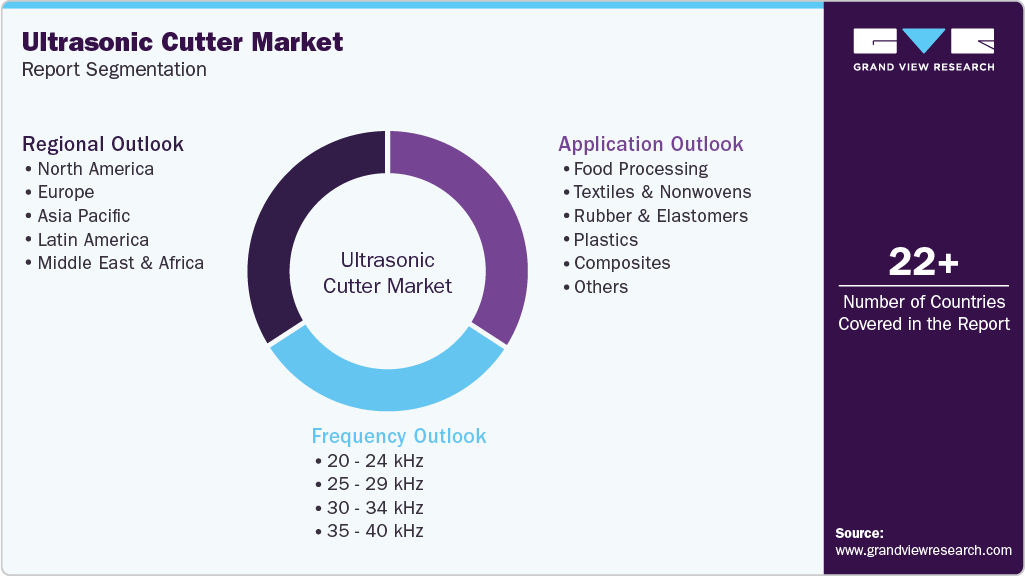
This report forecasts revenue growth at global, regional, and country levels and provides an analysis of the latest industry trends in each of the sub-segments from 2021 to 2033. For this study, Grand View Research has segmented the global ultrasonic cutter market report based on frequency, application, and region.
 To learn more about this report, Download Free Sample Report
-
Frequency Outlook (Revenue, USD Billion, 2021 - 2033)
-
20 - 24 kHz
-
25 - 29 kHz
-
30 - 34 kHz
-
35 - 40 kHz
-
-
Application Outlook (Revenue, USD Billion, 2021 - 2033)
-
Food Processing
-
Textiles & Nonwovens
-
Rubber & Elastomers
-
Plastics
-
Composites
-
Others
-
-
Regional Outlook (Revenue, USD Billion, 2021 - 2033)
-
North America
-
U.S.
-
Canada
-
Mexico
-
-
Europe
-
Germany
-
Spain
-
France
-
Italy
-
UK
-
-
Asia Pacific
-
China
-
India
-
Japan
-
Australia
-
South Korea
-
-
Latin America
-
Brazil
-
Argentina
-
-
Middle East and Africa
-
Saudi Arabia
-
UAE
-
South Africa
-
-
Research Methodology
The ultrasonic cutter market figures in this report are based on a proven research process that combines executive interviews with secondary research from proprietary databases, company filings, and recognized regulatory and institutional sources. Market size is built through value-chain sizing-reconciling supply-side and demand-side estimates-and triangulated with bottom-up and top-down approaches. Every estimate passes multiple levels of expert validation before publication, with each ultrasonic cutter segment quantified using the revenue-capture definitions in the table below.
Segment Definition
Frequency
Revenue Capture Definition
20-24 kHz
Revenue generated from the sale of ultrasonic cutters and complete cutting systems engineered to operate within the 20-24 kHz frequency range, including applicable cutting heads and specialized tooling supplied with the equipment.
25-29 kHz
Revenue generated from the sale of ultrasonic cutters and ultrasonic cutting systems designed for operation at 25-29 kHz, including integrated ultrasonic components and application-specific tooling.
30-34 kHz
Revenue generated from the sale of ultrasonic cutting equipment configured for 30-34 kHz operation, including cutters, cutting heads, generators, and specialized sonotrodes supplied as part of the system.
35-40 kHz
Revenue generated from the sale of ultrasonic cutters and cutting systems operating at 35-40 kHz, including associated cutting heads and application-specific tooling.
Application
Revenue Capture Definition
Food Processing
Revenue generated from the sale of ultrasonic cutting equipment and integrated systems specifically configured for commercial and industrial food-processing operations, including application-specific cutting assemblies.
Textiles & Nonwovens
Revenue generated from the sale of ultrasonic cutters, cutting heads, and integrated cutting systems supplied for textile and nonwoven production processes.
Rubber & Elastomers
Revenue generated from the sale of ultrasonic cutting equipment and specialized cutting systems configured for rubber and elastomer processing requirements.
Plastics
Revenue generated from the sale of ultrasonic cutters, cutting heads, tooling, and integrated systems designed for plastic-processing operations.
Composites
Revenue generated from the sale of ultrasonic cutting equipment and specialized systems engineered for processing composite materials and structures.
Others
Revenue generated from the sale of ultrasonic cutters and associated cutting systems supplied for applications outside the defined food processing, textiles & nonwovens, rubber & elastomers, plastics, and composites segments.
Estimation Model
Layer Name
Key Question
Description
Industrial Demand Layer
Where is demand for ultrasonic cutters generated?
Assess demand across food processing, textiles & nonwovens, rubber & elastomers, plastics, composites, and other manufacturing applications. Demand is evaluated based on production volumes, material characteristics, cutting precision requirements, automation levels, throughput, and equipment replacement needs.
Manufacturing & Equipment Demand Layer
Where is demand for new ultrasonic cutters created?
Evaluate investments in food-processing facilities, textile and nonwoven production, plastics manufacturing, composite processing, and other industrial production capacity. New facility development, production-line expansion, automation upgrades, and replacement of conventional cutting equipment are assessed to determine requirements for new ultrasonic cutters.
Technology & Frequency Adoption Layer
Which ultrasonic cutter configurations are being purchased?
Analyze equipment demand across 20-24 kHz, 25-29 kHz, 30-34 kHz, and 35-40 kHz frequency ranges. Adoption is assessed based on material properties, cutting thickness, required precision, operating speed, vibration characteristics, automation compatibility, and application-specific performance requirements.
Revenue Conversion Layer
How is market revenue estimated?
Convert estimated ultrasonic cutter demand into annual revenue based on the sales value of new equipment across defined frequency, application, and geographic segments. Revenue estimates incorporate equipment sold by manufacturers, OEMs, distributors, system integrators, and specialized industrial equipment suppliers.
Delivered Customizations
This report has been delivered with the following In-depth customizations
Client Request
Customization Delivered
Value Adds
Competitive Benchmarking
A comprehensive benchmarking assessment was conducted across ultrasonic cutter manufacturers, covering operating frequencies, cutting technologies, equipment configurations, tooling capabilities, material compatibility, geographic presence, product development, and market positioning.
Enables evaluation of technological differentiation, product breadth, customization capabilities, application expertise, and supplier positioning to support competitive analysis and strategic planning.
Regional Segmentation
A detailed regional assessment was conducted across North America, Europe, Asia Pacific, Latin America, and the Middle East & Africa, examining ultrasonic cutter demand across food processing, textiles & nonwovens, rubber & elastomers, plastics, composites, and other applications. Manufacturing output, automation investment, production capacity, technology adoption, and equipment replacement requirements were considered.
Helps stakeholders identify regional demand variations, prioritize attractive markets, evaluate application-specific potential, and develop targeted geographic expansion strategies.
Opportunity Assessment
Growth opportunities were evaluated across food processing, composites, plastics, textiles & nonwovens, rubber & elastomers, and emerging industrial applications, with emphasis on precision cutting, advanced materials, automation integration, specialized tooling, and application-specific equipment.
Supports identification of addressable growth areas, product development priorities, investment opportunities, application expansion potential, and strategies to strengthen competitive positioning in the global ultrasonic cutter market.
Frequently Asked Questions About This Report
The global ultrasonic cutter market size was valued at USD 1.3 billion in 2025 and is projected to reach USD 1.4 billion in 2026.
The market is driven by growing demand for precise, high-speed, and low-waste cutting across food processing, plastics, rubber, composites, textiles, and other industrial applications.
The market is expected to grow at a CAGR of 7.5% from 2026 to 2033, reaching USD 2.3 billion by 2033.
Asia Pacific dominated the global ultrasonic cutter market, accounting for the largest revenue share of 42.7% in 2025.
20-24 kHz segment accounted for the largest revenue share of 44.4% in 2025 while 35-40 kHz segment is expected to be the fastest-growing market.
The food processing segment accounted for the largest revenue share of 27.3% in 2025.
Key players include Dukane, RINCO ULTRASONICS, Weber Ultrasonics, Sino Sonics, UCM Ultrasonics, Johnson Plastosonic, Ultraautosonic, SONOTRONIC, Herrmann Ultrasonics, TELSONIC, MS Ultrasonic Technology Group, MECASONIC, Sonics & Materials, Emerson (Branson), and Sonic Italia.
About the Author(s)
Advanced Interior Materials Research Team
Advanced Materials · Advanced Interior MaterialsThis report was authored by the advanced interior materials research team at Grand View Research - comprising two research analysts, one senior research analyst, and one industry expert - with specialized expertise in the advanced interior materials segment of the advanced materials industry. All findings are based on proprietary advanced materials databases, executive interviews, and regulatory analysis, subject to internal peer review prior to publication.
Last Updated:
Speak to Analyst

Customize this report to your needs - add regions, segments, or data points, with 20% free customization.
Or view our licence options:


ISO 9001:2015 & 27001:2022 Certified
We are GDPR and CCPA compliant! Your transaction & personal information is safe and secure. For more details, please read our privacy policy.


