
- Home
- »
- Advanced Interior Materials
- »
-
Ultraviolet Analyzer Market Size & Share Report, 2026-2033GVR Report cover
![Ultraviolet Analyzer Market Size, Share & Trends Report]()
Ultraviolet Analyzer Market (2026 - 2033) Size, Share & Trends Analysis Report By Type (Liquid, Gas), By Portability (Portable, Fixed), By End-use (Semiconductor, Food & Beverages, Oil & Gas, Energy & Power, Chemical & Pharmaceutical, Environmental), By Region, And Segment Forecasts
Market Size, 2025
$1.6BMarket Estimate, 2026
$1.7BMarket Forecast, 2033
$2.6BCAGR, 2026–2033
6.0%Ultraviolet Analyzer Market Summary
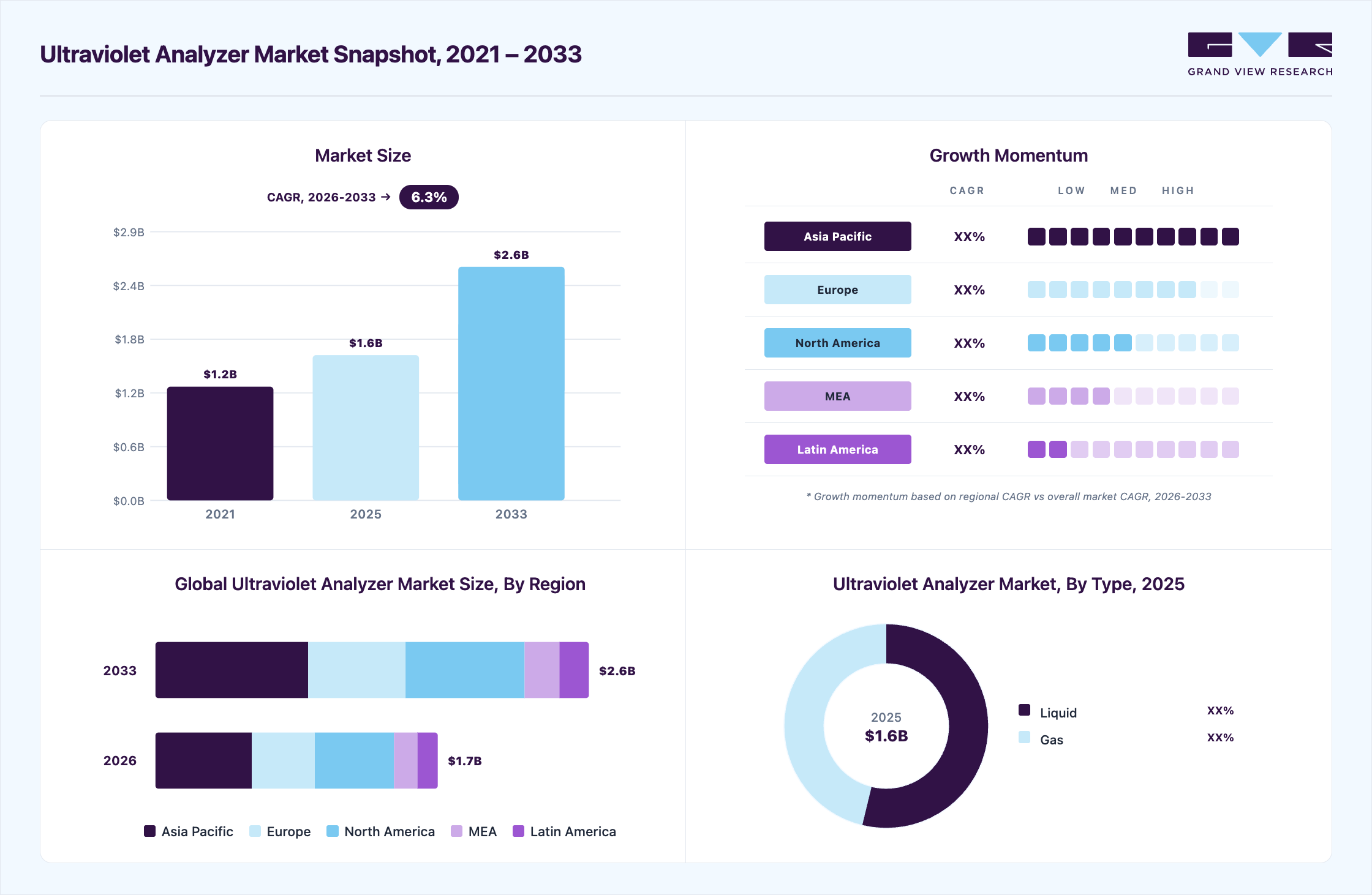
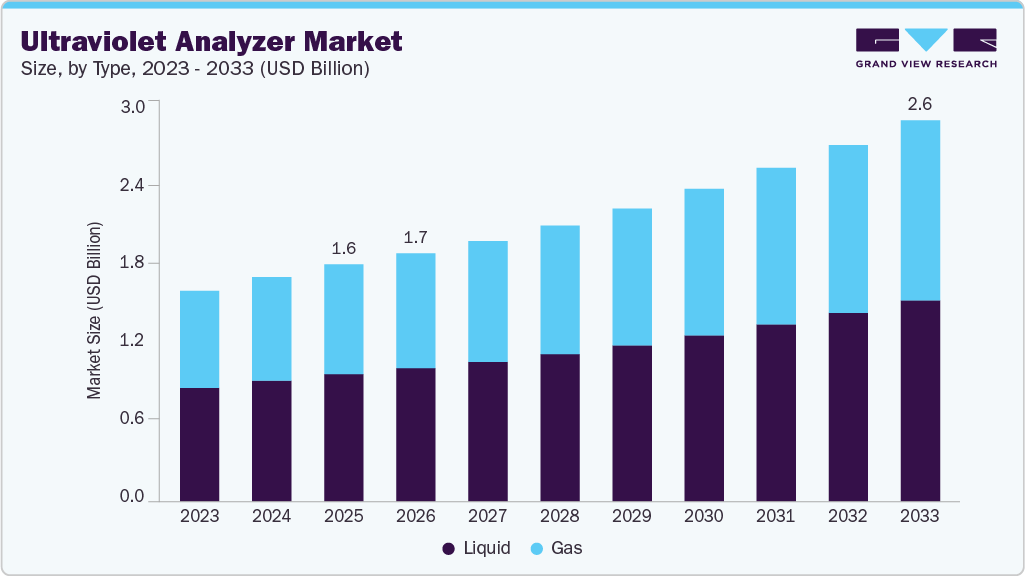
The global ultraviolet analyzer market size was valued at USD 1.6 billion in 2025 and is projected to grow from USD 1.7 billion in 2026 to USD 2.6 billion by 2033, at a CAGR of 6.3% from 2026 to 2033. Asia Pacific accounted for the largest global revenue share of around 34.0% in 2025. The global ultraviolet analyzer industry’s growth is driven by strict environmental regulations and growing demand for accurate industrial process monitoring across liquid and gas applications. Industries such as water treatment, chemical processing, power generation, and oil & gas increasingly use ultraviolet analyzers for contamination detection and quality control.
Key Market Trends & Insights
- The China ultraviolet analyzer industry is projected to grow at a significant CAGR from 2026 to 2033.
- Based on type, the liquid segment held the largest global revenue share of 53.8% in 2025.
- By portability, the portable segment is projected to grow at a CAGR of 6.7% from 2026 to 2033 in terms of revenue.
- Based on end-use, the semiconductor segment is expected to grow at the fastest CAGR of around 7.0% from 2026 to 2033.
Market Size & Forecast
- 2025 Market Size: USD 1.6 Billion
- 2026 Market Size: USD 1.7 Billion
- 2033 Projected Market Size: USD 2.6 Billion
- CAGR (2026-2033): 6.3%
- Asia Pacific: Largest market in 2025
Three ways to get this report
Buy it, customize it, or ask a question.Get the Full Report
What the study covers
- FormatsPDF · Excel · Dashboard
- Timeline2026–2033 annual, 2025 base
- Coverage20+ countries, 5 regions
- Companies10+ key players profiled
Customize the Report
20% free customization
- IncludeCountries, segments, points
- TailorTo your product definition
- ExtendDeeper competitor detail
- OrA fully bespoke study
- Turnaround5–10 working days
Ask Prism AI
A cited answer in seconds
- Corpus30K studies, 1.2M points
- ScopeAll markets, not just this
- CitationTraced to report & table
- HonestySays "not covered" if so
- SpeedSeconds, not days
The ultraviolet analyzer market is also supported by advancements in UV LED technology, photodetectors, and compact sensor systems, which are improving analyzer efficiency, portability, and maintenance performance. These developments are supporting broader adoption of online and portable UV analyzers across water treatment, food & beverage, and industrial process monitoring applications.Market Dynamics
Increasing enforcement of environmental monitoring and industrial compliance regulations across chemical processing, oil & gas, and power generation industries is driving the ultraviolet analyzer market growth. Regulatory authorities globally are implementing stricter standards for wastewater discharge, industrial emissions, and contamination control, creating strong demand for continuous and accurate analytical monitoring systems. UV analyzers are widely adopted for real-time measurement of parameters such as total organic carbon (TOC), chemical oxygen demand (COD), nitrate concentration, and gaseous pollutants due to their high sensitivity, rapid response capability, and suitability for continuous process monitoring. The growing industrial focus on operational safety, process optimization, and regulatory compliance is further driving the adoption of advanced UV-based analytical systems across industrial and environmental applications.
Infrared (IR) and electrochemical analyzers represent major competitive alternatives to ultraviolet (UV) analyzers across industrial and environmental monitoring applications. In gas analysis applications across the oil & gas, chemical, and power generation industries, IR analyzers are widely used to monitor hydrocarbons, carbon monoxide (CO), and carbon dioxide (CO₂) in multi-component gas streams. Electrochemical analyzers are also widely adopted in environmental and liquid monitoring applications due to their lower cost and suitability for portable, compact systems.
Market Concentration & Characteristics
The ultraviolet analyzer market is moderately fragmented, with the presence of global analytical instrumentation companies, specialized spectroscopy solution providers, and regional process monitoring equipment manufacturers competing across industrial, environmental, pharmaceutical, and laboratory applications. Market participants primarily compete on measurement accuracy, real-time monitoring, software integration, and compliance with industrial quality standards.
Leading companies are increasingly focusing on expanding process automation capabilities, strengthening digital monitoring platforms, and integrating analyzers with industrial control systems to improve operational efficiency and data traceability. Strategic collaborations with water treatment operators, chemical manufacturers, and pharmaceutical companies also remain important for strengthening long-term market positioning.
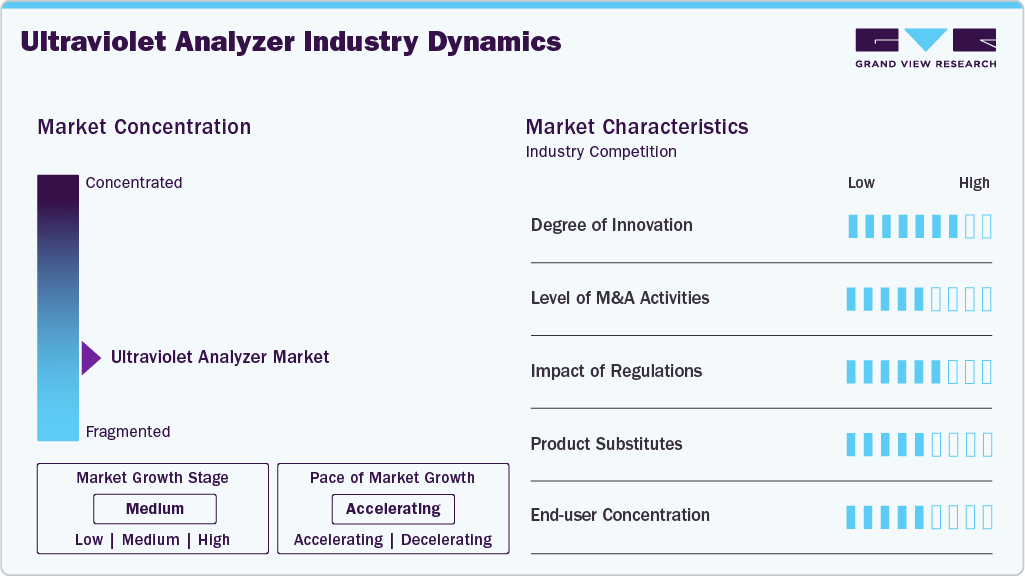
Technological advancement represents a major competitive factor within the market. Manufacturers are increasingly developing compact, high-sensitivity, and low-maintenance ultraviolet analyzers capable of continuous real-time monitoring across demanding operating environments. Integration of advanced spectroscopy techniques, automated calibration systems, fiber-optic sensing technologies, and artificial intelligence (AI)-enabled data analytics is improving detection accuracy and reducing operational downtime. Demand is also increasing for multi-parameter analyzers capable of monitoring organic compounds, water quality indicators, and chemical concentrations simultaneously. Moreover, growing adoption of Industrial Internet of Things (IIoT)-enabled monitoring systems is supporting remote diagnostics, predictive maintenance, and centralized process control across industrial facilities.
Regulatory standards related to water quality, industrial emissions, pharmaceutical manufacturing, and environmental monitoring continue to play a significant role in market development. Industries such as water treatment, chemicals, food & beverage, and pharmaceuticals increasingly rely on ultraviolet analyzers to maintain compliance with stringent safety and quality regulations governing contamination control and process monitoring. Environmental regulations regarding wastewater discharge and industrial pollution monitoring are also supporting broader adoption of continuous analytical instrumentation. However, the market faces competition from alternative analytical technologies such as infrared (IR) analyzers, electrochemical sensors, chromatography systems, and fluorescence-based detection methods, which may offer advantages in certain applications depending on sensitivity requirements, operational complexity, and cost considerations.
Type Insights
The liquid segment constitutes a substantial share of the UV analyzers market, driven by the indispensable need for fluid purity assessment, wastewater management, and process chemical monitoring. These analyzers are extensively deployed to measure Organic Carbon (TOC), Chemical Oxygen Demand (COD), and nitrate levels in water matrices across municipal and industrial sectors. Since UV light enables non-contact, reagent-free, rapid, continuous monitoring without altering the sample, it is highly favored for aggressive process liquids and effluent monitoring, where sensor fouling would degrade alternative chemical-reactive systems.
The gas segment is projected to grow at a CAGR of 6.6% over the forecast period, driven by the global enforcement of industrial stack emission standards and air quality protocols. Gas-phase UV analyzers are crucial for detecting trace concentrations of critical criteria pollutants, including sulfur dioxide, nitrogen oxides, hydrogen sulfide, and elemental mercury. A major competitive advantage of UV gas analyzers over infrared (IR) alternatives is their inherent immunity to water vapor cross-interference, allowing operators to measure hot, wet exhaust gases directly without the need for intensive sample-conditioning or dehumidification systems.
Portability Insights
The fixed segment dominated the ultraviolet analyzer market, accounting for the largest share of 57.9% in 2025, due to the industry's baseline requirement for uninterrupted, real-time process control and regulatory reporting. Installed permanently at specific inline or bypass stations within industrial facilities, these robust systems are routinely integrated into distributed control systems (DCS) to facilitate automated adjustments. Their heavy construction, climate-controlled enclosures, and continuous uptime capabilities make them standard infrastructure for critical applications in stack monitoring, refinery process streams, and large-scale water treatment plants.
The portable segment is expected to grow rapidly over the forecast period, driven by technological advancements in miniaturized optical components and long-life battery systems, such as UV-C LEDs. These lightweight, handheld, or benchtop analyzers are heavily utilized for field-based environmental sampling, localized occupational safety inspections, and spot-checking industrial effluent lines. Portable units offer immediate, on-site analytical verification, allowing technicians to bypass time-consuming laboratory dispatch while maintaining tight operational oversight across vast, remote infrastructure networks.
End-use Insights
The oil & gas segment dominated the ultraviolet analyzer industry, accounting for the largest revenue share of 28.4% in 2025. The industry utilizes them heavily across upstream extraction, midstream transport, and downstream refining. Key applications include sulfur recovery unit (SRU) optimization via tail gas analysis, hydrogen sulfide monitoring in natural gas lines, and oil-in-water detection for produced water management. The technology's capacity to withstand high pressures, corrosive environments, and complex hydrocarbon backgrounds makes it an industrial standard for mitigating process risks and preventing regulatory penalties.
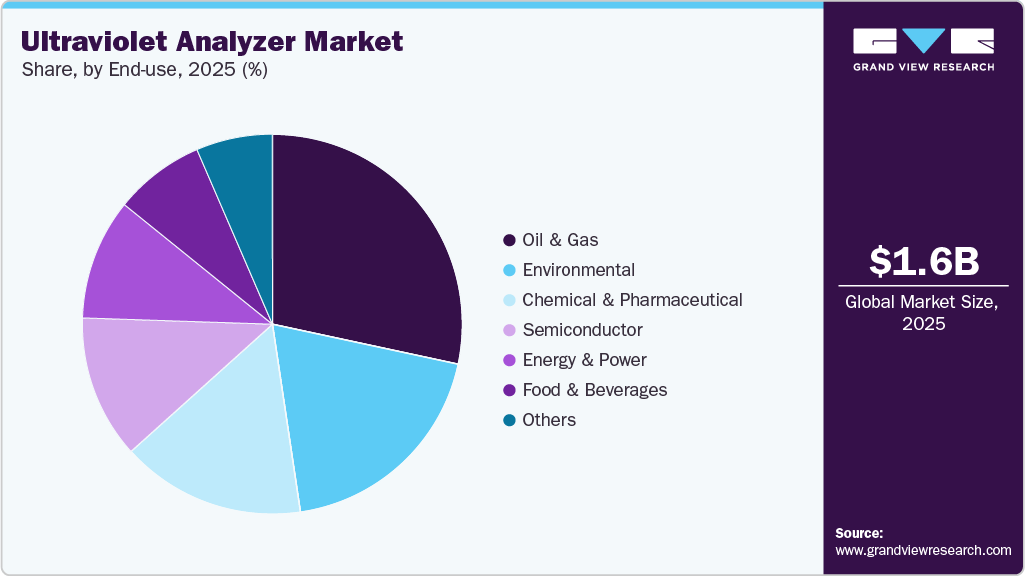
The semiconductor end-use segment is projected to grow at a rapid CAGR over the forecast period. In the semiconductor industry, UV analyzers are essential tools for maintaining the extreme purity levels required in fabrication facilities (fabs). As the semiconductor industry expands rapidly, the demand for ultraviolet analyzers is subsequently expected to rise. In the industry, they are primarily used to monitor ultra-pure water (UPW) systems for micro-contamination, specifically trace organic carbon and silica, which can compromise wafer yields. Additionally, UV spectroscopy detects trace impurities in process chemical delivery and specialty gas loops, ensuring that the strict contamination limits mandated by sub-nanometer node manufacturing are strictly sustained.
Regional Insights
Asia Pacific accounted for the largest global revenue share of around 34.0% in 2025. The Asia Pacific ultraviolet analyzer market is expected to witness strong growth over the forecast period, driven by the rapid industrialization, expansion of manufacturing industries, and increasing environmental monitoring requirements across developing economies. Demand is increasing across water treatment, chemicals, oil & gas, food processing, and electronics manufacturing sectors. Governments across the region are strengthening industrial pollution control and wastewater management regulations, supporting broader adoption of analytical monitoring systems. In addition, growing investments in industrial automation and the expansion of semiconductor and pharmaceutical manufacturing are contributing to market growth.

China Ultraviolet Analyzer Market Trends
The China ultraviolet analyzer marketis expected to grow rapidly due to large-scale industrial manufacturing, expanding chemical and petrochemical industries, and increased enforcement of environmental compliance. Rising investments in wastewater treatment infrastructure, industrial emissions monitoring, and semiconductor manufacturing continue to support market growth. The country is also witnessing increasing adoption of automated process monitoring technologies across industrial facilities. Strong domestic manufacturing capabilities and the expansion of local analytical instrumentation suppliers further enhance market competitiveness.
The ultraviolet analyzer market in India is growing steadily, driven by the increasing industrialization, expansion of pharmaceutical and chemical manufacturing, and rising investments in municipal water treatment infrastructure. Regulatory focus on industrial wastewater discharge and environmental pollution monitoring is supporting demand for continuous analytical systems. The market also benefits from increasing adoption of process automation technologies across industrial facilities. Growth in food processing, power generation, and industrial water treatment applications continues to create additional opportunities for UV analyzer deployment.
North America Ultraviolet Analyzer Market Trends
The North America ultraviolet analyzer industry is characterized by strong adoption across oil & gas, water treatment, chemicals, pharmaceuticals, and power generation industries. The region benefits from established industrial monitoring infrastructure, high environmental compliance requirements, and widespread integration of automated process control systems. Market growth is supported by increasing investment in industrial emissions monitoring, wastewater treatment modernization, and digital process analytics. The presence of major analytical instrumentation manufacturers and strong adoption of online monitoring technologies further strengthen the region’s technological position.
The U.S. is the largest market for ultraviolet analyzers in North America, driven by its extensive oil & gas, chemical processing, semiconductor, and municipal water treatment sectors. Regulatory frameworks for industrial emissions, water quality, and workplace safety continue to drive demand for continuous analytical monitoring systems. The country also demonstrates strong adoption of advanced process automation and real-time industrial analytics technologies. In addition, increasing semiconductor manufacturing investments and industrial sustainability initiatives are supporting demand for high-precision monitoring equipment.
Europe Ultraviolet Analyzer Market Trends
Europe is a technologically mature market for ultraviolet analyzers supported by stringent environmental regulations and strong industrial sustainability initiatives. Demand is concentrated across water treatment, pharmaceuticals, chemicals, food & beverage, and industrial emissions monitoring applications. The region demonstrates high adoption of automated and energy-efficient analytical systems integrated with industrial control platforms. Regulatory focus on wastewater discharge, industrial pollution reduction, and process safety continues to encourage adoption of continuous monitoring technologies across industrial facilities.
The Germany ultraviolet analyzer market is the largest in Europe due to its strong chemical manufacturing, pharmaceutical, industrial processing, and environmental engineering sectors. The country demonstrates high adoption of precision analytical instrumentation and Industry 4.0-enabled process monitoring systems. Demand is also supported by strict industrial compliance standards and advanced wastewater management infrastructure. Germany’s strong engineering base and presence of industrial automation and analytical technology companies further strengthen market development.
The ultraviolet analyzer market in the UK is supported by established pharmaceutical manufacturing, water utilities, chemical processing, and environmental monitoring sectors. The continued focus on industrial emissions compliance, water quality monitoring, and process optimization continues to support the adoption of advanced analytical instrumentation. The market also benefits from growing investment in industrial automation and digital monitoring systems across manufacturing and utility operations. In addition, environmental sustainability targets and wastewater management regulations remain important market growth factors.
Latin America Ultraviolet Analyzer Market Trends
The Latin America ultraviolet analyzer industry is supported by growth in mining, oil & gas, chemicals, water treatment, and food processing industries. Demand is increasing for industrial water quality monitoring and emissions control systems as environmental compliance standards gradually strengthen across the region. Industrial modernization and expansion of municipal wastewater treatment infrastructure are also supporting the adoption of analytical instrumentation technologies. However, market growth remains relatively influenced by industrial investment cycles and economic conditions across major regional economies.
The ultraviolet analyzer market in Brazil is one of the leaders in Latin America, due to its large industrial base, oil & gas sector, water treatment investments, and chemical processing industry. Demand is supported by increasing environmental monitoring requirements and the expansion of industrial wastewater treatment operations. The country is also witnessing the gradual adoption of automated industrial process monitoring systems across manufacturing and utility sectors. In addition, growth in food & beverage processing and biofuel production supports broader analytical instrumentation demand.
Middle East & Africa Ultraviolet Analyzer Market Trends
The Middle East & Africa ultraviolet analyzer market is expected to grow at 5.8% CAGR during the forecast period and is primarily driven by oil & gas operations, petrochemical production, desalination facilities, and industrial water treatment requirements. The increased focus on industrial process optimization, environmental compliance, and water resource management is supporting the adoption of continuous monitoring technologies across the region. Investments in refinery expansion, industrial infrastructure, and utility modernization are also contributing to market growth. However, adoption levels vary significantly across countries depending on industrial development and regulatory enforcement.
The Saudi Arabia ultraviolet analyzer market represents a key region in the Middle East due to its extensive oil & gas, petrochemical, refining, and desalination industries. Demand for ultraviolet analyzers is supported by increasing investment in industrial process monitoring, wastewater treatment, and emissions management systems across energy and industrial facilities. The country is also investing in industrial diversification, smart manufacturing, and the modernization of environmental infrastructure as part of long-term economic development initiatives. The presence of large-scale energy and chemical processing operations continues to support the adoption of advanced analytical instrumentation technologies.
Key Ultraviolet Analyzer Company Insights
Some of the key players operating in the market include Shimadzu Corporation and Agilent Technologies, Inc.
-
Shimadzu Corporation is a Japan-based manufacturer of analytical and measuring instruments, medical systems, industrial equipment, and aerospace components. The company has a strong global presence across analytical instrumentation, including chromatography, mass spectrometry, spectroscopy, and material testing systems used in pharmaceutical, environmental, food, chemical, and semiconductor industries.
-
Agilent Technologies, Inc. is a U.S.-based analytical instrumentation and diagnostics company specializing in life sciences, chemical analysis, laboratory diagnostics, and applied industrial markets. Formed as a spin-off from Hewlett-Packard in 1999, Agilent provides instruments, software, consumables, and laboratory workflow solutions across pharmaceuticals, environmental testing, food safety, chemicals, and semiconductor applications. Agilent also supports industrial and research customers through integrated analytical platforms and technical service capabilities across more than 100 countries.
Key Ultraviolet Analyzer Companies:
The following key companies have been profiled for this study on the ultraviolet analyzer market.
-
Shimadzu Corporation
-
Agilent Technologies, Inc.
-
PerkinElmer
-
AMETEK.Inc.
-
ABB
-
Siemens
-
IST METZ GmbH & Co. KG.
-
Gigahertz Optik GmbH
-
Horiba Ltd.
-
Teledyne Technologies Incorporated
-
Xylem, Inc
-
Hitachi High-Tech Corporation
-
JASCO
-
Thermo Fisher Scientific Inc.
-
BIOBASE GROUP
Company Categorization
Operating Strategies
Competitive Edge
Weaknesses
Mature Players: Thermo Fisher Scientific Inc.; Agilent Technologies, Inc.; ABB
- Mature participants focus on integrated analytical instrumentation portfolios, expansion of industrial process monitoring capabilities, and development of high-precision UV analysis platforms across various applications.
- These companies emphasize automation integration, regulatory-compliant monitoring systems, software-enabled analytics, and global service infrastructure.
- Mature companies benefit from extensive global distribution networks, strong regulatory credibility, broad analytical technology portfolios, and advanced R&D capabilities in spectroscopy, optical sensing, and industrial analytics.
- Their established presence in pharmaceutical, semiconductor, and other industries supports recurring demand for high-performance and compliance-oriented analytical systems.
- High system costs, complex product portfolios, and dependence on industrial capital expenditure cycles may limit flexibility in price-sensitive markets.
- Large multinational structures may reduce responsiveness to niche or highly customized application requirements compared to smaller specialized competitors
Emerging Players: Gigahertz Optik GmbH; JASCO; BIOBASE GROUP
- Emerging participants primarily compete through specialized UV sensing technologies, compact analytical platforms, application-focused instrumentation, and cost-competitive regional expansion strategies.
- They are expected to increase participation in semiconductor and environmental monitoring -related applications through targeted product development and regional distribution partnerships.
- Strong specialization in niche UV measurement applications enables faster product customization and targeted solution development for specific industrial and laboratory requirements.
- Competitive pricing and compact system designs support stronger adoption among regional laboratories, research institutions, and small- to mid-sized industrial facilities.
- Emerging companies generally possess narrower product portfolios, more limited industrial process monitoring capabilities, and smaller global service and calibration networks compared to established analytical instrumentation leaders.
- Lower brand recognition in highly regulated industrial sectors may also restrict participation in large-scale compliance-driven projects and multinational procurement contracts.
Recent Developments
-
In October 2025, Testron Group announced the launch of the TT-UV1100 UV-VIS Spectrophotometer, a single-beam analytical instrument designed for laboratory and industrial testing applications. The company stated that the system offers a wavelength range of 320-1100 nm, touchscreen-based operation, multiple spectral bandwidth options, and USB connectivity for data output and workflow integration.
-
In January 2025, Shimadzu Corporation announced plans to establish a new manufacturing facility in Bengaluru, India, with operations expected to begin in 2027. The company stated that the plant will manufacture analytical and measuring instruments, including liquid chromatographs, gas chromatographs, UV-VIS spectrophotometers, and mass spectrometry systems, to strengthen local supply capabilities and support growing demand from India’s pharmaceutical, semiconductor, EV, and industrial sectors.
Ultraviolet Analyzer Market Report Scope
Report Attribute
Details
Market size value in 2025
USD 1.6 billion
Market size value in 2026
USD 1.7 billion
Revenue forecast in 2033
USD 2.6 billion
Growth Rate
CAGR of 6.3% from 2026 to 2033
Base year for estimation
2025
Historical data
2021 - 2024
Forecast period
2026 - 2033
Quantitative units
Revenue in USD million/billion and CAGR from 2026 to 2033
Report coverage
Revenue forecast, company market position analysis, competitive landscape, growth factors, and trends
Segments covered
Type, portability, end-use, region
Regional scope
North America; Europe; Asia Pacific; Latin America; Middle East & Africa
Country Scope
U.S.; Canada; Mexico; Germany; UK; Italy; Spain; France; China; Japan; India; Australia; South Korea; Brazil; Saudi Arabia; UAE
Key companies profiled
Shimadzu Corporation; Agilent Technologies, Inc.; PerkinElmer; AMETEK, Inc.; ABB; Siemens; IST METZ GmbH & Co. KG.; Gigahertz Optik GmbH; Horiba Ltd.; Teledyne Technologies Incorporated; Xylem, Inc.; Hitachi High-Tech Corporation; JASCO; Thermo Fisher Scientific Inc.; BIOBASE GROUP
Customization scope
Free report customization (equivalent up to 8 analysts working days) with purchase. Addition or alteration to country, regional & segment scope.
Pricing and purchase options
Avail customized purchase options to meet your exact research needs. Explore purchase options
Global Ultraviolet Analyzer Market Report Segmentation
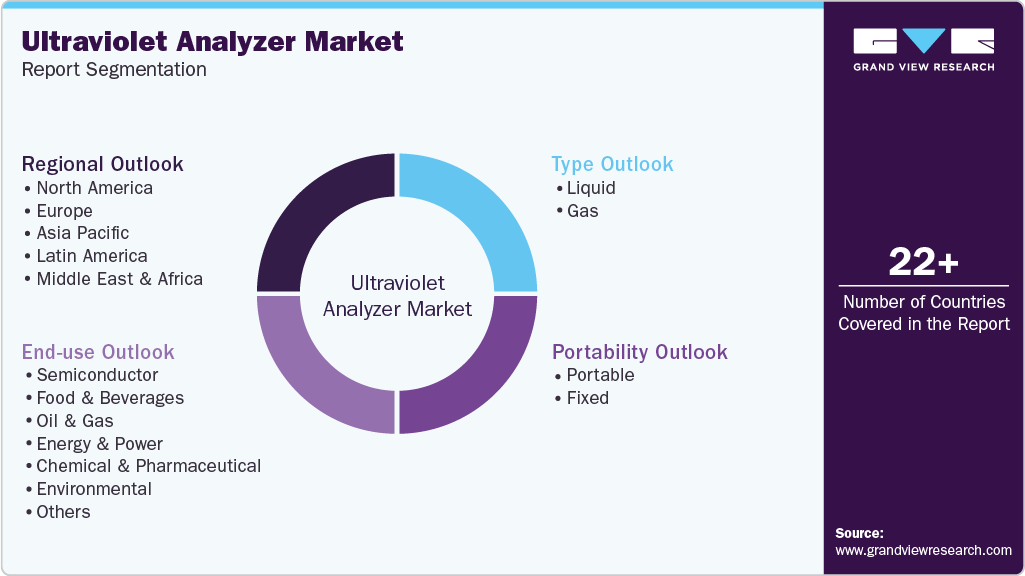
This report forecasts revenue growth at the global, regional & country levels and provides an analysis of the industry trends in each of the sub-segments from 2021 to 2033. For this study, Grand View Research has segmented the global ultraviolet analyzer market report based on type, portability, end-use, and region:
-
Type Outlook (Revenue, USD Million, 2021 - 2033)
-
Liquid
-
Gas
-
-
Portability Outlook (Revenue, USD Million, 2021 - 2033)
-
Portable
-
Fixed
-
-
End-use Outlook (Revenue, USD Million, 2021 - 2033)
-
Semiconductor
-
Food & Beverages
-
Oil & Gas
-
Energy & Power
-
Chemical & Pharmaceutical
-
Environmental
-
Others
-
-
Regional Outlook (Revenue, USD Million, 2021 - 2033)
-
North America
-
U.S.
-
Canada
-
Mexico
-
-
Europe
-
UK
-
Germany
-
France
-
Italy
-
Spain
-
-
Asia Pacific
-
Japan
-
China
-
India
-
Australia
-
South Korea
-
-
Latin America
-
Brazil
-
Argentina
-
-
Middle East & Africa
-
Saudi Arabia
-
UAE
-
South Africa
-
-
Delivered Customizations
This report has been delivered with the following In-depth customizations
Client Request
Customization Delivered
Value Adds
Regional Segmentation
Delivered regional and country-level analysis covering industrial monitoring demand, environmental compliance trends, water treatment infrastructure development, semiconductor and pharmaceutical industry expansion, technological adoption patterns, and presence of major analytical instrumentation manufacturers across key regions and countries.
Helped the client evaluate region-specific demand dynamics, identify high-growth industrial and environmental monitoring markets, and support strategic expansion and investment prioritization decisions.
Competitive benchmarking
Delivered comparative analysis of mature and emerging ultraviolet analyzer manufacturers based on product portfolio strength, technological positioning, industrial application focus, regional presence, financial strength, and operational strategies.
Supported the client in benchmarking competitive positioning, understanding technology and application-level differentiation, and identifying potential market positioning and partnership opportunities.
Opportunity Assessment
Delivered assessment of growth opportunities across water quality monitoring, industrial emissions analysis, semiconductor manufacturing, pharmaceutical process monitoring, wastewater treatment, and portable analytical instrumentation applications.
Enabled the client to identify high-potential application areas, align product strategies with evolving industrial and regulatory requirements, and evaluate future demand opportunities across end-use sectors and regions.
Frequently Asked Questions About This Report
The global ultraviolet analyzer market size was estimated at USD 1.6 billion in 2025 and is expected to reach USD 1.7 billion in 2026.
The global ultraviolet analyzer market, in terms of revenue, is expected to grow at a compound annual growth rate of 6.3% from 2026 to 2033 to reach USD 2.6 billion by 2033.
The Asia Pacific ultraviolet analyzer market dominated the global revenue share in 2025 accounting for 34% of the share, driven by rapid industrialization, expanding water treatment infrastructure, increasing environmental monitoring requirements, and growing semiconductor, pharmaceutical, and chemical manufacturing activities across developing economies such as China and India.
Some of the key players operating in the ultraviolet analyzer market include Shimadzu Corporation, Agilent Technologies, Inc., PerkinElmer, AMETEK, Inc., ABB, Siemens, IST METZ GmbH & Co. KG., Gigahertz Optik GmbH, Horiba Ltd., Teledyne Technologies Incorporated, Xylem, Inc., Hitachi High-Tech Corporation, JASCO, Thermo Fisher Scientific Inc., BIOBASE GROUP, among others.
The ultraviolet analyzer market is driven by stringent environmental regulations, increasing demand for continuous industrial process monitoring, expansion of water and wastewater treatment infrastructure, and growing adoption of automated analytical systems across industrial sectors.
About the Author(s)
Advanced Interior Materials Research Team
Advanced Materials · Advanced Interior MaterialsThis report was authored by the advanced interior materials research team at Grand View Research - comprising two research analysts, one senior research analyst, and one industry expert - with specialized expertise in the advanced interior materials segment of the advanced materials industry. All findings are based on proprietary advanced materials databases, executive interviews, and regulatory analysis, subject to internal peer review prior to publication.
Last Updated:
Speak to Analyst


Customize this report to your needs - add regions, segments, or data points, with 20% free customization.
Or view our licence options:


ISO 9001:2015 & 27001:2022 Certified
We are GDPR and CCPA compliant! Your transaction & personal information is safe and secure. For more details, please read our privacy policy.


