
- Home
- »
- Advanced Interior Materials
- »
-
Unconventional Mining Technologies Market Report, 2033GVR Report cover
![Unconventional Mining Technologies Market (2026 - 2033)Report]()
Unconventional Mining Technologies Market (2026 - 2033)
Size, Share & Trend Analysis Report, By Technology (Bioleaching, In-Situ Recovery), By Material Recovery (Uranium, Copper, Gold), By Region (North America, Europe, Asia Pacific, Latin America, MEA), And Segment Forecasts
Market Size, 2025
$44.1BMarket Estimate, 2026
$47.8BMarket Forecast, 2033
$85.9BCAGR, 2026–2033
8.7%Unconventional Mining Technologies Market Summary
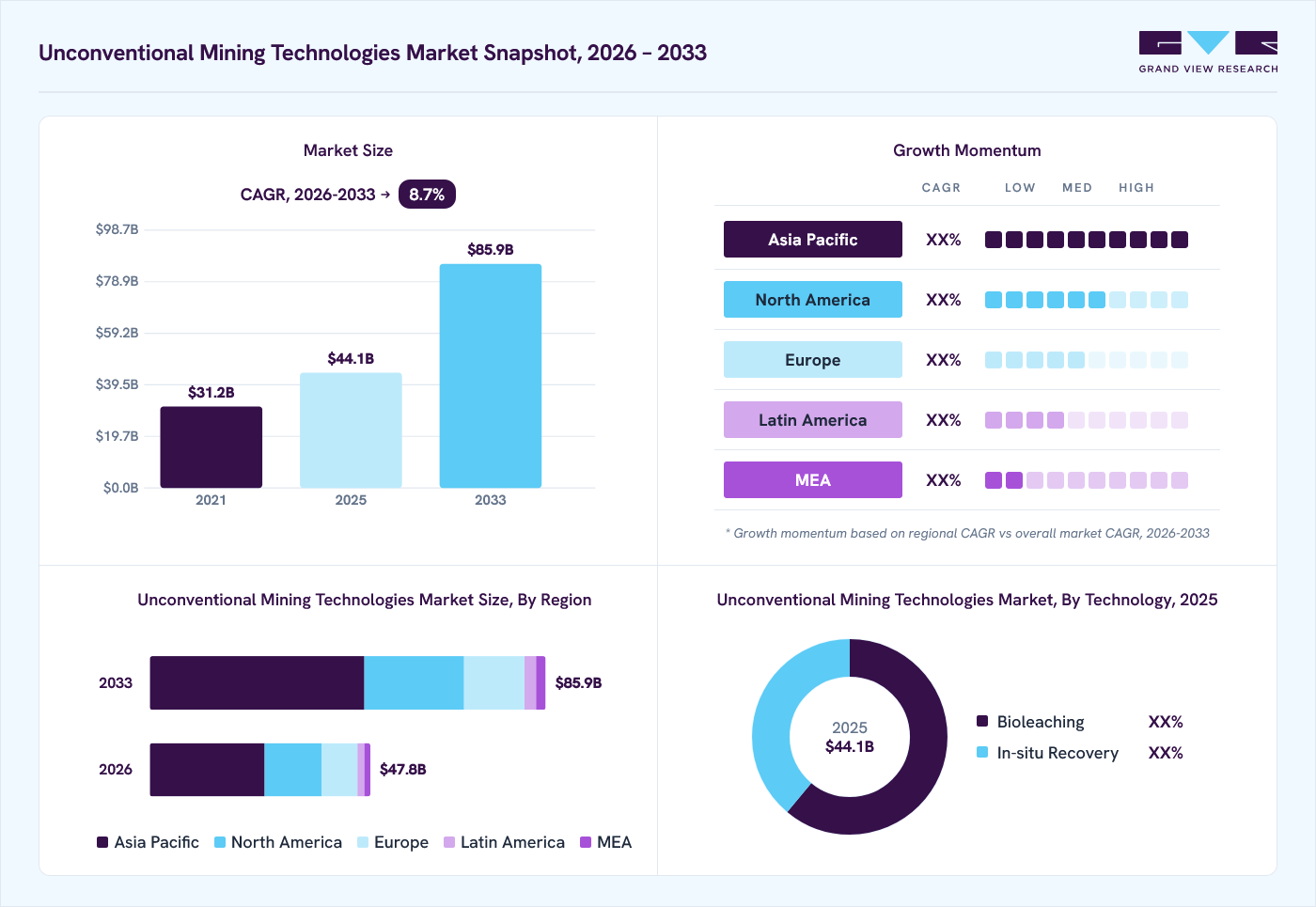
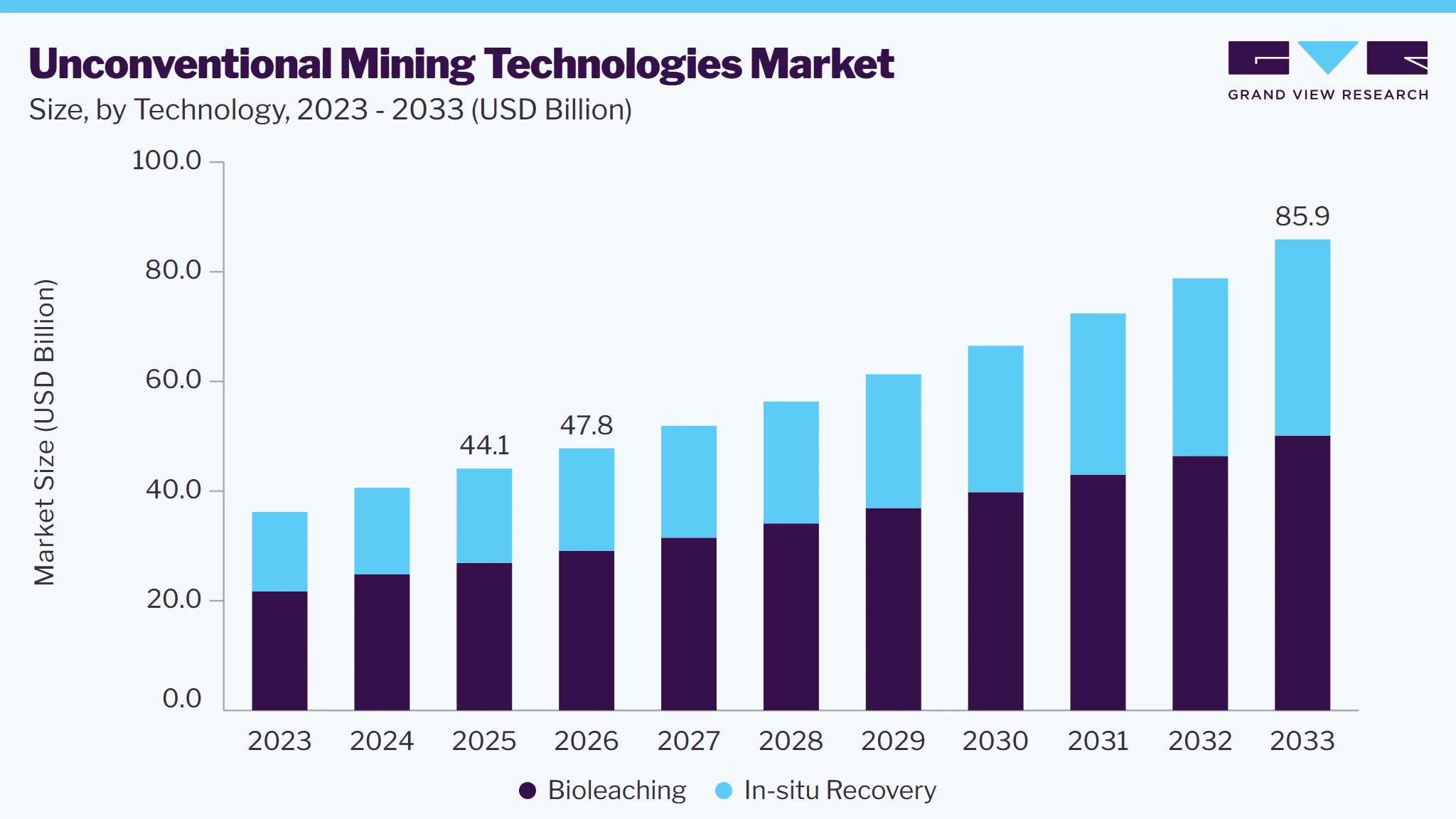
The global unconventional mining technologies market size was valued at USD 44.1 billion in 2025 and is projected to grow from USD 47.8 billion in 2026 to USD 85.9 billion by 2033, at a CAGR of 8.7% from 2026 to 2033. Asia Pacific dominated the market, accounting for a revenue share of 51.7% in 2025. Growth is supported by the increasing need to access difficult-to-extract mineral resources, including low-grade deposits, brines, refractory ores, mine tailings, and other unconventional sources.
Key Market Trends & Insights
- By technology: Bioleaching segment held the largest market share of 61.0% in 2025.
- By material recovery: Uranium segment held the largest market share of 38.7% in 2025
Regional Highlights
- Largest regional market: Asia Pacific (51.7% revenue share, 2025)
- By country: Kazakhstan dominated the Asia Pacific with the largest revenue share in 2025
Market Size & Forecast
- Market size in 2025: USD 44.1 Billion
- Estimated market size in 2026: USD 47.8 Billion
- Projected market size by 2033: USD 85.9 Billion
- CAGR (2026-2033): 8.7%
The industry is increasingly moving toward extraction methods that can reduce the environmental footprint associated with conventional mining. In situ recovery, direct lithium extraction, bioleaching, and tailings reprocessing can reduce excavation, material transport, and waste generation where geological conditions are suitable.
Growing emphasis on water conservation, lower energy consumption, reduced emissions, and recovery of valuable minerals from mining waste is encouraging companies to improve process efficiency. These developments are also supporting the adoption of technologies that enable greater resource recovery with comparatively lower surface disturbance.
Market Dynamics
Increasing demand for lithium, uranium, copper, nickel, rare earth elements, and other critical minerals is encouraging investment in alternative extraction technologies. Conventional resources are becoming increasingly difficult to develop in some regions, creating a need for technologies capable of accessing brines, low-grade deposits, refractory ores, tailings, and other challenging resources.
Government initiatives aimed at strengthening domestic and diversified critical-mineral supply chains are further supporting this trend. Companies are increasingly evaluating unconventional extraction routes to expand available resources, reduce dependence on imports, and improve the security of mineral supply.
Many technologies require substantial expenditure on research, pilot facilities, specialized equipment, process optimization, and environmental testing before commercial deployment. Performance can vary considerably depending on deposit geology, mineral composition, brine chemistry, recovery rates, and site-specific operating conditions, increasing uncertainty during project development.
Regulatory approvals, environmental assessments, limited commercial operating experience, and uncertain project economics can further extend development timelines. These factors may restrict adoption among smaller operators and make it difficult for emerging technologies to compete with established extraction methods in the near term.
These technologies provide opportunities to recover minerals from resources that may be uneconomic or technically difficult to exploit using conventional methods. Lithium-rich brines, mine tailings, refractory concentrates, low-grade deposits, and other secondary resources represent potential sources of additional mineral supply.
Advances in selective separation, automation, biotechnology, hydrometallurgy, and process monitoring are improving the feasibility of these applications. Rising investment in domestic mineral production and supply-chain diversification is expected to create opportunities for technology developers, project operators, and specialized equipment providers.
Analyst Perspective
The unconventional mining technologies market is gaining momentum as mining companies seek alternatives for extracting difficult-to-access, low-grade, and unconventional mineral resources. In situ recovery, direct lithium extraction, bioleaching, and deep-sea mining are attracting investment due to their potential to improve recovery efficiency and reduce the requirements of conventional mining. Growing demand for critical minerals, technological advancements, and the need for more resource-efficient extraction are expected to support adoption, although regulatory, environmental, scalability, and economic challenges remain key constraints.
Technology Insights
The bioleaching segment led the market with the largest revenue share of 61.0% in 2025. The segment benefits from its established application in recovering valuable metals from low-grade ores and complex mineral resources, particularly copper and gold. Its ability to process resources that are difficult or uneconomical to treat using conventional methods supports its broad contribution to the value of recovered minerals.
The in-situ recovery segment is anticipated to grow at the fastest CAGR of 9.7% during the forecast period. Growth is driven by increasing uranium recovery through solution-based extraction methods and the potential expansion of in-situ techniques to other suitable mineral deposits. Lower surface disturbance and reduced requirements for conventional excavation further support adoption.
Material Recovery Insights
The uranium segment led the market with the largest revenue share of 38.7% in 2025. The segment benefits from the extensive commercial use of in-situ recovery for uranium extraction, particularly in major uranium-producing countries with suitable sandstone-hosted deposits. Large-scale ISR operations and the growing importance of nuclear power are supporting the value of uranium recovered through unconventional methods.
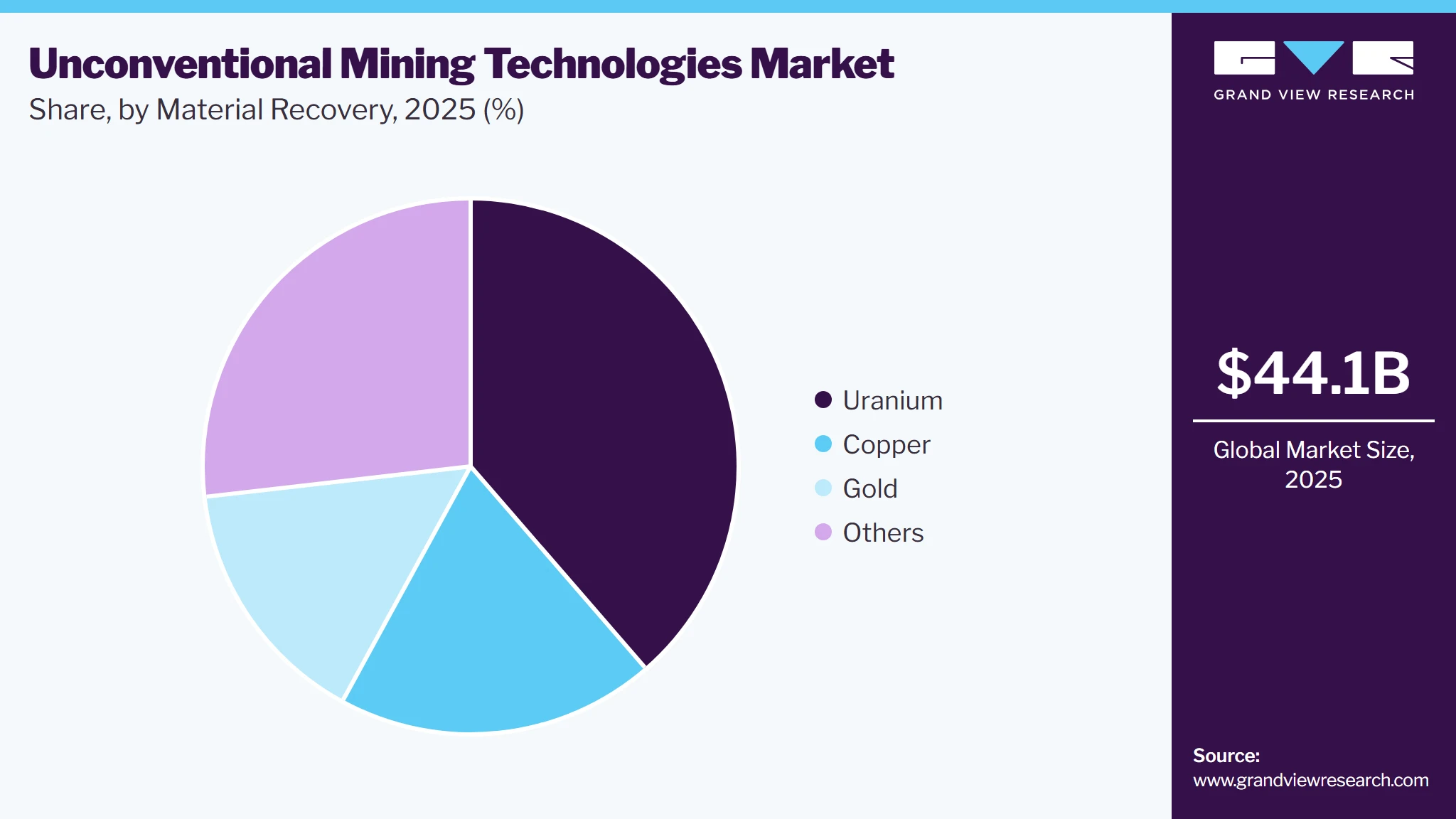
The gold segment is projected to grow at the fastest CAGR of 8.8% during the forecast period. Growth is supported by growing interest in bioleaching for processing refractory gold ores and concentrates, where conventional treatment methods may be less effective or less economically attractive. The growing need to recover gold from increasingly complex, lower-grade resources is expected to further support segment expansion.
Regional Insights
The unconventional mining technologies market in North America is anticipated to grow at a significant CAGR during the forecast period, supported by increasing investment in direct lithium extraction (DLE), in situ recovery, bioleaching, and advanced mineral recovery technologies. The U.S. is a major technology-development hub, particularly for DLE, while Canada has significant activity in uranium ISR, bioleaching, and emerging deep-sea resource recovery. Growing demand for critical minerals and efforts to strengthen domestic supply chains are further supporting technology development.
U.S. Unconventional Mining Technologies Market Trends
The unconventional mining technologies market in the U.S. is a leading country for the development and commercialization of DLE, brine-based mineral recovery, bioleaching, and other advanced extraction technologies. Several companies are developing projects targeting lithium-rich brines from oilfields, geothermal resources, and sedimentary formations. Government support for domestic critical-mineral production is also encouraging investment in technologies that can recover resources from previously difficult-to-exploit deposits.
Asia Pacific Unconventional Mining Technologies Market Trends
The Asia Pacific unconventional mining technologies market held the largest revenue share of 51.7% in 2025 and is projected to grow at the fastest CAGR during the forecast period, due to its large mineral resource base, growing demand for critical minerals, and established use of ISR for uranium production. Kazakhstan is a major center for ISR-based uranium extraction, while China, Australia, and Kazakhstan are developing advanced mineral processing and resource recovery capabilities. The region is also active in exploration for deep-sea mineral resources, including polymetallic nodules and seafloor massive sulfides.

The unconventional mining technologies market in Kazakhstan accounted for the largest revenue share in the Asia Pacific region in 2025, driven by its extensive uranium resources and global leadership in in situ recovery (ISR), which is widely used in the country’s uranium mining operations. Its established ISR infrastructure, strong mining sector, favorable geological conditions, and increasing focus on critical mineral development support continued investment in advanced extraction and resource-recovery technologies.
Europe Unconventional Mining Technologies Market Trends
The unconventional mining technologies market in Europe is focusing on low-impact resource extraction technologies, particularly DLE from geothermal brines, bioleaching, and advanced hydrometallurgical processes. Russia, France, the UK, and Italy are among the countries pursuing research and demonstration projects for lithium and other critical mineral recovery. Geothermal brines in regions such as the Upper Rhine Graben are receiving particular attention because mineral extraction can potentially be integrated with geothermal energy production.
Latin America Unconventional Mining Technologies Market Trends
The unconventional mining technologies market in Latin America is an important emerging region, particularly for DLE, bioleaching, and hydrometallurgical extraction. Chile, Argentina, and Bolivia possess substantial lithium-brine resources, creating significant opportunities for DLE systems designed to improve recovery efficiency and reduce reliance on conventional evaporation ponds. Chile also has extensive experience with bioleaching for copper, while the region's large copper and lithium resources continue to attract investment in alternative extraction methods.
Middle East & Africa Unconventional Mining Technologies Market Trends
The unconventional mining technologies market in the Middle East & Africa is anticipated to grow at a substantial CAGR during the forecast period. The Middle East & Africa are at an earlier stage of adoption but offer opportunities for recovering minerals from brines, mine tailings, low-grade deposits, and other unconventional resources. South Africa, Saudi Arabia, and Egypt are among the countries investigating advanced mineral-recovery technologies. Interest is emerging around lithium recovery from seawater and desalination brines, although several applications remain at the research and demonstration stage.
Key Unconventional Mining Technologies Company Insights
Some of the key players operating in the market include BacTech Environmental Corporation, Cameco Corporation, and others.
-
BacTech Environmental Corporation, established in 1986, is a Canada-based cleantech company specializing in bioleaching and environmentally focused mineral processing technologies. The company develops its proprietary BACOX bioleaching technology to process difficult-to-treat mineral concentrates, including arsenic-bearing refractory gold concentrates, using naturally occurring microorganisms. BacTech is also developing its Zero Tailings technology to recover valuable metals and other products from historical mine waste and tailings while reducing environmental liabilities.
-
Cameco Corporation, established in 1988, is a Canada-based uranium producer with significant expertise in unconventional uranium extraction through in-situ recovery (ISR). The company operates or has operated ISR assets in the United States and holds a 40% interest in the Inkai uranium operation in Kazakhstan, where ISR is used to extract uranium from sandstone aquifers. Cameco's ISR process circulates a solution through uranium-bearing formations to dissolve uranium and pump the resulting solution to the surface for recovery, minimizing surface disturbance and eliminating conventional waste rock and mill tailings.
-
Energy Exploration Technologies Inc. (EnergyX), established in 2018, is a U.S.-based technology company specializing in Direct Lithium Extraction (DLE) and lithium refining. The company develops its proprietary GET-Lit platform, which combines membrane-based lithium separation, ion-exchange materials, and refining technologies to recover lithium from brines. EnergyX is developing DLE projects in the U.S. and Chile, positioning its technology as an alternative to conventional evaporation-based lithium extraction.
Key Unconventional Mining Technologies Companies
The following key companies have been profiled for this study on the unconventional mining technologies market.
-
BacTech Environmental
-
BioSigma
-
Cameco Corporation
-
EnergyX
-
Impossible Metals
-
International Battery Metals (IBAT)
-
Kazatomprom
-
Lilac Solutions
-
Orano
-
The Metals Company
Competitive Benchmarking
Category
Operating Strategies
Competitive Edge
Weakness
Established Players (Cameco Corporation, Kazatomprom, Orano, The Metals Company)
- Operate or develop large-scale resource projects where unconventional extraction provides geological or economic advantages over conventional mining.
- Build strategic partnerships with governments, resource owners, engineering firms, and downstream mineral consumers to secure project access and commercialization pathways.
- Expand technology capabilities through pilot testing, process optimization, environmental assessment, and staged project development.
- Established resource portfolios and access to large deposits provide a strong foundation for commercial-scale deployment.
- Extensive experience with permitting, environmental compliance, mine development, and large-scale resource operations reduces execution barriers.
- Strong financial, technical, and institutional capabilities support lengthy development cycles and capital-intensive projects.
- Project development can involve lengthy permitting procedures, environmental assessments, and regulatory uncertainty, particularly for emerging extraction methods.
- Commercial viability can remain sensitive to commodity prices, recovery rates, resource characteristics, and project-specific operating costs.
- Large projects can face substantial public, environmental, and stakeholder scrutiny, especially in sensitive terrestrial and marine environments.
Emerging & Regional Players (BacTech Environmental, BioSigma, EnergyX, Impossible Metals, International Battery Metals (IBAT), Lilac Solutions)
- Develop proprietary extraction platforms targeting difficult-to-process resources such as brines, refractory concentrates, mine waste, and seafloor mineral deposits.
- Use pilot and demonstration facilities to validate recovery performance, operating economics, scalability, and environmental performance before commercial deployment.
- Pursue technology licensing, joint ventures, strategic investments, and project partnerships to accelerate commercialization without relying exclusively on company-owned mining assets.
- Proprietary process technologies can provide differentiated recovery rates, selectivity, processing speed, or environmental performance compared with conventional extraction routes.
- Asset-light technology models can enable deployment across multiple resource owners and geographic markets without owning every underlying mineral deposit.
- Smaller technology-focused organizations can rapidly modify process designs in response to specific brine chemistry, ore characteristics, or customer requirements.
- Technologies may still require extensive pilot validation and commercial-scale demonstration before achieving widespread industry adoption.
- Limited operating track records and smaller balance sheets can make it difficult to finance large demonstration plants and full-scale projects.
- Commercial success depends heavily on securing suitable resource partners, obtaining regulatory approvals, and demonstrating competitive economics against established extraction processes.
Recent Development
-
In May 2026, BacTech updated its Zero Tailings provisional patent application to incorporate reverse osmosis pre-concentration and mechanical vapor recompression evaporation, aimed at improving the production of specification-grade ammonium sulfate fertilizer from mining-related process streams.
-
In July 2026, EnergyX announced a USD 225 million strategic investment from Eni for Project Black Giant in Chile. The project is planned to produce up to 52,500 tons of lithium carbonate per year using EnergyX's GET-Lit DLE technology.
Unconventional Mining Technologies Report Scope
Report Attribute
Details
Market Definition
The market size represents the value of minerals and metals recovered through unconventional extraction technologies, including in situ recovery and bioleaching, from uranium, copper, gold, and other mineral resources.
Market size in 2025
USD 44.1 billion
Estimated market size in 2026
USD 47.8 billion
Projected market size by 2033
USD 85.9 billion
Growth rate
CAGR of 8.7% from 2026 to 2033
Base year for estimation
2025
Historical data
2021 - 2024
Forecast period
2026-2033
Quantitative units
Revenue in USD billion and CAGR from 2026 to 2033
Report coverage
Revenue forecast, competitive landscape, growth factors, and trends
Segments covered
Technology, material recovery, region
Regional scope
North America; Europe; Asia Pacific; Latin America; Middle East & Africa
Country scope
U.S.; Canada; Mexico; Russia; Ukraine; China; Kazakhstan; Australia; Chile; South Africa; Namibia
Key companies profiled
BacTech Environmental; BioSigma; Cameco Corporation; EnergyX; Impossible Metals; International Battery Metals (IBAT); Kazatomprom; Lilac Solutions; Orano; The Metals Company
Customization scope
Free report customization (equivalent up to 8 analysts working days) with purchase. Addition or alteration to country, regional & segment scope.
Pricing and purchase options
Avail customized purchase options to meet your exact research needs. Explore purchase options
Global Unconventional Mining Technologies Market Report Segmentation
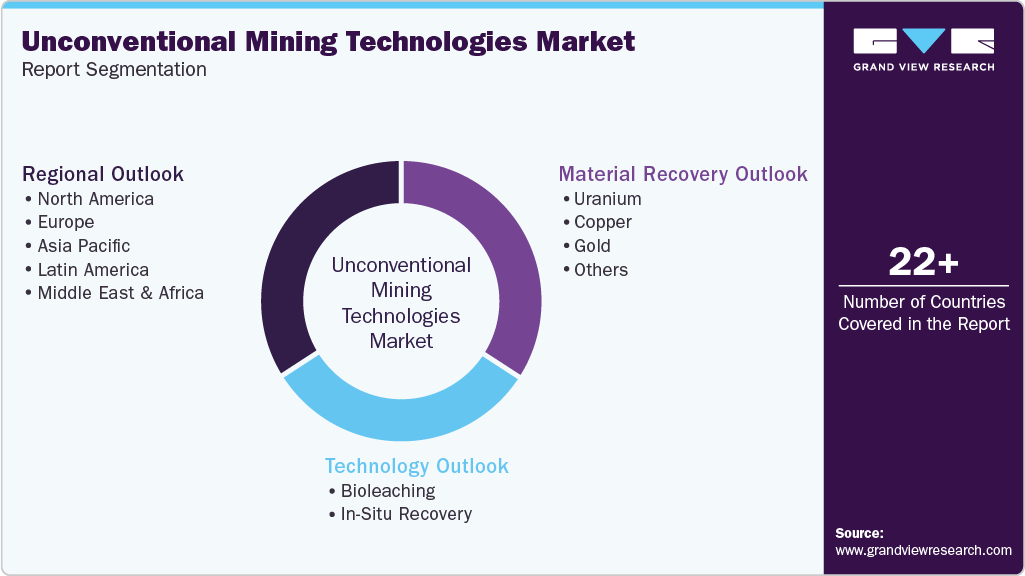
This report forecasts revenue growth at global, regional, and country levels and provides an analysis of the latest industry trends in each of the sub-segments from 2021 to 2033. For this study, Grand View Research has segmented the global unconventional mining technologies market report based on the technology, material recovery, and region.
-
Technology Outlook (Revenue, USD Billion, 2021 - 2033)
-
Bioleaching
-
In-Situ Recovery
-
-
Material Recovery Outlook (Revenue, USD Billion, 2021 - 2033)
-
Uranium
-
Copper
-
Gold
-
Others
-
-
Regional Outlook (Revenue, USD Billion, 2021 - 2033)
-
North America
-
U.S.
-
Canada
-
Mexico
-
-
Europe
-
Russia
-
Ukraine
-
-
Asia Pacific
-
China
-
Kazakhstan
-
Australia
-
-
Latin America
-
Chile
-
-
Middle East & Africa
-
South Africa
-
Namibia
-
-
Research Methodology
The unconventional mining technologies marketfigures in this report are based on a proven research process that combines executive interviews with secondary research from proprietary databases, company filings, and recognized regulatory and institutional sources. Market size is built through value-chain sizing-reconciling supply-side and demand-side estimates-and triangulated with bottom-up and top-down approaches. Every estimate passes multiple levels of expert validation before publication, with unconventional mining technologies segment quantified using the revenue-capture definitions in the table below.
Segment Definition
Technology
Revenue Capture Definition
Bioleaching
Revenue is generated from bioleaching technology and associated processing systems used to recover valuable metals from low-grade ores, refractory concentrates, and mine waste. Revenue capture includes technology licensing, bioleaching equipment, process engineering, microbial systems, and commercial processing services.
In-Situ Recovery
Revenue is derived from technologies used to extract minerals by injecting and recovering leaching solutions through underground ore-bearing formations. Revenue includes wellfield development, solution processing systems, ion-exchange and recovery equipment, engineering services, and technology-enabled extraction operations.
Material Recovery
Revenue Capture Definition
Uranium
Revenue is captured from unconventional extraction technologies deployed for uranium recovery, primarily through in-situ recovery operations. The market value includes technology, equipment, process systems, and services directly associated with uranium extraction and recovery.
Copper
Revenue is generated from bioleaching, in-situ leaching, and other advanced recovery technologies used to extract copper from low-grade ores, sulfide resources, and secondary materials. Revenue includes process technology, specialized equipment, recovery systems, and related services.
Gold
Revenue is derived from bioleaching and other specialized processing technologies for recovering gold from refractory ores, concentrates, and complex mineral deposits. Revenue capture includes pretreatment technologies, processing systems, equipment, and technical services.
Others
Revenue is captured from technologies deployed to recover lithium, nickel, rare earth elements, polymetallic minerals, and other resources from brines, low-grade deposits, mine waste, and unconventional geological settings.
Estimation Model
Layer Name
Key Question
Description
Resource & Project Opportunity Base Layer
What resource base can be addressed by unconventional technologies?
Establish the addressable resource base across uranium deposits, lithium brines, copper and gold deposits, polymetallic nodules, mine tailings, and other difficult-to-access mineral resources. Map identified, explored, pilot, and commercial projects by resource type, geological conditions, location, and suitability for unconventional extraction.
Technology Deployment Layer
Which unconventional technologies are being deployed and at what scale?
Assess deployment of major technologies such as in-situ recovery (ISR/ISL), direct lithium extraction (DLE), bioleaching, borehole/hydraulic mining, tailings reprocessing, and deep-sea extraction. Classify projects by development stage and determine technology adoption based on the number of operating, pilot, demonstration, and planned facilities.
Extraction Capacity & Utilization Layer
How much material can these technologies recover?
Estimate recoverable mineral output using installed or planned extraction capacity, ore/brine throughput, recovery rates, operating days, and utilization levels. Apply technology-specific parameters such as uranium recovery from orebody solutions, lithium recovery from brines, metal recovery from concentrates or tailings, and annual collection capacity for seafloor resources.
Revenue Layer
How is market revenue generated?
Quantify revenue associated with technology deployment through technology licensing, equipment and processing systems, engineering and project services, technology-operated extraction facilities, and related processing solutions. Apply technology-specific pricing or revenue-per-unit parameters to estimated deployment capacity and extracted material, while separating mining commodity revenue from technology-related revenue to avoid market-size inflation.
Delivered Customizations
We have successfully delivered the following deep-dive customizations
Client Request
Customization Delivered
Value Adds
Technology Cost & Economics Analysis
Assessment of capital and operating costs for ISR/ISL, DLE, bioleaching, borehole mining, and deep-sea extraction, including equipment, energy, reagents, water, labor, maintenance, infrastructure, and processing costs.
Identifies technology-specific cost drivers, compares economic feasibility, supports project screening, technology selection, and investment decisions.
Resource & Project Pipeline Assessment
Evaluation of unconventional resource projects by mineral, country, technology, project stage, resource size, planned capacity, commissioning timeline, and operator/technology provider.
Identifies high-potential projects, emerging technology opportunities, geographic hotspots, and future capacity additions.
Project CAPEX & OPEX Benchmarking
Benchmarking of project development costs, plant/equipment expenditure, infrastructure requirements, operating expenses, and cost per unit of recovered mineral across technologies and region.
Supports project economics, feasibility assessment, investment planning, and comparison of conventional versus unconventional extraction routes.
Frequently Asked Questions About This Report
The bioleaching segment led the market with the largest revenue share of 61.0% in 2025 while in-situ recovery segment is second fastest growing market.
The global unconventional mining technologies market size was estimated at USD 44.1 billion in 2025 and is expected to reach USD 47.8 billion in 2026.
The global unconventional mining technologies market is expected to grow at a compound annual growth rate of 8.7% from 2026 to 2033 to reach USD 85.9 billion by 2033.
Asia Pacific dominated the unconventional mining technologies market with the largest revenue share of 51.7% in 2025.
The key factor driving the growth of the global unconventional mining technologies market is the increasing need to economically extract critical minerals from difficult-to-access and low-grade resources using more efficient and lower-impact methods.
Some of the key players of the global unconventional mining technologies market are BacTech Environmental, BioSigma, Cameco Corporation, EnergyX, Impossible Metals, International Battery Metals (IBAT), Kazatomprom, Lilac Solutions, Orano, The Metals Company, and others.
The uranium segment led the market with the largest revenue share of 38.7% in 2025. The segment benefits from the extensive commercial use of in-situ recovery for uranium extraction, particularly in major uranium-producing countries with suitable sandstone-hosted deposits.
About the Author(s)
Advanced Interior Materials Research Team
Advanced Materials · Advanced Interior MaterialsThis report was authored by the advanced interior materials research team at Grand View Research - comprising two research analysts, one senior research analyst, and one industry expert - with specialized expertise in the advanced interior materials segment of the advanced materials industry. All findings are based on proprietary advanced materials databases, executive interviews, and regulatory analysis, subject to internal peer review prior to publication.
Last Updated:
Speak to Analyst


Customize this report to your needs — add regions, segments, or data points, with 20% free customization.
Or view our licence options:


ISO 9001:2015 & 27001:2022 Certified
We are GDPR and CCPA compliant! Your transaction & personal information is safe and secure. For more details, please read our privacy policy.


