
- Home
- »
- Next Generation Technologies
- »
-
Unmanned Logistics Systems Market Size Report, 2026-2033GVR Report cover

Unmanned Logistics Systems Market (2026 - 2033)
Size, Share & Trends Analysis Report By Type (Automated Guided Vehicles (AGVs)), By Application (AGVs, AMRs, Robotic Arms, Drone-Based Logistics Robots), By End Use, By Region, And Segment Forecasts
Market Size, 2025
$6.1BMarket Estimate, 2026
$7.3BMarket Forecast, 2033
$22.2BCAGR, 2026–2033
17.2%Unmanned Logistics Systems Market Report Summary
The global unmanned logistics systems market size was valued at USD 6.1 billion in 2025 and is projected to grow from USD 7.3 billion in 2026 to USD 22.2 billion by 2033, at a CAGR of 17.2% from 2026 to 2033. The market in North America dominated with a revenue share of 35.2% in 2025. The unmanned logistics systems industry is primarily driven by the explosive growth of global e-commerce and omnichannel retail, which has fundamentally reshaped supply chain expectations toward faster, more accurate, and highly scalable fulfillment operations.
 Source: Grand View Research, IR Documents, Primary Interviews, Paid DatabasesTo learn more about this report,
 Download Free Sample Report
 Key Market Trends & Insights
- By type: Autonomous mobile robots (AMRs segment held the largest market share of 37.0% in 2025.
- By application: Warehouse automation segment held the largest market share in 2025.
- By end use: Retail & e-commerce segment held the largest market share in 2025.
Regional Highlights
- Largest regional market: North America (35.2% revenue share, 2025)
- Fastest-growing regional market: Asia Pacific (highest CAGR, 2026-2033)
- By country: U.S. held the largest market share in 2025
Market Size & Forecast
- Market size in 2025: USD 6.1 Billion
- Estimated market size in 2026: USD 7.3 Billion
- Projected market size by 2033: USD 22.2 Billion
- CAGR (2026-2033): 17.2%
Three ways to get this report
Buy it, customize it, or ask a question.Ask an Analyst
Analyst response in 1 business day
- AccessReport author, directly
- Reply timeWithin 1 working day
- No sales callDirect answer only
- FormatEmail reply
- CostFree, no cost
Get the Full Report
What the study covers
- FormatsPDF · Excel · Dashboard
- Timeline2026–2033 annual, 2025 base
- Coverage20+ countries, 5 regions
- Companies10+ key players profiled
Customize the Report
20% free customization
- IncludeCountries, segments, points
- TailorTo your product definition
- ExtendDeeper competitor detail
- OrA fully bespoke study
- Turnaround5–10 working days
Retailers and logistics providers are increasingly deploying autonomous mobile robots (AMRs), automated storage and retrieval systems (AS/RS), and AI-enabled warehouse orchestration platforms to manage rising order volumes, SKU complexity, and same-day or next-day delivery demands. This shift is pushing warehouses to transition from manual or semi-automated operations to fully autonomous, software-driven fulfillment ecosystems. To learn more about this report, Download Free Sample Report
 In addition, the global labor shortage and rising labor costs in the warehousing, transportation, and distribution sectors are significantly driving market expansion. With manual operations becoming increasingly expensive and difficult to scale, companies are investing heavily in robotics and autonomous systems to reduce dependency on human labor while improving operational consistency and safety. This is particularly evident in large distribution hubs, where repetitive tasks such as picking, sorting, and pallet movement are rapidly being automated.
Furthermore, the rapid advancement in artificial intelligence, machine vision, and sensor technologies has significantly improved the capabilities of unmanned logistics systems. Modern robots can now navigate dynamic environments, identify and handle diverse objects, and coordinate with other machines in real time. This technological evolution is enabling higher levels of autonomy, making unmanned systems more reliable, cost-effective, and adaptable across warehouses, manufacturing plants, and distribution networks.
Moreover, the growing focus on supply chain resilience, sustainability, and operational efficiency is driving enterprises to adopt unmanned logistics systems at scale. Companies are leveraging automation to reduce energy consumption, optimize space utilization, minimize errors, and improve throughput efficiency. In addition, the rise of autonomous last-mile delivery solutions, including delivery robots and drones, is extending automation beyond warehouses into urban logistics, further expanding the scope and impact of unmanned logistics systems globally.
Market Dynamics
The rapid expansion of e-commerce and omnichannel retail has become one of the primary growth drivers for the unmanned logistics systems industry. Rising online order volumes and increasing consumer expectations for faster delivery are pushing logistics providers and retailers to automate warehouse operations using autonomous mobile robots (AMRs), robotic picking systems, and AI-enabled logistics platforms. These systems help improve order accuracy, reduce fulfillment time, and increase operational scalability.
Another major factor driving market growth is the increasing labor shortage across the warehousing, manufacturing, and logistics industries. Companies are facing growing challenges related to workforce availability, rising labor costs, and high employee turnover, particularly for repetitive and physically demanding tasks. Unmanned systems provide a cost-effective solution by reducing dependence on manual labor while improving operational consistency, safety, and productivity.
Technological advancements in robotics, artificial intelligence, machine vision, and autonomous navigation systems are also accelerating adoption across industries. Improvements in sensor technologies, real-time data analytics, and cloud-based fleet management platforms are enabling unmanned systems to operate more efficiently in dynamic warehouse and industrial environments. As automation technologies continue to mature, businesses are increasingly investing in autonomous logistics infrastructure to strengthen supply chain resilience and efficiency.
One of the major restraints in the unmanned logistics systems industry is the high initial investment required for deploying advanced automation infrastructure. Implementing autonomous robots, warehouse management software, sensors, and integrated logistics platforms often requires significant capital expenditure, making adoption difficult for small and medium-sized enterprises. The cost of customization, maintenance, and workforce training further increases overall implementation expenses.
Integration complexity also remains a major challenge, particularly for companies operating legacy warehouse and supply chain systems. Integrating autonomous technologies with existing enterprise resource planning (ERP), warehouse management systems (WMS), and operational workflows can be technically demanding and time-consuming. In many cases, businesses require specialized system integration expertise to ensure smooth deployment and interoperability between multiple automation components.
In addition, regulatory and operational safety concerns continue to limit adoption in certain applications, especially in autonomous delivery, drones, and outdoor logistics environments. Different countries maintain varying standards related to autonomous operations, workplace safety, and transportation regulations, creating compliance challenges for global deployments. Concerns related to cybersecurity, system reliability, and operational disruptions also remain key barriers for some organizations considering large-scale implementation of unmanned systems.
The growing adoption of AI-driven logistics ecosystems presents a major opportunity for the unmanned logistics systems industry. Companies are increasingly integrating artificial intelligence, predictive analytics, and real-time monitoring systems into warehouse and supply chain operations to improve efficiency and decision-making. This creates significant demand for autonomous systems capable of intelligent navigation, dynamic task allocation, and automated inventory management.
The expansion of autonomous last-mile delivery solutions also offers strong growth potential for the market. Rising urbanization, increasing consumer demand for rapid delivery, and growing investments in smart city infrastructure are encouraging development of autonomous delivery robots and drones. These technologies are expected to transform urban logistics by reducing delivery costs, improving speed, and enabling contactless transportation solutions.
Another important opportunity lies in the increasing adoption of Robotics-as-a-Service (RaaS) business models. Many companies are shifting toward subscription-based automation solutions to reduce upfront investment costs and improve operational flexibility. This model allows businesses to scale automation gradually while gaining access to advanced robotics technologies without large capital expenditure, making unmanned systems more accessible across a wider range of industries and enterprise sizes.
Market Concentration & Characteristics
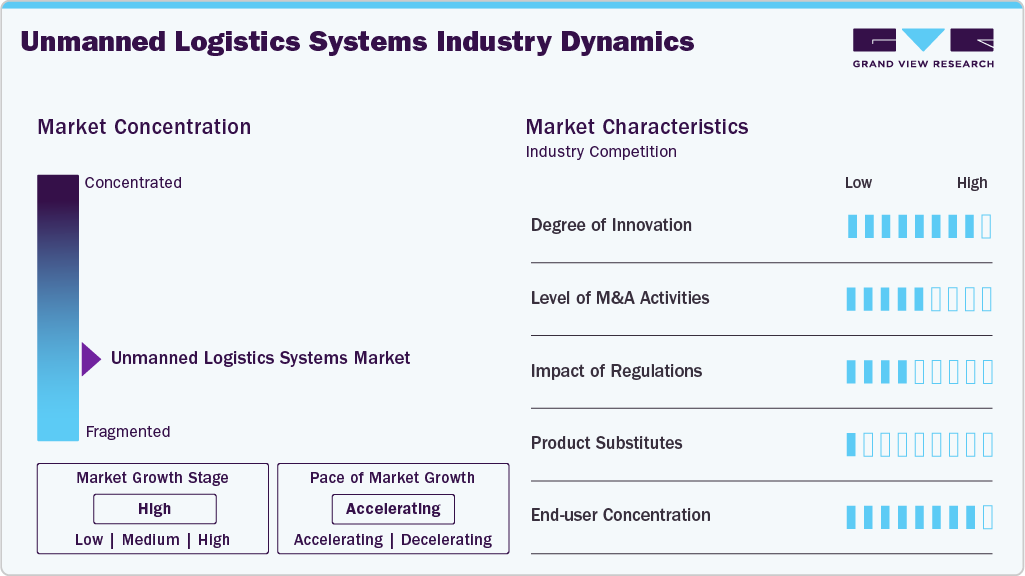
The market is moderately fragmented, with a few dominant global players holding strong positions in large-scale automation projects, while a wide range of regional, niche, and emerging companies compete across robotics, software, and system integration segments, leading to a highly competitive and diversified ecosystem. In terms of market characteristics, the unmanned logistics systems industry demonstrates a high level of innovation, driven by advancements in robotics, artificial intelligence, autonomous navigation, and warehouse automation.
 To learn more about this report, Download Free Sample Report
 Product substitutes remain relatively low, as traditional logistics systems lack the efficiency and scalability of automated solutions. The level of mergers and acquisitions is moderate, supported by strategic partnerships and investments among robotics, automation, and supply chain technology companies. Meanwhile, the impact of regulations is moderate due to safety and operational compliance requirements, while end-user concentration is high, with demand largely driven by major e-commerce, logistics, and manufacturing companies.
Type Insights
The autonomous mobile robots (AMRs) segment led the market with the largest revenue share of 37.0% in 2025 and is projected to grow at the fastest CAGR during the forecast period, reflecting the growing trend toward flexible and scalable warehouse automation. This growth is driven by the rapid expansion of e-commerce fulfillment centers, increasing adoption of goods-to-person logistics, and advancements in AI, SLAM, and sensor technologies that enhance navigation efficiency and adaptability in dynamic warehouse environments.
The robotic arms segment is expected to witness at a significant CAGR from 2026 to 2033, driven by rising demand for high-speed, precision automation across warehousing, manufacturing, and distribution centers. Growth is supported by increasing adoption for picking, packing, sorting, and palletizing tasks, alongside advancements in AI, computer vision, and machine learning that enhance accuracy, flexibility, and operational efficiency.
Application Insights
The warehouse automation segment accounted for the largest market revenue share in 2025, driven by the rapid expansion of e-commerce fulfillment operations and the need for high-speed order processing systems capable of managing large volumes of packages with minimal human intervention. These unmanned logistics robots are designed to automate picking, sorting, and packing tasks, enabling warehouses to maintain continuous operations while reducing labor dependency and operational costs. Their ability to operate in coordinated fleets significantly improves throughput and minimizes order processing delays in high-demand logistics environments.
The last-mile delivery segment is expected to witness at the fastest CAGR from 2026 to 2033, driven by the increasing consumer expectations for faster delivery times and the growing need for cost-effective transportation solutions in urban and suburban logistics networks. These unmanned delivery robots can transport packages directly to customers while reducing reliance on traditional delivery vehicles and manual distribution processes. Their ability to navigate sidewalks and residential areas enhances delivery efficiency and supports contactless service models in densely populated regions.
End Use Insights
The retail & e-commerce segment accounted for the largest market revenue share in 2025, reflecting the growing trend toward automation-driven fulfillment operations. This growth is supported by rising online shopping activity, increasing demand for faster and more accurate order processing, and greater adoption of technologies such as AMRs, AS/RS, and AI-powered inventory management to improve efficiency, scalability, and cost optimization across fulfillment networks.
 To learn more about this report, Download Free Sample Report
 The healthcare segment is expected to witness at the fastest CAGR from 2026 to 2033, driven by the increasing trend toward automated and precision-based medical logistics. Rising adoption of hospital automation systems, drone-based medical deliveries, and cold-chain logistics, along with the expansion of telemedicine and decentralized healthcare services, is accelerating demand for unmanned logistics solutions to enable safe, reliable, and efficient delivery of critical medical supplies.
Regional Insights
North America dominated the global unmanned logistics systems market with the largest revenue share of 35.2% in 2025, driven by the rapid expansion of e-commerce, widespread adoption of warehouse automation, and strong penetration of autonomous mobile robots (AMRs) across fulfillment centers, alongside increasing investment in AI-driven supply chain optimization and last-mile delivery innovation. These trends are further strengthened by persistent labor shortages, high labor costs, and the need for faster order fulfillment cycles, pushing retailers, 3PL providers, and industrial operators toward large-scale deployment of unmanned logistics technologies across warehousing, distribution, and transportation networks.
 To learn more about this report, Download Free Sample Report
 U.S. Unmanned Logistics Systems Market Trends
The unmanned logistics systems market in the U.S. accounted for the largest market revenue share in North America in 2025, fueled by the dominance of large-scale e-commerce and retail giants, especially highly automated fulfillment ecosystems, combined with rapid scaling of robotics-as-a-service models, autonomous warehouse fleets, and AI-enabled logistics orchestration platforms; growth is further accelerated by strong venture capital funding in robotics startups, increasing pilot programs for autonomous delivery and trucking, and structural labor constraints in warehousing and logistics, making the US one of the most advanced and fastest adopters of unmanned logistics systems globally.
Europe Unmanned Logistics Systems Market Trends
The unmanned logistics systems market in Europe is expected to grow at a significant CAGR of 10% from 2026 to 2033, driven by the Industry 4.0 transformation, a strong emphasis on supply chain sustainability, and the increasing integration of robotics and automation in manufacturing and logistics operations, particularly across the automotive, pharmaceutical, and FMCG sectors. These developments are supported by stringent environmental regulations, rising labor costs, and growing demand for energy-efficient and carbon-reducing logistics solutions, encouraging companies to invest heavily in smart warehouses, autonomous intralogistics systems, and digitally connected supply chains.
The UK unmanned logistics systems market is expected to grow rapidly in the coming years, owing to the expanding e-commerce penetration, increasing automation of retail distribution centers, and growing experimentation with autonomous last-mile delivery solutions including drones and delivery robots; these trends are reinforced by urban density-driven logistics challenges, labor shortages in warehousing and delivery operations, and supportive regulatory frameworks for testing smart mobility and unmanned delivery systems in controlled environments, accelerating adoption of robotics-based logistics infrastructure.
The unmanned logistics systems market in Germany is propelled by its leadership in industrial automation and Industry 4.0, with strong adoption of robotics in automotive manufacturing, engineering, and warehouse intralogistics systems, including automated storage and retrieval systems (AS/RS) and autonomous forklifts. This growth is further supported by high precision manufacturing requirements, strong export-driven supply chains, and continuous investment in smart factory-warehouse integration to improve efficiency, productivity, and operational reliability.
Asia Pacific Unmanned Logistics Systems Market Trends
The unmanned logistics systems market in the Asia Pacific is expected to grow at the fastest CAGR of over 20% from 2026 to 2033, driven by explosive e-commerce growth, rapid industrialization, and large-scale adoption of warehouse robotics and autonomous logistics systems across China, Japan, South Korea, and India, making it the fastest-growing global market. This growth is further fueled by strong government initiatives promoting smart logistics ecosystems, rising labor cost pressures in developed APAC economies, and the massive expansion of manufacturing and cross-border trade networks requiring highly efficient and scalable unmanned logistics solutions.
The Japan unmanned logistics systems market is gaining traction, supported by advanced robotics adoption, high penetration of automation in manufacturing and warehousing, and strong integration of precision logistics technologies across automotive and electronics supply chains. These developments are primarily driven by severe labor shortages due to an aging population, national policies promoting productivity-enhancing automation, and ongoing robotics innovation aimed at maintaining efficiency in highly developed, yet workforce-constrained, logistics operations.
The unmanned logistics systems market in China is rapidly expanding, driven by the world’s largest e-commerce logistics ecosystem, extensive deployment of warehouse automation technologies, and strong domestic robotics manufacturing capabilities that reduce costs and accelerate adoption. These trends are reinforced by government-backed smart city and smart logistics initiatives, rapid growth of express delivery networks, and aggressive investment by logistics giants in fully automated fulfillment centers and unmanned supply chain infrastructure.
Key Unmanned Logistics Systems Company Insights
Some of the key players operating in the market are Boston Dynamics and Agility Robotics, among others.
-
Boston Dynamics is a robotics company focused on designing and developing advanced humanoid robots and unmanned systems that combine mobility, agility, and artificial intelligence for real-world applications. The company develops robots with a strong emphasis on mobility, agility, and intelligence, enabling them to operate effectively in challenging and unstructured settings.
-
Agility Robotics is a robotics company focused on developing and deploying humanoid automation solutions for industrial and logistics environments, with a strong emphasis on real-world applications and measurable performance. Its core offering, the humanoid robot Digit, is combined with a cloud-based platform (Agility Arc) to deliver scalable automation with clear operational benefits, particularly in warehousing, manufacturing, and distribution settings.
GreyOrange and Locus Robotics are among the emerging market participants in the unmanned logistics systems industry.
-
GreyOrange is a technology company focused on transforming warehouse and retail operations through AI-driven robotics and automation software. It develops integrated solutions that combine intelligent orchestration software (such as its GreyMatter platform) with autonomous mobile robots to optimize fulfillment, inventory management, and order processing in real time.
-
Locus Robotics is a warehouse automation company that develops autonomous mobile robot (AMR) solutions to improve fulfillment efficiency in logistics operations. Its core offering is the LocusONE platform, which uses AI-driven orchestration to coordinate fleets of robots that assist workers in picking, sorting, transporting, and replenishment tasks within warehouses.
Key Unmanned Logistics Systems Companies:
The following key companies have been profiled for this study on the unmanned logistics systems market.
- Agility Robotics
- Amazon Robotics
- Boston Dynamics
- Figure AI
- Geek+
- GreyOrange
- KUKA AG
- Locus Robotics
- Swisslog
- Symbotic
- UBTech Robotics
- Unitree Robotics
Competitive Benchmarking
Operating Strategies
Competitive Edge
Weaknesses
Mature Players: Amazon Robotics; KUKA AG; Symbiotic; Swisslog
- Focus on large-scale integrated automation solutions combining robotics, software, and warehouse management systems.
- Expand through long-term contracts, strategic partnerships, and global service and maintenance networks.\
- Strong financial capabilities and established customer relationships enable large enterprise deployments.
- Extensive R&D expertise and proven operational reliability across complex logistics environments.
- Higher system costs and longer deployment cycles compared to smaller agile competitors.
- Slower adaptability to rapidly evolving niche technologies and customized automation demands.
Emerging Players: Locus Robotics; Agility Robotics; UBTech Robotics
- Focus on niche robotics solutions, AI-driven software platforms, and flexible Robotics-as-a-Service (RaaS) models.
- Target mid-sized warehouses and specialized logistics applications with scalable and cost-efficient offerings.
- Faster innovation cycles and greater flexibility in adopting new technologies and business models.
- Lower upfront costs and highly customizable solutions for specific customer requirements.
- Limited global presence and lower financial resources compared to established market leaders.
- Challenges in scaling operations, maintaining large deployments, and building long-term customer trust.
Recent Developments
-
In April 2026, KUKA AG showcased advanced packaging automation solutions, including high-speed pick-and-place systems, hygienic/cleanroom robots, palletizing solutions, heavy-duty robots, and AMRs integrated with intelligent software.
-
In September 2025, Geek+ announced a strategic partnership with global logistics provider DHL Supply Chain to deploy autonomous mobile robots across warehouse facilities in Asia and Europe.
-
In January 2025, Symbotic announced a partnership with Walmart to develop and deploy advanced AI-enabled robotics platforms for automated pickup and delivery centers across retail stores.
Unmanned Logistics Systems Market Report Scope
Report Attribute
Details
Market size in 2025
USD 6.1 billion
Estimated market size in 2026
USD 7.3 billion
Projected market size by 2033
USD 22.2 billion
Growth rate
CAGR of 17.2% from 2026 to 2033
Base year for estimation
2025
Historical data
2021 - 2024
Forecast period
2026 - 2033
Quantitative units
Revenue in USD million/billion, and CAGR from 2026 to 2033
Report Product
Revenue forecast, company ranking, competitive landscape, growth factors, and trends
Segments covered
Type, application, end use, region
Regional scope
North America; Europe; Asia Pacific; Latin America; Middle East & Africa
Country scope
U.S.; Canada; Mexico; UK; Germany; France; China; Australia; Japan; India; South Korea; Brazil; South Africa; Saudi Arabia; UAE.
Key companies profiled
Agility Robotics; Amazon Robotics; Boston Dynamics; Figure AI; Geek+; GreyOrange; KUKA AG; Locus Robotics; Swisslog; Symbotic; UBTech Robotics; Unitree Robotics
Customization scope
Free report customization (equivalent to up to 8 analyst’s working days) with purchase. Addition or alteration to country, regional & segment scope.
Pricing and purchase options
Avail customized purchase options to meet you exact research needs. Explore purchase options
Global Unmanned Logistics Systems Market Report Segmentation
This report forecasts revenue growth at the global, regional, and country levels and provides an analysis of the latest technological trends in each of the sub-segments from 2021 to 2033. For this study, Grand View Research has segmented the global unmanned logistics systems market report based on type, application, end use, and region:
 To learn more about this report, Download Free Sample Report
 -
Type Outlook (Revenue, USD Million, 2021 - 2033)
-
Automated Guided Vehicles (AGVs)
-
Autonomous Mobile Robots (AMRs)
-
Robotic Arms (Picking & Sorting)
-
Drone-Based Logistics Robots
-
-
Application Outlook (Revenue, USD Million, 2021 - 2033)
-
Warehouse Automation (Picking, Sorting, Packing)
-
Last-Mile Delivery
-
Inventory Management
-
Intralogistics (Factory Material Movement)
-
Cold Chain & Healthcare Logistics
-
Others
-
-
End Use Outlook (Revenue, USD Million, 2021 - 2033)
-
Aerospace & Defense
-
Retail & E-commerce
-
Healthcare
-
Manufacturing
-
Food & Beverage
-
Others
-
-
Regional Outlook (Revenue, USD Million, 2021 - 2033)
-
North America
-
U.S.
-
Canada
-
Mexico
-
-
Europe
-
UK
-
Germany
-
France
-
-
Asia Pacific
-
China
-
Japan
-
India
-
South Korea
-
Australia
-
-
Latin America
-
Brazil
-
-
Middle East & Africa
-
Saudi Arabia
-
South Africa
-
UAE
-
-
Delivered Customization
This report has been delivered with the following In-depth customizations
Client Objective
Custom Research Modules Delivered
Strategic Value / Business Impact
Market Entry & Expansion Assessment
Regional demand sizing and forecasting
Customer segmentation and buying behavior analysis
Competitive landscape benchmarking
Regulatory and distribution channel assessment
Identified high-growth market opportunities
Supported go-to-market strategy development
Highlighted investment priorities and risks
Enabled data-driven expansion planning
Technology & Innovation Assessment
Emerging technology trend analysis
Innovation pipeline and patent review
Technology adoption readiness assessment
Ecosystem and partnership mapping
Identified future growth areas
Supported innovation roadmap planning
Evaluated commercialization potential
Strengthened strategic partnership decisions
Frequently Asked Questions About This Report
The global unmanned logistics systems market is driven by key factors including increasing demand for automation in logistics, rising e-commerce activities, and advancements in autonomous and AI-based technologies.
The autonomous mobile robots (AMRs segment led with a 37.0% revenue share in 2025, while the robotic arms segment is the fastest-growing.
The warehouse automation segment held the largest revenue share in 2025, while the last-mile delivery segment is the fastest-growing.
The retail & e-commerce segment held the largest revenue share in 2025, while the healthcare segment is the fastest-growing.
North America dominated with a 35.2% revenue share in 2025.
The global unmanned logistics systems market size was valued at USD 6.1 billion in 2025 and is estimated at USD 7.3 billion for 2026.
The global unmanned logistics systems market is expected to grow at a CAGR of 17.2% from 2026 to 2033, reaching USD 22.2 billion by 2033.
Asia Pacific is the fastest-growing region over the forecast period.
Key players include Agility Robotics; Amazon Robotics; Boston Dynamics; Figure AI; Geek+; GreyOrange; KUKA AG; Locus Robotics; Swisslog; Symbotic; UBTech Robotics; Unitree Robotics
About the Author(s)
Next Generation Technologies Research Team
Technology · Next Generation TechnologiesThis report was authored by the next generation technologies research team at Grand View Research - comprising two research analysts, one senior research analyst, and one industry expert - with specialized expertise in the next generation technologies segment of the technology industry. All findings are based on proprietary technology databases, executive interviews, and regulatory analysis, subject to internal peer review prior to publication.
Last Updated:
Speak to Analyst

Customize this report to your needs - add regions, segments, or data points, with 20% free customization.
Or view our licence options:


ISO 9001:2015 & 27001:2022 Certified
We are GDPR and CCPA compliant! Your transaction & personal information is safe and secure. For more details, please read our privacy policy.


